Blog

  • US Open Women’s Semifinals Schedule of Play: Friday, Sept. 6

    US Open Women’s Semifinals Schedule of Play: Friday, Sept. 6

    [Scores added as known.]

    Arthur Ashe Stadium – 12:30 P.M.

    Mixed Doubles – Final
    Andrea Hlavackova (CZE) (7) / Max Mirnyi (BLR) (7) d. Abigail Spears (USA) / Santiago Gonzalez (MEX) — 7-6(5), 6-3

    Not Before: 1:45 P.M.

    Women’s Singles – Semifinals
    Victoria Azarenka (BLR) (2) d. Flavia Pennetta (ITA) — 6-4, 6-2

    Not Before: 3:45 P.M.

    Women’s Singles – Semifinals
    Serena Williams (USA) (1) d. Na Li (CHN) (5) — 6-0, 6-3

    Ater Suitable Rest — Women’s Doubles – Semifinals

    Andrea Hlavackova (CZE) (5) / Lucie Hradecka (CZE) (5) d. Serena Williams (USA) / Venus Williams (USA) — 6-4, 6-2

    [divider]

    Click here to discuss the Serena Williams/Li Na semifinal in our discussion forum.

    Click here to discuss the Victoria Azarenka/Flavia Pennetta semifinal in our discussion forum.

    [divider]

  • Age Has the Edge (Mostly) at the US Open in the SF/QFs

    Age Has the Edge (Mostly) at the US Open in the SF/QFs

    Day 9 of the US Open featured more than a few 30-somethings in the mid-late rounds of men’s and women’s singles. Flavia Pennetta, 31, upset countrywoman Roberta Vinci, 30.  Pennetta, who had fallen down to being the fourth ranked Italian, behind Errani, the best Italian, and Vinci, one of her erstwhile doubles partners.  While Pennetta is currently ranked No. 85,  she dominated Vinci, 6-4, 6-1, to reach her first ever semifinal of a Major.

    The “youngster” of the day, Victoria Azarenka, 24, beat 30-year-old Daniela Hantuchova, 6-2, 6-3.  The hope is this sets up a meeting with Serena Williams in a final, the two women who are the greatest rivals at this point in the women’s game, though Azarenka still has to beat Flavia Pennetta.  For them to meet, however, Williams will have to beat the great Chinese star and fellow 31-year-old, Li Na.

    On the men’s side, Richard Gasquet emerged as the winner of a 5-set battle with David Ferrer, another 31-year-old.  Gasquet dominated the first two sets, in a surprise over the No. 4 seed, who has had a lackluster summer.  Ferrer evened the match to 2-sets a piece, but Gasquet fulfilled the aggression he brought to the beginning of the match, and closed it out for 6-3, 6-1, 4-6, 2-6, 6-3.

    The Frenchman Gasquet is 27 — on the younger edge of today’s players — and he will meet Rafael Nadal, also 27, who beat his countryman, Tommy Robredo, 31, the vanquisher of Roger Federer in the Round of 16.  Robredo went down without seriously troubling Nadal.  Final score:  6-0, 6-2, 6-2.  Nadal has yet to drop his serve the entire tournament.

    That so many 31-year-olds have lasted so long in this tournament, one has to say that 1981-82 must have been a great vintage for tennis players, if a somewhat late-maturing grape.

    [divider]

    Click here to discuss the Nadal/Robredo quarterfinal in our discussion forum.

    Click here to discuss the Ferrer/Gasquet quarterfinal in our discussion forum.

    Click here to discuss the Azarenka/Hantuchova quarterfinal in our discussion forum.

    Click here to discuss the Vinci/Pennetta quarterfinal in our discussion forum.

    [divider]

  • US Open Men’s Quarterfinals Schedule of Play: Thursday, Sept. 5

    US Open Men’s Quarterfinals Schedule of Play: Thursday, Sept. 5

    [Scores added as known.]

    Arthur Ashe Stadium – 12:00 P.M.

    Men’s Doubles – Semifinals
    Leander Paes (IND) (4) / Radek Stepanek (CZE) (4) d. Bob Bryan (USA) (1) / Mike Bryan (USA) (1) — 3-6, 6-3, 6-4

    Not Before: 1:30 P.M.

    Men’s Singles – Quarterfinals
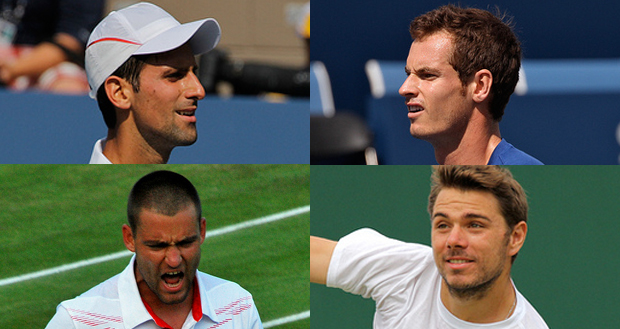
    Stanislas Wawrinka (SUI) (9) d. Andy Murray (GBR) (3) — 6-4, 6-3, 6-2

    Not Before: 8:00 P.M.

    Men’s Singles – Quarterfinals
    Novak Djokovic (SRB) (1) d. Mikhail Youzhny (RUS) (21) — 6-3, 6-2, 3-6, 6-0

    [divider]

    Click here to discuss the Murray/Wawrinka quarterfinal in our discussion forum.

    Click here to discuss the Djokovic/Youzhny quarterfinal in our discussion forum.

    [divider]

    Louis Armstrong Stadium — Not Before: 12:30 P.M.

    Women’s Doubles – Quarterfinals
    Serena Williams (USA) / Venus Williams (USA) d. Sara Errani (ITA) (1) / Roberta Vinci (ITA) (1) — 6-3, 6-1

    Men’s Doubles – Semifinals
    Alexander Peya (AUT) (2) / Bruno Soares (BRA) (2) d. Ivan Dodig (CRO) (10) / Marcelo Melo (BRA) (10) — 7-5, 6-4

    Women’s Doubles – Semifinals
    Ashleigh Barty (AUS) (8) / Casey Dellacqua (AUS) (8) d. Sania Mirza (IND) (10) / Jie Zheng (CHN) (10) — 6-2, 6-2

  • Those Lethal Cocktails

    Those Lethal Cocktails

    US Open, Fourth Round Recap

    A brief survey of the men’s quarterfinalists for this year’s US Open is revealing. For starters all eight men are Europeans, of whom three, naturally, are Spanish. Unsurprisingly, one of them is Swiss. Three of these men are over thirty, while the youngest is twenty-six. Unbelievably, none of these elderly Continental gents is Roger Federer.

    [divider]

    Discuss this article and more in the Tennis Frontier Forum

    [divider]

    (21) Youzhny d. Hewitt, 6-3, 3-6, 6-7(3), 6-4, 7-5

    The match of the day, and probably of the round, was the terrific dust-up between Lleyton Hewitt and Mikhail Youzhny, which stretched to five sinuous sets, the last of which was eventually won by the Russian. Hewitt led by two sets to one, and by 4-1 in the fourth. Hewitt’s mental fortitude was duly praised, or, as it happened, overpraised. Contrary to popular opinion, he was never an accomplished frontrunner, and even during his eighty weeks atop the rankings would often permit leads disastrously to slip. There have been a few players more habituated to producing monuments, but Hewitt is nearly unmatched in his capacity to make routines matches unnecessarily monumental.

    From that perilous position, Youzhny clawed back, and won the next six games, in the process taking the fourth set and moving ahead by a break early in the fifth. From there it was Hewitt’s turn, winning five of the next six, moving to 5-2. Winning a sixth game would have snared him the match, but it wasn’t to be. Youzhny surged again, broke, held, broke, and served out the match, which is an exceedingly rapid way of describing a process that was fraught, frequently brilliant, and occasionally approached genius. A quarterfinal would have been a fitting result for Hewitt, who’d performed so mightily to defeat Juan Martin del Potro a few rounds ago. Alas.

    It is equally as fitting a result for Youzhny, if not to say a surprising one. I confess, watching on as he struggled to overcome Matthew Ebden in five sets in Melbourne in January, I’d believed that Youzhny’s best days were fast receding behind him. Ebden was actually pushing him around. One should have more faith, though that’s an easy thing to misplace when an aggressive player loses confidence. Tentative where once he’d been reckless, he now appeared indecisive and error-prone, and it was easy to assume, too, he’d never regain his speed and certainty. I am pleased to be wrong, but surely not as pleased as he was today, saluting the crowd. It would’ve been nice to hear what he had to say, but instead Eurosport cut away to Barbara Schett, who was bringing her weaponised vivacity to bear on Victoria Azarenka. “You haven’t just been busy on the court, but off the court as well! I hear you’ve been involved in a photo-shoot for a campaign to help ex-smokers! Can you tell us a little bit about that?!” “Well, I’ve never smoked myself so I can’t really relate. But I do find them very inspirational.”

    (1) Djokovic d. Granollers, 6-3, 6-0, 6-0

    Sadly this lethal cocktail of bonhomie couldn’t go on indefinitely. There was live tennis to be had, though live is perhaps a misleading term, if not an ironic one, in the case of the sadly lifeless Marcel Granollers. One presumes he hadn’t held out much hope against Novak Djokovic, though he probably hoped for more than he got, or at any rate hoped that his inevitable beating might be less savage. He won only three games, all of which came in the first set, although this should not lead one to believe he was any closer to winning that set than the others. He failed to win a single point on Djokovic’s first six service games. Then he failed to win a game on his own serve for the rest of the match. Chris Bowers on Eurosport suggested that had it been a boxing match the referee would have stopped the bout. But it was a tennis match, and so Djokovic was permitted to continue pummelling Granollers for our entertainment, until the Spaniard lay unmoving on the side of the court and even his groans had ceased.

    Afterwards, Djokovic granted Brad Gilbert the brief contractually-obligated interview, thus augmenting his total time on court by about a third. The world No. 1 was typically classy, smoothly stepping around his opponent’s body, though if asked he’d no doubt subscribe to Andre Agassi’s view that one should not deny any opponent so rich a learning-experience. When quizzed about his magisterial serving stats, Djokovic took due care to praise John Isner, to scattered applause from the sparse American crowd. Realistically the assembled onlookers might have filled a less extravagant facility, but even sizeable crowds can be lost within Arthur Ashe Stadium. Presumably many of those absent had stepped out to relieve themselves or seek sustenance after the previous match, and couldn’t make it back in time. Tournament officials had by now scraped Granollers’s remains off the court, and Djokovic respectfully followed the procession up the tunnel. “He’s good, isn’t he?” asked one Eurosport commentator. “Djokovic or Brad Gilbert? Djokovic, yes,” responded the other.

    We were returned to Schett. “He was just better in every compartment!” she declared breathlessly. Apparently denied a studio of their own, she and Wilander were once more anchoring the Eurosport coverage from the grounds. Djokovic soon joined them, looking as relaxed as a man who’d just won a tennis match as easily as he had should. He summoned a sensible response when queried about Federer’s loss, and the persistent demands for the great man to retire, although he might have pointed out that the persistent demands largely consist of the media asking questions like that. He didn’t think Federer should retire. He did point out that time catches up to us all, and that younger players are always appearing, making the tour, stronger, and faster than ever. Presumably by younger players he was speaking of his own “generation”, and not the next one.

    (19) Robredo d. (7) Federer, 7-6(3), 6-3, 6-4

    He was mostly right, although it should equally be pointed out that Federer did not lose to a younger player yesterday, but to Tommy Robredo, a veteran to whom he’d never lost. In some ways this was the most telling aspect of yesterday’s upset, not least because it continues a trend that has underscored Federer’s long decline. Defining when such things begin is mostly idle folly, and would serve no special purpose even if consensus were possible. But one cannot help but think back to late 2009, when there was still a large pool of very good players who had either never beaten Federer, or at any rate hadn’t beaten him for a very long time. Prominent among this group were Nikolay Davydenko, Robin Soderling, Andy Roddick, Lleyton Hewitt, Mikhail Youzhny, David Ferrer, and Robredo. Ferrer and Youzhny are still winless, but the rest of them have since defeated Federer at least once, in every case inspiring onlookers to recycle Vitas Gerulaitis‘s venerable quip about no one beating him seventeen times in a row. The significance is that these players are all around Federer’s age. Failure to sustain his domination of them cannot be ascribed to advanced years, to being overrun by the race.

    On the other hand, Federer going undefeated against these guys for so long is probably more amazing than any eventual loss proved to be, a fact we tend to overlook. Winning streaks work the strange trick of making it seem as though constant victory is the natural way of things, or normalising what is in fact exceptional. It is a paradox of sport that although the longest streaks are the most difficult to compile, they work to make any eventual loss seem aberrant. Even sprinting along a tightrope can look easy after a while, such that one forgets it is only growing harder. Sooner or later there will be a misstep.

    These are broadly satisfactory musings, perhaps, but they don’t tell us much about any specific encounter. They don’t quite explain how Federer actually managed to lose to Robredo yesterday. The answer, I suspect, is that everyone has bad days, and sometimes they occur on a big stadium against a guy you’ve never lost to. Federer had a very bad day, bad in almost every direction at once. His movement was sluggish, his decisions were poor, his returning patchy, his serve lacked bite, and his outfit didn’t match. It was altogether a worse performance than the one that saw him lose to an inspired Sergiy Stakhovsky in Wimbledon. He was unfortunate that he had this bad day against a player as solid as Robredo, though the truth is that because the bad days are now coming more often, they’re more likely to come when it matters. Part of it is age, but I maintain that he’s mostly just short on form.

    Robredo was admittedly outstanding, but Federer was still correct in declaring that he had largely beaten himself. Robredo pulled off any number of improbable passing shots, but they wouldn’t have been possible at all if Federer hadn’t so consistently failed to put balls away into the open court, or essay approaches with greater venom. Time and again Robredo simply stood his ground. By the third set even he stopped looking surprised when Federer hit the ball straight back to him. Often these came on crucial points, such as the many break points on Robredo’s serve. Federer grabbed at handfuls of these after the first set, but could hang on to none of them, and that’s really the whole deal with break points. Similarly Robredo was dictating most of the rallies. It tells you everything about Federer’s lethargy that the Spaniard was permitted to maintain pressure from ten feet behind the baseline while maintaining high clearance over the net and rarely going for the lines. On a reasonably quick hardcourt – Federer afterward said Armstrong if anything plays faster than Ashe – this should never happen.

    But it did happen, and it does seem to be happening with gathering regularity. As with Youzhny earlier in the year, Federer looked like a temperamentally aggressive player very low on confidence, plagued with uncertainty. Even comparing them feels odd. I hold Youzhny in the highest esteem, but Federer’s career has instilled in us a belief that even when his form was off, he remained in a separate class. His bad patches were not like others, and even when he played badly he still won. Now when he plays badly, he looks like anyone else playing badly, which is to say he looks lost.
  • US Open Quarterfinals Schedule of Play/Scores: Wednesday, Sept. 4

    US Open Quarterfinals Schedule of Play/Scores: Wednesday, Sept. 4

    [Scores added as known.]

    Arthur Ashe Stadium – 12:00 P.M.

    Women’s Singles – Quarterfinals
    Flavia Pennetta (ITA) d. Roberta Vinci (ITA) (10) — 6-4, 6-1

    Men’s Singles – Quarterfinals
    Richard Gasquet (FRA) (8) d. David Ferrer (ESP) (4) — 6-3, 6-1, 4-6, 2-6, 6-3

    Not Before 7:00 P.M.

    Women’s Singles – Quarterfinals
    Victoria Azarenka (BLR) (2) d. Daniela Hantuchova (SVK) — 6-2, 6-3

    Men’s Singles – Quarterfinals
    Rafael Nadal (ESP) (2) d. Tommy Robredo (ESP) (19) — 6-0, 6-2, 6-2

    [divider]

    Click here to discuss the Nadal/Robredo quarterfinal in our discussion forum.

    Click here to discuss the Ferrer/Gasquet quarterfinal in our discussion forum.

    Click here to discuss the Azarenka/Hantuchova quarterfinal in our discussion forum.

    Click here to discuss the Vinci/Pennetta quarterfinal in our discussion forum.

    [divider]

    Louis Armstrong Stadium — 11:00 A.M.

    Men’s Doubles – Quarterfinals
    Ivan Dodig (CRO) (10) / Marcelo Melo (BRA) (10) d. Treat Huey (PHI) (16) / Dominic Inglot (GBR) (16) — 7-5, 6-3

    Women’s Doubles – Quarterfinals
    Sania Mirza (IND) (10) / Jie Zheng (CHN) (10) d. Su-Wei Hsieh (TPE) (4) / Shuai Peng (CHN) (4) — 6-4, 7-6(5)

    Mixed Doubles – Semifinals
    Abigail Spears (USA) / Santiago Gonzalez (MEX) d. Anabel Medina Garrigues(ESP)(5) / Bruno Soares(BRA)(5) — 6-3, 6-1

    Not Before: 4:30 P.M.

    Women’s Doubles – Round 3
    Serena Williams (USA) / Venus Williams (USA) d. Anastasia Pavlyuchenkova (RUS) (11) / Lucie Safarova (CZE) (11) — 6-1, 7-6(3)

    [divider]

    Grandstand — 12:00 P.M.

    Women’s Doubles – Quarterfinals
    Andrea Hlavackova (CZE) (5) / Lucie Hradecka (CZE) (5) d. Nadia Petrova (RUS) (3) / Katarina Srebotnik (SLO) (3) — 4-6, 6-4, 7-5

    Not Before: 2:00 P.M.

    Women’s Doubles – Quarterfinals
    Ashleigh Barty (AUS) (8) / Casey Dellacqua (AUS) (8) d. Ekaterina Makarova(RUS)(2) / Elena Vesnina(RUS)(2) — 6-2, 6-3

    Not Before: 5:00 P.M.

    Mixed Doubles – Semifinals
    Andrea Hlavackova (CZE) (7) / Max Mirnyi (BLR) (7) d. Kristina Mladenovic (FRA) / Daniel Nestor (CAN) — 7-5, 6-7(4), 12-10

    Credits: Cover Photo: kbrinker (Creative Commons License)

  • A Precarious Position

    A Precarious Position

    US Open 2013, Men’s Fourth Round

    [19] Tommy Robredo def [7] Roger Federer 7-6(3), 6-3, 6-4
    [2] Rafael Nadal def [22] Philipp Kohlschreiber 6-7(4), 6-4, 6-3, 6-1

    This morning, as the sun broke open over Northern California, I woke with Federer and Nadal on my mind (a little bit of Kohlschreiber, Robredo, Gasquet, and Ferrer, too, but mostly Roger and Rafa). And there they stayed. As the September sunshine warmed my shoulders, I made my way to my favorite cooperative bakery for a croissant (typical behavior for a Northern Californian on a Tuesday morning) and wondered if you, my readers, would forgive me for recycling a sentence I stole, stripped, and re-purposed for tennis once already.

    A year and a week ago I quoted Jorge Luis Borges in a post about the 2012 US Open draw. In his essay The Superstitious Ethics of the Reader, Borges wrote, “the perfect page, the page in which no word can be altered without harm, is the most precarious of all.” As I took my place in the bakery line—eying the cheese Danish with affection—I couldn’t help but think Borges’s well-crafted sentence was the perfect way to describe my experience of watching Roger Federer lose in straight sets to Tommy Robredo in Louis Armstrong Stadium last night.

    As it happened, the young woman ahead of me in line wasn’t in the market for baked goods so much as she was wanting employment baking goods. And she was mucking it up royally. All she needed to do was turn in her application and cover letter and walk out of the shop, but she could not stop talking. She asked what her chances were; she explained how willing she’d be to work early in the morning; and to stay in the position at least a year; and how fond she was of bread; and cookies, too; and when, she wondered, might she find out if she would be called for an interview? She spoke quickly and bounced on her heels as she talked, and reminded me of nothing so much as the cringe-inducing answering machine scene from Swingers.

    No sooner did she—finally—turn to leave the counter than did she turn back, “I hope my cover letter is OK!” She bounced. I stared, openly eavesdropping at this point. Ohmygod, please stop, I thought. Just go! Quit while you’re ahead, or at least before you make it worse!

    She continued, “I worked a long time on it, but I’m still not sure if it’s good. But there’s a lot in it! I hope it’s OK. It’s like a list.”

    The Amish-bearded baker behind the counter paused before answering. He spoke in a soothing voice, “Remember what Borges said: ‘Every list abounds with meaning.’”

    The young woman was quiet for at least a second, maybe even two. “What? Who?”

    “Borges, he was a writer. From Argentina. He said: ‘Every list abounds with meaning.’” The baker paused again, touching his fingertips to his beard, “So, it’s important you wrote the letter. It’s meaningful.”

    “Oh.” She bounced again. “That’s great! And it’s so true, too, isn’t it? Wait, what was it again??”

    “Every list abounds with meaning.”

    “Right! That’s great. Who said it?”

    “Borges.”

    “Oh, right. Well, thank you! When will I find out about the interview again?”

    When it came to be my turn at the counter I refrained from sharing my tennis thoughts with the bearded baker-sage. He’d listened enough for one morning. But I did tell him that I’d been thinking about a line from Borges on my way over, and we marveled together at the coincidence of so much Jorge Luis on a Tuesday morning. He recommended that I listen to Borges’s Harvard lectures, “This Craft of Verse,” which the author delivered from memory in the 1960’s when he was nearly blind. I said I would, and then I bought breakfast.

    On my way home, happily chewing on my croissant, I also chewed over thoughts about lists and meanings. It seemed to me that the baker was trying to reassure the young woman that her act of writing the cover letter—the declaration of personal intent—could never be time wasted, whether or not the finished product was anything like perfection. This led me back to thoughts about Roger Federer …

    Thousands of fans on Armstrong, who’d all waited out a rain delay to see Federer play for a spot opposite Rafael Nadal in the quarterfinals, must have felt their time had been wasted, or worse. If it hurt to watch on television, it had to have been more difficult in person, where the lack of sting off the Swiss’ miniature racquet would have been even more apparent.

    From where I sat, Tommy Robredo looked to be Roger’s pink elephant. Federer could not seem to help hitting directly to him. Volleys, approach shots, passing shorts, rally balls — all went toward Robredo’s racquet, and often to his forehand. And when Federer’s shots didn’t find the nineteenth seed, neither did they find the tennis court. And the break points —only 2 of 16 for Federer— those were the most painful points of all. I imagine many spectators were having thoughts like mine in the bakery this morning: Ohmygod, please stop. Just go! Quit while you’re ahead, or at least before you make it worse!

    Robredo’s tennis was more than competent— and he was psychologically rock-solid— but his performance wasn’t half as special as it should have needed to be to beat the five-time US Open champion. Many tennis fans, including a few with the last name of Nadal, think that Roger Federer’s best level is as close to perfection as mere mortals can get. In fact, there are many who believe The Mighty Fed’s mortal guise is merely that:  a way to dress down his divinity. (Another way is to wear royal blue shorts that don’t quite match one’s polo shirt.) But dressed-down is one thing; diminished is another. Divine beings are not supposed to perish, especially not in straight sets in the fourth round after a near-immaculate performance in the third. In his essay, Borges goes on to say that perfection “consists of those delicate fringes that are so easily worn away.” Last night Federer was without his fringes, a king without his miniver collar.

    ESPN aired Roger Federer’s press conference side-by-side with Rafael Nadal’s highly entertaining four-set win over Philipp Kohlschreiber. There was an especially poignant moment when Federer confessed he’d been looking forward to the intimacy of playing on Armstrong, and to the experience of the crowd being enthusiastically with him. As he spoke on the right-hand side of my TV screen, Rafael Nadal was in the process of gaining a stranglehold on the entire Arthur Ashe Stadium on the left. Roger looked ready to cry; Rafa looked ready to shred concrete with his teeth.

    Like Federer, Nadal lost the first set of his fourth-round match in a tiebreaker. As did his longtime rival, Nadal also struggled to convert break points (5 of 21 overall). But there the resemblance ended. Kohlschreiber played beautifully from first point to the third-to-last —excepting that disastrous overhead in the fourth set— but all his intricacy and angles weren’t nearly enough to overcome Nadal, whose brutality was especially evident on his drop shots and backhand-passing winners. The Spaniard has only faced six break points in the tournament, and has yet to lose a single one.

    If you’re like me, a Rafa-fan with a healthy appreciation for Kohlschreiber’s shot-making, you will have found it a delightful match. Nadal got better all the way through, while the German hardly got worse. In my opinion, Sloane Stephens and Kohlschreiber are now tied for the most entertaining breadstick-set losses of the tournament.

    If you’re a Federer fan, watching the commanding victory of his rival might not have done much to ease the ache of the evening. Maybe there was comfort to be had in Ferrer’s grinding triumph over Tipsarevic, or, more likely, in the eventual victory of Gasquet’s one-handed backhand over his own history at Majors. There’s no doubt Federer finds himself in a precarious position. How meaningful was this latest loss? There’s also no telling, with any degree of certainty, what the future will bring for the player whose game is so often called poetry-in-motion.

    In another essay, this one titled “History of Angels,” Jorge Luis Borges wrote:

    …No poetry, however modern, is unhappy to be a nest of angels and to shine brightly with them. I always imagine them at nightfall, in the dusk of a slum or a vacant lot, in that long, quiet moment when things are gradually left alone, with their backs to the sunset, and when colors are like memories or premonitions of other colors. We must not be too prodigal with our angels; they are the last divinities we harbor, and they might fly away.

    In other words, it’s a bummer Fed lost. Let’s hope he’s not ready to fly away.

    [divider]

    Click here to discuss “A Precarious Position” in our discussion forum.

  • US Open Day 9 Schedule of Play / Scores: Tuesday, Sept. 3

    US Open Day 9 Schedule of Play / Scores: Tuesday, Sept. 3

    [Scores added as known.]

    Arthur Ashe Stadium – 11:00 A.M.

    Women’s Singles – Round 4
    Victoria Azarenka (BLR) (2) d. Ana Ivanovic (SRB) (13) — 4-6, 6-3, 6-4

    Women’s Singles – Quarterfinals
    Na Li (CHN) (5) d. Ekaterina Makarova (RUS) (24) — 6-4, 6-7(5), 6-2

    Not Before: 2:30 P.M.

    Men’s Singles – Round 4
    Novak Djokovic (SRB) (1) d. Marcel Granollers (ESP) — 6-3, 6-0, 6-0

    Not Before: 7:00 P.M.

    Women’s Singles – Quarterfinals
    Serena Williams (USA) (1) d. Carla Suarez Navarro (ESP) (18) — 6-0, 6-0

    Men’s Singles – Round 4
    Andy Murray (GBR) (3) d. Denis Istomin (UZB) — 6-7(5), 6-1, 6-4, 6-4

    [divider]

    Click here to discuss the Men’s matches in our discussion forum.

    Click here to discuss the Serena Williams vs. Suarez Navarro match in our discussion forum.

    Click here to discuss the Pennetta vs. Vinci match in our discussion forum.

    Click here to discuss the Na vs. Makarova match in our discussion forum.

    [divider]

    Louis Armstrong Stadium — 11:00 A.M.

    Women’s Doubles – Round 3
    Su-Wei Hsieh (TPE) (4) / Shuai Peng (CHN) (4) d. Jelena Jankovic (SRB) (15) / Mirjana Lucic-Baroni (CRO) (15) — 6-4, 6-2

    Not Before: 12:30 P.M.

    Men’s Singles – Round 4
    Mikhail Youzhny (RUS) (21) d. Lleyton Hewitt (AUS) — 6-3, 3-6, 6-7(3), 6-4, 7-5

    Men’s Doubles – Quarterfinals
    Leander Paes (IND) (4) / Radek Stepanek (CZE) (4) d. Aisam-Ul-Haq Qureshi (PAK) (5) / Jean-Julien Rojer (NED) (5) — 6-1, 6-7(3), 6-4

    Not Before: 5:00 P.M.

    Men’s Singles – Round 4
    Stanislas Wawrinka (SUI) (9) d. Tomas Berdych (CZE) (5) — 3-6, 6-1, 7-6(6), 6-2

    [divider]

    Grandstand — 11:00 A.M.

    Mixed Doubles – Quarterfinals
    Kristina Mladenovic (FRA) / Daniel Nestor (CAN) d. Hao-Ching Chan (TPE) / Martin Emmrich (GER) — 7-6(5), 6-3

    Women’s Doubles – Round 3
    Sara Errani (ITA) (1) / Roberta Vinci (ITA) (1) d. Anabel Medina Garrigues (ESP) (16) / Flavia Pennetta (ITA) (16) — 6-1, 7-5

    Mixed Doubles – Quarterfinals
    Abigail Spears (USA) / Santiago Gonzalez (MEX) d. Liezel Huber (USA) (8) / Marcelo Melo (BRA) (8) — 2-6, 6-1, 11-9

    Women’s Doubles – Round 3
    Ekaterina Makarova (RUS) (2) / Elena Vesnina (RUS) (2) d. Cara Black (ZIM) (13) / Marina Erakovic (NZL) (13) — 5-7, 6-2, 6-4

    [divider]

    Court 17 — 12:00 P.M.

    Men’s Doubles – Quarterfinals
    Alexander Peya (AUT) (2) / Bruno Soares (BRA) (2) d. Jamie Murray (GBR) / John Peers (AUS) — 6-4, 6-7(4), 6-4

    Mixed Doubles – Quarterfinals
    Andrea Hlavackova (CZE) (7) / Max Mirnyi (BLR) (7) d. Kveta Peschke (CZE) (4) / Marcin Matkowski (POL) (4) — 6-1, 6-2

    Mixed Doubles – Quarterfinals
    Anabel Medina Garrigues (ESP) (5) / Bruno Soares (BRA) (5) d. Lucie Hradecka (CZE) / Frantisek Cermak (CZE) — 6-4, 6-7(3), 13-11

    Credits: Cover Photo: bausmus (Creative Commons License)

  • Federer Stunned by Resurgent Robredo

    Federer Stunned by Resurgent Robredo

    Day 8 of the US Open was marred by a long rain delay, and suffered further from the five-time champion Roger Federer being upset by Tommy Robredo in straight sets:  7-6(3), 6-3, 6-4. The loss by the former No. 1 and 17-time Slam winner deprives the fans of what was hoped would be a quarterfinal meeting between Federer and Rafael Nadal, the sport’s great rivals.  They have never met at the US Open.

    Robredo, the 31-year-old Spaniard, younger than Federer by one year, has been coming back from injury.  Once as high as No. 5 in the world, he was at No. 545 just over a year ago, but a run back has put him currently at No. 22.  Of the number of things that were surprising about the upset today, their previous head-to-head was 10-0 in favor of the Swiss, with Robredo having only won 2 sets.  Today he won three, without dropping one.

    An irritatingly consistent rain most of the afternoon caused the match to be moved to Louis Armstrong Stadium from Arthur Ashe, in order for the schedule not to fall behind.  Federer started sluggishly, in the high humidity, and dropped his first service game, while Robredo was going for the fast start.  Federer broke back for 2-2, and it seemed that that would be the beginning of setting things to rights, but instead, it seems that the sloppy start was the portent of what was to come.  The Swiss champion lost the first set in a tiebreak, and never recovered from breaks of serve in the subsequent 2 sets.  In fact, the break point statistic was telling:  Federer was 2/16 on conversions (13%,) while Robredo was 4/7 (57%.)

    In an understandably somber press conference, Federer called it a “frustrating” performance.  He felt his “rhythm was off,” and, while giving credit to great play by Robredo, he said, “I beat myself.  I kind of self-destructed.”

    [divider]

    Click here to discuss the Roger Federer loss in our discussion forum.

    [divider]

    Credits: Cover Photo: Marianne Bevis (Creative Commons License)

  • Federer Crashes Out of the US Open

    Federer Crashes Out of the US Open

    Roger Federer crashed out of the US Open in a stunning straight sets upset at the hands of veteran Tommy Robredo in their 4th round clash at Flushing Meadows.

    Federer was defeated 7-6(3), 6-3, 6-4 by the Spaniard who sealed victory with a thumping ace down the middle.

    Robredo took the first set tie break 7-3 and then broke Federer at 4-3 in the second set to move within a game of establishing a two set lead. Federer had two break points to restore parity but 19th seed Robredo held firm to take the set. In all, the Swiss squandered 12 break points in the second set.

    Robredo seized the opportunity in the third set breaking Federer to love, and held onto take the set and match to confirm his place in the quarterfinals.

    Federer, a five-time former champion, had never lost any of ten previous encounters with Robredo. It is also the first time in a decade that he has failed to make the quarterfinal stages in New York, thwarting a potential showdown with Rafael Nadal.

    Robredo will now meet the winner of the Nadal and Philip Kohlschreiber match.

    [divider]

    Discuss the Robredo/Federer match in our tennis forums.

    [divider]

    Cover Photo: asterix611 (Creative Commons License)

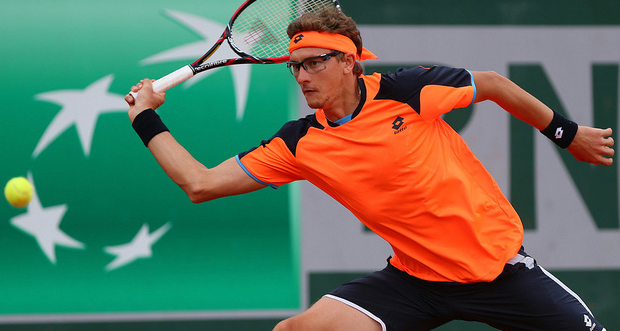
  • Denis Istomin Biofile

    Denis Istomin Biofile

    OLYMPUS DIGITAL CAMERA


    Status:  ATP #65. Career high ranking was #33 in August 2012.


    From: Uzbekistan.


    Age: 26.


    First Tennis Memory: “When I came on the court with my mom [Klaudiya Istomina], she was coach. And I just take the racquet and go hit the ball on the wall. And I was like playing for two hours on the wall. That’s my first memory of tennis.”


    Tennis Inspirations: “Everybody wants to be a good player, win a Grand Slam, be No. 1. So for me, the same.”


    Last Book Read: “Paulo Coelho The Alchemist.”


    Greatest Sports Moment: “I think the greatest moment – when I play first match in Grand Slam against Roger Federer [2006 Australian Open].”


    Most Painful Moment: “I think it’s my car accident [driving to Futures tournament in Tashkent in 2001]. I was in hospital for three months and I have to stop playing tennis for 2 1/2 years.”


    First Famous Tennis Player You Met Or Encountered: “It was Marat Safin and he was playing in Tashkent ATP tournament. I was small. I won junior tournament in Tashkent and he gave us the present.”


    Closest Tennis Friends: “Mikhail Elgin, Andrey Golubev.”


    Funniest Player Encountered: “Michael Llodra.”


    Strangest Match: “Actually it was the longest match in my career. I played the Ecuadorian guy [Nicolas] Lapentti in U.S. Open. I beat him 7-6 in the fifth. The match was like only rallies and it was a tough, tough match for me. And I think, for me, it was the more unusual, normally I play not so long but with him I play for five hours. It was long match.”


    Current Car: “Actually I have a Peugeot 308 in Moscow now.”


    Favorite Sport Outside Tennis: “Soccer.”


    Three Athletes You Like To Watch & Follow: “Didier Drogba. I’d say Roger Federer. And I think Yelena Isinbayeva [Russian pole vaulter].”


    People Qualities Most Admired: “I think it’s good to be friendly, like open for everybody, and just talk with everybody. And be funny.”


    ______________________________________

    Credits: Cover Photo: Feruza48 (Creative Commons License)

    [divider]

    Discuss Denis Istomin in the Tennis Frontier Forums.