Blog

  • Serena Williams Wins the US Open

    Serena Williams Wins the US Open

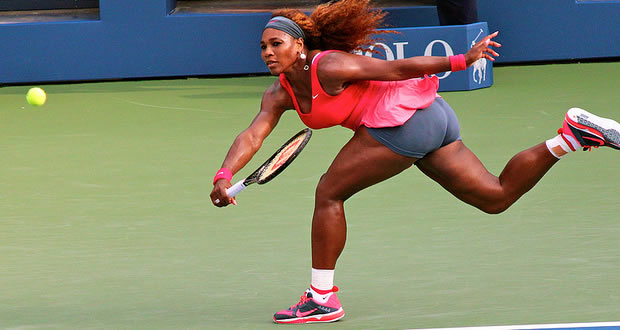
    Serena Williams fought Victoria Azarenka, the wind, and her nerves to win her 17th Major title.

    [divider]

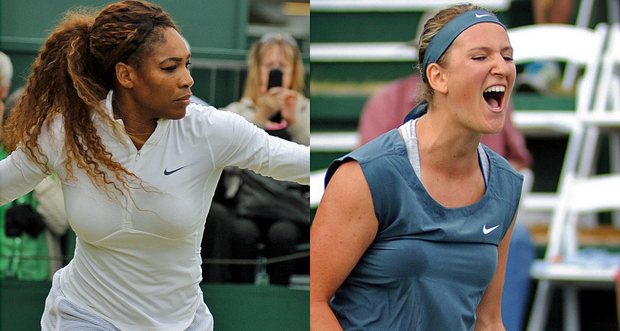
    Serena Williams has won her fifth US Open crown with a hard fought victory over world No. 2 Victoria Azarenka, 7-5, 6-7(6), 6-1, in a match lasting 2 hours and 45 minutes.  Oddly, it was the first time that the world No. 1 and No. 2 had faced each other in a US Open final in 10 years.

    It didn’t come easy. Serena had to overcome blustery weather conditions, unforced errors, and a very stubborn opponent in the Belorussian. Twice in the second set she served for the match but Azarenka broke her both times to force a deciding set.

    Azarenka had beaten Williams recently in Cincinnati in a three-set thriller but fell behind early in the final set and could not recover. Williams finally sealed the match when an Azarenka return sailed long.

    Williams increased her Grand Slam count to 17, one fewer than Chris Evert and Martina Navratilova on the all-time list, and jumped for joy on winning her fifth US Open title.

    [divider]

    Discuss the US Open Final on the Tennis Frontier Message Forums.

    [divider]

    Cover Photo: edplain (Creative Commons License)

  • Johan Kriek’s “Drugs in Sports” — A Masterclass Perspective

    Johan Kriek’s “Drugs in Sports” — A Masterclass Perspective

    Mr. Kriek wrote a wonderful article on this site in his Johan Kriek Drugs in Sport blog entry. He is to be commended for having the courage to write it.  It goes a long way in demonstrating why one should not accept performance enhancing drug (PED) use or doping as part of any sport, and how the penalties should be severe to discourage the doper.

    However, as much as I admire the article, I believe more needs to be said.  One cannot only place blame on the athletes, though they of course make their own decisions on whether to dope or not.  But let’s get real, the risk right now of doing time for doping is minuscule compared to the potential reward.  Let’s see.  “Hmm, I’m a good athlete, but I could be much better, even the best, and make millions, have fame, and with my smart doping program and the current testing regime, I won’t get caught. In fact, if I’m near the top who will want to catch me and destroy the sport?”  Well, perhaps players with high moral standards will refuse such a temptation. But how many will not?

    [divider]

    Discuss this blog post and the subject in the discussion forums.

    [divider]

    The management of the sport and management of anti-doping controls share in the responsibility with the players in keeping the sport clean.  But I firmly believe that no sport’s organization should be responsible for anti-doping control within their own sport.   There is an obvious conflict of interest with those who manage it, market it, and promote the players, also being given the responsibility of controlling management and testing of anti-doping in their own sport. The trouble is that no sport wants to give up this control.  Why would they? They are the proverbial fox managing the chicken coop.  If some independent international authority were given control over managing anti-doping, who knows what would happen? Some top athlete or many might actually get caught and publicly be outed.  What would that do to the sport?  A sport may claim to be diligent in their management and may produce examples of such, but the inherent conflict of interest is too great.

    The best response from a sport’s organization would be that they shouldn’t have the responsibility for managing anti-doping in their own sport in the first place and hand it over to an independent authority.  But which sport would have the courage to do that?  As long as each individual sport has control over anti-doping nobody will know what is actually happening. Transparency is kept at a minimum, ostensibly to protect players’ rights, but in the eyes of the sport’s management, it obviously protects the sport if the sport can control what kind of testing is done, how often, at what times both in and out of competition, who gets tested, and how much of what is known is released to the public.

    WADA (World Anti-Doping Agency) should do all they can to separate the interests. I don’t know if they have the power to do this. Maybe they need to get individual governments where the sport is being played to mandate the separation of interests.  See their most recent report on the lack of effectiveness in testing programs. Please pay particular attention to Appendix A and #2. International Sports Organizations.

    [divider]

    Obviously, the sport of tennis is not immune.  Drugs won’t make a major champion out of someone who has little ability in the sport, but among the top 500 players, there is not a great deal of difference in the abilities of players that play the sport.  The differences are small, especially within each tier – Top 10, 20, 30, etc.  Use of drugs for extra power, for endurance, recovery, and growth can obviously give the edge to that player within his tier level,  or perhaps even a few levels difference.  And not only in the actual physical effect like strength and endurance, but moreover in confidence and therefore mental strength, which, as any top player will tell you, is what mostly differentiates the players at a certain level.

    Additionally, when one combines the drug effects with the conditions present in the sport, the effects can be augmented or diminished.  Ask yourself, “Are playing conditions generally slower today, or faster?  Will they favor those with artificially increased endurance, recovery ability, power, etc., or those that play with better tactics and aggressive shotmaking skills?”

    Someone who is making superior shots should be able to win points without having to hit three or more winning shots, only to see them come back back again and again, point after point.  Superior shotmaking and tactics over the match should be able to tire the other player sufficiently to win the match.

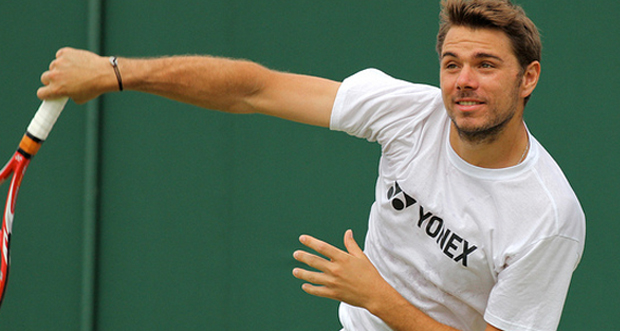
    As an example, I am disturbed when I observe a match like yesterday’s men’s semifinal at the 2013 US Open between Stanislas Wawrinka and Novak Djokovic.  Here are some relevant quotes from the players in their post-match interviews or press conferences that also disturbed me.

    Stan Wawrinka [about Novak]:  “He was f*****g strong.”

    Novak Djokovic:  “Wawrinka was a better player for most of the better part of the match because he was aggressive and played better tennis. Other hand, me, I just tried to hang on and fight and be mentally tough and believe all the way through I can actually win.  And I sincerely believed that as the match progresses and longer it goes, I felt I have maybe that physical edge over him…”

    Sadly for many tennis purists, strong endurance and almost endless retrieval ability on these slowed hard courts of the US Open triumphed over tactics and aggressive shotmaking yet again.  It’s generally accepted that a clay court should have these attributes, but the US Open? Traditionally one of the faster hard courts?  Not only does the slowing of hard courts or grass (by causing a higher bounce) diminish a player’s superior shot making results, it also can produce more injuries.  The hard courts are not as forgiving on the joints as the natural surfaces.  Long matches on hard courts are not conducive to a player’s well being in the short term, and the effect is probably cumulative over the long term.

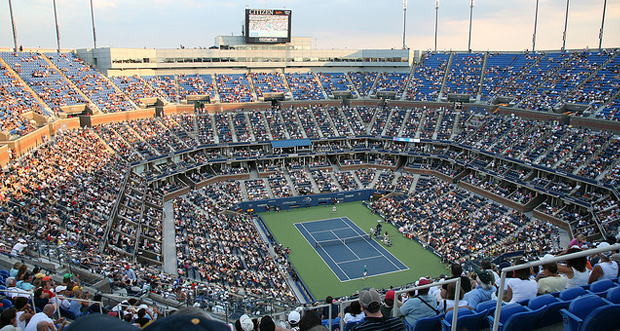
    These days, Arthur Ashe Stadium’s DecoTurf 2 court in Flushing Meadows, New York, plays barely faster than Rod Laver Stadium’s Plexicushion court in Melbourne, Australia.  When they repaint the court before the event, they use enough grit in the top layer of paint to slow it down from its standard medium-fast pace.  There is also a lack of transparency in advertising the conditions.  In my opinion, the adjusted court pace rating  should be displayed prominently, say on the court’s scoreboard,  at every ITF/ATP/WTA event.  There are standard machines that calculate the pace and bounce characteristics, as well as a formula to adjust the calculation based on weather conditions (temperature and humidity).  It should not be a guessing game for the fans and players.

    But those in power (ITF, ATP, WTA) realized there is more money in having marathon matches, so what else can one expect?  Tournaments and sponsors are also culpable in this regard.

    In slower conditions, if a player has sufficient skills to hit the ball back in the court decently, and possesses an extraordinary ability to run balls down for as long as it takes, then he can be a winner.  He doesn’t have to play better tennis.  He just has to run more and outlast his opponent.  When two such similar players play against each other, it’s anyone’s guess who will be the last one standing — the winner.

    [divider]

    Worst of all, one can’t be sure if athletes naturally have superior endurance and recovery attributes via genetics and hard training, or are being artificially enhanced.

    Why can’t one be sure? Because those who currently manage anti-doping controls hardly test off-season when the drugs’ benefits can be used to their greatest affect, they rarely use blood testing, sometimes don’t test top players at all, or test using known methods with loopholes. For example, the T/E test used for steroid-testosterone detection won’t catch dopers that use micro-dosing or other methods to fly in under the established limits, or those genetically predisposed to not exhibit a high ratio, instead of using more definitive but more expensive tests like CIR (carbon isotope ratio).   The lack of funding argument to perform better and increased testing doesn’t fly with the millions being earned by the sport.  With the lax or inept management, a doper with knowledge and common sense or with access to a knowledgeable professional will not get caught via the current testing regime.  You don’t have to look further than the USADA report on Lance Armstrong and the US Postal Team for how canny the doper culture can be in avoiding getting caught.  And if a doper makes a mistake (usually those that may not have the best professional advice), there is every chance that they may be able to serve their time quietly (provisional ban) while their case is argued, and under the right circumstances it won’t be publicly revealed.  At worst, an occasional scapegoat not in the top echelon may be exposed to demonstrate the effectiveness of the testing regime and be publicly banned for a time.

    If a doping athlete is accused or suspected of doping based on his appearance or incredible performances, he can simply say that he has never used anything illegal and never tested positive.

    On the other hand, if someone is not doping, but they have the natural strength/endurance attributes and/or excellent training programs, they may still be suspected of doping due to their performance, and it’s difficult for them to prove themselves innocent to a suspicious public, because the anti-doping controls are so suspect for all of the reasons already given.

    Victor Conte, the former BALCO head who served time in prison in 2005 for his part in a conspiracy to distribute steroids and money laundering, but since then has admirably educated people about doping methods and joined the fight against doping in sports, said that PED use in tennis is “likely rampant because testing is inept.” I believe he has used figures of 30% or more when describing rampant.  Thirty percent or more of the top players are doping?  Shocking to us perhaps, but not Victor Conte.  He’s been around and has usually been on target with his assessments.

    There are remedies for all of this, and one doesn’t  pretend to have all the answers, but it will certainly take time and the will to make changes.  The public also has a responsibility.  We have to do our part to convince those in charge that we don’t want doped athletes cheating those who do not dope, even if the former provide great entertainment.  We cannot turn a blind eye to this.  We cannot be conveniently naive or bury our heads in the sand and say it’s not happening.  Athletes that don’t use PEDs are being cheated by those that do.  It discredits all involved in all sports from all eras if we cannot be sure who is doping and who is not.

    Credits: Cover Photo: Russell Bernice (Creative Commons License)
  • Djokovic Outlasts Wawrinka in the Semifinals; Sets Up Nadal Rematch

    Djokovic Outlasts Wawrinka in the Semifinals; Sets Up Nadal Rematch

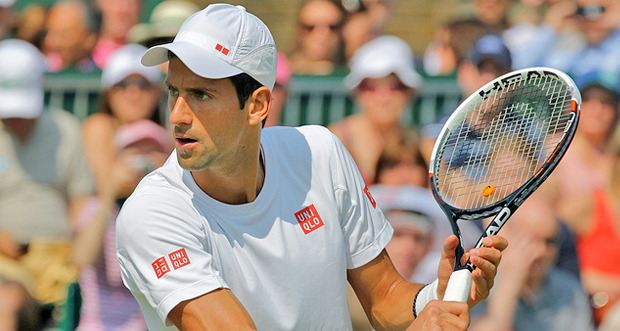
    Novak Djokovic overcame an overall lackluster performance, and an onslaught from Stanislaw Wawrinka to prevail in a thrilling 5-set match, 2-6, 7-6(4), 3-6, 6-3, 6-4.

    It was a roller-coaster ride of a semifinal.  Wawrinka, the still-but-perhaps-not-for-long Swiss No. 2 came out strong and broke Djokovic three times in the first set.  He went up a break in the second, but Djokovic broke back, and sent the set into a tiebreak, which the world No. 1 snatched up.  The Swiss took the third set on one break, and Djokovic the fourth via the same.  Also in the fourth set, Wawrinka had a medical timeout for an injury to his upper-thigh, and did seem to be hampered the rest of the match.

    [divider]

    Click here to discuss the Nadal/Djokovic final in our discussion forum.

    Click here to discuss the Nadal/Gasquet semifinal in our discussion forum.

    Click here to discuss the Djokovic/Wawrinka semifinal in our discussion forum.

    [divider]

    The stakes were raised in the fifth set.  At 1-1, with Wawrinka serving, they played a nearly 21-minute, 30-point game.  It was taken to deuce 12 times, with Djokovic having five break chances.  In the end, Wawrinka held, but it seemed to be all he had left.  Djokovic broke at 2-2 and ran away with it.

    After the match, Djokovic said:  “I think it was obvious Stan played more aggressive; he played better tennis over all,” adding, “I was glad I was able to find my best tennis when I needed it.”

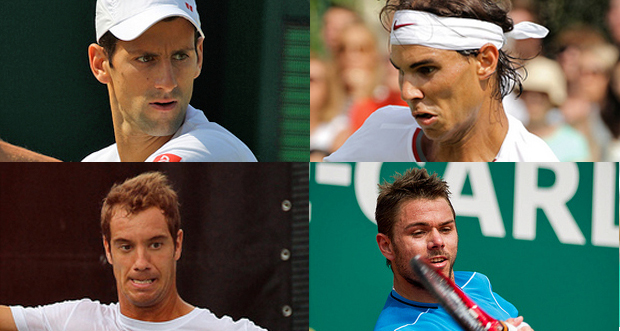
    In the second semifinal of the day, Rafael Nadal beat Richard Gasquet with his B-Game, 6-4, 7-6(1), 6-2.  While Gasquet came up with some showy tennis at times, and Nadal was having trouble finding the lines, the best Gasquet can say is that he broke Nadal’s serve for the first time in the tournament.

    The win assures Djokovic that he holds his No. 1 ranking for the time being, and sets up his 37th match with his rival Nadal — an Open Era record for most matches played.  The Spaniard currently leads the head-to-head 21-15.  They will play for the trophy on Monday.

  • The Ebb and Flow of Talent in the ATP Era

    The Ebb and Flow of Talent in the ATP Era

    2645577395_fed7784140_o

    Photo provided by rainycat (Creative Commons license)

    When looking at the different periods of tennis history, the late 1970s to early 1980s is often considered the “Golden Era,” highlighted by what must be the greatest rivalry in tennis history: Bjorn Borg versus John McEnroe. We could say that this era began in 1978 when the young American upstart McEnroe surprised the tennis world by beating Bjorn Borg at the Stockholm Open, the first of 14 matches they played against each other, each winning seven. The natural end of this era, then, would be their last match: the 1981 US Open, when McEnroe solidified his usurpation as the top player in the world by beating Borg in the final, and also Borg’s last Grand Slam contest.

    [divider]

    Click here to discuss “The Ebb and Flow of Talent in the ATP Era” in our discussion forum.

    [divider]

    So from the very end of 1978 to late into the 1981 season was a great era of men’s tennis, dominated by Borg and McEnroe, with older but still excellent Jimmy Connors and Guillermo Vilas rounding out the elite and, in the last half of that span, young Ivan Lendl coming onto the scene. Yet the question that arises is this: Was it the most talent-rich period of tennis history or merely the most celebrated? This set me to doing some research; for the sake of ease I stuck to the Open Era and, in particular, the period of ATP rankings, 1973 to the present. So we can fine-tune the question a bit and ask: How has “talent-richness” changed over the last 40 years of men’s tennis?

    I decided to look at only those players who could be considered “all-time greats.” My criteria were flexible, but included all players who had won three or more Slams in the Open Era, or were likely to win three or more, and at more than one venue. This means that I excluded Gustavo Kuerten, who won three Slams at Roland Garros, but included Andy Murray, who has won two Slams at different venues, and seems likely to win at least one more.

    I came up with a list of nineteen players; here is a chart that shows their year-end rankings (click on chart for better viewing):

    Greats ATP Ranking

    Just looking at that chart gives us a sense of the ebbs and flows of upper echelon talent in men’s tennis, although of course it is important to point out that I’m only looking at the very greatest players and not the “near-elites” or players that might have been great for a short period of time (e.g. Lleyton Hewitt, Michael Stich, etc.). The purpose here is to focus on truly great talent and in what density it has shown up over the last four decades.

    I then separated those nineteen players into three groups or tiers by their total Slam count, to differentiate levels of greatness:

    Tier One (10+ Slams): Rosewall, Laver, Borg, Sampras, Federer, Nadal

    Tier Two (6-9 Slams): Newcombe, Connors, McEnroe, Lendl, Wilander, Edberg, Becker, Agassi, Djokovic

    Tier Three (5 or fewer Slams): Ashe, Vilas, Courier, Murray

    I think we can safely say, without too much quibbling, that the above list represents the 19 greatest players of the Open Era, roughly arranged in levels of greatness. Strike that; I’m sure there will be quibbling, and I can imagine the protests of, say, Andy Murray’s inclusion but not Gustavo Kuerten’s or Marat Safin’s or Patrick Rafter’s or Ilie Nastase’s. But I think we can at least agree on most of that list; in other words, if we want to quibble about Murray or Ashe or Vilas or Courier, fine, but the other fifteen are clearly all-time greats, and of the four “Tier Three” players we can, at the least, say that they’re deserving of consideration and at least as deserving as anyone else.

    That aside, I won’t go into exact numbers for the sake of avoiding complexity and confusion, but I then assigned different points for different rankings, with Tier One getting roughly twice the points of Tier Three, and Tier Two halfway in between. Players would get points for different levels of ranking – #1, #2-5, #6-10, #11-20, etc. Finally, I counted up the points from each year for the above 19 players, from 1973 to 2012, arriving at a number which is meant to indicate “talent-richness” of any given year.

    Let me be clear and re-emphasize what I just wrote: This number indicates (or describes); it does not seek to definitively finalize or give us any more than a sense of talent-richness. To get a more accurate, comprehensive picture we’d have to look much deeper than the above nineteen players. What this does show us in a relatively accurate manner is how dense or rich the level of truly great talent has been in any given year. In other words, it tells us for any given year what level of all-time great talent was playing at a high level; it doesn’t tell us the total depth and breadth of talent.

    The next chart shows us that number over time:

    20130907054418


    There are a few things that stand out for me:

    One, there’s an interesting two-year window in 1974-75 which, according to this calculation, were the two most talent-rich years in the last 40 years. The reason for this is that a few of the top players of the 1960s—Laver, Rosewall, and Ashe—were still playing at a high level; at the same time, you had Newcombe in his prime, a young Connors and Vilas, and a teenage Borg establishing himself as an elite player. The number dropped as the older players faded away; in 1976, for instance, Laver finished the year at No. 76 compared to No. 10 the year before.

    Secondly, we can see that the 1978-81 period—while talent-rich—is not as much so as the late 1980s when you had three generations all playing at or near their peaks. This is not to say that the ’78-81 period wasn’t talent rich; but this certainly supports the idea that its appellation as the “golden era” of men’s tennis has more to do with the great Borg-McEnroe rivalry than it does with a clear supremacy of talent over other periods.

    Moving on, there is an obvious and massive decline in the mid-90s. Wilander and Connors were done as elite players by 1990, McEnroe retired in ’92, Lendl a couple years later, and then Edberg and Becker faded just after that, and Jim Courier—like Wilander—peaked and faded at a young age, so during the mid-to-late 90s there were only two clear elite players, Agassi and Sampras, and Sampras started fading in the late 90s.

    The absolute nadir of Open Era talent seems to be 2000. The talent-level began to rise with the arrival of Roger Federer, and then jumped when Rafael Nadal stormed through Roland Garros in 2005. From 2008 through 2012 it has “flat-lined,” with four players dominating the field in a way previously unseen.

    Before ending, allow me to indulge in some speculation. It seems clear that Roger Federer has slipped out of the elite; perhaps the best we can hope for is him hanging around the Top 10 for another couple years. Nadal, Djokovic, and Murray should be around for some time, but the big concern is that there are no obvious candidates to join the above list, to turn that list of 19 into 20 or more. Of course we will see more elite players, but it’s hard to imagine Milos Raonic or Jerzy Janowicz or Grigor Dimitrov winning three or more Slams and earning a spot on this list. Who knows? I could be wrong–I certainly hope I am!–but my sense is that for that next great player, we’re going to have to wait two to three years or more before we even know who he (or they) will be.

    With Federer unlikely to finish in the Top 5, that number is going to drop for 2013. Not by much, but probably by five points. I could see it holding steady in the upper 40s for another year or two, but after that it all depends upon whether we start seeing signs of that next great player and/or how quickly the current Big Three will decline. The decline of all players is inevitable, and we’re likely going to start seeing signs of the decline of the Big Three within the next two or three years, as they enter their late 20s and are more frequently beaten by the hungry near-elite players below them.

    In conclusion, talent ebbs and flows and no era is quite like any other. Neither of the above charts shows a clear pattern or cycle; it would seem that each new era is different and that all we can be certain of is change itself. One of the great joys of tennis, at least for myself, is waiting and watching for the next generation of talent to arise, to try to understand who the next great player will be, and what match – like Stockholm in 1978 – will signal the changing of an era. So I will continue to watch and wait. Meanwhile, we can sit back and enjoy the great tennis play of today.

  • Masterclass Match of the Day: Novak Djokovic vs. Stanislas Wawrinka

    Masterclass Match of the Day: Novak Djokovic vs. Stanislas Wawrinka

    A Breath of Fresh Air, Or The Same Old Song?

    As we approach the business end of the US Open, some of the same top names appear in the semifinal matches.  Race to London leader and world No. 2  Rafael Nadal continues to be on a tear, and the current No. 1 player in the world, Novak Djokovic, marches on.  But their opponents are in rather new territory.  Current world No. 8, Richard Gasquet, has never made it past the Round of 16 at the US Open, and has only made it to the semifinals of a major once in his career at Wimbledon 2007.  He has the tough task of taking on Rafael Nadal.  Stanislas Wawrinka has never made it past the quarterfinals of any major and faces Novak Djokovic, but I believe Stan’s recent play this year warrants him having a fair chance of upsetting the world No. 1 of the last two years.

    Let me put it this way: I wouldn’t put my own money on this match if I were a betting man.  But if I had some money given to me, I would put it on Stan Wawrinka and hope he plays as well as he did against Andy Murray.

    [divider]

    Discuss this article and the match with fellow tennis fans in the forum.

    [divider]

    Novak Djokovic has certainly dominated their head-to-head in the past, but every match is different.

    Based on their prior record, few if any would have picked Stan to come as close as he did in Australia to removing the three-time Plexicushion prize-winner from the premises.

    I think these days the US Open Arthur Ashe Stadium surface unfortunately plays only slightly faster than the Australian Open’s Rod Laver Arena.  It seems to have a little less grit and not quite as high a bounce.  I don’t see Djokovic sliding as much in New York as in Melbourne.  I think this will reduce Novak’s ability to defend as well as he does down under.

    Novak has been prone to concentration lapses this year.  Hard courts are no longer a bastion of certainty as they had been for the most part since 2011.  How has he done on hard courts this year?

    He started out extremely well by winning the Australian Open and Dubai.  But then something happened.  He allowed Juan Martin Del Potro to come from behind and beat him in the semifinals at Indian Wells, and followed that up with a Round of 16 straight-set loss to Tommy Haas.  His next hard court tourney was in Montreal, where he lost to Nadal in three sets in the semifinals, and followed that up with a three-set loss in Cincinnati to John Isner.

    Again, every match is different.  But Djokovic’s recent trend does not bode as well for him.

    Thus far at the US Open, he has not played any difficult opponents, easily beating unseeded opponents Berankis, Becker, Sousa, Granollers, and No. 21 seed Mikhail Youzhny in four sets.  I think the rather weak draw thus far might not be to his benefit.

    Wawrinka had not played that much on hard courts this year, choosing to focus on clay.  Aside from his Round of 16 loss to Djokovic at the Australian Open, he lost a tough one to Federer in the Round of 16 in three sets at Indian Wells, and lost to Paire and Robredo in the Round of 32 at both Montreal and Cincinnati.  So his preparation for the US Open definitely has been light.

    However, thus far in the US Open, his path has been rather difficult, and I believe it has only benefited him and he has improved his play as the tournament has progressed.  He beat Stepanek while dropping a set, defeated a tough Karlovic in a not so easy three sets, held off a tenacious Baghdatis in four sets, stepped it up another level to down Berdych who had been playing very well, and, as many saw, played a very intelligent and strong match to down Andy Murray in three sets. Thus, I feel Stan Wawrinka is much better prepared in terms of his play for this match with Djokovic.

    I think the match up is quite similar as to the one with Andy.  Stan must play with variety to Djokovic as he did with Murray, and not let Djokovic get into any good rhythm.  I think Stan would do better to go to body serves against Djokovic, since he stretches so well to get to balls.  Nole must try to get Stan into a power struggle from the baseline for him to have a good chance.

    Andy beat Novak last year in five sets at the US Open.  Stan beat Andy this year in three sets.

    I believe Stan could force Nole out in three or four sets if he plays like he has been considering the level of opponents they have both played and their level during this tournament, and if he can use similar tactics and execution as he did against Murray.

    The only problem with Stan is lack of a strong mental stability.  He has been known to suddenly go walkabout or get down on himself and go away in a match.  Additionally, one cannot be certain that he will not have a bit of  letdown after beating Andy.  These are the chief reasons why I would not bet money on the match, if I were a betting man.  Also, Nole has been known to raise his game occasionally and refuse to lose.  So though I stick by my call, I would never be surprised to see Novak Djokovic win.

    As always I hope for a good, entertaining match and wish good luck to both players and their fans!

  • All Manner of Absurdity

    All Manner of Absurdity

    US Open, Quarterfinals Recap

    The US Open, an entity which I contend boasts not only impish sentience but an eye for proportion, thoughtfully balanced a pair of men’s quarterfinals that more or less lived down to expectations with two others that could have hardly conformed less. Two predictable blowouts and two extravagant upsets: what could be more formally elegant? There was a brief period in the last of these encounters, as Mikhail Youzhny stole a set from a momentarily unfocussed Novak Djokovic, when I feared this graceful symmetry might be fractured, or, more worryingly, that I might have to rewrite this opening paragraph. Fortunately the world number one steadied magnificently, and I was able to salvage my broader point, such as it is. For all that I would have enjoyed an audacious comeback from Youzhny almost as much as the tennis-starved punters in Arthur Ashe Stadium, I’d prefer it didn’t cost me whole minutes of work.

    [divider]

    Click here to discuss “All Manner of Absurdity” and more in our discussion forum.

    [divider]

    It’s a nice question whether Richard Gasquet defeating David Ferrer in five sets constitutes a more surprising upset than Stanislas Wawrinka beating Andy Murray in straights, leaving to one side the question of which was the more upsetting surprise. If one were writing a screenplay, which result would cause viewers suddenly to rediscover their disbelief, and simply walk out? Cinema audiences will put up with all manner of absurdity – midi-chlorians, Nicholas Cage – but there are limits. This is the US Open, not Wimbledon. It would probably be more convincing had the scores been swapped: Wawrinka might have prevailed in a tough grind, while an incandescent Gasquet might conceivably have swept the formless Ferrer aside quickly.

    (2) Nadal d. (19) Robredo, 6-0, 6-2, 6-2

    It was always likely that Rafael Nadal would make short work of his quarterfinal, given his exalted hardcourt form and Roger Federer’s exit in the fourth round. But the fact that he was facing a veteran who’d never progressed beyond this stage of a Major in several dozen attempts put it almost beyond doubt. Realisation that this veteran was a compatriot of Nadal’s removed even that modicum of uncertainty. Add in a single-handed backhand and it was hard to see how the encounter would stretch far beyond eighty-minutes. The opponent was Tommy Robredo, who’d done such a sterling job two days earlier in providing a sturdy platform for Federer to ritually disembowel himself on. Robredo brought a similar commitment into his match with Nadal – standing way back, looping groundstrokes, and retrieving like a terrier – with the result that he won five whole points in the opening set. These points sadly weren’t clumped such that they equated to a whole game. Forget eighty minutes — maybe it wouldn’t last the hour.

    The next two sets were marginally more competitive, but such terms are relative, and it was never a contest. Before the match Nadal had somehow maintained a straight face while declaring that in order to have any chance at beating Robredo he’d have to play his best. As it happened Nadal did play somewhere near his best, with the result that Robredo had no chance whatsoever. Nadal has moved through to the semifinals, an outcome he subsequently described as “unbelievable”, which I think translates as “very believable”, considering he has made it at least that far in New York every year since 2007, apart from last year when he didn’t reach the first round.

    For a refreshing contrast he will next face a tour veteran to whom he has never lost, who employs a single-handed backhand, and prefers to operate ten feet behind the baseline. This player is Richard Gasquet, and to say that Nadal has never lost to the Frenchman is slightly misleading. Gasquet actually beat Nadal fourteen years ago, in juniors. This result has no material bearing on their upcoming US Open semifinal except that Gasquet brought it up in his press conference, thereby proving that it’s no longer possible for a professional sportsperson to make a joking aside without having it over-analysed to death. Nadal was naturally quizzed about this during his post-match interview, and astonished everyone by recounting the match in granular detail. Even Brad Gilbert was left momentarily speechless. Jason Goodall reliably wasn’t, joking, “I suppose he’s out for revenge in the semifinal, then.”

    (8) Gasquet d. (4) Ferrer, 6-3, 6-1, 4-6, 2-6, 6-3

    It is hard to imagine he won’t get it, but then it’s pretty hard to believe that Gasquet is there at all. Even to reach the quarterfinals he required five sets, and had to overcome one of the worst fourth round Major records in history (0-11 since Wimbledon 2007). Admittedly that was only against Milos Raonic, who himself had never progressed beyond the round of sixteen. In the quarterfinal Gasquet faced the fourth seeded David Ferrer, thus pitting a man who rarely beats those ranked above him against a guy who seldom loses to those ranked lower, a guy whose constant presence in Major semifinals has ceased to elicit surprise even if it is destined never to gain acceptance. Ferrer will presumably drop out of the top four long before everyone stops wrongly assuming that his quarter of the draw is the one fated to collapse. It was once again to everyone’s chagrin that the only quarterfinal match-up that panned out according to seedings was Ferrer’s, although I do maintain that it was only by the grace of Dmitry Tursunov’s delicate thighs that this was possible.

    Gasquet took the first two sets in fairly convincing fashion, and it seemed likely that a perfunctory upset was underway. This would have been surprising in a sense, though hardly in the league of Federer’s loss to Robredo. Ferrer has been horribly short on form, and sometimes Gasquet is simply unplayable. It happens. But then Ferrer fought back, and levelled the match at two sets each. Gasquet was no longer anything like unplayable, and Ferrer wasn’t playing that badly. The scene – an idyllic French farm setting circa 1917 – was precisely the kind of one into which the Frenchman will typically plummet in a tangle of flaming wreckage. But somehow he remained aloft, mostly due to his serve. Despite his appalling record in fourth rounds, Gasquet has also never lost in the quarterfinals. But nor has he won a semifinal.

    (9) Wawrinka d. (3) Murray, 6-4, 6-3, 6-2

    Murray’s seppuku was only marginally less extravagant than Federer’s, though it was characteristically louder, and given he was facing a superior opponent on a bigger stage, it all worked out looking about the same. By losing to Wawrinka, Murray has failed to reach the final at a Major for the first time since Roland Garros last year (he didn’t play Paris this year). Indeed, aside from last year’s French Open he had reached at least the semifinals at the last nine Majors he had entered, going back to the 2010 US Open, where he lost in the third round to, as fortune would have it, Wawrinka. A mere coincidence, of course, though Murray’s many fans are no doubt right to be dismayed by the connection, since their man is supposed to have moved on from flaccid efforts like this.

    Perhaps they can find some comfort in the suggestion that this new Wawrinka is a categorically superior version to the old one. The addition of Magnus Norman to his team appears to have worked a similar trick for the Swiss that it did for Robin Soderling a few years ago, although it’s worth bearing in mind that Wawrinka was still coach-less when he almost beat Djokovic in Melbourne, so far the season’s finest match. Any changes that Norman has wrought in Wawrinka’s game – the focus appears heavily to be on buttressing his sense of self-belief more than anything technical – are a refinement to the course he’d already set. Wawrinka’s faith in his own capacity to match top ten players was amply displayed against Tomas Berdych in the last round, and reprised today.

    History, in the guise of countless mid-match collapses against Federer, had previously taught all discerning fans that it is rarely a question of whether Wawrinka will collapse in a high-stakes tennis match. It is merely a question of when, which in turn propels one onward to the gasping query of why (for the love of god). So it was today, when Eurosport’s English commentators tirelessly awaited a reversal that never came, even to the end. Wawrinka opened his final service game with a double-fault, then watched unperturbed as Murray smacked a return winner past him. From there it was all Wawrinka, all aggression – including a tremendous bounce-smash winner from the baseline – all the way to the end.

    The defending champion is out.

  • Rematch: Williams – Azarenka Prevail in Semifinals

    Rematch: Williams – Azarenka Prevail in Semifinals

    There were a lot of nerves on display in today’s women’s semifinals…and Serena Williams played, too.

    [divider]

    Victoria Azarenka and Serena Williams got through their semifinal matches today to set up the anticipated (and generally hoped-for) final, a rematch of last year’s, in which Williams prevailed.

    Azarenka played the Italian veteran Flavia Pennetta, who is coming back from a serious wrist injury and reaching her first Grand Slam semifinal.  It was a nervy affair, featuring 13 breaks of serve in 18 games.  It started with 5 service breaks at a trot until Azarenka finally held.  Pennetta tried to hang with the Belorussian, staving off 5 set points in the first set before Azarenka closed it out, but overall Azarenka’s powerful game was too much for Pennetta.  Azarenka prevailed in the end, 6-4, 6-2.

    [divider]

    Click here to discuss the Serena Williams/Li Na semifinal in our discussion forum.

    Click here to discuss the Victoria Azarenka/Flavia Pennetta semifinal in our discussion forum.

    [divider]

    Williams beat Li Na of China, who battled both her nerves and a confident Serena, who is currently on a 24-match winning streak. It wasn’t until the second set that Li Na even won a game.  A letdown from Williams helped Li break for 2-1 in the second, to get her first lead in the match, and her legs back under her.  After that, she played more like the player that reached the semifinals, but Serena recovered and broke back in the next game.  Serving at 2-5, Li played an astonishingly gutsy game, saving 6 match points before finally holding for 3-5 in a nearly 14-minute game.  She then managed to get it to 30-all on Serena’s serve before the American closed it out on her 7th match point.  Williams won 6-0, 6-2 and has yet to drop a set in the tournament.

    Later Friday evening, Serena and Venus Williams lost in the doubles semifinals to the Czech Republic team of Andrea Hlavackova and Lucie Hradecka.

  • US Open Men’s Semifinals Schedule of Play: Saturday, Sept. 7

    US Open Men’s Semifinals Schedule of Play: Saturday, Sept. 7

    [Scores added as known.]

    Arthur Ashe Stadium — 12:00 P.M.

    Men’s Singles – Semifinals
    Novak Djokovic (SRB) (1) d. Stanislas Wawrinka (SUI) (9) — 2-6, 7-6(4), 3-6, 6-3, 6-4

    Not Before: 2:50 P.M.

    Men’s Singles – Semifinals
    Rafael Nadal (ESP) (2) d. Richard Gasquet (FRA) (8) — 6-4, 7-6(1), 6-2

    Women’s Doubles – Final
    Andrea Hlavackova (CZE) (5) / Lucie Hradecka (CZE) (5) d. Ashleigh Barty (AUS) (8) / Casey Dellacqua (AUS) (8) — 6-7(4), 6-1, 6-4

    [divider]

    Click here to discuss the Nadal/Gasquet semifinal in our discussion forum.

    Click here to discuss the Djokovic/Wawrinka semifinal in our discussion forum.

    [divider]

  • Djokovic Into Semifinals

    Djokovic Into Semifinals

    World #1 Novak Djokovic booked his place in his 18th consecutive Major semifinal by beating Mikhail Youzhny under the lights in New York tonight, 6-3, 6-2, 3-6, 6-0.

    The Russian Youzhny, who was coming off a long and valiant 5-set win over Lleyton Hewitt, came up with break points in the first game of the match, but failed to capitalize.  Djokovic then broke immediately on Youzhny’s first service game.  The Russian tried to hang close, but looked under-inspired, and never found a way into the Djokovic serve, either in the first, or the second sets.

    [divider]

    Click here to discuss the Djokovic/Youzhny quarterfinal in our discussion forum.

    [divider]

    In the fourth game of the third set, however, after a fantastic get on a drop volley at 1-2 on Djokovic’s serve, Youzhny energized both himself and the crowd.  He finally converted his 8th break point chance for a 3-1 lead.  The fans in the stadium, clearly wanting to see a real match, got behind the Russian, which seemed to rattle the Serbian favorite, who began to spray errors.  Djokovic broke back from 0-40 down, for 3-4 in the 7th game, but then double-faulted away his hold game for 3-5.  It was a surprisingly passive and  poor game from Djokovic that gave Youzhny the third set on his serve.

    In the fourth, however, all the accumulated effort seemed to have left the Russian with nothing, and Djokovic appeared to have righted the ship.  Youzhny failed to win a single game.

    Djokovic will play Stan Wawrinka in the semifinals, who upset the defending champion Andy Murray earlier today.

  • Wawrinka Shocks Murray in New York

    Wawrinka Shocks Murray in New York

    Andy Murray’s reign as the US Open champion was brought to an abrupt end in New York by the Swiss Stanislas Wawrinka.

    Wawrinka dominated the encounter in Arthur Ashe stadium, prevailing in straight sets 6-4, 6-3, 6-2.

    [divider]

    Discuss this match and more with fellow tennis fans on the Tennis Frontier forums.

    [divider]

    It was a lacklustre performance by the third seeded Scot.  He failed to earn a single break point opportunity on the Wawrinka serve throughout the entire match, and lost the first set after being 40-0 up at 4-5.  In a critical game, lasting over 15 minutes, the Swiss finally converted his sixth set point to take the opening stanza.

    Murray’s woes continued in set two, as Wawrinka got even better, hitting winners from both wings in an impressive display of controlled aggression that Murray seemingly had no answer for.

    Devoid of energy, the Scot found himself a double break down and could not recover as Wawrinka served out the set to take a comfortable lead.

    The third set continued in the same fashion. Murray’s game was littered with uncharacteristic errors and his second serve was being attacked with impunity by the Swiss.  Wawrinka secured another early break to jump out to a 1-3 lead.  A second break to go 2-5 all but ended the Scot’s title defense.

    After 2 hours and 15 minutes, Wawrinka wrapped the match up by first executing a powerful overhead to set up match point, and then a netted Murray return secured it. He won 107 points to Murray’s 78 — a clear reflection of his dominant display.

    Post-match, Murray stated: “He played exceptional tennis and served very, very well. He hit a lot of lines on big points, went for his shots, and they all went in today. He played too well.”

    Wawrinka, seeded 9, will meet the winner of Novak Djokovic and Mikhail Youzhny for a place in the final.

    Cover Photo: Marianne Bevis (Creative Commons)