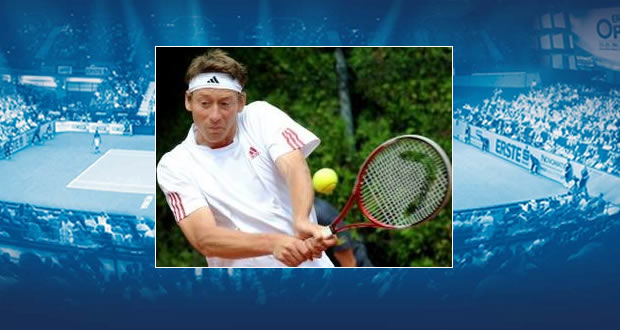
![On the Cherry Path — [An Up-and-Coming Player and His Unorthodox Coach]](https://www.tennisfrontier.com/archive/wp-content/uploads/2013/10/Bild-im-Text_Fleisch27_Resnik_02.jpg)

Sepp Resnik turned 60 recently. Now the man with the most colorful reputation in Austria’s sport scene wants to prove that “world class” works differently than everybody thinks it does. He has tennis prodigy Dominic Thiem, recently turned 20, shower in a waterfall, carry tree trunks through the woods, and do sit-ups at midnight until he screams.
By Stefan Wagner
Photographs by Max Kropitz
Originally published in the Austrian magazine Fleisch.
[divider]
Dominic Thiem really got to know his fitness coach Sepp Resnik on a March afternoon, by the banks of the Wiener Neustadt canal, an unadorned waterway in the dull outer districts of the town.
Thiem (barely 20, running and hence out of breath): “Look, Sepp, over there, on the other side, there’s some sun on the meadow. That’d be a good place to work out.”
Resnik (also running, but not quite as out of breath): “Good idea, let’s do that.”
Thiem: “But…”
Resnik: “But what?”
Thiem: “But… bridge?”
Resnik: “Who needs a bridge? That creek isn’t wider than five meters, and it ain’t deeper than two. You won’t drown.”
Resnik stops, steam clouds forming before his mouth, strips down to his underpants, enters the water as if it’s a hot spring, and motions for Thiem to do the same.
“What are you waiting for?”
Doing the same takes a little time, first of all because Thiem felt like hesitating for a moment and second of all because he had a lot of clothes on, including a parka and a woolen hat. Then Thiem enters the water, toes first, with friendly encouragement by Resnik (“What’s taking you so long?”), and swims through the fresh spring water, fidgeting, gasping for air, only to commence doing all sorts of exercise, the kind of which usually gets you in shape for a military pentathlon, on the other side of the canal for an hour. The March sun is only slowly drying the clothes on Thiem. Afterwards, both swim back, get into their clothes, and Resnik says cheerfully, “Look, now we’re even showered.”
Ferrari Mouse
One could easily attribute the collaboration of Dominic Thiem and Sepp Resnik to a commentator’s joke. Resnik is a former gymnast, soccer player, judoka, track and field athlete, and military pentathlete (in 1984, he was the first Austrian at Hawaii’s Ironman Triathlon). Afterwards he made a name for himself in various ultra-triathlons, for example 1988 in Grenoble (13km swimming, 540km cycling, 126,6 km running); he got attention in 1994 when he circled the world with his bike. With two decades of management experience in the Vienna Go-Go Bar “Beverly Hills”, a marriage to a women who called herself Ferrari Mouse (and who married a woman after their divorce), projects like a world record in endurance downhill skiing, and participating in a nationally televised matchmaking show, he crossed over from the sports section to general news and the gossip pages.
The increasing restraint among sports journalists in appreciation of Resnik’s achievements is based in certain doubts about the reliability of his statements. When a sports magazine published a major piece on Resnik’s ultra-triathlon, a letter to the editor urged for more critical research and enumerated how Resnik’s account of his crossing of the Gibraltar Strait meant he would’ve equaled the 100 meter freestyle world record over the whole distance. (“All accounts were correct. You have to take the current into consideration,” Resnik says even today, two decades later.) The 300 daily kilometers in his 80-days-around-the-world bike tour also raise some skepticism about the credibility of the pipe-smoking Resnik: 300 km is double the distance of an average Tour de France stage, and Resnik was facing non-closed, public roads in countries like Pakistan or Iraq. (“300? It was 350!” says Resnik).
On the other hand, Thiem is one of the world’s best tennis players in his age group, and along with David Alaba one of the only young Austrians on the radar in tennis, which is viewed as a global sport in ski-centric Austria. When Thiem was 17, he caught Ivan Lendl’s eye. Right on the court, Lendl called Adidas and recommended they get the boy a multi-year contract.

Flashes of talent weren’t scarce for the young Lower Austrian in the following years, but overall, he seemed a little too delicate for pro tennis. His health was frail, he was often tired, and, on the court, wasn’t convincing as a competitor. He always looked as if he’d want to apologize for his thundering winners. When Dominic Thiem would get over himself and pump his fist after a hard-fought point, as is expected by a tennis player in Austria ever since Thomas Muster, he’d hold his thumb in a way that would have got it broken should he actually have used the fist to punch.
Our locker is the trunk
Günter Bresnik, 52, has been Thiem’s coach for eight years and when he’s asked about the most important feature of a successful tennis professional, he says, “Stress tolerance.” Bresnik has been looking for years for the right fitness trainer for his protégé. There were even talks with Roger Federer’s staff member Pierre Paganini, or Bernd Pasold from the Red Bull training center, but somehow nothing worked out.
Then, in the fall of 2012, Bresnik met Resnik. They knew each other from years before, got to talking, and Bresnik invited Resnik to visit them in the Südstadt training center, between a soccer stadium and the parking lot of a shopping mall. Resnik came, watched the boy for ten minutes, and said, “Günter, I saw everything. The boy can do anything from the hip upwards and nothing from the hip downwards.”
About Christmastime of that year, they started working together on a trial basis, in idling mode by Resnik’s standards, which means 15 km runs in the park of the military academy in Wiener Neustadt.
“We went running at midnight, so we’d be undisturbed. The first time, Dominic asked where the lockers are, and I told him: our locker is the trunk. Then he said that it’s dark. And I told him: what else do you expect at midnight? When I say right, you go right, when I say left, you go left. I’ve run 60.000 km in this park, I know my way around.”
In the first workout together, Resnik counted 16 walk-breaks in 15 kilometers. “The boy’s pulse hit the roof.“ Two weeks later, it was two walk-breaks.
Stalingrad et cetera
Sepp Resnik is one of those people you can’t be formal with. And he’s a rather entertaining narrator, with strengths in the more associative form. When the conversation turns to the topic of sleep, because you ask whether Dominic Thiem would get enough to be on the court the next day after 15km at midnight, he’ll say, “For years, I trained by myself every night. Every evening I biked from Vienna to the Wechsel. [Note: 1.700 m mountain pass about 100km south of Vienna.] And at 7.30 am in the morning I was here to wish the company a good morning.”
But when did you sleep?
“I didn’t.”
But man can’t live without sleep… ?
“I didn’t sleep for decades. And do I look bad? There you have it. I’m not wasting my time with sleeping anymore.“
Sepp, with all due respect, but I can’t believe that. Completely without sleep, that’s not possible.
“Says who?”
Silence.
“Now pay attention to what I’m saying. Thirty years ago my coach, Hans Schackl [note: the way Resnik refers to him as “der Schackl Hans” is equally casual and untranslatable] told me: Stop sleeping. From now on, we’re training every evening from seven in the evening to five in the morning, every day, and Saturday, Sunday are the races. I told him, I don’t get it, so he just handed me war literature. Stalingrad, mountaineering, wars, Solzhenitsyn, Gulag Archipelago. I read that, and then I knew, my whole life truly is a vacation.
But the body’s requirements…
“I don’t care about requirements. Whatever. You’d be amazed at what you’re capable of when the going gets tough. In the Battle of Stalingrad, people recognized the senselessness of their actions and said, I’m going home now. Then they went home on foot. Those are landmarks for me. You get that?“
Hm.
“You know, I’m from an industry where the establishment of boundaries doesn’t exist.“
Sentences like this one showcase Sepp Resnik’s prominent chin. In the chin discipline, he’s world champion, leagues ahead of Michael Schumacher and Jay Leno.

For aerobic capacity
Immediately after the tournament in Kitzbuhel at the end of July – Thiem beat Juergen Melzer and reached his first quarterfinal at the ATP level – the schedule called for a week of fitness training. In pro sports, such timeouts from the everyday training and competition cycle are called a “fitness block“, where the core elements of Athleticism 101 are refreshed: strength, speed, coordination, endurance. Fitness blocks are usually held in gyms with mirrored walls, heart-rate monitor straps, lactate tests at the earlobes, ergometers, various colorful training utensils, hip-hop from the sound system, and a laptop to analyze all data on the spot.
Resnik doesn’t like gyms. He also doesn’t like it when things get too technical: “What sports scientists say is the base, not the purpose.” He doesn’t care much for training schedules. He measures Dominic Thiem’s pulse by putting the finger at his carotid artery. “Right at the start I told Dominic, ‘We’re never going to a fitness center. We’re not lifting weights, we’re lifting tree trunks. Our fitness center is nature, where the best water and the best oxygen are. We’re getting our strength from where most of it is found.’” For the fitness block, Resnik organized a hunter’s cabin near Gutenstein in the southern parts of Lower Austria. “A friend of mine owns half the valley,” says Resnik, “so we got plenty of space.” And then they went back into the woods.
“One, two hours uphill on a forest trail at first, just walking, not running. Then there’s a tree trunk, 25 kilograms. ‘Dominic’, I say to him, ‘take it on your shoulders’. Then we keep on walking, and I explain to him what this is good for: shoulder girdle, upper body, aerobic capacity. Every five minutes, we switch, and I take the trunk. And so we keep on walking for another two hours.”
There isn’t a drill that Resnik doesn’t do along with Thiem.
“There’s a purpose behind that. Not for me, but for him. Because when he says that he’s hurting, then he looks at me. And he sees a sixty year old doing all the same things he does and whistling all the while.
“One of the following days, I woke up Dominic before midnight, brought him to the parlor, and told him, ‘We’ll do sit-ups now. Forty-five minutes. And just so things don’t get too easy, we’re each gonna be holding a chair in front of our chest. In the dark, because I didn’t turn on the lights, so he’ll concentrate on the drill. At some point, he started screaming, because it hurt that much, and he said, ‘I can’t do it anymore, I can’t do it anymore!’ I reply, ‘I never want to hear that again, not ever, because what a sixty year old can do, a twenty year old has to be able to do three times.’”
That morning, they showered under a waterfall.
Doubt soothes me
Sepp Resnik’s stories rise above the usual form of conversation in colorful arabesques. For instance, when it comes to the general topic of the extraordinary, it sounds like this:
“Extraordinary goals require extraordinary measures. I always knew that. If you walk the path that everybody walks, you’ll only reach the goal that everybody reaches. So it’s a great honor to me when someone says, Resnik is a lunatic, a nutjob. Because that means I do something that the other one can’t comprehend. For me, doubt is confirmation. Doubt soothes me.”
“I used to care about what other people think of me. By now, I don’t give a crap. I’m untouchable, because I don’t care about everyone else. If I want to yell something on court during a tennis match, then I’ll yell. Let people think whatever they want. At the final in Este [a Futures in Italy, which Thiem won in late August], when Dominic went up 1-0 in the first set, I yelled at him, ‘Attack! Attack him now! Break!’ And he went on to break.“
“Money? It’s not an issue. I have what I need. I have my [Mercedes] 500 Coupé and my Jaguar, in dark blue with beige leather, just like I always wanted. I’m no fool, that’s for sure. I told them, I’d do the first year with Dominic for free. I’ll even pay for my gas, when I have to drive somewhere, and my food. That way, I’m free in what I do and how I do it. I can tell him: If you’re late once, by one minute, I’m gone. Forever. We’ll talk about money when Dominic gets to some cash. And the boy will get there, you bet he will. Did you ever listen when he’s playing? He’s the only one, the only one of them all, who’ll have you hear a bang when he strikes the ball.”
“When I got back from a tournament with Dominic, the police called and told me that there’d been a burglary at my house. The whole place was messed up. So I get there, take a look around, and the policeman asks me if I need a psychologist, because they have professional assistance for victims of break-ins. So I tell him, ‘Listen. Next time, you’ll need a psychologist. Because I’ll have this whole place fixed, and then I’ll put in some booby traps. Just like I was taught at the army. And next time when someone comes and tries to mess with the door, there’ll be a cadaver lying around by the time you get here.’“
Solzhenitsyn has to wait
Last Christmas, Thiem was ranked outside of the Top 300. Eight months later – including two months in spring he lost due to intestinal surgery – he’d cut his ranking number in half. No younger player is ranked ahead of him right now. After making the quarterfinals in Kitzbuhel, he won the Futures tournament in Este and reached his first Challenger level final in Como. He barely missed the cut for the US Open in New York, and will have his Grand Slam debut with the pros in January at the Australian Open in Melbourne.
When you talk about Resnik with Dominic Thiem , his father Wolfgang, or with Günther Bresnik, they all admit to having reservations initially, but they all praise his creativity, his dedication and enthusiasm. “He’s crazy, in a good way,“ says Bresnik, “and so he’s a rather good fit for our team.”
Resnik’s approach to tennis is not clogged up with detailed knowledge, but that maybe is the refreshing thing about it. “Tennis is a ghetto,” he says. “As a tennis idiot, Dominic will never be a successful tennis player. In professional sports, everyone talks the same language. And there are cherries that you can pick and transfer from one sport into another. If you master that, to recognize the cherries and transfer them, then jumps in performance are rather easily possible. You just have to accept the experience people in other disciplines have achieved.” Resnik gave Thiem a book about Zen Buddhism, one of those cherries, “so he knows what he can do with his breathing,“ and another book about anatomy, “so he knows what goes where in his body.“
And the cherry Solzhenitsyn?
“Solzhenitsyn has to wait for now. But we’ll get there.“
That out there is not a game , it’s a war
You can tell rather easily by looking at him that Dominic Thiem doesn’t particularly enjoy grinding sit-ups in a clearing in the woods. And he doesn’t enjoy getting bugs from the tree trunks into his hair when he’s weightlifting. Still, he has come to appreciate the sometimes unorthodox methods of his fitness coach. And besides, Thiem likes Resnik. “He’s just a wicked guy,” he says.
For his 60th birthday, Thiem even made him a special present. It was the day of his Futures final in Este, Italy. At some point halfway through the first set a spectacular rally brought both players to the net. After a body fake, Thiem wanted to put the ball past his duped opponent in slow motion, but the ball caught the tape, wandered a bit on the edge, before dropping back on Thiem’s side of the court. Thiem looked up to Resnik sitting in the stands, yelled, “Happy Birthday, Sepp!”, and thrashed his racquet. Thiem had never destroyed a racquet in a tournament before.
“That’s my gift to you,” he yelled and grinned.
If Resnik had a talent for emotion, his eyes probably would’ve watered. “Yes, that was a beautiful moment,” he says, “Because for my taste, Dominic was too well-behaved on court. I told him, listen, when you get out there, you’re going to be an animal. That out there is not a game , it’s a war. And now… such aggression… a great gift.”
Ever since, he carries around that racquet like a trophy. “Should I get it? It’s out in the car!”
Recently, Sepp Resnik got his very first mobile phone. “So I’m available to Dominic at all times.”
So it goes, day and night.
At the end of last year, Sepp Resnik quit working at the Beverly Hills, the Go-Go bar in Vienna, where he’d spent almost every night for the last twenty years. On November 30th, he’ll have his last day as a soldier. Then, he’ll be a retiree.
He’s looking forward to that, the freedom: “From December 1st on, I’m on permanent vacation.”
And then, almost as if it’s a slip, he adds, “I don’t even know if I’m still up-to-date. In my work with Dominic, I go back 40, 50 years and check whether the standards are still the same. Whether my standards are still up-to-date. This is now an examination on the highest level, how much 40 years of experience are still worth.”
Can you say that the Dominic project reassures your own youth?
“No. You can’t. The Dominic project reassures my life. That all parameters of my life are working.”
Uh, imagine. Failure!
“There is no failure” — there goes old Sepp Resnik again — “failure would only be proof that I made a mistake and have to change something.”
And now to the topic of a grand finale:
“On May 1st, I’ll leave from Rathausplatz, in front of 40.000 people. [Note: Masses actually do congregate on this central spot in Vienna on May 1st. This, however, has nothing to do with Resnik, but with the traditional Labour Day rally.] At the end of my career, one more time: In 80 days around the world. By bike. Get your stuff together, I told my helpers from back then, who’re all now 70, 80 years old, we’ll do it one last time. And if someone has doubts: just come along. Everybody is invited. On May 1st, we’ll ride out of Rathausplatz, turn right, and 80 days later we’ll be coming back, from the left.”
Which course?
“Same as always. Our regular course.”
Right, that would be…
“Vienna, Hungary, Romania, Bulgaria, from Istanbul through Turkey, through Iran …“
It’s not very pleasant there at the moment, supposedly.
“I’ve ridden through war before, that doesn’t matter. Then on through Pakistan, Balochistan, India. We’ll pack up everything at the embassy in New Delhi, then we’re gonna fly to Australia, Cairns, 4.700 kilometers down along the coast to Sydney, then Hawaii, 600 kilometers around the main island for nostalgic reasons, on the plane to Los Angeles, then across Albuquerque, Pasadena, Washington DC, by plane to Lisbon, then down south via Cadiz, Marbella, up towards Barcelona, Genoa, to the left up into Switzerland, Locarno, Feldkirch, and back home to Vienna.”
“Yes, so it goes,” he says, “day and night.”
[divider]
Translation by Tennis Frontier moderator johnsteinbeck.
Our thanks to Stefan Wagner, Max Kropitz, and Fleichmagazin for allowing us to reproduce their article here.
[divider]