Blog

  • Small Miracles

    Small Miracles

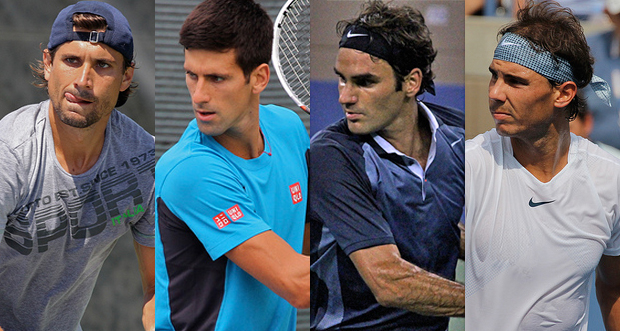
    Paris SF Rafa Roger Novak Ferrer

    Paris Masters, Quarterfinals

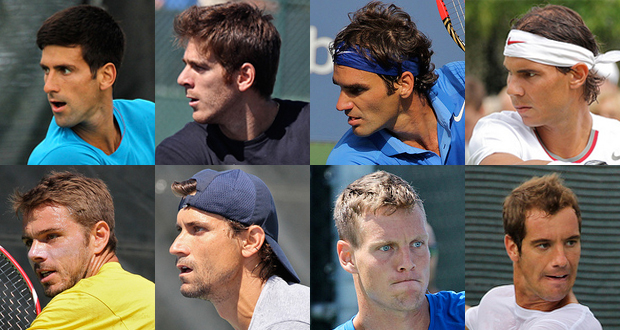
    It is rare at any level for the top eight seeds to populate the quarterfinal stage of a tournament, a result that was guaranteed the moment Rafael Nadal defeated Jerzy Janowicz in the last of the Paris Masters fourth round matches. At Masters level this hadn’t occurred in over four years. More intriguing still was the fact that the last eight men remaining at the Palais Omnisports de Paris-Bercy were the same eight who’ll descend upon London’s O2 Arena next week for the World Tour Finals.

    Apparently such a miracle has never happened before, although if it was going to, this was probably the year for it. Coming in to this week, three qualification spots remained open, meaning that a number of men had every reason not only to turn up but to give their best effort, which is precisely the kind of effort that can be lacking at this tournament. Added interest came in the form of Roger Federer, who was prominent among those yet to qualify. By winning his first round match against Kevin Anderson he took care of that, and yet another comfortable victory over Philipp Kohlschreiber saw him attain the quarterfinals. By joining him at that stage both Stanislas Wawrinka and Richard Gasquet ensured their spots in London as well, although whether they’ll do much more than make up the numbers is a nice question. The very best players seem uncharacteristically committed this year.

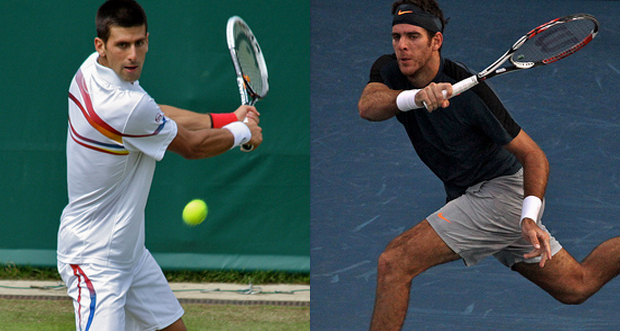
    Novak Djokovic lost to Sam Querrey in strange circumstances last year, withdrew the year before after proving he cannot lose to Viktor Troicki under any circumstances, and fared badly against Michael Llodra the year before that. Yet this week he has hardly looked like losing or withdrawing. Indeed, through the first set of his quarterfinal against Wawrinka he seemed reluctant to give up points. The Swiss had an early chance to recover an even earlier break, didn’t take it, and was reduced to spectating for the next twenty minutes. The second set was tighter, especially at the start, but Djokovic always had it well in hand.

    Nadal often doesn’t turn up in Paris at all, as a culmination of his disinclination to contest any of the other European indoor events that precede it. One can understand his disinterest, given that conditions don’t suit his game, and he hardly needs the points. He has won precisely one indoor hard-court title in his career (Madrid 2005). But in a season in which he cleaned up the American summer and went undefeated on hard courts until September, who is to say he cannot win the Paris Masters? Gasquet certainly had little say in the matter, thrashed four and one in just over an hour. There was a belief that the last three rounds in Bercy would provide a preview of what to expect in London. It seems that this is the case.

    Many are convinced Nadal will not only win Paris, but the World Tour Finals as well, thereby tripling his collection of indoor titles. One viewer took the trouble to email Sky Sports to that effect, adding, however, that she would be equally happy if Federer never won another match. Marcus Buckland and Barry Cowan professed themselves shocked by this, suggesting neither man spends much time on the internet, which is largely powered by schadenfreude and self-importance, and is thus self-sustaining. Wishing catastrophe on total strangers based on perceived minor transgressions is an even more popular online hobby than charmless grandiosity, though the two are easily combined.

    Cowan confessed he did not understand how anyone could actively dislike watching Federer play, even if for whatever reason you do not care for him off the court. Buckland invited the viewer to email in their reasons, which they naturally did. It turned out to be the usual tedious guff about arrogance and poor losing. Ho-hum. Cowan still didn’t get it. To his credit I’ll hazard that the reason for his confusion is that he fundamentally doesn’t grasp how many ostensible tennis fans are a fan of a particular player more than they’re a fan of the sport. For all Cowan’s manifold shortcomings as a commentator and a player, the fact that he was a professional sportsman means that only a tiny portion of his engagement with tennis concerns any particular player. For the fan who emailed in, and many others just like her, the opposite is true. Their approach to professional tennis is primarily concerned with the deification of their favourite player, and the revilement of whichever players they’ve been taught are diametrically opposed. You’ll observe that fanatics always reserve their unkindest hopes for rivals. No one wastes time wishing Ivo Karlovic never wins another match.

    It was another reminder, as if more were needed, that many sports fans are dullards who cannot function without a depressing little assortment of heroes and villains, and that these roles are by necessity cast within very tight parameters. Thus, say, the soft-spoken and sardonic Robin Soderling is a villain, held by some to be morally on par with Timothy McVeigh. The reality is that most of us encounter considerably worse people than any professional tennis player every time we leave the house, or even when we don’t. You can hear the squalid thoughts of the ethically bankrupt merely by switching on commercial radio, and after listening to many politicians speak you’ll want to take a dip in the septic tank just to feel comparatively clean. Remember the supposed falling out between Federer and Nadal at the beginning of last year over the ATP Player Council? I must have attended half a dozen more acrimonious meetings than that in the last month, and am daily obliged to shake hands with far bigger wankers than any man in the Top 10. As far as I can make out, and for all that it matters, all the top players seem like pretty nice people.

    The fan who’d emailed Sky Sports can’t have been happy with Cowan’s mystified response, and was surely brought to a high simmer by the subsequent coverage, which was unabashedly Federer-centric. “I’m not even looking at del Potro right now,” declared Andrew Castle in commentary as the second quarterfinal commenced, “All my focus is on Federer!” He went on to add that for him Federer was the story of the next twelve to eighteen months in men’s tennis, which seemed rather disrespectful to Philipp Kohlschreiber, who is poised to commence his audacious run to the No. 1 ranking. (Mark my words.) It was also somewhat disrespectful to del Potro, who has been in tremendous form of late, and will be a legitimate title-contender in London next week. He at least deserved a look-in.

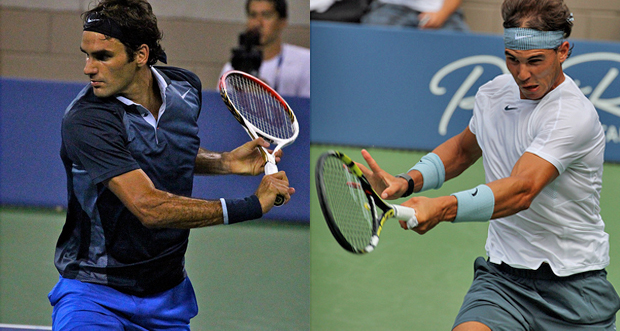
    It was clear as the first set proceeded that Federer wasn’t about to give him one. Federer was quite magnificent, hitting seventeen winners to just four errors and comprehensively shutting down the forecourt. It was almost enough to justify the presumption that Federer would was eager for another shot at del Potro so soon after the Basel final. His success against tall, powerful players traditionally entailed exploiting their lack of agility with constant variations of spin, width, and depth. Del Potro admittedly moves superbly for a man his height, but compelling him to lunge, dip, and pivot is still a wiser strategy than trying to trade lusty blows from the baseline. Federer’s first set was a testament to this: 47% of his backhands were slices, the kind of figure he used to post when dispatching the arch-villain Soderling. Unaccountably he went back to hitting over his backhand more in the second, although until 4-5 he remained untroubled on serve. Del Potro so far had had an awful day on return, but at this moment unleashed his biggest forehand, and subsequently broke to take the set. The third set was patchier, with a string of breaks each way. Federer steadied quicker, and eventually served it, to his evident relief and the visceral disgust of at least one fan. Del Potro didn’t appear particularly fazed. If anything he’d looked a trifle fatigued as the match wore on, and I imagine the longer rest will do him a power of good.

    Federer has now posted just his second win over a Top 10 player for the season, offset by five loses. Andrew Castle reminded viewers that by the end of next week he might conclude his season with a more respectable win-loss tally of 9:5, assuming he defeats Djokovic in the semifinals, Nadal (probably) in the final, then everyone in London. This seems rather a generous assumption to make, even by Castle’s standards. We were also reminded that Federer has now beaten at least one Top 5 opponent at least once in each of the last fifteen years. It seemed a strange point to belabour, since he is after all Roger Federer. He is not Philipp Kohlschreiber, although soon Philipp Kohlschreiber won’t be, either. Mark my words.
  • BNP Paribas Paris Masters Semifinals – Scores and Schedule of Play – Saturday, November 2

    BNP Paribas Paris Masters Semifinals – Scores and Schedule of Play – Saturday, November 2

    Order of Play – Saturday, November 2 (Scores added as known.)

    COURT CENTRAL — Not Before 2:30 P.M.

    [2] Novak Djokovic (SRB) d [5] Roger Federer (SUI) — 4-6, 6-3, 6-2

    Not Before 5:00 P.M.

    [3] David Ferrer (ESP) d [1] Rafael Nadal (ESP) — 6-3, 7-5

  • Goodbye Mr. Hyde, Welcome Back Roger Federer – 2013 Paris SF

    Goodbye Mr. Hyde, Welcome Back Roger Federer – 2013 Paris SF

    Masterclass Fed

    That Mr. Hyde impostor that we have seen most of the year in Roger Federer’s shoes appears to have finally departed.  Is it because Roger has finally overcome some of his physical problems with his back?  Did he simply need more practice and play without pain to raise his level?  Is it because he has returned from a mental vacation?  Has he found new motivation despite his countless accomplishments?  Did he need to dismiss Paul Annacone to find himself?  To play indoors again in Basel to find his game?  One doesn’t know for sure, but one hopes that Mr. Hyde is gone for a good while.

    The Juan Martin Del Potro-Roger Federer match today in the Paris-Bercy quarterfinal was played at a very good level throughout, a little higher level than last week’s Basel final, mostly because Federer played better tactically and executed well.

    Del Potro did well to hang in the first set as well as he did. I don’t think any player in the game would have stayed with Federer at that level he showed in the first set.  I think some of the best would have been served a bakery item.

    Del Potro upped his level a bit in the second and Federer’s level dropped a bit due to mostly tactical mistakes (not hitting enough slice and not moving Del Potro around enough horizontally and vertically as he had done in the first set), so it became a very even set. It probably should have gone to a tiebreak, but Federer’s level dipped a bit in his last service game and Del Potro continued to play well and snatched his opportunity to break Federer’s serve and win the second set with a flourish.

    The third set started with momentum on Del Potro’s side but he couldn’t cash in.  Federer stayed with him, then broke rather determinedly going back to his first set tactics, but then Del Potro put in a great effort to break back.  Then Federer broke Del Potro rather easily with a dip in level by Del Potro.  I think with that, Federer had his mental second wind, held serve, and Del Potro couldn’t recover his level and basically gave way in the final game.

    [divider]

    [#2] Novak Djokovic (SRB) vs. [#5] Roger Federer (SUI)

    Let’s see what level Roger Federer and Novak Djokovic bring to their next match. Djokovic looked in excellent form from the start vs. Stan Wawrinka, and then played well enough to finish it in two sets.  Federer had a chance to take his match with Juan Martin Del Potro in two sets, faltered a bit at the end of the second to lose it, but finished well to take it in three.  Will that blip cost him against Djokovic?

    Federer is playing well enough to beat Djokovic if he can stay at the level he had against Del Potro.  Djokovic doesn’t hit as brilliantly hard as Del Potro, but is more consistent.  So Federer mustn’t slip up against Djokovic as Djokovic will take any chance and run with it to the bank.

    Federer needs to use his good Djokovic tactics and execution to beat him.  Give Novak little rhythm, keeping points fairly short like he has done in many of his wins.  But he must choose good moments to create and execute his winning plays, not haphazardly rush his shots.  Djokovic, on the other hand, has to try to impose his game, and lure Federer into that metronome rallying game.  Federer will need a bit more patience against Djokovic, as Djokovic will get more balls into play with his ultimate retrieving game, but I don’t think Federer wants to get into long rallies and should go for the winner at the first good opportunity.

    The problem for Federer is that when Nole is on, he plays excellent defense, generally doesn’t send back too many short balls, and pins one at or behind the baseline.  Federer will need to vary his game, lure Djokovic to the net with some short slice to the mid-backhand side, but not necessarily wide.

    Against Djokovic, I believe one is better off hitting in the middle third of the court, width wise, and more right at him with depth a majority of the time, varied with slices inside the service line, and force him to use good footwork to get at the proper distance from the ball.  He often gets discombobulated balance wise more often when the balls are hit at him, whereas he may be the best player in the world when he is able to stretch far left or right for balls with his near elastic reach, as he seems either to slap them on the side lines at will, or defensively get the ball on or near the baseline almost every time.  Djokovic is not as good when he has to move vertically up and down the court – short slice and high mid-court lobs a bit behind him make him uncomfortable.

    Keys:  Variety and Explosiveness from Federer.  Consistency and Physicality from Djokovic.

    I’m pretty sure Novak Djokovic’s form his good enough to execute his plan if he gets the chance.

    The question mark for many is Roger Federer.  Is he close enough to the form that led him to convincing wins over Novak Djokovic at Cincinnati and Wimbledon in 2012, and Roland Garros in 2011?  Or will he be prone to what I call his “Mr. Hyde Performances” of 2013 and some of his other losses to Djokovic in the past two to three years?

    The one who can assert his game over the other should win.

    Good luck to both players.

    [divider]

    Discuss this article with fellow tennis fans in the tennis forums

    [divider]

  • Racquets: Wilson Six.One 95S

    Racquets: Wilson Six.One 95S

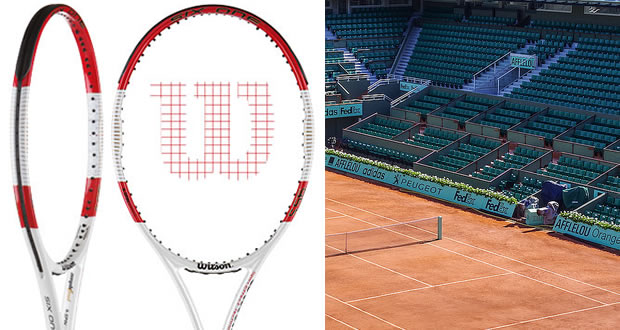
    WSO95-1The Wilson Six.One 95S is a new addition to the Six.One line of racquets that have been a popular choice among many players. The S in the Wilson Six.One 95S stands for the new Spin Effect Technology that has been added to this new racquet frame. This racquet has an 18 x 16 string pattern which is an extremely open string pattern.

    By having more main strings and less cross strings, Wilson says that players are to able apply more top spin on their shots, which will result in a projectile that explodes off the ground with extreme spin, driving opponents back. From the baseline, this racquet has a similar feel to the other Six.One racquet, and with the 6 points head light balance, players will find this racquet to be rather maneuverable and spin friendly. As a mid-11 ounce racquet, this is the answer to players wanting the Spin Effect Technology in a heavier frame as compared to the Steam 99 and 105s. Although this racquet has an extremely open string pattern, control is not an issue.

    The Parallel Drilling Technology that Wilson has incorporated will help dial in more control than an ordinary racquet with an extreme string pattern. Overall this will be a great racquet for the player wanting a spin-friendly racquet with enough heft behind it for extra stability.

    Recommended strings: Co-polyester strung at high forties to low fifties (e.g: Wilson Rip Spin, Luxilon ALU Power)

    Technologies

    Amplifeel: It works similar to the BLX technology. Basalt plates are placed on the handle of the racquet, which according to Wilson will filter out unwanted vibrations that will give players a uniquely pleasant feel when striking the ball.

    Spin Effect Technology: It utilizes extremely open string pattern. In this case, the Wilson Six.One 95S has a string pattern of 18 x 16, which is a relatively open string pattern. Open string pattern such as this will cause the ball to come off the string bed with more spin, as with a more open string pattern, the strings are given more freedom to move and snap back upon back impact.

    Parallel Drilling: Ensures a more consistent stringbed, and it also provides a larger sweet spot giving the player more forgiveness on off-center hits.

    Racket specifications

    Weight (unstrung) 309g/ 10.9 oz
    Head size 95 sq. inch
    Swing weight 317
    Stiffness 67
    balance 6 points head light
    Beam width 21.6mm/21.6mm/21.6mm
    String pattern 18 x 16
    Length 27 in. / 685mm


  • BNP Paribas Paris Masters Quarterfinals – Scores and Schedule of Play – Friday, November 1

    BNP Paribas Paris Masters Quarterfinals – Scores and Schedule of Play – Friday, November 1

    Paris Friday

    Order of Play – Friday, November 1 (Scores added as known.)

    COURT CENTRAL — Start 2:00 P.M.

    [2] Novak Djokovic (SRB) d [7] Stanislas Wawrinka (SUI) — 6-1, 6-4

    [5] Roger Federer (SUI) d [4] Juan Martin Del Potro (ARG) — 6-3, 4-6, 6-3

    Not Before 7:30 P.M.

    [1] Rafael Nadal (ESP) d [9] Richard Gasquet (FRA) — 6-4, 6-1

    Not Before 8:30 P.M.

    [3] David Ferrer (ESP) d [6] Tomas Berdych (CZE) — 4-6, 7-5, 6-3

  • BNP Paribas Paris Masters – Scores and Schedule of Play – Thursday, October 31

    BNP Paribas Paris Masters – Scores and Schedule of Play – Thursday, October 31

    Paris Thursday

    Order of Play – Thursday, October 31 (Scores added as known.)

    COURT CENTRAL — Start 10:30 A.M.

    [7] Stanislas Wawrinka (SUI) d [12] Nicolas Almagro (ESP) — 6-3, 6-2

    [3] David Ferrer (ESP) d [15] Gilles Simon (FRA) — 6-2, 6-3

    [2] Novak Djokovic (SRB) d [13] John Isner (USA) — 6-7(5), 6-1, 6-2

    Roger Federer (SUI) d Philipp Kohlschreiber (GER) — 6-3, 6-4

    Not Before 7:30 P.M.

    [9] Richard Gasquet (FRA) d Kei Nishikori (JPN) — 6-3, 6-2

    Not Before 8:30 P.M.

    [1] Rafael Nadal (ESP) d [14] Jerzy Janowicz (POL) — 7-5, 6-4

    [divider]

    COURT 1 — Not Before 2:30 P.M.

    [4] Juan Martin Del Potro (ARG) d Grigor Dimitrov (BUL) — 3-6, 6-3, 6-4

    Not Before 4:30 P.M.

    Tomas Berdych (CZE) d Milos Raonic (CAN) — 7-6(13), 6-4

    [divider]

    Cover Photo (Creative Commons License): Marianne Bevis

  • BNP Paribas Paris Masters – Scores and Schedule of Play – Wednesday, October 30

    BNP Paribas Paris Masters – Scores and Schedule of Play – Wednesday, October 30

    Paris Wednesday

    Order of Play – Wednesday, October 30 (Scores added as known.)

    COURT CENTRAL — Start 10:30 A.M.

    [3] David Ferrer (ESP) d Lukas Rosol (CZE) — 6-0, 2-6, 6-3

    [15] Gilles Simon (FRA) d [WC] Nicolas Mahut (FRA) — 6-4, 6-7(5), 7-6(3)

    [4] Juan Martin Del Potro (ARG) d Marin Cilic (CRO) — 6-4, 7-6(3)

    [1] Rafael Nadal (ESP) d Marcel Granollers (ESP) — 7-5, 7-5

    Not Before 7:30 P.M.

    [5] Roger Federer (SUI) d Kevin Anderson (RSA) — 6-4, 6-4

    Not Before 8:30 P.M.

    [10] Milos Raonic (CAN) d [Q] Robin Haase (NED) — 6-3, 6-4

    [divider]

    COURT 1 — Start 11:00 A.M.

    [13] John Isner (USA) d [Q] Michal Przysiezny (POL) — 7-6(3), 4-6, 6-3

    [12] Nicolas Almagro (ESP) d Ivan Dodig (CRO) — 6-4, 6-3

    [7] Stanislas Wawrinka (SUI) d Feliciano Lopez (ESP) — 6-3, 3-6, 6-3

    Grigor Dimitrov (BUL) d [16] Fabio Fognini (ITA) — 6-3, 5-7, 6-2

    Philipp Kohlschreiber (GER) d [11] Tommy Haas (GER) — 6-2, 6-2

    [6] Tomas Berdych (CZE) d [LL] Pablo Andujar (ESP) — 6-2, 7-5

    [divider]

    Cover Photo (Creative Commons License): Marianne Bevis

  • War and Peace: Victoria Azarenka

    War and Peace: Victoria Azarenka

    By Stefan Wagner

    Photographs by Greg Funnell

    Reprinted with permission from The Red Bulletinredbull-com-logo 80

    [divider]

    VictoriaAzarenka_MG_0675

    The moment that reveals the most about Victoria Azarenka—over $20 million in prize money, the loudest scream in professional sports, girlfriend to the bizarre entertainer Redfoo—is this: Late Sunday morning, two bumpy hours by car outside the capital Minsk, in a holiday home that looks like a UFO damaged on crash-landing in the Belarusian forest, Victoria Azarenka is shuffling across the lobby, leading an older lady by the hand. This is her grandmother. For more than 50 years she worked as a kindergarten teacher, starting work at 5 o’clock in the morning. These days she comes here twice a year for three weeks’ rest.

    She only found out yesterday that her granddaughter was coming to visit, and she hurried to get some grapes and white chocolate. The old lady walks with a stoop. “Slowly, Babushka, slowly,” her granddaughter is saying. “We’ve got all the time in the world.”

    Victoria Azarenka’s racket is indistinguishable from those used on the men’s circuit: Grip size four, wrapped in a sweat-absorbing band, it handles like a birch sapling. Wilson delivers her rackets with a cup per Grand Slam title engraved on the inner rim. Her racket has been adorned with two cups since January, when she defended her Australian Open title and reclaimed the top spot in women’s tennis, ahead of Serena Williams and Maria Sharapova.

    VictoriaAzarenka_MG_4406

    The roles in the three-way bout for No. 1 are evenly distributed.

    There’s Williams, who has 16 Grand Slam titles to her name, and recently turned 31—she’s the grande dame of world tennis. Then there’s Sharapova, who transformed the women’s circuit into a catwalk and has been the best-paid female sports star in the world for the last eight years.

    And Victoria Azarenka? Victoria Azarenka wins. Has won, in fact, 28 out of 31 matches since the beginning of the year; injury forced her to withdraw from Wimbledon in the second round.

    Victoria Azarenka—Victoria as in “victory,” a name her parents consciously chose in 1989. Back then Belarus was still part of the Soviet Union. “There were six of us living in a small apartment, my brother and I, parents, grandparents. My father had two jobs, my grandmother would go to work at 5 o’clock in the morning, my mother worked until late at night—all so I could have the opportunity to play tennis.”

    Azarenka was 9 when her first coach gave her children’s tennis group the challenge of hitting a ball 1,000 times perfectly against the wall. The number was utterly unrealistic; the trainer simply wanted to know how her junior charges handled impossible tasks. Azarenka hit the ball 1,460 times.

    VictoriaAzarenka_MG_0596

    At 13 she won her first tournament in Uzbekistan, on the international under-18s’ circuit; there were no opponents left to conquer in Belarus. A year later, when she was already training in a camp in Marbella, Spain, she broke through to the women’s circuit. Kristin Haider-Maurer, an ex-pro who played against the 14-year-old at a minor tournament in Croatia, recalls a “complete beast who didn’t surrender a single ball, extremely ambitious, tenacious.” The more experienced Haider-Maurer was leading 3-0; Azarenka cried when they swapped sides. Then she emitted a scream of pure rage and ceded just one more game to her opponent, four years her senior: 6-4, 6-0.

    Sam Sumyk, a Frenchman possessed of an imperturbable serenity, has been Azarenka’s trainer for the last three years. When asked what it is that makes Azarenka No. 1 in the world-—her backhand perhaps?—he shakes his head. “It’s her professionalism that makes the difference. It’s fascinating how determined she is to sacrifice everything to success.”

    At the Australian Open they measured the volume of her screams whenever she hit the ball. It was just over 100 decibels. The threshold of pain for the human ear is 110 decibels.

    VictoriaAzarenka_MG_0565

    Some journalists are calling for a change in the regulations to stop female tennis players from screaming; Azarenka and Sharapova come in for particularly harsh criticism.

    “It’s unfair,” says one of Azarenka’s main rivals, Poland’s Agnieszka Radwanska. “It ruins the game,” says tennis legend Martina Navratilova. But for Azarenka: “It’s part of my game.”

    It’s early April and winter still has Minsk in its grip. Azarenka shouldn’t be here at all right now, but rather in Miami, where the world’s fifth-largest tennis tournament is taking place. Or in Arizona, where she moved at age 15 to live with the family of Russian NHL goalie Nikolai Khabibulin, who financed her training in the U.S. Or at least in Monte Carlo, where she has an apartment. But after she sustained an ankle injury in Indian Wells in March, she decided she wanted to recuperate at home, “and home will always be Minsk.” Convalescence combined with a family visit and training camp: Even when you spare an ankle, there are plenty of body parts left to torture.

    As Azarenka relaxes with some yoga in a gym in Belarus’s National Tennis Center, her coach Sumyk, agent Meilen Tu, physical therapist Per Bastholt, and fitness trainer Mike Guevara sip coffee outside the door. The top-flight entourage of a multimillion-dollar international star—two Americans, a Dane, and a Frenchman—presents a striking contrast to the surroundings: greenish neon light, worn floor, shabby ceiling panels, and faded black-and-white photos of Soviet tennis pioneers on the walls.

    VictoriaAzarenka_MG_4248

    Some parts of the National Tennis Center have been refurbished in the last 15 years; the courts have been modernized and windows insulated so you no longer have to scratch frost off from the inside. But the changing rooms, the corridors, the gyms—they still look the same as they did when the 7-year-old Vika encountered them for the first time. Her mother, Alla, had just started a new job, sitting at a glass booth in the reception area from 8 o’clock in the morning to 10 at night.

    On her first day at work Alla handed little Vika a racket. (Azarenka recalls an early Prince aluminum racket, a model that even some adults have difficulty handling. Does she still have it? “No. I was a crazy kid. I’m sure I smashed it up out of anger.”) Vika discovered a kind of gymnasium in the basement, with horizontal stripes on the walls and colorful lines on the floor. And for two years, day after day after day, she would hit tennis balls at that wall until her mother came to pick her up.

    No sooner has the international star finished yoga than Guevara is expecting her for an endurance session on the ergometer. To ensure they remain undisturbed, Guevara has dragged the machine to a dingy room at the end of a dark corridor. Azarenka laughs as she enters the room. She points to the wall: “That was my net.” And indicating a few colored lines on the floor, she says, “That was my center court.”

    VictoriaAzarenka_MG_0111

    The charms of Azarenka’s homeland are slow to reveal themselves. Belarus is located between Poland and Russia, between the Baltic states and Ukraine, and has just under 9.5 million inhabitants. The political power structures are just a little too entrenched to duck the description “dictatorial”: 2014 will mark President Lukashenko’s 20th year in power. The country’s favored foreign partners are Russia, Iran, and Venezuela.

    The soldiers you see around Minsk all wear comically outsized caps, and you almost feel that it is the effort of keeping the enormous things on their heads that gives these officers their slightly swaying, officious gait. It’s a cheerful image that stands in contrast to the kind of relations between authority figures and average citizens that ordinarily prevail here, which are rarely distinguished by humor. You can recognize an experienced Belarusian driver, for instance, by the webcam positioned behind the windshield and pointed in the direction of travel; they’re designed to document excessively arbitrary exercises of power, if not prevent them altogether. At intersections, large-format billboards depict a man lying in bed smoking, the image struck through with a thick red line: Smoking and drunk in bed is a popular cause of death in Minsk. The billboard is rendered in the kind of rudimentary pictograms used to denote Olympic sports, as if drunkenly smoking in bed were a Belarusian Olympic discipline.

    Belarusians generally avoid subjects like politics and social issues—call it post-Soviet fatalism. But they love talking about their land, the people, the traditions, the culture. Belarusian patriotism is proud, peppy, and omnipresent.

    VictoriaAzarenka_MG_4252

    Azarenka, for example, loves talking about fellow Belarusian athletes. Natalia Zvereva, for instance, who represented the Soviet Union at the 1988 French Open and made it to the finals; Max Mirnyi, a world-class doubles player; and world champion biathlete Darya Domracheva (“she’s incredible.”)

    Azarenka is also happy to discuss her role as a national heroine, a job she interprets in a very straightforward manner. When she drives through Minsk in her burgundy Porsche Cayenne, for instance, she isn’t saying: I’m better than you. Rather she’s saying: I am one of you, look at what I’ve achieved—and you can, too. “I would like to help raise the self-confidence of people here,” she says.

    And she’s particularly eager to talk about Ulyana Grib, 13, and Ekaterina Grib, who’s 12. They train in the same tennis center in which Azarenka grew up. “They could be very, very good,” says Azarenka. How good is very, very good? “They have something that is extremely rare. When I asked them what their dream was, they were shy and hesitant at first. And then they said: ‘Please don’t get mad, but we want to be better than you.’ That’s when I knew: I want to help these girls.”

    When she received a bonus for winning Olympic medals in London—bronze in singles, gold in the doubles along with Mirnyi—she sent the money to the young girls to help cover travel costs. She also trains with them, checks in on their progress by text, encourages them, cautions them, shares tips with them.

    VictoriaAzarenka_MG_3423

    “In Belarusian culture there are three basic rules,” says Azarenka. “You can’t understand us until you understand our rules. Number 1: Your family is sacred. Number 2: Do everything for the children. And the most important rule: Respect your elders.”

    In spring 2011, after Azarenka had already slugged her way to a spot on the fringes of the world elite, she lost her passion for tennis. “Training, torturing myself to fight for a tennis ball like I was fighting for my life: I didn’t want it anymore. I wanted to do something different. I asked my grandmother for advice. She listened to me, nodded, smiled, and said, ‘You have to find the thing which makes you happy. And then you have to keep doing that thing even when you’re just not in the mood.” That’s all she said. I went home, gave it some thought, and the next day I started training again.”

    Nine months later, Azarenka won the Australian Open and reached No.1 in the world rankings.

    Sunday afternoon back in the careworn UFO deep in the Belarusian forest. Inside the small holiday apartment, Azarenka sits next to her grandmother on the sofa; on the table in front of them are grapes, white chocolate, and Tolstoy’s War and Peace—grandmother’s holiday reading.

    VictoriaAzarenka_MG_0291

    War and peace: Which one is the real Victoria Azarenka?

    “There’s only one. She has two sides. If you want to win you have to fight. Don’t show weakness, don’t go soft, don’t be sensitive. Otherwise your opponent will use it to her advantage. During a match I’m a warrior.”

    How does one switch between war and peace?

    “It’s natural, like the lioness who goes out and fights. She will kill if she has to, but to her offspring she is the most loving mother imaginable. That’s life.”

    It’s Sunday afternoon and Victoria Azarenka is eating grapes and stroking her grandmother’s hand. As soon as her ankle will support her, she’ll go back out, scream to the threshold of pain with every stroke, and run down the tennis ball as if it were a matter of life and death.

  • Nature’s Eternal Wonder

    Nature’s Eternal Wonder

    Valencia Youzhny

    Basel, Final

    (1) Del Potro d. (3) Federer, 7-6(3), 2-6, 6-4

    Roger Federer this afternoon enjoyed the unusual sensation of entering Basel’s St. Jakobshalle as the underdog, although perhaps “enjoyed” isn’t the word. In truth he probably enjoyed it about as much as the Swiss crowd, which for the better part of a decade had been sustained on easy brilliance, but must now seek additional nourishment in hope, a notoriously fickle dietary supplement. It has been that kind of season, and in Juan Martin del Potro he was facing a fine player who has transformed himself into a fearsome contender on every surface, roofed or not.

    Last year in Basel Federer performed about as patchily as he has this year, and eventually fell to del Potro in a reasonable three-set final. At that time he was the world No. 1, and all the commentary centred on his doomed bid to retain his ranking until the end of the year. His return to No. 1 had been masterful, and apparently entailed visiting an unusual number of dispiriting losses on del Potro, indeed rather more than seemed necessary. As a consequence, Federer was still the strong favourite for last year’s final. This year he certainly wasn’t. Before the final, he hadn’t defeated another member of the Top 10 since the quarterfinal of the Australian Open, and was now ranked lower than del Potro. After the final, both those facts are still true. The interest this year lies in wondering whether he will qualify for the World Tour Finals, an event he has won six times. Sky Sports’ resident math-whiz Barry Cowan has run the sums, and reassured us that Federer will be there. Even so, it has, to put it mildly, been a horrible season.

    Even that is misleading, though, since the concept of a single season in professional tennis is mostly meaningless. The suggestion that Federer is having a bad season glosses over the reality that he has been playing quite poorly for much longer than that. In fact, though I might be courting a measure of disapproval by saying so, I don’t think he has looked truly impressive since last year’s Olympics. This may seem a contentious point, given that soon after the Games he claimed the Cincinnati Masters without dropping serve, bagelling Novak Djokovic in the final. To the already potent mixture of injury and slumping form, one cannot help but add the question of desire. Overall, his hunger no doubt remains as undiminished as he insists when asked, but at those crucial moments in important matches when every choice must be razor sharp and execution flawless, his instinct lately seems blunted, the old audacity dulled. Perhaps it is merely an issue of confidence, the least tangible casualty of injury and prolonged poor form, and always the last to recover.

    Still, Federer looked amply committed today, and wasn’t all that far from winning, and far from sanguine when he didn’t. It was a decent final, and tangentially diverting for how the shape of the whole match was thoughtfully captured in the first set, the way a tree’s form is reprised in each leaf, or the entire idiocy of pop culture is present in a single Kardashian. Nature’s wonder truly is eternal. Anyway, both players looked good early, before del Potro broke and moved ahead, but was broken back to love as he served for the first set. They reached a tiebreak, and Federer’s level plummeted while the Argentine’s didn’t. Federer stormed back in the second, as del Potro conducted an ill-conceived experiment to ascertain how well he’d do without a first serve. Not very well, it turned out.

    Having satisfied himself of this, he set about proving the corollary in the third set, winning sixteen of the seventeen first serves he put into play. On the slick Basel court, this rendered him all but unbreakable. If only Federer had been. Alas, the key moment came early in the set, as Federer forwent several chances of maintaining his second set momentum, and was laboriously broken. His only opportunity to break back came immediately, but del Potro held steady when it counted. The rest of the match turned out to be a long coda. Del Potro, afterwards, was ecstatic. Look for him in Paris, and London. Look for Federer, too.

    [divider]

    Valencia, Final

    Youzhny d. (1) Ferrer, 6-3, 7-5

    Mikhail Youzhny won’t feature in London, although by claiming the title in Valencia a short while later he has reinserted himself back into the Top 20, displacing a few others, and settling at No. 15. Ferrer, meanwhile, will be in London, since despite losing today he remains comfortable at world No. 3. I cannot help but think this lofty position does not reflect his current form.

    Unlike Federer, the last twelve months have been the finest of Ferrer’s career, including a maiden Masters title, a Roland Garros final, and a career-high ranking. Again I’ll court perversity, this time by arguing that Ferrer has achieved these results in spite of his form and not because of it. If anything this renders his achievement greater still, although I also suspect he has enjoyed a healthy slice of luck, which at the right dosage is hard to gainsay. Consider this: he won the Bercy title last year without playing a match in which he was not the clear favourite, which is a pretty unlikely scenario when you think about it. He reached the Australian Open semifinal only by the grace of Nicolas Almagro’s brain, while the Jo-Wilfried Tsonga whom Ferrer encountered in the Roland Garros semifinal was a mere shade of the majestic Frenchman who’d trounced Federer the round before. A similar case can be made for Ferrer’s run to the Miami final. I’m not one of those who take pleasure in deriding Ferrer. He’s likeable, is rightly commended for the extent to which he maximises his gifts, and all any player can do is take advantage of situations that fall his way. But I do think he was a much better player last year.

    That being said, I also thought he would beat Youzhny in the Valencia final. For all that victories over Almagro shouldn’t be considered a form guide for anything – even allowing for the degree to which match-ups between compatriots can go haywire – it seemed that Ferrer’s inherent advantages over Youzhny would only be rendered overwhelming by the environment. People euphemistically call Basel Federer’s court, but Valencia really is Ferrer’s court. He co-owns the event, which is staged in the Agora, an attractively stylised bone-cathedral that helps it feel like a novelty level from Topspin 4. One presumes Ferrer’s interests are at least partly responsible for the chemical miracle of Valencia’s surface, so far the world’s most successful attempt at rendering molasses into so striking a shade of cobalt. Unlike Stockholm where the court rewards excellent value for shots, a fact Grigor Dimitrov eventually exploited by hitting a few of his in, the Valencia surface is notoriously difficult to penetrate. Like Ferrer, this court is built for retrieval. For an aggressive yet self-destructive player like Youzhny, whose passage through the draw had mostly entailed outlasting even flakier men than himself, it was a tough proposition.

    However, while I maintain that there’s more that can go wrong with an attacking game than a defensive one, Ferrer this year is living proof that inherently defensive tennis still requires more than a pair of legs. He remains as quick as ever, but his retrieving lately has been nowhere near as accomplished as one might expect. Youzhny was superb, bold from the very beginning, from all parts of the court, varied in his approach, and fearless when pressed. Once he finds his groove there are few players more attractive, although his recurrent issue is that he can be de-grooved so readily by a really tenacious opponent. Often the one extra shot is one too many, but today Ferrer only sporadically forced the Russian to come up with it.

    There was a brief period in the second set when it felt like Ferrer would tear the match away. Youzhny could barely win a point, the local crowd found its voice as their man pulled ahead. But Ferrer’s momentum mysteriously flagged, and a poor service game saw him repeatedly out-rallied and broken back. Soon he was broken again, and Youzhny stepped up to serve for the title, after spending a precious minute pre-visualising it under his towel at the changeover. I cannot say whether it went as he’d planned, but it went as well as he could have hoped. His backhand up the line is unorthodox and beautiful, and today it was instrumental. The last point was thus an appropriate summary: Youzhny launched an attack, Ferrer scrambled desperately, and finally managed to get the ball safely up high to the Russian’s single-hander. The Russian, despite many excellent reasons to grow timid, launched a fearless backhand up the line. Ferrer could reach it, but not control it, and that was the match. Youzhny’s smile afterwards as he saluted the Valencia crowd – far more civilised than Madrid’s – was immense, but exceeded easily by that of his coach. Boris Sobkin doesn’t smile often, but it’s always worth the wait.

    Cover Photo (Creative Commons License): Marianne Bevis

  • Youzhny Reigns in Spain, Wins Valencia Open 500

    Youzhny Reigns in Spain, Wins Valencia Open 500

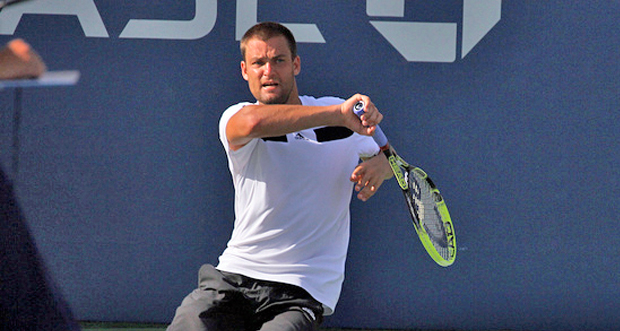
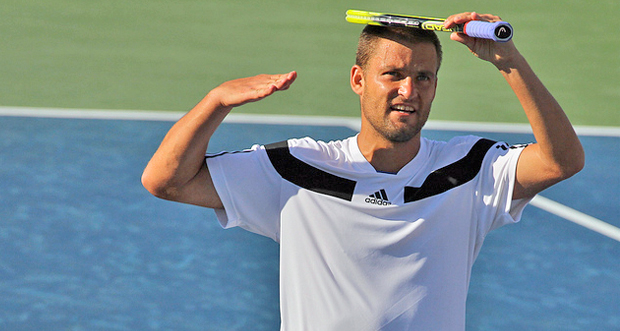
    Mikhail Youzhny

    In a battle of the 31-year-olds, Russian Mikhail Youzhny, ranked No. 15 in the world, overcame local boy David Ferrer, world No. 3, to snag a surprising, and surprisingly dominant win over the three-time previous winner by a score of 6-3, 7-5.  The win gave Youzhny his tenth career title, and only his second at the ATP 500 level, and his second of the season, having also won in Gstaad.  2013 has been something of a renaissance for the Russian, who was ranked as high as No. 8 in 2010, but has slumped around the 20-30s for the past couple of years.

    Ferrer had been having a very fine week, and was doing away handily with most of all comers.  However, he encountered a very motivated Youzhny today and failed to find the answers.

    “It was a great week for me and a great tournament,” Youzhny said. “It was a great atmosphere. I felt nobody was against me, of course they were for David, but when I played well they applauded me.”

    [divider]

    Photo credit:  Marianne Bevis  (Creative Commons License)