Blog

  • Nadal Wins Inaugural Rio Open 500

    Nadal Wins Inaugural Rio Open 500

    Rafael Nadal

    Everything old is new again. As Rio de Janeiro brings ATP 500 tennis back to the Carioca city, Rafael Nadal defeated Alexandr Dolgopolov of the Ukraine, 6-3, 7-6(3) in the inaugural Rio Open. The old was Nadal winning on clay. The new was the tournament, and the renewed play by Dolgopolov of the Ukraine, who has been a rising star, though with troubles along the way.

    The Ukrainian upset David Ferrer and Nicolas Almagro to get to the final. His quirky style of play may have been recently served by joining forces with another “eccentric” player, Fabrice Santoro, the Frenchman who is also known as “The Magician.”  It seems a coaching choice made in heaven. A Kiev native, Dolgopolov wore a black ribbon on his chest, and spoke in his final remarks of the struggles of the people in his country, to sustained applause. Brazil has also suffered unrest in recent months.

    For Nadal, it was his 62nd title, his 43rd on clay. After a huge battle with Pablo Andujar in the semifinals yesterday, it was not completely clear that Nadal would win today. But some things never change. Nadal wins again on clay, but Dolgopolov comes out of it with renewed encouragement.

    [divider]

    In the women’s final, Kurumi Nara defeated the No. 1 seed, Klara Zakopalova, 6-1, 4-6, 6-1.  It was the first WTA title for the 22-year-old Japanese player.

    [divider]

    Cover Photo (Creative Commons License): Marianne Bevis

  • So Many Yangs

    So Many Yangs

    Ernests Gulbis

    Marseilles, Final

    (3) Gulbis d. (2) Tsonga, 7-6(5), 6-4

    It is a strange quirk that Ernests Gulbis, that least reliable of professional tennis players, somehow boasts a perfect record in tour finals, a record he kept intact today in Marseille. He has now won five ATP titles without losing one, a kind of scruffy yin to so many proven yangs, such as Gael Monfils or Julien Benneteau. Gulbis didn’t get to play either Monfils or Benneteau this week, though that wasn’t his fault, since the former wasn’t here and the latter was defeated early on in another part of the draw. As the truism goes, you don’t get to choose which Frenchmen you face in tennis. You can only defeat the ones who are placed in front of you.

    It was, fittingly, a non-Frenchman Gulbis struggled with. His toughest test came against Roberto Bautista Agut in the second round, although this wasn’t strictly a surprise. (The surprise was that having eluded defeat the Latvian went on winning.) Bautista Agut has distinguished himself this season with several scrapping, aggressive, and defiant efforts, though this week he also distinguished himself by being just about the only Spanish man with a tennis racquet who didn’t show up in Rio. Consider this: there were more Spaniards in Rafael Nadal’s half of the Rio draw than there were Frenchmen in the entire Marseille draw. Once Gulbis had survived that early round struggle, he set about beating any locals he could lay his hands on, starting with Nicolas Mahut, continuing with Richard Gasquet, and concluding today with Jo-Wilfried Tsonga.

    It wasn’t a particularly exciting final as these things are measured, and certainly not compared to last year’s decider between Tsonga and Tomas Berdych. As you’d imagine when two big men face each other on a fast indoor court, the service dominated, though better returning would have helped it dominate less. Gulbis had not been broken since the second round, and Tsonga today could engineer only two opportunities, which he characteristically flubbed. Gulbis, on the other hand, was in plenty of the Frenchman’s service games, although he was no more effective at converting break points, ending the match with a rather  memorable 1/11. The Frenchman generally saved them with muscular play, and managed to do the same with a few match points in the second tiebreak. Gulbis served it out with an ace, before commencing a victory routine from which he’d carefully expunged any trace of exaltation. It made Marat Safin’s celebrations look flamboyant by comparison. You’d think Gulbis wins these things every other week.

    Actually, that’s not far off. He usually wins these things in this week every other year. Last year he won Delray Beach as a qualifier, and his maiden title came at that tournament in 2010. It may seem surprising that he hasn’t returned to Florida this year, but his failure to show up for title defences is another of the few infuriatingly consistent things about him. So far in his career he has never once graced a tournament the year after he has won it. Look for him in Rio next year, or at least anywhere but Marseille.

    Rio de Janeiro, Final

    (1) Nadal d. Dolgopolov, 6-3, 7-6(3)

    Owing to a minor calendar shake-up, Nadal will next week find himself in the rare position of having two titles to defend, in Acapulco and Sao Paulo. Taking a leaf from Gulbis’ playbook, he has chosen to skip both, preferring instead to win this week’s inaugural Rio event. After all, opportunities to be the first name on a new trophy don’t come round every week, presuming there’s a trophy upon which names can be inscribed.

    Nadal almost surprised us all by not winning the tournament, though got there in the end. The direst moment came against Pablo Andujar in the semifinal, a match that saw the world No. 1 recover from a set down, and finally take it in a mighty third set tiebreak, saving a pair of match points along the way. For once the bromidic phrase “he found a way to win,” usually uttered at the first faint whiff of adversity, was actually merited. Usually the way he finds entails being better at tennis than his opponent, but against an inspired Andujar there were stretches of the match in which Nadal was emphatically outplayed. Indeed, Andujar won more points overall. Alas for him, he lacked either the savagery or the cold precision necessary to claim the points that mattered most. He has thus been relegated to a statistical anomaly – this was the first time Nadal has won from match point down since beating Troicki in Tokyo in 2010.

    Alex Dolgopolov’s half of the Rio draw had, for a wonder, boasted only two Spaniards, but they were two of the toughest in David Ferrer and Nicolas Almagro, although the latter has lately learned to be as disappointing on South American clay as he perennially is on the European variety. Throw in Fabio Fognini, and plenty of reasons to be distracted by events back home, and Dolgopolov’s run to the Rio final proved to be a minor masterpiece of tightrope-sprinting. He’d been marvellous, in his dicey weird way. I wouldn’t go so far as to say that there’s no better player to watch when he’s on. Indeed, to say that would be to confess to fetishism. He has a game only a mother could love, but there’s no denying the excitement he delivers, especially for those of us drawn to unpredictable, aggressive tennis.

    Regardless, the betting markets, history, and the general opinion of the person on the street were unanimous in believing that it wouldn’t be enough to get by Nadal in the final. The only exceptions were those subsets of Nadal fandom which insisted that Nadal’s flat performance against Andujar would be sustained into the final: a passionately misguided belief in Nadal’s frangibility has meant some fans fail to absorb the lesson that he very rarely plays badly, and almost never plays badly twice in a row. As ever with Dolgopolov the interest lay in discovering whether the strobes of brilliance could be spaced with sufficient proximity so as to provide consistent luminescence. So far this week they had. His only real chance for the final, however, was to hope they joined up to form a band of light so incandescent it might sear the retinas from Nadal’s head. Dolgopolov lacks anything resembling a bread-and-butter game. Whether through technique or temperament, he appears incapable of sustaining discernible, or at any rate reliable, patterns of play. He is hell to play when he’s playing well. The trick, as far as I can tell, is to force him to have to play well or else, thus ensuring that he probably won’t.

    Nadal, as ever, had the luxury of being able to achieve this by deploying any number of established patterns, knowing that most, if not all, of these would likely guarantee him victory. Today’s patterns involved nothing fancier than the judicious application of just enough pressure to provoke Dolgopolov into over-hitting. This was particularly apparent in the first set, in which Nadal himself hit only one winner, which was the ace he served to seal it. The Spaniard broke early in the second set (as he had in the first), and looked likely to coast it out. Dolgopolov, after all, had not broken Nadal, not merely in this match, but in any of the four other matches they’ve contested.

    It therefore came as something of a surprise when an apparently nervous Nadal lost his way while trying to serve it out at 5-4, the break sealed with yet another scything Dolgopolov crosscourt backhand into the top seed’s forehand corner. I recall how effective this tactic was for Troicki in Tokyo three years ago, thus providing a lesson that Novak Djokovic subsequently learned by rote. You can go crosscourt to Nadal’s forehand, but you have to take the ball very early, and go there flat and with tremendous pace. Dolgopolov went there time and again today with great success, but it’s a dicey way to live, especially on clay, where Nadal is inexorable. He was certainly inexorable in the eventual tiebreak, and Dolgopolov proved all over again that risky tennis only looks good when it comes off. The flashes of light were now spaced too far apart, and soon they went out entirely.

    Nadal won’t be the last Rio champion, but he’ll always be the first. The trophy, worthy of a European indoor event in its determination to reference anything but a trophy, was handed over by the universally beloved Gustavo Kuerten. It’s a kind of lattice-worked wave arrangement, and thus provided plenty of spots for Nadal’s teeth to find purchase. (Marseille, ironically, has a perfectly ordinary trophy, which Gulbis did not bite.) Both men brought up Ukraine’s current situation in their speeches, Nadal graciously and Dolgopolov with all his heart.

    [divider]

    Cover Photo (Creative Commons License): Marianne Bevis
  • Venus Still Formidable in Dubai

    Venus Still Formidable in Dubai

    Venus Williams

    Venus Williams won her 45th title today, defeating  France’s Alize Cornet, 6-3, 6-0, in the Dubai Open. Williams, 33 years old, hadn’t won a title in 16 months. Her recent battles with illness, and her age, have put her career in question. However, the seven-time Grand Slam Champion and former world No. 1 put all of her skills on display today. The French woman, Cornet, who was the vanquisher of Venus’s sister yesterday, had little answer to the big serving American, who was having a very strong day.

    Cornet scored the upset and was the surprise finalist over world No. 1 Serena Williams. As Venus said, “I was expecting to be playing Serena, but Alize played an amazing game in the semis, so congratulations on that.”

    Venus staved off retirement questions for another tournament, and proved she still has more than a little game.

    [divider]

    Cover Photo (Creative Commons License): Marianne Bevis

  • Giants of Serve Do Battle at Delray Beach

    Giants of Serve Do Battle at Delray Beach

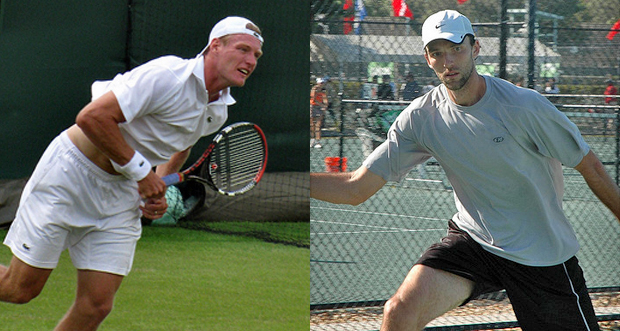
    Sam Groth Ivo Karlovic

    In a meeting between two of professional tennis’s giants of serve, Ivo Karlović, of Croatia, defeated the Australian Sam Groth 7-6(4), 6-3 in the first round of the Delray Beach Open.

    It was the first encounter between the two men, who stand 6 ft. 10 and 6 ft. 4, respectively. And it was probably the most unique of the first-round matches in Las Vegas, not only for the serve-and-volley style that both players employed, but for the fact that Groth was the first man to surpass the Croatian’s record for biggest serve in a professional tournament in 2012.

    Although the ATP doesn’t officially recognize serve speed records because of the diversity of radar equipment used on the tour, the Australian earned the unofficial honor at a Challenger event in Busan, South Korea, in 2012. In his second-round match against Uladzimir Ignatik, Groth blasted a 163.7 mph serve to break Karlović’s earlier record of 156 mph registered at the 2011 Davis Cup.

    Since then, the Croat’s prior record has been equaled or bested by two others. But it was that first record-breaker from Groth that was the more interesting because of the discourse that ensued. Legendary former player and coach Paul Annacone jumped in, saying, “I can’t believe it. I’ve seen Groth play. I haven’t seen him play in a year, but I’ve seen him. It’s got to be the radar gun.” Fellow big server Milos Raonic added that readings do vary depending on the tournament and location, though in the end he believed players cared little about the actual figures.

    Interestingly enough, the technology used at the Busan tournament, FlightScope, is the same implemented at many ATP World Tour events. A representative from the company verified that the reading was accurate.

    In Grand Slam tournaments, IBM provides the radar guns used to measure serve speed. For those who doubted Groth’s big serve potential because of his status in the second-tier of pro tennis, he actually recorded the fastest serve in Australian Open history this year with a 145.4 shot against Vasek Pospisil. Across the Slams, only two serves have been faster: Andy Roddick, 2004 US Open, 152 mph; Taylor Dent, 2010 Wimbledon, 148 mph.

    While it’s easy to get lost in the numbers, suffice it to say that both Karlović and Groth are some of the biggest servers in the game. To some extent, they are also breaths of fresh air with their willingness to come to the net and volley rather than hug the baseline like most modern-day pros.

    The Australian is certainly the more athletic, though both are enjoying very good starts to the year. Groth reached as high as world No. 157 in January after years outside the Top 200. At 34 years old, Karlović reached the final in Memphis last week, however he did retire after only one game today, while playing fellow giant Kevin Anderson of South Africa.

  • Halep Takes Doha

    Halep Takes Doha

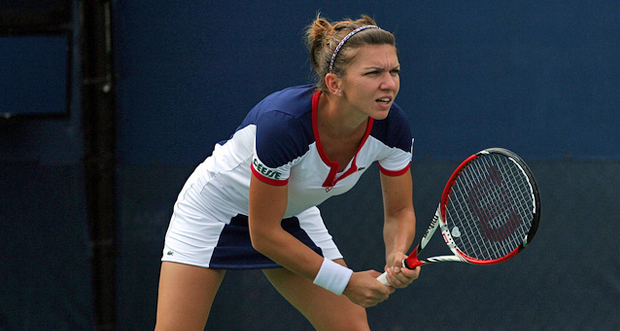
    Simona Halep

    Simona Halep, the 22-year-old Romanian who made a splash last year by winning six titles on the WTA Tour, has won her biggest one yet at the Qatar Open, beating Germany’s Angelique Kerber in the final, 6-2, 6-3.

    For the first time, Halep beat 3 Top 10 players on her way to the trophy, including Kerber (No. 9), having already dispatched Sara Errani (No. 7), and Agnieszka Radwanska (No. 4.)

    Despite four break point opportunities, Kerber was unable to break Halep in the match.

    “It’s tough to play against a player like Simona,” Kerber said. “I was trying to play my game plan, but it was not easy … she hit the balls very well and on the line.”

    “I just want to be focused for every point, to fight for every point,” Halep said.  She will rise to a career-high No. 9 when the rankings come out on Monday.

    [divider]

    Cover Photo (Creative Commons License): robbiesaurus

  • Nishikori Repeats in Memphis

    Nishikori Repeats in Memphis

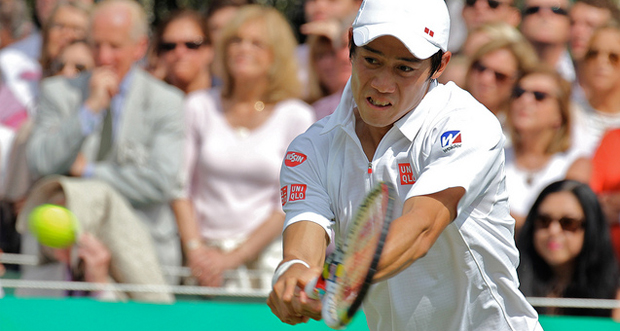
    Kei Nishikori

    Japan’s Kei Nishikori defeated the big-serving Croat Ivo Karlovic, 6-4, 7-6(0) today in Memphis to successfully defend his U.S. National Indoor Tennis Championships.

    “It’s amazing to defend a title for the first time, especially here,” Nishikori said. “I had a great memory from last year and I’m playing great.”

    The win gave Nishikori his fourth ATP World Tour title.  He has taken Michael Chang as his new coach and improves to 11-2 this season.

    Nishikori secured an early break in the third game of the match and despite 20 aces from Karlovic, he took the second-set tiebreak at love, and the final in 90 minutes.

    “He’s really fast,” Karlovic said. “He hits winners from any position on the court. That’s his game. He returned really well.”

    [divider]

    Cover Photo (Creative Commons License): Marianne Bevis
  • Berdych Ends Drought; Wins Rotterdam

    Berdych Ends Drought; Wins Rotterdam

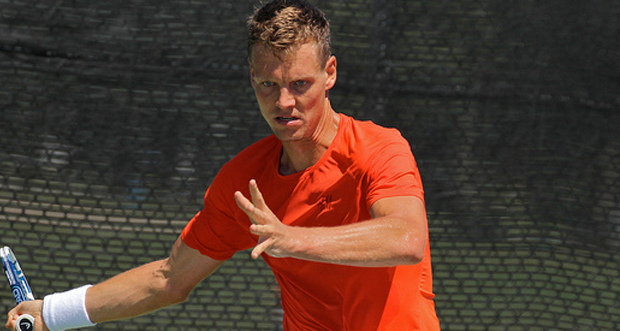
    Tomas Berdych

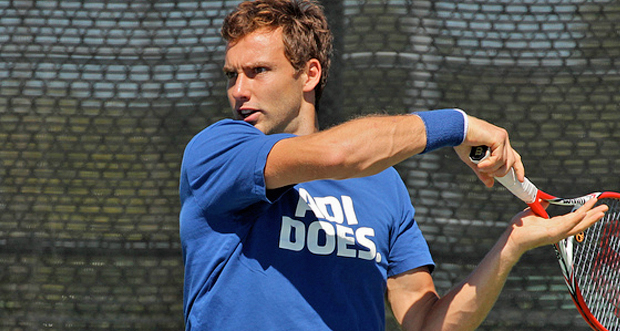
    Tomas Berdych made short work of Marin Cilic today, beating him 6-4, 6-2 to win the ABN AMRO tournament in the Netherlands.  This is his first trophy in 16 months, having gone all of last season without a title.  He was the only player in the Top 10 last year without one.

    “It feels absolutely amazing,” Berdych said. “It’s been a while, actually 16 months since I won a title. To win a title in Rotterdam it’s a nice bonus. I’m extremely happy with the way I handled it throughout the week. I’ve been serving pretty well, which has been the strong part of my game.”

    It was indeed serving that gave the Czech the advantage.  He recorded nine aces and had an 82% first serve stat.  The downfall for Cilic was 22 unforced-errors.  The match was over in 75 minutes.

    Cilic, who is newly coached by Goran Ivanisevic, is now 14-4 on the season, a strong start, despite the loss today.

    “It was a tough one today,” said Cilic. “What made the difference in the end was that Tomas served really well …. Overall I think the tournament was great. I played great tennis and enjoyed it here. I had a great run of nine [straight] wins and I hope to make that run soon again.”

    [divider]

    Cover Photo (Creative Commons License): Marianne Bevis
  • Ferrer Makes History in Buenos Aires

    Ferrer Makes History in Buenos Aires

    David Ferrer

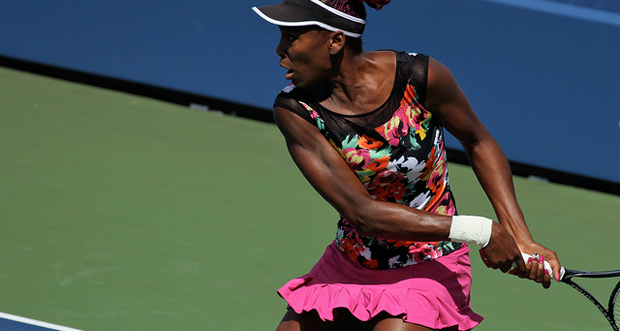
    David Ferrer became the first player to win three consecutive titles at the Copa Claro in Argentina today, defeating Fabio Fognini 6-4, 6-3.  The win gives him a 7-0 head-to-head over the Italian. It also snapped a run of losses in finals by the Spaniard (his previous seven), while ending what has been a very good run of fortune for the Italian.

    Ferrer led 3-0 to start the final, before Fognini evened things to 3-3. The Spaniard broke to win the first set, and broke again at the start of the second.

    Fognini was contesting the final for a fifth straight clay-court tournament and looking to win his fourth title. He triumphed last week at the Royal Guard Open Chile, the opening tournament of the Golden Swing, and entered Buenos Aires at a career-high No. 14 in the Emirates ATP Rankings.

    Sunday’s loss snapped Fognini’s 10-match winning streak and marked just his second loss in his last 25 clay-court matches.  For Ferrer, who goes back up to No. 4 on Monday, this is his 21st career title, 11 of those coming on clay.

    [divider]

    Cover Photo (Creative Commons License): Marianne Bevis

  • Viña del Mar Finalist Leonardo Mayer Books Fognini Rematch in Buenos Aires

    Viña del Mar Finalist Leonardo Mayer Books Fognini Rematch in Buenos Aires

    Leonardo Mayer
    On Sunday, a number of tennis fans who tuned in to the Viña del Mar final without having followed the rest of the tournament were probably curious what a tall, lanky Argentine was doing standing crosscourt from Fabio Fognini. Two hours later, despite a 6-4, 6-2 loss to the top-seeded Italian, everyone watching had a much clearer idea.

    Leonardo Mayer is one of a group of promising Argentine players that began to emerge in the past half-decade to replace fellow countrymen David Nalbandian, Gaston Gaudio, and Juan Ignacio Chela near the top of the ATP rankings. However, until the tournament in Chile last week, the all-court specialist seemed to have slowly faded from memory, surpassed since his emergence in 2009 by his compatriots.

    Of those, Horacio Zeballos has made the biggest splash on the tour, winning the 2013 Viña del Mar in spectacular fashion against Rafael Nadal. In doing so, he became only the third man to defeat the Spaniard on his surface of choice after Roger Federer and Novak Djokovic. Carlos Berlocq, Eduardo Schwank, and Juan Mónaco have been vital parts of Argentina’s Davis Cup teams for years, while Mayer has been only a sporadic presence for his country. In fact, most people who have recognized his surname have quickly had to be redirected to another, realizing they were thinking of German No. 3 Florian Mayer.

    But, all of that isn’t meant to discredit the athletic and agile 26 year old. It’s just that the tennis world hasn’t seen the best of him until now. And I’m convinced that 2014 might finally be the year Mayer actually makes the jump from contender to victor.

    The son of a banker and teacher, Mayer picked up his first tennis racket at the age of nine. Although he has called soccer his first love and Diego Maradona his greatest idol, he stuck with tennis and went on to a highly-accomplished junior career, reaching the quarterfinals of the 2005 US Open, where he lost to eventual winner Ryan Sweeting, and winning the 2005 French Open doubles with Emiliano Massa. He reached as high as No. 2 in the ITF rankings before turning professional.

    Mayer quickly rose from the Futures circuit to the Challenger tour, making three quarterfinals in addition to a final in Puebla, Mexico in 2006. The following year he would win his first two singles titles: one in Cuenca against Thomaz Bellucci, and another against Dawid Olejniczak in Puebla, reaching No. 189 in the world rankings.

    From 2008-2010, Mayer would really start to emerge as one of the most promising players in South America, collecting singles and doubles titles on the Challenger tour and making his first ATP-level appearance at the Austrian Open in 2008. In 2009, he reached the second round of the US Open, French Open, and Wimbledon. By the end of 2010, he was No. 51 in the world and had reached his first ATP semifinal at the Nice Open, where he lost to Fernando Verdasco, advanced one round further at the French Open, where he lost to Marin Čilić, and was a member of the Argentina Davis Cup team.

    Then it seems stagnation hit. Despite reaching the third round at Roland Garros again in 2011 and 2012, most of Mayer’s success came on the Challenger tour, winning five more titles by the end of that year. Though he remained in the Top 100 and won his first ATP doubles title with Pablo Andujar at Winston-Salem, he could not manage more than two quarterfinal appearances at São Paulo and Los Angeles on the ATP tour, and a third-round showing at the US Open in 2012 to accompany first-round eliminations in Australia and Wimbledon.

    2013 brought much of the same, though Mayer received greater attention when he took a set off defending champion Andy Murray in the second round of the US Open. He finished off the year by winning a Challenger title against Pedro Sousa in Guayaquil.

    And now to the past two months, arguably Mayer’s best start to the year at the top level.

    At the Aussie Open, Mayer defeated then world No. 60 Albert Montañés in straight sets before he was ousted in convincing fashion by Novak Djokovic. The potential was there, however, with his forehand looking strong and his long, swift backhand looking particularly effective.

    The tournament in Chile last week was considerably more impressive, as Mayer, ranked No. 91 at the time, defeated opponents of higher ranks in all but the Round of 32. His most noteworthy victory was against Tommy Robredo, who he came from one set down to beat 3-6, 7-6(8), 6-4 in the Round of 16.

    Fognini exposed his inconsistent return game in the final, though Mayer did save a match point with a stunning crosscourt forehand (video above) before going down in straight sets, 2-6, 4-6.
    Mayer, however, has a chance for redemption today in Buenos Aires.

    The 26-year-old defeated compatriot Facundo Arguello 6-3, 6-4 in the first round of the Copa Claro yesterday, thus securing a rematch against Fognini to be played at 6:00 P.M. EST.

    Although the Italian has only lost once in his last 21 matches on clay, it wouldn’t be an absolute gaffe to put some money on Mayer adding a second loss to that impressive tally.

    Below is a video of Mayer’s loss to Juan Martin del Potro in the 2012 US Open that highlights some of his greatest assets: a willingness to come to net, good volleys, and a variety of angled shots on the forehand and backhand to stretch his opponent.

    Cover Photo (Creative Commons License): Carine06

  • Fognini Dispatches Mayer in Vina del Mar

    Fognini Dispatches Mayer in Vina del Mar

    Fabio Fognini

    Fabio Fognini clinched his third career title and first of 2014 in a comfortable straight sets win over Leonardo Mayer at the Royal Guard Open, Vina del Mar, Chile.

    The 6-2, 6-4 scoreline was secured on the back of a strong service game with Mayer only winning seven points against the Italian’s serve.

    Fognini raced to a 4-0 lead in the first set and Mayer, who was playing his first tour final, was never able to recover. He was broken again in the third game of the second set as Fognini stormed toward the title.

    Fognini squandered two match points in the ninth game, but it proved to be a short-lived respite for his Argentine opponent as victory was sealed in the following game.

    [divider]

    Cover Photo: carine06, Creative Commons Licence