Blog

  • Gael Monfils Wins the Open Sud De France

    Gael Monfils Wins the Open Sud De France

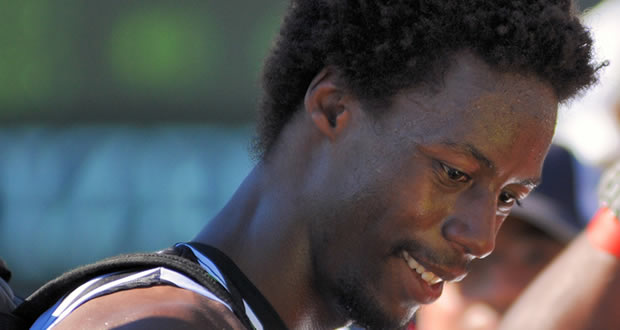
    Gael Monfils

    Gael Monfils defeated fellow Frenchman Richard Gasquet 6-3 6-4, en route to winning his fifth career title at the Open Sud de France in Montpellier.

    Monfils never looked in danger of losing his service game, banging down nine aces and didn’t face a single break point during the match.

    His overall dominance was further highlighted by 34 winners to top seeded Gasquet’s 17.

    “This is unbelievable for me,” said Monfils. “I had some back problems at the beginning of the week and I didn’t know if I was going to be able to play.”

    Monfils has had a stellar start to the season, his only two defeats of 2014 coming to World No. 1 Rafael Nadal.

    [divider]

    Cover Photo: Christian Mesiano, Creative Commons

  • Cilic Defeats Haas to Win in Zagreb

    Cilic Defeats Haas to Win in Zagreb

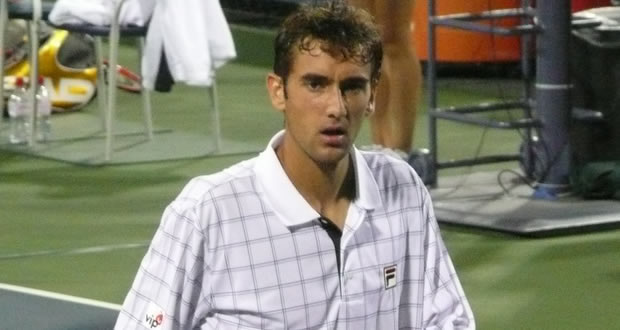
    Marin Cilic

    Croat Marin Cilic won his fourth Zagreb title defeating top seed Tommy Haas 6-3, 6-4.

    Cilic got off to a slow start and was broken in the opening game by the 35-year-old Haas before recovering to take five of the next six games to seize control of the opening set. Haas was unable to recover and the remainder of the set played out to serve with Cilic taking it 6-3.

    The second set was closely contested with Haas having an opportunity to break for a 4-2 lead. He wasn’t able to capitalize and Cilic fought back by holding serve and then broke Haas to jump out to a 5-3 lead.

    Haas did manage to save one match point but Cilic brought proceedings to an end at the second attempt.

    The victory gave Cilic his tenth career title and first since returning from a drug suspension.

    [divider]

    Cover Photo: angela n (Creative Commons License)


  • Italy Soars in Davis Cup; Argentina Risks Relegation from World Group

    Italy Soars in Davis Cup; Argentina Risks Relegation from World Group

    Canever DC blog post

    In a shock Davis Cup result in Buenos Aires this weekend, Argentina fell 3-1 to Italy and now run the risk of relegation from the World Group only one year after losing a tight semifinal to eventual winners Czech Republic.

    Without world No. 4 Juan Martin del Potro and recently-retired David Nalbandian in the lineup, the hosts were forced to depend on world No. 44 Carlos Berlocq and No. 40 Juan Monaco to carry them forward to the quarterfinals for the thirteenth consecutive year.

    Berlocq won his opening match against world No. 31 Andreas Seppi in four sets (4-6, 6-0, 6-2, 6-1), but Monaco was soundly defeated by an on-fire Fabio Fognini in the second rubber (7-5, 6-2, 6-2).

    Fognini, world No. 15, is fresh off a fourth-round appearance at the Australian Open and showed a newfound level of confidence as he anchored the Italian team. He went on to secure victory with a 7-6(5), 4-6, 6-1, 6-4 triumph over Berlocq after partnering with Simone Bolelli to win the doubles, 6-7(6), 7-6(8), 7-6(3), 6-4, on Saturday.

    Italy will now host Great Britain in the quarterfinals held from April 4-6. The nation will be in search of its second ever Davis Cup trophy, after defeating Chile 4-1 to clinch the title in 1976. Italy only returned to the World Group in 2011 following a victory over the same opponent in a playoff.

    Argentina has been playing in international tennis’s top tier since 2001, when it defeated Belarus 5-0 in Cordoba. The country then went on a phenomenal run that included finals in 2006, 2008, and 2011, although all three ended in defeats: first to Russia and twice to Spain. The South Americans will now face a playoff against one of the eight Zonal Group 1 qualifiers in September to stay in the World Group.

    Perhaps the biggest influence in Argentina’s defeat was the failure to convince 2009 US Open winner del Potro to return to the team following a dispute with team captain Martin Jaite and officials from the Argentine Tennis Association (ATA). His last appearance was in the 2012 semifinal loss to the Czechs, where he won the opening rubber against Radek Stepanek in straight sets.

    Del Potro is upset about the initial selection of Jaite as captain in 2011, and a lack of consultation in regards to surfaces and locations by the ATA. The Olympic bronze medalist also spoke in the open letter (see link above) to Jaite and ATA president Arturo Grimaldi about the hypocrisy of the organization for attempting to make him look bad in the public eye while awaiting his response for the Italy tie.

    Tennis fans in Argentina are split over the stance of their top player, with a number of those inside the stadium during the Berlocq loss that clinched the Italian victory singing, “This is for you, del Potro, watching on TV.” Others displayed signs saying, “Volvé del Potro” — “Come back del Potro”.

    Grimaldi was quick to hit the damage control button and released a statement saying that he would do anything within reason to get del Potro back on the team for the crucial playoff. He was followed by Berlocq, who also spoke about how vital his compatriot is to every tie and how much more potent Argentina is with him in the team.

    Thus far, there has been no response from the world No. 4, who is currently undergoing treatment for an injury to his left wrist. But with the risk of sinking out of the World Group so soon after becoming the most dominant South American team in recent memory, all will be hoping that somehow del Potro and the AFA figure out a solution sooner rather than later.

  • Davis Cup Results

    Davis Cup Results

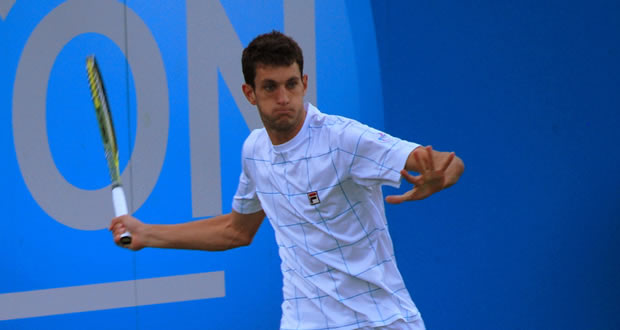
    James Ward

    Great Britain moved into the quarterfinals of the Davis Cup for the first time in over 27 years following Andy Murray’s defeat of Sam Querrey to clinch the tie over their American hosts. Murray had already defeated Donald Young in an earlier singles rubber.

    The crucial breakthrough for the British team came when unheralded James Ward shocked Querrey to put the UK in the driving seat going into the final day.

    Full Results:

    Czech Republic 3; Netherlands 2
    Japan 4; Canada 1
    Germany 4; Spain 1
    France 5; Australia 0
    USA 1; Great Britain 3
    Argentina 1; Italy 3
    Kazakhstan 3; Belgium 2
    Serbia 2; Switzerland 3

    [divider]

    Cover Photo: Carine06, Creative Commons License (James Ward, GB)

  • Anastasia Pavlyuchenkova Wins the Open GDF SUEZ

    Anastasia Pavlyuchenkova Wins the Open GDF SUEZ

    Anastasia Pavlyuchenkova

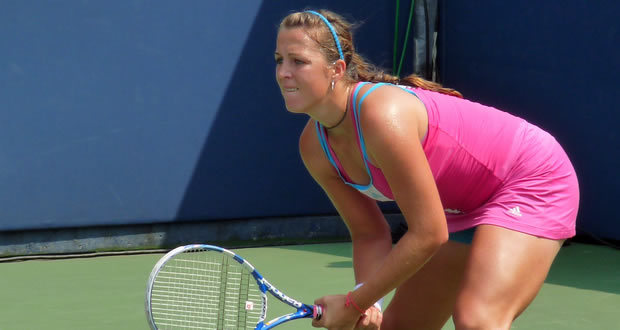
    Anastasia Pavlyuchenkova ended a memorable week in Paris by defeating Sara Errani at the Open GDF SUEZ. The Russian reeled off 48 winners en route to taking the match 3-6, 6-2, 6-3.

    In a match of many momentum swings, Pavlyuchenkova began by racing out to a 3-1 lead in the opening set. She then dropped seven consecutive games to leave Errani firmly in the driving seat with a set lead and a 2-0 buffer in the second.

    The Russian then awoke from her slumber and took seven consecutive games of her own behind strong serving and huge groundstrokes. With the second set sealed, the match was carefully balanced as it progressed into the deciding stanza.

    Pavlyuchenkova took the opening game but her advantage was short-lived, with Errani reeling off three more consecutive frames to move out to a 3-1 lead.

    The see-saw battle turned on its head again – this time decisively, with Pavlyuchenkova recovering her rhythm and dropping only six more points throughout the remainder of the match. She won the remaining five games without reply to secure the biggest title of her career.

    “I just want to keep working hard and improving my game, and if I keep doing those things it will show in rankings and results,” said the Russian after the match.

    It was Pavlyuchenkova’s sixth career title and it was well earned. Earlier in the week, she defeated Carla Suárez Navarro, Angelique Kerber, and top seed Maria Sharapova.

    [divider]

    Cover Photo: karlnorling, Creative Commons License (Anastasia Pavlyuchenkova)

  • Makarova Wins Pattaya Open

    Makarova Wins Pattaya Open

    Ekaterina Makarova

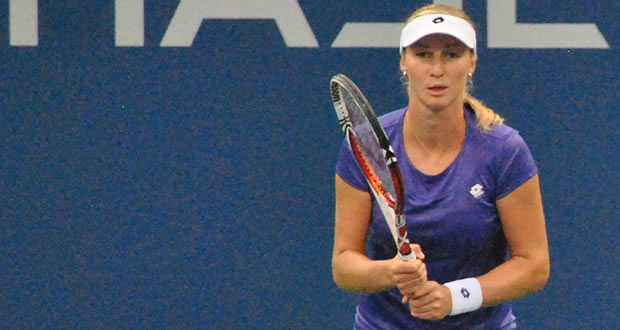
    Ekaterina Makarova won her first title in nearly four years clinching the Pattaya Open in Thailand with a 6-3, 7-6 (7) victory over Karolina Pliskova.

    The Russian took the match in 1 hour 36 minutes and fought off two set points in the second set tiebreak to take the championship.

    “It was a nervous ending and a really tough match, and she was playing really great tennis today,” stated Makarova after the match.

    [divider]

    Cover Photo: angela n, Creative Commons License (Ekaterina Makarova)

  • Federer Commits to Davis Cup Action

    Federer Commits to Davis Cup Action

    Roger Federer

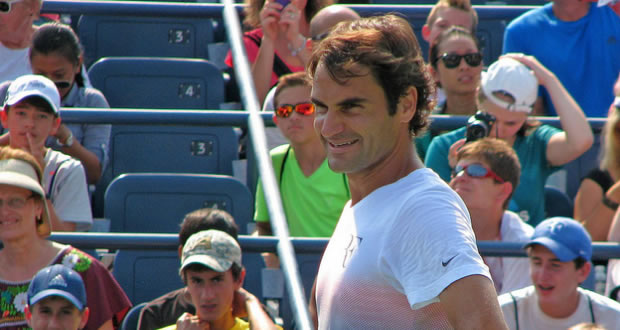
    Roger Federer will join the Australian Open champion and new Swiss No.1 Stanislas Wawrinka in their Davis Cup first-round tie against Serbia.

    “I can confirm that Roger is in Serbia and will play in the Davis Cup,” stated Sandra Perez of the Swiss Tennis Federation.

    It is the first time since 2012 that Federer has made the commitment to play Davis Cup and the last time he played a first round tie was back in 2005.

    The Swiss will begin the tie as favorites with Serbia missing Novak Djokovic and Janko Tipsarevic. The makeshift Serbian team will provisionally feature Dusan Lajovic (ranked No. 102) and Filip Krajinovic (No. 280) in singles, with Nenad Zimonjic and Ilija Bozoljac pairing up for the doubles.

    The tie will be played on an indoor hard court in Novi Sad.

    [divider]

    Cover Photo: Kenneth Hong, (Creative Commons License)

  • Australian Open Final Review: Wawrinka v Nadal

    Australian Open Final Review: Wawrinka v Nadal

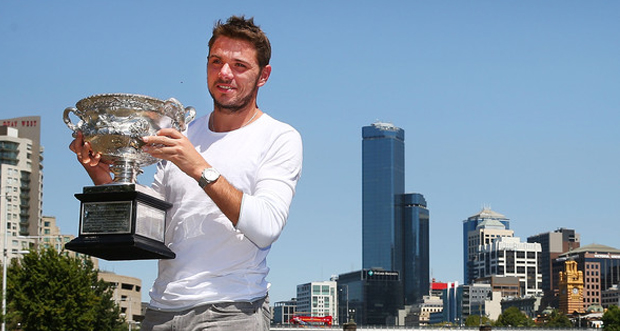
    AO ATP Winner - Stan 2

    What an amazing final it was. I know it wasn’t such an epic on court. More of a drama of sorts but as a culmination of an amazing path to glory it was a real feat of Tennis.

    Stan swept past three Top 10 players to clinch the trophy. Beating the No. 1 and 2 players in the world. En route he overcame the reigning champion of three years and swept aside a former champion in the final. He weathered the extreme heat and changeable conditions like everyone else but he managed to do all this without getting injured. Still standing and strutting until the end.

    What I had forgotten was that I was at their last match at the World Tour Finals. I know exactly what it is like to see both men in full flight. I can appreciate just what Stan has achieved and how he did it.

    I had been wondering over Christmas just how close Stan had come to the Top 4. I had completely forgotten the score line at the O2. Had I not then I really would have favoured Stan much more given his consistent progress during 2013.

    The seeds were there in the Millennium Dome. Stan pushed Rafa as hard as he possibly could without winning a set, with the score being 7-6(5), 7-6(6) to Rafa. It truly was one of those results where the score does not reflect the story of the match. Stan broke Rafa twice. At times he literally owned him. You could see he was starting to realise that the very top players like Rafa actually fear him because their strength plays into his strength.

    Rafa particularly likes to get the ball high to an opponent through his spin. That troubles most people but not Stan. That is just where he wants it. Put it high to his backhand and he couldn’t thank you enough. You’ve served him his favourite opportunity on a platter.

    Stan doesn’t need to run around his backhand like his colleagues in the Top 10. He loves a chance to express his creative skills with his beautifully-crafted technique. He just steps up to it and releases his aggression through the ball, trusting his well-honed technique. The rest is just a blur.

    So from this spectacular experience in London I can testify to how big Stan hits. Only Berdych rivals him in the Top 8 for pure power. They’re both just powerhouses. The type that have had wins against Rafa his whole career. It is only now that they are both realising just what this could mean for them in their best years.

    So the result on Sunday wasn’t as much as a surprise to those who have seen Stan play, particularly those who still remembered last year’s match against Novak. He pushed the eventual winner of this trophy right to the wire. If he had won the match then a route to the final was open. This time he did and it was. So let us see where this leads.

    Nadal still impressed me and I think won many new followers. Clearly injured he pressed on. I’ve always wondered what is best in this case. Should he just surrender and proclaim Stan champion? Does he have that right? I’ve read many of the debates with the issue getting cloudier and more complex instead of clearer.

    Though now, if Tennis is to proclaim itself a profession then I like to draw parallels from other professions to gain some perspective. If a chief executive were struggling during negotiations with a migraine, severe back trouble or whatever, then they would take painkillers or anything prescribed to get through. Taking a rest some other time. Peoples’ jobs and the future of the company are at stake. What is the difference here with a tennis player?

    This of course isn’t an answer; it’s more a question. Yet it simply places each player as CEO of their brand providing a performance for their company on the biggest stage possible. The fans have played their part, paying their money and making their own sacrifices to be there. They have a right to see the match they paid for.

    That is what made Nadal’s effort respectful. He gave all he could. Enough to win a set, in fact. He gave the crowd and his opponent the best of himself. Getting on with his job and doing it as best he could.

    I learnt a lot more about Rafa from this match and I liked it. I still don’t know what is best when a player is injured, but I am learning that the show must go on. Rafa didn’t steal the limelight and showed deep respect throughout, by treating others as he would like to be treated. He was professional.

    On his worst days as much as on his best he is a professional to admire. He, and the band of brothers he tours the globe with on this Tennis tour, are bringing an impressive breed of professionalism to the tour. As a professional myself it’s nice to see.

    A truly exciting time for the tour. An exceptional start to 2014.

    Cover Photo (Creative Commons License): Marianne Bevis

  • Tears and Laughter

    Tears and Laughter

    Stanislas+Wawrinka+Australian+Open+2014+Men+eaKRCvehVMHl e

    The 2014 Australian Open Finals

    Li Na [4] def. Dominika Cibulkova [20] 7-6(3), 6-0

    Stanislas Wawrinka [8] def. Rafael Nadal [1] 6-2, 6-3, 3-6, 6-3

    At some point in the twelve months between the day Swiss player Stanislas Wawrinka lost a five-set, five-hour tennis match to defending champion Novak Djokovic at the Australian Open, and the night when he won a five-set Australian Open match against the again-defending champion Djokovic, Wawrinka got a tattoo on his forearm. A motivational tattoo courtesy of Samuel Beckett’s Worstward Ho: “Ever tried. Ever failed. No matter. Try again. Fail again. Fail better.”

    Tennis players see a lot of their forearms. If Wawrinka ever forgot to try, or forgot how important it is to fail in life, all he had to do was glance downward and Mr. Beckett could remind him of the game plan. Keep going! I remember deploying the same passage on my site, Extreme Western Grip in early 2012, after Rafael Nadal lost a grueling six-hour Australian Open final, also to Novak Djokovic. After falling to Djokovic in umpteen straight finals, Nadal had, I believed, finally failed better—a lot better. And, indeed, next time Djokovic and Nadal met in a tournament final, Rafa won. But that’s Rafa; getting badly burned and then rising majestically, muscularly from the ashes—fist-pumping and vamos-ing in six directions at once—is what he does. He almost did it this past Sunday, despite carrying a back injury so severe he required a medical timeout and repeated visits from the trainer.

    I ought to have realized, from the evidence of the permanent marker he’d injected into his very being, that Stanislas Wawrinka was very also serious about rising like a scruffy phoenix from the ashes. Instead, I was surprised when he pulled himself together, after a very shaky first set against Djokovic in last week’s quarterfinal match, to win in five. I was impressed to see the Swiss force himself, time and time again, to cling to the baseline when it was clear as the stripes on Berdych’s T-shirt that his instinct was to retreat to the comparative emotional safety of the backcourt. I was relieved when he didn’t let down in the next round, defeating Tomas Berdych and earning his first chance to play for a slam title. But he’d never taken a set off Rafael Nadal, not in 26 tries, so all I expected—hoped—for him was that he keep trying again, and again. I hoped he’d get a set, or maybe even two. I hoped the loss wouldn’t hurt too much. 

    In fact, I suspected that the match might unfold in much the way the women’s final did, with the underdog putting up an admirable fight but succumbing in the end to the better, more experienced player. Despite being billed on Channel 7 as a Bond-girl-esque battle between “Lethal Li and Dominika the Dominator,” the attention during coverage of the women’s match remained, and fittingly so, on the tennis. (So far as I can recall, Eugenie Bouchard’s impending marriage to Justin Bieber was not mentioned even once.) It was good tennis, with a happy ending. During the trophy speeches, Li Na’s comic timing was, as usual, impeccable—much like her backhand in the second set— and the smile on her face was unguarded and wonderful to see. But Cibulkova, despite the tears coursing down her face, also seemed honestly happy to be there. It’s not that she was “just” happy to be there, Cibulkova obviously wanted to win. (And if she can keep playing the kind of tennis she played throughout the Open, win she will.) Yet her 6-7(3), 0-6 loss—that second set was closer than it sounds—hadn’t obliterated her awareness of how much she’d accomplished before it.

    Dominika+Cibulkova+2014+Australian+Open+Day+pMzpaSOaaYKl

    Watching the two pose for trophy photos, I was hard-pressed to remember another time when the person left holding the runner-up plate looked so, well, radiant. It’s a shame it doesn’t happen more often. Being No. 2 out of 128 is an achievement to be proud of, but tennis doesn’t work that way. It’s a psychologically harsh sport. Take a tune-up tournament for example. Thirty-two players enter the Sydney draw, but only one gets to go on to the Australian Open with a victory fresh on her mind. Others might win a match or two, or possibly even three, but the last experience will be of loss. No wonder it’s the nihilistic Samuel Beckett and not, say, Ram Dass, to whom tennis players turn to for their inspirational tattoos. 

    After watching Wawrinka defeat Djokovic, I expected that Wawrinka, like Cibulkova, would put up a good fight in the final. I didn’t think he would win. But more important, I didn’t think he’d win playing the way he did: first, so spectacularly, and then so very anxiously. The first set and a half from Wawrinka—regardless of whether Nadal was already injured or not—was magnificent on all fronts. After the match he called it the best tennis he’s ever played. He served well, returned well, and drove his backhand down the line in a way that made Roger Federer look almost frail. Wawrinka’s forehand might be the stroke most vulnerable to a dip in form (he occasionally forgets he has knees to bend), but the winners he strikes off that side are likely to cause sharp, admiring intakes of breath from onlookers. (Or, at least from me.) If only he’d kept it up after he knew Nadal was hurt, like Rafa would have done himself.

    For all that Nadal is kind to children, afraid of puppies, and modest on the podium, he’s ruthless when it comes time to drive the dagger home. Stanislas Wawrinka, on the other hand, is more like the rest of us. As he said after the match, it was hard for him to know that his friend and rival was hurting, hard to stay focused on what he needed to do. Well, it was also hard for me to watch. I was at Indian Wells in 2013 when Wawrinka managed to lose to an injured Roger Federer in much the same way that Wawrinka played the third set of the Australian Open final. He obligingly hit half-paced balls directly to his opponent’s racquet so that the poor guy with the bad back didn’t have to run. It was painful to watch. The next round, which pitted the wounded Federer against Rafael Nadal wasn’t a barrel of fun either, but it was a relief to see Rafa move swiftly to put his ailing opponent out of his misery.

    There is another passage from Beckett, this time from Molloy, which could describe the spiral of psychological struggle that became the men’s final: “I did my best to go in a circle, hoping in this way to go in a straight line.” It was difficult to watch Wawrinka wrestle with himself to keep his aggressive game turned outward against his opponent, and not against himself. It was difficult to watch Nadal struggle to keep himself in the match, knowing that he would (or should) lose, and painful to see his tears when it was done. It would have been Rafael Nadal’s 14th slam title, equaling Pete Sampras’ tally, and the American was on hand to present the trophy. If there was ever doubt about the psychological law of diminishing returns, all that needs to be done is to compare the crestfallen face of Rafael Nadal to the brimming smile of Dominika Cibulkova. Success is nothing if not relative.

    But if the 2014 Men’s Final was messy, Wawrinka’s joy at winning it was sublime. With this title he becomes the new Swiss No. 1 and World No. 3, and he, like many of us, couldn’t quite believe it, saying he’d find out the next morning whether or not he was dreaming. For me, the disappointment of the final two sets gave way to a vicarious experience of Wawrinka’s happiness in a matter of hours. By the early hours of Monday morning, as I waited in line at the airport to board my flight to New Zealand, it was not only the pleasure of the smiles of two new Australian Open champions, and two wonderful weeks spent in Melbourne that was on my mind, but also the loss of an ending. I didn’t want it to be over. Samuel Beckett once wrote, “tears and laughter, they are so much Gaelic to me.” It’s a sad sentence, not suitable for inspirational body art. Tears and laughter are without clear meaning, and of the past. But I mention it now because tears and laughter are also of a piece. In tennis, there’s no winner without a runner-up plate. And there’s no beginning to a holiday down under without its ending. 

    I’ll see you all back in California.

  • Speechless Saying That

    Speechless Saying That

    Australian Open, Final

    (8) Wawrinka d. (1) Nadal, 6/3 6/2 3/6 6/3

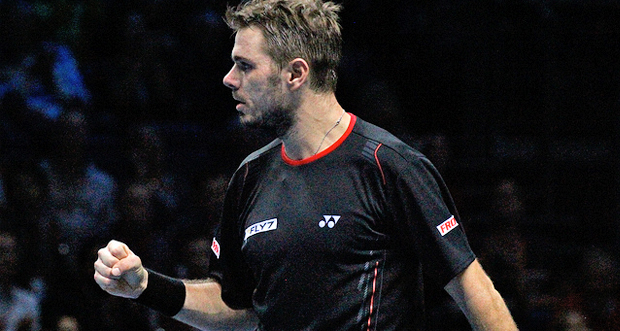
    Stanislas Wawrinka has won the 2014 Australian Open, thereby proving wrong those who’d maintained he couldn’t, a group in which he himself was often prominent. At a single broad stroke, which began in his coiled shoulders and uncurled through that mighty backhand, he has become a Major champion, soared into the top three, and stopped Rafael Nadal from becoming the first man in the Open Era to claim a career Grand Slam twice. Due in part to the circumstance and in part to the innate preposterousness of what he had achieved, Wawrinka’s initial reaction was one of muted disbelief, a response that he managed to sustain through the trophy ceremony, and the endless interviews he subsequently granted to all of the world’s main broadcasters. For all I know he is still wearing an expression of bemused incredulity. He wouldn’t be the only one. It was with unabashed wonder that Brad Gilbert on ESPN declared that Wawrinka actually was the Australian Open champion, adding that he was ‘still kinda speechless saying that.’

    To say that Wawrinka was a little lucky is a little redundant. No one wins a Major without some luck, least of all those who aren’t lucky enough to be Roger Federer, Nadal, Novak Djokovic or Andy Murray, collectively known as the big four. Since the 2004 French Open, only three men besides those four have contrived to win a Major – a sequence of thirty-nine tournaments – and in no case was the eventual winner permitted to amble through a wide open draw. At the 2005 Australian Open Marat Safin defeated the first (Federer) and third (Hewitt) seeds. At the 2009 US Open, Juan Martin del Potro also beat the first (Federer) and third (Nadal) seeds. Wawrinka is the first man to see off the first (Nadal) and second (Djokovic) seeds to win a Major since Sergi Bruguera at the 1993 French Open.

    Boris Becker insisted when probed that he would never concede any side of a draw is easier than the other, but then the words that tumble out of Becker’s mouth often bear no trace of a supervising intellect. Perhaps they should have probed him more thoroughly, or with a sharper implement. Wawrinka’s half of the draw was certainly friendlier than the other half, and he was unquestionably helped by a retirement in the first round (Golubev) and a walkover in the third (Pospisil), especially since it limited his exposure to the apocalyptic conditions of the first week. But that merely helped him survive the early rounds, and no draw is benign that brings one up against Djokovic, especially in Melbourne.

    From the quarterfinal until the second set of the final, when events lurched into a strange place, Wawrinka was mostly majestic. As he did with Robin Soderling, Magnus Norman has performed wonders with Wawrinka, and in a relatively short time has ensconced himself among the coaching elite. Unfortunately, even Norman hadn’t anticipated the sharp dip the final would take – a slow turn through the S-bend – and thus couldn’t have known to prepare his charge accordingly. Perhaps he’d figured that the concept of hitting the ball away from an immobile opponent was too obvious to need saying. It turns out nothing is too obvious in a Slam final. It might have been worth a professional code violation to belatedly deliver this complicated message. Marching onto court and smacking Wawrinka upside the head probably would have risked a default, but Norman must have been sorely tempted. I know I was. I suspect even Nadal was by the end.

    Nadal’s back injury inevitably obliges one to wonder what might have transpired had he remained fit, though I confess I don’t find such speculation worthwhile. There was one set in which both players looked fine, and Wawrinka dominated it, but this was his first Major final and there is little reason to think he could have sustained that level indefinitely. One suspects Nadal eventually would have pegged him back. In any case, Nadal’s injuries are a misted, shifting quagmire in which even well-provisioned expeditions are liable to be waylaid and careen over a precipice. Mountains spring from molehills, or at any rate, blisters become volcanoes. Writers who toil hard to maintain a veil of impartiality can fall to anxious weeping the moment Nadal stumbles. There was a moment when he might have twisted his ankle against Kei Nishikori. It soon turned out that he hadn’t, though not soon enough for some alleged professionals to demonstrate that there are in fact fifty-four stages of grief, and that they’re all boring. By the same token, those insisting that Nadal was not injured are certainly wrong, and in many cases have taken their insistence to contemptible lengths. They are also beyond convincing, being possessed by a special kind of mania. As I say, a quagmire, and not worth the trouble.

    Others have insisted they noticed something awry with Nadal early in the first set, if not in the hit-up. Perhaps I’m obtuse, or I was busy staring awestruck at the fearless guy up the other end, but I confess I didn’t see anything wrong. I did remark to my companions that Nadal appeared to have fallen into the trap he used to with David Nalbandian, which was to pay a famous backhand too much respect. Wawrinka’s backhand is, without doubt, a superb shot, one by which I am often reduced to envy. But his forehand remains the more potent shot, and it’s from that wing that most of his groundstroke winners originate. The semifinal was an especially fine showcase for this. Tomas Berdych heard countless forehands hum past. I suppose it hardly mattered, Wawrinka was fearsome from both sides through the first set. It’s worth remembering that this was the first set he ever took from Nadal, though he nearly didn’t. He fell down 0-40 while serving for it, halfway through a sequence of six missed first serves. Nadal then failed to put another second serve return into play, and it’s easy enough to belief his later claim that his back was already bothering him. Something was wrong somewhere.

    The matched changed completely in the second set, which Wawrinka opened in grand fashion by breaking to love. It wasn’t long after this that Nadal evinced clear signs of distress, leaning over and clutching his back, and at 1/2 availed himself of a long off-court medical timeout. Wawrinka, left in the dark on the bright court, took his frustration out on Carlos Ramos, and was only slightly mollified when tournament referee Wayne McKewan emerged with an explanation. There was some concern that the Swiss was thereby squandering valuable energy. Magnus Norman looked on serenely. Nadal re-emerged, encountering lusty boos from the Rod Laver Arena crowd, behaviour that what won’t go down as its finest. (Nadal later said he understood their frustration, though unlike Bernard Tomic he didn’t call a separate press conference to explain himself.) Nadal’s face looked exactly the way it had in the 2011 Australian Open quarterfinal, when an injury early in the first set combined with a ruthless David Ferrer to destroy his at chance at the ‘Rafa Slam’. Wawrinka worked out his vestigial frustration with a brace of aces, while Nadal commenced lobbing serves over at about 140kmh. Before long Wawrinka had won his second set against Nadal. There was speculation that Nadal would default. I didn’t think he would, but believed that the match was essentially over, assuming Wawrinka would do the smart thing and make the Spaniard run.

    This turned out to be a rather large assumption to make. Although physicists have yet to isolate the mechanism by which this process works, injured players will sometimes transform into a kind of localised gravity-well, drawing every ball inexorably towards them. The only reliable way for the opponent to avoid this effect is to launch their shots ten feet out. For the next set and a half Wawrinka tried both these approaches, with limited success. It recalled Albert Montanes’ flailing and dispiriting loss to a crippled Fabio Fognini at Roland Garros three years ago, and Mikhail Kukushkin’s near-implosion against Gael Monfils at the Australian Open. In both cases the latter player could barely move, and was reduced to windmilling his arms at any ball that strayed within reach, generally to devastating effect. In much the same mood, Nadal hardly bothered running for any ball more than a few metres away, but swung lustily at any that landed nearby, which, somehow, was nearly all of them. Thus we discovered yet again that the world number one in a reckless mood is perfectly capable of striking fabulous winners off both sides from neutral balls, leaving some of us to wish that he’d play like this more often. Nadal still missed plenty, however, enabling Wawrinka to achieve multiple breakpoints in every other game, whereupon Wawrinka’s return would explore the bottom of the net or the unscuffed part of the court beyond the Melbourne sign. Nadal’s pace and mobility began gradually to improve, and he won the third set. Wawrinka took to shouting at himself, but not in English. Magnus Norman looked on serenely.

    A match that began electrifyingly for Wawrinka, and continued dismally for Nadal, now spiralled into absurdity for both. Nadal, by his own admission, was mainly continuing for the fans who’d paid a lot of money to be there, but he must have wondered if he wouldn’t be doing them a kindness to end it immediately. Then again, I imagine by this time he was harbouring a few desperate dreams of victory. Aside from his first serve, which Wawrinka could barely return anyway, the Spaniard was starting to play a great deal better. On the other hand, Wawrinka, aside from his serve, had lost all coherence, and his eyes grew clouded with dread. The 2004 French Open final was invoked – always a sure sign that the ropes binding reality together had begun to fray. Jim Courier in commentary pointed out, astutely, that Wawrinka could have lost the final in straight sets and still regarded the tournament as a triumph, but to lose it from this point would be a fiasco. Wawrinka was playing like someone aware of no other fact. He somehow broke, but followed up this accomplishment, monumental in the circumstances, with the worst service game of the modern era, and lost his serve to love. He broke again, more decisively. The crowd went crazy – demented might be a better word – having stared once too often into the abyss. Wawrinka served it out to love, the way exactly no one assumed he would. In deference to his wounded opponent, his celebration was diffident. Magnus Norman leapt to his feet, exultant, and threw his arms around Severin Luthi. Nadal had been granted an unlooked-for hour on court to come to terms with the near-certainty of defeat, but he still looked quite stricken, a look he retained throughout the trophy ceremony.

    Thomas Oh, Kia Motor’s ineffable representative, was so moved by what he’d seen that he kept his speech down to a few minutes, instead of its usual hour. Both players spoke well, though their efforts hardly compared to Li Na’s masterpiece from the night before. Where before they’d booed him, the RLA crowd now hurled their adoration down on Nadal, who fought to quell his tears but lost. Pete Sampras was on hand to dole out the silverware. The official reason for this was because it is the twentieth anniversary of his first Australian Open title. No one failed to grasp the deeper significance, however, which was that, had Nadal won, the world number one would have equalled the American’s Major tally of fourteen. It brought to mind the 2009 final, in which Federer failed to win his expected fourteenth Major. We were in turn reminded that the French Open is only months away. I doubt whether anyone believes Nadal won’t surpass Sampras before long.

    For now, however, the important number isn’t fourteen, but one. Stan Wawrinka, who at some point regressed down the evolutionary chain from being ‘Stan the Man’ to became the ‘Stanimal’, has won his first Major, and has earned his place among the sport’s elite. I, too, feel kind of speechless saying that.