Tag: atp

  • Fognini Dispatches Mayer in Vina del Mar

    Fognini Dispatches Mayer in Vina del Mar

    Fabio Fognini

    Fabio Fognini clinched his third career title and first of 2014 in a comfortable straight sets win over Leonardo Mayer at the Royal Guard Open, Vina del Mar, Chile.

    The 6-2, 6-4 scoreline was secured on the back of a strong service game with Mayer only winning seven points against the Italian’s serve.

    Fognini raced to a 4-0 lead in the first set and Mayer, who was playing his first tour final, was never able to recover. He was broken again in the third game of the second set as Fognini stormed toward the title.

    Fognini squandered two match points in the ninth game, but it proved to be a short-lived respite for his Argentine opponent as victory was sealed in the following game.

    [divider]

    Cover Photo: carine06, Creative Commons Licence


  • Gael Monfils Wins the Open Sud De France

    Gael Monfils Wins the Open Sud De France

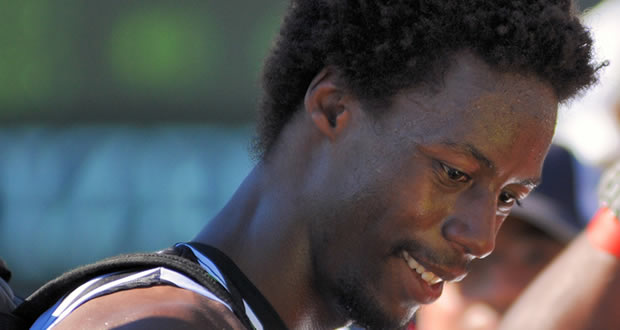
    Gael Monfils

    Gael Monfils defeated fellow Frenchman Richard Gasquet 6-3 6-4, en route to winning his fifth career title at the Open Sud de France in Montpellier.

    Monfils never looked in danger of losing his service game, banging down nine aces and didn’t face a single break point during the match.

    His overall dominance was further highlighted by 34 winners to top seeded Gasquet’s 17.

    “This is unbelievable for me,” said Monfils. “I had some back problems at the beginning of the week and I didn’t know if I was going to be able to play.”

    Monfils has had a stellar start to the season, his only two defeats of 2014 coming to World No. 1 Rafael Nadal.

    [divider]

    Cover Photo: Christian Mesiano, Creative Commons

  • Cilic Defeats Haas to Win in Zagreb

    Cilic Defeats Haas to Win in Zagreb

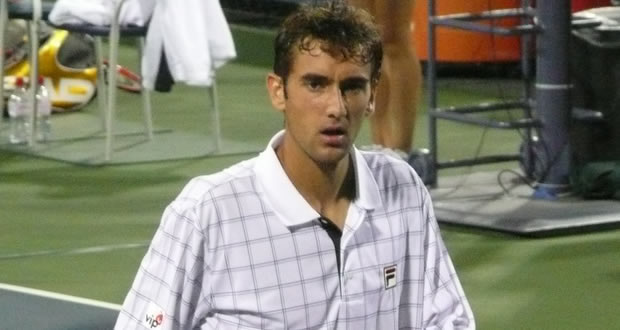
    Marin Cilic

    Croat Marin Cilic won his fourth Zagreb title defeating top seed Tommy Haas 6-3, 6-4.

    Cilic got off to a slow start and was broken in the opening game by the 35-year-old Haas before recovering to take five of the next six games to seize control of the opening set. Haas was unable to recover and the remainder of the set played out to serve with Cilic taking it 6-3.

    The second set was closely contested with Haas having an opportunity to break for a 4-2 lead. He wasn’t able to capitalize and Cilic fought back by holding serve and then broke Haas to jump out to a 5-3 lead.

    Haas did manage to save one match point but Cilic brought proceedings to an end at the second attempt.

    The victory gave Cilic his tenth career title and first since returning from a drug suspension.

    [divider]

    Cover Photo: angela n (Creative Commons License)


  • Wabi-Sabi and Spider Bites

    Wabi-Sabi and Spider Bites

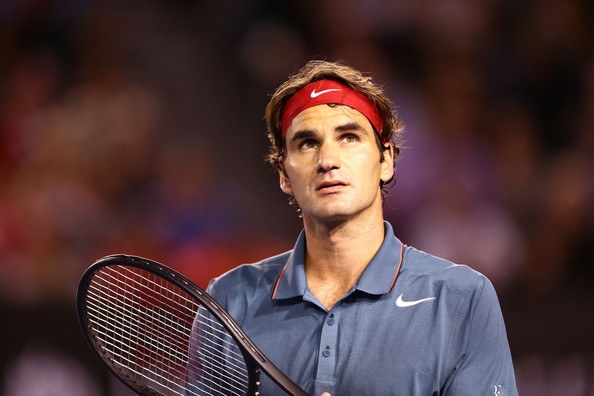
    Roger+Federer+2014+Australian+Open+Day+12+Wn7S9KclWuCl

    The Australian Open 2014 Men’s Semifinals

    Stanislas Wawrinka [8] def. Tomas Berdych [7] 6-3, 6-7(1), 7-6(3), 7-6(4)
    Rafael Nadal [1] def. Roger Federer [6] 7-6(4), 6-3, 6-3
     

    The redback spider, Latrodectus hasselti, is a species of venomous spider indigenous to Australia. By way of dinner preparation, the redback uses her fangs to inject a neurotoxin into the vulnerable flesh of her prey, liquefying its insides before binding it thoroughly in silk and sautéing it lightly under the hot Australian sun. Lucky for me, I was able to see a redback—at delightfully close range— on my very first evening in Australia, right about dinnertime, in fact. There she was: sleek and elegant, with a bright red stripe running down her back, and lethal as hell. My Australian hosts took no small pleasure in explaining that recent research indicates the people who’ve been killed by a redback bite actually died from the pain, not the venom. But not to worry, they cheerfully reassured me, should I be bitten by a redback, I’d simply be rushed to hospital, injected with an anti-venom serum, and then pumped full of morphine for a few days to prevent pain-induced organ failure. Easy.

    Now, I won’t go so far as to compare World No. 1 Rafael Nadal to the Latrodectus hasselti, but I will go so far as to say that beating him at tennis isn’t easy, and losing to him looks like it hurts. Both these points were amply demonstrated by Grigor Dimitrov in his 6-3, 6-7(3), 6-7(7), 2-6 quarterfinal loss to the Spaniard. The Bulgarian shed tears after the match. But, at 22 years-of-age, Dimitrov is still very much a player in-process. The 32-year-old Roger Federer, on the other hand, has been declared dead, buried, and resurrected at least a dozen times by now. He already is who he will be, at least on the tennis court. (But after he retires, Federer might want to consider a second career in necromancy.) Maybe this is why it can be so painful to watch the Swiss superstar lose, yet again, to Nadal. There is a sense that instead of getting closer to deciphering the trick to making Rafa’s forehand disappear, Federer’s chances are getting ever more remote.

    This is not to say that Federer will never beat Nadal again. He probably will, possibly soon. But he will never discover the magic serum that allows him to avoid the pain of fending off a fusillade of Rafa forehands—all exploding into his backhand corner like hollow-point bullets—with only one hand on his tennis racquet. (And he will especially not discover the special serum if he persists on approaching into Nadal’s lethal side.) Roger Federer will never gain anything like ownership over their head-to-head, which Nadal now leads 23-10.

    There is not much new to say about this latest encounter, which was a comprehensive and familiar-feeling victory for the Spaniard, though it was Nadal’s first win in straight sets at a major since the French Open in 2008. As anticipated, Nadal arrived with almost none of the unsettled confusion he showed against Dimitrov two days earlier. From his serve, to his forehand, to his clenched jaw, Rafa looked muscular in his determination. Yes, he was blistered, but he was also callous. [Sorry, couldn’t help it.] There are those of us who imagine it causes Rafael Nadal some degree of internal pain to pummel the great Roger Federer. But that doesn’t stop him from doing it. And, really, those forehands are so much fun to see. 

    Watching Federer, I wasn’t quite sure what I felt. Wabi-sabi comes to mind, The Japanese aesthetic wherein impermanence, incompleteness, and imperfection are prized. The flaw highlights the beauty, and objects become more treasured as they become more worn. Besides, he’ll always have those 17 Major titles, 300-odd weeks at No. 1, and et cetera, et cetera on which to rest his weary, single-handed laurels.

    Watching the other Swiss semifinalist, the new Swiss No. 1, I knew exactly how I felt: “really happy,” just as Stanislas Wawrinka described himself. Considering this was the first Australian Open semifinal for either Wawrinka or the Czech seventh-seed Tomas Berdych, and that three of their four sets were decided by tiebreakers, the match was oddly flat. This might have had something to do with the fact that while Berdych and Wawrinka own no major titles, the players in the other semifinal have thirty between them. It might also have something to do with the fact that Wawrinka and Berdych took turns tightening up abysmally in the breakers. Stan went first, losing all but one point of the second set tiebreak. Then it was Berdych’s turn, and he double-faulted left and right in the second set breaker, which could be seen as ironic, since his tremendous serve was the whole reason the set had reached a tiebreak in the first place.

    But the real problems started for Berdych when he failed to remember, at the very end of the fourth set—which turned out to be the end of the match— that it was meant to be Wawrinka’s turn to screw up the tiebreak. So, after selfishly mishitting the same volley twice, Berdych went on to miss some more serves, make a few errors off the ground, and before we knew it—but not before three-and-a-half hours had elapsed—the match was over. Stanislas Wawrinka had done what no ATP player has done since Tomas Berdych did it at Wimbledon in 2010. He’d earned himself a spot in a slam final while seeded outside the top four. In fact, Wawrinka became the first No. 8 seed to reach the Australian Open final since Brian Teacher did it 34 years ago, which was so long ago, even Roger Federer wasn’t born.

    I don’t want to give the impression that this semifinal, which almost felt like an undercard show compared with the hype surrounding Fedal XXXIII, wasn’t a quality match. It was, and one aggressively played; it just wasn’t a great one. The contest had its moments: Wawrinka hit approximately twelve dozen exciting forehand winners, and exactly two even-more-exciting backhand winners down the line (or possibly three, stats is not my strong suit). Berdych did serve exceptionally, except for when it counted most. And, beginning in the second set, Wawrinka also developed an interesting, slightly frustrating habit of ceding the first 15 points of his service games to his opponent. So, his games were infused with a little extra tension, thus giving the crowd more reason cry out Stanimal! in loving, pleading tones.

    But the real outpouring of emotion came directly after match point was won. The stadium went all warm and loudly fuzzy with joy. Wawrinka earned the affection of the Australian crowd last year, with his valiant five-set loss to the 2013 champion, Novak Djokovic. He doubled that affection by beating Djokovic in five in the quarterfinals this week. The Swiss also happens to be modest, open-hearted, and articulate in his interviews. In the on-court interview after Thursday’s match, Jim Courier asked Wawrinka if Stan’s young daughter understands what her father does for a living. Wawrinka replied she only understands that if he loses, she gets to see him sooner. Then he apologized to her, on camera, that he wouldn’t be home for another couple days yet. He was brimming over with emotion, and I admit, when he said the bit about his daughter, I got a little teary, too.

    Rafael Nadal defeated a series of one-handed backhands—Philipp Kohlschreiber, Tommy Robredo, and Richard Gasquet—to reach the most recent major final, the 2013 US Open. Now, in 2014, he’s already defeated Dimitrov and Federer, and will get a shot at a third one-handed backhand and a second Australian Open title on Sunday. It’s likely he’ll win it. But, I hope, not too easily.

  • An Elemental Truth

    An Elemental Truth

    The 2014 Australian Open Men’s Quarterfinals, and Other Observations

    Tomas Berdych [7] def. David Ferrer [3] 6-1, 6-4, 2-6, 6-4

    Stanislas Wawrinka [8] def. Novak Djokovic [2] 2-6, 6-4, 6-2, 3-6, 9-7

    Rafael Nadal [1] def. Grigor Dimitrov [22] 6-3, 7-6(3), 7-6(7), 6-2

    Roger Federer [6] def. Andy Murray [4] 6-3, 6-4, 6-7(7), 6-3

    Speaking from the expertise of over week’s worth of days in south Australia, I can say there are a lot of great things about Australians, not least of which is a penchant for friendly abbreviations. Here, on this vaster than vast continent, language lovers can discover more diminutives than Merriam and Webster ever imagined possible. Chocolate becomes ‘choco’ or even ‘choc,’ special becomes ‘spesh,’ documentaries are ‘docos,’ a renovation is a ‘reno,’ mosquitos are ‘mozzies,’ Stanislas Wawrinka is, well, ‘Stanimal,’ and the 2014 Australian Open becomes, simply, ‘The Tennis.’

    Television announcers tell you “the Channel 7 News will be aired following the tennis.” The gate staff at Melbourne Park will tell you to “have a great day at the tennis!” And if you clap your hands very, very loudly when Mikhail Youzhny wins a point in men’s doubles, the elderly lady next to you will whisper to her husband in an tolerant, amused tone, “She really enjoys the tennis, doesn’t she?” ‘The tennis’ is endowed with such easy intimacy, and it’s wonderfully, unabashedly tennisy. “Are you going to the tennis today?” is a question I’ve been asked by everyone from friends, to fellow tram passengers, to complete strangers. Even the Uniqlo brand-representative standing outside the Uniqlo pop-up store hopes I’ve been enjoying my time at the tennis.

    Uniqlo is newly arrived in Melbourne, and the line outside this particular location—on bustling Swanston Street, not far from Federation Square—zigged and zagged across the wide sidewalk so many times I was all but sure I’d find Novak Djokovic perched at its end, signing autographs, or maybe doing his best Boris Becker impersonation. When I asked the Uniqlo representative where they’d put Novak, he explained that the long line had less to do with the tennis than it had to do with free underwear. In honor of the brand’s entrance to the Melbourne market, Uniqlo was giving away underclothes to all comers. And not just any underclothes, “AIRism” undershirts. Equally as philosophical as it is sartorial, the entire AIRism line is hand-woven from molecules of pure, organic oxygen. “No matter what you wear it under, the AIRism will keep you cool,” the Uniqlo representative told me with a friendly smile. (The AIRism is also worn by Novak Djokovic, on the rare occasion when his opponents require him to sweat.) 

    If I’d waited in line I could’ve tested that theory, because the temperature rose into well into the 40s (approximately 2,012 F) before lunchtime on that day. But I didn’t wait in line, because it’s nonsense to wait in a 40-minute line in the 40-degree heat for what is essentially a white tank top. Besides, I was on my way to the tennis. Since arriving in Australia I’ve done all sorts of southern-hemisphere type activities. I’ve gone swimming in the South Sea, kangaroo spotting on a suburban golf course, to the Queen Victoria Market to ogle barrels of ground spices and buy myself one of those hats with the corks hanging off the brim to keep the mozzies away. But most of all, I’ve gone to the tennis.

    clouds

    And not unlike the hours spent frolicking in the ocean waves, the tennis has been an immersive experience. To keep on with the elemental metaphors, my Australian Open experience reminds me of going to the Musée de l’Orangerie—which I did for the first time years ago, on an August day in Paris hot enough to melt my unfashionable American tennis shoes— and standing very, very close to Monet’s water lilies to admire the rainbow of color on the surface of all that blue water. Looking at a Monet up that close is a textural and evocative experience, the brush strokes brim with feeling, but it’s damn near impossible to distinguish anything like structure or form, let alone plants, in all that scribbled mess.

    That’s what the first week at the Australian Open was like for me. I was submerged in the experience of colorfully garbed athletes—Adidas blues, Lacoste sea foam green, Asics pink, Nike teal, and shades of Uniqlo sand—skittering across a sea of blue concrete. But, unlike trying to discern les nymphéas at close range, if you stay at a tennis tournament long enough, allowing your gaze to soften and the pace of your thoughts to slow until it matches the rhythmic chanting of Bulgarian tennis enthusiasts, you will begin to discover the lilies. And one of those lilies will have a gilded backhand, and his Aussie name will be Stanimal.

    Stanislas Wawrinka’s surprising upset of the Australian Open defending champion, and the champion of defending, Uniqlo’s Novak Djokovic, was far and away the best match of the tournament, and will likely feature as one of the best of 2014. And I was there. And I did not take a single bathroom break. Granted, it was a relatively quick five-setter, for all that the score was 9-7 in the final set. The first set went by all too quickly for those of us hoping Wawrinka would put up the kind of fight that gave us their tremendous five-set, five-hour encounter in the 2013 Australian Open fourth round. I confess to being one of those tennis fans who thought this year’s sequel would fail to live up to the hype. (I felt the same about the second edition of Sloane Stephens vs. Victoria Azarenka, especially because that matchup wasn’t even particularly close last year, just controversial.) Imagine how elated I was to be wrong.

    Throughout the first set, and for a good portion of the second, I mostly marveled at what seemed like the sheer impossibility of hitting a tennis ball to a place on the court not occupied by the World No. 2. Djokovic’s defense is uncanny, for its impenetrability, but also for its strategy. He has a habit of accelerating into his forehand when least expected, and the placement on his return is downright cruel. If Wawrinka landed a competent first serve, the Swiss was likely to find the ball bouncing off his shoelaces a second later, or buried into the farthest corner of the court. Wawrinka’s response to the confidence-killing Djokovic return seemed to be to avoid serving the ball anywhere near the service box. Likewise, the Swiss response to the Serb’s forward-moving, attacking defense was to retreat well beyond the baseline and try (and fail) to fire winners from behind the Melbourne sign.

    But, as the second set wore on, Wawrinka kept forcing himself back up to the baseline, willing himself to try again, to fail better. Being there, I could imagine that I, too, felt the depth of his effort. I suspect many others in the crowd would agree with me, because the stadium was enthusiastically, warm-heartedly behind the scruffy, barrel-chested No. 8 seed. Objectively speaking, the second set featured some of the best tennis of the match, as the upward arc of Wawrinka’s tennis intersected with the vaguely downward trajectory of Djokovic’s game. But it was the fifth set that was most thrilling.

    After Wawrinka somehow won the second and then the third sets, my spectating companion—a fellow tennis-writer whose humor plays equally as well live as it does on the page—remarked that now we were at least guaranteed five sets. And Djokovic did win the fourth, though he didn’t run away with it as I’d thought he might. There was also a moment in the fourth, somewhere nearer the end of the set than the beginning—one of the things about getting caught up in the creative flow of live tennis is that, for me, time loses some of its linearity—when Wawrinka left a ball he should have hit, thinking it would float wide. It was a decision clouded by hope, and the Swiss looked utterly deflated afterward. It was one of those moments that could have marked a turning point in the match. Indeed, I noted it with an eye toward mentioning it here, as evidence of the difference between the unwavering concentration of tennis’s demi-gods and the emotional force that rules the lives of mere mortals.

    But as the fifth set opened, Djokovic’s nerves were every bit as jangled as Wawrinka’s, and the set was a wild ride. As they had been in the second set, the rallies in the fifth were sometimes stunning, and stunningly long, with booming backhands from both men, and those wonderful, dramatically angled flat forehands from Stan. But there were also plenty of cautious, tentative rallies, with both players trying to wait out the other. Wawrinka’s serve came in and out of focus, as did Djokovic’s forehand wing, which often flapped fitfully at his side, all out of sync with the rest of his body. The Serb’s primal scream, however, remained as richly articulated as ever. I wish I could tell you exactly how the final two games unfolded, but the details are lost in the massive emotional wave that crashed through Rod Laver Arena after Djokovic’s attempt to serve and volley away match point went quietly, strangely awry. Even the AIRism underclothes weren’t enough to keep Novak’s head cool in the moment, and he pushed a relatively routine forehand volley wide. 

    can tell you that by the time we got to 5-5 in the fifth I was feeling intensely for both men, who were so clearly giving the match their all. The stakes felt sky high. There was a moment—again, I’m not sure when it was, maybe in the 7-7 game—wherein Wawrinka landed an excellent first serve, and saw it come back to him made even more dangerous by the Serb’s return. For few points before this one, Wawrinka had been playing tight, tentative tennis. But as the defending champion’s service return came flying back at his feet it seemed as if something clicked inside the Swiss. He went after the ball, really went after it, as if he finally realized he could only win if he put his whole heart into it. And he won the point, and then, miraculously, the match. Afterward, he said he felt really, really, really happy. It showed.

    None of the other quarterfinals were near the quality of this one, though they were all exciting in their way. I somehow found myself watching most of Berdych’s upset of Ferrer on a muted television screen under Rod Laver Arena in the players’ cafe, surrounded by tennis people who all seemed to agree that Ferrer was out of form. They also agreed that while Berdych’s serve might often rise to the level of unplayable, his T-shirt is downright unwearable. 

    Federer’s four set win over Andy Murray, which I did not see live, should have been over in three. As Federer told Courier afterward, he knows he’s better at earning break points than converting them. And as high as the stakes felt for Djokovic and Wawrinka, the Federer-Murray encounter was relatively tensionless (unless you count the tension Murray managed to work into his grimaces, which was, as per usual, tremendous). It is good to have the Scot back on tour after his back surgery, but it was also evident that he’s not yet fully returned to form. As a spectator, and a Jo sympathizer, I preferred Federer’s fourth round win over Tsonga. It was a sumptuous match, and so easy to admire for the beauty of the brushstrokes. Sure, there was never much sense that the Frenchman might win a set, let alone the match, but there were so many points to be enjoyed as stand-alone creations, like the public art that decorates the urban landscape here in Melbourne.

    As a Rafael Nadal fan, and one who would also be pleased to see the Bulgarian Grigor Dimitrov take up residence somewhere nearer the Top 10, I’d hoped to enjoy their quarterfinal match more than I actually did. Maybe it was the fact that my seat was positioned in the midst of twenty or so spectators who’d disembarked from a cruise ship that morning and felt compelled to compare notes on the wall décor in their various cabins (very similar, it turns out). Or maybe it was that Dimitrov’s serves were either astonishing or terrible. Or that Nadal’s forehand was like Dimitrov’s serve, and that the Bulgarian’s return of serve was nearly non-existent. Maybe it was because I was aware Mikhail Youzhny and Max Mirnyi were losing their doubles match out on Court 2. Or—and, this is just a guess—it might be that I’d already watched 20 hours of tennis in the past two days.

    As close as Nadal came to not winning the two tiebreak sets, I didn’t worry much that he’d fail to win the entire match. His champions’ fire was too well lit. And, as Rafa said when it was all over, he also got very, very lucky. Taken together, the No. 1 and 2 seed’s quarterfinal matches reinforced both sides of an essential, conflicting reality: Most of the time, the better player wins the match, especially when the better player is one of the Big Four. But, it’s tennis, which also means anything can happen, anything can be. Call it an elemental truth, call it a TRUEism if you like—or just call it another great day at the tennis.

  • Federer Defeats Murray to Set Up Nadal Semifinal Clash

    Federer Defeats Murray to Set Up Nadal Semifinal Clash

    Brisbane - Federer

    Roger Federer advanced to the Australian Open semifinals after defeating Britain’s Andy Murray 6-3, 6-4, 6-7 (6), 6-3 in 3 hours and 20 minutes in Rod Laver Arena.

    A revitalised Federer dominated the first two sets and much of the third where he served for the match at 5-4 before Murray gatecrashed the party to break serve and force the set into a tiebreak. The fourth seeded Scot made the most of the opportunity and went on to win the tiebreak after Federer squandered two match points.

    The momentum shift was short-lived as Federer regrouped to take the fourth and final set breaking Murray in the eighth game.

    Federer will now face old nemesis Rafael Nadal in the semifinal.

    “I’m looking forward to it,” he smiled when asked about renewing hostilities with the Mallorcan World No. 1. It is the first meeting at a Major of the two tennis greats since they met in the semifinals at Melbourne in 2012.

    [divider]

    Cover Photo (Creative Commons License): Marianne Bevis
  • Wawrinka Stuns Djokovic in 5 Set Thriller

    Wawrinka Stuns Djokovic in 5 Set Thriller

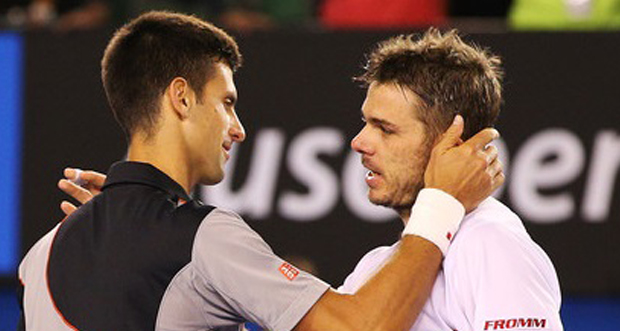
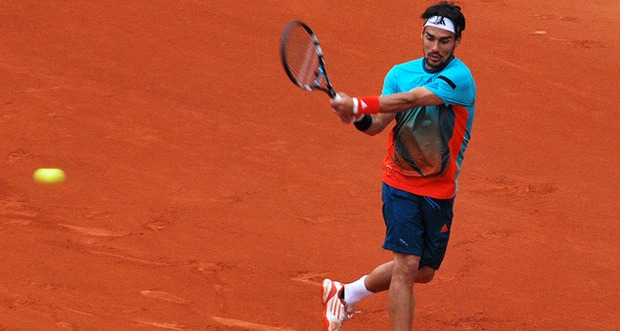
    Stanislas Wawrinka


    Stanislas Wawrinka produced the performance of his career to stun defending champion Novak Djokovic and march into the semifinals of the Australian Open.  The pair had met in two Majors last year with Djokovic triumphing in five sets on both occasions.  This time, the Swiss World No. 8 was not to be denied.

    Djokovic got off to a flying start by breaking Wawrinka twice to secure the opening frame 6-2. The Swiss finally made a breakthrough at 3-3 in the second set, capitalizing on a break point opportunity by unleashing a monstrous backhand that just clipped the line. The remainder of the set went with serve, allowing Wawrinka to level the match. It was the first set Djokovic had dropped during the entire tournament.

    An inspired Wawrinka broke twice in succession early in the third set to wrestle control of the match. He served it out and now the pressure was on his Serb opponent to match his intensity.

    The fourth set was a tightly contested affair before Djokovic broke the Wawrinka serve in the ninth game after coming back from 40-0 down.

    In common with their last three meetings at Grand Slam tournaments, this was going to a fifth and final deciding set.

    Both players had opportunities in the fifth and traded early breaks. The defining moment came at 7-8 on the Djokovic serve where the Serb shepherded a volley out of the court for Wawrinka to break and take the match in a nail-biting finish.

    [divider]

    Cover Photo: karlnorling, Creative Commons License

  • Hewitt Defeats Federer to Win Brisbane Title

    Hewitt Defeats Federer to Win Brisbane Title

    Brisbane - Hewitt

    32-year-old Australian Lleyton Hewitt ended a fine week at the Brisbane International by defeating old adversary Roger Federer in the final.

    Hewitt prevailed 6-4, 4-6, 6-3 in 2 hours and 7 minutes.

    An error-strewn opening set from Federer (22 unforced errors) helped Hewitt race out to an early lead.

    Federer battled back in the second and crucially broke for a 5-4 lead before sealing the second set with a powerful forehand.

    The Swiss maestro had chances in the deciding set but couldn’t capitalize on 7 break point opportunities, and Hewitt held on after breaking to 3-1 to secure the championship.

    “I didn’t play great today which is a bit unfortunate, but also Lleyton was the best player I played this week,” stated Federer in the post-match assessment.

    The victory secured Hewitt’s 29th ATP Tour title and first since 2010. He also moves back into the Top 50.

    “A lot depends on draws and how I play,” Hewitt replied when queried about his chances at the forthcoming Australian Open in Melbourne.

    [divider]

    Cover Photo (Creative Commons License): Marianne Bevis

  • Federer and Edberg Hook Up (Now Official)

    Federer and Edberg Hook Up (Now Official)

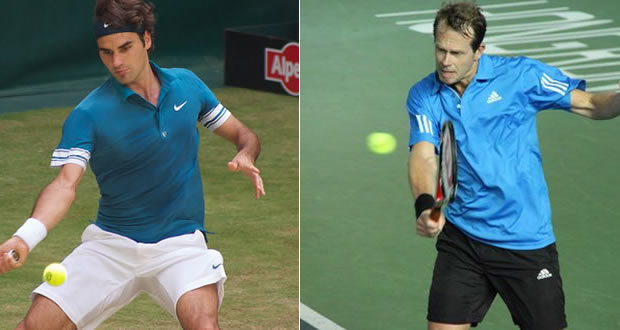
    Stefan Edberg has officially joined the Roger Federer coaching team for the 2014 season. The Swedish legend will travel with the Federer camp for around 10 weeks during the forthcoming year.

    Federer has described Edberg’s role in the context of providing inspiration and bringing a fresh pair of eyes to the camp rather than providing specific coaching.

    “I am sure he can bring a different angle to my game which is interesting,” stated Federer.

    Edberg, 47, is a former world No. 1 who won six singles and three doubles Majors, and has been described as a “childhood idol” by Federer during his formative years.

    The appointment comes on the heels of Novak Djokovic hiring Boris Becker as head coach. A third legend of the period, Ivan Lendl, has already had considerable success coaching within the Andy Murray camp.

    Edberg will join Federer initially in Australia. The appointment coincides with the Swiss maestro’s decision to try a racquet with a bigger frame at his first Brisbane International.

  • What’s Next?

    What’s Next?

    WTF Winner - Djokovic 3

    The Barclay’s ATP World Tour Finals, Final

    [2] Novak Djokovic def [1] Rafael Nadal 6-3, 6-4

    [6] Verdasco/Marrero def [1] Bryan/Bryan 7-5, 6-7 (3), 10-7


    Hello.

    I know. It’s been awhile. And I’m sorry about that. But I did bring excuses. Some of them are even good ones. Others are distinctly less good-– such as, for instance, would you believe that a few days after the US Open final a convocation of eagles flew in through my office window and made off with my laptop? Or that in October a lamentation of swans invaded my living room and ate the TV? A bevy of larks broke in last week and took off with all my pens? Or, wait, here’s one: How about that I kept trying to watch Asian Swing tennis after work but the Tennis Channel was only showing matches from 2012? (Bingo!) See, a whole flock of excuses. But suffice it for now to say: I’m back, and just in time to say goodbye to another tennis season, to close the book on a heroic tale so many tennis fans fervently hope is only half-finished. That’s right — I’m talking about Fernando Verdasco’s doubles career.

    The Spaniard and his compatriot, David Marrero, defeated the No. 1 ranked Bryan brothers 10-7 in the super tiebreak to claim the WTF beribboned doubles cup. The celebration and victory speech from the Spanish pair could hardly have been more emotional and touching, even by Verdasco’s extraverted, emoticoned standards. I only got home to my TV (a special swan-proof model) in time to see Verdasco win the final point of the match (a serve), and even without knowing anything about the dramatic arc of the match, I was immediately caught up in the exuberance of the moment. First, Verdasco fell joyfully to the ground. Then he got back up, leapt into his partner’s arms and hugged him with all four limbs before running to the sidelines to hug an entire century’s worth of Spaniards. Verdasco then wrote twelve stanzas of free verse poetry on the TV camera lens, and joined forces with Marrero—who became emotionally overcome while dedicating the victory to his late grandfather—to give the season’s most heartwarming acceptance speech. It was a lovely moment, and made me wish I’d seen the tennis that inspired it. (After the trophy presentation both men were stripped from the waist up, interviewed, and made to declare their intention to, first put clothes on, and then go eat Spanish food in South Kensington. Huzzah.)

    I did, however, see all the points of the thirty-ninth chapter in the Nadal v. Djokovic rivalry. So far as tennis rivalries go, it’s hard to fathom how anybody could still argue against this one being among the very best. The pair has met fifteen times since 2011, and all but two of those encounters were tournament finals. (Both other meetings were semifinals:  Roland Garros and Beijing in 2013. The match on the Paris clay was made of such high-quality drama that I wouldn’t be surprised if, going forward, it’s frequently misremembered as the tournament final.) Sure, the six-hour-long Australian Open final in 2012 could be accused of being a too-drawn-out slug-fest, but the rivalry has matured considerably over the past two years, with both players (and their ever-present support squads) devising new and more intricate ways to torture each other on the tennis court.

    Unfortunately, no matter how good the rivalry, an individual tennis match tends not to soar to the outer-reaches of greatness when one half of the participants forgets to bring his forehand to the court. Novak Djokovic, ever the generous competitor, tried to make up for Rafael Nadal’s absentmindedness by playing super incredibly well from pretty much everywhere on the court, but no matter how hard he tried, he couldn’t quite compensate for Rafa’s missing forehand. (Even Djokovic isn’t quick enough to return his own serves.)

    The world No. 2 held easily to open the match, then broke fairly easily, then held again. By the time we reached 3-0 in the opening set Novak had won 12 points to Nadal’s four, and Rafa’s game was looking as if his second serve might have run off with his forehand (probably to South Kensington to eat gambas al ajillo with Fernando). When Djokovic nearly broke the Spaniard again in the fourth game, the Serb decided he had to change tactics if there was any hope of elevating this edition of The Rivalry off the plywood floor. So, Djokovic started to make strange errors on his own forehand wing, and the backhand one, too. And it worked like a charm. Rafa held, and then broke back, and then held again.

    By now—we’re at 3-3 in the first, in case you’ve lost count—Djokovic realized that if he went on smothering his forehand and forcing his backhand wide, he might actually not win the match, especially considering that Nadal had begun to play somewhat more assertively and that wary, feral gleam was now visible in the Spaniard’s eyes. Since losing the final of the Barclay’s ATP World Tour Finals would have been no good at all for Djokovic’s twenty-something match win streak (tennis players tend to prefer their streaks to their rivalries), he resumed playing incredibly well and quickly went back to winning the match.

    The highlight of the day came on break point at 3-4 on Nadal’s serve. The point, which you must watch if you haven’t seen it, featured stunning movement and hands from both men. But it was Djokovic who hit the eye-popping lob and Djokovic who won the point, and therefore it was the Serb who was entitled to claim the bonus loot, aka “the manna of destiny.” In the next game, Nadal won a point almost as good to go up 30-15 on Djokovic’s serve—Rafa slammed a muscular forehand down-the-line and followed it up by a no-look jumping backhand volley winner—but Djokovic got a lucky net cord the very next point and therefore collected double manna, which he promptly cashed in for an ace on set point.

    From there the Serb looked like he was made of starswhile Rafael Nadal kept on fending off break points like a man who refused to be forced to earth. (Nadal defended 8 of 11 break points, compared with Novak’s 2 of 3.) But despite Nadal’s best psychological efforts, and perhaps because of several forehand errors, Djokovic still managed to break early in the second set. It should be said that Rafa brought his full measure of grit to the contest—fighting off two championship points before sending one of his trademark forehands just wide on the third— but he simply did not have the game today, while Djokovic had more than plenty. The final score was a surprisingly straightforward 6-3, 6-4.

    After the match, as I waited patiently for the ATP Steering Committee to take their places near the trophy table, and for a nice lady named Rebecca to walk the trophy out onto the court, I took a moment to reflect on the state of men’s tennis today. Yesterday’s WTF semifinals featured Federer, Nadal, Djokovic, and Stanislas Wawrinka. Federer has career 77 titles, Nadal has 60, Djokovic now has 41. The 27-year-old Wawrinka has collected four. Nadal eased by Federer in the first semifinal, despite being outplayed in throughout most of the first set. Wawrinka was psychologically overmatched from the start and didn’t offer Djokovic anything like the fight he showed in Australia or New York. And while I agree with Darren Cahill that Roger Federer is likely to have a better 2014 than his 2013, he is 32 years old. Who’s next?

    Even if Nadal didn’t play anything like his best tennis today, both men belonged in the final ATP match of the year. They’ve been several cuts above the competition for the majority of the season. Nadal will finish the “most emotional season” he’s had as the No. 1 ranked player in the world. Djokovic will be right behind him, at No. 2, with a Major title to defend in two months’ time. As exciting as it’s going to be to watch and see where 2014 takes this rivalry, it’s hard to imagine who is going to be able to hang in there with these two. Healthy versions of Murray, Federer, and del Potro? Pierre-Hugues Herbert? Martin Alund? Whomever he is, he’s going to need to be very good at tennis, and even better at summoning destiny.

    When Novak Djokovic accepted his WTF trophy, he thanked the London crowd for coming out all week to watch tennis. “Thank you for appreciating what we do,” he said. “It means a lot to us.” This isn’t the first time Djokovic has thanked a crowd for hanging in there through a tournament or a match. He has a way of sounding not only grateful, but also surprised that people turn up to watch him—one of the greatest tennis players in the game—play great tennis. Nadal and Djokovic will both take home more than a million dollars for their London efforts, but it’s still the human recognition that counts. That’s heartwarming. Not quite a Fernando-Verdasco-hug level heartwarming, but nice nonetheless.

    It’s also why I would like somebody to tell Djokovic—and Rafa and the rest—that I have plans to fly all the way across the Pacific Ocean to turn up to watch them play tennis at the Australian Open. I’m sure it will mean a lot to them. It also means that I will be able to write to you all about it. And that means a lot to me.

    Cover Photo (Creative Commons License): Marianne Bevis