Tag: world tour finals

  • 2015 ATP World Tour Finals: Title Match Preview

    2015 ATP World Tour Finals: Title Match Preview

    16055198803_c453b99b81_z

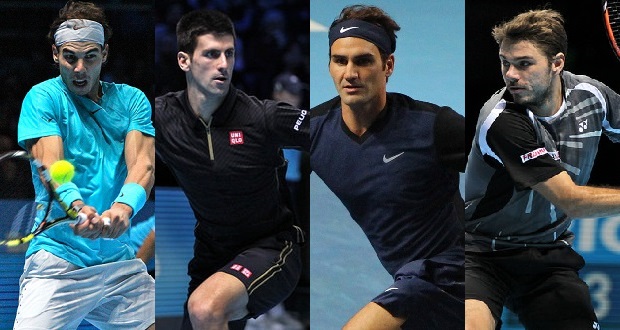
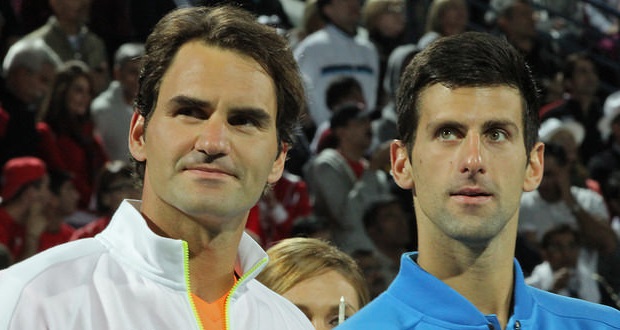
    As predicted in the tournament preview here this time last week, Novak Djokovic and Roger Federer shall contest today’s final of the season ending finale. It is fitting that the two best players of the year, who have contested six finals this season, should lock horns in the final tour match of the year.

    Unlike last year, with the spectre of the Davis Cup Final lurking in the background, Federer can go into this match knowing that he can go flat out with no playing obligations until January of next year. Neither has he exerted himself physically nor emotionally in his semi-final against Wawrinka as he did last year, the result of which was a precautionary pull out of the final due to a tender back and representing his country in the Davis Cup final the following weekend. Federer has many incentives to win. Posting two wins in a week against Novak would be quite a punctuation mark with which to close the season out with. He would also have some momentum going into next season, being undefeated in five matches against his top eight peers. Furthermore, were he to haul the trophy tonight, he would climb back to number two in the world, crucial with regards to being seeded high at the Australian Open in January and avoiding meeting Djokovic before the final, and the potential of threatening rivals all being clumped together on the opposite side of the draw.

    Djokovic meanwhile has masses to play for in tonight’s match. He can add a career best eleventh title in a season to cap off his best season in which the smallest title he won was a lucrative 500 point event in Beijing. He can also match Sampras’ and Lendl’s haul of five year end championships, putting him within striking distance of record holder Federer’s six. Finally, today is an opportunity to once again tie Federer in their head to head tally, and with the opportunity to face his Swiss nemesis on favourable slow hard courts and clay in the first third of next season, surely there has never been a better opportunity to put himself in a position to inch ahead of Roger for the first time in their nine year rivalry?

    In terms of their form there is little to choose between the pair. Both suffered blips in form in the group stages, Federer losing a set in a scrappy affair against Nishikori, whilst Novak lost his sole match of the tournament against Roger earlier in the week. Both have looked imperious though in all other matches besides, saving some of their best for yesterday’s semi-final clashes. Novak beat Nadal for the fourth time this season in an increasingly one-sided rivalry, Whilst Roger vanquished Wawrinka after initially losing an early break, extending his lead over his countryman to 18-3.

    I expect a thrilling match this evening. Both are excellent indoor players, each has won a title in these conditions in recent weeks. I will give the edge to Djokovic in this encounter. I think that he is a quick learner, he will thus have analysed how Federer hurt him in Tuesday’s clash, and will make a concerted effort to hurt him on the return, hit with depth to pin Federer back, and hit his signature backhand down the line at every available opportunity. The longer he stretches out the match, turns it into a war of attrition, the more errors he will draw from the Swiss. If Federer comes out of the blocks quickly though, serves at a high percentage, dictates from on top of the baseline, and is able to be at his slicing and dicing best, attacking the net intelligently and with purpose, he could frustrate the Serbs rhythm sufficiently to snatch the victory.

    Novak to win in three sets.

    Author’s Blog: danopines22

    [divider]

    Cover Photo (Creative Commons License): Marianne Bevis

  • 2015 World Tour Finals: Semifinals Preview

    2015 World Tour Finals: Semifinals Preview

    11206695823_bd037c35af_z

    First Semi-final: Djokovic vs. Nadal

    Nadal has been the standout player of not only his group, but perhaps the tournament. He dealt with Wawrinka and Murray pretty tamely, dispatching both in straight sets, whilst surviving a tenacious challenge from compatriot Ferrer to come back and win the final two sets on Friday. This is a timely bit of form for Nadal, beating three quality opponents on his least favourite surface in his poorest season in a decade.

    Djokovic has equally surprised. He destroyed Nishikori in straight sets, but wasn’t at his sharpest against an inspired Federer on Tuesday, falling in straight sets. This was not a great surprise, Federer perhaps being the greatest indoor player in history, as well as Novak’s only regular challenger this season. Nevertheless, the manner in which he fell away in the second set against the Swiss is cause for minor concern. He restored order to his world mind on Thursday, taking down Berdych, who offered some resistance, in two sets.

    I think Ferrer is akin to Djokovic, but without the weapons. He was able to push Rafa with defence and speed. Novak possesses these attributes, but in greater abundance. Furthermore, he has a strong serve, the best backhand in the game, and the ability to dictate and finish points quickly. I think therefore, despite his loss to Federer, form and the recent history of their rivalry shall see the Serb prevail. He has Nadal’s number now, likes the rhythm of their rallies and enjoys the edge in physicality. Nadal has been showing glimpses of brilliance this week, but it would take his sustaining of that level in combination with Djokovic turning up sluggish and error prone to cause the upset.

    Second Semi-Final: Federer vs. Wawrinka

    It had to happen again, didn’t it? Last year the Swiss pair met in the semi-finals and delivered a pulsating contest that was far and away the match of the tournament. It was also a heated contest. Tensions were high throughout, Wawrinka exchanging words with Mrs. Federer. Roger saved five match points before staggering over the line. The match, which was a highly physical and emotional affair, left Federer in such poor shape he was unable to contest the final.

    Federer has enjoyed a great tournament so far. He made short work of Berdych in his first round match, before dispatching Novak in straight sets in his second with an awesome display offence and variety. He had his struggles in his last match against Nishikori, producing multiple errors and breaks, and also looked tired out in stretches of the match before attacking decisively to win whilst Kei served to stay in the match. I suppose having already won the group, the last match was as good a one as any to have a sluggish performance and set off the alarm bells for coach Edberg for what needs to be worked on for the weekend.

    Wawrinka has had to work harder than his countryman to reach this stage. Wawrinka was a shadow of himself in his opening match against Nadal, falling meekly in a match I thought would be an epic contest. This was seemingly a blip though, as he turned things around from thereon in to beat Ferrer and Murray in straight sets.

    I think Roger has the edge in this encounter. If physicality is not an issue, I believe variety and a generally good run of recent indoor form will see him through Wawrinka. Federer leads their head-to-head 17-3, and has only ever lost to Stan on clay surfaces. Wawrinka likes the high ball, and Federer has of late used his slice and court craft to offer opponents low bouncing, off pace balls. This could be decisive against Stan, a player who benefits much with time to set up his strokes. Further, Stan is a good rather than great mover, and I think Federer will do everything he can to get his man chasing awkward shots. I expect a tight affair and a shot making exhibition. I think if the Federer which beat Djokovic and Berdych turns up, as opposed to the one who edged Nishikori, we will see him contest tomorrow’s final.

    Author’s Blog: World Tour Finals: Semifinal Preview

    [divider]

    Cover Photos (Creative Commons License): By Marianne Bevis.
    Followed by the name, such as Marianne Bevis

  • 2015 ATP World Tour Finals Preview

    2015 ATP World Tour Finals Preview

    15612895007_1565dcee0d_z

    ‘The end is here’ ‘The Final showdown’ ‘The Stage Is Set’ ‘Insert overdramatic cliché’. Yes, ATP overkill at its finest. But cynicism aside, I am of course looking forward to the season ending shindig in London. It is a pleasure to see the best players in the world battle it out for a colossal sum of money and ranking points. Not bad for a week’s work, that’s for sure.

    There is little change in the line-up since last year’s event, with Nadal and Ferrer replacing Milos Raonic and Marin Cilic in the eight man field, although Ferrer was an alternate last year. The event is a great yardstick of both season long consistency, but even more so of longevity. This shall be Berdych’s sixth straight year of qualification, Ferrer’s fifth, Djokovic’s ninth and one Mr Roger Federer’s fifteenth. The other four meanwhile have all made multiple appearances, again a testament to the depth and quality atop the men’s game.

    On the subject of depth and quality, Novak Djokovic stands a head higher than even his closest competitors at the event, and as I breakdown the draws and offer my thoughts, it becomes clear: All roads pass through Novak in the quest to haul in the trophy a week from Sunday.

    Group A

    This group, consisting of Djokovic, Federer, Berdych and Nishikori, is for me the more likely of the two to see the big names advancing.

    Novak leads Berdych a lopsided 20-2 in their head to head, never having lost to the Czech on a hard court. Berdych has enjoyed some form this autumn, but even his biggest shots seem to make little indentations in the Serb’s defences. Nishikori has enjoyed a bit more success against Djokovic, winning two of their six matches, including at the US Open last year. In addition, Nishikori pushed Novak at the World Tour Finals last year in one of the few matches that weren’t duds. With Kei’s lack of matches lately though, and Djokovic’s imperious form, I suspect Djokovic to come through these two hassle free.

    Federer, although not as dominant over the afore mentioned pair as Djokovic, still enjoys healthy head to heads against both. Against Berdych the Swiss leads 14-6. Berdych does not seem to have as big a block against Roger compared to the more defensive members of the ‘big four’, his big game when clicking can overcome him, including twice in Slams. Federer has not lost to Tomas though since an injury plagued 2013, winning the last three matches. I think Berdych could trouble the Swiss, especially when one looks at his recent loss to the big hitting Isner in Paris, but the court in London has in recent years yielded a slower bounce, which should aid Federer in nullifying Berdych’s power.

    What of the marquee matchup between the two most successful players of the season? It seems strange for Novak and Roger to meet in the round robin stage of the tournament, but that is the nature of rolling rankings and contributes towards the excitement of this unique event. There is little to choose between the pair going into the tournament, Federer triumphing in Basel, Djokovic a week later in Paris. Both are in fine fettle, and play some of their best indoors. Based on his sheer dominance in the last few months, Novak for me edges their encounter.

    Group Winner: Djokovic

    Group Runner Up: Federer

    Group B

    The other group, consisting of Murray, Wawrinka, Nadal and Ferrer, offers more in the way of unpredictability and intrigue than the first.

    Murray is in a rich vein of form, reaching the Paris Masters final before falling tamely to Djokovic. He will benefit from home crowd support, and is a fine indoor player. Although trailing Nadal 6-15 in their head to head, this is not the same Nadal of late, Murray beating him on the home clay of Madrid in their last meeting this year. Murray has had a better season, and I think in terms of speed, fitness and form the Scot starts out as favourite against Rafa. In his last meeting with Ferrer, recently in Paris, he overcame him in two straight forward sets, and leads their series 11-5, as well as having won their last three indoor meetings. Ferrer has enjoyed a successful autumn, but Murray would start as a clear favourite. Murray’s match with Wawrinka should prove to be the hardest. While he leads the Swiss 8-4, Stan won their last two encounters in 2013, and they have not met since in a period where he became a two time slam winner. I would not be surprised to see Wawrinka power through the Scot, as he did last time they met.

    Stan Wawrinka comes to London having enjoyed the best year of his career. Nadal was long a nemesis for him, leading their head to head 13-3. Stan has put things to rights in recent years however, winning three of their last four meetings,  including on Nadal’s beloved clay earlier this year, and then in two pulsating sets in Paris in similar conditions to London last week. If Wawrinka hits his offensive stride, I see him edging the Spaniard. Against Ferrer meanwhile, Stan, whilst trailing 6-7, he has won their last three meetings. Ferrer can certainly hang in there with the more powerful Swiss, still prone to bouts of inconsistency, but Stan remains the favourite.

    Nadal has done well in making the finals in London, having a rather modest year by his lofty standards, winning just three minor titles. He has qualified the hard way, but qualified all the same. He has shown some good form in the indoor season, stretching Federer, perhaps the greatest indoor player in history, to three sets in the Basel Final, before falling in a tight quarterfinal last week in Paris. I have already above given two opponents an edge over Nadal in his group, and I struggle to see him making the semi-finals this year. All the same, it would be a great end to the year for Nadal to score a win against his friend and rival, the dogged David Ferrer. Rafa enjoys a 23-6 lead in their matches, and won their sole meeting this year in Monte Carlo. Ferrer is nevertheless an effective indoor player, coming into London with two trophies at indoor events. Furthermore, four of his six wins against his compatriot were on hard courts, two of them indoors. This match represents both men’s best chances of a win in London, and the accompanying $167,000 and 200 ranking points. Expect an entertaining slugfest in their final encounter of the year.

    Group Winner: Murray

    Group Runner Up: Wawrinka

    Semi-Finals

    Federer Defeats Murray

    Djokovic Defeats Wawrinka

    Final

    Djokovic Defeats Federer

    [divider]

    Link to author Daniel Edwards’ blog

    Cover Photo (Creative Commons License): Marianne Bevis

  • The Bryan Brothers Reign Again in London

    The Bryan Brothers Reign Again in London

    Bryan Brothers Mike Bryan Bob Bryan

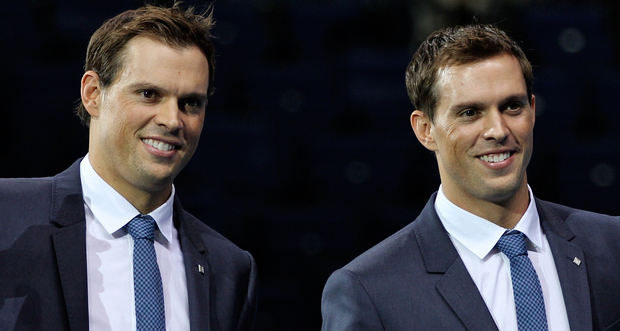
    Bob and Mike Bryan beat Ivan Dodig and Marcelo Melo in the final of the Barclays ATP World Tour finals, 6-7(5), 6-2, 10-7.

    In the first set, both teams were able to hold serve easily, barely losing a point on serve. In the tiebreak, Dodig/Melo managed to pull out a mini-break lead, and clenched the set when Mike Bryan returned a serve wide.

    At 1-2 in the second set, Melo quickly got down 15-40. They managed to save the first break point, but lost the game on a double fault.

    Serving to stay in the set, Melo again went down double break point, and this time Bob Bryan grabbed the set with a backhand volley.

    The super-tiebreak opened with a flurry of mini-breaks. Eventually the Bryans pulled out a 9-7 lead, and on championship point, Melo sent a lob long.

    This was the Bryan brothers’ fourth time winning the prestigious year-end championship. They had previously won in 2003, 2004, and 2009.

    [divider]

    Cover Photo (Creative Commons License): Marianne Bevis

  • Barclays ATP World Tour Finals: Final – Order of Play & Scores

    Barclays ATP World Tour Finals: Final – Order of Play & Scores

    Roger Federer Novak Djokovic

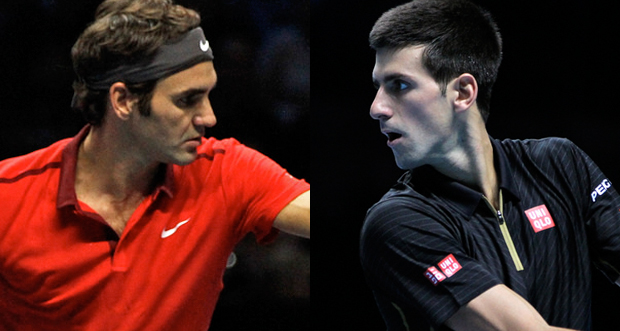
    On Sunday, November 16, in the final of the Barclays ATP World Tour Finals, World No. 1 and defending champion Novak Djokovic will face World No. 2 and six-time year-end championship winner Roger Federer. In the doubles final, the Bryan brothers will play the team of Ivan Dodig and Marcelo Melo for the title.

    [Scores added as known. All times are local.]

    [divider]

    Doubles — 3:30 P.M.
    Bryan/Bryan vs Dodig/Melo

    Singles — 6:00 P.M.
    Djokovic vs Federer

    [divider]

    Click here to discuss the Djokovic/Federer final in the discussion forum.

    [divider]

    Cover Photo (Creative Commons License): Marianne Bevis

  • Barclays ATP World Tour Finals – Semifinals – Order of Play & Scores

    Barclays ATP World Tour Finals – Semifinals – Order of Play & Scores

    Roger Federer Stan Wawrinka Novak Djokovic Kei Nishikori

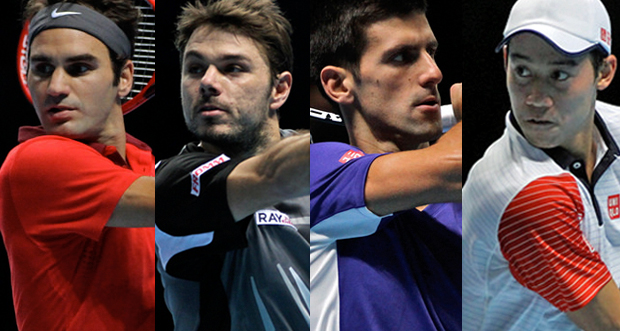
    The semifinals of the Barclays ATP World Tour Finals will take place on Saturday, November 15. The afternoon session pits Novak Djokovic, who just secured the year-end No. 1 ranking, against the US Open finalist Kei Nishikori. The evening session features 17-time Grand Slam titlist Roger Federer, who will face his compatriot Stan Wawrinka, this year’s Australian Open champion.

    [Scores added as known. All times are local.]

    [divider]

    Afternoon Session:

    Doubles — 12:00 P.M.
    Dodig/Melo d Kubot/Lindstedt — 4-6, 6-4, 10-6

    Singles — 2:00 P.M.
    Djokovic d Nishikori — 6-1, 3-6, 6-0

    [divider]

    Evening Session:

    Doubles — 6:00 P.M.
    Bryan/Bryan d Benneteau/Roger-Vasselin — 6-0, 6-3

    Singles — 8:00 P.M.
    Federer d Wawrinka — 4-6, 7-5, 7-6(6)

    [divider]

    Click here to discuss the Barclays ATP World Tour Finals semifinals in the discussion forum.

    [divider]

    Cover Photo (Creative Commons License): Marianne Bevis

  • Barclays ATP World Tour Finals – Day 6 – Order of Play & Scores

    Barclays ATP World Tour Finals – Day 6 – Order of Play & Scores

    Novak Djokovic Stan Wawrinka Tomas Berdych Marin Cilic

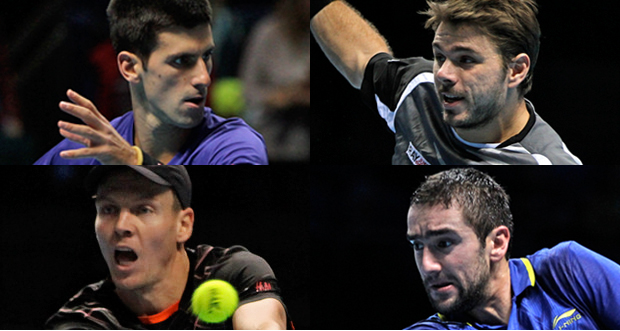
    Round robin play at the Barclays ATP World Tour Finals concludes on Friday, November 14. The afternoon session features World No. 1 and the defending champion Novak Djokovic, facing off against the Czech Tomas Berdych. The evening session will conclude with Australian Open champion Stan Wawrinka playing the US Open champion Marin Cilic.

    [Scores added as known. All times are local.]

    [divider]

    Afternoon Session:

    Doubles — 12:00 P.M.
    Kubot/Lindstedt d Rojer/Tecau — 6-5, 7-6(4)

    Singles — 2:00 P.M.
    Djokovic d Berdych — 6-2, 6-2

    [divider]

    Evening Session:

    Doubles — 5:45 P.M.
    Bryan/Bryan d Peya/Soares — 7-6(3), 7-6(2)

    Singles — 8:00 P.M.
    Wawrinka d Cilic — 6-3, 4-6, 6-3

    [divider]

    Click here to discuss the Day 6 matches in the discussion forum.

    [divider]

    Cover Photo (Creative Commons License): Marianne Bevis

  • What’s Next?

    What’s Next?

    WTF Winner - Djokovic 3

    The Barclay’s ATP World Tour Finals, Final

    [2] Novak Djokovic def [1] Rafael Nadal 6-3, 6-4

    [6] Verdasco/Marrero def [1] Bryan/Bryan 7-5, 6-7 (3), 10-7


    Hello.

    I know. It’s been awhile. And I’m sorry about that. But I did bring excuses. Some of them are even good ones. Others are distinctly less good-– such as, for instance, would you believe that a few days after the US Open final a convocation of eagles flew in through my office window and made off with my laptop? Or that in October a lamentation of swans invaded my living room and ate the TV? A bevy of larks broke in last week and took off with all my pens? Or, wait, here’s one: How about that I kept trying to watch Asian Swing tennis after work but the Tennis Channel was only showing matches from 2012? (Bingo!) See, a whole flock of excuses. But suffice it for now to say: I’m back, and just in time to say goodbye to another tennis season, to close the book on a heroic tale so many tennis fans fervently hope is only half-finished. That’s right — I’m talking about Fernando Verdasco’s doubles career.

    The Spaniard and his compatriot, David Marrero, defeated the No. 1 ranked Bryan brothers 10-7 in the super tiebreak to claim the WTF beribboned doubles cup. The celebration and victory speech from the Spanish pair could hardly have been more emotional and touching, even by Verdasco’s extraverted, emoticoned standards. I only got home to my TV (a special swan-proof model) in time to see Verdasco win the final point of the match (a serve), and even without knowing anything about the dramatic arc of the match, I was immediately caught up in the exuberance of the moment. First, Verdasco fell joyfully to the ground. Then he got back up, leapt into his partner’s arms and hugged him with all four limbs before running to the sidelines to hug an entire century’s worth of Spaniards. Verdasco then wrote twelve stanzas of free verse poetry on the TV camera lens, and joined forces with Marrero—who became emotionally overcome while dedicating the victory to his late grandfather—to give the season’s most heartwarming acceptance speech. It was a lovely moment, and made me wish I’d seen the tennis that inspired it. (After the trophy presentation both men were stripped from the waist up, interviewed, and made to declare their intention to, first put clothes on, and then go eat Spanish food in South Kensington. Huzzah.)

    I did, however, see all the points of the thirty-ninth chapter in the Nadal v. Djokovic rivalry. So far as tennis rivalries go, it’s hard to fathom how anybody could still argue against this one being among the very best. The pair has met fifteen times since 2011, and all but two of those encounters were tournament finals. (Both other meetings were semifinals:  Roland Garros and Beijing in 2013. The match on the Paris clay was made of such high-quality drama that I wouldn’t be surprised if, going forward, it’s frequently misremembered as the tournament final.) Sure, the six-hour-long Australian Open final in 2012 could be accused of being a too-drawn-out slug-fest, but the rivalry has matured considerably over the past two years, with both players (and their ever-present support squads) devising new and more intricate ways to torture each other on the tennis court.

    Unfortunately, no matter how good the rivalry, an individual tennis match tends not to soar to the outer-reaches of greatness when one half of the participants forgets to bring his forehand to the court. Novak Djokovic, ever the generous competitor, tried to make up for Rafael Nadal’s absentmindedness by playing super incredibly well from pretty much everywhere on the court, but no matter how hard he tried, he couldn’t quite compensate for Rafa’s missing forehand. (Even Djokovic isn’t quick enough to return his own serves.)

    The world No. 2 held easily to open the match, then broke fairly easily, then held again. By the time we reached 3-0 in the opening set Novak had won 12 points to Nadal’s four, and Rafa’s game was looking as if his second serve might have run off with his forehand (probably to South Kensington to eat gambas al ajillo with Fernando). When Djokovic nearly broke the Spaniard again in the fourth game, the Serb decided he had to change tactics if there was any hope of elevating this edition of The Rivalry off the plywood floor. So, Djokovic started to make strange errors on his own forehand wing, and the backhand one, too. And it worked like a charm. Rafa held, and then broke back, and then held again.

    By now—we’re at 3-3 in the first, in case you’ve lost count—Djokovic realized that if he went on smothering his forehand and forcing his backhand wide, he might actually not win the match, especially considering that Nadal had begun to play somewhat more assertively and that wary, feral gleam was now visible in the Spaniard’s eyes. Since losing the final of the Barclay’s ATP World Tour Finals would have been no good at all for Djokovic’s twenty-something match win streak (tennis players tend to prefer their streaks to their rivalries), he resumed playing incredibly well and quickly went back to winning the match.

    The highlight of the day came on break point at 3-4 on Nadal’s serve. The point, which you must watch if you haven’t seen it, featured stunning movement and hands from both men. But it was Djokovic who hit the eye-popping lob and Djokovic who won the point, and therefore it was the Serb who was entitled to claim the bonus loot, aka “the manna of destiny.” In the next game, Nadal won a point almost as good to go up 30-15 on Djokovic’s serve—Rafa slammed a muscular forehand down-the-line and followed it up by a no-look jumping backhand volley winner—but Djokovic got a lucky net cord the very next point and therefore collected double manna, which he promptly cashed in for an ace on set point.

    From there the Serb looked like he was made of starswhile Rafael Nadal kept on fending off break points like a man who refused to be forced to earth. (Nadal defended 8 of 11 break points, compared with Novak’s 2 of 3.) But despite Nadal’s best psychological efforts, and perhaps because of several forehand errors, Djokovic still managed to break early in the second set. It should be said that Rafa brought his full measure of grit to the contest—fighting off two championship points before sending one of his trademark forehands just wide on the third— but he simply did not have the game today, while Djokovic had more than plenty. The final score was a surprisingly straightforward 6-3, 6-4.

    After the match, as I waited patiently for the ATP Steering Committee to take their places near the trophy table, and for a nice lady named Rebecca to walk the trophy out onto the court, I took a moment to reflect on the state of men’s tennis today. Yesterday’s WTF semifinals featured Federer, Nadal, Djokovic, and Stanislas Wawrinka. Federer has career 77 titles, Nadal has 60, Djokovic now has 41. The 27-year-old Wawrinka has collected four. Nadal eased by Federer in the first semifinal, despite being outplayed in throughout most of the first set. Wawrinka was psychologically overmatched from the start and didn’t offer Djokovic anything like the fight he showed in Australia or New York. And while I agree with Darren Cahill that Roger Federer is likely to have a better 2014 than his 2013, he is 32 years old. Who’s next?

    Even if Nadal didn’t play anything like his best tennis today, both men belonged in the final ATP match of the year. They’ve been several cuts above the competition for the majority of the season. Nadal will finish the “most emotional season” he’s had as the No. 1 ranked player in the world. Djokovic will be right behind him, at No. 2, with a Major title to defend in two months’ time. As exciting as it’s going to be to watch and see where 2014 takes this rivalry, it’s hard to imagine who is going to be able to hang in there with these two. Healthy versions of Murray, Federer, and del Potro? Pierre-Hugues Herbert? Martin Alund? Whomever he is, he’s going to need to be very good at tennis, and even better at summoning destiny.

    When Novak Djokovic accepted his WTF trophy, he thanked the London crowd for coming out all week to watch tennis. “Thank you for appreciating what we do,” he said. “It means a lot to us.” This isn’t the first time Djokovic has thanked a crowd for hanging in there through a tournament or a match. He has a way of sounding not only grateful, but also surprised that people turn up to watch him—one of the greatest tennis players in the game—play great tennis. Nadal and Djokovic will both take home more than a million dollars for their London efforts, but it’s still the human recognition that counts. That’s heartwarming. Not quite a Fernando-Verdasco-hug level heartwarming, but nice nonetheless.

    It’s also why I would like somebody to tell Djokovic—and Rafa and the rest—that I have plans to fly all the way across the Pacific Ocean to turn up to watch them play tennis at the Australian Open. I’m sure it will mean a lot to them. It also means that I will be able to write to you all about it. And that means a lot to me.

    Cover Photo (Creative Commons License): Marianne Bevis
  • Direction and Magnitude

    Direction and Magnitude

    WTF Winner - Djokovic 1

    World Tour Finals, Final

    (2) Djokovic d. (1) Nadal, 6-3, 6-4

    Novak Djokovic tonight defeated Rafael Nadal in the final of the World Tour Finals, an unlovely sentence to commemorate a forgettable match. It was the third time in the last four years that the top two players have closed out the ATP season, but the first time it has been these two. I suppose it had to happen eventually, since they seem to have played finals everywhere else. Consequently everyone knew what to expect, especially given the glacial surface: an extended defensive slog based around the repetition of readily identifiable patterns. As with minimalism – which people persistently confuse with simplicity – great complexity is achieved by the reiteration of basic blocks, not to mention great length. No one expected it to be simple, and no one expected it to be quick.

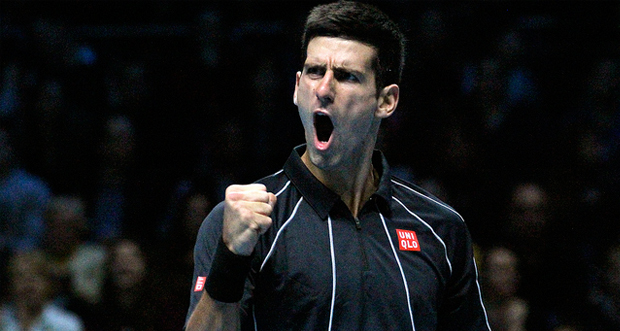
    I confess to feeling some relief when everyone was proved wrong, at least when it came to length. When two players face each other thirty-nine times – an Open Era record – it’s inevitable that not all of them with be classics, although one hoped that the last match of a memorable season would turn out to be a bit less forgettable. Alas, Nadal commenced nervously and never entirely settled. Meanwhile, Djokovic was fierce initially – tearing out to a 3-0 lead – then meek for a while, and then forceful all the way until the end. He seemed to hold break points in most of Nadal’s service games, but only reciprocated the favour once to be broken back in the first set. Whatever hope this kindled of a competitive match was lessened by the consideration that the quality wasn’t high enough that you’d necessarily want to see more of it, then doused entirely when Djokovic lifted again. The point with which he re-broke Nadal to claim the eighth game ranks among the finest defensive efforts I have ever seen, a masterpiece of thrust, parry, loft, and touch. Djokovic’s bellow afterwards was long and lusty, and certainly justified. Most of us will never do anything nearly so masterful in that atmosphere for those stakes.

    Djokovic broke early in the second set – more shouting – and threatened to do so repeatedly as the set wore down. Insurance breaks are nice, but aren’t necessary if you never face calamity (like all insurance, really). The Serb was never again threatened on serve, rarely conceded the baseline, and ended up with atypically excellent numbers at the net. Nadal was almost always on the move, and even when he could set his feet on a forehand found it hard to shift his opponent for long. The length on his groundstrokes was a constant problem, except for Djokovic.

    In truth Djokovic was the real problem. Afterwards Nadal conceded that his opponent had simply been too good. On this surface, playing at his best, Djokovic truly is. The homogenisation of the court surfaces has helped ensure that these two end up facing each other at nearly every tournament everywhere, and that when they do they barely have to alter their basic game, but between them the surface still matters. Nadal is better on clay, and Djokovic is superior on hard court, assuming both men play at their best. In both cases the gap is closing, but it is still there.

    Since the beginning of his career, Nadal fading through the late part of the season, has come to feel like a structural requirement of men’s tennis, although it says a lot about his magisterial 2013 season that losing in the final of the year end championships can be construed as a letdown. It is also a testament to his evolving mastery of all surfaces that one’s definition of “late” has had to be pushed further and further back as the years rolled by. Initially that late part of Nadal’s year kicked off very early — once the main clay tournaments were over. Admittedly that was long ago, when he was very young. Soon he learned to commence fading after Wimbledon, with the results petering out by the US Open. In 2008 he became a factor in the later stages in New York, and has never since failed to reach at least the semifinals, assuming he turns up at all.

    Yet the period after the year’s final Major – pollen-choked Australians find it difficult to call this the “fall season” – has remained unaccountably lean. In his entire career he has won just two titles after the US Open, and one of those was in 2005 in Madrid, enabled by an extravagant collapse from Ivan Ljubicic. That remains Nadal’s only indoor title, since the Ariake Coliseum roof remained open through his Tokyo title run in 2010, his other career title in what northern hemisphere fans obdurately refuse to term “the Australian Spring”. But this year one could be forgiven for assuming the usual rules don’t apply, especially on hard courts. Up to and including the US Open, Nadal hadn’t lost a tournament on that surface. After that he contested four events – the same ones as Djokovic – and for all that he seemed more determined than ever to capture the few important titles that have eluded him, and didn’t win any. That’s nothing to be ashamed of, of course. Winning these things is really, really hard.

    Djokovic, of course, won them all, though in the process lost his No. 1 ranking. The extent to which those two events are connected is open for debate. Some felt that losing the top spot firmed his resolve. There’s probably something to this. After a strong start to the year Djokovic’s form grew patchy, even within matches. Transcendent sets would be interleaved with uncharacteristic dreck, as he would unaccountably lose his way. Since Beijing, however, these periods have grown fewer – there was a bizarre one in the Shanghai final – and he has looked more like the Djokovic who swept through the first two thirds of the 2011 season. (Surgically combining the first part of his 2011 season with the last part of his 2013 yields a year of near perfection.) One shouldn’t forget he almost did exactly the same thing last year, but for that strange loss to Sam Querrey in Bercy. Last year he was chasing down Federer for the No. 1 spot, successfully as it turned out. Grand purposes certainly sharpen his focus.

    On the other hand, it’s probably pointless to search for additional reasons for Djokovic to play superbly on hard courts. At his best he is without question the world’s best player on that surface. His current streak of twenty-two matches isn’t the longest by any means, but it is hard to top for quality. It includes twelve victories over the current Top 10 (aside from the injured Murray), including two wins each against Nadal, Federer, and Wawrinka, and eight in less than two weeks. That’s hard to top. The appropriately renamed Brad Drewett Trophy, bedecked with blue streamers and bestowed amidst a blizzard of confetti, was a fitting reward.

    Thus ends the latest edition of the World Tour Finals. It certainly wasn’t the most memorable installment, from any point of view. Perhaps it was the absence of Murray, but the entire week has felt slightly deflated. The Sky Sports commentary was certainly less demented as a direct result. Recall their tedious tut-tutting during last year’s semifinal over the London crowd’s divided loyalties, particularly Sir Ian McKellen’s unforgivable decision to sit in the Federer box. Sir Ian was nowhere to be seen this year. No doubt he’s chasing monsters in New Zealand. One wonders whether the Scot’s absence was a deciding factor in keeping other celebrities away. Last year there was a cameraman tasked with capturing Kevin Spacey’s every facial tic, and apparently no one could get enough of Pippa Middleton. This year there were endless footballers and one of the mannequins from One Direction. Still, you can’t have everything.

    Photo credit:  Marianne Bevis (Creative Commons License)