The Championships at Wimbledon, 2014 Men’s Final
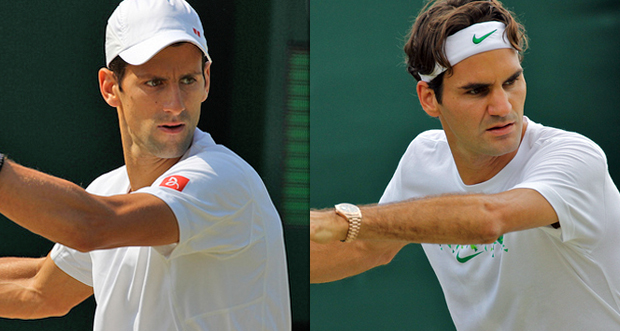
[1] Novak Djokovic def. [4] Roger Federer 6-7(7), 6-4, 7-6(4), 5-7, 6-4
A little less than a fortnight ago, on a drizzly afternoon in London—which also happened to be a gray, foggy early morning in Northern California—I read an essay by Clive James on Camille Paglia’s book Break, Blow, Burn: Camille Paglia reads forty-three of the world’s best poems (Knopf Doubleday, 2005). The dry, sometimes sour Australian commends Paglia’s skill in the face of a difficult task. Explaining the meaning of poetry—writing on writing that describes the indescribable—without snuffing out its essential mystery requires sure-footed assertion and lacewing intricacy. In the essay’s final paragraphs James moves on from his book review to scold, first, Americans in general, and then Paglia specifically, for failing, in certain important ways, to grow all the way up. It was all very interesting, and totally unrelated to tennis.
However, for the purposes of writing about the 2014 Wimbledon Championships, there’s one passage—maybe it was partly on account of the dreary weather— that stayed with me. It was James’ description of Emily Dickinson as “a poet who could enamel the inside of a raindrop.” It’s an impeccable observation. One that almost rivals Jane Austen’s two inches on ivory (on which she painted with so fine a brush), and it made me immediately envious. I wished I’d thought of it first. I stared at my TV screen, at the wet, beaten-down tarps pulled over the All England Club’s outer courts, and sighed glumly. I despaired of ever crafting such a perfect point of praise. And then, being the bright-side type of tennis blogger, I spent the next two weeks waiting for Roger Federer to reach the Wimbledon final so I could happily pillage and have my way with James’ phrase.
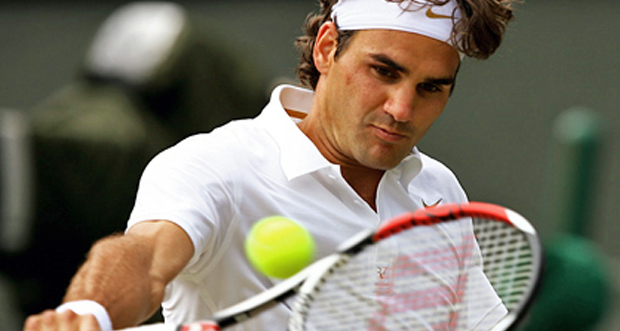
The cloisonné interior of a raindrop would do admirably, it occurred to me, as metaphor for the Swiss athlete’s style of tennis. There is no tennis player, ever, who has been heaped with as much taffeta praise as Roger Federer, especially on the grass. From the grandiloquent to the superlative variety, every kind of lily has been plucked and gilded in the name of the Federeresque Roger Federer. David Foster Wallace raised the bar by ranging into the realm of the numinous. Suffice it to say, it gets to be a challenge to find words and phrases that don’t feel either overwrought or overdone.
Granted, pulling a connective thread between a reclusive poet who kept her manuscripts hidden away in her sock drawer, and an extroverted millionaire who once strode onto Centre Court, waving to an adoring throng of thousands while wearing a gold-lamé-trimmed blazer (gilding the lily!) might seem like the very definition of overwrought and overdone. But Federer gets compared to poetry in motion at least a dozen times a tournament. (Unless he loses early, in which case he’s promptly consigned to annals of past geniuses, with the likes of Mozart, or Nijinsky, or the guy who invented car phones.) But from the romantic’s point of view—and today my glasses are thoroughly rose-colored, with gilt wire frames— Dickinson and Federer are, in words and gestures respectively, engaged in very similar conversations: Life, death, immortality, obscurity, risk, vulnerability, love, grace, and that indomitable thing with feathers—it’s all right in front of us, ready to teach us about the beautiful life. So, I assume I was not alone in my desire to write about an eighteenth slam title.
Indeed the media buzz going into the final was much more about Federer’s chances than it was about his opponent’s, despite the fact that the Serb would regain the World No. 1 ranking with a win. Partly this was because Federer is a father of four in his mid-thirties, and who knows how many more major finals we’ll get to watch him play. Partly because this is Wimbledon, and Federer’s game—not to mention his brand— has, over the course of nine finals and seven titles, merged with the public’s perception of lawn tennis at its refined best. (Federer and Wimbledon: the storied tradition of ivy-covered, Evian-drenched, Rolex-bound, Nike-clad greatness.) And also, partly, because Novak Djokovic doesn’t play tennis like he’s making art on the inside of a water droplet.
Oh, sure, he plays great tennis. But it’s his tennis, as opposed to Federeresque tennis, that is, as opposed to lawn tennis. Instead of small balletic steps, Djokovic takes big striding slides, and he falls. Often. He messes up easy volleys (but tends to nail the tough ones). He stays back. He defends. The go-to guy in his box has a face like Boris Becker instead of like the fine-featured Stefan Edberg. His return-winner count is higher than his ace tally. He chest thumps; his shoulders heave as he fights for air (Federer’s, by contrast, are as still as a glass lake); he makes a lot of strange sniffing sounds between points. And he did all of the above in the Wimbledon final, too—not to mention Boris was looking especially Borisy in the afternoon sunshine—but he also played a match that was as exquisite as it was mighty. If it wasn’t quite cloisonné tennis, it was at least champlevé. And it was quite good-enough.
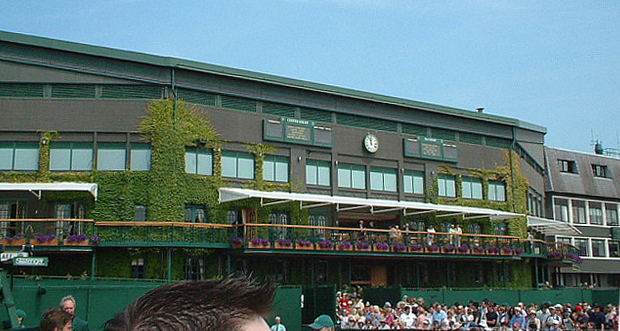
There was no sign of the pouring rain that plagued two-thirds of the tournament over Centre Court on Sunday. And one thing I noticed, early on in the first set, was how thoroughly the rest of the Championships faded into the mizzle of the past. This was not a final that was going to be outshone by a semi, or the quarters, or even the upset of two-time champion Rafael Nadal by a brazen, energetic, first-pumping teen-ager. [I did see that match and though Nadal played passably, all the while his body language seemed to be asking, ‘so, what does this prove?’ Head down, gaze wary but remote, he seemed just beyond the reach of tennis. Meanwhile, for Kyrgios, who had everything to prove, and wanted to prove it every way possible, every shot was a thrill.] As Federer and Djokovic moved toward a tiebreak, Andy Murray and Grigor Dimitrov seemed a long way away. Even the British fans seemed to think so, as they alternated between an intense hush and exuberant ‘ahhs.’ This match was the rare breed of major final that declares its substance immediately. Its magnetic core pulls the audience in so completely the outside world—even the part of the world with Lionel Messi in it—ceases, for a few hours, to be. Instead, we’re given direct passage to the shining, variegated center of the purely metaphorical raindrop.
Another thing I noticed, again early on, is that both Federer and Djokovic were doing what they do well, so well, that the well-roundedness of each man’s game was obscured. In other words, Federer’s successful serving and chip-charging masked the fact that he was also playing very effective defense, hitting some fearsome shots on the run, and generally scramble-floating hither and thither without anyone being the wiser. For Djokovic’s part, his wicked return game, which improved incrementally as the match wore on, drew attention away from his clever serving—especially his aggressive second serves— and his precision passing shots were much more noticeable than his improved backhand slice.
Other than that, the match went by for me in a pleasurable blur of spectating, despite the fact that I took five pages of notes. I dutifully wrote down the dozens of potentially pivotal shots, concomitant scores, and every time Federer shouted ‘Allez!’ I noted that Djokovic did not start grunting loudly in rallies until the fourth set. There was a 23-shot rally, won by Djokovic, which took approximately as long as an entire Federer service game at 4-all in the third set (56 seconds). There was a lull in action midway through the second set, during which I did not take notes, but instead had a brief nap. Lines, passes, aces, and winners were struck from all points of the compass and with happy regularity. Tension and momentum were traded back and forth, also with regularity, if less happily. Royals clapped enthusiastically, and Bradley Cooper texted a lot.
Serving at 4-5 in the fourth set Federer fought off a championship point with an ace down the T that was initially called out. He then served another ace, earning a game point, which he sealed with a forehand winner. He moved swiftly to break, helped along by a sudden tightness from Djokovic, and held again to force a fifth set. Had Federer won the fifth, this string of points would have marked the official turning point of the match (OTP). But, he didn’t win. (And there really wasn’t a discernible OTP.) He did, however, give himself, and the match, an extension. This final deserved its fifth set.
Still, in the end, it ended quickly. At 4-5 in the fifth the Swiss went down two quick points to 0-30. He blinked. Federer won the next point, but then sent a ball long, and one more into the tape. Had the match gone on for another eight or ten points, it’s not hard to imagine Federer winning it. But, of course, that’s not how it works. Nonetheless, there was something about this particular finish that reminded me of a friendly game of musical chairs. The music simply stopped too soon for Federer, and at exactly the right time for Novak Djokovic.
No sooner was the match over than did the American ESPN team elevate the match to the lofty ground of the Federer/Nadal contest in 2008. Yes, the excellence of this final was nothing if not co-authored, yet there is an irony in the fact that Roger Federer might be best remembered at Wimbledon for the finals that he lost. Today’s was the kind of match that makes a person (specifically, me) want to decry the false dichotomy of sports that locates all the loss in one player and all the triumph in the other. Although, obviously, the trophy ceremonies would be much less emotional without all the winning and losing, and the trophy itself wouldn’t look half as impressive actually chopped in half.
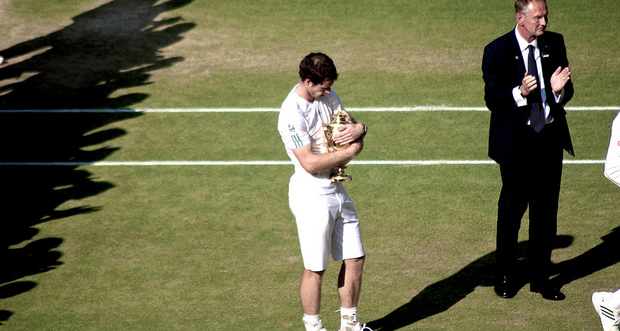
Djokovic was especially emotional during this particular trophy presentation. No wonder, the 27-year-old just returned to the top of the rankings, broke a streak of three slam finals losses, and defeated the man whose name is synonymous with grass court greatness in a high-quality final. But the tears somehow seemed more personal than all this. Djokovic dedicated his victory to the people who mean the world to him: his parents and his childhood coach, and especially his wife and soon-to-be-born child. If Federer’s defeat was not one that made the Swiss player look old or tired, there was something about the manner of Djokovic’s victory that made him look more mature. This is a strange thing to say about a man who has already spent over 100 weeks at No. 1 and is the owner of seven slam titles, but, Sunday, posing with his second Wimbledon trophy, he really looked all grown up.
As for Federer, during the trophy ceremony he let fall a single, poignant teardrop—no doubt one enameled on the inside—but, though he lost, and though it’s far from granted that he’ll have another shot at a Wimbledon crown, it’s clear, as Ms. Dickinson might write, that Roger Federer’s Verse is alive—
[divider]
Cover Photo (Creative Commons License): rainycat