Tag: us open

  • US Open Day 1: Order of Play & Scores

    US Open Day 1: Order of Play & Scores

    US Open

    The full schedule for Day 1 is listed below (Results to follow)…

    [divider]

    Arthur Ashe Stadium — 11:00 A.M.  

    Women’s Singles – Round 1
    Simona Halep (ROU) (2) d. Danielle Rose Collins (USA) — 6-7(2), 6-1, 6-2

    Not Before: 1:00 P.M.

    Women’s Singles – Round 1
    Venus Williams (USA) (19) d. Kimiko Date-Krumm (JPN) — 2-6, 6-3, 6-3

    Men’s Singles – Round 1
    Stan Wawrinka (SUI) (3) d. Jiri Vesely (CZE) — 6-3, 7-6(6), 7-6(3)

    7:00 P.M.
    US Open 2014 Opening Ceremony

    Women’s Singles – Round 1
    Maria Sharapova (RUS) (5) d. Maria Kirilenko (RUS) — 6-4, 6-0

    Men’s Singles – Round 1
    Novak Djokovic (SRB) (1) d. Diego Schwartzman (ARG) — 6-1, 6-2, 6-4

    [divider]

    Louis Armstrong Stadium — 11:00 A.M.    

    Women’s Singles – Round 1
    Agnieszka Radwanska (POL) (4) d. Sharon Fichman (CAN) — 6-1, 6-0

    Men’s Singles – Round 1
    Andy Murray (GBR) (8) d. Robin Haase (NED) — 6-3, 7-6(6), 1-6, 7-5

    Women’s Singles – Round 1
    Sloane Stephens (USA) (21) d. Annika Beck (GER) — 6-0, 6-3

    Not Before: 5:00 P.M.

    Men’s Singles – Round 1
    Milos Raonic (CAN) (5) d. Taro Daniel (JPN) — 6-3, 6-2, 7-6(1)

    [divider]

    Grandstand — 11:00 A.M.  

    Women’s Singles – Round 1
    Angelique Kerber (GER) (6) d. Ksenia Pervak (RUS) — 6-2, 3-6, 7-5

    Men’s Singles – Round 1
    Jo-Wilfried Tsonga (FRA) (9) d. Juan Monaco (ARG) — 6-3, 4-6, 7-6(2), 6-1

    Men’s Singles – Round 1
    Blaz Kavcic (SLO) d. Donald Young (USA) — 7-5, 6-4, 6-4

    Women’s Singles – Round 1
    Caroline Wozniacki (DEN) (10) d. Magdalena Rybarikova (SVK) — 6-1, 3-6, 2-0 (Ret.)

    [divider]

    Court 17 — 11:00 A.M.  

    Men’s Singles – Round 1
    Nick Kyrgios (AUS) d. Mikhail Youzhny (RUS) (21) — 7-5, 7-6(4), 2-6, 7-6(1)

    Women’s Singles – Round 1
    Jelena Jankovic (SRB) (9) d. Bojana Jovanovski (SRB) — 6-2, 6-3

    Men’s Singles – Round 1
    Tommy Robredo (ESP) (16) d. Edouard Roger-Vasselin (FRA) — 6-4, 6-3, 6-4

    Women’s Singles – Round 1
    Madison Brengle (USA) d. Julia Glushko (ISR) — 6-3, 6-2

    [divider]

    Court 5 — 11:00 A.M. 

    Women’s Singles – Round 1
    Andrea Petkovic (GER) (18) d. Ons Jabeur (TUN) — 7-6(7), 1-6, 6-3

    Men’s Singles – Round 1
    Simone Bolelli (ITA) d. Vasek Pospisil (CAN) — 2-6, 6-4, 6-2, 3-6, 6-3

    Women’s Singles – Round 1
    Alize Cornet (FRA) (22) d. Amandine Hesse (FRA) — 6-1, 6-2

    Men’s Singles – Round 1
    Michael Llodra (FRA) d. Daniel Gimeno-Traver (ESP) — 6-4, 6-3, 7-5

    [divider]

    Court 11 — 11:00 A.M. 

    Men’s Singles – Round 1
    Benoit Paire (FRA) d. Julien Benneteau (FRA) (24) — 7-6(4), 5-7, 6-4, 4-6, 6-4

    Women’s Singles – Round 1
    Shahar Peer (ISR) d. Johanna Konta (GBR) — 6-2, 6-3

    Men’s Singles – Round 1
    Andrey Kuznetsov (RUS) d. Bradley Klahn (USA) — 6-4, 4-6, 6-3, 7-5

    [divider]

    Court 13 — 11:00 A.M. 

    Women’s Singles – Round 1
    Kurumi Nara (JPN) (31) d. Aleksandra Wozniak (CAN) — 6-2, 6-1

    Women’s Singles – Round 1
    Shuai Peng (CHN) d. Jie Zheng (CHN) — 6-3, 6-3

    Men’s Singles – Round 1
    Aleksandr Nedovyesov (KAZ) d. James McGee (IRL) — 4-6, 6-2, 6-1, 7-6(3)

    Women’s Singles – Round 1
    Sabine Lisicki (GER) (26) d. Francoise Abanda (CAN) — 6-3, 7-5

    Women’s Singles – Round 1
    Sara Errani (ITA) (13) d. Kirsten Flipkens (BEL) — 6-1, 7-5

    [divider]

    Court 4 — 11:00 A.M.    

    Women’s Singles – Round 1
    Lucie Safarova (CZE) (14) d. Timea Babos (HUN) — 6-4, 7-5

    Men’s Singles – Round 1
    Matthias Bachinger (GER) d. Radek Stepanek (CZE) — 6-3, 6-2, 6-2

    Men’s Singles – Round 1
    Philipp Kohlschreiber (GER) (22) d. Facundo Bagnis (ARG) — 6-2, 7-6(3), 6-3

    Women’s Singles – Round 1
    Roberta Vinci (ITA) (28) d. Paula Ormaechea (ARG) — 6-3, 6-3

    [divider]

    Court 6 — 11:00 A.M.    

    Men’s Singles – Round 1
    Leonardo Mayer (ARG) (23) d. Albert Montanes (ESP) — 6-2, 3-0 (Ret.)

    Women’s Singles – Round 1
    Daniela Hantuchova (SVK) d. Romina Oprandi (SUI) — 4-6, 6-2, 6-3

    Women’s Singles – Round 1
    Anastasia Rodionova (AUS) d. Camila Giorgi (ITA) — 1-6, 7-5, 6-3

    Men’s Singles – Round 1
    Jeremy Chardy (FRA) (30) d. Alejandro Falla (COL) — 6-7(5), 6-2, 7-5, 6-4

    [divider]

    Court 7 — 11:00 A.M.  

    Men’s Singles – Round 1
    Andreas Seppi (ITA) d Sergiy Stakhovsky (UKR) — 6-3, 6-1, 6-4

    Men’s Singles – Round 1
    Fernando Verdasco (ESP) (31) d. Blaz Rola (SLO) — 6-3, 3-6, 7-5, 1-6, 6-4

    Women’s Singles – Round 1
    Mirjana Lucic-Baroni (CRO) d. Garbine Muguruza (ESP) (25) — 6-3, 7-6(4)

    Women’s Singles – Round 1
    Irina-Camelia Begu (ROU) d. Silvia Soler-Espinosa (ESP) — 7-6(4), 6-3

    [divider]

    Court 8 — 11:00 A.M. 

    Women’s Singles – Round 1
    Saisai Zheng (CHN) d. Stefanie Voegele (SUI) — 1-6, 6-2, 6-2

    Women’s Singles – Round 1
    Alla Kudryavtseva (RUS) d. Ying-Ying Duan (CHN) — 2-6, 6-2, 6-4

    Women’s Singles – Round 1
    Timea Bacsinszky (SUI) d. Kiki Bertens (NED) — 6-7(7), 4-3 (Ret.)

    Men’s Singles – Round 1
    Paul-Henri Mathieu (FRA) d. Gilles Muller (LUX) — 6-7(7), 7-5, 7-6(6), 6-7(5), 6-1

    [divider]

    Court 10 — 11:00 A.M. 

    Women’s Singles – Round 1
    Belinda Bencic (SUI) d. Yanina Wickmayer (BEL) — 6-3, 6-2

    Women’s Singles – Round 1
    Monica Puig (PUR) d. Tereza Smitkova (CZE) — 3-6, 6-3, 6-3

    Women’s Singles – Round 1
    Johanna Larsson (SWE) d. Virginie Razzano (FRA) — 6-0, 6-0

    Men’s Singles – Round 1
    Peter Gojowczyk (GER) d. Benjamin Becker (GER) — 6-2, 6-4, 6-2

    [divider]

    Court 14 — 11:00 A.M. 

    Men’s Singles – Round 1
    Matthew Ebden (AUS) d. Tobias Kamke (GER) — 6-4, 6-3, 7-6(2)

    Men’s Singles – Round 1
    Pablo Carreno Busta (ESP) d. Andreas Beck (GER) — 6-3, 4-6, 6-2, 7-6(0)

    Women’s Singles – Round 1
    Aliaksandra Sasnovich (BLR) d. Anna Schmiedlova (SVK) — 6-4, 6-3

    [divider]

    Court 15 — 11:00 A.M.  

    Women’s Singles – Round 1
    Jana Cepelova (SVK) d. Maria-Teresa Torro-Flor (ESP) — 2-6, 7-5, 6-1

    Women’s Singles – Round 1
    Tsvetana Pironkova (BUL) d. Karin Knapp (ITA) — 6-4, 6-3

    Men’s Singles – Round 1
    Thomaz Bellucci (BRA) d. Nicolas Mahut (FRA) — 7-6(4), 6-4, 6-1

    Women’s Singles – Round 1
    Alexandra Dulgheru (ROU) d. Kristyna Pliskova (CZE) — 6-3, 6-4

    [divider]

    Cover Photo (Creative Commons License): Kiu Kaffi
  • 2014 US Open Men’s Draw

    2014 US Open Men’s Draw

    US Open

    The men’s draw for the US Open was released today. In the top half are the No. 1 seed, Novak Djokovic (SRB), and the No. 3 seed, Stan Wawrinka (SUI). In the bottom half are the No. 2 seed, Roger Federer (SUI), and the No. 4 seed, David Ferrer (ESP).

    [divider]

    First Quarter

    Novak Djokovic (SRB) (1)
    Diego Schwartzman (ARG)

    Gilles Muller (LUX)
    Paul-Henri Mathieu (FRA)

    Maximo Gonzalez (ARG)
    Sam Querrey (USA)

    Yen-Hsun Lu (TPE)
    Guillermo Garcia-Lopez (ESP) (28)

    Philipp Kohlschreiber (GER) (22)
    Qualifier

    Michael Llodra (FRA)
    Daniel Gimeno-Traver (ESP)

    Mikhail Kukushkin (KAZ)
    Jan-Lennard Struff (GER)

    Marcos Giron (USA)
    John Isner (USA) (13)

    Jo-Wilfried Tsonga (FRA) (9)
    Juan Monaco (ARG)

    Qualifier
    Aleksandr Nedovyesov (KAZ)

    Pablo Carreno Busta (ESP)
    Qualifier

    Benoit Paire (FRA)
    Julien Benneteau (FRA) (24)

    Fernando Verdasco (ESP) (31)
    Blaz Rola (SLO)

    Bradley Klahn (USA)
    Andrey Kuznetsov (RUS)

    Qualifier
    Radek Stepanek (CZE)

    Robin Haase (NED)
    Andy Murray (GBR) (8)

    [divider]

    Second Quarter

    Stan Wawrinka (SUI) (3)
    Jiri Vesely (CZE)

    Thomaz Bellucci (BRA)
    Nicolas Mahut (FRA)

    Blaz Kavcic (SLO)
    Donald Young (USA)

    Alejandro Falla (COL)
    Jeremy Chardy (FRA) (30)

    Mikhail Youzhny (RUS) (21)
    Nick Kyrgios (AUS)

    Sergiy Stakhovsky (UKR)
    Andreas Seppi (ITA)

    Simone Bolelli (ITA)
    Vasek Pospisil (CAN)

    Edouard Roger-Vasselin (FRA)
    Tommy Robredo (ESP) (16)

    Kei Nishikori (JPN) (10)
    Wayne Odesnik (USA)

    Pablo Andujar (ESP)
    Jack Sock (USA)

    Matthew Ebden (AUS)
    Tobias Kamke (GER)

    Albert Montanes (ESP)
    Leonardo Mayer (ARG) (23)

    Lukas Rosol (CZE) (29)
    Qualifier

    Victor Estrella Burgos (DOM)
    Igor Sijsling (NED)

    Qualifier
    Benjamin Becker (GER)

    Qualifier
    Milos Raonic (CAN) (5)

    [divider]

    Third Quarter

    Tomas Berdych (CZE) (6)
    Lleyton Hewitt (AUS)

    Qualifier
    Martin Klizan (SVK)

    Evgeny Donskoy (RUS)
    Qualifier

    Teymuraz Gabashvili (RUS)
    Santiago Giraldo (COL) (27)

    Feliciano Lopez (ESP) (19)
    Ivan Dodig (CRO)

    Steve Johnson (USA)
    Qualifier

    Lukas Lacko (SVK)
    Dominic Thiem (AUT)

    Kenny De Schepper (FRA)
    Ernests Gulbis (LAT) (11)

    Marin Cilic (CRO) (14)
    Marcos Baghdatis (CYP)

    Qualifier
    Qualifier

    Jerzy Janowicz (POL)
    Dusan Lajovic (SRB)

    Pablo Cuevas (URU)
    Kevin Anderson (RSA) (18)

    Gilles Simon (FRA) (26)
    Qualifier

    Noah Rubin (USA)
    Federico Delbonis (ARG)

    Bernard Tomic (AUS)
    Dustin Brown (GER)

    Damir Dzumhur (BIH)
    David Ferrer (ESP) (4)

    [divider]

    Fourth Quarter

    Grigor Dimitrov (BUL) (7)
    Ryan Harrison (USA)

    Carlos Berlocq (ARG)
    Dudi Sela (ISR)

    Qualifier
    David Goffin (BEL)

    Frank Dancevic (CAN)
    Joao Sousa (POR) (32)

    Gael Monfils (FRA) (20)
    Jared Donaldson (USA)

    Alejandro Gonzalez (COL)
    Dmitry Tursunov (RUS)

    Qualifier
    Paolo Lorenzi (ITA)

    Denis Istomin (UZB)
    Richard Gasquet (FRA) (12)

    Fabio Fognini (ITA) (15)
    Andrey Golubev (KAZ)

    Pere Riba (ESP)
    Adrian Mannarino (FRA)

    Qualifier
    Tim Smyczek (USA)

    Andreas Haider-Maurer (AUT)
    Roberto Bautista Agut (ESP) (17)

    Ivo Karlovic (CRO) (25)
    Jarkko Nieminen (FIN)

    Jurgen Melzer (AUT)
    Marcel Granollers (ESP)

    Albert Ramos-Vinolas (ESP)
    Sam Groth (AUS)

    Marinko Matosevic (AUS)
    Roger Federer (SUI) (2)

    [divider]

    Cover Photo: Kiu Kaffi, Tennis Frontier correspondent

  • 2014 US Open Women’s Draw

    2014 US Open Women’s Draw

    US Open

    The women’s draw for the 2014 US Open is out. Serena Williams (USA), the No. 1 seed, is in the top half of the draw, along with Petra Kvitova (CZE), the No. 3 seed. In the bottom half are the No. 2 seed Simona Halep (ROU), and the No. 4 seed Agnieszka Radwanska (POL).

    [divider]

    First Quarter

    Serena Williams (USA) (1)
    Taylor Townsend (USA)

    Francesca Schiavone (ITA)
    Vania King (USA)

    Varvara Lepchenko (USA)
    Alison Van Uytvanck (BEL)

    Mona Barthel (GER)
    Shuai Zhang (CHN) (32)

    Samantha Stosur (AUS) (24)
    Lauren Davis (USA)

    Pauline Parmentier (FRA)
    Kaia Kanepi (EST)

    Coco Vandeweghe (USA)
    Donna Vekic (CRO)

    Ajla Tomljanovic (AUS)
    Carla Suarez Navarro (ESP) (15)

    Flavia Pennetta (ITA) (11)
    Julia Goerges (GER)

    Shelby Rogers (USA)
    Qualifier

    Nicole Gibbs (USA)
    Caroline Garcia (FRA)

    Teliana Pereira (BRA)
    A.Pavlyuchenkova (RUS) (23)

    Casey Dellacqua (AUS) (29)
    P. Mayr-Achleitner (AUT)

    Qualifier
    Qualifier

    Karolina Pliskova (CZE)
    Yvonne Meusburger (AUT)

    Alison Riske (USA)
    Ana Ivanovic (SRB) (8)

    [divider]

    Second Quarter

    Petra Kvitova (CZE) (3)
    Kristina Mladenovic (FRA)

    Klara Koukalova (CZE)
    Petra Cetkovska (CZE)

    Qualifier
    Katarzyna Piter (POL)

    Jarmila Gajdosova (AUS)
    Madison Keys (USA) (27)

    Svetlana Kuznetsova (RUS) (20)
    Marina Erakovic (NZL)

    Elena Vesnina (RUS)
    Qualifier

    Chanelle Scheepers (RSA)
    Christina McHale (USA)

    Misaki Doi (JPN)
    Victoria Azarenka (BLR) (16)

    Dominika Cibulkova (SVK) (12)
    Catherine Bellis (USA)

    Zarina Diyas (KAZ)
    Qualifier

    Elina Svitolina (UKR)
    Polona Hercog (SLO)

    Grace Min (USA)
    Ekaterina Makarova (RUS) (17)

    B. Zahlavova Strycova (CZE) (30)
    Qualifier

    Yaroslava Shvedova (KAZ)
    Monica Niculescu (ROU)

    Sorana Cirstea (ROU)
    Heather Watson (GBR)

    Olga Govortsova (BLR)
    Eugenie Bouchard (CAN) (7)

    [divider]

    Third Quarter

    Angelique Kerber (GER) (6)
    Qualifier

    Qualifier
    Qualifier

    Belinda Bencic (SUI)
    Yanina Wickmayer (BEL)

    Aleksandra Wozniak (CAN)
    Kurumi Nara (JPN) (31)

    Sloane Stephens (USA) (21)
    Annika Beck (GER)

    Virginie Razzano (FRA)
    Johanna Larsson (SWE)

    Karin Knapp (ITA)
    Tsvetana Pironkova (BUL)

    Bojana Jovanovski (SRB)
    Jelena Jankovic (SRB) (9)

    Lucie Safarova (CZE) (14)
    Timea Babos (HUN)

    Qualifier
    Stefanie Voegele (SUI)

    Romina Oprandi (SUI)
    Daniela Hantuchova (SVK)

    Amandine Hesse (FRA)
    Alize Cornet (FRA) (22)

    Roberta Vinci (ITA) (28)
    Paula Ormaechea (ARG)

    Irina-Camelia Begu (ROU)
    Silvia Soler-Espinosa (ESP)

    Shuai Peng (CHN)
    Jie Zheng (CHN)

    Sharon Fichman (CAN)
    Agnieszka Radwanska (POL) (4)

    [divider]

    Fourth Quarter

    Maria Sharapova (RUS) (5)
    Maria Kirilenko (RUS)

    Kristyna Pliskova (CZE)
    Alexandra Dulgheru (ROU)

    Julia Glushko (ISR)
    Madison Brengle (USA)

    Qualifier
    Sabine Lisicki (GER) (26)

    Andrea Petkovic (GER) (18)
    Qualifier

    Tereza Smitkova (CZE)
    Monica Puig (PUR)

    Anna Schmiedlova (SVK)
    Qualifier

    Magdalena Rybarikova (SVK)
    Caroline Wozniacki (DEN) (10)

    Sara Errani (ITA) (13)
    Kirsten Flipkens (BEL)

    Qualifier
    Camila Giorgi (ITA)

    Kiki Bertens (NED)
    Timea Bacsinszky (SUI)

    Kimiko Date-Krumm (JPN)
    Venus Williams (USA) (19)

    Garbine Muguruza (ESP) (25)
    Qualifier

    Johanna Konta (GBR)
    Shahar Peer (ISR)

    Jana Cepelova (SVK)
    M. Torro-Flor (ESP)

    Danielle Rose Collins (USA)
    Simona Halep (ROU) (2)

    [divider]

    Cover Photo: Kiu Kaffi, Tennis Frontier correspondent

  • Nadal Pulls Out of the US Open

    Nadal Pulls Out of the US Open

    Rafael Nadal

    In a statement released through the USTA, written in both English and Spanish, defending champion Rafael Nadal has announced he is withdrawing from the US Open:

    “I am very sorry to announce I won’t be able to play at this year’s US Open a tournament on which I’ve played 3 consecutive finals in my last participations. I am sure you understand that it is a very tough moment for me since it is a tournament I love and where I have great memories from fans, the night matches, so many things… Not much more I can do right now, other than accept the situation and, as always in my case, work hard in order to be able to compete at the highest level once I am back.”

    “Siento anunciar que no podré participar en el US Open, torneo en el que en los últimos años he tenido muy buenos resultados. Entenderéis que es un momento duro para mi porque es un torneo que me encanta y en el que tengo muy buenos recuerdos, de los fans, de los partidos nocturnos, de tantas cosas. No me queda otra que aceptar que no puedo competir este año y como siempre trabajar para que cuando vuelva esté preparado de la mejor manera para competir.”

    [divider]

    Cover Photo (Creative Commons License): Marianne Bevis

  • US Open 2013 Review: Men’s Final: Solving Problems

    US Open 2013 Review: Men’s Final: Solving Problems

    I don’t know about you but I am slowly becoming a fan of Rafa. I have always been impressed by him of course but I naively concluded that his game was built on muscle.

    The closer I look the more I notice the attention to detail. I first noticed it early in this year’s US Open. To be a contender Rafa had to serve well.  He did that when he won in 2010 but it put too much strain on his knees, so naturally I wondered whether he would have an answer this time.  It turns out that he does. His answer is to trade pace for spin, saving his knees but creating big problems for his opponents. The extra spin is most obvious on TV in his swinging slice serve. The amount of movement he got looked like he was hitting a forehand for his serve and I liked it. The result of these changes is that in the final we saw that Rafa is currently the player that is better at solving the big problems. He backed up everything we have seen throughout 2013 to cement his claim as the best player of the year.

    Technically and even tactically there really is not that much between the top two players. Rafa has won their two Major meetings this year but Novak has looked dominant many times during these matches. One thing Rafa hasn’t looked is desperate. That was how Djokovic looked for most of the match. Particularly when he was up in the third set. Not a calm man confident of success but a man celebrating as if he has to convince everyone, including himself, of his ability.

    Rafa clearly put in diligent study, tennis R&D, during his seven months out exploring ways to compete with his obvious limitations. He used the injuries to improve his technique and strategy. Now that he is back on tour he is putting the R&D to work and taking the theory and molding it into a polished product.

    What I mean here is that Rafa knows both himself, the tennis court, and his rivals. As a tennis player he knows what is available to both him and his opponents in any given situation. He uses that knowledge to formulate a plan of both attack and defense, where he can attack to setup a winning shot but also defend so that the attack doesn’t expose weakness. That is what I see. The specific shots and technical weaknesses are important mainly because they become the targets at which each player aims their strategy. What I see is that Rafa has built a huge castle around his game where he can rush in and attack yet quickly retreat to safety. He is using time and the art of surprise to his advantage at a level we haven’t seen before.

    I see it most in his serve but it permeates his whole game. He doesn’t just use his shots and the court to apply pressure; he uses time itself. Controlling the rhythm of play can be a very useful weapon. It is complicated to achieve this by changing your effort, how hard you hit the ball because it affects your timing. Spin is one of the best ways to adjust the rhythm of a point without affecting the effort you put in and thus your timing. Rafa is addicted to spin and he has begun to use it to control the rhythm and timing of the point. That is his weapon. Things like his slice backhand can also be a weapon when used effectively to alter the rhythm of a point.

    Like any gladiator it is not necessarily what that weapon is that matters, but how well he masters it. This battle is all about location, location, location. What I see is Rafa varying the pace of every shot through spin to defend when he has a weak position and attack when he has a good position. At the same time spin allows him to hit a very hard, very complicated shot with little risk of missing. The ball may go short or sit up but the effect of the spin creates an extra challenge for his opponent to overcome, adding to the defensive quality of the shot — something we noticed particularly in the fourth set with Novak missing several sitters with heavy spin.

    Rafa also uses slice to slow the point down so that he can retreat to a good position or top spin to speed the point up and rush the ball past Novak. Slice can also keep it low and force Novak to hit up or Rafa’s topspin forehand can get the ball up high and make him stretch.

    The use of spin and its effects are not new in this story between Rafa and Novak; Novak does exactly the same to Rafa and has had great success. What is new is how well Rafa is using the element of time to take the best positions and remove all but the riskiest opportunities. Just like classical warfare it is he who takes the best position most often that is most likely to win. That is what we have seen this tournament and this year.

    Rafa understands more than anyone that odds and averages are everything, and he and Uncle Tony are happy to trawl through any data they can find to shift the odds their way. All the while they are just finding ways to create more pressure on their opponent over time. Attackers like Federer apply a lot of pressure in a short time but often run out of energy or start missing. This is true for mind, body, and spirit. Fed can literally run out of ideas. Rafa applies less pressure but keeps applying it for much longer. Novak is the same. They are used to applying pressure on every point. The physical side isn’t what matters to them; it’s the mental and emotional side.

    Rafa handles that better than anyone. Many have better shots and physical attributes than he does, but no one has a better mind, and since tennis is 90% mental and a game of problem solving that’s the perfect recipe for success.

    Edit September 16th

    I watched the French Open Semi Final match between these two over the weekend. I forgot just how dominant Novak was at times. He was a break up in the fifth set until the eighth game. There are lots of ways to explain the ebbs and flows. The commentators put it all down to who hit the hardest. As a player myself with my own Rafa (Spin master) to train with I find the opposite to be the answer. Both were pushing their attack to its limits throughout the match. When we do that we often push too far and error, often tiring ourselves aswell and getting out of position. Djokovic was just giving lots of points away for this reason. Many more than he was winning with his all out attack. Nadal just defends too well and uses his attack against him.

    Dialling back on the attack even just a couple of percent means you get much more in but also you are ready for the opponents response much sooner. Combine this with the concept of directionals and you see how getting the ball quickly to your opponent while at the same time putting yourself in bad position is giving them the key to open the door to your defence.

    So, my interpretation of the ebbs and flows is that when a player patiently built a point focusing on consistently good position they generally did well. Novak particularly can attack off both wings and when he used this balanced attack he did well. It was much less effort and less risky. However Novak kept panicking and overplaying, often using Federers favourite, the inside out forehand, this is what Rafa wants, it creates a lot of space to aim at in Novaks forehand side and Novak is slow to recover from his big attack. Novak won less of these exchanges than he realises. Rafa won because maintaing position and waiting for the right ball and establishing a pressurising defence instead of risky and exciting attack demands patience and discipline. Two things Rafa did better than Novak in both the French and US open finals.

    I say this mainly because I am finding this a much more efficient way to win. Particularly as I meet higher level opponents. Expecting longer points and having a strategy built for it is powerful. Using the opponents pace and spin against them becomes more and more important and ensures you have an answer even against much higher ranked opponents. They often get lulled into the belief that you don’t possess power and invariably hit harder against you giving you more to work with. I learnt the concepts from Fuzzy Yellow Balls which consider this the sneakiest weapon in tennis. Now I have learnt how to use it I agree and I am using it more and more. Seeing it work at the highest level really shows its value to me.

  • Indefatigable

    Indefatigable

    US Open, Final

    (2) Nadal d. (1) Djokovic, 6-2, 3-6, 6-4, 6-1

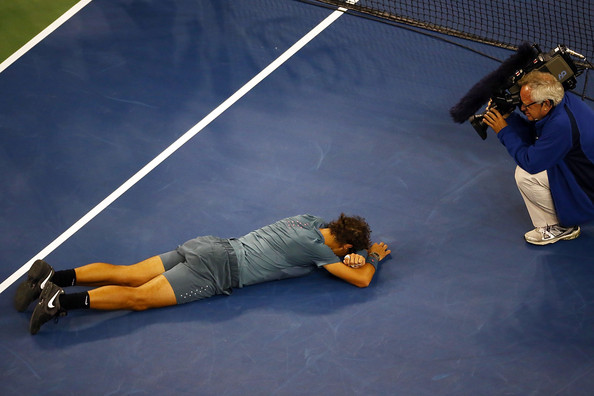
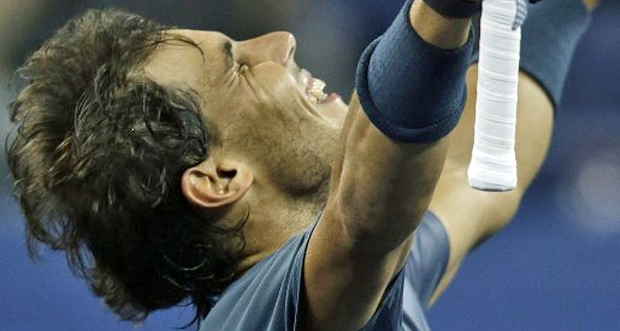
    Rafael Nadal yesterday defeated Novak Djokovic to win his second US Open title, continuing a return to the men’s tour that has surpassed the most ardent hopes of all but of his most ambitious fans. It has been a comeback to beggar belief, an opinion I’ll continue to maintain despite the fact that Greg Rusedski agrees with it. If anything, Rusedski went further, and summarily declared it to be the greatest comeback in sporting history. One questions both the length and breadth of his historical perspective, given he’d earlier insisted the match was well on the way to becoming the greatest US Open final ever played. It certainly wasn’t that, though it undeniably had its moments. The longest of these moments was a 54-stroke rally destined to pad out innumerable highlights packages. The best of them came at the very end as Nadal collapsed in ecstasy to the court, victorious in New York once more.

    [divider]

    Click here to discuss “Indefatigable” in our discussion forum.

    [divider]

    First some numbers, which can as ever be relied upon to render the achievement excitingly comprehensible. This US Open is Nadal’s thirteenth Major overall, which moves him to third on the all-time list of winners, one ahead of Roy Emerson, and trailing only Roger Federer and Pete Sampras. Since returning to the tour in February he has contested thirteen events, reaching the final at all but one of them (Wimbledon), and claiming the title ten times. (This incidentally equals the number of titles Jo-Wilfried Tsonga has won in his entire career.) He has won sixty matches, easily the most on tour, and lost just three. Today he became only the third player ever to sweep the main events comprising the US summer, meaning Canada, Cincinnati, and the US Open (the other two men were Andy Roddick in 2003, and Pat Rafter in 1998). Overall Nadal has compiled an astonishing 22-0 record on hard courts this year, and hasn’t technically lost a hard-court match since Indian Wells last year.

    Nadal’s previous US Open title came in 2010, although I’ll court opprobrium and suggest that today’s title is more convincing, insofar as the convincingness of tournament victories is something that can or should be measured. There was a prevailing sense that his first title, for all that it completed his Career Grand Slam, was a testament to opportunism. The fast New York DecoTurf was generally held to be his worst surface. Meanwhile, the two best hard-courters at the time – Federer and Djokovic – had fought each other to a standstill in the late semifinal, after Nadal had already breezed past a wearied Mikhail Youzhny, having faced no one more threatening before that. Realistically his path to this year’s final hasn’t been much more taxing: replace Verdasco with Robredo, and a weary Youzhny with a weary Gasquet. The difference is that this time round Nadal was deservedly one of the pre-tournament favourites, and, given his recent results and form, it is perverse to pretend he is now anything but entirely suited to outdoor hard courts. Favourites always have an easier draw, since by definition they rarely face anyone they are not expected to defeat. He had a favourable US Open draw for the same reason he had favourable draws at Roland Garros: because he earned them.

    Nadal might have been a favourite, but he was by no means unbacked, especially faced with the other favourite. Djokovic is still the world No. 1, even if it is rare for him to recapture the form of his majestic 2011 season, and rarer still to see him sustain it outside of Australia. It’s been the pattern of his year, and it was his pattern in tonight’s final. When Djokovic played at his best, and more importantly, when he thought at his best, he was the better player. But he couldn’t keep it up. Nadal began exceptionally well, once more employing the tactic that had served him well in the French Open semifinal, of pressing hard up the line with his forehand early in the rallies, invariably catching Djokovic out. Djokovic also reprised his strategy from Paris, which was to eschew tactical clarity of any sort, and to avoid the authoritative backhand up the line that once ranked among the sport’s most fearsome shots. The two players combined for a one-sided 6-2 first set.

    The change came in the second set, and it had little to do with Nadal, who continued to strike his forehand ferociously. Suddenly he was having fewer of them to hit, and he was increasingly obliged to hit them from less stable positions. Djokovic hadn’t started to strike the ball better, but he was now directing it far more intelligently, which enabled him to control the rallies. Then, having established himself, he did start to strike the ball better, and abruptly revealed himself to be the fearsome version of himself from two years ago, the one who would patiently pummel Nadal’s backhand until it cracked, and who would only bring the Spaniard’s forehand into play at a moment of his choosing. Djokovic romped through the latter stages of the second set, and moved ahead a break in the third.

    Then, inexplicably, he abandoned this winning game plan, and returned to scattered hitting. Why he didn’t keep it up, one cannot imagine, although I’ll admit that although Nadal’s backhand seems dramatically less fearsome from a remote vantage, it might not feel so gentle when it’s coming at you. It isn’t a poor shot by any standards – even when he isn’t hitting it that well it remains solid, and today he was hitting it well – but it doesn’t measure up to his forehand. More importantly, it doesn’t measure up to Djokovic’s forehand, which is the match up that matters, or would have mattered if Djokovic had only maintained it. It would be useful to see Hawkeye data on Djokovic’s groundstroke placement for that period when he was ascendant, as compared to his placement for the rest of the match. I suspect it would be sufficiently revealing that even he as a player might take notice. Certainly it would tell us more than blunt instrument stats such as unforced errors. Alas, the presiding powers keep their data close, preferring to use them to generate complicated metrics of use to nobody.

    Nadal is probably the best player I have ever seen at sustaining apparently mortal blows yet remaining unbowed, having proved his resilience in countless matches, especially against Federer. He knows in his armature that while anyone can ascend to stratospheric heights for a time, even the very best must come down for oxygen eventually. If they don’t, then well-played to them, but if they do . . . Djokovic had been soaring into orbit, but the moment his throat constricted, Nadal leaped forward, and planted his foot on it. I suspect this made it hard to think clearly. With his mind gone, Djokovic’s body soon followed. Before long he was spraying balls everywhere, and was broken again to drop the set. The fourth set wasn’t close, although considering the 6-1 scoreline it wasn’t especially short, either. But it wasn’t too long before Nadal was accepting Djokovic’s heartfelt congratulations at the net, while 20,000 onlookers screamed affectionately at them. Nadal moves to an impressive 13-5 in Major finals, while Djokovic falls to 6-6.

    CBS had its usual way with the trophy presentation, just as they’d had their way with the schedule. Having learned the lesson of the 2009 final, after which Juan Martin del Potro selfishly attempted to address his supporters in Spanish, the tournament’s broadcaster ensured today’s ceremony was as brief as it was devoid of interest. The whole thing was over in about five minutes. In Melbourne the indefatigable Kia spokesman would have barely begun his vocal warm-ups. Neither Djokovic nor Nadal bothered to dignify Mary Carillo’s inane questions with anything like an answer. Nor did they manage to look more than mildly appreciative as the lavish cash prizes were rapturously announced. Nadal bit into his silverware, and loyal American viewers were whisked away to confront the recurring enigma of Two and a Half Men (now that the smart-arse kid has grown up, the enduring mystery of the show’s popularity has been augmented with confusion over which of them is actually the half-man).

    Those of us lucky enough to be watching on an alternative network weren’t let off so lightly. Sky Sports had assembled its entire team on the court, though they were still one microphone short. Nadal wandered over for a chat, and hit all his marks: gracious, thoughtful, and clearly keen to be elsewhere. Asked if he was going to take a rest now he responded with a chuckle that he had Davis Cup, and then ambled away. After he’d left Rusedski lamented that they hadn’t asked him whether he would overtake Federer’s Major title record. I can’t imagine what Rusedski thinks Nadal’s response might have been.

    Djokovic will still be world No. 1 when the rankings are released next week, regardless of what happens in Davis Cup, and the week after that. The change will likely come in Asia, assuming Nadal bothers to play. Indeed, given he has precisely zero points to defend until February, Nadal boasts the enviable luxury of being able to choose when and where he retakes the top spot. It must be a pleasant thought. Then again, one imagines that having emphatically claimed his thirteenth Major title, Rafael Nadal hardly requires another reason to feel joy.

  • All The Way Up

    All The Way Up

    The 2013 US Open Men’s Final

    [2] Rafael Nadal def. [1] Novak Djokovic 6-2, 3-6, 6-4, 6-1 

    From the perspective of a psychologist-Rafa-fan-tennis-blogger, there was not a lot wrong with the 2013 US Open men’s final. The trophy ceremony is another story, but the final itself was tremendous—Brobdingnagian, even. From Novak Djokovic’s perspective, the immense beauty of the match was likely diminished by the bevy of unforced errors that contributed to his losing. (The Serb made upwards of four-dozen.) But from where I sat—on a blue yoga ball in my living room —it was not only an exciting final, but also an instructive one. Over the course of nearly four hours, Nadal and Djokovic took turns revealing the frescoed ceiling of what is possible when preternatural talent meets application and deep-seated drive.

    [divider]

    Comment on Arienna’s blog and more in our tennis forums.

    [divider]

    No, the trouble with this final, from my perspective, had nothing to do with the tennis. It was the desire the tennis instilled in me to quote novelists, in particularly, the urge to quote Ernest Hemingway— or as the Gulbis Clan would spell it, Ernests. The problem with quoting the Latvian No. 1’s approximate namesake is twofold. First, when the opportunity arises to connect tennis matches to the American Jazz Age—such opportunities are shockingly few and far between—I prefer to quote F. Scott (or even Zelda) Fitzgerald because they are, well, way jazzier than Ernie. Those two really knew how to make their adjectives sing. Second, and perhaps more important, I’ve already quoted this particular passage of Hemingway here once before.

    Much like Novak Djokovic feeding balls to Nadal’s forehand, re-quoting famous authors is not a pattern I’m looking to fall into. Last week it was Borges, this week Hemingway. Who’s next, Carrie Bradshaw? (Yes, I am 99.9% percent sure I somehow linked Sex & the City to Nadal’s footwork. Or maybe it was David Ferrer’s calves.*) But the fact remains that when Rafael Nadal stole the third set out from under Djokovic’s racquet, and then executed a deep knee-bend accompanied by a lawnmower-style fist-pump, my first thought was a worry that he’d pulled a hamstring. (It was a fist-pump as awkward-looking as it was enthusiastic.) The second thing that popped into my head was Jake’s answer to Robert Cohn in Hemingway’s The Sun Also Rises: “Nobody lives their life all the way up except bull-fighters.” Whether or not the statement is accurate, the sentiment underneath it is true.

    So, to continue in the storied tradition of assembling terminology from other sports into descriptive metaphors about tennis—e.g., boxing, horse racing, ballet, baseball, orienteering, hopscotch, glee club, etc.—this tennis match was a bull-fight. To keep the outcome in question as long as possible, Djokovic and Nadal took turns playing the roles of matador and bull. They traded-off between sets, or on the occasional change of ends. Once in awhile they even switched between individual points, one assumes so they’d have something to do while they waited for that annoying guy in the stands to stop lowing like a wounded herbivore. The 2013 final was a showy spectacle; as brutal as it was beautiful.

    If you saw this tennis fight—maybe from the comfort of your own yoga ball, or even better, from a seat in the stands—you won’t soon forget it. And if you did not watch it, you should. But if you did see it and want to relive it, or if you couldn’t watch, maybe because you forgot what TV channel CBS occupies (I had some trouble with this myself last weekend) here’s how I saw it:

    Nadal was extraordinarily dominant in the first set—100% torero. He served thoughtfully and forcefully, winning 80% of his first serves and nearly 60% of the second. The Mallorcan maintained his aggressive 2013 court positioning; sliced and passed with his backhand; and did all the standard damage, plus a little extra, with his forehand. When Rafa held for 4-2 John McEnroe said, “This first set is highly important, to put it mildly.” I agreed, mildly. Including yesterday’s match, Rafael Nadal is 152-3 when winning the first set at a major.

    Of course, one of those three losses came to Novak Djokovic, on a hard court in Australia, in a match that lasted forty days and forty nights (or at least all the way through a California night). During yesterday’s surprisingly lopsided first set, it looked as if Djokovic was struggling mightily with the wind on Arthur Ashe Stadium, which is known intergalactically as the universe’s largest-ever sporting centrifuge. When Djokovic stretches for a backhand return out wide, or a forehand on the run, he looks like he travels through space and time. It’s uncanny eye-bending stuff. The Serb moves with marvelous quickness and his balance is fantastic, but his footwork can’t quite keep up with the rest of him. Nadal’s form is better there. So is Ferrer’s, for that matter. (Probably because of his calves.**)

    Anyway, as Rafa closed out the first set 6-2, I start to wonder if the combined forces of Nadal’s aggression and Mother Nature’s breath were going to make quicker-than-expected work of this match. It was about that time that Djokovic began to find his footing and take the ritual steps that would transform him into a full-fledged tennis deity. It’s tempting to say the change hinged on the 54-shot rally on break point in the second set. It was a rally that included several pummeled forehands from Rafa, ended with Nadal netting a ball, and was immediately followed by Djokovic lifting his arms in triumph while the stadium erupted in applause. In reality, the change started early in the second set, and would require a few more games to solidify.

    In fact, Nadal broke back immediately to put the set back on serve at 3-4. But then Djokovic broke back again, and Nadal found himself pushed well behind the baseline. The Serb won the second set convincingly, but it wasn’t actually until the beginning of the third set that Djokovic played his best tennis. It’s almost not enough to say he was unplayable, his shots—particularly his return of serve and his forehand crosscourt—were downright untouchable. On the other side of the net, Rafael Nadal hung his head, downtrodden. It was 2011 all over again.

    At 1-1, 4-4, 0-40 on Nadal’s serve, Rafa-fans were experiencing some measure of distress (to put it mildly). Djokovic had won the first point of the game with a brilliant lob, and most all of the Serb’s returns were skimming the baseline. In the process of losing the second point of the game, after hitting a quality forehand that Nadal seemed to have expected to be a winner, Rafael Nadal stumbled on the baseline and went down—swinging. (He was truly trying to hit the tennis ball even as his rear-end hit the concrete.) The Spaniard looked wounded, but in soul more than body. I wondered if he would recover from the indignity of having to stand by helplessly as Djokovic turned the match on its head. I should have known better.

    It’s both tempting and accurate to say that it was at the very moment when Rafa was down triple break point that he turned it all the way up. Nadal saved the first break point with a forehand winner, a better version of the shot that saw him to the seated position just minutes earlier. At 15-40 he slowed the rally to a snail’s pace by slicing his backhand until he drew the error from Djokovic. The third break point he saved with his first ace and fastest serve of the match, at 125 mph. Nadal eventually held with an overhead smashed so hard it bounced into the stands and flattened Edward Norton’s hairdo. Nadal went on to wrest the third set away from Djokovic’s deserving hands, then run away with the fourth, while Novak went back to making unhappy unforced errors.

    The most pronounced moment of tension in the fourth set actually came from the stands, when the crowd was unable to shush itself before championship point. I didn’t have my stopwatch handy, but that had to be the most protracted collective “shhhhhhhh” in the record books. It was, I suspect, longer than the combined time CBS gave Nadal and Djokovic to thank their coaches and families. The match ended, fittingly, with an error from Djokovic.

    Continuing on with his habit of flinging his body against every hard court he conquers, Rafael Nadal immediately stopped, dropped, and rolled—and cried. Nadal and Djokovic shared a warm hug at the net, and then Rafa went back to joyfully rolling around on the court. (Who can blame him? He really has been on fire this season. Rafa now owns 10,860 ranking points as compared with Novak Djokovic’s 10,980.) The trophy ceremony was awkward and rushed. Both Nadal and Djokovic did well to answer the question they should have been asked, rather than the one they were asked. There were also way too many American flags. It’s better not to dwell on it. Instead, I’ve prepared a poignant summation, replete with fitting quotations:

    Last time I mentioned the Hemingway passage from The Sun Also Rises was in a post I wrote before the 2012 US Open. My intention had been to comfort dismayed Nadal fans. Hey, the sun also rises. Buck up, and whatnot. And see, I was right. A lot can change in twelve months’ time. With some trepidation—given my loyalties—I offer the same sentiment to Djokovic fans today. Novak Djokovic will probably be disappointed with this performance, particularly with his play in the first and fourth sets. But in watching both the men’s and women’s finals this year I was mostly struck by the shared capacity of this small group of extraordinary athletes. They fight.

    The other SwissStanislas Wawrinka, authored the most heartwarming storyline at this year’s US Open and I was disappointed not to have a chance to write more about him. I did watch, and cheer for him, and even found myself doing an air-punch fog-horn blast thing whenever he hit a booming backhand winner. (Which none of you saw, right?) So, I think it’s fitting if I let Stan have the last word. When it comes to Djokovic and Nadal—and Serena and Vika—they’re supremely good at tennis, that’s true. But when it comes to effort, will, and intent, they’re seriously “fucking strong.”


    *In case you are wondering, I try to mention David Ferrer’s calves at least once per major tournament. His calf muscles happen to generate dozens upon dozens of Google searches (more even than the number of unforced errors Djokovic hit in the final) and I have decided they’re good for business.

    ~For those of you who do not live in the United States and were deprived of team-ESPN’s commentary, you might be interested to know that Brad Gilbert and Patrick McEnroe tirelessly interviewed each and every American football player who showed up in the stands to gain the best possible understanding of exactly which position Nadal should have played had he ever shown the slightest interest in playing American football. From what I can tell the verdict was split between “running back” and “he’s too f***ing small to play football.”

    **See first footnote.

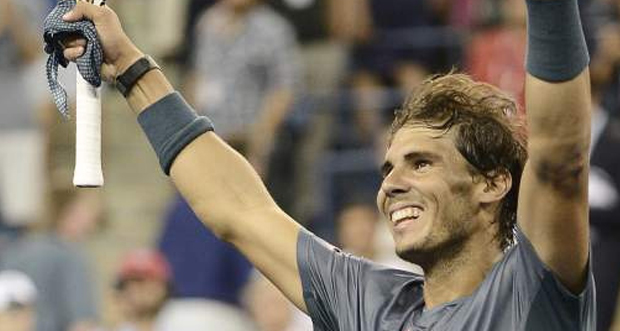
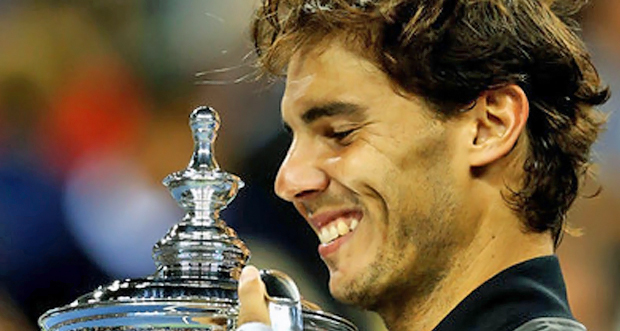
  • Rafael Nadal Wins the US Open

    Rafael Nadal Wins the US Open

    Takes his second US Open singles title, 6-2, 3-6, 6-4, 6-1 over Novak Djokovic.

    [divider]

    In what was widely set up as a battle for dominance at the end of this year, Rafael Nadal beat Novak Djokovic in a four-set war.  Most of their battles seem to involve blood, and this was no different, even though it failed to go the distance.

    [divider]

    Click here to discuss the Nadal/Djokovic USO final in our discussion forum.

    [divider]

    Both seemed to start sharp in the first.  Djokovic may have been feeling the effects of the five-set semifinal he played against Stan Wawrinka two days ago, and failed to meet Nadal’s intensity.  The Spaniard won the first set, 6-2, with two breaks of serve.

    In the second, Djokovic broke early, but Nadal broke straight back.  However, the Serbian No. 1 found the intensity he had been lacking and began to run the No. 2 around the court.  He broke again at 3-4 to serve for it at 5-3, and won the set.  All momentum at this point was in his favor.

    To open the third, Djokovic broke at love.  While Djokovic seemed to be in control in the early part of the set, Nadal kept up the pressure, broke back, and finally snuck the set out at the last minute:  6-4.

    Djokovic initially pressured on the Nadal serve at the beginning of the fourth set, but the Spaniard eventually ran away with it to win the title: 6-1 in the fourth.

    Previous to this match, each had won one title at the USO, so the balance now falls in Rafa’s favor.  Nadal also lifts his unbroken streak on hard courts this year to 22-0.  And, while Djokovic retains his No. 1 status for a short while longer, Nadal has crept up to within 920 points of Novak, with nothing to defend for the rest of the year.  The shift at the top seems only a matter of time.


  • Serena Williams Wins the US Open

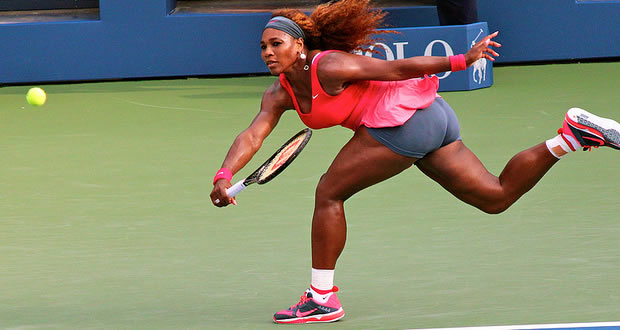
    Serena Williams Wins the US Open

    Serena Williams fought Victoria Azarenka, the wind, and her nerves to win her 17th Major title.

    [divider]

    Serena Williams has won her fifth US Open crown with a hard fought victory over world No. 2 Victoria Azarenka, 7-5, 6-7(6), 6-1, in a match lasting 2 hours and 45 minutes.  Oddly, it was the first time that the world No. 1 and No. 2 had faced each other in a US Open final in 10 years.

    It didn’t come easy. Serena had to overcome blustery weather conditions, unforced errors, and a very stubborn opponent in the Belorussian. Twice in the second set she served for the match but Azarenka broke her both times to force a deciding set.

    Azarenka had beaten Williams recently in Cincinnati in a three-set thriller but fell behind early in the final set and could not recover. Williams finally sealed the match when an Azarenka return sailed long.

    Williams increased her Grand Slam count to 17, one fewer than Chris Evert and Martina Navratilova on the all-time list, and jumped for joy on winning her fifth US Open title.

    [divider]

    Discuss the US Open Final on the Tennis Frontier Message Forums.

    [divider]

    Cover Photo: edplain (Creative Commons License)

  • Djokovic Outlasts Wawrinka in the Semifinals; Sets Up Nadal Rematch

    Djokovic Outlasts Wawrinka in the Semifinals; Sets Up Nadal Rematch

    Novak Djokovic overcame an overall lackluster performance, and an onslaught from Stanislaw Wawrinka to prevail in a thrilling 5-set match, 2-6, 7-6(4), 3-6, 6-3, 6-4.

    It was a roller-coaster ride of a semifinal.  Wawrinka, the still-but-perhaps-not-for-long Swiss No. 2 came out strong and broke Djokovic three times in the first set.  He went up a break in the second, but Djokovic broke back, and sent the set into a tiebreak, which the world No. 1 snatched up.  The Swiss took the third set on one break, and Djokovic the fourth via the same.  Also in the fourth set, Wawrinka had a medical timeout for an injury to his upper-thigh, and did seem to be hampered the rest of the match.

    [divider]

    Click here to discuss the Nadal/Djokovic final in our discussion forum.

    Click here to discuss the Nadal/Gasquet semifinal in our discussion forum.

    Click here to discuss the Djokovic/Wawrinka semifinal in our discussion forum.

    [divider]

    The stakes were raised in the fifth set.  At 1-1, with Wawrinka serving, they played a nearly 21-minute, 30-point game.  It was taken to deuce 12 times, with Djokovic having five break chances.  In the end, Wawrinka held, but it seemed to be all he had left.  Djokovic broke at 2-2 and ran away with it.

    After the match, Djokovic said:  “I think it was obvious Stan played more aggressive; he played better tennis over all,” adding, “I was glad I was able to find my best tennis when I needed it.”

    In the second semifinal of the day, Rafael Nadal beat Richard Gasquet with his B-Game, 6-4, 7-6(1), 6-2.  While Gasquet came up with some showy tennis at times, and Nadal was having trouble finding the lines, the best Gasquet can say is that he broke Nadal’s serve for the first time in the tournament.

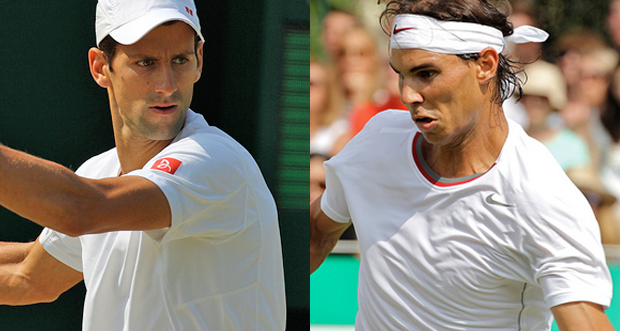
    The win assures Djokovic that he holds his No. 1 ranking for the time being, and sets up his 37th match with his rival Nadal — an Open Era record for most matches played.  The Spaniard currently leads the head-to-head 21-15.  They will play for the trophy on Monday.