
Introduction to the Series
Imagine if each country had a tennis career. Rather than individual players, you have nationalities; rather than an individual career, you have a national one. As a thought experiment, I decided to compile the top Slam-winning countries in Open Era history, from the 1968 French Open to the 2015 French Open. How would these “national careers” look, as if they had careers spanning 48 years? What would their stories be? I looked at and compiled the best results from players of a given nationality, created a “national career chart” for the Open Era, and in doing so gained a deeper understanding of the history of men’s tennis. I’d like to share that research and understanding with you.
For this exercise I looked at the top five nations by Open Era Slams: The United States (51), Sweden (25), Spain (21), Australia (20), and Switzerland (19). Beyond those five, only Czechoslovakia/Czech Republic has double digits (12); Serbia (8), Germany (7), Argentina (6), Russia (4), and Brazil (3) all have more than two. The countries with two are Croatia, Romania, South Africa, and the United Kingdom; the countries with one are Austria, Ecuador, France, Italy, and the Netherlands.
This will be a six-part series, the first five articles covering the “Big Five” tennis nations, and the sixth part being a summarization, with a look at recent years and some thoughts about the game going forward. Look for further installments every few days to a week through June and July.
In each article I will briefly overview the trajectory of the nation during the Open Era, looking at the top players and compiling a Top 10 list for each nation. For these lists I am using a statistical system that takes into account Slam results, titles, and rankings. For the most part I am faithful to the system, although in one or two cases I add a subjective element – usually as a tiebreaker. Also, for these lists I am including some players who played before the Open Era, but only those players that played a significant portion of their careers in the Open Era. Finally, I will look at the current national players, including a glimpse at any potential up-and-comers.
On to the New World…
PART ONE: THE UNITED STATES
RISE AND FALL OF THE AMERICAN EMPIRE
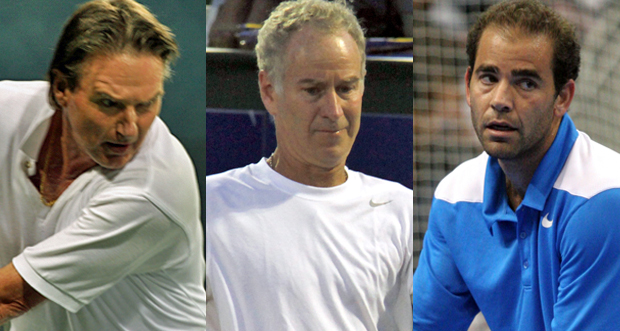
The United States is the greatest tennis nation of the Open Era–actually, tennis history as a whole–and it isn’t particularly close: With 51 Slam titles during the Open Ea they have more than any other two nations combined, and include greats and multi-Slam winners such as Pete Sampras (14), Andre Agassi (8), Jimmy Connors (8), and John McEnroe (7), as well as lesser greats such as Jim Courier (4), Arthur Ashe (3), Stan Smith (2), and single Slam winners Roscoe Tanner, Vitas Gerulaitis, Brian Teacher, Michael Chang, and Andy Roddick.
Now let’s take a look at the performance timeline:

As you can see, there’s a build-up in the early years of the Open Era with Stan Smith and Arthur Ashe being among the best players in the sport, that blossomed with the first great American phase of Jimmy Connors and John McEnroe, who together won 15 Slams between 1974 and 1984.
After that there was a lull in the mid-to-late 80s as Connors and McEnroe declined, until Michael Chang won his lone Slam in 1989, the harbinger of the second great American era of Courier-Sampras-Agassi that dominated the 90s and into the new century. Finally we have a last gasp in 2003, with Agassi winning the Australian Open and Andy Roddick winning the US Open, and decline since then. Roddick retired in 2012 as the last Slam-winning American. His last Slam final appearance was the epic 2009 Wimbledon, and since then an American has only reached the second week of a Slam three times.
Top 10 Americans of the Open Era
- Pete Sampras
- Jimmy Connors
- John McEnroe
- Andre Agassi
- Arthur Ashe
- Jim Courier
- Andy Roddick
- Stan Smith
- Michael Chang
- Vitas Gerulaitis
Honorable Mentions: Roscoe Tanner, Brian Gottfried, Harold Solomon, Todd Martin, Eddie Dibbs, Cliff Richey, Brad Gilbert, Aaron Krickstein, Brian Teacher, Tim Mayotte, Gene Mayer, Bob Lutz, Jimmy Arias, Marty Riessen, Eliot Teltscher, Tom Gorman, James Blake, Steve Denton, MaliVai Washington, Bill Scanlon, Dick Stockton, Tim Gullikson, Mel Purcell, Mardy Fish, John Isner.
Determining the Top 10 greatest American players was relatively easy as there is a drop-off from Gerulaitis to the rest of the pack. That said, the Americans are so strong that there are several players not in the Top 10—namely Tanner, Gottfried, Solomon, and Martin—that would be in the Top 10 of any other nation, with the possible exception of Spain.
Clearly the Top 4 are relatively easy, although some might quibble about the order of Connors, McEnroe, and Agassi. But using my system, Connors is actually closer to Sampras than he is to the rest, while McEnroe just edges Agassi. Further down we become more controversial. Courier had a higher peak than Ashe, but Ashe was good for so long; those two are also very close, but the edge goes to Ashe. Roddick, Smith, and Chang are also very close and most might rank Smith higher than Roddick due to his better peak, but I ranked them according to my system, which acknowledges that despite being dominated by Roger Federer, Roddick was still one of the best players in the sport for a decade. Finally, Gerulaitis is a big step behind the first nine, but even further ahead of No. 11 (Roscoe Tanner).
Pre-Open Era Greats
American greatness in men’s tennis did not start with Jimmy Connors, or even his precursors, Arthur Ashe and Stan Smith. While this series focuses on the Open Era, it would be remiss on my part not to mention some of the best players before the Open Era: Bill Johnston, Bill Tilden, Ellsworth Vines, Don Budge, Jack Kramer, Tony Trabert, Bobby Riggs, Pancho Segura, Vic Seixas, and Pancho Gonzales. Tilden, Gonzales, and Budge are probably all among the dozen or so greatest players in tennis history, with Vines, Kramer, and Riggs not too far behind.
Pancho Gonzales in particular remains one of the most underrated all-time greats, perhaps mainly because he only won two Grand Slams. But he also won 12 Pro Slams and the Tournament of Champions three times, so essentially has 17 Majors to his name – as many as Roger Federer, and more than any player other than Ken Rosewall and Rod Laver. Gonzales was almost certainly the greatest player of the 1950s, just as Rod Laver was of the 1960s (with Ken Rosewall bridging the two decades as second fiddle to both). I place Gonzales, Tilden, and Sampras as the Trinity of greatest American tennis players, with Budge, Connors, McEnroe, and Agassi after them, then Vines, Kramer, Trabert, Riggs, Segura, Seixas, Ashe, and Courier following in some order.
But the key here is to get a sense that American greatness in men’s tennis goes back virtually to the beginning of the sport. Richard Sears won the first seven US Opens, from 1881 to 1887, although it wasn’t until 1908 that an American won a Slam outside of the US–John Alexander at the Australian Open–and not until 1920 when an American first won Wimbledon, the great Bill Tilden. The first American to win the French Open was Don Budge in 1938. The United States remained dominant through the 1950s, until a pair of Aussies led the way for dominance from Down Under…but more on that in a later installment.
Will the Empire Rise Again?
Other than Roddick, American tennis has been slim since the retirement of Andre Agassi. Consider also that in 1990 fully 35 of the Top 100 were Americans; today it is only six, and none in the Top 10. Players such as James Blake, Mardy Fish, and John Isner have been decent but unremarkable. Some players such as Donald Young, Sam Querrey, and Ryan Harrison have displayed varying degrees of promise but have all disappointed in different ways.
What about the future? Is there any hope? First of all, let’s look at the Americans currently in the Top 100, as of June 8:
18. John Isner (30)
31. Jack Sock (22)
39. Sam Querrey (27)
51. Steve Johnson (25)
57. Donald Young (25)
72. Tim Smyczek (27)
Given their ages, the only player who looks to have solid upside is Jack Sock, who is memorable for his solid run at Roland Garros this year, defeating Grigor Dimitrov, Pablo Carreno Busta, and Borna Coric before being defeated by Rafael Nadal in the fourth round. While it seems unlikely that Sock will become an elite player, he at least seems like a probable Top 20 regular, and perhaps could challenge for a spot in the Top 10. But it seems very unlikely that Sock will rise above the level of Fish, Isner, and Blake.
What about younger players? Beyond the Top 100 there are two that are especially worth taking note of: 18-year-old Jared Donaldson, currently ranked No. 152, and 17-year-old Francis Tiafoe, ranked No. 279. Clearly these two are a long ways from making a mark, but Donaldson is just around the corner, and Tiafoe has only just gone pro and is showing promise. Keep your eyes on these two. Also on the radar is 21-year-old Bjorn Fratangelo, ranked No. 144 – but he needs to move fast if he’s going to make his mark.
Summation
American men’s tennis clearly saw its golden age from the early 70s to the early 00s, but has really been in a slump for over a decade now. While it may be that American tennis will never regain its glory, it is worth mentioning that there have been slumps before. After dominance in the 1930s to 50s, from Bill Tilden to Pancho Gonzales, the Australians took the mantle during the late 50s and 60s before Ashe and Smith, and then more fully Jimmy Connors, took it back in the 1970s. Yet unlike that era, when fading great Pancho Gonzales played long enough–into his mid-40s–to see Jimmy Connors emerge, there are no elder statesmen to pass the mantle – Agassi is ten years gone; even lesser great Andy Roddick has been gone for almost three years now (can you believe it?).
So it seems that we’re left with a moderate view: that American tennis will probably not return to its dominant position in the sport any time soon, but that better days are ahead.
[divider]
Cover Photo (Creative Commons License): robbiesaurus / bootbearwdc / craigoneal