Tag: tommy haas

  • Open Era Generations, Part Eleven: Gen 9 (1974-78) – A Transitional Era

    Open Era Generations, Part Eleven: Gen 9 (1974-78) – A Transitional Era

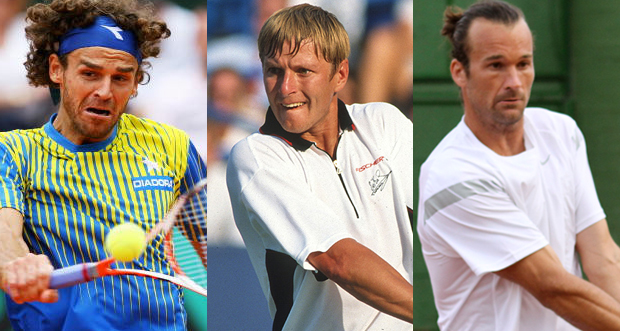
    Gustavo Kuerten Yevgeny Kafelnikov Carlos Moya

    While one of the weakest generations of the Open Era — by my account, third after Gen 2 (1939-43) and Gen 12 (1989-93) — I personally find this one of the most interesting. I’m not exactly sure why, but I think it has to do with the fact that it is hard to define, with no clear stars. It is the generation that was at its peak in the late 90s and early 00s, between the dominance of Sampras-Agassi and Federer.  The generation has an interesting balance of players – no real standouts or all-time greats, but several excellent players.

    Best Players by Birth Year
    1974: Yevgeny Kafelnikov (RUS, 2), Alex Corretja (ESP), Thomas Enqvist (SWE), Andrei Medvedev (UKR), Tim Henman (UK)
    1975: Marcelo Rios (CHIL), Thomas Johansson (SWE, 1), Jiri Novak (CZE), Albert Costa (ESP, 1)
    1976: Gustavo Kuerten (BRA, 3), Carlos Moya (ESP, 1), Mark Philippoussis (AUS), Rainer Schüttler (GER), Magnus Norman (SWE)
    1977: Nicolas Kiefer (GER), Guillermo Canas (ARG)
    1978: Gaston Gaudio (ARG, 1), Tommy Haas (GER), Radek Stepanek (CZE), Sébastien Grosjean (FRA), Michael Russell (USA)

    [divider]

    Click here to discuss “Open Era Generations, Part Eleven: Gen 9 (1974-78) – A Transitional Era” in the Discussion Forum.

    [divider]

    This generation is responsible for only 9 Slams, the lowest since the 1939-43 generation (4). There are no all-time greats, merely a couple almost-greats, and a handful of very good players.

    The two best players of the generation were Gustavo Kuerten and Yevgeny Kafelnikov, who accounted for five of the nine Slams. Kuerten was a clay-court specialist who won the French Open three times, as well as four clay Masters. But he also won the 2000 Tennis Masters Cup, defeating Pete Sampras and Andre Agassi – the only player to defeat both in the same tournament –  and the hard-court Cincinnati Masters, so could play well off clay.  “Guga” was only a Top 5 player for three years (1999-2001), and only finished in the Top 40 for eight years (1997-2004); his “near-greatness” was largely due to his lack of longevity, which was largely because of injuries starting in 2002. The second half of his career is one of the great What-If stories of the last couple decades.

    Kafelnikov was less brilliant at his best, but had a longer peak than Guga, ranking No. 11 or better from 1994 to 2001. The third most accomplished player of the generation, Carlos Moya, ranked No. 61 or higher for fourteen straight years, from 1995 to 2008, including thirteen years No. 43 or better, and five years No. 7 or better – a consistently very good player.

    Single-Slam winners Thomas Johansson, Albert Costa, and Gaston Gaudio are the definition of one-Slam wonders. Johansson had a long career, including eleven years in the Top 100, but he never finished a year in the Top 10; imagine if someone like Nicolas Almagro won a Slam and you get a sense of Johansson’s feat. Costa was a clay-court specialist, probably similar in talent to someone like Feliciano Lopez, but happened to play between the reins of Kuerten and Rafael Nadal, and thus able to win a French Open (in 2002). Gaudio could be the worst player in the Open Era ever to win a Slam, the 2004 French Open against Guillermo Canas. He finished No. 10 in 2004 and 2005, but never finished another year in the Top 20.

    This is the oldest generation to still have players on tour, but it won’t be much longer. After a resurgence in 2012-13, 37-year-old Tommy Haas has slipped the last couple years and seems like he’s winding down. Haas started on the ATP tour in 1996, losing his first Slam match to Sergi Bruguera at the US Open in the first round. 2015 makes it 20 years on tour. Haas has been around so long that his first year was the last year Boris Becker won a Slam (although he never played Becker).

    Radek Stepanek is also ranked around No. 200, which would be the first year on tour that he hasn’t finished No. 68 or higher – going back to 2002. Michael Russell, also from that 1978 birth year, just retired.

    Underachievers and Forgotten Players
    There’s a reason I didn’t mention Marcelo Rios above, as I was saving him for this category. In 1998 he looked like the heir apparent to Pete Sampras as the premier player in the game, taking the No. 1 ranking in late March and winning three Masters that year, as well as the Grand Slam Cup. Yet Rios’s relatively mediocre second half of the year led to a loss of the No. 1 ranking to Sampras, and while he remained a Top 10 player in 1999, he slipped and stumbled in 2000 and never regained his elite status, largely due to injuries.

    Another player who had a disappointing career is Andrei Medvedev, who was the first of the generation to rank in the year-end Top 10, finishing 1993 ranked No. 6 at age 19. While he would go on to win four Masters, he would never rank in the Top 10 again and made a Slam final only once.

    There are several other players who fit the category of “close, but no cigar” as far as Slams go – Alex Corretja was 0-2 at French Open Slam finals, Thomas Enqvist was meant to revive Swedish tennis but–along with Johansson–instead ended up being a kind of dead-cat bounce after the great 1970s-80s era, and Tim Henman goes down as one of the greatest grass court players never to win Wimbledon. And boy did he try – eight out of nine years from 1996-2004 making the quarterfinals or later, including four semifinals but never a final. Mark Philippoussis also comes to mind in this category.

    Did You Know?
    I first came across Roberto Carretero’s name when looking at Masters winners of the 90s. Carretero has quite a story: he won the Hamburg Masters in 1996 as a virtual unknown, ranked No. 143 and defeating Yevgeny Kafelnikov en route to a final win against rising young Spanish star, Alex Corretja. He never ranked higher than No. 58 and never made it past the second round in a Slam, retiring in 2001. But he does have that Hamburg Masters title.

    Top Ten Players of the Generation

    1. Gustavo Kuerten
    2. Yevgeny Kafelnikov
    3. Carlos Moya
    4. Marcelo Rios
    5. Alex Corretja
    6. Tim Henman
    7. Tommy Haas
    8. Albert Costa
    9. Thomas Enqvist
    10. Andrei Medvedev

    Honorable Mentions: Mark Philippoussis, Thomas Johansson, Sebastian Grosjean, Magnus Norman, Gaston Gaudio, Radek Stepanek.

    This is actually a hard generation to rank. I feel confident about the top four, although think Moya and Rios could be swapped, and I went back and forth on Kuerten and Kafelnikov, but in the end prefer Kuerten’s higher peak to Kafelnikov’s greater longevity. After the “biggish four,” Corretja is probably the best of the rest, with Henman, Haas, Costa, and Enqvist not far behind, but that tenth spot could go to any of Medvedev, Philippoussis, Johansson, or Grosjean.
  • Cilic Defeats Haas to Win in Zagreb

    Cilic Defeats Haas to Win in Zagreb

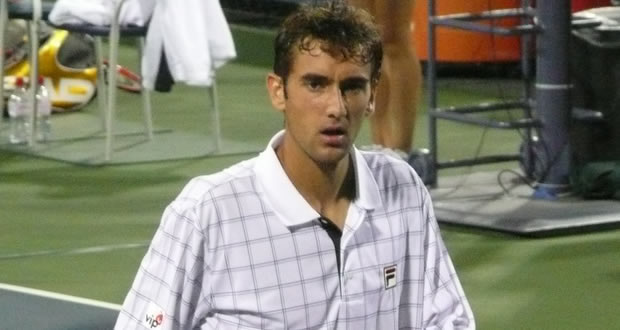
    Marin Cilic

    Croat Marin Cilic won his fourth Zagreb title defeating top seed Tommy Haas 6-3, 6-4.

    Cilic got off to a slow start and was broken in the opening game by the 35-year-old Haas before recovering to take five of the next six games to seize control of the opening set. Haas was unable to recover and the remainder of the set played out to serve with Cilic taking it 6-3.

    The second set was closely contested with Haas having an opportunity to break for a 4-2 lead. He wasn’t able to capitalize and Cilic fought back by holding serve and then broke Haas to jump out to a 5-3 lead.

    Haas did manage to save one match point but Cilic brought proceedings to an end at the second attempt.

    The victory gave Cilic his tenth career title and first since returning from a drug suspension.

    [divider]

    Cover Photo: angela n (Creative Commons License)


  • Tommy Haas Wins the Vienna Open

    Tommy Haas Wins the Vienna Open

    Tommy Haas

    German veteran Tommy Haas won his second Vienna Open title in Austria defeating Dutchman Robin Haase, 6-3, 4-6, 6-4, in two hours fifteen minutes. His first Vienna title was twelve years ago.

    Haase is a two-time former winner of the Vienna Open himself and pushed his near namesake all the way in a toughly contested encounter.

    It was the fifteenth career title for Haas, who has enjoyed a rich vein of form since returning to the tour after a long-term injury.  He is positioned 12th in the ATP race and still hopeful of gatecrashing the end-of-year World Tour Finals.

    [divider]

    Cover Photo: karlnorling, Creative Commons License

  • Imagine That

    Imagine That

    US Open, Second Round Recap

    The second round of this year’s US Open is now complete, which, until tonight, was about all that usefully could be said about it. There was plenty being said, of course, but little of it was specifically about tennis. It’s always revealing when the controversy centres around those parts of the tournament that don’t involve players hitting balls at each other. Often it reveals that there’s not enough transpiring on court. What is it they say about devilry and idle hands?

    For some among the idle-handed this has provided further opportunity to wax righteous on Andy Murray’s behalf. It has been another wearying reminder that burning indignation is a bad state for weak writers to find themselves in, made worse by the fact that for too many of them it is also their default state. In any case, justifiable concern at Murray’s very late first round finish has given way to disgruntlement at his second round relegation to Louis Armstrong Stadium. Rightly or wrongly, placement on the second court was held to be a slight on the defending champion’s status. Murray himself has previously made his distaste for the venue plain. That’s fair enough – he doesn’t have to like it.

    More problematic, apparently, was that by playing third today his match wouldn’t see completion before deadlines expired for the attendant British press corps. The USTA was taken to task for this oversight, most notably by Neil Harman of The Times. Some responded that it isn’t the job of the US Open to worry on behalf of the English press. It was pointed out in turn that with newspaper revenues collapsing it was incumbent upon premium events such as this to ensure that newsprint journalists are given every advantage. While I certainly agree that the death of print journalism is deplorable, I’m not convinced it is the task of tennis tournaments to nurse it along more than they already do. Print outlets are already given preference over online interests, including priority seating for late round matches with limited capacity. Print journalists are often the keenest advocates for the suppression of interview transcripts.

    Amidst all this, it’s worth remembering than Murray did actually win today in four sets over a surprisingly gallant Leonardo Mayer. Ivan Lendl is doubtless earning his salary by ensuring his man isn’t distracted by all this subsidiary nonsense, although I don’t doubt he’ll have some stern words about today’s third set letdown.

    Of course, the United States has its own issues on the home front. The enemy is within the gates. Many of them were in the Louis Armstrong Stadium crowd last night, watching John Isner play Gael Monfils. Television viewers were presented with the unusual spectacle of an American crowd showing vociferous support for a guy who wasn’t born in the same country as them, as opposed to the guy who was. Much has been made of this; rather too much, in fact. It was no coincidence that Monfils, who is immensely popular everywhere – except, often, with his own fans –gained favour when he picked up his game while trailing by two sets to love. This change in sympathy was briefly noted on Eurosport, afterwards regretted by Isner himself, and dissected exhaustively on ESPN. Really, the crowd just wanted a few more sets, and appreciated the things Monfils was doing with his body and the tennis ball. He still couldn’t serve, and Isner often did little else, but it nonetheless transformed into a very entertaining match. The crowd got its wish, which I suspect always included eventual victory for Isner. The American was afterwards equally lavish in praising his opponent.

    In other results, both Roger Federer and Rafael Nadal were  imperious and utterly untroubled against Carlos Berlocq and Rogerio Dutra Silva, respectively. There’s a real chance they will actually meet in the quarterfinals, although it’s possible they’re just lulling us into complacency. Stan Wawrinka started slowly against Ivo Karlovic, but was quite excellent once he regained the break in the first set. Novak Djokovic also took an age to get going, and almost dropped the first set to Benjamin BeckerMarcos Baghdatis, on the other hand, began superbly and stayed that way until the end against Kevin Anderson. For all we know Baghdatis’s brilliance didn’t abate once he left the court. His momentum was such that he’s probably doing a first-rate job with his dinner even as I write, delivering bon mots that have the table on a roar.

    Dan Evans’s excellent New York adventure continues. He beat Bernard Tomic quite comfortably to reach the third round, although his understandable elation at this accomplishment was tempered by the sobering discovery that the result came too late for British print deadlines. For his part, Tomic was typically frank in assessing his own shortcomings: “I think I get lazy on the court, my tennis sort of comes a bit slow. I don’t really know how to put guys away.” I imagine a proper coach could help with that. No one is sure where Tomic’s game is, but his capacity to make the right noises after losses has nearly matched Ryan Harrison’s.

    The delightfully articulate Dmitry Tursunov remains a fine advertisement for the sport, and for my powers of prescience: I suggested he’d be the one to emerge from David Ferrer’s quarter, and he has now reached the third round. Even if he somehow loses to the eighth seeded Richard Gasquet, I still get to be half-right. Meanwhile, Tommy Haas moved another round closer to a return to the Top 10, defeating Yen-Hsun Lu in straight sets. As far as I can tell he’ll need to reach the quarterfinals at least, which means he’ll have to beat Mikhail Youzhny in the next round, unquestionably the pick of the round.

    Lleyton Hewitt tonight recovered from two sets to one down to defeat Juan Martin del Potro in five sets on Arthur Ashe Stadium, entirely justifying the primetime scheduling. Del Potro has notoriously never recovered from a two set deficit, and for a time appeared fortunate that he didn’t have to put that record to the test. The Australian led by a set, and served for the second at 5-4, but didn’t acquit himself well on either of the set points he gained. The Argentine broke back, broke again to take the set, then again to open the third. He took the third, and then emphatically failed to gallop away with the fourth. Instead Hewitt pressed, and broke again. Again he failed to serve out the set. Del Potro, capricious in his way, defied every assumption that he’d again make Hewitt pay once more. The tiebreaker was all Hewitt, except for the errors, which were all del Potro’s. From there Hewitt went on with it, and broke three times in the final set, which ended with a double fault.

    It was a strange match, the type of upset that resists easy categorisation. The quality varied immensely, especially from del Potro, whose left wrist inhibited his backhand, and who sometimes grew oddly fearful when he wasn’t behind. Still, the overall inconsistency of momentum guaranteed consistency of drama, further heightened by the occasion and the venue, and only slightly marred by the heroic sequence of toilet breaks enjoyed by both men. Hewitt is fond of saying that it is for occasions such as these that he still plays, even if he is earning fewer opportunities to say it as the years advance. It is his first victory over a Top 10 opponent in over three years. Whether he’ll go on with it is a nice question, although even wearied he must fancy his chances against Evgeny Donskoy in the next round. After that he might face Haas. In the fourth round of a Major. In 2013. Imagine that.

  • Nadal, Djokovic, Haas, Wawrinka Advance to the Roland Garros Men’s Quarterfinals

    Nadal, Djokovic, Haas, Wawrinka Advance to the Roland Garros Men’s Quarterfinals

    Seven-time Roland Garros champion Rafael Nadal, of Spain, the No. 3 seed, faced off against the highest ranked player ever from Japan, Kei Nishikori, the No. 13 seed, and prevailed 6-4, 6-1, 6-3. Nadal is seeking a record eighth French Open title.

    Tommy Haas, at 35, is the oldest man to reach the QFs of the French Open since 1971. He survived a 5-setter against John Isner to get to Mikhail Youzhny today, whom he beat in straight sets. He’ll face Novak Djokovic in the next round. The last time they played was in March at the Miami Masters, when the German upset Djokovic 6-2, 6-4. Haas, coming back from injury several times, has twice been named Comeback Player of the Year, including last year.

    Djokovic, the No. 1 seed, rebounded after losing the first set, beating the German Philipp Kohlschreiber, 4-6, 6-3, 6-4, 6-4.

    In the last men’s match of the day, the Swiss Stanislas Wawrinka (No. 9) came back from two sets down to defeat Richard Gasquet, of France, the No. 7 seed, 6-7(5), 4-6, 6-4, 7-5, 8-6.

    [divider]

    Click here to discuss the Nadal/Wawrinka quarterfinal, and more with fellow tennis fans on our discussion boards.

    Click here to discuss the Djokovic/Haas quarterfinal, and more with fellow tennis fans on our discussion boards.

  • Tommy Haas takes Munich title

    Tommy Haas takes Munich title

    Tommy Haas won his 14th ATP title on Sunday by defeating two-time former champion Philipp Kohlschreiber at the BMW Open in Munich.

    Haas won the match in straight sets 6-3 7-6 taking 83 minutes.

    “It’s a little dream,” said Haas, a German now residing in California.

    Tommy will rise to 13th in the ATP World Rankings, and the 35 year old is enjoying a fine year, having already beaten World #1 Novak Djokovic in Miami and making the finals at San Jose.

    “Tommy played outstanding tennis, without any mistakes – almost a perfect match,” said Kohlschreiber.

    It was Haas’s fourth title on German soil.

    Click here to discuss the Munich Open with fellow tennis fans in our message board forums.

  • Take me home, country roads…

    Take me home, country roads…

    All roads point to West Virginia for tennis legends Pete Sampras, John McEnroe and Ivan Lendl as they confirmed participation in the White Sulphur Springs exhibition at the Greenbier Resort.

    The trio will be joined by Tommy Haas – still active on the ATP circuit and currently enjoying a rich vein of form.

    Haas will face off against 14 time major titleist Sampras, whilst McEnroe will renew hostilities with old adversary Lendl.

    The following day will see a doubles match between the quartet.

    It is the second successive year that Sampras and McEnroe have been invited to the tournamount.

    The two day exhibition is scheduled to begin on the 21 September.