Tag: tomas berdych

  • 2015 ATP World Tour Finals Preview

    2015 ATP World Tour Finals Preview

    15612895007_1565dcee0d_z

    ‘The end is here’ ‘The Final showdown’ ‘The Stage Is Set’ ‘Insert overdramatic cliché’. Yes, ATP overkill at its finest. But cynicism aside, I am of course looking forward to the season ending shindig in London. It is a pleasure to see the best players in the world battle it out for a colossal sum of money and ranking points. Not bad for a week’s work, that’s for sure.

    There is little change in the line-up since last year’s event, with Nadal and Ferrer replacing Milos Raonic and Marin Cilic in the eight man field, although Ferrer was an alternate last year. The event is a great yardstick of both season long consistency, but even more so of longevity. This shall be Berdych’s sixth straight year of qualification, Ferrer’s fifth, Djokovic’s ninth and one Mr Roger Federer’s fifteenth. The other four meanwhile have all made multiple appearances, again a testament to the depth and quality atop the men’s game.

    On the subject of depth and quality, Novak Djokovic stands a head higher than even his closest competitors at the event, and as I breakdown the draws and offer my thoughts, it becomes clear: All roads pass through Novak in the quest to haul in the trophy a week from Sunday.

    Group A

    This group, consisting of Djokovic, Federer, Berdych and Nishikori, is for me the more likely of the two to see the big names advancing.

    Novak leads Berdych a lopsided 20-2 in their head to head, never having lost to the Czech on a hard court. Berdych has enjoyed some form this autumn, but even his biggest shots seem to make little indentations in the Serb’s defences. Nishikori has enjoyed a bit more success against Djokovic, winning two of their six matches, including at the US Open last year. In addition, Nishikori pushed Novak at the World Tour Finals last year in one of the few matches that weren’t duds. With Kei’s lack of matches lately though, and Djokovic’s imperious form, I suspect Djokovic to come through these two hassle free.

    Federer, although not as dominant over the afore mentioned pair as Djokovic, still enjoys healthy head to heads against both. Against Berdych the Swiss leads 14-6. Berdych does not seem to have as big a block against Roger compared to the more defensive members of the ‘big four’, his big game when clicking can overcome him, including twice in Slams. Federer has not lost to Tomas though since an injury plagued 2013, winning the last three matches. I think Berdych could trouble the Swiss, especially when one looks at his recent loss to the big hitting Isner in Paris, but the court in London has in recent years yielded a slower bounce, which should aid Federer in nullifying Berdych’s power.

    What of the marquee matchup between the two most successful players of the season? It seems strange for Novak and Roger to meet in the round robin stage of the tournament, but that is the nature of rolling rankings and contributes towards the excitement of this unique event. There is little to choose between the pair going into the tournament, Federer triumphing in Basel, Djokovic a week later in Paris. Both are in fine fettle, and play some of their best indoors. Based on his sheer dominance in the last few months, Novak for me edges their encounter.

    Group Winner: Djokovic

    Group Runner Up: Federer

    Group B

    The other group, consisting of Murray, Wawrinka, Nadal and Ferrer, offers more in the way of unpredictability and intrigue than the first.

    Murray is in a rich vein of form, reaching the Paris Masters final before falling tamely to Djokovic. He will benefit from home crowd support, and is a fine indoor player. Although trailing Nadal 6-15 in their head to head, this is not the same Nadal of late, Murray beating him on the home clay of Madrid in their last meeting this year. Murray has had a better season, and I think in terms of speed, fitness and form the Scot starts out as favourite against Rafa. In his last meeting with Ferrer, recently in Paris, he overcame him in two straight forward sets, and leads their series 11-5, as well as having won their last three indoor meetings. Ferrer has enjoyed a successful autumn, but Murray would start as a clear favourite. Murray’s match with Wawrinka should prove to be the hardest. While he leads the Swiss 8-4, Stan won their last two encounters in 2013, and they have not met since in a period where he became a two time slam winner. I would not be surprised to see Wawrinka power through the Scot, as he did last time they met.

    Stan Wawrinka comes to London having enjoyed the best year of his career. Nadal was long a nemesis for him, leading their head to head 13-3. Stan has put things to rights in recent years however, winning three of their last four meetings,  including on Nadal’s beloved clay earlier this year, and then in two pulsating sets in Paris in similar conditions to London last week. If Wawrinka hits his offensive stride, I see him edging the Spaniard. Against Ferrer meanwhile, Stan, whilst trailing 6-7, he has won their last three meetings. Ferrer can certainly hang in there with the more powerful Swiss, still prone to bouts of inconsistency, but Stan remains the favourite.

    Nadal has done well in making the finals in London, having a rather modest year by his lofty standards, winning just three minor titles. He has qualified the hard way, but qualified all the same. He has shown some good form in the indoor season, stretching Federer, perhaps the greatest indoor player in history, to three sets in the Basel Final, before falling in a tight quarterfinal last week in Paris. I have already above given two opponents an edge over Nadal in his group, and I struggle to see him making the semi-finals this year. All the same, it would be a great end to the year for Nadal to score a win against his friend and rival, the dogged David Ferrer. Rafa enjoys a 23-6 lead in their matches, and won their sole meeting this year in Monte Carlo. Ferrer is nevertheless an effective indoor player, coming into London with two trophies at indoor events. Furthermore, four of his six wins against his compatriot were on hard courts, two of them indoors. This match represents both men’s best chances of a win in London, and the accompanying $167,000 and 200 ranking points. Expect an entertaining slugfest in their final encounter of the year.

    Group Winner: Murray

    Group Runner Up: Wawrinka

    Semi-Finals

    Federer Defeats Murray

    Djokovic Defeats Wawrinka

    Final

    Djokovic Defeats Federer

    [divider]

    Link to author Daniel Edwards’ blog

    Cover Photo (Creative Commons License): Marianne Bevis

  • Australian Open Day 11: Semifinals – Order of Play & Scores

    Australian Open Day 11: Semifinals – Order of Play & Scores

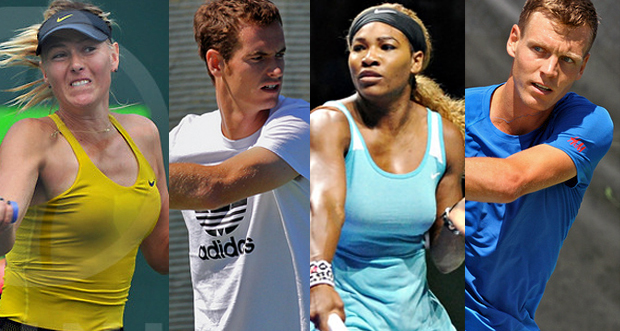
    Maria Sharapova Andy Murray Serena Williams Tomas Berdych

    The women’s semifinals are featured during the day session on Rod Laver Arena on Day 11 of the Australian Open. Up first is Maria Sharapova (2), who faces her compatriot Ekaterina Makarova (10). Following them will be the No. 1 seed, Serena Williams (USA), who also plays a compatriot, Madison Keys. The night session focuses on the first of the men’s semifinals: Andy Murray (6) takes on Tomas Berdych (7).

    The schedule for Day 11 is listed below (Results to follow). All times are local.

    [divider]

    Rod Laver Arena — 11:00am    

    Men’s Doubles – Semifinals
    Simone Bolelli (ITA) / Fabio Fognini (ITA) d. Jean-Julien Rojer (NED) (6) / Horia Tecau (ROU) (6) — 6-4, 3-6, 6-3

    Not Before: 1:30pm

    Women’s Singles – Semifinals
    Maria Sharapova (RUS) (2) d. Ekaterina Makarova (RUS) (10) — 6-3, 6-2

    Women’s Singles – Semifinals
    Serena Williams (USA) (1) d. Madison Keys (USA) — 7-6(5), 6-2

    Not Before: 7:30pm

    Men’s Singles – Semifinals
    Andy Murray (GBR) (6) d. Tomas Berdych (CZE) (7) — 6-7(6), 6-0, 6-3, 7-5

    [divider]

    Click here to discuss the S. Williams/Keys semifinal in the discussion forum.

    Click here to discuss the Sharapova/Makarova semifinal in the discussion forum.

    Click here to discuss the Murray/Berdych semifinal in the discussion forum.

    [divider]

    Margaret Court Arena — 11:00am 

    Men’s Doubles – Semifinals
    Pierre-Hugues Herbert (FRA) / Nicolas Mahut (FRA) d. Ivan Dodig (CRO) (4) / Marcelo Melo (BRA) (4) — 6-4, 6-7(5), 7-6(5)

    Not Before: 1:30pm

    Mixed Doubles – Quarterfinals
    Kristina Mladenovic (FRA) (3) / Daniel Nestor (CAN) (3) d. Cara Black (ZIM) (5) / Juan Sebastian Cabal (COL) (5) — 6-2, 6-3

    Mixed Doubles – Quarterfinals
    Su-Wei Hsieh (TPE) / Pablo Cuevas (URU) d. Katarina Srebotnik (SLO) (2) / Marcelo Melo (BRA) (2) — 6-1, 6-2

  • Second Tier Players

    Second Tier Players

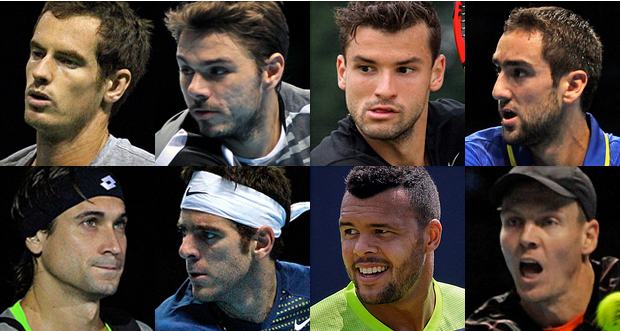
    Andy Murray Stan Wawrinka Grigor Dimitrov Marin Cilic David Ferrer Juan Martin Del Potro Jo-Wilfried Tsonga Tomas Berdych

    Most tennis fans, whether casual or serious, tend to follow the elites – the best players in the game who are perennial contenders for Grand Slams, ranked in the Top 5, and assemble resumes for the history books. Think Roger Federer, Rafael Nadal, Novak Djokovic, and, at times, Andy Murray. Serious fans of the game might extend their radar to the Top 100 and even a bit beyond, especially for long-time veterans and up-and-coming players. Your average serious fan – which I’d define as someone who follows the tour on at least a weekly basis and generally knows what tournaments are occurring, at least the bigger ones – probably could scan the Top 100 and recognize the names of most of them (perhaps another criteria for “serious fan”).

    Federer, Nadal, and Djokovic are household names – they have all been to the top of their sport and are all-time greats. Andy Murray is borderline, but after that it gets dicey. A casual fan of tennis knows the names Juan Martin Del Potro, David Ferrer, Tomas Berdych, Jo-Wilfried Tsonga, and, after 2014, Stan Wawrinka and Marin Cilic, and depending upon where one lies on the casual-to-serious scale, it starts tapering off after the Top 10. But those names – bonafide Top 10 players, but generally not Slam winners – aren’t all that well known among the general public.

    The purpose of this thread is to look at those “second tier” players – players who are not all-time greats, not multi-Slam winners, not No. 1’s, but still very good players. In fact, let’s define a few criteria for what I’m calling a “second tier” player:

    • No more than a single, “stray” Slam
    • No more than five “big” titles (Slams, Masters, World Tour Finals)
    • Never ranked No. 1

    What differentiates a second tier player versus a “third tier” and the rest of the pack? Some general guidelines might be:

    • Must have ranked in the Top 10 at least for a week, and/or
    • Must have won a big tournament
    • Must have at least five career titles
    • Multiple years finishing in the Top 20

    Who fits the bill among active players? Let’s take a look at the players, with a brief overview of their careers.

    [divider]

    Click here to discuss “Second Tier Players” in the discussion forum.

    [divider]

    David Ferrer

    David Ferrer is an interesting case, because on one hand he’s a bit of a tragic figure – he’s made it to the final of nine big tournaments (one Slam, one WTF, and seven Masters) and won only a single one, perhaps the weakest of the lot—the Paris Masters in 2012, and only then arguably because he didn’t have to face any of the erstwhile Big Four (his opponent in the final was Jerzy Janowicz).

    On the other hand, he’s a testament to hard work and thus is perhaps the definition of over-achiever. In other words, Ferrer has made the most of what he has and has come away with an impressive resume. He’s won 21 titles and finished in the Top 10 eight years in a row, the Top 20 ten years in a row, ranking as high as No. 3. He’s had his best two years in 2012-13, at the age of 30-31. In a way he’s as good as you can be without being great. There’s no shame in that.

    [divider]

    Juan Martin del Potro

    Of all the players on this list, del Potro might be the biggest “could have been.” A promising young player he finished 2008, the year he turned 20, at No. 9. Then, in 2009—at a time when the tour was dominated by two players, Federer and Nadal, with everyone else lining up to try to get a piece of the pie—he took the tennis world by storm by defeating Federer in the US Open final. He was not yet 21, and it looked like tennis had a new superstar, or at least someone to complete with Djokovic and Murray for “best of the rest.” After finishing the year No. 5 at the tender age of 21, the sky seemed the limit.

    Then, in an exhibition match in January of 2010, disaster struck: del Potro’s wrist began to hurt, and it kept on hurting. He entered the Australian Open with an ailing wrist, eventually losing in the fourth round to Marin Cilic. He then proceeded to miss nine months and only came back for a couple small tournaments late in the year, his ranking dropping to No. 258. He seemed healthy (or healthy-ish) in 2011, but wasn’t the same player. He did win a couple ATP 250 tournaments but could not make it into the second week at any Slam, although still finished the year No. 11. 2012 and 2013 saw further improvement, years in which he finished No. 7 and No. 5, respectively, but he could not quite match his 2009 glory. In early 2014 disaster struck again, and del Potro was out for most of the year, finishing at No. 138. We can only hope that “Delpo” will come back strong in 2015; he is only 26 years old and still in his prime, but he is clearly a brittle player.

    [divider]

    Tomas Berdych

    Berdych is another player with elements of disappointment to his career (see a pattern here?). The Czech rose quickly in 2005, winning his first, and so far only, big tournament – the revolving door that is the Paris Masters. Not to take that away from him, but it is worth noting that neither of the top two players in the game – Roger Federer and Rafael Nadal – played in the 2005 Paris Masters. Anyhow, Berdych finished that year at No. 24 and seemed poised to challenge for a place among the elite. Yet he stagnated, finishing the next four years in the No. 13-20 range, making the quarterfinal of only one Slam.

    Yet something seemed to click for Tomas in 2010 and, since then, he’s been one of the more consistent players on tour – finishing either No. 6 or No. 7 in each of the past five years, a span of time in which he’s made it to the second week (quarterfinal or later) in half of all Slams, once making the final – losing to Rafael Nadal in the 2010 Wimbledon, although not before defeating Roger Federer and Novak Djokovic.

    Berdych remains an excellent player and a fixture, for the time being, in the Top 10. But he does turn 30 years old in 2015, so the window is closing for him.

    [divider]

    Jo-Wilfried Tsonga

    It is easy to pair Berdych and Tsonga, for not only were they born in the same year (1985), but they’ve haunted similar territory in the lower half of the Top 10 for the last half decade or so, and their career accomplishments are quite similar, although with Tsonga’s win at the Canada Masters this year he’s pulled ahead a bit.

    Tsonga was a successful junior player, winning the 2003 Junior US Open over Marcos Baghdatis. He suffered through a series of injuries before rising quickly on the tour in 2007 and 2008, finishing that year at No. 6. For the last seven years he’s finished No. 13 or higher, five of those years in the Top 10. Tsonga has been deemed an underachiever; he’s got a big game, but doesn’t seem to have the big match mentality. Like Berdych he turns 30 next year, so the hourglass is about to turn.

    [divider]

    Stan Wawrinka

    The “Stanimal” was born the same year as Berdych and Tsonga and, if you look at his career through 2012, could be viewed as an underachiever and disappointment – yet as of this writing, he’s the only one of the Class of ’85 who has come away with a big prize. He rose to No. 54 in 2005, No. 30 in 2006, and then crept up to No. 13 in 2008, but floundered for a few years – looking more like a third tier and perennial Top 20 player, but only just grazing the Top 10 for a few months in 2008. But something seemed to click in 2013 – his results were more consistent as he regularly went deeper into tournaments, including his first Slam semifinal at the US Open and making it to the final of four tournaments, although winning only one, an ATP 250 (the Portugal Open). Stan finished the year at No. 8 after a not-embarrassing performance at the ATP World Tour Finals where he defeated David Ferrer and Tomas Berdych to make it to the semifinals where he lost to eventual champion Novak Djokovic.

    At the beginning of 2014 it seemed that Wawrinka was coming off a career year. He began the year well by winning the Aircel Chennai Open. But it was the Australian Open that proved the shocker: After defeating Novak Djokovic in the quarterfinals, and Tomas Berdych in the semifinals, Stan faced off against No. 1 Rafael Nadal. No one really gave him a chance, but he ended up defeating Rafa in four sets (it is easy to call this a cheap win for Wawrinka as Rafa was injured in the second set, but let us not forget that Stan won the first set and Rafa was well enough to win the third; certainly Rafa’s injury was a major factor, but the focus should be on Stan’s accomplishment). It was easy to consider that a fluke win, but Stan ended up also winning his first Masters, defeating Roger Federer in the Monte Carlo final and improving upon his 2013, finishing No. 4.

    What’s next for Stan? It is hard to imagine a quick drop-off, but it is also hard to imagine him repeating his 2013 performance – especially his Slam. But he’s likely going to remain a Top 10 player for at lest another year or two.

    [divider]

    Marin Cilic

    Talk about a surprising player. After a surge into the Top 10 in early 2010, after making it to the semifinals of the Australian Open at the age of 21, Cilic was erratic for the last few years, settling in as a third tier player. Then he was suspended for nine months (which was reduced), which seemed to serve as a wake-up call, or perhaps merely inspiration, as he rose quickly through the rankings in 2014, winning three minor tournaments before his surprising win at the US Open.

    Cilic is not the worst player ever to win a Slam, but there are better players in terms of overall career level, and thus is a good example of both how a single Slam does not equate with greatness, but also how tenacity can pay off. But he is a Slam winner and finished his second year in the Top 10, so is now a bonafide second tier player. It will be interesting to see whether he can maintain it.

    [divider]

    Just Missing the Cut: Richard Gasquet, Nicolas Almagro, Gilles Simon, Tommy Robredo, John Isner, Feliciano Lopez, Gael Monfils.

    You might quibble with my choices, but in my mind none of them are true second tier players. Some have vied for a spot in the second tier; for instance, Tommy Robredo finished 2006-07 in the Top 10, but for most of his career he’s been more of a third tier No. 20-30-type player. The same could be said for the others. Gasquet is an interesting one because in some sense he’s been the “gatekeeper” between the second and third tier for the last few years, or at least for 2012-13 when he finished No. 10 and No. 9. Gasquet would consistently beat everyone below him and lose to everyone above; previously other players like Janko Tipsarevic, perhaps Almagro, and before both, Fernando Verdasco, filled this role.

    Among this group, or at least those mentioned, the one who stands out as the “could have been more” (and perhaps still can be) is Gael Monfils. He is a player whose reputation and ability far exceeds his usual ranking, mainly due to seemingly being injury prone and perhaps a non-championship mentality. Monfils is a second tier talent with a third tier career–in a sense, the inverse of David Ferrer—and thus is the type of player who could surprise us and win a big tournament. The 2015 Paris Masters?

    [divider]

    On the Cusp: Milos Raonic, Kei Nishikori, Grigor Dimitrov, Ernests Gulbis.

    Kei in particular might deserve to be a second tier player by virtue of his No. 5 finish this year. He’s won six titles but consider that he has not yet won a big tournament (he made the final of both a Slam and Masters this year), nor has he finished in the Top 10 more than once. But if he finished in the Top 10 a second year in a row and/or wins a big tournament, he’s in.

    Similarly with Raonic and Dimitrov. It only seems a matter of time. With Dimitrov there may even be a chance that he becomes a lesser first tier player along the likes of Andy Murray, but the clock is ticking.

    [divider]

    Addendum: The Question of Andy Murray

    It is hard to feel bad for someone with two Grand Slam trophies, 31 titles overall, not to mention an impending marriage to the beautiful Kim Sears. Andy will forever be beloved in the United Kingdom for being the first British player to win a Grand Slam title in the Open Era, and the first since Fred Perry in 1936 to take Wimbledon. But Andy comes off, at least in the press, as disgruntled, surly, and forever unhappy with his standing. Just as Novak Djokovic was the third wheel on the Fedal bicycle for four years in a row, Andy has been the “best of the rest/worst of the best” for just about his entire career. Unlike Novak, Andy didn’t break through the players ahead of him and rise to No. 1. He did win two Grand Slams within one calendar year, being a true member of the Big Four for at least that year, but he couldn’t maintain it.

    That said, Andy Murray is no second tier player. He is a truly great player, the third greatest of a generation that has produced what should turn out, when all is said and done, two of the ten or so greatest players of all time in Nadal and Djokovic. If Andy were born ten years earlier and peaked in the weak era of the late 90s to early 00s, he would undoubtedly have many more Slams than two. But every player has a “what if” story, and in the end, Andy’s career is what it is – and not only is it not over yet, it has been a stellar one so far. My opinion is that Andy is the greatest player of the Open Era with less than four Slams – greater than Kuerten, Hewitt, Safin, even Ashe. (What I mean by “greatness,” in this context, is a combination of peak level and career accomplishment).

    In some ways Andy is the Guillermo Vilas of the current era. Vilas was born in the same year as Jimmy Connors and peaked alongside Connors, Bjorn Borg, John McEnroe, and, to a lesser degree, Ivan Lendl. That’s what I’d call a “raw deal.” Yet Vilas still managed to win four Slams and 62 titles and was ranked in the Top 6 for nine years in a row, but—like Andy so far—he never did rank higher than No. 2, despite arguably being the best player in 1977.

    Career-wise, despite currently stalling out in his Slam count, Andy is closing in on four-Slam winners Vilas and Jim Courier, who are the gatekeepers to the true elites of the Open Era. I’d say he probably needs at least one more Slam to join them, but still has the possibility of surpassing him. Wouldn’t it be appropriate if Andy finished his career with four or five Slams, and became the historical “best of the rest, worst of the best?”

    [Note: At some point I’d like to write a “Part Two – Second Tier Players of the Past,” but there are a few articles on the burner, so stay tuned.]
  • Barclays ATP World Tour Finals – Day 6 – Order of Play & Scores

    Barclays ATP World Tour Finals – Day 6 – Order of Play & Scores

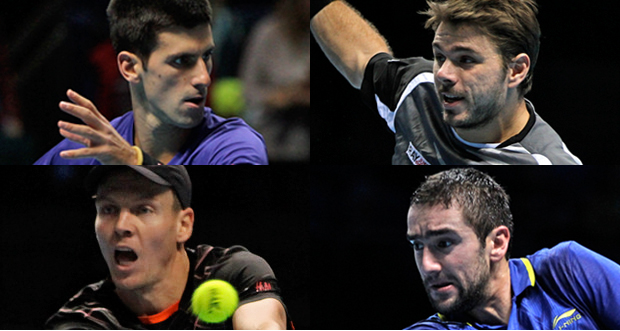
    Novak Djokovic Stan Wawrinka Tomas Berdych Marin Cilic

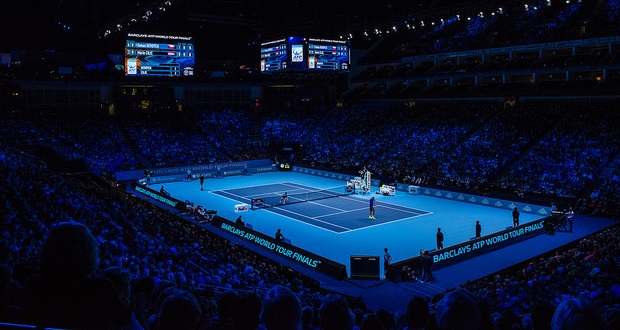
    Round robin play at the Barclays ATP World Tour Finals concludes on Friday, November 14. The afternoon session features World No. 1 and the defending champion Novak Djokovic, facing off against the Czech Tomas Berdych. The evening session will conclude with Australian Open champion Stan Wawrinka playing the US Open champion Marin Cilic.

    [Scores added as known. All times are local.]

    [divider]

    Afternoon Session:

    Doubles — 12:00 P.M.
    Kubot/Lindstedt d Rojer/Tecau — 6-5, 7-6(4)

    Singles — 2:00 P.M.
    Djokovic d Berdych — 6-2, 6-2

    [divider]

    Evening Session:

    Doubles — 5:45 P.M.
    Bryan/Bryan d Peya/Soares — 7-6(3), 7-6(2)

    Singles — 8:00 P.M.
    Wawrinka d Cilic — 6-3, 4-6, 6-3

    [divider]

    Click here to discuss the Day 6 matches in the discussion forum.

    [divider]

    Cover Photo (Creative Commons License): Marianne Bevis

  • Not In My House – Djokovic Wins a Fifth Beijing Championship

    Not In My House – Djokovic Wins a Fifth Beijing Championship

    Novak Djokovic

    Truly, it seems that with this fifth championship, Novak has made Beijing his home.  It was one of those matches where Berdych’s easy power was returned with interest as Djokovic was dialed in and hitting as well as any fan could hope.

    At 15-15 in the first game, he hit a backhand down-the-line return that was a portent of how the rest of the match would unfold.  Novak would return booming serves dropping them near (or on) the baseline.  There were some very good rallies early on, but just when you thought Berdych had a winner, it came back.

    Berdych ended the first set having landed only 48% of his first serves with two double faults.  There were few opportunities to find a foothold.  Down 0-3, he blistered a winner to get up on Djokovic at 0-30, but the Serb served his way out of trouble.  Then again at 0-4, 40-15 he had game points to get on the board.  Novak went into his Gumby defense (aided and abetted by the slower courts) and replied with a scorching backhand down-the-line winner off an excellent forehand crosscourt from Tomas.

    A few moments later he found himself down a break point, fought back to deuce, only to see it all slip away due to the laser-sharp shot-making of his opponent.  Outclassed and discouraged, Berdych’s error count surged, losing the first set without winning a game, and the first two games of the second set without winning one point.

    Berdych had his moments.  A beautiful backhand down-the-line shot at 0-3, 0-40.  In the fifth game, down 0-15, they had an incredible rally using every corner of the court.  Novak hit a sharply angled crosscourt forehand pulling Tomas off the court.  The Czech flicked his racquet for a beautiful forehand down-the-line winner to win the point.

    The people loved it.  I so appreciate the Beijing crowd.  They’re polite and attentive, but not at all jaded.  As these guys would rally, hitting one unbelievable shot after another, the oohs and aahs would get louder and louder — then they would explode when the point finished.

    Novak didn’t even blink, and fired more winners of his own.  Suddenly it was 5-0 in the second set, and Novak was serving for the championship.  Tomas was fighting to avoid eating two bagels, and managed to see his first break points of the match, capitalizing on the second to get his first game.  He then held serve for the first time all day, before Djokovic closed it out on his serve.

    It was an entertaining match for the most part, and the scoreline should take nothing away from Berdych’s play this week.  This was just one of those days when Djokovic was on his game; he even said later that it was the best final he has ever played.  It’s his house for another year.

    [divider]

    Click here to the discuss the Djokovic/Berdych final in our Discussion Forum.

    [divider]

    Cover Photo (Creative Commons License): Marianne Bevis

  • US Open Day 11: Men’s Quarterfinals – Order of Play & Scores

    US Open Day 11: Men’s Quarterfinals – Order of Play & Scores

    2014 US Open QF 2

    Day 11 features the Men’s Quarterfinals for the bottom half of the draw – Berdych v. Cilic, and Federer v. Monfils, to set the men’s semis.  Also in play are the Women’s and Men’s Doubles Semi-finals.  Women’s singles semi-finals are Day 12.

    The full schedule for Day 11 is listed below (Results to follow).  All times are local.

    [divider]

    Arthur Ashe Stadium — 12:00 P.M.  

    Men’s Doubles – Semifinals
    Bob Bryan (USA) (1) / Mike Bryan (USA) (1) d. Scott Lipsky (USA) / Rajeev Ram (USA) — 6-4, 4-6, 6-3

    Not Before: 1:30 P.M.

    Men’s Singles – Quarterfinals
    Marin Cilic (CRO) (14) d. Tomas Berdych (CZE) (6) — 6-2, 6-4, 7-6(4)

    Not Before: 8:00 P.M.

    Men’s Singles – Quarterfinals
    Roger Federer (SUI) (2) d. Gael Monfils (FRA) (20) — 4-6, 3-6, 6-4, 7-5, 6-2

    [divider]

    Louis Armstrong Stadium — 11:00 A.M.

    Women’s Doubles – Semifinals
    Ekaterina Makarova (RUS) (4) / Elena Vesnina (RUS) (4) d. Kimiko Date-Krumm (JPN) / Barbora Zahlavova Strycova (CZE) — 7-5, 6-3

    Not Before: 12:30 P.M.

    Men’s Doubles – Semifinals
    Marcel Granollers (ESP) (11) / Marc Lopez (ESP) (11) d. Ivan Dodig (CRO) (4) / Marcelo Melo (BRA) (4) — 6-4, 6-4

    Not Before: 2:00 P.M.

    Women’s Doubles – Semifinals
    Martina Hingis (SUI) / Flavia Pennetta (ITA) d. Cara Black (ZIM) (3) / Sania Mirza (IND) (3) — 6-2, 6-4

    [divider]

  • Federer Wins Record Sixth Dubai Title

    Federer Wins Record Sixth Dubai Title

    Roger Federer

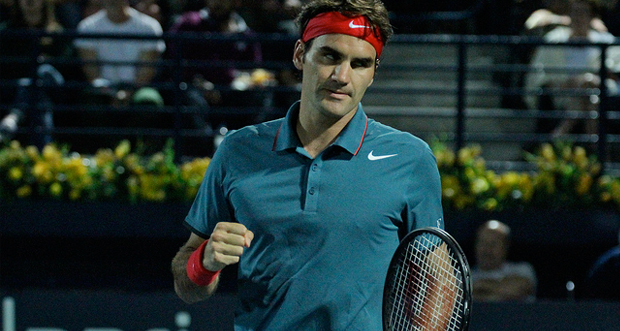
    Roger Federer rebounded from a set and a break deficit to defeat Tomas Berdych 3-6, 6-4, 6-3 for the trophy at the Dubai Duty Free Championships.  It was a topsy-turvy affair, with several swings in momentum and breaks of serve. As Berdych’s first serve percentage dropped, however, Federer’s came up, and the Swiss overall had more winners and fewer unforced errors than the Czech (25-23 v. 20-29.)

    Federer defeated Novak Djokovic yesterday to secure his place in the final and the victory today sees him at at 14-2 win-loss start to the year, which seems to bode well, after a less-than-stellar 2013 for the great champion. ‘Things definitely went my way out here tonight,” Federer said. ”I’ve had a lot of tough matches in the last year and a half so it was nice to get a lucky break again.”

    Berdych recently the saw the end to his even longer drought, winning the title in Rotterdam three weeks ago, ending an 18-month streak without a trophy. ”He’s the greatest player of all time and he’ll never give up and give you anything for free,” Berdych said. ”I knew that and thought I was ready for it, but my execution wasn’t good enough to hold it to the end.”

    The win gives Federer his 78th career title, putting him one above John McEnroe, and alone at third on the all-time list behind Jimmy Connors (109) and Ivan Lendl (94). In addition, as his first title of 2014 (first since Halle last June), the win in Dubai means that Roger has won at least one title in each of the last 14 years.

    [divider]

    Cover Photo (Creative Commons License): Marianne Bevis

  • Berdych Ends Drought; Wins Rotterdam

    Berdych Ends Drought; Wins Rotterdam

    Tomas Berdych

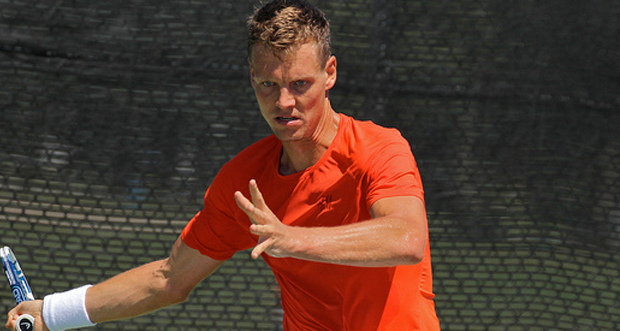
    Tomas Berdych made short work of Marin Cilic today, beating him 6-4, 6-2 to win the ABN AMRO tournament in the Netherlands.  This is his first trophy in 16 months, having gone all of last season without a title.  He was the only player in the Top 10 last year without one.

    “It feels absolutely amazing,” Berdych said. “It’s been a while, actually 16 months since I won a title. To win a title in Rotterdam it’s a nice bonus. I’m extremely happy with the way I handled it throughout the week. I’ve been serving pretty well, which has been the strong part of my game.”

    It was indeed serving that gave the Czech the advantage.  He recorded nine aces and had an 82% first serve stat.  The downfall for Cilic was 22 unforced-errors.  The match was over in 75 minutes.

    Cilic, who is newly coached by Goran Ivanisevic, is now 14-4 on the season, a strong start, despite the loss today.

    “It was a tough one today,” said Cilic. “What made the difference in the end was that Tomas served really well …. Overall I think the tournament was great. I played great tennis and enjoyed it here. I had a great run of nine [straight] wins and I hope to make that run soon again.”

    [divider]

    Cover Photo (Creative Commons License): Marianne Bevis

  • Wabi-Sabi and Spider Bites

    Wabi-Sabi and Spider Bites

    Roger+Federer+2014+Australian+Open+Day+12+Wn7S9KclWuCl

    The Australian Open 2014 Men’s Semifinals

    Stanislas Wawrinka [8] def. Tomas Berdych [7] 6-3, 6-7(1), 7-6(3), 7-6(4)
    Rafael Nadal [1] def. Roger Federer [6] 7-6(4), 6-3, 6-3
     

    The redback spider, Latrodectus hasselti, is a species of venomous spider indigenous to Australia. By way of dinner preparation, the redback uses her fangs to inject a neurotoxin into the vulnerable flesh of her prey, liquefying its insides before binding it thoroughly in silk and sautéing it lightly under the hot Australian sun. Lucky for me, I was able to see a redback—at delightfully close range— on my very first evening in Australia, right about dinnertime, in fact. There she was: sleek and elegant, with a bright red stripe running down her back, and lethal as hell. My Australian hosts took no small pleasure in explaining that recent research indicates the people who’ve been killed by a redback bite actually died from the pain, not the venom. But not to worry, they cheerfully reassured me, should I be bitten by a redback, I’d simply be rushed to hospital, injected with an anti-venom serum, and then pumped full of morphine for a few days to prevent pain-induced organ failure. Easy.

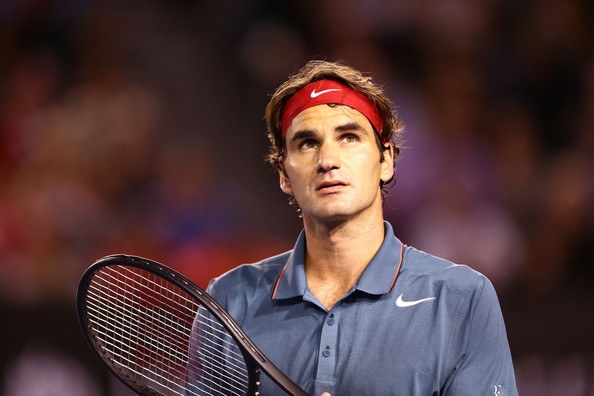
    Now, I won’t go so far as to compare World No. 1 Rafael Nadal to the Latrodectus hasselti, but I will go so far as to say that beating him at tennis isn’t easy, and losing to him looks like it hurts. Both these points were amply demonstrated by Grigor Dimitrov in his 6-3, 6-7(3), 6-7(7), 2-6 quarterfinal loss to the Spaniard. The Bulgarian shed tears after the match. But, at 22 years-of-age, Dimitrov is still very much a player in-process. The 32-year-old Roger Federer, on the other hand, has been declared dead, buried, and resurrected at least a dozen times by now. He already is who he will be, at least on the tennis court. (But after he retires, Federer might want to consider a second career in necromancy.) Maybe this is why it can be so painful to watch the Swiss superstar lose, yet again, to Nadal. There is a sense that instead of getting closer to deciphering the trick to making Rafa’s forehand disappear, Federer’s chances are getting ever more remote.

    This is not to say that Federer will never beat Nadal again. He probably will, possibly soon. But he will never discover the magic serum that allows him to avoid the pain of fending off a fusillade of Rafa forehands—all exploding into his backhand corner like hollow-point bullets—with only one hand on his tennis racquet. (And he will especially not discover the special serum if he persists on approaching into Nadal’s lethal side.) Roger Federer will never gain anything like ownership over their head-to-head, which Nadal now leads 23-10.

    There is not much new to say about this latest encounter, which was a comprehensive and familiar-feeling victory for the Spaniard, though it was Nadal’s first win in straight sets at a major since the French Open in 2008. As anticipated, Nadal arrived with almost none of the unsettled confusion he showed against Dimitrov two days earlier. From his serve, to his forehand, to his clenched jaw, Rafa looked muscular in his determination. Yes, he was blistered, but he was also callous. [Sorry, couldn’t help it.] There are those of us who imagine it causes Rafael Nadal some degree of internal pain to pummel the great Roger Federer. But that doesn’t stop him from doing it. And, really, those forehands are so much fun to see. 

    Watching Federer, I wasn’t quite sure what I felt. Wabi-sabi comes to mind, The Japanese aesthetic wherein impermanence, incompleteness, and imperfection are prized. The flaw highlights the beauty, and objects become more treasured as they become more worn. Besides, he’ll always have those 17 Major titles, 300-odd weeks at No. 1, and et cetera, et cetera on which to rest his weary, single-handed laurels.

    Watching the other Swiss semifinalist, the new Swiss No. 1, I knew exactly how I felt: “really happy,” just as Stanislas Wawrinka described himself. Considering this was the first Australian Open semifinal for either Wawrinka or the Czech seventh-seed Tomas Berdych, and that three of their four sets were decided by tiebreakers, the match was oddly flat. This might have had something to do with the fact that while Berdych and Wawrinka own no major titles, the players in the other semifinal have thirty between them. It might also have something to do with the fact that Wawrinka and Berdych took turns tightening up abysmally in the breakers. Stan went first, losing all but one point of the second set tiebreak. Then it was Berdych’s turn, and he double-faulted left and right in the second set breaker, which could be seen as ironic, since his tremendous serve was the whole reason the set had reached a tiebreak in the first place.

    But the real problems started for Berdych when he failed to remember, at the very end of the fourth set—which turned out to be the end of the match— that it was meant to be Wawrinka’s turn to screw up the tiebreak. So, after selfishly mishitting the same volley twice, Berdych went on to miss some more serves, make a few errors off the ground, and before we knew it—but not before three-and-a-half hours had elapsed—the match was over. Stanislas Wawrinka had done what no ATP player has done since Tomas Berdych did it at Wimbledon in 2010. He’d earned himself a spot in a slam final while seeded outside the top four. In fact, Wawrinka became the first No. 8 seed to reach the Australian Open final since Brian Teacher did it 34 years ago, which was so long ago, even Roger Federer wasn’t born.

    I don’t want to give the impression that this semifinal, which almost felt like an undercard show compared with the hype surrounding Fedal XXXIII, wasn’t a quality match. It was, and one aggressively played; it just wasn’t a great one. The contest had its moments: Wawrinka hit approximately twelve dozen exciting forehand winners, and exactly two even-more-exciting backhand winners down the line (or possibly three, stats is not my strong suit). Berdych did serve exceptionally, except for when it counted most. And, beginning in the second set, Wawrinka also developed an interesting, slightly frustrating habit of ceding the first 15 points of his service games to his opponent. So, his games were infused with a little extra tension, thus giving the crowd more reason cry out Stanimal! in loving, pleading tones.

    But the real outpouring of emotion came directly after match point was won. The stadium went all warm and loudly fuzzy with joy. Wawrinka earned the affection of the Australian crowd last year, with his valiant five-set loss to the 2013 champion, Novak Djokovic. He doubled that affection by beating Djokovic in five in the quarterfinals this week. The Swiss also happens to be modest, open-hearted, and articulate in his interviews. In the on-court interview after Thursday’s match, Jim Courier asked Wawrinka if Stan’s young daughter understands what her father does for a living. Wawrinka replied she only understands that if he loses, she gets to see him sooner. Then he apologized to her, on camera, that he wouldn’t be home for another couple days yet. He was brimming over with emotion, and I admit, when he said the bit about his daughter, I got a little teary, too.

    Rafael Nadal defeated a series of one-handed backhands—Philipp Kohlschreiber, Tommy Robredo, and Richard Gasquet—to reach the most recent major final, the 2013 US Open. Now, in 2014, he’s already defeated Dimitrov and Federer, and will get a shot at a third one-handed backhand and a second Australian Open title on Sunday. It’s likely he’ll win it. But, I hope, not too easily.

  • An Elemental Truth

    An Elemental Truth

    The 2014 Australian Open Men’s Quarterfinals, and Other Observations

    Tomas Berdych [7] def. David Ferrer [3] 6-1, 6-4, 2-6, 6-4

    Stanislas Wawrinka [8] def. Novak Djokovic [2] 2-6, 6-4, 6-2, 3-6, 9-7

    Rafael Nadal [1] def. Grigor Dimitrov [22] 6-3, 7-6(3), 7-6(7), 6-2

    Roger Federer [6] def. Andy Murray [4] 6-3, 6-4, 6-7(7), 6-3

    Speaking from the expertise of over week’s worth of days in south Australia, I can say there are a lot of great things about Australians, not least of which is a penchant for friendly abbreviations. Here, on this vaster than vast continent, language lovers can discover more diminutives than Merriam and Webster ever imagined possible. Chocolate becomes ‘choco’ or even ‘choc,’ special becomes ‘spesh,’ documentaries are ‘docos,’ a renovation is a ‘reno,’ mosquitos are ‘mozzies,’ Stanislas Wawrinka is, well, ‘Stanimal,’ and the 2014 Australian Open becomes, simply, ‘The Tennis.’

    Television announcers tell you “the Channel 7 News will be aired following the tennis.” The gate staff at Melbourne Park will tell you to “have a great day at the tennis!” And if you clap your hands very, very loudly when Mikhail Youzhny wins a point in men’s doubles, the elderly lady next to you will whisper to her husband in an tolerant, amused tone, “She really enjoys the tennis, doesn’t she?” ‘The tennis’ is endowed with such easy intimacy, and it’s wonderfully, unabashedly tennisy. “Are you going to the tennis today?” is a question I’ve been asked by everyone from friends, to fellow tram passengers, to complete strangers. Even the Uniqlo brand-representative standing outside the Uniqlo pop-up store hopes I’ve been enjoying my time at the tennis.

    Uniqlo is newly arrived in Melbourne, and the line outside this particular location—on bustling Swanston Street, not far from Federation Square—zigged and zagged across the wide sidewalk so many times I was all but sure I’d find Novak Djokovic perched at its end, signing autographs, or maybe doing his best Boris Becker impersonation. When I asked the Uniqlo representative where they’d put Novak, he explained that the long line had less to do with the tennis than it had to do with free underwear. In honor of the brand’s entrance to the Melbourne market, Uniqlo was giving away underclothes to all comers. And not just any underclothes, “AIRism” undershirts. Equally as philosophical as it is sartorial, the entire AIRism line is hand-woven from molecules of pure, organic oxygen. “No matter what you wear it under, the AIRism will keep you cool,” the Uniqlo representative told me with a friendly smile. (The AIRism is also worn by Novak Djokovic, on the rare occasion when his opponents require him to sweat.) 

    If I’d waited in line I could’ve tested that theory, because the temperature rose into well into the 40s (approximately 2,012 F) before lunchtime on that day. But I didn’t wait in line, because it’s nonsense to wait in a 40-minute line in the 40-degree heat for what is essentially a white tank top. Besides, I was on my way to the tennis. Since arriving in Australia I’ve done all sorts of southern-hemisphere type activities. I’ve gone swimming in the South Sea, kangaroo spotting on a suburban golf course, to the Queen Victoria Market to ogle barrels of ground spices and buy myself one of those hats with the corks hanging off the brim to keep the mozzies away. But most of all, I’ve gone to the tennis.

    clouds

    And not unlike the hours spent frolicking in the ocean waves, the tennis has been an immersive experience. To keep on with the elemental metaphors, my Australian Open experience reminds me of going to the Musée de l’Orangerie—which I did for the first time years ago, on an August day in Paris hot enough to melt my unfashionable American tennis shoes— and standing very, very close to Monet’s water lilies to admire the rainbow of color on the surface of all that blue water. Looking at a Monet up that close is a textural and evocative experience, the brush strokes brim with feeling, but it’s damn near impossible to distinguish anything like structure or form, let alone plants, in all that scribbled mess.

    That’s what the first week at the Australian Open was like for me. I was submerged in the experience of colorfully garbed athletes—Adidas blues, Lacoste sea foam green, Asics pink, Nike teal, and shades of Uniqlo sand—skittering across a sea of blue concrete. But, unlike trying to discern les nymphéas at close range, if you stay at a tennis tournament long enough, allowing your gaze to soften and the pace of your thoughts to slow until it matches the rhythmic chanting of Bulgarian tennis enthusiasts, you will begin to discover the lilies. And one of those lilies will have a gilded backhand, and his Aussie name will be Stanimal.

    Stanislas Wawrinka’s surprising upset of the Australian Open defending champion, and the champion of defending, Uniqlo’s Novak Djokovic, was far and away the best match of the tournament, and will likely feature as one of the best of 2014. And I was there. And I did not take a single bathroom break. Granted, it was a relatively quick five-setter, for all that the score was 9-7 in the final set. The first set went by all too quickly for those of us hoping Wawrinka would put up the kind of fight that gave us their tremendous five-set, five-hour encounter in the 2013 Australian Open fourth round. I confess to being one of those tennis fans who thought this year’s sequel would fail to live up to the hype. (I felt the same about the second edition of Sloane Stephens vs. Victoria Azarenka, especially because that matchup wasn’t even particularly close last year, just controversial.) Imagine how elated I was to be wrong.

    Throughout the first set, and for a good portion of the second, I mostly marveled at what seemed like the sheer impossibility of hitting a tennis ball to a place on the court not occupied by the World No. 2. Djokovic’s defense is uncanny, for its impenetrability, but also for its strategy. He has a habit of accelerating into his forehand when least expected, and the placement on his return is downright cruel. If Wawrinka landed a competent first serve, the Swiss was likely to find the ball bouncing off his shoelaces a second later, or buried into the farthest corner of the court. Wawrinka’s response to the confidence-killing Djokovic return seemed to be to avoid serving the ball anywhere near the service box. Likewise, the Swiss response to the Serb’s forward-moving, attacking defense was to retreat well beyond the baseline and try (and fail) to fire winners from behind the Melbourne sign.

    But, as the second set wore on, Wawrinka kept forcing himself back up to the baseline, willing himself to try again, to fail better. Being there, I could imagine that I, too, felt the depth of his effort. I suspect many others in the crowd would agree with me, because the stadium was enthusiastically, warm-heartedly behind the scruffy, barrel-chested No. 8 seed. Objectively speaking, the second set featured some of the best tennis of the match, as the upward arc of Wawrinka’s tennis intersected with the vaguely downward trajectory of Djokovic’s game. But it was the fifth set that was most thrilling.

    After Wawrinka somehow won the second and then the third sets, my spectating companion—a fellow tennis-writer whose humor plays equally as well live as it does on the page—remarked that now we were at least guaranteed five sets. And Djokovic did win the fourth, though he didn’t run away with it as I’d thought he might. There was also a moment in the fourth, somewhere nearer the end of the set than the beginning—one of the things about getting caught up in the creative flow of live tennis is that, for me, time loses some of its linearity—when Wawrinka left a ball he should have hit, thinking it would float wide. It was a decision clouded by hope, and the Swiss looked utterly deflated afterward. It was one of those moments that could have marked a turning point in the match. Indeed, I noted it with an eye toward mentioning it here, as evidence of the difference between the unwavering concentration of tennis’s demi-gods and the emotional force that rules the lives of mere mortals.

    But as the fifth set opened, Djokovic’s nerves were every bit as jangled as Wawrinka’s, and the set was a wild ride. As they had been in the second set, the rallies in the fifth were sometimes stunning, and stunningly long, with booming backhands from both men, and those wonderful, dramatically angled flat forehands from Stan. But there were also plenty of cautious, tentative rallies, with both players trying to wait out the other. Wawrinka’s serve came in and out of focus, as did Djokovic’s forehand wing, which often flapped fitfully at his side, all out of sync with the rest of his body. The Serb’s primal scream, however, remained as richly articulated as ever. I wish I could tell you exactly how the final two games unfolded, but the details are lost in the massive emotional wave that crashed through Rod Laver Arena after Djokovic’s attempt to serve and volley away match point went quietly, strangely awry. Even the AIRism underclothes weren’t enough to keep Novak’s head cool in the moment, and he pushed a relatively routine forehand volley wide. 

    can tell you that by the time we got to 5-5 in the fifth I was feeling intensely for both men, who were so clearly giving the match their all. The stakes felt sky high. There was a moment—again, I’m not sure when it was, maybe in the 7-7 game—wherein Wawrinka landed an excellent first serve, and saw it come back to him made even more dangerous by the Serb’s return. For few points before this one, Wawrinka had been playing tight, tentative tennis. But as the defending champion’s service return came flying back at his feet it seemed as if something clicked inside the Swiss. He went after the ball, really went after it, as if he finally realized he could only win if he put his whole heart into it. And he won the point, and then, miraculously, the match. Afterward, he said he felt really, really, really happy. It showed.

    None of the other quarterfinals were near the quality of this one, though they were all exciting in their way. I somehow found myself watching most of Berdych’s upset of Ferrer on a muted television screen under Rod Laver Arena in the players’ cafe, surrounded by tennis people who all seemed to agree that Ferrer was out of form. They also agreed that while Berdych’s serve might often rise to the level of unplayable, his T-shirt is downright unwearable. 

    Federer’s four set win over Andy Murray, which I did not see live, should have been over in three. As Federer told Courier afterward, he knows he’s better at earning break points than converting them. And as high as the stakes felt for Djokovic and Wawrinka, the Federer-Murray encounter was relatively tensionless (unless you count the tension Murray managed to work into his grimaces, which was, as per usual, tremendous). It is good to have the Scot back on tour after his back surgery, but it was also evident that he’s not yet fully returned to form. As a spectator, and a Jo sympathizer, I preferred Federer’s fourth round win over Tsonga. It was a sumptuous match, and so easy to admire for the beauty of the brushstrokes. Sure, there was never much sense that the Frenchman might win a set, let alone the match, but there were so many points to be enjoyed as stand-alone creations, like the public art that decorates the urban landscape here in Melbourne.

    As a Rafael Nadal fan, and one who would also be pleased to see the Bulgarian Grigor Dimitrov take up residence somewhere nearer the Top 10, I’d hoped to enjoy their quarterfinal match more than I actually did. Maybe it was the fact that my seat was positioned in the midst of twenty or so spectators who’d disembarked from a cruise ship that morning and felt compelled to compare notes on the wall décor in their various cabins (very similar, it turns out). Or maybe it was that Dimitrov’s serves were either astonishing or terrible. Or that Nadal’s forehand was like Dimitrov’s serve, and that the Bulgarian’s return of serve was nearly non-existent. Maybe it was because I was aware Mikhail Youzhny and Max Mirnyi were losing their doubles match out on Court 2. Or—and, this is just a guess—it might be that I’d already watched 20 hours of tennis in the past two days.

    As close as Nadal came to not winning the two tiebreak sets, I didn’t worry much that he’d fail to win the entire match. His champions’ fire was too well lit. And, as Rafa said when it was all over, he also got very, very lucky. Taken together, the No. 1 and 2 seed’s quarterfinal matches reinforced both sides of an essential, conflicting reality: Most of the time, the better player wins the match, especially when the better player is one of the Big Four. But, it’s tennis, which also means anything can happen, anything can be. Call it an elemental truth, call it a TRUEism if you like—or just call it another great day at the tennis.