As the first tournaments of 2015 wrap up, it is almost shocking to think that the Australian Open is just around the corner on January 19. As always, we’ll all be watching the top players with the usual questions: How healthy will Rafael Nadal be and will it be enough to supplant Novak Djokovic at the top of the rankings? Can Novak maintain his focus? Will Father Time catch up with Roger Federer, who turns 34 later this year? Can Andy Murray find his 2012-13 form again? Will Juan Martin del Potro be healthy enough to rise again? And so on.
But what about the rest of the pack? We focus so much on the “Big Four” and a few dark-horse candidates, while there are a lot of interesting stories and players beyond the big name elite. Let’s take a look at these other players, in particular those who bear watching in 2015 for whatever reason – but mainly as players poised to rise in the rankings. Some may be knocking at the door of the elite, while others may simply be establishing themselves as players to know, while others yet might be potential future stars.
There are, of course, many other players worth watching – but I wanted to highlight these fifteen as particularly interesting, for a variety of reasons. Let’s take a look.
[divider]
Click here to discuss “15 Up-and-Coming Players to Watch in 2015” in the discussion forum.
[divider]
THE ALMOST BIG THREE
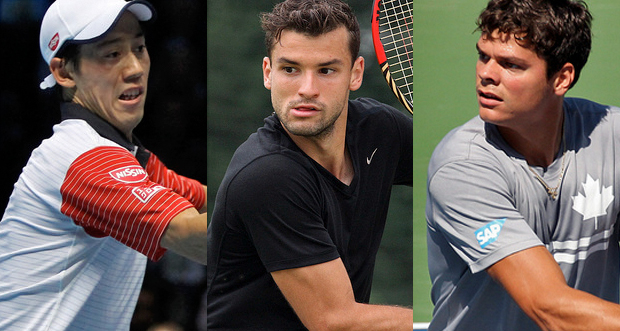
Grigor Dimitrov
Let’s start with Grigor Dimitrov, who may have been so overrated in the past in terms of expectations that he’s now being underrated (although his recent Brisbane demolishing at the hands of Federer is not exactly encouraging). Let us not forget that Grigor has improved in each year he’s been on tour; consider his year-end rankings since 2008: 493, 288, 106, 76, 48, 23, 11. Notice the trend? If Grigor keeps it up in 2015 he will possibly make it as high as the edge of the Top 5. But of course at some point he’s going to even out, and it is hard to imagine him supplanting Novak, Rafa, or even Roger. But it seems that he can beat anyone else, or at least remain competitive among the rest of the near-elites of the game. The problem with Grigor seems to be that, while he’s very good at almost every facet of the game, he doesn’t have any truly killer weapons – and seemingly lacks a killer instinct altogether.
Prediction: The book is still open for Grigor. He needs something else — a killer shot and perhaps more of a killer instinct — to fully actualize his potential, otherwise he’ll remain more of a pretty player to watch, but not a true elite. In 2015 I think we’ll see continued incremental gains as Grigor creeps into the Top 10. He’ll continue to go deeper in Slams, being relevant at Masters tournaments, with a chance of winning one late in the year (Paris?), eventually earning his way to the World Tour Finals next November.
Kei Nishikori
On one hand, we may have seen the best of Kei in 2014. On the other, he seems to keep getting better and better, and of the rest of the field seems like he has what it takes to upset one of the Big Three. Kei is now a legit candidate to win a Masters and a dark horse at the Slams. Whether he has the stamina to make it through remains to be seen; despite his strong year, it should be remembered that he still only made it to the second week once.
Prediction: Kei settles in within the second half of the Top 10. For some reason Nikolay Davydenko comes to mind – a player that never really challenged at Slams, but won a couple Masters and was always around. Perhaps Kei will have a similar peak.
Milos Raonic
At first I excluded Mighty Milos from this list but then I decided that it would be unfair. The big Yugo-Canadian is, quite frankly, a bit underrated at this point. Like Dimitrov it is hard to imagine him beating any of the Top 3 when it really counts, but he did just that versus Roger Federer at the Paris Masters. Milos continues to make small gains, as evidenced by his year-end rankings: 373, 156, 31, 13, 11, 8. If the pattern holds he’ll finish 2015 in the No. 5-6 range. At the least, though, I think Milos is a fixture to hand out in the latter half of the Top 10 for years to come, playing a similar role in the next half decade as Tsonga and Berdych have for the last half decade.
Prediction: Something good for Milos in 2015. Will it be a Masters? A Slam even? Hard to imagine, but he’s knocking at the door. I think he wins several titles in 2015, maybe even a Masters. He feels close.
DON’T FORGET ABOUT THE OTHER TWO
Jiri Vesely & Dominic Thiem
For some reason I pair these two players. Well, the reasons are pretty clear: they’re of a similar age, on the younger side of “Generation Raoshitrov”; Vesely’s advancement was steady but perhaps a bit disappointing, going from No. 85 to No. 66, while Thiem jumped 100 ranks from No. 139 to No. 39.
Prediction: I expect continued steady progress from both. Both, I think, will fully establish themselves in the Top 40, and Thiem might even challenge for the Top 20. I think we’re still a couple years away from their peaks, but both should eventually be fixtures in the Top 20 and may even challenge for the Top 10 as players like Ferrer, Berdych, Wawrinka, and Tsonga age themselves out of it. But that’s probably a couple years away.
THE BOYS ARE GROWING UP
Nick Kyrgios
The first of two up-and-comers to beat Rafael Nadal in 2014. Nick Kyrgios is a big kid (6’4”) with a big game and a big serve (14.8 ace %, good for No. 6 among the Top 50); I can’t help but think of Juan Martin del Potro when I see him out there. Ironically enough, the last time a teenager upset the world No. 1 at a Grand Slam was Rafa over Roger Federer at the 2005 French Open. Anyhow, great things are ahead for the Australian – he finished the year at No. 52 up from No. 182 in 2013, so he made quite a jump. He turns 20 years old in April, so still has some room to grow.
Prediction: Nick makes steady progress but doesn’t quite jump into the elite. That said, he fights for, and at least comes close to, a year-end Top 20 ranking. While he may play the spoiler in 2015 again, he probably won’t be in the mix for big titles until 2016.
Borna Coric
No young player has me quite as excited as Borna Coric. I just see him having the highest upside of any player currently on the radar (that is, in the Top 300 or so). We all know him for taking out Rafael Nadal at Basel, but let’s not forget that he also beat Ernests Gulbis in that tournament and lost to red-hot David Goffin in three sets. Coric is for real and his advancement should be steady from here on, although at this point we should remain patient – he did just turn 18 a couple months ago, after all.
That said, it is important to note that most truly elite players were ranked somewhere in the second half of the Top 100 or so at Coric’s age, and most jumped into the Top 20 the year after. Compare the year-end rankings for recent all-time greats at age 18 and 19:
Djokovic: 78, 16
Nadal: 51, 2
Federer: 64, 29
Sampras: 81, 5
Agassi: 3, 7
(Prior greats – starting with Agassi, but including Becker, Edberg, Wilander, etc., tended to have their break-out a year earlier, with age 17 being the first in the Top 100 and age 18 the big jump; one could speculate that perhaps we’re going ahead another year, with Nick Kyrgios’ trajectory being closer to the norm for elite players – first year in the Top 100 at age 19, big jump at age 20).
Now compare the next tier down:
Del Potro: 92, 44
Murray: 65, 17
Roddick: 156, 14
Hewitt: 25, 7
Kuerten: NA, 188
Kafelnikov: 275, 102
Courier: 43, 24
As you can see, the next tier tends to rise a bit later, or at least more slowly.
The point here is that if Coric is going to be great—as in an all-time great—then he needs to rise fast. Given the fact that players seem to be taking longer to develop these days with later peaks, I think we can go a bit easier on him and not expect a Rafa-like or Pete-like rise, but for me the benchmark would be a Top 40 or 50 ranking by year’s end. If he makes it into the upper half of the Top 100, then I think it is a sign that he has a chance to be special, even a truly great player. If he sticks around No. 100 or slips out of the Top 100, then we might need to temper our expectations a bit.
Prediction: Borna will continue to rise, with some bumps in the road, but his overall trajectory will be clear. He finishes somewhere in the No. 40-50 range, although I would be surprised if he wins anything more than maybe an ATP 250.
Alexander Zverev
The second youngest player on this list, 17-year-old Zverev finished the year ranked No. 136. That might not sound all that impressive, but consider that of the active players who have ranked in the Top 10, only Tomas Berdych (No. 103), Lleyton Hewitt (No. 100), and Rafael Nadal (No. 49) ranked higher at the end of the year they turned 17. Novak was No. 186, Roger No. 301, and many players weren’t even on tour yet. While we should be moderate in our expectations at this point, it is hard not to get excited about this kid. If Nick Kyrgios and Borna Coric are the top two candidates to be the next elite players, then Zverev is No. 3 and not far behind.
Prediction: Baby steps. Zverev doesn’t turn 18 until April, so has a lot of room to grow – both as a human body and as a player. I think he has a good shot at the Top 100 this year, but I wouldn’t expect much more than a year-end No. 80-100 ranking.
OTHERS TO KEEP AN EYE ON
Ernests Gulbis: Long viewed as an underachiever, Ernests (named after Hemingway) had his best year, challenging at one point for the Top 10. But questions remain: After an erratic career, can he maintain his current level? Can he take it a step higher? Or is he in the vein of up-and-down perennial underachievers like Alexandr Dolgopolov and Richard Gasquet? Who knows with Ernests. I suspect he’ll have more upsets like the fourth round French Open victory over Roger Federer, but not be consistent enough to break into the elite. That said, I think he’ll flirt with the Top 10 and maybe dip into it briefly, but then fall back and finish somewhere in the latter half of the Top 20. I’d prefer not to be so specific in my predictions, but for some reason No. 15-18 sounds about right.
Jack Sock: While it is hard to become too excited about a 22-year old ranked No. 42 and with no titles to his name, consider that Sock is now the fourth highest ranked American and only one of five in the Top 100. Not only that, he’s the youngest American ranked in the Top 200, just a month younger than No. 121 Denis Kudla, and a few months younger than No. 190 Ryan Harrison. But here is where there is some hope: Sock’s rise has been strong and steady – consider his year-end rankings from 2010 to the present: 878, 381, 150, 102, 42. We probably can’t expect Sock to be the next Andy Roddick, but he could be the next John Isner or Mardy Fish.
Stefan Kozlov: Stefan who? Well, a year or two from now he could be front and center in our minds. Who is Stefan Kozlov, you ask? He’s the youngest player to finish in the Top 500 this year at No. 468. No. 468?! Who cares? Well, I care – because Stefan Kozlov was born in 1998. Yes, 1998. Kozlov is 16-years old, turns 17 in February. He hasn’t done much yet, but he did play in the qualification rounds of the US Open, defeating his first round opponent, Mitchell Frank, before losing in three sets to “old man” Borna Coric. Kozlov is a long way away, but I wanted to introduce him as he’s a player worth keeping an eye on. Oh yeah, and best of all, while he’s Macedonia-born, he’s technically American (I know, it feels like cheating – but tell that to the Canadians re: Milos).
Yoshihito Nishioka: In the shadow of similarly named (at least to a Westerner) top-ranked and fellow Japanese player, Kei Nishikori, Nishioka is 19 years old and ranked No. 156, and could be a real sleeper to break into the Top 100 next year and a player to watch.
Thanasi Kokkinakis: Another member of the “Class of ’96,” which is turning out to have some talent. Kokkinakis is the third highest ranking teenager at No. 150, behind only Coric and Zverev. Another Australian to watch.
Jared Donaldson: Ranked all the way down at No. 261, 18-year-old Jared Donaldson is worth mentioning not as much because he’s the sixth highest ranking teenager, but mainly because he’s the highest ranking American teenager; actually, he’s the highest ranking American age 21 or younger, which makes him arguably America’s Great Hope to return to relevance. But let’s check in next year to see where he is.
Hyeon Chung: Korean-born, the fourth member of the Class of ’96 on this list (along with Coric, Kokkinakis, and Donaldson). I don’t know what his upside is but at No. 173 he’s the highest ranked Korean by a good margin, and well-situated on the career trajectory towards a strong career.
ADDENDUM: Another 15 to the Mix
I’d like to add a few more names to keep an eye on. Again, remember that the above list is not meant to be comprehensive, but a the same time I’d be remiss not to give at least an honorable mention to a few others.
Roberto Bautista Agut: A surprising rise from No. 58 to No. 15 in 2014, can he maintain a top 20 ranking for a few years?
David Goffin: After a disappointing 2013, Goffin had a tremendous rise in 2014, going from No. 110 to No. 22.
Jerzy Janowicz: Let’s not forget about Jerzy, but’s he fast becoming a cautionary tale, a least for those of us that got excited a year or two ago. He’s still young enough to turn it around.
Pablo Carreno Busta: It seemed that he was a cult favorite to be excited about a year ago, but after only a moderate rise in 2014–to a solid No. 49–I think expectations have cooled. Still, he’s a name to get used to as he could be a regular in the top 40 for years to come.
Dusan Lajovic: Best known for making it the 4R at Roland Garros where he lost to Rafa, but not before beating Delbonis and Sock to get there. I think he’s a sleeper to be a solid player.
Bernard Tomic: Oh Bernie, it is hard to root for you. You’re like a playboy superstar that isn’t a star. Time to grow up if you want a decent career.
Victor Estrella Burgos: In contrast to Tomic, how can we not cheer for this guy? Starting on the ATP tour at age 33-34, and he made it as high as No. 65! Who knows what’s ahead but I’m cheering him on.
Lucas Pouille: Another sleeper – seems talented.
Luke Saville: Ditto. These guys aren’t future elites, but they are probably future top 50 players.
Diego Schwartzman: At 5’7″ you’ve got our attention. Seems like another sleeper.
Elias Ymer, Christian Garin, Roman Safiullin, Andrey Rublev, Gianluigi Quinzi: More young ‘uns to keep an eye on, all born in 1996-97.
OK, that’s it. The problem with trying to be semi-comprehensive with this second list is that there is no way to draw the line. No Vasek Pospisil? Federico Delbonis? Well, I had to draw the line somewhere and it is “15 + another 15.”