Tag: tennis

  • Open Era Generations, Part Eleven: Gen 9 (1974-78) – A Transitional Era

    Open Era Generations, Part Eleven: Gen 9 (1974-78) – A Transitional Era

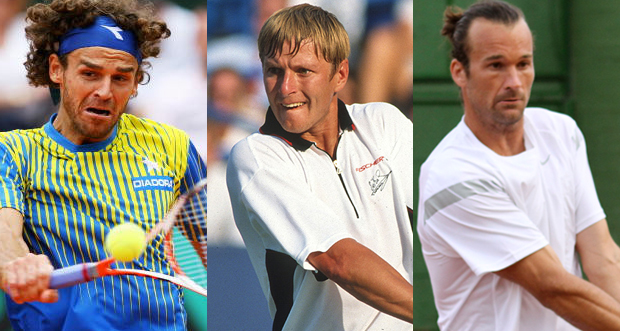
    Gustavo Kuerten Yevgeny Kafelnikov Carlos Moya

    While one of the weakest generations of the Open Era — by my account, third after Gen 2 (1939-43) and Gen 12 (1989-93) — I personally find this one of the most interesting. I’m not exactly sure why, but I think it has to do with the fact that it is hard to define, with no clear stars. It is the generation that was at its peak in the late 90s and early 00s, between the dominance of Sampras-Agassi and Federer.  The generation has an interesting balance of players – no real standouts or all-time greats, but several excellent players.

    Best Players by Birth Year
    1974: Yevgeny Kafelnikov (RUS, 2), Alex Corretja (ESP), Thomas Enqvist (SWE), Andrei Medvedev (UKR), Tim Henman (UK)
    1975: Marcelo Rios (CHIL), Thomas Johansson (SWE, 1), Jiri Novak (CZE), Albert Costa (ESP, 1)
    1976: Gustavo Kuerten (BRA, 3), Carlos Moya (ESP, 1), Mark Philippoussis (AUS), Rainer Schüttler (GER), Magnus Norman (SWE)
    1977: Nicolas Kiefer (GER), Guillermo Canas (ARG)
    1978: Gaston Gaudio (ARG, 1), Tommy Haas (GER), Radek Stepanek (CZE), Sébastien Grosjean (FRA), Michael Russell (USA)

    [divider]

    Click here to discuss “Open Era Generations, Part Eleven: Gen 9 (1974-78) – A Transitional Era” in the Discussion Forum.

    [divider]

    This generation is responsible for only 9 Slams, the lowest since the 1939-43 generation (4). There are no all-time greats, merely a couple almost-greats, and a handful of very good players.

    The two best players of the generation were Gustavo Kuerten and Yevgeny Kafelnikov, who accounted for five of the nine Slams. Kuerten was a clay-court specialist who won the French Open three times, as well as four clay Masters. But he also won the 2000 Tennis Masters Cup, defeating Pete Sampras and Andre Agassi – the only player to defeat both in the same tournament –  and the hard-court Cincinnati Masters, so could play well off clay.  “Guga” was only a Top 5 player for three years (1999-2001), and only finished in the Top 40 for eight years (1997-2004); his “near-greatness” was largely due to his lack of longevity, which was largely because of injuries starting in 2002. The second half of his career is one of the great What-If stories of the last couple decades.

    Kafelnikov was less brilliant at his best, but had a longer peak than Guga, ranking No. 11 or better from 1994 to 2001. The third most accomplished player of the generation, Carlos Moya, ranked No. 61 or higher for fourteen straight years, from 1995 to 2008, including thirteen years No. 43 or better, and five years No. 7 or better – a consistently very good player.

    Single-Slam winners Thomas Johansson, Albert Costa, and Gaston Gaudio are the definition of one-Slam wonders. Johansson had a long career, including eleven years in the Top 100, but he never finished a year in the Top 10; imagine if someone like Nicolas Almagro won a Slam and you get a sense of Johansson’s feat. Costa was a clay-court specialist, probably similar in talent to someone like Feliciano Lopez, but happened to play between the reins of Kuerten and Rafael Nadal, and thus able to win a French Open (in 2002). Gaudio could be the worst player in the Open Era ever to win a Slam, the 2004 French Open against Guillermo Canas. He finished No. 10 in 2004 and 2005, but never finished another year in the Top 20.

    This is the oldest generation to still have players on tour, but it won’t be much longer. After a resurgence in 2012-13, 37-year-old Tommy Haas has slipped the last couple years and seems like he’s winding down. Haas started on the ATP tour in 1996, losing his first Slam match to Sergi Bruguera at the US Open in the first round. 2015 makes it 20 years on tour. Haas has been around so long that his first year was the last year Boris Becker won a Slam (although he never played Becker).

    Radek Stepanek is also ranked around No. 200, which would be the first year on tour that he hasn’t finished No. 68 or higher – going back to 2002. Michael Russell, also from that 1978 birth year, just retired.

    Underachievers and Forgotten Players
    There’s a reason I didn’t mention Marcelo Rios above, as I was saving him for this category. In 1998 he looked like the heir apparent to Pete Sampras as the premier player in the game, taking the No. 1 ranking in late March and winning three Masters that year, as well as the Grand Slam Cup. Yet Rios’s relatively mediocre second half of the year led to a loss of the No. 1 ranking to Sampras, and while he remained a Top 10 player in 1999, he slipped and stumbled in 2000 and never regained his elite status, largely due to injuries.

    Another player who had a disappointing career is Andrei Medvedev, who was the first of the generation to rank in the year-end Top 10, finishing 1993 ranked No. 6 at age 19. While he would go on to win four Masters, he would never rank in the Top 10 again and made a Slam final only once.

    There are several other players who fit the category of “close, but no cigar” as far as Slams go – Alex Corretja was 0-2 at French Open Slam finals, Thomas Enqvist was meant to revive Swedish tennis but–along with Johansson–instead ended up being a kind of dead-cat bounce after the great 1970s-80s era, and Tim Henman goes down as one of the greatest grass court players never to win Wimbledon. And boy did he try – eight out of nine years from 1996-2004 making the quarterfinals or later, including four semifinals but never a final. Mark Philippoussis also comes to mind in this category.

    Did You Know?
    I first came across Roberto Carretero’s name when looking at Masters winners of the 90s. Carretero has quite a story: he won the Hamburg Masters in 1996 as a virtual unknown, ranked No. 143 and defeating Yevgeny Kafelnikov en route to a final win against rising young Spanish star, Alex Corretja. He never ranked higher than No. 58 and never made it past the second round in a Slam, retiring in 2001. But he does have that Hamburg Masters title.

    Top Ten Players of the Generation

    1. Gustavo Kuerten
    2. Yevgeny Kafelnikov
    3. Carlos Moya
    4. Marcelo Rios
    5. Alex Corretja
    6. Tim Henman
    7. Tommy Haas
    8. Albert Costa
    9. Thomas Enqvist
    10. Andrei Medvedev

    Honorable Mentions: Mark Philippoussis, Thomas Johansson, Sebastian Grosjean, Magnus Norman, Gaston Gaudio, Radek Stepanek.

    This is actually a hard generation to rank. I feel confident about the top four, although think Moya and Rios could be swapped, and I went back and forth on Kuerten and Kafelnikov, but in the end prefer Kuerten’s higher peak to Kafelnikov’s greater longevity. After the “biggish four,” Corretja is probably the best of the rest, with Henman, Haas, Costa, and Enqvist not far behind, but that tenth spot could go to any of Medvedev, Philippoussis, Johansson, or Grosjean.
  • Australian Open Final Preview: The Tilted Mirror

    Australian Open Final Preview: The Tilted Mirror

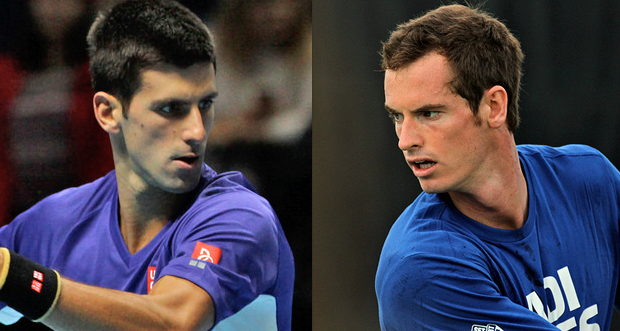
    Novak Djokovic Andy Murray

    When Novak Djokovic and Andy Murray contest a tennis match, it brings to mind to me Djokovic staring at a tilted mirror. Both players are in essence counterpunchers. Both rely on superior movement, low error rates, and superior defensive skills to confound most opponent’s efforts. Novak looks across the net and will see much of himself reflected back in Andy. It is a tilted reflection, though, as Murray will often seem further back than Djokovic in their baseline exchanges, Novak’s own strokes sending the ball farther than those that are being sent back. That is the essence of the matchup: The offensive counterpuncher in Djokovic doing pretty much everything the defensive counterpuncher Murray can do, only better.

    [divider]

    Click here to discuss the Djokovic/Murray Australian Open final in the Discussion Forum.

    [divider]

    Djokovic is perhaps playing the best tennis the men’s tour has witnessed in many years. He looks untouchable. Although he lacks the flare of Federer in his prime, the explosiveness of Nadal in his heyday, he looks somehow more complete than either in their own periods of domination, less liable to upsets or struggles on a specific surface. Nadal could always be counted upon to trouble Federer, whilst a Davydenko or Blake could make Rafa look amateur on a hard court at times. Nobody comes to mind that can be a regular thorn in Novak’s side, rather the current status quo of a Wawrinka pummelling him on rare occasions, or Federer seizing the initiative on fast courts in the Middle East or North East America.

    Seizing the initiative sums up rather nicely what Djokovic is doing. Though a counterpuncher, he is continuing to show his natural ability as an offensive baseliner. He is serving big, stepping into the court, and unloading on balls with natural and seemingly increasing power. He is not content to ride out storms against Federer or Nadal; he is actively seeking to deny their like of getting any momentum at all by attacking with controlled aggression.

    Needless to say this presents Murray with an instant uphill climb. He will be able to stay with Djokovic physically better than arguably anyone else on tour. Little separates the two in terms of speed and conditioning, but Murray I believe will suffer on two counts of positioning. Firstly, Murray does not hog the baseline, rather stands well behind it. This allows Novak to dictate from the off, sending his man into the far reaches of the court and opening up space for easy winners, regardless of Murray’s speed. The other is the position of Murray’s shots. Unlike the Lendl days, Murray is content again to revert back to rallying mode. The shots are often pushed into play, particularly with his weaker forehand, sitting up in the centre of the court where the Serb can merrily swat them away for winners or forcing Murray into the defensive.

    Murray’s last win at a Major against Novak was in 2013; he is 0-3 against him in them since, and has won just one of their last eleven matches overall. Furthermore, he is 9-21 in their entire head-to-head series — not a terrible number, but hardly encouraging, especially as Djokovic has grabbed their rivalry by the scruff of the neck since Murray’s 2013 Wimbledon triumph. Murray’s biggest wins against Novak have also occurred on the slicker surfaces of London’s grass or the fast hard courts of Canada, Cincinnati, and New York. He is no slouch on the slower hard courts, reaching four finals in Melbourne, as well as winning two Miami Masters titles. His relative lack of power and defensive style, though, leave him with his work cut out on slower surfaces.

    All is not lost for Murray. I think his first serve at its best is better than the Serb’s, albeit less reliable. I think Murray also has softer hands, and choice attacks at the net could prove bountiful for him. The Australian crowd are definitely the most sporting of the four Majors, and definitely have taken to Djokovic more than their three counterparts. From experience, though, they have always backed Murray more when the two have met here, perhaps out of the Aussie appreciation for the underdog, as well as for a fellow member of the Anglosphere. Crowd support for Murray could spur him on if he were to take an early lead, as well as rile Djokovic, often acutely sensitive to the biases of those in the audience. Murray fans could also take heart from the Djokovic vs. Simon match. The Frenchman, my favourite defensive counterpuncher on tour, has sometimes been labelled derogatorily as a ‘poor man’s Murray’. Both play similar styles, though Murray has more weapons and variety. If Simon can stretch Djokovic to five sets and make him produce 100 errors, it’s more than conceivable Murray could better that.

    All things being equal, such is Novak’s form, dominance of the tour and of Melbourne; it is hard to see him not triumphing tomorrow. I believe Murray will contest and win a couple more Major finals before his career is over, but I feel the only haul he will add to in this year’s Australian Open is his runner-up plates.

    Novak to win in four sets.

    [divider]

    Cover Photo (Creative Commons License): Marianne Bevis

  • Hot on the Frontier: Is This the Beginning of the Incline?

    Hot on the Frontier: Is This the Beginning of the Incline?

    imageedit_1_7870310887

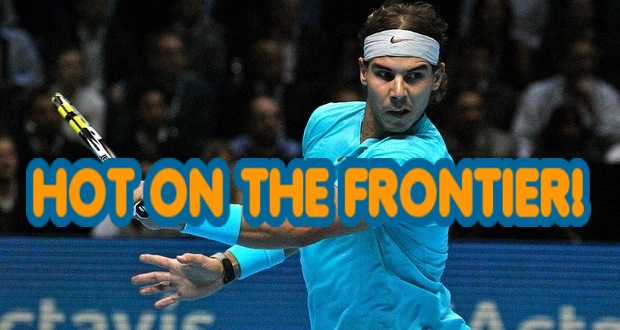
    Our hottest new topic in our discussion forum this week: Is This the Beginning of The Incline?

    Nobody can dispute the fact that Rafael has had, by his own lofty standards, a rough year. He lost his French Open crown, lost several times to lower ranked players, saw his 10-year streak of at least one Grand Slam title end, and saw his ranking slip down to No. 8. Many were predicting that Nadal was finished, that he would soon retire, or at least get a new coach. So far none of that has happened. And during the Asian Tour, we saw Nadal get to the finals in Beijing and the semifinals in Shanghai. From these results, many fans think he is on the rise and will take his place back in the Top Three of Four soon. Our member GameSetAndMath started this week’s Hot Topic that got everyone debating over Nadal’s future. Congratulations to GameSetAndMath for starting this week’s Hot Topic on the Frontier, “Is This the Beginning of the Incline?” Come check it out!

    avatar_170


    GameSetAndMath
    Tennis Frontier Member since: July 2013


    Some questions for GameSetAndMath!
    1. Who is your all-time favorite tennis player?
        Answer: Roger Federer
    2. If you could attend any Grand Slam tournament, which one would you like to go to?
        Answer: Wimbledon
    3. If you could slip back in time and see one match, which would it be?
         Answer: Bjorn Borg vs. John McEnroe 1980 Wimbledon final
    4. Which two players would you like to see playing doubles together?
         Answer: Fedal
    Check back for next week’s Hot Topic on the Frontier!
    [divider]
    Cover Photo (Creative Commons License): Marianne Bevis
  • Open Era Generations, Part One: Introduction

    Open Era Generations, Part One: Introduction

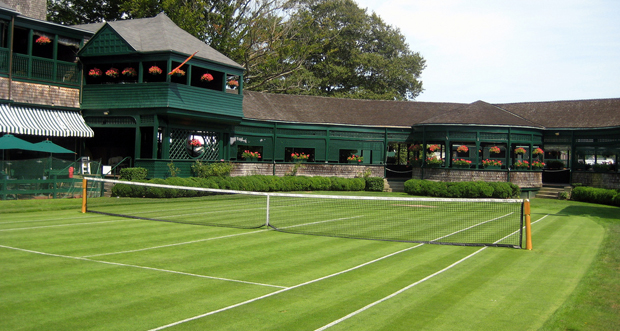
    Open Era Generations 01 - Tennis Hall of Fame


    Preamble

    While I’ve followed tennis in a very casual way going back to vague memories of Bjorn Borg and John McEnroe, it is only in the last half decade or so that I’ve become a serious fan. I mark the beginning of my interest in tennis back to a vague memory of liking Bjorn Borg and disliking this new young upstart named John McEnroe who seemed to have his number. While I was only around seven years old at the time and cannot pinpoint the exact date, I imagine that this was due to either of McEnroe’s defeats of Borg at Wimbledon or the US Open in 1981. My favorite players in the 1980s and 90s were Ivan Lendl, Stefan Edberg, and Pete Sampras; I remember enjoying Edberg’s defeat of Jim Courier in the 1991 US Open, memorable because my friend and classmate (this was senior year in high school) had played with Courier and was cheering for the American.

    My tennis fandom remained casual until just a few short years ago. There isn’t an exact moment when I went from “casual” to “serious” fan, as it was a gradual transition over a year or two, but it happened sometime in the 2008 to 2011 range. While I had been a (casual) fan of Roger Federer, my all-time favorite player, since early on, it is interesting (for me, at least) to consider that during my tenure as a diehard tennis fan—someone who follows all of the big tournaments and some of the smaller ones—I have only really truly loved the game while my favorite player has been past his highest peak. In fact, it could be the legendary 2008 Wimbledon final that drew me into a greater interest in the sport, the match that saw the baton of greatest player passed from Roger to Rafa. So I cannot be accused of being a fair weather fan!

    Anyhow, the reason I offer an overview of my tennis biography is to lay the groundwork for what is to follow – to provide context and perhaps a sense of why I am writing what I’m writing, and why I write this blog at all, for that matter. It is simply this: I write these articles to share my own learning experience. I am very curious and autodidactic by nature and because I’ve only followed tennis closely for about half a decade, I am constantly researching this or that tidbit from the past. In a way I’m both trying to fill in my own limited (but growing) knowledge of the sport’s history, but also enjoy taking variant angles using statistical analysis to better understand the game. This blog is my sharing my journey with you, the reader.

    And now for the caveat: I am not a tennis player, not an expert on the game itself or its history. I am, first and foremost, a fan of the game. None of these statistics are meant to be definitive in any way; a common misunderstanding about statistical analysis in sports—particularly in baseball, if only because no other sport is as statistically analyzed (and fetishized) as baseball—is that statistical models and advanced metrics are somehow meant to replace firsthand knowledge of the game and/or be definitive. Now some “statnerds” might take this a bit too far, but for the most part it is generally understood that statistics are secondary and complementary to real knowledge of the game.

    That said, statistics have their uses and are neglected in the tennis world. There are a few pockets on the internet where tennis is analyzed statistically, but it is rare.

    [divider]

    Generation Theory
    So what’s this all about, you might be asking? Well, I’m going to be starting a series on tennis generations, using what I call “Generation Theory,” which is a tool or lens that is quite useful for understanding tennis history. The theory is based upon the idea that a generation is roughly five years in length, that once you have two players that are more than a few years apart they are of a different generation.

    This begs a couple questions: One, where to draw the line between generations? This is pretty arbitrary. At first I was going to use half-decades, neatly dividing each decade into two generations. But I soon found that it wasn’t the optimal way of grouping players. I then decided to use Roger Federer as a baseline. Federer was born in August of 1981, so I asked what would happen if we used him as the middle of a five-year generation? That made Generation Federer those players born between January 1, 1979, and December 31, 1983. This also lined up well with Rafael Nadal, born in May of 1986 — the midpoint of the next generation, 1984-88. It was almost too perfect, but what better two players to center Generation Theory on? I then went forward and back and found that players grouped well within those parameters, with few exceptions.

    Again, generational divisions are arbitrary. In this model Juan Martin del Potro and Kei Nishikori are of two different generations, which may seem strange considering that they were born in consecutive years; in this system, del Potro is of the same generation as Robin Soderling, who was born in 1984. We could look at “Generation del Potro” as being those players born within a couple of years of him, thus 1986-90. So in that sense we could use a five-year tennis generation: in a player-centered way, that is spreading out a five-year umbrella centered on an individual player’s birth-year, or in a static way, which is based upon Federer (and, conveniently enough, both Nadal and Pete Sampras) and spreading the generations out from there, each generation beginning with the year that ends with either a 4 or a 9 (e.g., 1974-78 and 1979-83). This series is based on the static approach, although at different times and in other articles I might use the player-centered approach.

    This series will be focused on the Open Era, beginning with the 1968 French Open, which has technically seen 16 different generations play in it. The oldest player that I could find who played in an Open Era Grand Slam was Pancho Segura, who was 49 years old when he played in the 1970 US Open. Segura, if you’re not familiar with him, is a lesser great of the 40s and 50s – who we could call “The Other Pancho” after the greater Pancho Gonzales. Segura had one of the longest careers in tennis history, being a top college player in the mid-1940s before going professional in 1947, and then playing his last professional singles match at the 1970 US Open, at 49 years old, although he played doubles until 1975 when he was 54 years old. A different era, no doubt!

    [divider]

    Thirteen Generations of the Open Era
    For the sake of this study, I am going to focus on those generations that made a significant impact in the Open Era. My criteria for the first generation will be a Slam title within the Open Era, which would be the great 1934-38 generation that included Ken Rosewall and Rod Laver, two of the very greatest players in tennis history. So 1934-38—bookended by Rosewall’s birth in 1934 and Laver’s in 1938—is the First Generation of the Open Era, with the youngest generation of players on tour born in 1994-98 the Thirteenth Generation (although as of this writing there are actually a few ranked players from the 1999-03 generation, including Canadian Felix Auger Aliassime ranked No. 751 as of August 24, 2015; Aliassime was born in August of…wait for it…2000).

    [divider]

    This Series
    After this introductory piece, each article will be dedicated to a different generation, with the first briefly discussing older generations and then focusing on the First Generation of the Open Era, those players born between 1934 and 1938. I will probably do a summarizing piece, so this means that this will be in fifteen parts and likely spread out over two or three months. It will be my intention to publish one or two articles a week, so stay tuned and I hope you enjoy joining me on my journey through the thirteen generations of Open Era tennis!

    Author Note (9/2/2015): I timed this series poorly, starting right before the US Open, so with my apologies I’ve decided to push it back until after the US Open is finished. Look for the next part in this series a day or two after the US Open finals. Best regards ~JN.

    [divider]

    Cover Photo (Creative Commons License): wallyg

  • National Tennis Careers – Part Six: Summing Up

    National Tennis Careers – Part Six: Summing Up

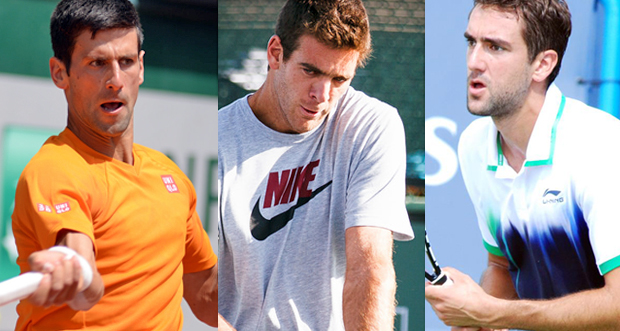
    Novak Djokovic Juan Martin del Potro Marin Cilic

    After surveying Open Era tennis through the five nations with the highest Slam totals, we’re left with a few questions and unexplored areas which I’ll try to tackle in this concluding segment.

    [divider]

    Click here to discuss National Tennis Careers – Part Six: Summing Up in the discussion forum.

    [divider]

    Who’s left?
    The “big five” tennis nations include many, even most, of the all-time greats of the Open Era. Let’s take a look at the other nations and their players by Slam count:

    Czechoslovakia/Czech Republic (12): Ivan Lendl (8), Jan Kodes (3), Petr Korda (1).
    Serbia (9): Novak Djokovic (9)
    Germany/West Germany (7): Boris Becker (6), Michael Stich (1)
    Argentina (6): Guillermo Vilas (4), Gaston Gaudio (1), Juan Martin del Potro (1)
    Russia (4): Yevgeny Kafelnikov (2), Marat Safin (2)
    Brazil (3): Gustavo Kuerten (3)
    Croatia (2): Goran Ivanisevic (1), Marin Cilic (1)
    Romania (2): Ilie Nastase (2)
    South Africa (2): Johan Kriek (2)
    United Kingdom (2): Andy Murray (2)
    Austria (1): Thomas Muster (1)
    Ecuador (1): Andres Gomez (1)
    France (1): Yannick Noah (1)
    Italy (1): Adriano Panatta (1)
    Netherlands (1): Richard Krajicek (1)

    Before Djokovic is through, Serbia’s Slam count should surpass that of the Czechs as a whole.

    Slavic Surge?
    I almost titled this last part “Slavic Surge!” because it would seem that the tennis from Slavic countries has been on the rise. But it wasn’t quite as extreme as I thought. There are some strong Slavic players currently in their peaks, namely Djokovic, Berdych, Cilic, and Karlovic. There are some younger players with some upside, including Damir Dzumhur (23, No. 100), Grigor Dimitrov (24, No. 16), and Jiri Vesely (22, No. 45). But there is only one player that looks like a potential future star, and that is the 18-year-old Croatian Borna Coric, who is currently ranked No. 37. So while Slavic tennis is strong, it is hardly dominant (Novak aside).

    Possible Future Slam Winning Countries
    So who might the next Slam winners be? Specifically, which countries have the most possible future Slam winners? Well, that is for a future study that I’m working on. But I will say that as we’ve seen in the previous segments, there isn’t much on the horizon for Spain or Switzerland, and only really the Ymer brothers in Sweden; in the US there are a few prospects, and Australia at least has “K&K”: Kyrgios and Kokkinakis.

    All in all there doesn’t seem to be a central location for tennis right now or the foreseeable future. We can sum up the Open Era by looking at early dominance by Australians, namely Ken Rosewall, Rod Laver, and John Newcombe, then the rise of Americans in Jimmy Connors and John McEnroe, and Sweden in Bjorn Borg, Mats Wilander, and Stefan Edberg. Along with German Boris Becker and Czech Ivan Lendl, Americans and Swedes dominated tennis from the mid-70s into the early 90s, with Sweden dropping off as Edberg retired, but the United States remained dominant into the 21st century, led by Pete Sampras and Andre Agassi. But then the US dropped off precipitously, and Switzerland and Spain took up the rulership of men’s tennis, with Serbia playing its part.

    What the future will bring, well, it is a truly global world out there. There’s no sign of any of the five great tennis nations regaining their dominance. There are some glimmerings of improvement in Australia, and a bit in the US, but nothing substantial or worthy of the term “future dominance.” We’re going to see a shared effort, it would seem.

    [divider]

    Cover Photo (Creative Commons License): kulitat / mirsasha / Kiu Kaffi

  • Wimbledon Review 2015

    Wimbledon Review 2015

    14456980118_7dfc83dbab_o


    Wimbledon has always been a tournament steeped in history and tradition. Every year, a little more history is added to the legend and charm to the greatest tournament in the world. This year was no different, with the top players fighting off challenges and establishing their positions as the greatest in the world.

    Manic Monday: One of the Best Days of the Tennis Year. The middle Sunday of Wimbledon is almost a bit of a downer, with no action and an extra day when we are forced to anticipate and wait for the upcoming fourth round matches. But the crazy, non-stop action of eight men’s and eight women’s matches all crammed into one day makes for one of the most exciting and exhausting days in tennis. On the men’s side, No. 1 seed and defending champion Novak Djokovic almost got an early vacation when Kevin Anderson took the first two sets, but after winning the next two sets to tie it up, thanks to the English curfew, the last set was played on Tuesday, and Djokovic quickly finished the match to move on. Thomas Berdych, however, fell a round early before his anticipated match with Roger Federer. On the women’s side, the marquee match was between the two players who have won eleven of the last sixteen Wimbledon titles. Venus Williams was playing extremely well this tournament and there were some experts saying that she just might be the one to beat Serena Williams and end her sister’s chance for a Grand Slam. But after that close encounter with Heather Watson, Serena was in no mood to fool around. Serena defeated Venus for the 15th time in 26 matches to advance. The biggest surprise was French Open finalist and No. 6 seed Lucie Safarova being upset by American Coco Vandeweghe. That left three American women (Serena, Vandeweghe, and Madison Keys) in the quarterfinals.

    Nick Kyrgios and Vasek Pospisil: The Good and the Ugly. After Milos Raonic went down in the 3rd round, fellow Canadian Vasek Pospisil took up the banner and surprised everyone, probably even himself. The 2014 Wimbledon doubles champion came back from two sets down to shock No. 22 Viktor Troicki in the fourth round and advance to his first ever Grand Slam quarterfinal. With his doubles matches going the distance as well, he didn’t have much left against Andy Murray but it was an encouraging result for Pospisil and Canada’s future Davis Cup hopes. Meanwhile, a player who went the extra mile to make a fool out of himself was Nick Kyrgios. In his 4th round match against No. 21 Richard Gasquet, Kyrgios clearly tanked during the second set; sat down during a game to change his socks, and got into an argument with the umpire; was almost disqualified when the racket he flung bounced into the stands, narrowly missing hitting someone; and finally hugged a ball boy in a desperate attempt to grab a laugh. His post-match interview was just as embarrassing. After kicking Bernard Tomic off the Davis Cup team, now Tennis Australia is going to have to figure out how to teach their young players on- and off-court manners. It’s a shame, because they have a group of young men who could bring Australia back to the top. But right now an implosion seems just as likely.

    Maria Sharapova and Victoria Azarenka: The Invisible Champions. They are both Grand Slam champions. They have both been ranked No. 1. And they are a combined five wins and thirty-five losses against Serena. In Grand Slam tournaments alone, they are a combined one win and sixteen losses. Watching their matches, you get the impression that Maria Sharapova no longer has any chance against Serena, but with Victoria Azarenka, there is some hope that someday she will finally beat Serena on the big stage and a true rivalry will be born. But as it stands, their failure to beat Serena — or, depending on your point of view, Serena’s brilliance against these two — are big reasons for Serena’s march through the tour during the last few years.

    Andy Murray: A Whole Lot of Questions Are Answered. It looked so good for Andy Murray. His successful clay court season and his fourth Queen’s Club title had everyone thinking that Wimbledon would be the place where he would finally find the success he was enjoying before his back surgery. He even got lucky in avoiding his nemesis Djokovic until the final. But then he ran into Federer. The level of tennis between Federer and Murray was not bad, but Federer had a answer for everything Murray threw at him. He played the big points better, and shut down Murray in a rather shocking straight-set match. At this point, it’s obvious that while Murray is a great player, he is nowhere near the level of Djokovic or Federer. Several things would have to work in his favor if he is going to have a chance to beat them and win another Slam. Murray may have another major or two left in him before his career is over, but luck will have to play a part. He may prove that assumption wrong in the upcoming U.S. Open, but after this Wimbledon match, he is starting to look more and more like the ATP version of Sharapova.

    Doubles: Twice the Stories, Twice the Fun! The doubles draws had a lot of interesting stories this year as well. Bethanie Mattek-Sands and Lucie Safarova had won the first two Slams of the year, and were going for a calendar Slam of their own, but they were defeated in the quarterfinals. The title was won by none other than 34-year-old Martina Hingis and India’s Sania Mirza. They teamed up earlier this year and after taking several titles, they finally won their first slam together. This was Hingis’s 18th overall Slam title (5 singles, 10 doubles, 3 mixed) but perhaps the even bigger story was Mirza. She became the first female Slam winner from India. On the men’s side, Andy Murray’s older brother, Jamie, made it to the men’s doubles final with teammate John Peers. Murray was going for his second Wimbledon title after winning the mixed doubles with Jelena Jankovic back in 2007. With Andy watching from the stands, Jamie and Peers went down in straight sets to Jean-Julien Rojer and Horia Tecau.

    Garbine Muguruza: Gutsy Garbi’s Grand Slam Breakthrough. When Garbine Muguruza defeated Serena and advanced to the quarterfinals of the 2014 French Open, it looked like she was getting ready to bust out of the lower ranks of young players and come right up to the Top 10. She stalled a bit after that and struggled the first half of the year, but thanks to the bottom half of the draw opening up, she took advantage of the opportunity and defeated a revitalized Agnieszka Radwanska in the semifinals to reach her first Grand Slam final. She had a lead in the first but let Serena pull away. However, after falling behind 4-6, 1-5, she pulled out all the stops and broke Serena twice to pull within 4-5 before Serena was finally able to finish the match. If Garbi had won that game to get to 5-5, who knows what could have happened? But tennis fans everywhere were impressed with her big game and mental strength on the biggest stage in the world of tennis. She will be ranked in the Top 10 when the new rankings are released Monday. Instead of Simona Halep or Eugenie Bouchard, Muguruza could be the one who challenges Serena in the next few years.

    Roger Federer: Denied No. 8 and No. 18 — Once Again. Like Murray, Roger Federer had a perfect grass court season. He won his eighth Halle title in Germany and then went through the early rounds of Wimbledon without much fuss. His serve wasn’t broken until Giles Simon managed to do it once in the quarterfinals. Before the semifinals, six out of 10 experts were predicting a Murray win, but Federer once again went on to show us how far Murray has to go before he can start winning Slams again. It was a well-contested match and Murray did everything he could, but Federer stepped up when he had to and broke Murray at the end of each set to grab his fourth straight win over the Scot. In the final, Federer did not have the same level he brought to the Murray match. But that could also be blamed on the fact that Djokovic was a much better opponent. Federer had two set points on Djokovic’s serve in the first set, but ended up losing a tiebreak badly to fall behind. In the second, Federer fought off an amazing seven set points to take the second set tiebreak. But that was all he had left in him. A short rain delay wasn’t long enough for Federer to find a second wind and Djokovic seemed to have no fuss in grabbing the final two sets. At the age of 33, what Federer has accomplished is amazing, but you get the feeling that his chances of winning Grand Slams are beyond him now. Nevertheless, he is still No. 2 in the world, and if Djokovic trips up somewhere, Roger could definitely take a surprise Slam in the way Pete Sampras took the U.S. Open in 2002.

    Serena Williams: Wins Second “Serena Slam” Twelve Years After the First. Twenty-first Grand Slam. Sixth Wimbledon. Thirty-nine wins and one loss for the year. Twenty-eight straight Grand Slam wins. The list goes on and on. What Serena is doing at the age of 33 boggles the mind. She has gone up against long-time rivals, new rivals, her sister, and anyone else tennis can throw at her — and she just keeps finding ways to win. If her win over Timea Bacsinszky in last month’s French Open wasn’t proof enough, Serena’s third round win over Heather Watson was a true showcase of just how tough she is when the chips are down. Serena is very aware of what is at stake and she now has New York squarely in her sights. This is a player we will be telling our grandkids about someday, and it is a privilege to watch her go for the first calendar Grand Slam since 1988. She may make it; she may not — but every tennis player on the planet will be watching to see if history will be made at the U.S. Open.

    Novak Djokovic: Supremacy Reestablished. After being shocked at the French Open by Stan Wawrinka, and being denied again his first title at Roland Garros, everyone wondered what sort of state Djokovic would be in when he came to London. He skipped the pre-Wimbledon tournaments and only took part in an exhibition where he was beaten by youngster Alexander Zverev. He came into Wimbledon and after three easy matches was almost ousted by Kevin Anderson but somehow he was able to come back after dropping the first two sets. After that close call, he took care of Marin Cilic and surprise semifinalist Gasquet in straight sets. Against Federer, he seemed to be in control the entire match, even after dropping the second set tiebreak. Djokovic now has nine Grand Slams, good for sixth place on the all-time list. With Rafael Nadal struggling to regain his form, Federer showing his age, and Murray failing to find another level, Djokovic could very well be ruling the tour for the next couple of years and adding to his Grand Slam trophies until the next generation of players such as Thanasi Kokkinakis and Borna Coric come up to take his place.

    Wimbledon: The Grandest of Grand Slams. While each Grand Slam tournament has its own history, traditions, and charms, every year Wimbledon comes around to prove once again that there is no tournament like it. With the strengthened grass court season this year, it made its position even stronger. Novak Djokovic and Serena Williams solidified their positions as the No. 1 players in the world, and Wimbledon did the same, reminding everyone that it truly is the greatest tournament, of the greatest sport, in the world.

    [divider]

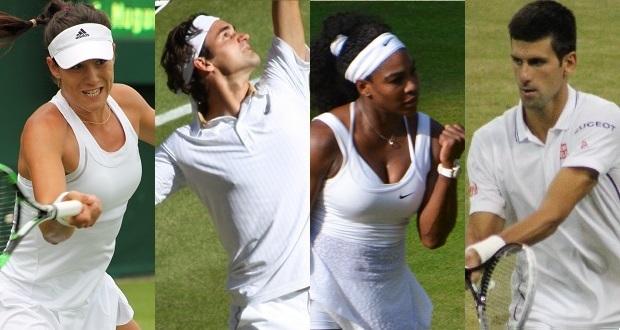
    Cover Photo (Creative Commons License): Si:robi / Marianne Bevis / Si:robi / Carine06

  • National Tennis Careers – Part Four: Australia

    National Tennis Careers – Part Four: Australia

    Rod Laver Patrick Rafter John Newcombe Lleyton Hewitt

    A Long Time Ago, Down Under…

    Of the five nations discussed, Australia peaked the earliest. Truly, Australia dominated men’s tennis in the late 1950s to the early 1970s led by two of the very greatest players of all time: Rod Laver and Ken Rosewall. Australia remained strong at the beginning of the Open Era, with Laver’s Calendar Slam in 1969, and the baton partially passed to John Newcombe, who was one of the few amateur stars that was able to maintain a similar level during the Open Era.

    Other top Australians before the Open Era include Frank Sedgman, Lew Hoad, Fred Stolle, Ashley Cooper, and Roy Emerson. Emerson held the Grand Slam record of 12 until Pete Sampras broke it, although it’s often considered overrated due to the fact that he dominated the Amateur Slams when the best players were playing pro – namely his countrymen Laver and Rosewall. Hoad is another “what if” story; Jack Kramer compared him to Ellsworth Vines as players with immense talent but lacking drive. Pancho Gonzales claimed that Hoad was the only player who could beat Gonzales when he was playing his best; others, including Ken Rosewall, voiced similar sentiment. Regardless, Hoad’s career was plagued by injury and even if he was arguably the most talented player of all time, his record places him as a lesser great: with five total majors to his name.

    [divider]

    Click here to discuss “National Tennis Careers – Part Four: Australia” in the discussion forum.

    [divider]

    Let’s take a look at the Open Era record:

    Australia Career

    As you can see, Australia dominated for the first few years of the Open Era then gradually petered out in the mid to late 70s and never recovered. There were a few bright spots – Pat Cash in the mid-80s with Australia’s lone Slam between 1976 and 1997, and then a short era of strength during the late 90s and early 2000s, when number ones Patrick Rafter and Lleyton Hewitt won two Slams each. Yet after Hewitt’s early peak and quick decline, Australian men’s tennis has been at a low during the last half decade or so. But there may be hope, but more on that in a moment…

    Ten Greatest Australian Players of the Open Era
    1. Rod Laver
    2. Ken Rosewall
    3. John Newcombe
    4. Lleyton Hewitt
    5. Patrick Rafter
    6. Tony Roche
    7. Pat Cash
    8. Mark Philippoussis
    9. Mark Edmondson
    10. John Alexander

    Honorable Mentions: Malcolm Anderson, Dick Crealy, Phil Dent, Kim Warwick, Mark Woodforde, John Marks, Roy Emerson.

    It is a bit tricky ranking the Australians of the Open Era as the top three all saw large portions of their careers before the Open Era, with Laver and Rosewall both seeing the bulk of their accomplishments happening before. But even if we rank them only by what they accomplished after the Open Era began, the top three remain the same.

    A brief word on Rosewall and Laver. The two are forever linked, not unlike Borg and McEnroe or Sampras and Agassi or Federer and Nadal. If we look at all-time greatness as merely a combination of longevity and accumulated career statistics, then Ken Rosewall would probably be considered the greatest player of all time due to his all-time best 23 Slam titles, including 8 Grand Slams and 15 Pro Slams. Perhaps even more remarkable is the fact that in all major tournaments, Rosewall played in 55 semifinals; consider that Bill Tilden (37), Roger Federer (36), Pancho Gonzales (34), Rod Laver (32), and Jimmy Connors (31) all made it to 31-37 Slam semifinals — all more than four year’s worth less than Rosewall.  Certainly, many of those were Pro Slams, which were shorter than today’s Grand Slams, but the fact that he is so far above everyone else is remarkable. But Laver had the greater peak – the two Grand Slams and the overall dominance during the 1960s and over Rosewall. Also, Laver’s 200 titles is by far the most in tennis history. Regardless, both men are on the very short list of GOAT candidates.

    John Newcombe is a bit underappreciated historically. I think this is partially because he played alongside the greater Laver and Rosewall, although was quite a bit younger than both, but also that he was surpassed later in his career by Connors and Borg. But Newcombe was, along with Arthur Ashe, the “bridge player” of the Amateur and Open Eras and was a top player for almost twenty years, including a shared No. 1 ranking in both 1970 and ’71. His overall record is comparable to players like Boris Becker and Stefan Edberg.

    There’s a big drop-off from Newcombe to the rest, with Lleyton Hewitt and Pat Rafter easy No. 4 and No. 5 picks. In a way the two have opposite careers: Rafter’s much shorter, only about a decade, and with a later peak, his last five years being his best; Hewitt’s has been quite long, with his best years early on. Having witnessed the diminished version of Hewitt over the last eight or nine years it is easy to forget that for a short period of time he was a truly great player. He is known for being the youngest world No. 1, at 20 years old, and if you looked at his career through 2002 when he was finishing his second year-end No. 1 ranking, at just 21 years of age, with two Slams and two World Tour Finals under his belt, you’d think he would be one of the all-time greats. But he never won another Slam and was eclipsed not only by Roger Federer, but Andy Roddick and a number of other players. Where Rafter retired as the No. 7 ranked player in the world, it has been a decade now since Hewitt has finished in the Top 20.

    Tony Roche’s peak was before the Open Era started, although he remained a good player deep into the 70s. Some might argue with the ranking of Philippoussis over Edmondson given that the latter won a Slam while the former did not, but Philippoussis was a superior player with an overall better career, and could be considered an underachiever. The last spot goes to John Alexander just edging out Phil Dent.

    The Future
    Let’s take a look at the Australian men in the Top 100, through Wimbledon:

    25. Bernard Tomic (22)
    41. Nick Kyrgios (20)
    68. Sam Groth (27)
    69. Thanasi Kokkinakis (19)
    84. James Duckworth (23)
    97. John Millman (26)

    Kyrgios dropped 12 spots when he couldn’t repeat last year’s quarterfinal appearance, although he still made it to the fourth round this year and has shown improvement overall this year, with a good chance of approaching the Top 20 by year’s end. Kokkinakis also shows some promise, being one of four teenagers currently in the Top 100. Bernard Tomic is also having his best year yet, although he has less upside. He is best known for reaching the Wimbledon quarterfinal in 2011, losing to Novak Djokovic. Tomic has still not reached the second week of a Slam since then, and is known to be somewhat of a playboy, but now ranked No. 25 he seems at least primed to be a Top 20 player. Groth is already 27 but looks to be a late-bloomer; his powerful serve might see him around for awhile. Duckworth is another interesting name, someone who was more highly regarded a few years ago but has progressed slowly. The top ranked 18-year old is Omar Jasika, ranked around No. 300, who won the Junior US Open and has won two ITF tournaments this year so far, so he bears keeping an eye on.

    There is hope for Australian men’s tennis, with Kyrgios and Kokkinakis possibly the best young prospects since Lleyton Hewitt came up 15 years ago, and Tomic, Groth, and Duckworth a solid supporting cast. Some have criticized Kyrgios for his diva antics, but as Jan Kodes just reminded us, Kyrgios is only just 20 years old, and many greats were also temperamental at that age. Kodes believes that Kyrgios has what it takes to win a Slam and is about “three years away.” We shall see.

    [divider]

    Cover Photo (Creative Commons License): Duncan

  • Wimbledon Final: A Rematch of 2014

    Wimbledon Final: A Rematch of 2014

    Novak Djokovic Roger Federer

    The 2015 men’s singles Wimbledon final will be contested between Novak Djokovic and Roger Federer, like last year. The World No. 1 and defending champion, Djokovic, has won his matches comfortably in three sets with the exception of the five-setter in the Round of 16 against Kevin Anderson. The World No. 2, Federer, has been impressive so far; he has dropped only one set, against Sam Groth, in the Round of 32, and the only time his serve was broken was in the quarterfinal against Gilles Simon.

    Federer comes to the final after an impressive semifinal win against Andy Murray. Federer was rock-solid in his service games. He served 20 aces and won 84% of points on his first serve and in the second set he won all of those.

    [divider]

    Click here to discuss “Wimbledon Final: A Rematch of 2014” in the discussion forum.

    [divider]

    Djokovic had big trouble against Kevin Anderson in the Round of 16. Anderson had played a good grass season, making the final at the Queen’s Club, so his good performance wasn’t quite so surprising. Anderson, with his big serve and net play, took the first two sets and was able to trouble Djokovic till the end of the match.

    Great serving (in a different way to Anderson) and net play are also Federer’s strengths, so I think he has the tools to beat Djokovic. And Anderson showed Djokovic is vulnerable. So did Stan Wawrinka in the French Open final, although on clay. Both matches showed offensive game puts Djokovic in trouble. Of course, Djokovic returns well and has a great defense but so does Murray, too, whom Federer just impressively beat. If Federer serves like today, he will be very hard to break and Djokovic can’t afford bad service games.

    The head-to-head is 20-19 to Federer. He used to be a difficult match-up for Djokovic; for example, he was the first to defeat Djokovic in 2011, in the French Open semifinal. Later Djokovic got good wins over Federer, such as the World Tour Finals final in 2012 and the Wimbledon final last year. Since 2014 the head-to-head is 5-4 to Djokovic, including Federer’s withdrawal from the World Tour Finals final. But on faster surfaces (Dubai, Wimbledon, Shanghai), Federer has fared well against Djokovic; matches 3-1 and sets 8-4 to Federer. So this is surely a great chance for Federer.

    Djokovic came to Wimbledon as the runner-up of the French Open. He had finally beaten Rafael Nadal at Roland Garros but got outplayed in the final against Stan Wawrinka. Being denied the French Open title once again may have hurt him but I don’t think it’s hurting his self-confidence here. He didn’t throw a win away; he simply got outplayed. He got outplayed by Anderson for two sets, yet he didn’t fold but won in five. That sort of consistency can pay dividends in best-of-five. Still, those Wawrinka and Anderson matches have showed he can get outplayed, and Federer surely can do that for an entire match. Also, Djokovic’s Grand Slam final record isn’t particularly great for a player of his caliber: 8-8. Playing all but two of those finals against a non-Big Four opponent partly explains that, but also shows some vulnerability; after all he isn’t so dominant.

    Federer is playing for a record eighth Wimbledon title, currently sharing the record of seven with Pete Sampras and William Renshaw. While he looked ageless in the semifinal against Murray, he’ll be 34 in a month and he’s the oldest Wimbledon finalist in 41 years. He won’t have many more chances to break the threeway tie, plus get to 18 total Grand Slam titles, furthering himself one more from Nadal, who has 14. But I don’t think pressure from that will be a factor on Sunday; Federer knows how to win, especially at Wimbledon.

    I think this is on Federer’s racquet. If he plays his best tennis, he will outplay Djokovic. He must serve well against Djokovic’s great return, be aggressive, and avoid getting into long baseline rallies where Djokovic is too solid. Djokovic must defend well against Federer’s offensive game but he must not be too passive, otherwise he’s giving the keys to victory to Federer and can only hope Federer starts missing his shots.

    Of course, Djokovic beat Federer last year in the Wimbledon final and Federer is probably the one facing the effects of aging faster now. But still, I think Federer is better prepared for the final this year. He had been coached by Stefan Edberg only since the start of the last season and I think his game reached its peak later that year when he won the Shanghai Masters, defeating Djokovic in two sets in the semifinal. Federer can still be the best player on fast surfaces; on Sunday he must be that to win the Wimbledon final.

    [divider]

    Cover Photo (Creative Commons License): Marianne Bevis

  • TENNIS QUIZ: Wimbledon Champions

    TENNIS QUIZ: Wimbledon Champions

    Novak Djokovic Petra Kvitova

    Test your knowledge of Wimbledon! See if you can name every champion since the Open Era began in 1968! You have to have all 48 champions in order! (For those of you who need to cheat a little bit, if you click on the year you can answer, the quiz will accept it. ;) )

    Wimbledon Men’s Champions

    Wimbledon Women’s Champions

    [divider]

    Cover Photo (Creative Commons License): Marianne Bevis / Carine06

  • Wimbledon Preview

    Wimbledon Preview

    Wimbledon

    Wimbledon, the granddaddy of Grand Slams, is set to commence on Monday, June 29. The grass has been cut, the strawberries have been picked, the whites have been pressed, the champagne is bubbling: Wimbledon is ready to begin! The grass court season has had several upgrades this year but it is finally time to get down to the one everyone is after. As usual, there is plenty of drama and intrigue this year. Here’s a look at some of the players who could be lifting the cherished trophies.

    When predicting the men’s champion at Wimbledon, there is no other place to start than the Big Four: Roger Federer, Rafael Nadal, Novak Djokovic, and Andy Murray. Between them, they have won the last twelve titles. Wimbledon is the only tournament where the other players have failed to break through the toughest quartet ever to rule tennis. In the last ten years, only two players (Andy Roddick and Tomas Berdych) have even managed to make it to the final, only to lose to one of the Big Four.

    [divider]

    Click here to discuss the men’s chances at Wimbledon in the Discussion Forum.

    Click here to discuss the women’s chances at Wimbledon in the Discussion Forum.

    [divider]

    Novak Djokovic (Serbia): Djokovic is coming off a very disappointing Roland Garros final. He was expected to finally win his first title there, but he was blown off the court by Stan Wawrinka. It will be interesting to see how he bounces back after losing in Paris, which may have been the best chance he will ever have of winning a calendar Grand Slam. He has advanced to at least the quarterfinals of the last 24 Majors, so it will be a complete shocker if he doesn’t get that far again. He is the defending champion and will be going for his third Wimbledon title, and ninth Grand Slam overall. Djokovic is projected to face Nishikori in the quarterfinal, and then his nemesis Wawrinka in the semifinal.

    Roger Federer (Switzerland): Federer has his pre-Wimbledon routine perfected. He just won his eighth Halle title and will now be going for his eighth Wimbledon. A title here would break his tie with Pete Sampras, making Federer the undisputed grass court king of all time. He has not won a Major since the 2012 Wimbledon, and he has advanced to a Major final only once in the last 11. He came so close last year in a five-set loss to Djokovic in the final. Does he have it in him to fight through seven best-of-five set matches during the next two weeks? Federer is expected to face Berdych in the quarterfinal, and then Murray in the semifinal.

    Andy Murray (Great Britain): Since his Wimbledon triumph two years ago, Murray has struggled. He finally underwent back surgery in the fall of 2013, and has since been slowly climbing back to his former level. After finishing as runner-up at the Australian Open in January, he won two clay court tournaments (including the Madrid Masters), advanced to the semifinals of the French Open, and just won a fourth time at Queen’s Club in London. A lot of experts are picking the newlywed Murray to lift his second Wimbledon trophy. There’s only one problem: Novak Djokovic, who has won their last eight encounters. But the feeling is that if Murray is to win again, Wimbledon will be the place. The Scot will have to get through Nadal or David Ferrer in the quarterfinal, and then Federer before getting to the final.

    Stan Wawrinka (Switzerland): Wawrinka is flying high after his incredible performance at Roland Garros. However, grass is not a surface he craves and his quarterfinal showing from last year was his best result. But if Stan the Man gets into a groove, no one can stop him. An early round loss or a deep run — it’s anyone’s guess. One thing we can be sure of: Wawrinka won’t be wearing his boxer shorts this time. Wawrinka is slated to play Milos Raonic in the quarterfinal, and then a possible rematch with Djokovic in the semifinal.

    Rafael Nadal (Spain): Yes, he’s fallen to No. 10 in the rankings and hasn’t advanced past the fourth round since 2011. But you can never overlook a 14-time Grand Slam champion, even if he has been struggling this year. A third Wimbledon title for the Spaniard would be quite a story. If he can make it to the quarterfinal, he could be dangerous. He will play David Ferrer in the fourth round, and if he gets through that, Murray should be waiting for him in the quarterfinal.

    The best of the rest: Kei Nishikori, Tomas Berdych, Milos Raonic, David Ferrer, Marin Cilic, and Grigor Dimitrov. Of these, only Cilic has been able to break through the Big Four to win a Major. Nishikori has had injury issues and is still looking for the next big win. Berdych can beat all under him, yet none above him. Raonic got bumped up a spot over Ferrer in the seedings but he has been troubled as well. After missing the French Open with a foot injury, he is still struggling to find his form. Ferrer is not at his best on this surface, so getting to the quarterfinals would be pretty surprising. Cilic has struggled to regain his form and has made the quarterfinals here only once (last year) so not much is expected. Dimitrov has had a season to forget. He has struggled up to this point, with no titles and a 19-12 win-loss record. Now would be a good time to get back into the later stages of a tournament.

    As for the women, the list of candidates is shorter. There are young and exciting players coming up but they are still struggling to make that breakthrough.

    Serena Williams (United States): It’s all about Serena Williams now. She has won the last three Majors, and will be going for her sixth Wimbledon and 21st Major to complete her “Serena Slam”. I’m sure she would like a win here to erase those bizarre images of her stumbling around court last year.

    Petra Kvitova (Czech Republic): Kvitova is the defending champion and No. 2 seed this time. Last year, she kind of went under radar until she finally blew Eugenie Bouchard off the court in the final for her second Wimbledon title. Kvitova is a very hard-to-predict player, but if she gets into the groove on grass, her favorite surface, two weeks from now, she could be lifting her third Wimbledon dish.

    Simona Halep (Romania): There was a lot of buzz around Halep before the clay season started, but that has fizzled out with her poor results. No one is talking about Halep winning the title here so it would be a huge surprise. She could be facing Kvitova in the semifinal, but she could be gone before then.

    Maria Sharapova (Russia): It’s been 11 years since we saw Sharapova come out of nowhere to shock Serena in the Wimbledon final to win her first Major. Since then she has added four more Majors and loads of other tournaments but she has one problem: she can’t beat Serena. They are slated to face off in the semifinal, but it’s very difficult to imagine an upset. But one thing Sharapova does not lack is determination, so you can bet she is going to give it everything she has. If she makes it that far, that is.

    The best of the rest: Some of the women who could pop up in the semifinal or final would include Caroline Wozniacki, Lucie Safarova, and Ana Ivanovic. Wozniacki is still searching for her first Grand Slam title since making the U.S. Open final way back in 2009. She has played decently this year but has struggled at times. If Serena or Kvitova are upset, she could surprise us, but grass is not Wozniacki’s best surface. Safarova had a fantastic French Open, finishing as runner up in the singles and winning the doubles title with Bethanie Mattek-Sands. It will be interesting to see if she can follow it up. Ivanovic is in year seven of looking for a second Grand Slam. She made it to the semifinals of Roland Garros, so we’ll see if she can build on that.

    Get ready for some great tennis, sleepless nights, and matches that will last a lifetime!

    Projected Quarterfinals:

    Men:
    Djokovic – Nishikori
    Wawrinka – Raonic
    Murray – Ferrer
    Federer – Berdych

    Women:
    Williams – Ivanovic
    Sharapova – Safarova
    Halep – Wozniacki
    Kvitova – Makarova

    [divider]

    Cover Photo (Creative Commons License): yvettemn