Tag: tennis

  • Lauren Davis Biofile

    Lauren Davis Biofile

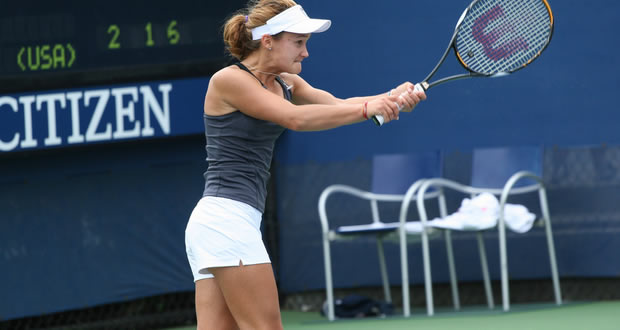
    Lauren Davis at Sony Open this year after beating her friend Madison Keys.
    Lauren Davis at Sony Open this year after beating her friend Madison Keys.


    Status: WTA no. 76.

    DOB: Oct. 9, 1993 In: Cleveland, OH

    Ht: 5-2

    First memory of tennis: “When I was nine and a half years old I played my first tournament and I made it to the final and I was wearing these big loafers as tennis shoes. And I lost in the final and I ended up crying, I was so mad because I wanted to win so bad.”

    Tennis inspirations: “Kim Clijsters. I think she was one of my favorites. She’s just an all around amazing person, so down to earth. And Roger Federer, of course.”

    Last book read: “I read Gaby Douglas’ book after she won the Olympics.”

    Current car: “A Volkswagen Antigua (white).”

    First famous tennis player you met or encountered: “Kim Clijsters. (Where?) Miami. When I was eleven, maybe. I came to watch her and she was signing autographs.”

    Favorite ice cream flavor: “Oreo.”

    Greatest career moment (so far): “Probably, so far, when I won Orange Bowl 2010. I won quite a few matches in a row and it was really a fulfilling feeling. It was really nice.”

    Most painful moment: “Can’t think of one. I mean, every time you lose is very painful.”

    Favorite tournaments: “Indian Wells, French Open, Miami.”

    Funny tennis memory: “I have gotten pooped on by birds quite a few times. During the match [smiles].”

    Strangest match: “No. Nothing comes to mind.”

    Closest tennis friends: “Madison Keys is one of my really good friends. Allison Riske. And Melanie Oudin.”

    Funniest players encountered: “Andrea Petkovic. She’s funny.”

    Favorite sport outside of tennis: “Soccer.”

    Three athletes you like to watch & follow: “Ray Lewis is my all time favorite. (Why?) Just his personality, it’s so amazing. He’s such a fighter, he’s fought so much adversity and hopefully I get the chance to meet him soon because he lives in Miami. Roger Federer. And Beckham.”

    Why do you love playing tennis: “The feeling you get when you win a match, it tops everything, any feeling in the world, so…”

    People qualities most admired: “I like a sense of humor. And honesty. And loyalty.”

    Scoop is the founder of www.Tennis-prose.com

  • Chris Lewis on How to Develop New American Tennis Stars

    Chris Lewis on How to Develop New American Tennis Stars

    I was recently asked a question by Valery Yalouskikh of tennisconsult.com: If you were putting in place a national development program, and you had twenty-million-plus dollars available to you, how would you spend it?

    Considering that no American reached the third round of the men’s singles at Wimbledon for the first time in 101 years, this is a question that needs answering, and fast.

    Many believe that the appalling 15+ year decline in US tennis since the days of Sampras, Agassi, Courier, and Chang is occurring because the sport no longer attracts the nation’s most talented athletes. Others believe that continued American dominance is unrealistic due to tennis’s globalization in the past few decades. Some point to a lack of both modern coaching methods and competent coaches, or a lack of clay courts, or an obsolete “American” style of playing, or that the USTA isn’t doing enough to help players – the list is as varied as it is long. Every passionate tennis fan has strong opinions regarding the current swamp that US tennis is mired in, including me.

    [divider]

    Discuss Chris’s thoughts on the development of American players in the tennis discussion forum.

    [divider]

    I’d like to address this issue at its most fundamental level; namely, the framework upon which national development systems are built. Let’s examine the typical national model. The hallmarks of all such bureaucracies include: a top-down approach, centralization, and conformity. A person (or committee) at the top determines how things are going to be done, and then everybody in the organization must conform to his decisions. Inevitably, the director of the national coaching program determines that young tennis players nation-wide must develop a certain style of playing, a blueprint is drawn up, and, in fear of losing their jobs, all of the coaches within the organization “agree” that players should play the way the director wants.

    Aside from the fact that recruitment of the most talented young players in the country invariably involves severing an existing and successful coach/player relationship, this regimented approach neglects to consider that every player is an individual with particular physical and mental attributes and a unique personality. When you attempt to coach identical strokes to all the top tennis talent in a country, you deprive those players of the opportunity to learn to counteract a variety of styles. In the main, players are practicing with and competing against mirror-images of themselves — never learning to deal with the unfamiliar. By adopting uniformity, you preclude the possibility of an exceptionally talented youngster developing his or her own style, based on his or her own unique physical attributes and tendencies, and in harmony with his or her own unique personality.

    Would John McEnroe have been a champion if, as a 12 year old, a Borg-like game had been imposed on him? Would it have suited his temperament to be molded into a patient, heavy-hitting baseliner? When you nationalize a particular playing style, you exclude the possibilities of innovation and creativity. By necessity, uniformity only looks backwards. It usually takes the current top player in the world as the model, and then an attempt is made to produce clones of that player, thereby excluding the possibility of the future development of playing styles as unique and radical as Connors’s, Borg’s, McEnroe’s, Lendl’s, Becker’s, and Agassi’s were in the days when national programs didn’t exist.

    Would Pete Sampras have been allowed to switch to a one-handed backhand so late in his junior career? Development of unique individual tendencies cannot be planned or tracked, and is not related to previous statistical success. Because of the personal element, a national body is ill-equipped to produce champions, who, invariably, do not conform to the average of the points on a graph. Sampras’s late alteration was a bad idea in general, but a fantastic idea for him. A private coach adept in nurturing the personal traits of each player could help make such a decision, a national body could not.

    A national body is not only in direct opposition to private coaching in philosophy and results, it is in direct competition to it in the real world, meaning the two options cannot co-exist peacefully. By establishing a national, centralized program, you quickly alienate the private coaching community when their best players are enticed away. This leads to an unhealthy ‘”us” versus “them” mentality, with the national organization being increasingly criticized as the nationalization of player development further expands. A further decline in playing standards accompanies this expansion as private coaches lose more of their players, and become increasingly hostile towards the organization that is meant to act in their interests, not contrary to them.

    Such a bureaucracy, once established, will always expand, and always use their power to regulate, not persuade. Typically, they follow a pattern like this: Someone within the organization decides that one reason why the country isn’t producing players is because the national program is inheriting players who have already been “ruined” by incompetent coaches. Their answer, then, is to grab the players when they are even younger (more expansion). Or, a clipboard-holder in the organization then decides that every 10-and-under player in the country should conform to his desire to see them playing with shorter racquets and pressureless balls (more regulation). The consequences of this dictatorial approach are devastating to player development. Through further expansion, you deny coaches, whose players have been enticed away, any chance of actualizing their players’ potential. Consider the consequences when all the private coaches and their varied approaches to player production are deprived of the opportunity to develop their players, instead forced to watch them sacrificed to a homogenous program that demands uniformity at the expense of creativity and variety.

    Would American tennis have been better off if Nick Bollettieri, Wayne Bryan, Robert Lansdorp, Gloria Connors, and every other coach who contributed to the development of a top player had lost their best students to a national program? Think of all the hours each of those coaches spent planning and managing the details of what’s involved in producing a champion. This planning process happens largely off the court, in deciding the best course of action for each student as an individual. Does the same amount of thought go into each of a national coaching program’s coach/player relationships, where, in many cases, the relationship with a coach is an involuntary one? Through further regulation, by mandating that every 10-and-under player be banned from competing with racquets and balls that a great majority of coaches think are in the best interests of a young player’s development, you preclude those coaches from acting on their own conclusions, which draw upon decades of practical observation and experience. At the stroke of a bureaucrat’s pen, all that expertise is rendered useless. Would Martina Hingis have won the French Open Juniors (18 & Under) as a twelve-year-old if she’d been forced to play with a toy racquet and balls until she was 11? I doubt it. What do you think?

    At this stage, things usually degenerate to such an extent that it becomes obvious national programs are synonymous with failure. When it comes to producing champion individuals, centralization, standardization, uniformity, rigidity, and regulation do not work. What, then, is the antidote?

    There are three essential components that need to be in place when it comes to producing champions. The first is that the player needs to have a certain amount of physical talent and mental toughness to one day be internationally competitive. The second is that there must be in place an environment that is conducive to ensuring that talented, tough players are given the best opportunity to allow their talent to reach its ceiling of potential. The third component is player choice; i.e., whether the player chooses to actualize his or her potential by doing justice to both his talent and the environment that gives him the opportunity to maximize it.

    When it comes to development programs, what we are really talking about is creating an environment within which gifted players have the best opportunity to flourish. When identifying these environments, the evidence consistently points to a committed, passionate coach teaching, guiding, and mentoring a gifted player to a successful pro-career. How, then, do we best ensure that such relationships are given the best opportunity to thrive in the future? First, it’s imperative to understand that tennis is a highly individualistic sport. Aside from a shared ability to win, the only thing that many of the great champions have had in common was that they have had virtually nothing in common. Nothing better illustrates this fact than the contrasting styles and personalities of some of the game’s great rivalries, like McEnroe and Borg, Evert and Navratilova, Sampras and Agassi, and Federer and Nadal. Incidentally, it’s a useful exercise to look at who the primary coaching influences were in the development of these players: John McEnroe – Tony Palafox and Harry Hopman; Chris Evert – her father; Martina Navratilova – Billie Jean King and I also understand that Tony Roche had an influence; Pete Sampras – Peter Fischer; Andre Agassi – his father and Nick Bollettieri; Roger Federer – Peter Carter; Rafael Nadal – Toni Nadal.

    Second, like players, coaches also have their own unique methods and personalities. The best ones are independent thinkers who wouldn’t survive for a second in a regimented environment, where they would be expected to ignore their own knowledge and conform to the dictates of a “one size fits all” approach. Can you imagine Wayne Bryan, Nick Bollettieri, or Toni Nadal working within the confines of a stifling bureaucracy? With such a diverse range of players and coaches out there, it’s essential that players and their parents are free to determine for themselves who is the best coach. Any wider program or system must take this into account.

    So then, back to the original question: What would I do if if I had upwards of twenty million dollars to spend in order to maximize the chances of creating future champions? I would use the money to create the most competitive tennis environment for both players and coaches in the world. I would make use of the exceptional junior talent that I see everywhere, as well as the enormous coaching talent that exists throughout the country. I would create a level-as-possible playing field for both players and coaches by offering them significant incentives, available to all in order to develop players and produce results.

    Instead of severing successful and existing coach-player relationships by seducing the top junior players away from the committed and passionate coaches who develop them, I would support those players and coaches.

    Here’s how I would do it: I would first design a US tournament infrastructure that offered year-round competitive opportunities to as many young players as possible. This infrastructure would place an equal emphasis on entry-level professional tournaments as it would on junior tournaments. To optimize the chances of young American players transitioning from top juniors to successful pros, I would make lower-level professional tournaments and the invaluable ATP ranking points they offer as accessible as possible. This would mean putting in place a year-round circuit of events on different surfaces, and in as many locations as practical.

    After establishing a comprehensive tournament infrastructure, I would design an objective and transparent player incentive scheme that directly links results and rankings to player funding. The criteria for funding would be publicized prior to the beginning of each year so that players could plan their schedules accordingly. To reward results at the junior level, I would select a number of the highest status junior events, and link performance in those tournaments to financial reimbursement for expenses incurred. For example, the winner of a high-status junior event might receive 100 percent reimbursement for all legitimate expenses (coaching, accommodation, travel, restringing, etc.) related to the event. The finalist might receive 75 percent reimbursement, the semifinalists 50 percent, and the quarterfinalists 25 percent. The total amount of reimbursement per player, per tournament, would be firmly set at a reasonable level. To further assist juniors receiving financial support based on junior tournament results, I would assist the top ten juniors in each age group, based on their national year-end junior rankings. For instance, the number one ranked junior in each age group might receive an amount equal to 80 percent of tennis-related expenses for the year, with a cap of, say, $20,000 for each number one ranked player. Percentages of expenses and capped amounts per player would be adjusted on a sliding scale downwards based on each player’s ranking.

    In addition to having a financial incentive scheme for junior players, I would have an ATP and WTA ranking-related incentive scheme for players aged 19 (or younger) up to 22 attempting to break into the pros. The criteria I would use for these transitioning players would, as I stated earlier, also be objective and transparent.

    Here’s how an objective incentive scheme for the transitional players would be established: I would document what each of the top 100 ATP and WTA players from the last 10 years was ranked at year’s end from the ages of 19 through 22. The results from this analysis would enable me to identify extremely reliable statistical criteria that could then be used to determine the players most likely to achieve a successful pro career. It would also be useful in determining the amount of financial assistance offered to each player who met the criteria.

    To concretize the above, let’s say that after conducting such an analysis, I find that 95 percent of 19-year-old male players who eventually reached the world’s top 100 were ranked inside the world’s top 800 when they were 19, and 95 percent of 19-year-old female players who eventually reached the top 100 were ranked inside the top 650. Let’s say I also find that 95 percent of 22-year-old male players who eventually reached the world’s top 100 were ranked inside the world’s top 275 when they were 22, and 95 percent of 22-year-old female players who eventually reached the top 100 were ranked inside the top 225 when they were 22.

    Using this data, linking a financial incentive scheme to a developing player’s ranking progress based on his or her age would be simple. I would opt for a three-tiered scheme that offered more assistance to higher ranked players than to mid- and lower-ranked players of the same age. In other words, a 19-year-old male player ranked 750 at the end of the year might receive an incentive payment of, say, 75 percent of annual tennis-related expenses up to a maximum of $10,000; however, a 19-year-old male player ranked 300 might be eligible for a payment of 75 percent of annual tennis-related expenses up to a maximum of $25,000. Ineligibility for the program would kick in when players either turned 23, or made it into the world’s top 100.

    In addition to being objective and transparent, this system would be fluid and dynamic. Even if players qualified for financial assistance one year, then the scheme would demand from them continued progress in order to qualify the following year. Conversely, players whose rankings and results precluded them from receiving assistance one year would have as much of a chance to qualify in subsequent years as the players who qualified the previous year. Under the criteria outlined above, the scheme would offer equal opportunities to all. There would be no subjectivity, no bias, no favoritism. It would be driven exclusively by performance, results, and age. By implementing such a scheme, I would be giving players, parents, and coaches not only a powerful incentive to succeed, but also a fair way to benefit from significant financial assistance while still retaining a full range of coaching and tournament options.

    Finally, it needs to be said that this is a highly complex subject. I do not attempt to address many of the issues that such a complex subject raises. What I have done is outlined, in principle, a national framework that maximizes the chances of producing champions. A framework that offers players (and their parents) the widest possible choice of coaches by offering earned financial support in a highly competitive environment supported by a national body that doesn’t play favorites.

    I expect there will be many who agree and many who disagree. Let’s hear from you, as this is a discussion that needs to be had.
  • Jack Kramer Explains Federer’s Fade

    Jack Kramer Explains Federer’s Fade

    Jack Kramer’s “The Game” with Frank Deford is one of the finest tennis books you’ll ever lay your hands on. Jack Kramer was a grand master of the sport, winning everything there was to win. With that kind of tennis success comes an expertise that only a select few can acquire.

    Kramer, now deceased for several years, could analyze and breakdown any match, any player, the mental side of the sport in a way that educates the reader.

    Discussing Stan Smith and his sudden rapid decline from the top, Kramer’s description seemed to also fit the current Federer situation…

    “When you reach a certain plateau in tennis, you do almost everything automatically,” wrote Kramer. “I would hit down the line at a certain moment without really knowing that I had made a choice and carried it out. When things start to go bad for a player, the first thing he loses is that spontaneity. He starts to think a little, which is bad enough, but then he starts to overthink. That’s what happened to (Stan) Smith. And then after a certain number of losses, he couldn’t march about with that air of confidence. Listen, let me assure you that you play better as Number l because most players cannot forget that fact, and thus they play worse. Once Stan was an ex-champion, the others wanted him all the more – which made it that much more difficult for him.”

    Kramer added some more thoughts: “He was reaching the peak of his career; he was still only 26, Number l in the world. And I think it is possible to speculate that had he played that (boycotted) Wimbledon, had he won it – which was the best guess – he might not have declined so spectacularly in the years that followed. The week after (boycotted) Wimbledon there were two tournaments on the continent, and the one at Gstaad in Switzerland had a much stronger field. So we asked Stan if he would switch to the other tournament, at Bastad, Sweden. As always, he promptly agreed to help. The tournament there was played on clay – hardly Smith’s favorite surface – but he won, which gives a pretty good hint that he was primed for Wimbledon.

    “But then he came back home from Wimbledon as an ex-champion, somehow he had lost the ability to win. Smith didn’t win another tournament for something like two years. It was not like he collapsed overnight though. A whole year later in the semifinals at Wimbledon ’74, he was serving for the match against Rosewall, up two sets to love, when he completely fell apart. That was the last nail in the coffin. That and Connors. He couldn’t stand Connors, and that made it all the worse that he couldn’t beat him.”

    Maybe Federer losing to Djokovic at the U.S. Open, with the two match points was one of the final nails in the coffin, though Federer did rebound, unlike Smith, to win Wimbledon last year.

    We’ll never know for sure the exact roots of a great champion’s decline. But it sure makes for an interesting discussion, where every pundit and fan, even an expert like Jack Kramer, has an idea.

    “first thing he loses is that spontaneity”

    [divider]

    Discuss this and more on the tennis community message boards.

  • Johan Kriek on Drugs in Sport

    Johan Kriek on Drugs in Sport

    Last week, Johan was asked by two different radio hosts about his thoughts on drugs in tennis.

    MY TAKE: and I hope this sparks a serious debate about drugs in tennis before it is TOO LATE!

    Back in 1979 and 1980 there were discussions within the ATP and its leadership on how to keep tennis clean from pros using drugs (my feeling was that there were just too many “rumors” of drug use, specifically “recreational drugs”). Remember Studio 54, Miami Vice, etc….etc? All so glamorous and fun….

    The ATP in the summer of 1980 (if my memory serves me correctly) had a big meeting at the Gloucester Hotel in London the weekend before Wimbledon, and it was unanimous that any player could be randomly picked for a drug test at that time. We were the first pro sports in the history of sports to implement such drug testing rules.

    After my 5 set loss to Bjorn Borg in the 1980 US Open semifinals I was escorted by security to the Marriott Hotel at La Guardia airport to be drug tested which was strictly a urine test. I was told I was the first pro player to be tested randomly under the rules. I was perfectly happy to do so since I had absolutely nothing to hide. I never heard back from anybody which confirmed I was no drug user of any kind. But doesn’t it suck to know you are clean to be “proven innocent”…..but this was the beginning of the ATP’s drug testing path.

    With Alex Rodriguez’s situation and the decades long baseball drug suspensions, and Pete Rose’s ridiculously over the top suspension for betting while others still play who use PED’s, the NFL steroid history, and many, many deaths most likely caused by the abuse of steroids (this is all very well documented), plus the pro-cycling tour’s doping scandals, and the fact that the names of pro tennis players are starting to pop up more and more in papers. I am very concerned as a former top ATP player that this kind of publicity is going to “kill the goose that lay the golden egg.” But that is just one concern….

    I know, there are people — many, in fact — who don’t care that there are PED’s (Performance Enhancing Drugs) and openly think it is OK to let athletes use whatever they want, and let it go on like that. But here is my argument: If an athlete then decides the risks are too high, and wants to stay “clean” and compete as such, such athlete will not be competitive! Is that fair? Of course not! What about the results physically long term on a body? We know a lot of it is very bad and some may get away with being OK, but too many will suffer very negatively. I am no scientist but I hope some scientist will comment and tell us what each of these drugs can do to a body, short term and long term.

    The second argument for me is, how do I tell my own flesh and blood kids that if they want to be competitive, you better start using HGH at age 8 so you can become taller. Or that they will have to use PED’s for as long as they want to be competitive on the pro tennis tours! What kinda world will we live in? Sure, those that like to see car and train wrecks will not give a damn and will probably not mind if somebody has a ”roid-rage” episode on court or on TV in front of millions and decapitate a linesman or skewer a fan with the sharp end of a “smithereened” racket since he did not like his “cheering”!

    I don’t pretend to have the answers to this. It is a vexing and very difficult subject since it has so many issues coming with it. I see juniors in tennis and I wonder why is this girl or boy 6 foot 4 and only 14 years old, and the parents are 5’8″? Must be from the grandparents … Yeah, right …

    To what length will some of these crazy parents go to get an “advantage” for their child? And more importantly, should there be drug testing in juniors and if so, at what age should they be randomly tested? It is just mind-boggling to me to even think in these terms but that is where it is heading! What about the issue of a kid who “unknowingly” is being “fed” stuff and maybe knows and doesn’t want to do it — what then? How sickening is that! And it has happened in junior sports!

    Here is a thought for at least the ATP Tour (I cannot speak for the WTA Tour but perhaps they have issues, too):

    Have random drug tests, lots of them, for the top 250 to 500 players. Make it an industry! You drop into any of those rankings for a minute you are “fair game”. Test each person at any time, at any tournament, while on vacation, in Richard Branson’s spaceship…I don’t care. If you cannot do it, immediate suspension for two years. You refuse, lifetime suspension. You fail the test first time, lifetime suspension. Period! Make drug issues a NON-ISSUE this way. I don’t care if you are number 1 in the world or number 500, everybody gets treated the same. In order to safeguard against “influences”, spread these drug testing centers all around the world. Only very few people will know where all of them are. Perhaps switch testing centers constantly so there will not be any chance of “meddling” with results. Maybe have a minimum of 5 drug testing facilities, maybe even more. One gets a result back and it is 3-2? Adios!

    I liken this scourge of drugs in sports to a slow growing cancer. Eventually it will kill, so it is better to ”cut it out” early when noticed and treat it aggressively.

    BTW….I know I will never be asked to head the ATP so being a wishy washy politician is never going to be my philosophy. I tell it the way I see it..

    I am very worried. You may ask me why am I worried…..

    “You are done playing so why inject yourself in this, you old fart!”

    Because my whole life was/still is TENNIS! I was always told that hard work, fair play, and honor are qualities needed to succeed. Now you tell me it is irrelevant??!!

    On top of it, I am coaching future college kids, maybe even future champions! I am changing lives and now I am to feel like if I keep doing this and pros are openly using drugs all I stand for is in FULL ASSAULT and I will be IRRELEVANT in the near future!! That is completely UNACCEPTABLE!!

    Here is another issue — look what happened to a situation like Southern chef Paula Dean who had used a racial slur. She lost a HUGE amount of MONEY, companies dropped her like a hot potato, and her reputation is tarnished, perhaps for life! For a “word” she used and her life and business are destroyed!

    I sincerely hope the 4 Majors and ALL ”powers that be” in our wonderful sport start dealing with this as the HIGHEST priority in sorting this out ASAP. SPONSORS all around the world should say to the ATP Tour leaders, if this continues to “crop up” we will WALK!

    Maybe it is easier to hit them (players) hard in the “pocketbook” than it is “morally”. But that is what modern man feels the most. Sad but true: we value money more than “values” themselves…

    I hope this sparks a HUGE debate……”

    Reposted from the Johan Kriek Tennis Academy website

    [divider]

    Discuss Johan’s blog post and the subject of doping in sport/tennis on our discussion forums.

  • Youzhny triumphs in Gstaad

    Youzhny triumphs in Gstaad

    Mikhail Youzhny triumphed 6-3 6-4 over dutchman Robin Haase to claim the Swiss Open title in front of a packed house.

    Youhzny took the match with a brace of service breaks, one in each set to clinch the title in just over an hour.

    After the match, Youzhny said “Every one of my matches was a tough one. It was a hard week but it ended very well.”

    It was the Russian veteran’s ninth ATP title and he extended his perfect Head to Head with Haase to 5-0.

    [divider]

    Click here to dicuss the match with fellow tennis fans in our discussion forum

  • Tommy turns back time – Wins the Croatia Open

    Tommy turns back time – Wins the Croatia Open

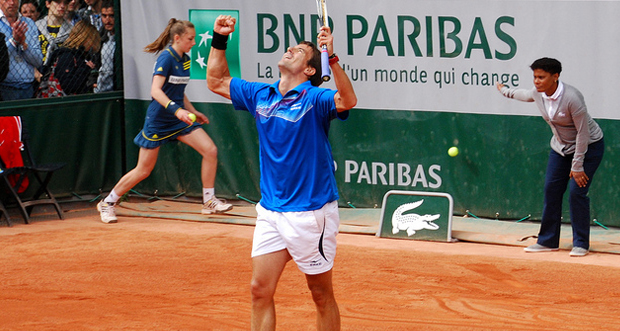
    Spanish veteran Tommy Robredo continued his recent resurgence by defeating Fabio Fognini 6-0 6-3 at the Croatia Open on Sunday.

    A dominant first set saw the 31 year old administer a bagel within 18 minutes to the bewildered Italian who won only six points in the opening stanza.

    Fognini rallied in the second set, breaking Robredo twice but had problems holding onto his own service game, as Robredo ran out the set relatively comfortabley to take it 6-3 and win his second tournament of the year.

    “No money can buy this feeling,” said Robredo after the match. “I played a perfect match, did a great job. But in matches like this it is always important to win.”

    [divider]

    Click here to dicuss the match with fellow tennis fans in our discussion forum

  • Cibulkova surprises Radwanska to take Stanford title

    Cibulkova surprises Radwanska to take Stanford title

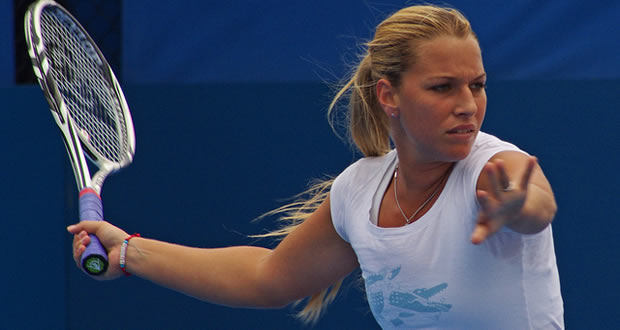
    Dominika Cibulkova defeated Agnieszka Radwanska 3-6 6-4 6-4 to take the Stanford title, reversing a 6-0 6-0 rout to the Polish #4 earlier in the year at Sydney.

    “It was big deal for me because I never beat Aga before and she’s a really tough competitor and I had to earn every point. It was really tough physically and mentally. That’s why I am so happy that I won.” stated Cibulkova following the match.

    The 24 year old Slovakian dropped the opening set, but recovered to break Radwanska in the second to force a final set championship decider. Radwanska marched out to a 4-2 lead but was quickly broken back.

    Cibulkova then took control of the final games, before unleashing a backhand winner to take the match and the championship.

    [divider]

    Click here to dicuss the match with fellow tennis fans in our discussion forum

  • Isner saves match points to seize Atlanta crown

    Isner saves match points to seize Atlanta crown

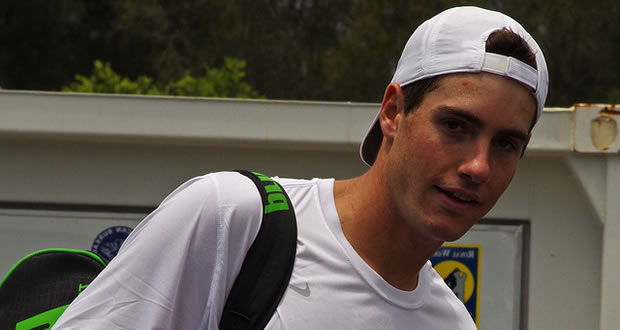
    John Isner pipped South African Kevin Anderson in a closely contested three set match (all tiebreaks) to win the battle of the big serving giants in Atlanta, Sunday.

    The match extended to just under three hours and proved to be a serving exhibition, the two players hitting 24 (Isner) and 21 aces (Anderson) respectively. Neither player suffered a break of serve in the entire match, although Anderson had the most break point opportunities – failing to take advantage of 11 chances, 7 of which came in the final set.

    Isner saved two championship points and served out the tiebreak to win his seventh ATP Tour title.

    [divider]

    Click here to dicuss the match with fellow tennis fans in our discussion forum

  • Teenager Elina Svitolina bags first title

    Teenager Elina Svitolina bags first title

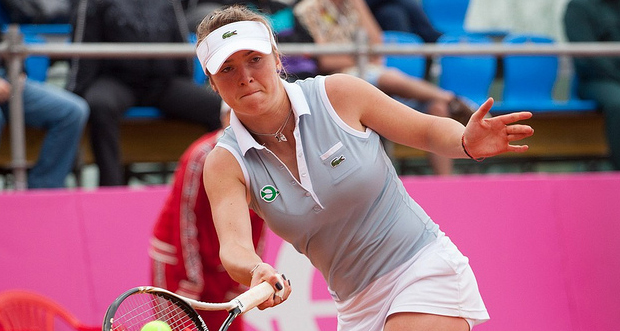
    Promising Ukranian teenager Elina Svitolina claimed her first WTA title, defeating Shahar Peer in the final of the Baku Cup.

    A brace of service breaks, one in each set gave the 18 year old the edge needed to defeat former world #11 Peer in 1 hour 37 minutes.

    After the match, Svitolina said “It was a very tough match today and I had a lot of tough matches throughout the week, but I worked really hard coming into the tournament, and it turned out well for me.”

    [divider]

    Click here to dicuss the match with fellow tennis fans in our discussion forum

  • Newport, Stuttgart, Båstad, Budapest, Palermo: ATP & WTA Results – Sunday, July 14

    Newport, Stuttgart, Båstad, Budapest, Palermo: ATP & WTA Results – Sunday, July 14

    [divider]

    Click here to discuss the ATP men’s tournaments.

    Click here to discuss the WTA women’s tournaments.

    [divider]

    Hall of Fame Championships — Newport, USA
    N Mahut defeats (4) L Hewitt — 5-7, 7-5, 6-3

    [divider]

    Mercedescup — Stuttgart, Germany
    (5) F Fognini defeats (2) P Kohlschreiber — 5-7, 6-4, 6-4

    [divider]

    Skistar Swedish Open — Båstad, Sweden
    C Berlocq defeats (8) F Verdasco — 7-5, 6-1

    [divider]

    Hungarian Grand Prix — Budapest, Hungary
    (3) Simona Halep defeats Yvonne Meusburger — 6-3, 6-7(7), 6-1

    [divider]

    XXVI Italiacom Open — Palermo, Italy
    (2) Roberta Vinci defeats (1/W) Sara Errani — 6-3, 3-6, 6-3