Tag: tennis

  • Agnieszka Radwanska Wins Korean Open

    Agnieszka Radwanska Wins Korean Open

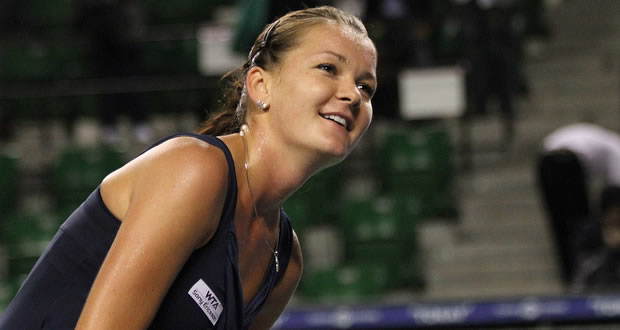
    Agnieszka Radwanska won her third WTA title of the year defeating Russia’s Anastasia Pavlyuchenkova in a gruelling match lasting 2 hours 45 minutes at the Korean Open in Seoul.

    The top seeded Pole prevailed 6-7, 6-3, 6-4. “After a great match, almost three hours of great tennis at a really high level, of course I’m very happy,” she said after clinching the title.

    After dropping a first-set tiebreak to Pavlyuchenkova she took back control of the match with an early second set break. Radwanska went on to seal the second set before breaking in the tenth game of a final set decider to take the match.

    [divider]

    Discuss the Korean Open with fellow tennis fans on the Tennis Frontier message board.

    [divider]

    Cover Photo: Christopher Johnson (Globalite), Creative Commons License

  • Davis Cup 2014: The World Group Draw

    Davis Cup 2014: The World Group Draw

    The 2014 Davis Cup draw for the World Group

    Home countries are listed first with seeding in brackets.

    Germany v Spain (3)

    Czech Republic (1) v Netherlands

    Japan v Canada (7)

    France (5) v Australia

    United States (6) v Great Britain

    Argentina (4) v Italy

    Kazakhstan (8) v Belgium

    Serbia (2) v Switzerland

    [divider]

    Discuss the draw with fellow tennis fans on the Tennis Frontier message boards.

    [divider]

    Cover Photo: Kevin Stephen (Creative Commons License)

  • Davis Cup Round-Up: Serbia and Czech Republic Make Finals

    Davis Cup Round-Up: Serbia and Czech Republic Make Finals

    Serbia and defending champions the Czech Republic booked their berths in the Davis Cup finals after defeating Canada and Argentina, respectively, in the tournament semifinals.

    Serbia progressed in front of a passionate partisan crowd with Janko Tipsarevic defeating Vasek Pospisil 7-6, 6-2, 7-6 in the deciding rubber to secure a come-from-behind victory.

    The Serbs had been down 2:1 coming into the final day after losing the doubles rubber and Tipsarevic losing a marathon five-set clash to Milos Raonic.

    [divider]

    Discuss Davis Cup with fellow tennis fans in the forums.

    [divider]

    Novak Djokovic pulled Serbia level with a 7-6, 6-2, 6-2 straight sets victory over Raonic, to set up a nail-biting decider between Tipsarevic and Pospisil in a winner-takes-all rubber. Tipsarevic prevailed, defeating Pospisil 7-6, 6-2, 7-6 to clinch a place in the finals for Serbia.

    The Czech Republic also prevailed 3:2, but it was a less bumpy ride as they built up an unassailable 3:0 lead that assured them of a finals place before the final day. The Czech victory was built on the exploits of Radek Stepanek and Tomas Berdych. The pair won both their singles matches and teamed up in the doubles to clinch victory.  The Czechs lost both dead rubbers as they fielded second string players.

    They now travel to Belgrade for the final, hosted from 15-17 November 2013. It is the third time in four years that they have faced Serbia in Davis Cup competition.

    [divider]

    Other results:

    World Group Playoffs:

    Spain 5:0 Ukraine
    Netherlands 5:0 Austria
    Croatia 1:4 Great Britain
    Switzerland 4:1 Ecuador
    Germany 4:1 Brazil
    Poland 1:4 Australia
    Belgium 3:2 Israel
    Japan 3:2 Colombia

    [divider]

    Cover Photo: elPadawan (Creative Commons License)

  • Wawrinka Shocks Murray in New York

    Wawrinka Shocks Murray in New York

    Andy Murray’s reign as the US Open champion was brought to an abrupt end in New York by the Swiss Stanislas Wawrinka.

    Wawrinka dominated the encounter in Arthur Ashe stadium, prevailing in straight sets 6-4, 6-3, 6-2.

    [divider]

    Discuss this match and more with fellow tennis fans on the Tennis Frontier forums.

    [divider]

    It was a lacklustre performance by the third seeded Scot.  He failed to earn a single break point opportunity on the Wawrinka serve throughout the entire match, and lost the first set after being 40-0 up at 4-5.  In a critical game, lasting over 15 minutes, the Swiss finally converted his sixth set point to take the opening stanza.

    Murray’s woes continued in set two, as Wawrinka got even better, hitting winners from both wings in an impressive display of controlled aggression that Murray seemingly had no answer for.

    Devoid of energy, the Scot found himself a double break down and could not recover as Wawrinka served out the set to take a comfortable lead.

    The third set continued in the same fashion. Murray’s game was littered with uncharacteristic errors and his second serve was being attacked with impunity by the Swiss.  Wawrinka secured another early break to jump out to a 1-3 lead.  A second break to go 2-5 all but ended the Scot’s title defense.

    After 2 hours and 15 minutes, Wawrinka wrapped the match up by first executing a powerful overhead to set up match point, and then a netted Murray return secured it. He won 107 points to Murray’s 78 — a clear reflection of his dominant display.

    Post-match, Murray stated: “He played exceptional tennis and served very, very well. He hit a lot of lines on big points, went for his shots, and they all went in today. He played too well.”

    Wawrinka, seeded 9, will meet the winner of Novak Djokovic and Mikhail Youzhny for a place in the final.

    Cover Photo: Marianne Bevis (Creative Commons)

  • US Open 2013 Preview: Womens draw so unpredictable

    US Open 2013 Preview: Womens draw so unpredictable

    The women’s draw is generally the hardest to predict and this year there really is a lot to consider. Along with Serena Williams, Azarenka and Sharapova we have newcomers like Sloane Stephens and Laura Robson rising fast and fearing nobody, and previous slam winners like Li Na trying new aggressive tactics.

    I think the brevity of women’s matches is an undervalued asset making the women’s game harder to dominate and upsets much easier. While it has become customary to consider it as Serena vs the rest of the world. Serena should win it barring injury. The women have not dominated like the men have. The share of the slam crowns has been much more democratic in the women’s game than the men’s. I lay that squarely with the women’s more middle distance, some times sprint nature of 3 sets compared to the men’s marathon of 5. For me it makes the men’s far too predictable and the women’s very unpredictable. Wimbledon 2013 Women’s finalists anyone?

    Alongside that, as a working father, I find it hard to keep up with the men’s game at the slams. The matches are just too long. The women’s game is fine and so I watch it throughout. I only watch the men’s game in the final stages. I just do not have the time. Even then I rarely watch the full match. Even though I find the quality of the men’s game higher the sheer quantity I have to watch is too much and there are few upsets. The women’s game encourages upsets so while the quality is lower the excitement is higher in general. It is reasons like this that some are considering whether men’s 5 set matches should be reduced?. I just don’t think the women realize how good their product is. The quality is not up with the men’s but the drama certainly is.

    [divider]

    WHAT CAN WE EXPECT?

    Serena Williams

    In terms of Serena’s dominance that just is not the case anymore. There seem to be more genuine contenders, if not to win, then to go very deep and cause upsets along the way and open up the field including challenging Serena. So let us look at some of the prospects.

    For the women Serena does not look invincible any more. She has lost to Azarenka twice on hard courts this year and almost lost to her in the final last year and of course she lost to Stosur the year before so it is hardly a given that Serena will win it. Of course the women’s has always been wide open but rarely has Serena had so much to prove. However given the Wimbledon results everyone also has so much to prove as well.

    Normally Serena goes into a slam with a dominant record against all comers. This year though she has lost more than she is used to. Particularly deep in slams. To Sloane Stephens in the quarters of Australia and Sabine Lisicki in the fourth round of Wimbledon. Then twice to Victoria Azarenka. So there are quite a few players who will feel they have a chance against her. A further twist is that she has never won this title twice in a row. Of course that stat could easily change but it could reflect the challenges of a player who is dominant on all surfaces. She does not get a rest all year and must be tired in the final stretch compared to other players who specialize. So there are a number of reasons that Serena may not be the most likely to win this time.

    She will potentially meet Sloane Stephens in the quarters again here and of course Serena won’t be getting all the home support against a fellow American player. That is a fascinating potential match. Before that it is possible Serena could meet Yaroslava Shvedova who pushed her to three sets in last years Wimbledon. Yaroslava hasn’t had the same form this year and has recently pulled out of matches indicating injury or other problems but she is a very exciting prospect who showed she isn’t afraid of Serena and has the game to push her.

    That said Serena is the best battler on tour. Her quarterfinal at the Australian Open against Sloane Stephens showed me how hard she is to beat. She got injured during the match and could not move well but Sloane still had to use everything she had to get past Serena. I do not see many female players able to narrow the court so well and put up an impenetrable wall. So, while Serena has the best weapons on tour in her serve and forehand I still feel it is how well she uses this defense that will determine her fortunes. I expect her to be pushed more than we have seen for years so how she adapts to the situation is what matters.

    [divider]

    Victoria Azarenka 

    Victoria Azarenka (Vika) is surely the WTA version of Novak Djokovic. She is supremely consistent, hits hard all the time and is in the form of her life. She no longer fears anyone in a final. Bring on Serena, bring on any one. She showed me in the Australian Open her professional attitude. How she beat Sloane Stephens was not pretty. It was not worthy of the world number one but she also showed Sloane’s lack of experience.

    In the final Vika faced not one but two injury time outs. How about that for disrupting your rhythm. Vika just got on with it. Where Sloane sat down, Victoria kept her feet moving. Practiced a few shots and kept her mind active. She is prone to choking but she handled it and you can not ask for more.

    So, on hard courts and where she served for the US Open title last year I expect her to do well this year. If she makes the final and is fit then it is hard to bet against her.

    Maria Sharapova is in that place where Andy Murray used to be. She can dominate all below her except the number one. She just can not beat Serena. Of course you can point out that all streaks come to an end. Masha’s game is perfect for hard courts and she has won here before so in theory she could beat Serena here. Especially if Serena has her usual lull in the second set. Of course if Serena does not make the final then Maria fears no one else. She will be ready and it could go either way.

    [divider]

    Agnieska Radwanska

    Agnieska Radwanska has an amazing game but without adding power I think she has reached her limit. She is an amazing counter puncher able to use an opponents weapons against them but she lacks the ability to dictate. 7 matches in a world class field is too much for her game. She will always have at least one poor game during the tournament. Who doesn’t but there will always be someone ready to hit her off the court or just not miss anything and leave nothing for her. Agga will most likely fall to that player. I hope I am wrong because she is a breath of fresh air but, at least for now I do not see that she has enough answers on the biggest stages against the top players.

    [divider]

    Li Na

    Last night I watched Li Na in her first round encounter against Sofia Arvidsson. What a difference Carlos Rodriguez has made. Li Na was using serve and volley and I could not believe my eyes. It worked very well against her lower ranked opponent. I certainly agree with the tactic but only time will tell if it is ready for the big time yet. Li is a slam champion and always a contender. I include her here simply because she is trying something different with a legendary coach. She is already potent from the back. This surprise factor at the net could pose serious questions for her opponents if she makes it deep in the draw. Probably too early for the new tactic to be reliable but very exciting for the future if she sticks with it.

    [divider]

    Sloane Stevens

    I find Sloane Stephens very exciting. She is a precocious rising star that plays well on a big stage. She is deceptively powerful. but uses her opponents strengths against them ala Radwanska. She is a threat not only due to her ranking but her Semi final appearance at the Australian Open this year. She was taught a lesson by Victoria Azarenka that I do not think she will forget quickly.

    I find she reads the game very well and has a good balance between risk and recovery. She can dictate when she needs but has fantastic defence and deceptively great footwork. I am certainly hoping she goes deep this year. Especially on her home ‘turf’. I don’t expect her to win the tournament but she could make the final if lots of things go her way. Particularly her scheduled encounter with Serena. She could certainly cause an upset.

    [divider]

    Laura Robson

    Of course being a Brit I have been following Laura Robson’s results for a while. But then since she won an Olympic silver medal and went deep in the US open last year who has not. We learnt that she rises to the occasion just like Sloane. While she has less variety in terms of her shots she does have a strong mind and the ability to boss the point and match. Like Sloane she has been coming to terms with her success but she seems to have a good off court approach to help her work through this part of the journey.

    Her US Open run last year where she beat former number one and US Open champ Kim Clijsters, then Li Na and pushed Former Champion Sam Stosur. So I am obviously excited for a repeat this year. To make it even sweeter Laura’s next opponent in the third round is Li Na. Both are coming from straight set wins both have power games and enjoy hard courts. What an exciting match we have in prospect.

  • One More Time, With Feeling

    One More Time, With Feeling

    The Western & Southern Open ATP Final, 2013

    Rafael Nadal [3] def. John Isner 7-6 (8), 7-6(3)

    Three tournaments, three crowns: With his 7-6, 7-6 win over John Isner in the final of the Western & Southern Open in Cincinnati, Rafael Nadal remains unbeaten on North American hard tennis courts in 2013. The Spaniard also reclaims the No. 2 world-ranking; earns his 26th career Masters title, the second in as many weeks; and gets to take home a floral-themed vessel adorned with an earthier-than-ever-before glaze palette of burgundy and green. (I am not making that last bit up.) Indeed, there is talk of crowning him King of Concrete, or, at the very least, considering him as a favorite to win the US Open.

    Last week, in the Montreal final, Nadal demolished his 6’ 5” Canadian opponent, Milos Raonic, 6-2, 6-2. Raonic’s performance was decidedly muted, and Nadal calibrated his victory celebration accordingly. (It involved little more than warm, heartfelt smiles and a a few thankyouverymucheverybodys.) Today, at the Lindner Family Tennis Center in Mason, Ohio, Rafael Nadal again faced a native son. But unlike Raonic in Canada, the 6’ 10” American played a fantastic final.

    Although, from my perspective, today’s two tiebreak-sets still weren’t as thrilling as the first two sets of Nadal’s quarterfinal victory over Roger Federer on Friday evening. (Read about it here.) Gargantuan serves like Isner’s are more fun for me to see in person than on TV. (In fact, they are almost impossible to see on TV, because although they are beastly in size, they are also avoidant creatures, and tend to scurry off the television frame before you can get a good look at them.) Nadal earned exactly zero break points in twelve Isner service games. John managed to get three break points of his own, but converted none. Isner’s forehand was tremendous, which was both enjoyable and visible, but his return let him down at crucial moments, most notably at 3-5 in the second set tiebreaker.

    It’s possible Nadal was every bit as good in the Cincinnati final as he was against Federer in the quarters, but with Isner on the other side of the net, the conversation wasn’t half as eloquent. Which isn’t to say it wasn’t deep and meaningful—Isner’s presence in the final means Americans who have heard of tennis can tell foreigners that we once again have a top twenty player in the ATP computer rankings. It will be good for our collective sense of numerical self-worth. It should also be good for John Isner’s sense of his tennis self as he prepares to enter the US Open with the weight of American expectations on his broad shoulders.

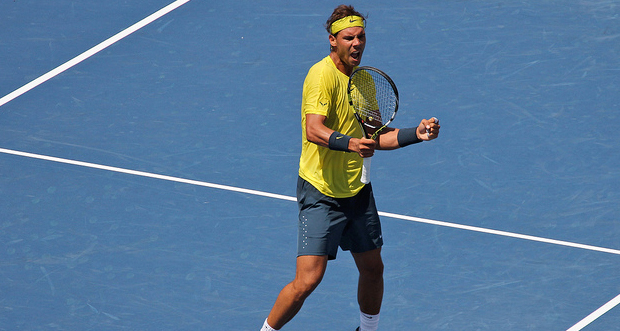
    Speaking of American pride, the U.S. crowd was with Isner from first point to last. Yet Nadal had a fair measure of support from the stands, and no small amount of their admiration. After all, he has put together a highly entertaining two weeks of tennis. And, like any great big-stage performer, when it came time—on his first of three available match points— for Rafa to bury his final forehand winner of the tournament down the line, he sensed the moment had arrived to let loose his inner celebratory animal.

    After collapsing flat onto his back (with impressive alacrity), the Spaniard screamed, tensing all his muscles, thereby paradoxically releasing all the tension accumulated during two taut hours of competition. Then, beaming like a ray of tennis-ball-colored sunshine, Nadal jogged to the net, shook the American’s proffered hand (resting his head briefly on Isner’s vast midsection) before going on delightedly screaming and jumping around the court. Oh, and he also wagged his No. 1 finger at the sky—just as he did after defeating Novak Djokovic in the Montreal semifinals.

    Given that finger-wagging was officially trademarked by RF, Inc. during the spring of 2011, Nadal’s infringement on copyright has not gone unnoticed—or unanalyzed. For my part, it was the finger-wag more than the third straight hardcourt title that reminded me of Mark Antony’s famous lines in Shakespeare’s Julius Caesar: “I thrice presented him a kingly crown, Which he did thrice refuse. Was this ambition?”

    Antony goes on to say that Brutus, an honorable man, did indeed think Caesar was a hair ambitious and ought therefore to be stabbed to death by a group of his buddies, making a mess of at least a dozen nice togas in the process. (I believe similar suggestions for summary execution have been put forth many-a-time on twitter in regards to Nadal, Federer, and also Gilles Simon.) But the reason Caesar had to be got rid of wasn’t because of his ambition; it was to do with how he applied it. Caesar sought to raise himself above the rules of the game, and to do so secretly— indirectly. Romans did not want to be ruled by a king (not when they could be gently guided by the classic democratic principles of bribery and corruption!). But tennis? Tennis craves kings. Every year—every week, even— tennis chooses the guy with the No. 1 finger.

    So, the thing I enjoyed most about this tournament—besides watching James Blake catch fire in his second round match against Jerzy Janowicz, of course—was seeing Rafael Nadal execute his tennis game with such clarity. He almost looked, well, entitled, out there. If I had a quarter for every time I saw Nadal move inside the baseline to hit groundstrokes, and go for winners, I could park my car at a meter in Oakland for long enough to do my grocery shopping and get a coffee. (For instance, during his semifinal match against Berdych, Nadal hit 19 forehand winners, 38 overall. That’s $9.50 for me, which roughly comes out to 11 minutes and 28 seconds of metered parking. See? Perfect.)

    One of the points from the final that sticks with me now was, I believe, the very first point of the second set tiebreaker. Nadal not only hit a winning forehand down the line, he managed to bend it so the ball struck the line as if it were an inside-out forehand hit from his backhand corner. Jim Courier, who was in the CBS booth, exclaimed, “Explain to me, how do you create an angle when you hit down-the-line?!” Then he told Mary Carillo how to do it. But even if Mary knows how to do it, that doesn’t mean she could. Which is why it is such a pleasure to watch a player capable of so much play so near that capacity.

    Without losing contact with his defensive skills, Nadal has spent the last two weeks executing the aggressive aspects of his game with remarkable openness. It’s refreshing; and it’s time.

    Not to play favorites for the Open, but if this is ambition—I like it.

    [divider]

    Discuss this article and the match on our tennis forums.

  • We Might Run Out Of Words

    We Might Run Out Of Words

    Cincinnati Masters, Final

    (4) Nadal d. Isner, 7-6(8), 7-6(3)

    Rafael Nadal has won the Cincinnati Masters, defeating John Isner to claim his second Masters event in two weeks, and his third hardcourt Masters of the year. Prolonged domination by a single player presents a writer with peculiar difficulties, assuming the writer is at all disinclined to repeat themself. This was a real problem in 2011, when Novak Djokovic refused to stop winning. I was not writing about tennis at the time, but I assume it must have been an issue in 2005 and 2006, when Roger Federer was nearly unbeatable, and very nearly unbeaten. Wimbledon aside, so it is proving this season with Nadal. I’d suggest there’s no higher compliment than to concede that if he keeps going on like this, we might run out of words.

    For example, there was little that could usefully be said after Nadal’s Rome triumph that hadn’t been said following the Madrid final a week earlier. His new Swiss opponent had greater pedigree, but won even fewer games. Similarly, today’s victory over a towering North American with a frightening serve and maneuverability on par with the Exxon Valdez more or less reprised last week’s. Last week it was local favourite Milos Raonic, whose trip to the Montreal final propelled him into the top ten. This week it was local favourite John Isner, whose passage to the final was if anything more impressive, and had the laudable effect of ensuring the United States has a man inside the top twenty for their home Grand Slam. Both giants progressed to the final after defeating Juan Martin del Potro in memorable fashion. Raonic, you will recall, generating fleeting controversy by delivering a series of roundhouse kicks to the net while cackling that he was “above the law.” Meanwhile Isner, more conventionally, saved a match point in a marathon. Isner also beat Raonic this week. The similarities mount, but ultimately amount to little. What really matters is that Nadal beat everyone. Again.

    Today’s final wasn’t the most memorable example we’ve witnessed this year, or even today, given that it was entirely upstaged by the women’s final that followed. Had it been a quarterfinal it would have already faded into the sepia backdrop of general forgetting: yet another example of a monstrous serve guaranteeing tiebreakers, which were then decided by the better player’s superior fortitude and technique. But it was a final, and so gains some luster by default, and thus bears recounting.

    If for no other reason, it was an interesting study in how two sets can be numerically similar yet end up feeling totally different. The first set was quite exciting, featuring multiple set points for both men, mostly in the fraught tiebreaker. Isner saved those he faced with typically muscular points on serve, but failed utterly to impose himself on return. Mark Petchey was correct in commentary when he remarked on the strange contrast that Isner presents us with. On serve he has an “all-American attacking game,” yet on return is “negative and pushy.” He did get an impressive number of Nadal’s serves back, yet they never had much on them, and thereafter he won very few points. It didn’t help that he facing one of the most punishing baseliners ever to heft a racquet. Nadal finally got a set point on his own serve, and duly took it.

    The second set, on the other hand, was frankly dull. If the first set demonstrated that tiebreakers are considerably more interesting when their arrival isn’t necessarily inevitable, the second set proved the corollary. Both men continued to serve magnificently, and return ineffectively. Nadal was more or less guaranteed a point whenever he switched up his serve wide to the deuce court, since the undeniable lethality of the American’s forehand requires that his feet are set. Nadal lifted and played a smart tiebreaker, and never looked in trouble. After victory he collapsed onto his back, and generally made it apparent just what winning Cincinnati means to him. It seems this tournament had featured on more bucket-lists than Serena Williams’s. The strange vase that Cincinnati passes off as a trophy proved every bit as awkward to bite as Montreal’s silverware had been.

    This was, of course, Nadal’s first strange vase. One can essay complicated reasons why he has never won this title before, including surface speed and bounce, opponents, balls, proximity to the US Open, and the misfortune a couple of years ago to combine with Fernando Verdasco to thrash out one of the worst tennis matches in living memory. All of these factors have merit, and combined meant that no one was surprised at his lack of success here (as opposed to Federer’s oddly dismal record at Bercy until 2011). Nadal characteristically offered the simpler explanation that he’d simply never played well in Cincinnati, and that this week he did. It was a salutary reminder that complicated rationales aren’t necessarily wrong so much as unnecessary, and that elite athletes generally operate with a savant-like eschewal of nuance. This is how Roger Rasheed can function effectively as a coach while employing the discursive range of an inspirational fridge magnet. The manner of Nadal’s progress this week certainly bore his contention out. There was no match in which he wasn’t the clear favourite – including the quarterfinal against the defending champion Federer – in which playing to his strengths would more than likely ensure victory. He just had to play well.

    This isn’t to suggest he didn’t have his difficulties. Federer came within a couple of games of winning, and Grigor Dimitrov boldly grabbed a set when Nadal allowed his focus to waver. However, this meant that in addition to savouring their hero’s triumph, the more martially-inclined portions of Nadal’s fan base could indulge themselves in their most cherished conceit, which is that of the Spaniard as el guerrero imparable. After what amounted to a fairly unremarkable defeat of Dimitrov there was no shortage of chest-beating proclamations that Nadal had not been at his best, yet had “found a way to win.” Insofar as the “way” consisted of “being better than his opponent at nearly every aspect of tennis,” I suppose it’s not inaccurate. What’s false is the emphasis. He didn’t win because of his warrior spirit, but because he’s a very good tennis player.

    Indeed, anyone still insisting Nadal isn’t the very best tennis player in the world right now sounds increasingly deluded. He will arrive in New York determined to become the first man to sweep the US summer since Andy Roddick ten years ago, and only the third man to do so ever (Pat Rafter also managed it in 1998, to Pete Sampras’s unstinting disgust). He will return to the number two ranking tomorrow, and could well return to number one if he sustains his current form for a few weeks in New York. Although the bookmakers in their wisdom have retained Djokovic and Andy Murray as US Open favourites ahead of the Spaniard, it will take a reckless punter to bet against him.

    But that’s all in the future. For now, Nadal has won twenty-six Masters 1000 titles, including a record-equalling five this season. It’s an accomplishment that is only enhanced by recalling that none of the five were Monte Carlo, which otherwise exists only that he might augment his tally by one each year. Aside from that, the only other Masters event Nadal hasn’t won this year was Miami, which he didn’t play. In order to break the record, which was only set two years ago by Djokovic, Nadal will have to win either Shanghai or Paris. History suggests that he is unlikely to do so. Then again, the Spaniard has already spent the season showing history just where it can shove its suggestions.

    [divider]

    Discuss this article, the match and lots more with fellow tennis fans in the forums.

  • Strong Believers

    Strong Believers

    Western & Southern Open, ATP Third Round

    [1] Novak Djokovic def. [Q] David Goffin 6-2, 6-0
    [5] Roger Federer def. [11] Tommy Haas 1-6, 7-5, 6-3
    [2] Andy Murray def. Julien Benneteau 6-2, 6-2
    [4] Rafael Nadal def. Grigor Dimitrov 6-2, 5-7, 6-2

    ESPN, Inc., formerly the Entertainment and Sports Programming Network Rulers of the Universe, has a way of making its fellow cable network, The Tennis Channel, look like it has the earnings potential of an independent bookseller—an independent used-bookstore with a leaky roof and a big CD section. I could watch Cincinnati tennis on two different ESPN stations today, while the Tennis Channel was stuck re-airing the Kooyong Classic from 2004. But, I could watch ESPN today, because today was a happy work-at-home paperwork-day. (This is a special kind of day, similar to a holiday. Sadly, it is also a type of day that has become all too rare in recent months.)

    Aside from making the Tennis Channel feel bad about itself, ESPN also has a way of reminding American tennis fans exactly how unimportant their sport-of-choice is in the grand scheme of chosen sports. Today they managed it by regulating Rafael Nadal and Grigor Dimitrov to ESPN3, an online stream, while airing Little League on television. Yes, a 1000-level ATP tournament contested on U.S. soil (specifically in the Western & Southern portion of the U.S.) took a back seat to eight-year-olds standing in a meadow chewing bubble gum. A match featuring one of the best players in tennis history versus the only active player on tour to be nicknamed after one of the other best players in tennis history was shunted aside by actual baby athletes.

    But I digress. Hmm. Why was I telling you about the ESPN programming schedule? Oh yes, for metaphorical purposes! And I’ll come to those in a moment, I promise. Everybody loves a metaphor. But first, since I’m on the subject of ESPN, I want to say a few words about ESPN commentator, Darren Cahill.

    In fact, you can consider this post my formal petition for Darren Cahill to take full coaching responsibility for Marion Bartoli’s post-retirement commentary career. Because, really, with Cahill in the booth, the video stream is almost optional. It isn’t simply that Darren Cahill mostly confines his commentary to the match at hand; it’s that his comments are so sensible. Indeed, when he has nothing sensible to say, he seems to say nothing at all. (Psychotherapists love this trait in their sportscasters.)

    For instance, during set one of Roger Federer’s three-set victory over Tommy Haas, Cahill wasted little time in the usual speculation about whether Roger was actually Federer, or if this Roger might not be an imitation version of the Swiss who had never learned to play tennis. Instead, he commented that Federer was more than typically nervous, rushing himself into poor decisions, mostly involving losing points at the net. Cahill also noted that Tommy Haas’s court position on the return was taking the out-wide serve from Roger forcing him into uncomfortable choices, and that Haas’s returns—flat and hard, down the middle of the court—were the best strategy to draw errors from Papa Fed.

    At some point in the middle of Nadal/Dimitrov match— the point when the Bulgarian ran down a drop shot, hit a winner, and then jumped into the air with glee—Darren Cahill chortled warmly, saying, “Goodness me, he’s fun to watch.” With Cahill in the ESPN booth, it’s also fun to listen.

    OK. That turned out to be an official second digression, which might be some type of digressive record, if such records were tracked. (I tried to keep track once, but I kept getting distracted.) So, without further ado, the metaphorical section of the post, wherein I compare the Big Four—defined herein as Djokovic, Nadal, Murray and Federer*— to ESPN, or perhaps Amazon.com, and their opponents to a cross between the Tennis Channel and various indie booksellers.

    [divider]

    Novak Djokovic d. David Goffin 6-2, 6-0

    The first men’s match on Center Court today was Novak Djokovic versus David Goffin. During Djokovic’s match, morning-time for me, I listened to my voicemail, ate a bagel, and blinked, twice. By the time I’d finished, it was all over. The second set took approximately five minutes and Goffin won exactly zero games. Djokovic, on the other hand, won six. Every time I had the opportunity to glance at my monitor I was treated to the sight of a blonde Belgian standing roughly fifty feet behind the baseline, and lunging in the general direction of a tennis ball.

    Goffin made his way to the third round via a 6-1, 6-1 win over Mackenzie McDonald, who is the first non-ranked ATP player to qualify for the main draw in Cincinnati. Ever. Mackenzie hails from Piedmont, California, an American hill-town so wealthy that it seceded from its surrounding city-state, which is a rough-and-tumble place called Oakland. Piedmont has a very tidy set of public courts. It is doubtful Mackenzie makes much use of them. In the second round, David Goffin bested last week’s Rogers Cup semifinalist Vasek Pospisil, 7-5, 1-6, 7-6. Neither of these victories offers exquisite insight into Goffin’s current form. Nor did today’s loss. Djokovic didn’t let him near the tennis ball. The Serb is looking fearsome.

    Djokovic has never won the Western & Southern Open. Conquering Mason, Ohio, would make him the only ATP player to win all nine of the Masters titles. I Googled No. 9 and it turns out to be – according to the internet’s most reputable numerology sites — “the number of destiny.” Wikipedia also defines nine as the number that follows eight and precedes ten. Make of that what you will.

    [divider]

    Roger Federer d. Tommy Haas 1-6, 7-5, 6-3

    Given that Federer spent a goodly portion of his third round match looking as if he were concerned that sustained rallies might damage his antique tennis racquet, you might be surprised that I’ve listed him among the metaphorically ESPN-esque players of the day. But—and I think I’m right about this—part of the reason Federer was able to come back and win the match from 1-6, 1-3 down is precisely because he is Roger Federer, or RF, Inc., for short. No matter how low the RF stock plunges, there is always a chance that his opponents will remember that they are up against a 17-time slam champion. (Sometimes, there is even opportunity for Federer to remember this, too, especially when he’s not wearing his special “warming shirt” and is therefore capable of hitting serves.)

    In Tommy Haas’s case, he must have also been aware of his 3-11 (now 3-12) career head-to-head against Federer. A tennis fan doesn’t need a numerology site to tell her that numbers like that can get in a player’s head. Nonetheless, the German got off to a stellar start, and looked as if he could continue being outstanding all day. Meanwhile, Federer proceeded to go from OK, to distinctly not OK, to much worse than that. By the end of the first set even his serve had abandoned him, protesting its owner’s wild net-rushing ways.

    But, midway through the second set the Cincinnati fans got to witness one of the marvels of today’s interdependent tennis economy. At very nearly the same moment in time, Federer began to produce his money shots, while Tommy’s currency took a sudden nosedive. Haas started his descent by re-gifting an early break back to Roger, leveling the set at 4-4. Federer consolidated, making one small fist pump in the process. Haas then gave away three straight points, which turned out to be set points, so he changed his mind and took them back. The set was still level at 5-5, but the momentum now rested with Federer.

    By the time the No. 5 seed closed out the match—an excellent drop shot to bring up match point, and a forehand winner to end it—Roger Federer looked like he had some measure of his aura back. (If you looked closely, you could even see it, shimmering in the Cincy sun — a pretty cornflower blue.) After the match, Federer was quoted as saying he is a “strong believer” he’s on the right path. Should Federer lose in the quarters, there’s still no proving him wrong. Even the most vintage version of Roger Federer could be excused for losing to Rafael Nadal at his most passionate™.

    [divider]

    Andy Murray d. Julien Benneteau 6-2, 6-2

    OK, I admit I did not see one ball of Murray’s win over Julien Benneteau. (I had to do some actual work today.) Andy Murray had to do some work, too — exactly one hour, nine minutes, and two seconds’ worth. Since I have no observations to make about this match, I’ll guess (blogger prerogative): the Scot is much improved this week from last. He is also the reigning Wimbledon Champion and the defending US Open Champion. He is a factor, whether he is happy about it or not.

    [divider]

    Rafael Nadal d. Grigor Dimitrov 6-2, 5-7, 6-2

    Nadal’s three-set defeat of Grigor Dimitrov was an exciting match, or might have been if I weren’t watching it while also trying to cook dinner for four. It is not easy being a Rafa fan, chopping vegetables, and watching a 6-2, 5-3 lead slip entirely away. In such moments one needs to be especially careful not to accidentally include small pieces of oneself in with the chopped kale and beans. (It’s what people like to eat in Northern California, I swear.)

    At some point during the first set, Darren Cahill said (sensibly), that, under pressure, Grigor Dimitrov had a tendency to abandon a winning strategy. As if Dimitrov knew he was being discussed, he demonstrated the truth of Cahill’s observation by gaining a hard-fought advantage in a long rally and proceeding to back it up by backing up, way up—deep into Goffin territory—losing the point because he couldn’t track down an inside-out forehand from Nadal. Case in point.

    However, when the Bulgarian made a mighty last stand, which came, as last stands will do, near the end of the second set, it turned out to be Nadal who abandoned his winning strategy. Instead of aggressively going for winners off his forehand, backhand, serves, and volleys, he mostly did not go for winners off all those same shots. When he did, he missed. Grigor, meanwhile, became good fun to watch.

    Fortunately for Rafa, he is, at the moment, well in touch with his trademark inner-passion for the game. As with Federer, you can see it in his aura, which shines bright yellow, and looks not unlike an incandescent tennis ball in the shape of a T-shirt. Even at night, the brilliant glow helps Rafa find anything from a moth resting its wings on the service-line to an aggressive baseline strategy. Having located his strategy Rafael Nadal, being Rafael Nadal, broke to open the third set. There were close games and see-saw moments in Set No. 3, but Nadal never relinquished the break. Why should he? He’s Rafa.

    [divider]

    At the beginning of Roger Federer’s match he was pronounced by many (many times over) to appear “not at all like Federer.” By the time he won, his play was dubbed “vintage Federer.” True Federer. (Though he was still far from full-flow-Federer, which is even truer than truth.) It fascinates me how often top players are defined as playing “like themselves.” It isn’t just linguistic laziness, or I don’t think it is. The technique is descriptive. If you tell me Djokovic was playing like Djokovic, I don’t picture baseline errors. No, I think it’s to do with how frequently the Big Four are able to channel their best selves, which — and this applies to all of us — is the truest version of the self. I am a strong believer in that.

    And because I’ve used up my entire allotment of words, including half my allowance for next week, I’ll end with mentioning players who deserved more mention: John Isner, Dmitry Tursunov, Juan Martin del Potro, and Tomas Berdych. Each man won a match today, and tomorrow they play Novak Djokovic, each other, and Andy Murray, respectively. I wish every one of them strong belief. I also wish tomorrow were another special stay-at-home-paper-work-day. So I could watch.

    *The Top Four (as opposed to the Big Four) includes Djokovic, Murray, Nadal, and David Ferrer, who is having a terrible time moving around tennis courts lately. I have to think it’s at least partly due to the damage done to his ankle at Wimbledon. The Spaniard tried so hard to give his second round match away to Ryan Harrison, but the American refused to take it. (Respect for his elders, and whatnot.) As a consequence, David Ferrer has now been Tursunoved twice this season. But it’s worth noting that last time he lost to the Russian was in Barcelona, mere weeks before he reached the French Open final.
  • Back to the Future! Roger reverts to his old racquet and wins in Cincinnati.

    Back to the Future! Roger reverts to his old racquet and wins in Cincinnati.

    Five-time winner of the Cincinnati Masters event, Roger Federer proceeded into the third round of the Western & Southern Open by defeating Philipp Kohlschreiber in straight sets (6/3 7/6).

    Federer had been testing a new 98-square-inch head racquet following an early Wimbledon exit, but reverted to his usual 90-square-inch Wilson for his opening match against Kohlschreiber.

    “I’m going to do more racquet testing when I have, again, some more time after the US Open. I was playing for a month with the black one, but it’s a prototype. At the end, I just felt like, you know what, right now I feel like I need to simplify everything and just play with what I know best,” stated Federer in the post-match interview.

    The former world number 1 and 17-time major winner also announced he’d got through the match without any back pain. He has been suffering from recurrent back spasms during the year.

    [divider]

    Discuss the Cincinnati Open with fellow tennis fans in our discussion forum.

  • Down the T #2: Johan Kriek Interview

    Down the T #2: Johan Kriek Interview

    We’re joined on our latest installment of “Down The T” by Johan Kriek, the two time Australian Open champion and a winner of multiple singles and doubles titles on the men’s tour.

    Johan, Thank you so much for taking the time out to share your views with the Tennis Frontier.

    Beginning with your roots, when did you first pick up a racquet and what was the driving force that encouraged you to take up the sport?

    I started playing at the age of four as my parents were weekend tennis players.

    I was impossible to babysit so they took me with them most of the time!

    [divider]

    How did you find the the junior scene in South Africa?  Did any anti-apartheid policies from other nations encroach on your development as a junior (or cause issues when you later turned pro)?

    I was not impeded in any way during my formative years by apartheid per se but since I was an Afrikaner boy with rugby in my veins and tennis was my hobby, I always had to “over perform” to show my talents. I also grew up on a sugar farm 400 miles from Johannesburg which was the junior tennis Mecca so the belief was that NOBODY speaking Afrikaans will ever come out from such a small town to play great tennis in the history of the continent. So the belief was he will be gone soon.

    I did however begin to feel the brunt of the apartheid era as I and other players like Kevin Curren were not allowed to play Davis Cup or the Olympics due to the apartheid policies in the late 70’s and the 80’s. It was very unfortunate since we were both in the top ten of the world. Sometimes we were asked to not enter certain tournaments due to the security issues, etc. Horrible time actually since I left SA to go live in Austria in 1975 to train with my coach Ian Cunningham who had emigrated.

    Politics followed me all the way to America as I was asked by Arthur Ashe to play Davis Cup for America in 1984-1985, and somehow I was met with stone silence after Arthur had called me to ask if I was ready to play. I said to him that I was but I never heard back from him ever.

    [divider]

    We recently talked with 1983 Wimbledon finalist Chris Lewis about how long it’s taking top juniors in the present era to make the transition to the pro tour in comparison to the 1970s and 1980s.  Chris was of the opinion that it’s largely down to increased competition and greater numbers playing the sport.  Bearing in mind you were winning majors within three years of turning pro, would you also subscribe to that view?

    Yes and no. It is absolutely correct that it is much harder to break in now as a junior but in my opinion it is because the tennis has become so much more physical now and these juniors have not “matured” physically yet.

    We see the top men pros mature in physical and the mental department now much later into their twenties. I think the days of seeing phenoms like Borg, Wilander, Agassi, Chang, and Becker winning majors at ages 17-19 won’t happen again. It has just become that more physical. I was incredibly fit and mature body-wise at age 19, so I was right there very quickly.

    [divider]

    You won the Australian Open in 1981 and 1982. Could you tell us a little about winning those titles? 

    Winning a Grand Slam title is the final exclamation mark in anybody’s career.

    You work all your life dreaming about playing at the top but winning one is so nearly impossible that when it actually happens it is like a dream. And to do it back to back is just amazing.

    I love Australia. It is just such a happy and fun place I always seem to play well there, maybe not always winning but Australians are just like South Africans in a way: very outgoing, fun, and always willing to help or just have fun. Great country!

    [divider]

    You had a long career, spanning a number of years, eras, and an array of great champions.  Could you tell us a little about some of the players you faced?

    I was very fortunate to have played in 4 very distinct eras of top players.

    Ashe, Smith, Connors, Borg, Vilas, Gerulaitis; then Lendl, McEnroe, Wilander, Clerc; then Edberg, Becker; then Agassi, Chang, Sampras.

    I beat just about everyone in my career which was just such a thrill. Beating McEnroe several times when he was number 1 in the world in my career was always a high.

    Borg and Lendl were probably the hardest types for me to play. They were so steady and could pass you on a dime. I loved playing shotmakers like Gerulaitis and McEnroe because it required me to invent shots which were so much more fun to play.

    [divider]

    You had one of the most impressive records in five set matches among your peers.  Did you put this down to conditioning, clutch play, or both?

    I had no idea I had the best 5 set record in the last 40 years until I read it in a tennis publication. I would say three things made me achieve this:

    1. I was very fit, could run all day, and could execute at the best of my ability after 4-5 hours on the court.

    2. I played very aggressive tennis and attacked my opponents relentlessly.

    3. Foot speed and quick hands were my trademarks, and I could hit impossible shots which surprised most players at the worst times for them.

    [divider]

    You’ve been fairly vocal about adopting a zero tolerance approach to doping in tennis.  There seem to be a wide range of views on how prevalent doping might be in the sport, so I’d like to ask how prevalent do you think it is? Secondly, I’d be interested in how much actual difference you think it could make and how to tackle it?

    I am not privy to “insider” information anymore in tennis but I am not liking what I am seeing happening in other American and international sports.

    Tennis has some very strict drug testing rules in place, and I am sure players are suspended for being caught. It is not as bad as, say, baseball or even the steroid use in American football, but I believe there are players trying to gain an edge, and they will try anything to do so.

    Here is what I think is happening. The biggest issue for players now is the fact they need to recover from a tough 5 setter maybe lasting around 4 or more hours, and having to play a day or two later. With the increased physicality of men’s tennis, we will see doping issues crop up! It is humanly virtually impossible to recoup within 24-36 hours from a match like Isner and Mahut which played an 11 hour singles match at Wimbledon two years ago. To combat PED’s in our sport the ATP and the majors need to adopt a zero policy towards this. If you get caught you are thrown out for life. I don’t see how our sport can even begin to stay clean unless the penalty is so severe that it will be a huge deterrent to use PED’s.

    The ATP and the majors need to have a serious discussion about a possible rule change at majors! The women play best of three sets, perhaps we can have best of three sets all the way through, too! One still has to win 7 matches to win! Or perhaps use best of three sets until the finals then a best of five for the finals only. But the testing must be done for even more athletes, perhaps top 200, not just the top 100. It is a very complex issue but zero tolerance in my opinion is a must.

    [divider]

    The modern era is often labelled as a golden era with the likes of Federer, Nadal, Djokovic, and Murray competing. Do you subscribe to that view? Or do you feel the courts and styles of play have become a little too homogenized? Of the top players, who do you particularly enjoy watching?

    I think we are witnessing a very special time in this era of top pros because we have actually 4 guys now doing major combat and winning and beating each other with lots of drama and fanfare, and it is great for our sport.

    I like to watch them all but because Roger Federer is such a classic and kind of “old school” player, I appreciate his way of playing more. But in terms of sheer heart and fight there are few as good as David Ferrer. He absolutely epitomizes a pro who gives it his all, and knows exactly his limitations, etc. Every era has its own superstars, and it is no different now. The difference is we have 4 guys at the top instead of 2. Fascinating time so we may as well enjoy it!

    [divider]

    What are you doing currently?

    I run my own tennis academy in Charlotte, NC.

    We have kids ages 8-25 and a very good mix of boys and girls at different levels.  Some of the older kids are on the ATP Tour and ITF tours, and some are here to get better to get a better scholarship to a college, etc., but what interests me the most is to build a talent from age 8 or so to age 18. That is what makes me the happiest is to see a young talent blossom and develop into a serious competitor. It takes a lot of time and effort to do that.

    We already have state and nationally ranked juniors in our academy, and we look forward to growing into one of the best academies in the world.

    [divider]

    Any young juniors we should be keeping a specific eye out for?

    I have not seen all the top juniors in the world but the Canadians have suddenly popped out.

    Peliwo is doing great and moving up. Pospisil just did really well in the Canadian Open, and then Raonic made a big jump to the top ten rankings by getting to the finals, so I expect Raonic to keep climbing to start challenging the very top guys, too. He has a huge serve and is a big hitter like Tsonga but perhaps a little more motivated at this time.

    Tennis is just very exciting right now, and I look forward to the rest of the summer events.

    [divider]

    Johan, thanks for your time. Appreciated.