Tag: tennis history

  • Open Era Generations, Part Six: Gen 4 (1949-53) – It’s Jimmy’s Show

    Open Era Generations, Part Six: Gen 4 (1949-53) – It’s Jimmy’s Show

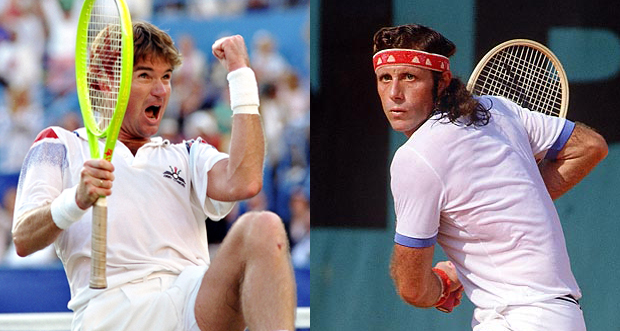
    Jimmy Connors Guillermo Vilas

    Open Era Natives
    Once we get to the generation of players born from 1949 to 1953, we are firmly in the Open Era. The oldest players of this generation were still teenagers when the Open Era began. Take generation elder statesman Manuel Orantes, born at the very beginning of the timespan in February of 1949: his first Slam was the 1968 Australian Open, the last of the amateur era.
    With apologies to Stan Smith, this generation also saw the first American superstar since Pancho Gonzales in Jimmy Connors. Pancho was the greatest tennis player of the 1950s but was past his prime and in his 40s when the Open Era began, although still ranking in the Top 10 as late as 1968. He played long enough to pass the baton to Jimmy Connors, their careers overlapping for a few years (more on that in a moment).

    [divider]

    Click here to discuss “Open Era Generations, Part Six: Gen 4 (1949-53) – It’s Jimmy’s Show” in the discussion forum.

    [divider]

    Best Players by Birth Year (Country, Slam Count)
    1949: Manuel Orantes (ESP, 1)
    1950: Adrian Panatta (ITA, 1), Phil Dent (AUS)
    1951: Roscoe Tanner (USA, 1), Eddie Dibbs (USA), John Alexander (AUS), Dick Stockton (USA)
    1952: Jimmy Connors (USA, 8), Guillermo Vilas (ARG, 4), Brian Gottfried (USA), Harold Solomon (USA), Wojtek Fibak (POL), John Marks (AUS), Kim Warwick (1952)
    1953: Raul Ramirez (MEX), Jose Higueras (ESP), Corrado Barazzutti (ITA)

    Discussion
    This generation, that owns a rather middle-of-the-road 15 Slam titles—the same as the previous generation—was dominated by hot-headed American Jimmy Connors, who was the first superstar that belonged entirely to the Open Era. In a way Jimmy had two careers, known equally for both: his peak in the 70s and his incredible longevity that saw his career stretch past two decades and into the 90s. Jimmy was a Top 10 player from 1973 to 1988, a remarkable span of 16 years. Only Andre Agassi has surpassed this span by a single year, from 1988 to 2005, although Andre dropped out of the Top 10 twice while Jimmy’s streak was unmarred (if you’re wondering, Roger’s streak is at 14, so will equal Jimmy if he remains in the Top 10 through 2017).

    I like to think of Guillermo Vilas as the gatekeeper to all-time greatness: if you’re better than Vilas, you’re a true all-time great. Vilas was in a way the Andy Murray of his era; he played alongside the peaks of better players like Connors, Borg, and then McEnroe and Lendl. Yet Vilas has a special record to his name: He still holds the most titles for a single year in the more fully documented ATP era (1973 to present), with 16 in 1977 (Rod Laver won 18 titles in 1969, the most in the Open Era). 1977 remains a controversial year as he finished No. 2 behind Connors in the ATP rankings, despite those sixteen titles and two Slams compared to Connors’ eight titles and zero Slams. It is the general consensus that Vilas had the better year and deserved the No. 1 ranking, but in a recent ruling the ATP decided not to reverse previous calculations, so Guillermo will remain the greatest player of the Open Era never to be ranked No. 1.

    The rest of the generation is not as well remembered, but includes some strong players, including the lone Italian Grand Slam winner of the Open Era, Adrian Panatta (who is also only one of two Italian Grand Slam winners in tennis history, along with two-time French Open champion Nicola Pietrangeli). Other Slam winners were hard-hitting Roscoe Tanner, whose 153mph serve in 1978 was the fastest recorded until Andy Roddick’s 155mph at the 2004 Davis Cup, and Manuel Orantes, who defeated a peak Connors at the 1975 US Open.

    Underachievers and Forgotten Players
    There’s no clear underachiever in this generation; no player who seemingly should have won more Slams, no Slam-less player who should have won one. That said, this category is also for forgotten players and I would like to mention Brian Gottfried, Harold Solomon, and Raul Ramirez as the “Slam-less three” of this generation – the three best players of this generation not to win a Slam. These three combined for 67 titles (or 25, 22, and 19, respectively), and 5 Masters equivalents among them. All three are among the twenty or so best Slam-less players of the Open Era; Gottfried could be in the Top 5.

    Did You Know?
    Jimmy Connors’ first final was at the age of 19 in the 1971 Los Angeles Open, equivalent to a Masters tournament today. His opponent? 43-year-old Pancho Gonzales, who beat Jimmy 3-6, 6-3, 6-3. They had actually played earlier that year at a lesser tournament, which Pancho also won.

    Top Ten Players of the Generation

    1. Jimmy Connors
    2. Guillermo Vilas
    3. Manuel Orantes
    4. Roscoe Tanner
    5. Brian Gottfried
    6. Harold Solomon
    7. Adrian Panatta
    8. Raul Ramirez
    9. Eddie Dibbs
    10. Jose Higueras

    Honorable Mentions: John Alexander, Phil Dent, Dick Stockton, Wojtek Fibak, Corrado Barazzutti.

    As with the generations before it, the top of the list is easy – no one would argue against Connors and Vilas, and Orantes is a pretty easy No. 3. Tanner gets the edge for No. 4 over Gottfried, Solomon, and Ramirez, but the “Slam-less Three” are relatively close – they were the Tomas Berdychs and Jo-Wilfried Tsongas of their era. I rank Adrian Panatta behind Gottfried and Solomon in a similar way that I will rank Marin Cilic behind Tsonga and Berdych (at least for now). While we all know that a single Slam title is more coveted than any number of lesser titles, when ranking overall career greatness, Slams titles must be contextualized with other factors—non-win Slam results, other titles, and rankings. Panatta simply wasn’t as good as the players ranked ahead of him. Dibbs and Higueras round out the Top 10.
  • Tennis Generations, Part Two: Before the Open Era

    Tennis Generations, Part Two: Before the Open Era

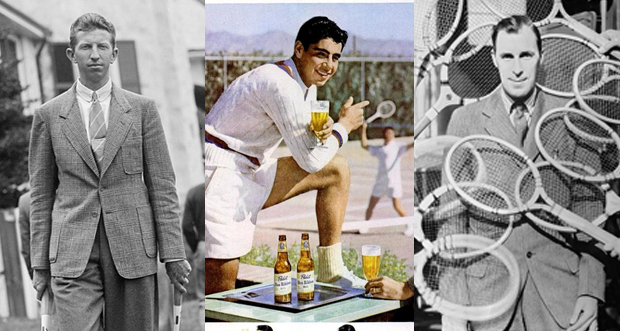
    Don Budge Pancho Gonzales Bill Tilden

    If we were to look at each tennis generation as a player with a count of Major titles—either pro, amateur, or Open Era Grand Slams—by far the greatest would be the generation born from 1934 to 1938, mainly on account of two players: Ken Rosewall and Rod Laver. This generation was, in many ways, the generation that brought tennis from the amateur/pro split into the modern Open Era in 1968.

    But tennis didn’t begin with this generation. Before focusing further on the First Generation of the Open Era, let’s take a brief look at what came before…

    Generations before the Open Era
    The oldest player in terms of birth year to win a Slam was John Hartley, born in 1849 – he won the third Wimbledon in 1879; the first Wimbledon in 1877 belongs to Spencer Gore, born a year later in 1850. This makes the first tennis generation of the entirety of its history being those players born in 1849-53, with possibly older players playing but none winning a major. Given that there were at least seventeen generations before Rosewall’s and Laver’s, this makes the current youngest generation–those players born 1994-98 like Nick Kyrgios, Borna Coric, and Alexander Zverev–the 30th five-year generation in tennis history. We are just starting to see players of the 31st generation, born in 1999-2003, appear deep in the rankings. As of this writing, the highest ranked player of Gen. 31 is No. 757, Felix Auger Aliassime, born in August of 2000.

    The main point here is that while modern tennis can be seen to have begun with the Open Era in 1968, it was actually past the mid-point of tennis history as a whole. Or to put that chronologically, we’re in the 48th year of the Open Era, which began in the 92nd year of Wimbledon, thus the Open Era began almost exactly two-thirds of the way into tennis history as a whole.

    I will not attempt to detail every generation, but thought it worthwhile to list some of the better players as they arrange within pre-Open Era generations, with their Slam title count—including Amateur and Pro—in parentheses:

    1849-53: John Hartley (2), Spencer Gore (1)
    1854-58: Frank Hadow (1)
    1859-63: William Renshaw (7), Richard Sears (7), Andre Vacherot (4), Henry Slocum (2), Ernest Renshaw (1)
    1864-68: Arthur Gore (3)
    1869-73: William Larned (7), Reginald Doherty (4), Paul Aymé (4), Robert Wrenn (4), Wilfred Baddeley (3), Oliver Campbell (3)
    1874-78: Lawrence Doherty (6), Norman Brookes (3), Malcolm Whitman (3)
    1879-83: Anthony Wilding (9), Max Decugis (8), Maurice Germot (3)
    1884-88: Rodney Heath (2)
    1889-93: Bill Tilden (15), Maurice McLoughlin (2), R Norris Williams (2), Robert Lindley Murray (2), Pat O’Hara Wood (2)
    1894-98: Jean Borotra (4), William Johnston (3), Gerald Patterson (3), James Anderson (3)
    1899-1903: Henri Cochet (11)
    1904-08: Frank Crawford (6), Rene Lacoste (7)
    1909-13: Fred Perry (10), Ellsworth Vines (8), Hans Nusslein (6), Adrian Quist (3), Gottfried von Cramm (2)
    1914-18: Don Budge (10), Bobby Riggs (6), Frank Parker (4), John Bromwich (2), Don McNeill (2)
    1919-23: Jack Kramer (5), Pancho Segura (4), Jaroslav Drobný (3), Vic Seixas (2), Ted Schroeder (2)
    1924-28: Pancho Gonzales (17), Frank Sedgman (7), Budge Patty (2), Dick Savitt (2)
    1929-33: Tony Trabert (7), Neale Fraser (3), Mervyn Rose (2), Nicola Pietrangeli (2)

    I tried to account for every Slam winner, although if I missed someone I apologize to their grand- or great-grandchildren.

    Top 10 Greatest Players Before the Open Era
    1. Pancho Gonzales
    2. Bill Tilden
    3. Don Budge
    4. Fred Perry
    5. William Renshaw
    6. William Larned
    7. Ellsworth Vines
    8. Anthony Wilding
    9. Henri Cochet
    10. Jack Kramer

    Honorable Mentions: Laurence Doherty, Bobby Riggs, Frank Sedgman, Reggie Doherty, Pancho Segura, Jack Crawford, Tony Trabert, Rene Lacoste, Hans Nusslein, Jean Borotra, Bill Johnston, Gottfried Von Cramm, Jaroslav Drobný, Vic Seixas, and many others.

    This is a hard list to compile, because it spans about a hundred years. But it is relatively easy to rank Gonzales and Tilden as No. 1 and No. 2, respectively, both being among the very best players in tennis history – on the short list of GOAT candidates. Tilden had a remarkable career that spanned three decades. He didn’t win his first Major until he was 27 years old, and won his last in his early 40s, making the 1945 US Pro semifinal at the age of 52. Pancho Gonzales remains one of the most underappreciated greats in the history of the game, perhaps largely because historical memory tends to be shallow and only notices “two Grand Slams” in his tally. But Gonzales also won 12 Pro Slams and 3 of the 4 Tournament of Champions, which are consider Majors by some – so he has a total of 17 Major titles, tied with Roger Federer and behind only Ken Rosewall and Rod Laver. He was, by a significant margin, the greatest player of the 1950s before Rosewall took over in the later part of the decade.

    Don Budge is perhaps best known as the only player other than Rod Laver to win the Calendar Slam. While he won all of his 10 Majors during a relatively short six-year span, he was as dominant in the late 30s as any player has ever been over a few-years span. Perry and Renshaw round out the Top 5, and then it becomes tricky to rank players, as the context of the game was so different and we can’t look at tennis records of, say, the 30s and 40s with the same criteria as we can the Open Era. But regardless, the above 10 are probably the 10 greatest players before the Open Era, with a handful of honorable mentions fleshing out the list.

    Up next, we’ll look at the great generation of players, born between 1934 and 1938, who dominated tennis from the late 50s into the early 70s, and the dawn of the Open Era.

    [divider]

    Cover Photo (Creative Commons License): boston_public_library / killingtime2 / boston_public_library

  • Open Era Generations, Part One: Introduction

    Open Era Generations, Part One: Introduction

    Open Era Generations 01 - Tennis Hall of Fame


    Preamble

    While I’ve followed tennis in a very casual way going back to vague memories of Bjorn Borg and John McEnroe, it is only in the last half decade or so that I’ve become a serious fan. I mark the beginning of my interest in tennis back to a vague memory of liking Bjorn Borg and disliking this new young upstart named John McEnroe who seemed to have his number. While I was only around seven years old at the time and cannot pinpoint the exact date, I imagine that this was due to either of McEnroe’s defeats of Borg at Wimbledon or the US Open in 1981. My favorite players in the 1980s and 90s were Ivan Lendl, Stefan Edberg, and Pete Sampras; I remember enjoying Edberg’s defeat of Jim Courier in the 1991 US Open, memorable because my friend and classmate (this was senior year in high school) had played with Courier and was cheering for the American.

    My tennis fandom remained casual until just a few short years ago. There isn’t an exact moment when I went from “casual” to “serious” fan, as it was a gradual transition over a year or two, but it happened sometime in the 2008 to 2011 range. While I had been a (casual) fan of Roger Federer, my all-time favorite player, since early on, it is interesting (for me, at least) to consider that during my tenure as a diehard tennis fan—someone who follows all of the big tournaments and some of the smaller ones—I have only really truly loved the game while my favorite player has been past his highest peak. In fact, it could be the legendary 2008 Wimbledon final that drew me into a greater interest in the sport, the match that saw the baton of greatest player passed from Roger to Rafa. So I cannot be accused of being a fair weather fan!

    Anyhow, the reason I offer an overview of my tennis biography is to lay the groundwork for what is to follow – to provide context and perhaps a sense of why I am writing what I’m writing, and why I write this blog at all, for that matter. It is simply this: I write these articles to share my own learning experience. I am very curious and autodidactic by nature and because I’ve only followed tennis closely for about half a decade, I am constantly researching this or that tidbit from the past. In a way I’m both trying to fill in my own limited (but growing) knowledge of the sport’s history, but also enjoy taking variant angles using statistical analysis to better understand the game. This blog is my sharing my journey with you, the reader.

    And now for the caveat: I am not a tennis player, not an expert on the game itself or its history. I am, first and foremost, a fan of the game. None of these statistics are meant to be definitive in any way; a common misunderstanding about statistical analysis in sports—particularly in baseball, if only because no other sport is as statistically analyzed (and fetishized) as baseball—is that statistical models and advanced metrics are somehow meant to replace firsthand knowledge of the game and/or be definitive. Now some “statnerds” might take this a bit too far, but for the most part it is generally understood that statistics are secondary and complementary to real knowledge of the game.

    That said, statistics have their uses and are neglected in the tennis world. There are a few pockets on the internet where tennis is analyzed statistically, but it is rare.

    [divider]

    Generation Theory
    So what’s this all about, you might be asking? Well, I’m going to be starting a series on tennis generations, using what I call “Generation Theory,” which is a tool or lens that is quite useful for understanding tennis history. The theory is based upon the idea that a generation is roughly five years in length, that once you have two players that are more than a few years apart they are of a different generation.

    This begs a couple questions: One, where to draw the line between generations? This is pretty arbitrary. At first I was going to use half-decades, neatly dividing each decade into two generations. But I soon found that it wasn’t the optimal way of grouping players. I then decided to use Roger Federer as a baseline. Federer was born in August of 1981, so I asked what would happen if we used him as the middle of a five-year generation? That made Generation Federer those players born between January 1, 1979, and December 31, 1983. This also lined up well with Rafael Nadal, born in May of 1986 — the midpoint of the next generation, 1984-88. It was almost too perfect, but what better two players to center Generation Theory on? I then went forward and back and found that players grouped well within those parameters, with few exceptions.

    Again, generational divisions are arbitrary. In this model Juan Martin del Potro and Kei Nishikori are of two different generations, which may seem strange considering that they were born in consecutive years; in this system, del Potro is of the same generation as Robin Soderling, who was born in 1984. We could look at “Generation del Potro” as being those players born within a couple of years of him, thus 1986-90. So in that sense we could use a five-year tennis generation: in a player-centered way, that is spreading out a five-year umbrella centered on an individual player’s birth-year, or in a static way, which is based upon Federer (and, conveniently enough, both Nadal and Pete Sampras) and spreading the generations out from there, each generation beginning with the year that ends with either a 4 or a 9 (e.g., 1974-78 and 1979-83). This series is based on the static approach, although at different times and in other articles I might use the player-centered approach.

    This series will be focused on the Open Era, beginning with the 1968 French Open, which has technically seen 16 different generations play in it. The oldest player that I could find who played in an Open Era Grand Slam was Pancho Segura, who was 49 years old when he played in the 1970 US Open. Segura, if you’re not familiar with him, is a lesser great of the 40s and 50s – who we could call “The Other Pancho” after the greater Pancho Gonzales. Segura had one of the longest careers in tennis history, being a top college player in the mid-1940s before going professional in 1947, and then playing his last professional singles match at the 1970 US Open, at 49 years old, although he played doubles until 1975 when he was 54 years old. A different era, no doubt!

    [divider]

    Thirteen Generations of the Open Era
    For the sake of this study, I am going to focus on those generations that made a significant impact in the Open Era. My criteria for the first generation will be a Slam title within the Open Era, which would be the great 1934-38 generation that included Ken Rosewall and Rod Laver, two of the very greatest players in tennis history. So 1934-38—bookended by Rosewall’s birth in 1934 and Laver’s in 1938—is the First Generation of the Open Era, with the youngest generation of players on tour born in 1994-98 the Thirteenth Generation (although as of this writing there are actually a few ranked players from the 1999-03 generation, including Canadian Felix Auger Aliassime ranked No. 751 as of August 24, 2015; Aliassime was born in August of…wait for it…2000).

    [divider]

    This Series
    After this introductory piece, each article will be dedicated to a different generation, with the first briefly discussing older generations and then focusing on the First Generation of the Open Era, those players born between 1934 and 1938. I will probably do a summarizing piece, so this means that this will be in fifteen parts and likely spread out over two or three months. It will be my intention to publish one or two articles a week, so stay tuned and I hope you enjoy joining me on my journey through the thirteen generations of Open Era tennis!

    Author Note (9/2/2015): I timed this series poorly, starting right before the US Open, so with my apologies I’ve decided to push it back until after the US Open is finished. Look for the next part in this series a day or two after the US Open finals. Best regards ~JN.

    [divider]

    Cover Photo (Creative Commons License): wallyg

  • National Tennis Careers – Part Six: Summing Up

    National Tennis Careers – Part Six: Summing Up

    Novak Djokovic Juan Martin del Potro Marin Cilic

    After surveying Open Era tennis through the five nations with the highest Slam totals, we’re left with a few questions and unexplored areas which I’ll try to tackle in this concluding segment.

    [divider]

    Click here to discuss National Tennis Careers – Part Six: Summing Up in the discussion forum.

    [divider]

    Who’s left?
    The “big five” tennis nations include many, even most, of the all-time greats of the Open Era. Let’s take a look at the other nations and their players by Slam count:

    Czechoslovakia/Czech Republic (12): Ivan Lendl (8), Jan Kodes (3), Petr Korda (1).
    Serbia (9): Novak Djokovic (9)
    Germany/West Germany (7): Boris Becker (6), Michael Stich (1)
    Argentina (6): Guillermo Vilas (4), Gaston Gaudio (1), Juan Martin del Potro (1)
    Russia (4): Yevgeny Kafelnikov (2), Marat Safin (2)
    Brazil (3): Gustavo Kuerten (3)
    Croatia (2): Goran Ivanisevic (1), Marin Cilic (1)
    Romania (2): Ilie Nastase (2)
    South Africa (2): Johan Kriek (2)
    United Kingdom (2): Andy Murray (2)
    Austria (1): Thomas Muster (1)
    Ecuador (1): Andres Gomez (1)
    France (1): Yannick Noah (1)
    Italy (1): Adriano Panatta (1)
    Netherlands (1): Richard Krajicek (1)

    Before Djokovic is through, Serbia’s Slam count should surpass that of the Czechs as a whole.

    Slavic Surge?
    I almost titled this last part “Slavic Surge!” because it would seem that the tennis from Slavic countries has been on the rise. But it wasn’t quite as extreme as I thought. There are some strong Slavic players currently in their peaks, namely Djokovic, Berdych, Cilic, and Karlovic. There are some younger players with some upside, including Damir Dzumhur (23, No. 100), Grigor Dimitrov (24, No. 16), and Jiri Vesely (22, No. 45). But there is only one player that looks like a potential future star, and that is the 18-year-old Croatian Borna Coric, who is currently ranked No. 37. So while Slavic tennis is strong, it is hardly dominant (Novak aside).

    Possible Future Slam Winning Countries
    So who might the next Slam winners be? Specifically, which countries have the most possible future Slam winners? Well, that is for a future study that I’m working on. But I will say that as we’ve seen in the previous segments, there isn’t much on the horizon for Spain or Switzerland, and only really the Ymer brothers in Sweden; in the US there are a few prospects, and Australia at least has “K&K”: Kyrgios and Kokkinakis.

    All in all there doesn’t seem to be a central location for tennis right now or the foreseeable future. We can sum up the Open Era by looking at early dominance by Australians, namely Ken Rosewall, Rod Laver, and John Newcombe, then the rise of Americans in Jimmy Connors and John McEnroe, and Sweden in Bjorn Borg, Mats Wilander, and Stefan Edberg. Along with German Boris Becker and Czech Ivan Lendl, Americans and Swedes dominated tennis from the mid-70s into the early 90s, with Sweden dropping off as Edberg retired, but the United States remained dominant into the 21st century, led by Pete Sampras and Andre Agassi. But then the US dropped off precipitously, and Switzerland and Spain took up the rulership of men’s tennis, with Serbia playing its part.

    What the future will bring, well, it is a truly global world out there. There’s no sign of any of the five great tennis nations regaining their dominance. There are some glimmerings of improvement in Australia, and a bit in the US, but nothing substantial or worthy of the term “future dominance.” We’re going to see a shared effort, it would seem.

    [divider]

    Cover Photo (Creative Commons License): kulitat / mirsasha / Kiu Kaffi

  • National Tennis Careers – Part Five: Switzerland

    National Tennis Careers – Part Five: Switzerland

    Roger Federer Stan Wawrinka

    The Maestro, Stan, and Some Other Guys

    When I began this series I was curious about Swiss tennis before Roger Federer took the tennis world by storm; I wondered whether there was some hidden jewel in the past who went under the radar due to lack of Slam wins but perhaps still had a strong career, perhaps the Swiss version of an Alex Corretja or Thomas Enqvist? Well, the simple answer is this: No, there wasn’t. There are a couple players who had decent careers, but really Swiss tennis began with Roger. And then Stan. And then…well, that’s about it.

    Let’s take a look at the Swiss tennis career:

    Switzerland Career

    That’s a pretty extreme picture. Consider that no Swiss player reached the 4th round of a Slam in the first ten years of the Open Era — not until Colin Dowdeswell made the 4th round of the US Open in 1978, defeated by a teenage John McEnroe. But even Dowdeswell was English-born, playing for Switzerland from 1977-81.

    Fast forward to 1985 and we have the first appearance by a Swiss player in a Slam quarterfinal in the Open Era, one Heinz Günthardt, who also appeared in the US Open quarterfinal that year, but never another Slam quarterfinal.  Günthardt won five career titles and had a career high ranking of No. 22; he was a better doubles player, with 30 titles to his name and a career high ranking of No. 3.

    1991 saw Jakob Hlasek reach the French Open quarterfinal where he was defeated by a 21-year-old Andre Agassi, and then five years later Marc Rosset reached the semifinal of the French Open where he was defeated by Michael Stich. Rosset also reached the quarterfinal of the 1999 Australian Open.

    So before Roger Federer, in the Open Era Swiss players only reached one semifinal and four quarterfinals.

    For those of us looking back, it is easy to forget the impact that Roger Federer had on the tennis world. He was a strong junior player, winning the 1998 US Open Junior final and ending the year with the No. 1 junior world ranking. His first professional tournament was also in 1998: Gstaad, where he lost in the first round to No. 88 Lucas Arnold Ker. To put that in historical context, Roger’s first pro tournament was when Bill Clinton was in the White House, Boris Becker was still playing tennis (he lost in that Gstaad final to Alex Corretja); it was also Pete Sampras’s last year as No. 1. Saving Private Ryan, There’s Something About Mary, and The Big Lebowski were in the movie theaters. In other words, it was a long time ago!

    A lot has been written about Federer elsewhere so I won’t go into too much detail, but over the next five years he gradually worked his way up, entering the Top 100 in 1999, then perhaps really gaining attention when he defeated a declining No. 6-ranked Pete Sampras in the 4th round of the 2001 Wimbledon. We didn’t know it at the time, but it was the passing of the baton from the only two seven-time Wimbledon champions (well, along with William Renshaw in the 19th Century). 2002 saw Federer enter the Top 10 and win his first Master’s, but it wasn’t until 2003 when he was almost 22-years-old that Federer won his first of seventeen Slams and the first of seven Wimbledon titles. He then proceeded to win 12 of the next 18 Slams, including all but five in the four years from 2004-07. It was a level of dominance not really seen in the Open Era.

    Roger’s reign was tarnished only by a young Spaniard named Rafael Nadal, who repeatedly kept him from winning the French Open and had the match-up edge overall. The baton was finally passed in 2008, a year that saw Roger suffer from mononucleosis. Roger regained the No. 1 ranking in 2009, but lost it again in 2010 and only gained it back for a short period in 2012. We can see now that Roger’s peak lasted from late 2003/early 2004 to early 2010, and he has been one of the two or three best players in the sport from 2003 to the present day – thirteen years of incredible consistency and elite performance perhaps unequaled in Open Era history.

    Five Greatest Swiss Players of the Open Era
    1. Roger Federer
    2. Stan Wawrinka
    3. Marc Rosset
    4. Jakob Hlasek
    5. Heinz Günthardt

    No. 1 and No. 2 are easy. Even before Stan’s rise to the top over the last few years, he’d probably rank as No. 2 – or at least similar to Rosset and Hlasek. But Wawrinka has been somewhat of a meteor recently, winning the two Slam finals he’s been in — over Nadal and Djokovic no less. He is 30 years old but shows no sign of declining. After that Rosset and Hlasek are close, but Rosset has eight titles to Hlasek’s two, although Hlasek’s Slam results and ranking history are slightly better, but just slightly. The two are very close. Gunthardt is a solid No. 5, and then there’s a huge drop-off.

    After those five, there really are no significant Swiss players in the Open Era. George Bastl was not a great player by any means, with a career high ranking of No. 71. But he is known for one thing: defeating Pete Sampras in the first round of the 2002 Wimbledon, one of the greatest upsets in Slam history. There are a few others: Claudio Mezzadri, Roland Stadler, Marco Chiudinelli, and others – but few even broke into the Top 50, and other than the five listed above, as far as I can tell only Mezzadri won a  tournament.

    The Future
    As with Spain, there really are no Swiss prospects on the horizon. After Federer and Wawrinka, the next highest ranked Swiss is 23-year-old Henri Laaksonen who is ranked No. 289. There are no Swiss teenagers in the Top 1,000 players, with 20-year-old Enzo Sommer being the youngest in the Top 1000 (No. 929). The point being, there is no one on the horizon to replace Federer and Wawrinka once they’re gone.

    And when will they be gone? Roger turns 34 in a few weeks, and Wawrinka turned 30 earlier this year. Wawrinka should be around at least for another couple years, if not longer. Roger, despite no longer being the player he was five or six years ago, is still ranked No. 2 in the world. He will seemingly play as long as he wants to, as long as he takes joy in playing. He is already approaching Andre Agassi longevity; Agassi remained an elite player through 2005, the year he turned 35, and retired in 2006; the equivalent to Federer of Agassi’s 2005 would be next year, 2016. Jimmy Connors is another comparable player in terms of possible longevity; Federer’s current year is, age-wise, equivalent to Connors’s 1986; Jimmy would have two more years in the Top 10, 1987-88, and of course had that semifinal run at the 1991 US Open just a bit shy of his 39th birthday.

    Yet while Roger seems immortal, at some point he’s probably going to slip enough that he won’t want to play anymore. I suspect that we have at least through next year of Roger playing at a high level, and maybe a year or two beyond that. But who knows? What we do know is that Roger is still here, and we should enjoy him while we can.

  • National Tennis Careers – Part Three: Spain

    National Tennis Careers – Part Three: Spain

    Sergi Bruguera Juan Carlos Ferrero Rafael Nadal Carlos Moya

    Rafa & The Conquistadores

    Among the five greatest tennis nations in this series, Spain and Switzerland share something in common: they are completely dominated by a single player, one who is head and shoulders above the rest of the field. These two players will be forever linked, not only as two of the greatest ever to play the game, but because of their evocative (albeit lopsided) rivalry.

    [divider]

    Click here to discuss “National Tennis Careers – Part Three: Spain” in the discussion forum.

    [divider]

    Before getting to Rafa, let’s look at Spanish tennis before the King of Clay. Before the Open Era, only three Spanish players appeared in Slam finals, Pro or Amateur: Manuel Santana, Andres Gimeno, and Juan Gisbert Sr. The first two are well known as top players of the 1960s, but Gisbert Sr is not so well known – he lost to William Bowrey in the 1968 Australian Open final, the last Slam before the Open Era began. Santana won four Amateur Slams in the 1960s and was ranked No. 1 among Amateurs in 1966 when he won Wimbledon, but never entered the professional circuit, so didn’t play the top players in the game.

    Andres Gimeno was one of the best players from the 60s that wasn’t Australian. He had a long career, beginning as an amateur in 1956, turning pro in 1961, and playing until 1973. While he never won a Pro Slam, he played in four finals – losing to Rod Laver three times, Ken Rosewall once. He is perhaps best known for winning the 1972 French Open at the ripe age of 34.

    Spanish tennis became stronger during the Open Era, but didn’t see its first truly great player until Rafael Nadal emerged from the clay of Manacor, fully formed like some Mediterranean deity. Let’s take a look at the Open Era Slam record:

    Spain Career

    As you can see, before Nadal seven Slams were won by Spanish players: one each by Gimeno, Manuel Orantes, Albert Costa, Carlos Moya, and Juan Carlos Ferrero, and two by Sergi Bruguera. The weakest era for Spain was the 1980s, after Manuel Orantes retired, but then picked up in the 90s with Bruguera, then later Moya and Ferrero, among others. It is also worth noting that of the seven Spanish Slam winners of the Open Era, only Orantes and Nadal won Slams on a surface other than clay.

    Ten Greatest Spanish Players of the Open Era
    1. Rafael Nadal
    2. Manuel Orantes
    3. Juan Carlos Ferrero
    4. Carlos Moya
    5. Sergi Bruguera
    6. David Ferrer
    7. Andres Gimeno
    8. Alex Corretja
    9. Albert Costa
    10. Tommy Robredo

    Honorable Mentions: Jose Higueras, Emilio Sanchez, Felix Mantilla, Carlos Costa, Albert Berasategui, Francisco Clavet, Feliciano Lopez, Fernando Verdasco, Nicolas Almagro, Albert Portas, Juan Aguilera.

    Number one is easy, but after that it gets really dicey. Orantes, Ferrero, Ferrer, Moya, Bruguera, and Gimeno could be ranked in any number of ways. Gimeno would probably be second if we counted his whole career, but his Open Era career wasn’t as impressive as the others. Albert Costa is, along with Thomas Johansson and Gaston Gaudio, a one-Slam wonder who benefited from playing in the weak early years of the 21st century. Alex Corretja is among the better players never to win a Slam – along with later countryman David Ferrer.

    Spanish tennis has been strong over the last ten years, although with one player dominating. But David Ferrer, Feliciano Lopez, Tommy Robredo, Fernando Verdasco, and Nicolas Almagro have all had very good careers.

    A bit on Rafael Nadal. There is little doubt that he is the most dominant clay court player in the history of the game, and there has been no harder task than beating Rafa at Roland Garros where he holds a 70-2 record. Rafa was the clear World No. 2 for 2005-07 but then stole not only Wimbledon but the No. 1 ranking from Roger Federer in 2008. He has struggled with injury through much of his career, so there’s an element of “what if” to Rafa’s career. Some say that if he had been healthy he’d have surpassed Federer’s Slam count by now, while others say that we cannot separate Rafa’s penchant for injury from his greatness due to his style of play. Either way, his record is what it is: Regardless of what his future accomplishments might be, right now he is one of the greatest players in tennis history.

    The Future
    Troubled times may be ahead for Spain. Consider the Spanish players current (as of July 6) in the Top 100 with their ages:

    7. David Ferrer (33)
    10. Rafael Nadal (29)
    16. Feliciano Lopez (33)
    19. Tommy Robredo (33)
    22. Roberto Bautista Agut (27)
    32. Guillermo Garcia-Lopez (32)
    37. Pablo Andujar (29)
    43. Fernando Verdasco (31)
    63. Daniel Gimeno-Traver (29)
    65. Albert Ramos (27)
    67. Pablo Carreno Busta (23)
    72. Marcel Granollers (29)

    Notice something? Nine of the twelve players are 29 or older. We could chalk this up to the way of things these days, but there’s a disturbing lack of young players on that list. In other words, of those twelve players only Carreno Busta and possibly Bautista Agut and Ramos have room to improve, however none of them are likely to be future elite players.

    There is also the question of Rafa’s decline. Clearly he is not the player he was in 2008-13, his peak range. Rafa has a tendency to play well, get injured, then surge back to the top again – a cycle that has repeated itself a few times. But this latest round hasn’t seen a surge (yet), and we’re now almost eight months from his appendicitis surgery. Does Rafa have another surge him? Who knows? Many, including myself, have long speculated that when the end comes for Rafa it will come quickly. But I, for one, am not ready to relegate him to the history books. Not yet. I doubt we’ll see another 2013, but we could see a lesser version.

    But other than the players listed above, is there a future for Spanish men’s tennis? Let’s take a look at the youth.

    Highest Ranked Player By Age
    23: Pablo Carreno Busta (No. 67)
    22: Roberto Carballes Baena (No. 169)
    21: David Perez Sanz (No. 305)
    20: Albert Alcaraz Ivorra (No. 481)
    18/19: Jaume Munar (No. 690)
    17: Carlos Taberner (No. 970)

    So consider that – the highest ranked Spanish teenager is No. 481 in the world. Even the United States has three teenagers ranked higher. History has shown us that great players are usually pretty good while still in their teens – meaning in or near the Top 100 – and there’s no player even close to that. Even if we say that players are starting their peaks more in the 23-25 range rather than 20-22, as in the past, there’s no young Spanish player who looks to be on the trajectory for greatness. Surprise weather patterns happen, but the forecast as of right now is not positive for Spanish men’s tennis – at least not over the next few years. What we are likely going to see is a gradual and then quick diminishing of Spanish tennis as Nadal, Ferrer, Lopez, Verdasco, Robredo, and Almagro all fade away and then retire, with perhaps only Bautista Agut and Carreno Busta carrying the torch as Spanish players in the Top 20-30 range in a few years time. Whether they can carry that torch long enough to pass to the next great Spaniard remains to be seen.

    [divider]

    Cover Photo (Creative Commons License): bourgol / Carine06 / Marianne Bevis / conson

  • National Tennis Careers – Part Two: Sweden

    National Tennis Careers – Part Two: Sweden

    Stefan Edberg Bjorn Borg Mats Wilander

    ONCE UPON A VIKING…

    Of the five great tennis nations covered in this series, three are no longer what they were: the United States, Australia, and Sweden. Whereas American dominance spread out over the majority of the Open Era in two great, interconnected eras, Swedish dominance was comparatively short – but equally dominant, at least for a time. It started with the rise of Bjorn Borg, who won his first major in 1974 and became the game’s top player by 1978, and ended with Stefan Edberg’s last Slam title in 1992. Outside of that range, only one Slam title belongs to a Swede: quintessential one-Slam wonder Thomas Johansson’s Australian Open in 2002.

    Let’s take a look at the Swedish career:

    Sweden Career

    As you can see, I split the chart differently than with the United States. The top chart includes the careers of Borg and Wilander, and ends with the last Slam won by Edberg. The bottom half sees the swift decline of Swedish tennis, with that lone major title in 2002.

    Swedish tennis was almost entirely ruled by three players: Bjorn Borg, Mats Wilander, and Stefan Edberg who, together, account for 24 of the 25 Slams. But they weren’t the only talented players during the 1980s in particular. Henrik Sundstrom, Anders Jarryd, Joakim Nystrom, and Mikael Pernfors all finished in the Top 10 at least once. Once we get to the 1990s we have players like Thomas Johansson, Magnus Gustafsson, Magnus Larsson, Jonas Bjorkman, Magnus Norman, and Thomas Enqvist.

    In the early 2000s, several promising young Swedes emerged: Andreas Vinciguerra, Joachim Johansson, and Robin Soderling. Vinciguerra is a name that you might not know, but he came of age around the turn of the millennium with other promising players born in the early 80s. If you look at the 1999 rankings, there were five teenagers who finished the year in the Top 100: Marat Safin (No. 24), Lleyton Hewitt (No. 25), Juan Carlos Ferrero (No. 42), Roger Federer (No. 64), and Vinciguerra (No. 98). Whereas the other four went on to win Slams and be No. 1s, Vinciguerra—still on pace to be a great player in 2001, rising as high as No. 33 at the age of 20—saw his career derailed by a back injury.

    [divider]

    Click here to discuss “National Tennis Careers – Part Two: Sweden” in the discussion forum.

    [divider]

    Similarly, Joachim Johansson rose as high as No. 9 and finished 2004 at No. 11 at the age of 22, but struggled with a shoulder injury and eventually retired in 2008. We are all more familiar with Soderling, who is one of only two men to defeat Rafael Nadal at Roland Garros, and unlike Novak Djokovic this year, Rafa was in his prime in 2009. From 2009 into 2011, Soderling was lingering on the edge of the Big Four, but was hit by mononucleosis and hasn’t played since late 2011, although has not officially retired. So in the post-Edberg/Wilander world of Swedish tennis, Thomas Johansson’s Australian Open title in 2002 was a lone bright spot, with lesser glimmers of unfulfilled promise by several Swedes in the last fifteen years.

    Ten Greatest Swedish Players of the Open Era
    1. Bjorn Borg
    2. Stefan Edberg
    3. Mats Wilander
    4. Thomas Enqvist
    5. Thomas Johansson
    6. Robin Soderling
    7. Jonas Bjorkman
    8. Magnus Norman
    9. Anders Jarryd
    10. (tie) Joakim Nystrom and Magnus Gustafsson

    Honorable mentions: Magnus Larsson, Jonas Svensson, Henrik Sundstrom, Mikael Pernfors, Kent Carlsson, and Joachim Johansson.

    The top three are not really debatable, although some would quibble with ranking Edberg over Wilander. Wilander had a higher peak, namely the 1988 season, and of course has one more Slam than Edberg. But both made 11 Slam finals, Edberg just lost one more, and this is more than balanced out by Edberg’s five more Semifinals and much greater consistency in the rankings. Wilander had one year-end No. 1 ranking, Edberg two; Wilander had seven to Edberg’s ten Top 10 rankings and eight to Edberg’s thirteen Top 20 rankings.

    There’s a big drop after the Tre Stora, and here is where the debate can come in. The system I used likes Enqvist quite a bit better than the rest, but some would prefer Thomas Johansson’s Slam title or Robin Soderling’s higher peak. Certainly if Soderling hadn’t gotten mono he’d probably be fourth on this list. Some might also prefer Jonas Bjorkman at fourth, who like Anders Jarryd was a No. 1 ranked doubles player, but it is hard to argue with Enqvist’s 19 titles versus Bjorkman’s six. Jarryd, Norman, Nystrom, and Gustafsson are almost too close to rank.

    The Future?
    Consider that since 2008, Robin Soderling has been the only Swede ranked in the year-end Top 100. Yes, that’s right. Since 2012 there have been no Swedes in the Top 100.

    But there’s hope, and his name is Elias Ymer. He’s 19 years old and as of this writing, currently ranked No. 130. Interestingly enough, Ymer isn’t your typical blond-locked Scandinavian; he’s of Ethiopian descent. Along with 23-year-old Christian Lindell (No. 188), he’s the only Swede ranked in the Top 400. Elias’ 16-year-old brother, Mikael, is also worth storing in your memory banks, but he’s a long ways off.

    Elias Ymer qualified for his first Slam main draw at Roland Garros this year, losing to Lukas Rosol in straights in the first round. Yet here is something promising: at the ATP 500 Barcelona, he beat Thiemo de Bakker and Nick Kyrgios before losing to David Ferrer in the round of 16. Kyrgios, No. 41 at the time, remains the highest ranked player he has defeated.

    So Ymer bears watching, although we should temper our expectations – there is no new Swedish golden age of Borg, Wilander, and Edberg on the horizon, but at least there’s someone. According to Magnus Norman, Swedish tennis has reached rock bottom and can only go up. Truly, there’s nowhere else it can go.

    [divider]

    Cover Photo (Creative Commons License): Carine06 / MadMarlin / Carine06

  • National Tennis Careers – Part One: United States

    National Tennis Careers – Part One: United States

    Jimmy Connors John McEnroe Pete Sampras

    Introduction to the Series

    Imagine if each country had a tennis career. Rather than individual players, you have nationalities; rather than an individual career, you have a national one. As a thought experiment, I decided to compile the top Slam-winning countries in Open Era history, from the 1968 French Open to the 2015 French Open. How would these “national careers” look, as if they had careers spanning 48 years? What would their stories be? I looked at and compiled the best results from players of a given nationality, created a “national career chart” for the Open Era, and in doing so gained a deeper understanding of the history of men’s tennis. I’d like to share that research and understanding with you.

    For this exercise I looked at the top five nations by Open Era Slams: The United States (51), Sweden (25), Spain (21), Australia (20), and Switzerland (19). Beyond those five, only Czechoslovakia/Czech Republic has double digits (12); Serbia (8), Germany (7), Argentina (6), Russia (4), and Brazil (3) all have more than two. The countries with two are Croatia, Romania, South Africa, and the United Kingdom; the countries with one are Austria, Ecuador, France, Italy, and the Netherlands.

    This will be a six-part series, the first five articles covering the “Big Five” tennis nations, and the sixth part being a summarization, with a look at recent years and some thoughts about the game going forward. Look for further installments every few days to a week through June and July.

    In each article I will briefly overview the trajectory of the nation during the Open Era, looking at the top players and compiling a Top 10 list for each nation. For these lists I am using a statistical system that takes into account Slam results, titles, and rankings. For the most part I am faithful to the system, although in one or two cases I add a subjective element – usually as a tiebreaker. Also, for these lists I am including some players who played before the Open Era, but only those players that played a significant portion of their careers in the Open Era. Finally, I will look at the current national players, including a glimpse at any potential up-and-comers.

    On to the New World…

    PART ONE: THE UNITED STATES

    RISE AND FALL OF THE AMERICAN EMPIRE

    The United States is the greatest tennis nation of the Open Era–actually, tennis history as a whole–and it isn’t particularly close: With 51 Slam titles during the Open Ea they have more than any other two nations combined, and include greats and multi-Slam winners such as Pete Sampras (14), Andre Agassi (8), Jimmy Connors (8), and John McEnroe (7), as well as lesser greats such as Jim Courier (4), Arthur Ashe (3), Stan Smith (2), and single Slam winners Roscoe Tanner, Vitas Gerulaitis, Brian Teacher, Michael Chang, and Andy Roddick.

    Now let’s take a look at the performance timeline:

    Screenshot from 2015-06-10 13:42:35

    As you can see, there’s a build-up in the early years of the Open Era with Stan Smith and Arthur Ashe being among the best players in the sport, that blossomed with the first great American phase of Jimmy Connors and John McEnroe, who together won 15 Slams between 1974 and 1984.

    After that there was a lull in the mid-to-late 80s as Connors and McEnroe declined, until Michael Chang won his lone Slam in 1989, the harbinger of the second great American era of Courier-Sampras-Agassi that dominated the 90s and into the new century. Finally we have a last gasp in 2003, with Agassi winning the Australian Open and Andy Roddick winning the US Open, and decline since then. Roddick retired in 2012 as the last Slam-winning American. His last Slam final appearance was the epic 2009 Wimbledon, and since then an American has only reached the second week of a Slam three times.

    Top 10 Americans of the Open Era

    1. Pete Sampras
    2. Jimmy Connors
    3. John McEnroe
    4. Andre Agassi
    5. Arthur Ashe
    6. Jim Courier
    7. Andy Roddick
    8. Stan Smith
    9. Michael Chang
    10. Vitas Gerulaitis

    Honorable Mentions: Roscoe Tanner, Brian Gottfried, Harold Solomon, Todd Martin, Eddie Dibbs, Cliff Richey, Brad Gilbert, Aaron Krickstein, Brian Teacher, Tim Mayotte, Gene Mayer, Bob Lutz, Jimmy Arias, Marty Riessen, Eliot Teltscher, Tom Gorman, James Blake, Steve Denton, MaliVai Washington, Bill Scanlon, Dick Stockton, Tim Gullikson, Mel Purcell, Mardy Fish, John Isner.

    Determining the Top 10 greatest American players was relatively easy as there is a drop-off from Gerulaitis to the rest of the pack. That said, the Americans are so strong that there are several players not in the Top 10—namely Tanner, Gottfried, Solomon, and Martin—that would be in the Top 10 of any other nation, with the possible exception of Spain.

    Clearly the Top 4 are relatively easy, although some might quibble about the order of Connors, McEnroe, and Agassi. But using my system, Connors is actually closer to Sampras than he is to the rest, while McEnroe just edges Agassi. Further down we become more controversial. Courier had a higher peak than Ashe, but Ashe was good for so long; those two are also very close, but the edge goes to Ashe. Roddick, Smith, and Chang are also very close and most might rank Smith higher than Roddick due to his better peak, but I ranked them according to my system, which acknowledges that despite being dominated by Roger Federer, Roddick was still one of the best players in the sport for a decade. Finally, Gerulaitis is a big step behind the first nine, but even further ahead of No. 11 (Roscoe Tanner).

    Pre-Open Era Greats
    American greatness in men’s tennis did not start with Jimmy Connors, or even his precursors, Arthur Ashe and Stan Smith. While this series focuses on the Open Era, it would be remiss on my part not to mention some of the best players before the Open Era: Bill Johnston, Bill Tilden, Ellsworth Vines, Don Budge, Jack Kramer, Tony Trabert, Bobby Riggs, Pancho Segura, Vic Seixas, and Pancho Gonzales. Tilden, Gonzales, and Budge are probably all among the dozen or so greatest players in tennis history, with Vines, Kramer, and Riggs not too far behind.

    Pancho Gonzales in particular remains one of the most underrated all-time greats, perhaps mainly because he only won two Grand Slams. But he also won 12 Pro Slams and the Tournament of Champions three times, so essentially has 17 Majors to his name – as many as Roger Federer, and more than any player other than Ken Rosewall and Rod Laver. Gonzales was almost certainly the greatest player of the 1950s, just as Rod Laver was of the 1960s (with Ken Rosewall bridging the two decades as second fiddle to both). I place Gonzales, Tilden, and Sampras as the Trinity of greatest American tennis players, with Budge, Connors, McEnroe, and Agassi after them, then Vines, Kramer, Trabert, Riggs, Segura, Seixas, Ashe, and Courier following in some order.

    But the key here is to get a sense that American greatness in men’s tennis goes back virtually to the beginning of the sport. Richard Sears won the first seven US Opens, from 1881 to 1887, although it wasn’t until 1908 that an American won a Slam outside of the US–John Alexander at the Australian Open–and not until 1920 when an American first won Wimbledon, the great Bill Tilden. The first American to win the French Open was Don Budge in 1938. The United States remained dominant through the 1950s, until a pair of Aussies led the way for dominance from Down Under…but more on that in a later installment.

    Will the Empire Rise Again?
    Other than Roddick, American tennis has been slim since the retirement of Andre Agassi. Consider also that in 1990 fully 35 of the Top 100 were Americans; today it is only six, and none in the Top 10. Players such as James Blake, Mardy Fish, and John Isner have been decent but unremarkable. Some players such as Donald Young, Sam Querrey, and Ryan Harrison have displayed varying degrees of promise but have all disappointed in different ways.

    What about the future? Is there any hope? First of all, let’s look at the Americans currently in the Top 100, as of June 8:

    18. John Isner (30)
    31. Jack Sock (22)
    39. Sam Querrey (27)
    51. Steve Johnson (25)
    57. Donald Young (25)
    72. Tim Smyczek (27)

    Given their ages, the only player who looks to have solid upside is Jack Sock, who is memorable for his solid run at Roland Garros this year, defeating Grigor Dimitrov, Pablo Carreno Busta, and Borna Coric before being defeated by Rafael Nadal in the fourth round. While it seems unlikely that Sock will become an elite player, he at least seems like a probable Top 20 regular, and perhaps could challenge for a spot in the Top 10. But it seems very unlikely that Sock will rise above the level of Fish, Isner, and Blake.

    What about younger players? Beyond the Top 100 there are two that are especially worth taking note of: 18-year-old Jared Donaldson, currently ranked No. 152, and 17-year-old Francis Tiafoe, ranked No. 279. Clearly these two are a long ways from making a mark, but Donaldson is just around the corner, and Tiafoe has only just gone pro and is showing promise. Keep your eyes on these two. Also on the radar is 21-year-old Bjorn Fratangelo, ranked No. 144 – but he needs to move fast if he’s going to make his mark.

    Summation
    American men’s tennis clearly saw its golden age from the early 70s to the early 00s, but has really been in a slump for over a decade now. While it may be that American tennis will never regain its glory, it is worth mentioning that there have been slumps before. After dominance in the 1930s to 50s, from Bill Tilden to Pancho Gonzales, the Australians took the mantle during the late 50s and 60s before Ashe and Smith, and then more fully Jimmy Connors, took it back in the 1970s. Yet unlike that era, when fading great Pancho Gonzales played long enough–into his mid-40s–to see Jimmy Connors emerge, there are no elder statesmen to pass the mantle – Agassi is ten years gone; even lesser great Andy Roddick has been gone for almost three years now (can you believe it?).

    So it seems that we’re left with a moderate view: that American tennis will probably not return to its dominant position in the sport any time soon, but that better days are ahead.

    [divider]

    Cover Photo (Creative Commons License): robbiesaurus / bootbearwdc / craigoneal