A few years ago I wrote a couple blog articles on the sad state of American tennis, one a bit more straightforward—Houston, We Have a Problem—and one a bit more mythological: American Men’s Tennis and the Cycle of Ages. At the time of those writings, August of 2013, there wasn’t a lot to be excited about. Andy Roddick had retired and the last truly great American men’s player, Andre Agassi, had retired in 2006. The top American players at the time of the former article were (with their ages at the time in parentheses):
14. John Isner (28)
29. Sam Querrey (25)
87. Jack Sock (20)
92. Michael Russell (35)
97. Ryan Harrison (21)
100. James Blake (33)
Sock and Harrison looked vaguely promising, but Harrison (now 24) continued to stagnate and is ranked #90, and Sock (now 23) slowed his development and seems to have peaked as a top 20-30 type.
Here’s an update, the 2016 year-end top 100 Americans:
19. John Isner (31)
23. Jack Sock (24)
31. Sam Querrey (29)
33. Steve Johnson (26)
76. Taylor Fritz (19)
88. Donald Young (27)
90. Ryan Harrison (24)
As you can see, it doesn’t look much better than three years ago. Isner remains the top American and he’s just barely hanging on to a top 20 ranking. There’s a bit more meet in the middle, with four Americans in or close to the top 30, where three years ago there were only two. And there’s Fritz, who is the brightest young American player in years. On the surface it looks like Sock was only a year older but ranked similarly to Fritz, but in actuality he was almost two years older, so Fritz’s ranking is far more impressive.
But the top 100 only tells part of the story. Let’s compare the top ranked Americans age 21 and under in 2016 with those in the year-end in 2013:
2013
100. Ryan Harrison (21)
102. Jack Sock (21)
114. Denis Kudla (21)
306. Bjorn Fratangelo (20)
437. Christian Harrison (19)
476. Mitchell Krueger (19)
573. Marcus Giron (20)
594. Evan King (20)
2016
76. Taylor Fritz (19)
105. Jared Donaldson (20)
108. Frances Tiafoe (18)
116. Stefan Kozlov (18)
141. Ernesto Escebedo (20)
198. Michael Mmoh (18)
200. Noah Rubin (20)
204. Reilly Opelka (19)
I picked eight players for each to give a sense of the depth of 2016’s field. As you can see, there is much more to be excited about now than there was three years ago. Looking solely on my “Pace of Greatness” theory, Fritz and Tiafoe have already accomplished the first benchmark: ranking in the top 100 as 18-year olds. Kozlov is very close, and Mmoh has an outside chance. But the main point is that even if none of these eight players become true greats, there is a lot more talent there than in 2013.
https://www.youtube.com/watch?v=iciaF8VryAU
Let’s go back a bit further. Starting in the late 90s and into the early 00s, there was a talented group of young Americans: James Blake, Andy Roddick, Taylor Dent, Mardy Fish, and Robby Ginepri. Ginepri and Dent had decent but unspectacular careers: Ginepri won an ATP 500 and reached the 2005 US Open semifinal, ranking as high as #15, and Dent won four titles and ranked as high as #21. Fish was better, finishing 2011 #8 in the world and reaching several Slam quarterfinals and Masters finals, but never winning more than an ATP 250 level tournament (he won six); his career was marred and shortened by a heart condition. Roddick was a Slam winner and #1, and perhaps the player who suffered most from Roger Federer’s dominance. James Blake had some good years, peaking in his late 20s, and was probably slightly better than Fish, and thus the distance second behind Roddick among this group.
After the group who came of age in the early 2000s, you get to players like John Isner, Sam Querrey, Brian Baker, and Donald Young. Isner is the best of the bunch, a third tier player who has spent many years in the top 20 but only just barely sniffed the top 10. Querrey is something of a disappointment, looking promising in his early 20s but stagnating; Baker never amounted to much, and the fact that I used Young as the emblematic player of the generation of players born from 1989-93 should speak volumes. I think we can safely say that the current crop of young Americans is the best such group that we’ve seen in at least fifteen years.
Going back before Roddick’s era, the mid-to-late 90s also didn’t see much in the way of American talent, with players like Vince Spadea, Jan-Michael Gambill and Justin Gimelstob being the top ranked young Americans. Gambill and Spadea were solid players who spent some time in the top 20, but never in the top 10 or with major titles.
We have to go all the way back to the early 90s to find a generation of truly great young Americans. Check out the American men age 21 and under in the top 100 in 1990:
1990
4. Andre Agassi (20)
5. Pete Sampras (19)
15. Michael Chang (18)
25. Jim Courier (20)
27. David Wheaton (21)
93. MaliVai Washington (21)
Sampras and Agassi are, along with Jimmy Connors and John McEnroe, two of four truly great American men’s players of the Open Era. Jim Courier won four Slams and remains the youngest player (at age 22 years and 11 months) to have appeared in the finals of all four Slams, and was #1 for 58 weeks; Michael Chang was also a Slam winner and perennial top 10 player, with 34 titles and 7 Masters to his name. Even David Wheaton won the prestigious Grand Slam Cup title and ranked as high as #12, and Washington is known for his run at the 1996 Wimbledon (he lost to Richard Krajicek in the final). Overall we probably haven’t seen a crop of this kind of talent coming up at the same time from any country.
In Conclusion
Let me be clear: I am not predicting that the current crop of young Americans is on par with that group from 1990, but what I am saying is that we have to go back to 1990 to find a more promising group of Americans in terms of youth and rankings. If you go back to that 2016 21-and-under rankings list, there probably isn’t an Andre Agassi or Pete Sampras in that group, but there could be an Andy Roddick, a Michael Chang, even a Jim Courier, or at least several players akin to Todd Martin or Mardy Fish. In other words, American men’s tennis is on the rise and looks more promising now than it has in at least 15 years, and possibly more like 25 years.
There is hope!
Cover photo from Wikimedia Commons courtesy of the Creative Commons License.
In Part One we looked at the players born from 1993 to 1996, with a resulting outlook which was pretty grim. There are several players who should be good players, even possible Slam contenders, but in general they continue a trend of weak talent from the 1989-92 group, with no clear future elite players. Let’s take a look at the players born in 1997 to 2000, the teenagers who turned 16 to 19 in 2016.
CLASS OF ’97
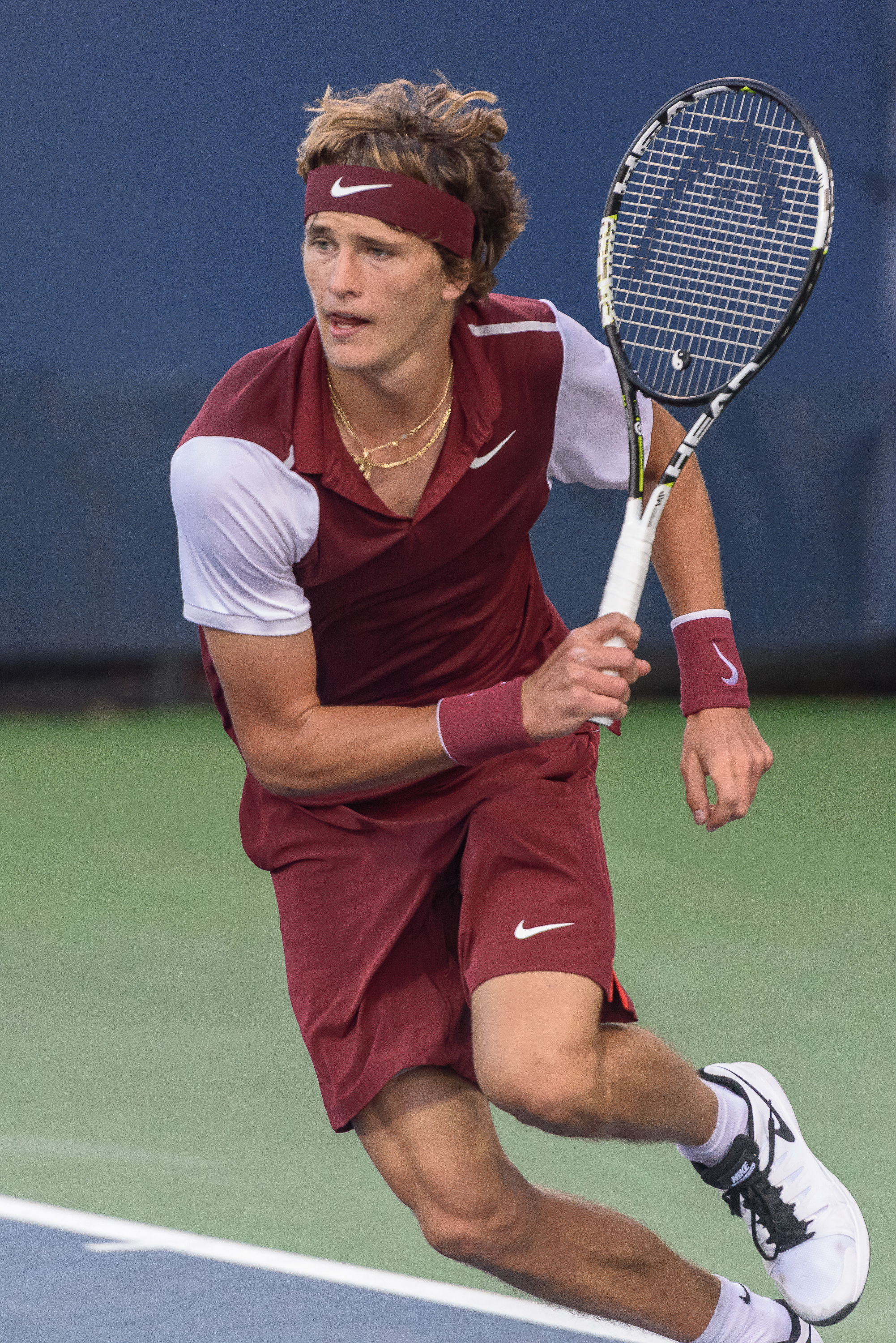
24. Alexander Zverev
76. Taylor Fritz
156. Andrey Rublev
204. Reilly Opelka
205. Alexander Bublik
The sun will always rise. Here we see arguably the brightest young player in the game: Alexander Zverev. If I had to put money on any one young player being a future multi-Slam winner, it would be Zverev. He may or may not be a future great, but he should at the least be very, very good. Consider that the last players to finish their age 19 season ranked in the top 25 were Novak Djokovic and Andy Murray in 2006, ranked #16 and #17, respectively. In other words, Zverev is the first teenager to finish in the top 25 in ten years. In fact, the list of teenagers in the Open Era who have finished in the top 25 is a relatively short one:
2016: Alexander Zverev (24)
2006: Novak Djokovic (16), Andy Murray (17)
2005: Rafael Nadal (2), Richard Gasquet (16)
2001: Andy Roddick (14)
2000: Lleyton Hewitt (7), (Roger Federer 29)
1999: Marat Safin (24), Lleyton Hewitt (25)
1995: Marcelo Rios (25)
1993: Andrei Medvedev (6)
1992: Andrei Medvedev (24)
1991: Michael Chang (15)
1990: Pete Sampras (5), Goran Ivanisevic (9), Michael Chang (15)
1989: Michael Chang (5), Andre Agassi (7), Jim Courier (24)
1988: Andre Agassi (3), Guillermo Perez Roldan (18)
1987: Kent Carlsson (12), Guillermo Perez-Roldan (19), Andre Agassi (25)
1986: Boris Becker (2), Kent Carlsson (13)
1985: Stefan Edberg (5), Boris Becker (6)
1984: Pat Cash (10), Aaron Krickstein (12), Stefan Edberg (20)
1983: Mats Wilander (4), Jimmy Arias (6)
1982: Mats Wilander (7), Jimmy Arias (20)
1980-81: Insufficient data
1979: Ivan Lendl (21)
1978: John McEnroe (4)
1977: John McEnroe (21)
1975: Bjorn Borg (3)
1974: Bjorn Borg (3)
1973: Bjorn Borg (18)
That’s 26 individual players in the ATP Era (1973-2016) who have finished a year ranked in the top 25 as a teenager. That may seem like quite a few players, and certainly there are several players on that list who didn’t have exactly stellar careers, but the majority of them were very good, and every applicable 6+ Slam winner—those who were teenagers during the ATP Era—is there, all except one: Roger Federer, who finished 2000—the year he turned 19—ranked #29; so he was close.
Furthermore, consider the aging of the tour: In the last 26 years, a teenager has ranked in the top 25 only 13 times by 11 players; in the previous 28 years (1973-1990) it was done 28 times by 16 players. Zverev is the first player in ten years to accomplish this.
All of this is to point out that Zverev’s accomplishment is quite rare. Secondly, it points to likely future success. Of those 26 players, 20 of the went on to win at least one Slam (77%), 14 won multiple Slams (54%), and 10 won 6+ Slams (38%). The Slamless players are Krickstein, Carlsson, Perez-Roldan, Medvedev, Rios, and Gasquet. Of those six only Krickstein, Perez-Roldan, and Gasquet didn’t win at least a Masters. If we look at only the last 26 years, of the ten players previous to Zverev, only three didn’t win Slams (Medvedev, Rios, Gasquet), five won 1-3 Slams (Chang, Hewitt, Safin, Roddick, Murray) and two became truly great players (Nadal, Djokovic). Going purely on percentages, that’s a 70% probability of at least one Slam title and a 50% probability of at least two. Of course this isn’t enough data to go on, but it gives us a sense of possible outcomes.
All that said, Zverev had a very good year, going from #83 to #24, and winning his first ATP title in his third final of the year, defeating Stanislas Wawrinka in three sets in St. Petersburg, an ATP 250 event. He didn’t make it past the third round of a Slam, but he had consistent results overall and situated himself to be seeded in Slams going forward.
Among the other players, Taylor Fritz is another exciting young player to watch. After starting the year ranked #174, he surged in early 2016, winning an early Challenger title and then gaining larger attention by a strong run at the ATP 250 Memphis Open, defeating second-seeded Steve Johnson en route (#29) to the final, which he lost to Kei Nishikori. He rose as high as #53 in late August, including a memorable three-set loss to Roger Federer at the Mercedes Cup, but then faded a bit later in the year, finishing at #76.
The big disappointment for me is Andrey Rublev, who is exactly the same age as Fritz but after winning his first Challenger title in March, stalled out and didn’t progress, going from #185 in 2015 to #156 in 2016. Big server Reilly Opelka shows some promise and could be the next John Isner. He rose from virtually unranked in 2015 (#981) to #204, including his first Challenger title in November.
2017 Outlook: After going from #83 to #24, including his first title, I’d like to say that Zverev—who turns 20 in April—is poised to enter the elite. But I think we’ll be talking that way more likely a year from now. In 2017 I predict stabilization and further modest gains, with an outside chance of sneaking into the top 10 and a World Tour Final berth, but more likely finishing in the 10-15 range. Look for him to be win more low level titles, maybe even compete for a Masters. More importantly, he needs to go deeper into Slams; he still hasn’t made it past the third round, which he made it to at both Roland Garros and Wimbledon. While 2018 might be the year he breaks through into the true elite and Slam contention, he is going to be a dangerous opponent in 2017, and not someone the elite will take for granted. I think that at some point this year, there will be a tournament that we look back on as breakthrough. It may be a second week run at a Slam, or a Masters final – but at some point this year, the big boys will take notice of him.
Fritz is exactly half a year younger than Zverev, and is probably more like a year behind him developmentally; expect to see him do in 2017 what Zverev did in 2016. His gains might be a bit more modest, but he should be in the top 40 by the end of the year, if not higher, and is a good candidate to win his first title. Fritz also will start getting more and more attention as he starts to upset top 20 players, and going deeper in tournaments.
I do expect both Rublev and Opelka to reach the top 100 this year; they just seem a year or so behind their two more successful peers. I do still hope that Rublev figures it out; he seems the type that could do it quickly, but his candidacy as a future elite is now greatly reduced. I see him more as a potential tier two or three player, which is still pretty good.
CLASS OF ’98
108. Francis Tiafoe
116. Stefan Kozlov
143. Duck Hee Lee
198. Michael Mmoh
209. Stefanos Tsitsapis
231. Casper Ruud
This is a subtly strong group, with no players that look like future greats but at least six—those listed above—who could be top 40 types. The jury is still out on Tiafoe; he made good strides this year, and some see him as a future star, but others are worried about his erratic serve and play. I don’t have much to say about Lee except that he continues to progress. Kozlov looks promising and between the first and final draft of this piece, moved up thirty ranks on account of winning his first Challenger title, which was the fifth won by an American teenager in 2016, after Fritz, Tiafoe, Opelka, and Mmoh, who is another promising young American. In those five players, the United States has the most talented group of young players since at least 2003, when Andy Roddick, Mardy Fish, Taylor Dent, and Robby Ginepri were all 22 or younger and ranked 33 or better. But more on that in another article.
Tsitsapis, a #1 ITF Junior, made good progress, as did Ruud. Another player to keep an eye on is Mikael Ymer (#492), who missed most of the year to injury but still holds promise.
2017 Outlook: These players are still quite young so expectations should be modest, but we could see several of them enter the top 100 in 2017, maybe even win a title. Of all of the “classes,” this one has perhaps the deepest talent—at least that we can see so far—so bears watching in 2017. Tiafoe, Kozlov, and Lee should all reach the top 100 sooner than later, and I wouldn’t be surprised to see Mmoh, Tsitsipas, and Ruud all approach the top 100 by year’s end. If Ymer stays healthy, he could rise quickly and be on the cusp of the top 100 as well. So that is at least seven players who bear watching. CLASS OF ’99
250. Denis Shapovalov
354. Alex De Minaur
519. Corentin Moutet
806. Miomir Kecmanovic
926. Yibing Wu
Denis Shapovalov is the big revelation here, with none of the others standing out yet. Shapovalov won his first Junior Slam at Wimbledon, defeating De Minaur, and also won three Futures titles, but it was at the Rogers Cup that he garnered more attention, upsetting Nick Kyrgios in the first round before losing to Grigor Dimitrov in the second.
2017 Outlook: Look for Shapovalov to move steadily up the rankings as he focuses on the Challenger tour. Good progress would be for him to reach the #100-150 range by year’s end, winning a Challenger title or two. It is possible that he breaks into the top 100 as soon as this year, although that is probably unlikely.
CLASS OF ’00
601. Felix Auger Aliassime
789. Nicola Kuhn
925. Yshai Oliel
1063. Rudolf Molleker
1066. Alen Avidzba
It is hard not to be excited about Felix Auger Aliassime, who just turned 16 in August shortly before winning the Junior title at the US Open, as well as winning his first Futures title just a couple weeks ago. And how about this: his birthday is August 8, the same day as a certain Swiss great you might have heard of….although Aliassime is 19 years younger than Federer. To put that in context, when Aliassime was born on August 8, 2000, Roger Federer was ranked #38 in the world and rising.
Aliassime is, by all accounts, an immense talent. There is also some room for concern, as it was revealed earlier this year that he has a heart condition that will almost certainly impact his career, although the question is to what degree (for reference, Mardy Fish had a similar condition). Let us cross our fingers and hope.
As for the others on the list, there isn’t a lot to know right now—but they’re the top players born in 2000. But chances are this list will look very different in year, when we should have a better sense who the true prospects of this year are.
2017 Outlook: Given that these players enter 2017 as 16-year olds, there isn’t much to expect and we just don’t know enough about any of them except for Aliassime, so we’ll have to revisit this group in a year or two. But Aliassime does bear watching, both because of his prodigious talent but also his health concerns. Aliassime will focus on the Junior tour and should be dominant; look for him to win a Slam or two, and start playing in more Futures. A year-end ATP ranking in the 200s is not out of the question.
Cover Photo by Steven Pisano from Wikimedia Commons, Courtesy of Creative Commons License
Revisiting the Benchmarks: the Pace of Greatness
To recap the last installment, we have clear benchmarks that all true greats (6+ Slam winners) hold in common:
Before their 19th birthday: Ranked in the top 100
Before their 20th birthday: Ranked in the top 50
Before their 21st birthday: Ranked in the top 10; won a title; made it to a Slam QF
Before their 22nd birthday: Ranked in the top 5
Before their 25th birthday: Ranked number 1, won a Slam
We also found that there are about 70 players in the ATP ranking era (1973-present) who met that first benchmark—a top 100 ranking at age 18. Of those 70, 17 are active today, a list we’ll get to in a moment.
“Failed Greats”
Now just because a player meets all of those criteria does not mean they will become a great player. There are players who met all of those criteria and only won a Slam or two. There are also players who met all of the criteria except for one or both of the “fruition” benchmarks met by age 25, the Slam and number one ranking. These two groups combined are players that we could call “failed greats”–they passed all, or almost all, of the benchmarks, but failed to become true greats.
Here are two lists of players, the first being those who accomplished all benchmarks, the second all but the age 25 criteria, the Slam and number one ranking:
All benchmarks: Jim Courier, Michael Chang, Marat Safin, Lleyton Hewitt, Andy Roddick
All except age 25: Goran Ivanisevic, Andrei Medvedev, Juan Martin del Potro
So these are eight players in the Open Era who were on the “pace of greatness,” including five who actually met all of the benchmarks, but eventually fell short of true greatness. It is a surprisingly small number, and tells us that most players who reach the various benchmarks along the way will become great players. If we go back to those players for whom we have all the data, from Borg to Djokovic, we have 11 all-time greats (6+ Slam winners). That means that 11 of 16 players (69%) who met all of the benchmarks became greats, and 11 of 19 (58%) who met all except the age 25 benchmarks.
The main thing these eight players have in common with the true greats is that they all developed very quickly. Consider the fact that one of the criteria is to reach the top 5 before turning 22 years old. That in itself is a difficult benchmark that erases many other players from contention.
Let’s take a look at each of these players, to get a sense of what “went wrong” in their careers. First we have four players born in the first half of the 1970s:
Jim Courier (b. 1970) was one of the top players on tour for a few years, the first of his generation to become #1, four months before Agassi and more than a year before Sampras. But Courier declined quickly, dropping from a top 3 player in 1993 to #13 in ’94, #8 in 95, and out of the top 20 for the remainder of his career. His mid-20s decline is similar to later number one players like Juan Carlos Ferrero and Lleyton Hewitt. There was always the sense with Courier that he was playing over his head and ability, and was less talented than his peers Sampras and Agassi. Courier’s decline coincided with Sampras’s rise to dominance; un-surprisingly, Courier won only 4 of his 20 matches with Sampras. Still, Courier ended his career with 4 Slams, 23 titles overall, a year-end #1 ranking in 1992 and, along with Guillermo Vilas, is one of the two players who I consider the “Gatekeepers” of true greatness.
Goran Ivanisevic (b. 1971) was one of the better players of the 90s who was unable to get past the dominance of Sampras and Agassi, losing two Wimbledon finals to Sampras and one to Agassi. Yet despite fading in the latter part of the decade, he entered the 2001 Wimbledon ranked #125 and miraculously won it, which was the inspiration behind the film Wimbledon. Known for his tremendous serve, Ivanisevic wasn’t very multi-dimensional, although not nearly as one-dimensional as, say, Ivo Karlovic, and was probably a bit better than Milos Raonic is now.
Michael Chang (b. 1972) was the youngest player of the Open Era to win a Grand Slam: the 1989 French Open at the age of 17 years and 4 months, one of only three players—along with Mats Wilander and Boris Becker—to win a Slam before his 18th birthday (Martina Hingis is the youngest woman, winning her first at 16 and 4 months). Yet Chang had a lower ceiling than other early bloomers. While he had a long and prolific career, including 34 titles and 7 Masters, he never ranked higher than #2 or won another Slam. In a way he was the David Ferrer of his generation (although more successful in big tournaments): never in contention for the best on tour, but always right there behind the top players.
Andrei Medvedev (b. 1974) was an early bloomer who looked destined for greatness after ranking #6 in 1993 at the age of 19, and then winning two Masters the following year. Yet Medvedev floundered and was never able to take that next step up. His best years were 1993-95 when he was 19-21 years old.
And then we come to the trio of Marat Safin, Lleyton Hewitt, and Andy Roddick—the best peers of Roger Federer.
Marat Safin (b. 1980) won his first Slam in 2000 at the age of 20 but only won one other and goes down as one of the biggest underachievers in tennis history. He was a very talented player who was capable of an extremely high level and very well could have formed a duo of greats with Federer, but he didn’t have the requisite focus and had the well-earned reputation of being something of a playboy.
Lleyton Hewitt (b. 1981) was the youngest player in the ATP era to reach the number one ranking, which he did in 2001 at the age of 20 years old and 9 months. Hewitt was a very strong player for the first half of the 00s, and was the year-end #1 player in 2001 and 2002, but was more the first among near-equals than truly dominant over the field, and was eclipsed first by Roddick and then Federer in 2003 and never could climb back to the top. He fell out of the top 10 in 2006 and was never to return, playing a long second-half of his career as a non-elite player.
Andy Roddick (b. 1982) is perhaps the player whose career was most damaged by Roger Federer’s greatness. Roddick won the US Open and the year-end #1 ranking in 2003 at 21 years old, and seemed destined for greatness. But Federer became simply better at almost every facet of the game, and Roddick’s relatively one-dimensional game became exploited by others. He was an excellent player and remained a consistent top 10 player throughout the 00s, but never won another Slam, going 1-4 in Slam finals.
Finally we come to Juan Martin del Potro (b. 1988), who through 2009 had met all of the benchmarks of greatness: he was 21, had won a Slam, and was ranked in the top 5. And then injury struck and he hasn’t been the same since. While still a dangerous player when healthy, we’ll never know what a fully healthy del Potro would have looked like. My guess is that he would have vied with Andy Murray for the title of third greatest player of his generation, perhaps even surpassed him. But “Delpo” turns 28 later this year and is unlikely to ever reach his full potential.
In all eight of these we see players who developed early and to a high level, but for various reasons were unable to take that next step, whether due to talent, mentality, or injury. Again, we can return to our “characteristics of greatness,” which all greats have had, and the failed greats have lacked one or more of.
It is also interesting to note that these are all players born 1970 or later; 18 years old in 1973 is the starting point of these criteria because that is the beginning of the computerized rankings. This means that, for whatever reason, for the first 15 years there were no failed greats. Every player that met all of the criteria up to age 25 became greats, including Bjorn Borg, John McEnroe, Ivan Lendl, Mats Wilander, Stefan Edberg, and Boris Becker—a 100% “conversion rate.” Since 1970 we’ve had the eight failed greats along with Agassi, Sampras, Federer, Nadal, and Djokovic—so 5 of 13, or a 38% rate. Why exactly this is, I don’t know, although it could simply be that, as we saw in Part One, there were many more 18-year olds in the top 100 in the late 80s and early 90s than any other period of the Open Era.
I would also add one more possibility. Note that the first four players—Courier, Ivanisevic, Chang, and Medvedev—were all peers of Sampras, while the next three—Safin, Hewitt, and Roddick—were peers of Federer. It could be that part of the reason these players “failed” in becoming true greats was because they were eclipsed by an even greater player in Sampras and and Federer (del Potro was close to Nadal and Djokovic, although his failure to achieve greatness has been blocked by injuries. We simply cannot know what a healthy del Potro would have looked like).
Current Players: Off the Pace of Greatness
So of active players, who was initially on the pace but has since fallen off? We’ll start with the oldest and work our way forward.
Mikhail Youzhny (b. 1982) met the first criteria, and also won his first title at age 20, but slowed in his development. He has had a solid career, been a top 10 player and won 10 titles, but is far from great; I ranked him as the tenth greatest player of his generation (b. 1979-83), behind Tommy Robredo and ahead of Fernando Gonzalez and Guillermo Coria, although the latter two were better players and possibly deserved to rank higher than Youzhny, although Mikhail’s longevity was better.
Tomas Berdych (b. 1985) met the first several benchmarks, ranking in the top 100 at age 18, the top 50 at age 19, winning his first title at 19 and even reaching the top 20 as a 20-year old. But he didn’t reach the top 10 or a Slam QF until a year later, at 21, and only made the top 5 at age 27. Berdych won the Paris Masters in 2005 at 20 years old, but has not won a Masters since. He is what could be called an “aborted great:” he had the early signs, but never blossomed beyond the level of a very good player, which he remains today.
Richard Gasquet (b. 1986) reached the top 100 at 17 years old, the top 50 and his first title at 18, and the top 20 as a 19 year old. But like Berdych, he didn’t reach a Slam QF or the top 10 until he was 21 and approaching 30-years old in June has never ranked in the top 5 or even won a title above an ATP 250. He is often cited as one of the more disappointing players of his generation, although I think in hind-sight it now looks like he simply had a lower ceiling of talent than his teenager career promised.
Gael Monfils (b. 1986) showed immense promise at a young age, winning three Junior Slams in 2004. Monfils ranked in the top 50 at age 18 but took another four years to reach the top 10. He remains an enigmatic player on tour, extremely talented but the classic “head-case.”
Andy Murray (b. 1987) was on the pace until his 21st birthday. He met all of the ranking benchmarks, won his first title, but failed to win a Slam QF until just after his 21st birthday. He also didn’t win his first Slam until 25 and has yet to rank number one. As we all know, Andy is known for his temper and penchant for falling apart in tight matches, as illustrated in his 2-7 record in Slam finals. While he could still win another Slam or two, especially as Federer and Nadal fade away, he turns 29 in a couple months and seems on the wrong side of his peak.
Juan Martin del Potro (b. 1988) is in the “failed great” category and accomplished all of the benchmarks except the number one ranking, so he was even closer than Murray. He is 27, so it hard to imagine him winning 5+ more Slams to become a true great.
Ernests Gulbis (b. 1988) is another of the same type as Gasquet and Monfils: very talented, but considered an underachiever. Gulbis reached the first two ranking benchmarks and also won his first title at age 19, but stalled out in his early 20s, not reaching the top 10 until 25, and then only briefly.
Donald Young (b. 1989), as I have said elsewhere, represents both the failure of his generation and American men’s tennis. He made the top 100 at 18 but has floundered since, still as yet not winning a title, reaching a Slam QF, or ranking higher than #38. According to my research, he has the dubious honor of being one of the half a dozen or so worst players in the ATP era to reach the top 100 as an 18-year old.
Kei Nishikori (b. 1989) won his first title at age 18, but slowed until his early 20s. He has met all of the criteria of 2-4 Slam winners, although at age 26 has yet to win a Slam. Kei has 11 titles so far, including 6 ATP 500s, and is the only player on tour with more than two ATP 500 titles and no Masters or Slams. While he’s a good candidate to eventually win a Masters, if he fails to do so he could end up being one of the greatest players ever not to win a Masters tournament or higher.
Bernard Tomic (b. 1992) reached the top 50 and a Slam QF at age 18, and won his first title at age 20, but then floundered around #50 for a couple years and is now well off the pace of greatness. He is still just 23-years old, although looks more like a top 20 type than a future Slam winner.
Nick Kyrgios (b. 1995) technically already missed one of the benchmarks, as he did not reaching the top 100 until he was 19 years and three months. But I do not think that three months should disqualify him. He did reach the top 50 before turning 20, win his first title and reach his first QF before 21, and he has a shot at reaching the top 20 by age 21, but probably not the top 10 (he turns 21 on April 27). So it could be that Kyrgios turns 21 with three of the first five benchmarks (not including a Slam title), which is pretty good. We’ll need to see a quick rise over 2016 and into the top 10 and, to get back on the pace, he would need to rank in the top 5 by his birthday in 2017. A tall order, but we’ve seen some positive signs of late, a high level of play that, if he can access on a regular basis, could make him a truly great player.
Active Players: On the Pace (So Far)
There are currently only four players who have both reached the first benchmark, the top 100 at age 18, and not yet failed one: Hyeon Chung, Borna Coric, Alexander Zverev, and Taylor Harry Fritz.
Hyeon Chung (b. 5/19/1996) reached the top 100 at 18 but has not yet broken into the 50, which is the benchmark that he must meet before his 20th birthday, on May 19 of this year. That said, he did reach as high as #51, so maybe we can give him some slack. He’s currently ranked #71 so has been stagnating for awhile now; hopefully we see a step forward this year.
Borna Coric (b. 11/14/1996) is 19 years old, turning 20 in November. He is the only player who has reached two benchmarks and is still on the pace: he was in the top 100 at age 18 and top 50 at age 19. Actually, Coric has accomplished one remarkable feat: he has out-paced Novak Djokovic in rankings on their17-19th birthdays; compare:
Djokovic: 515, 128, 63
Coric: 396, 89, 45
Just looking at those numbers point to potential great things for Coric. But beyond that, there are worrying signs. First of all, at 19 years and 4 months, Coric has yet to win a title; at the same age, Djokovic was about to win his second (both ATP 250s) and was about half a year away from his first Masters title and a little over a year from his first Slam.
Where Djokovic went from #63 on his 19th birthday to #6 on his 20th birthday, Coric has been stagnating for about a year now. That said, he doesn’t need to keep pace with Djokovic to be a future great. In order to remain on the pace, he needs to reach the top 10, win a title, and reach a Slam QF all before November of 2017. So he’s got plenty of time to develop his game further. That said, it seems more likely that he becomes closer to Richard Gasquet than Djokovic.
Alexander Zverev (b. 4/20/1997) turns 19 on April 20, and has already reached his first benchmark. In fact, he will turn 19 ranked #50, which is the next benchmark that he needs to reach—but not until April of 2017, so he’s a year ahead of schedule. After that, Zverev would need to reach the next round of benchmarks—top 10, a title, and Slam QF—all before April of 2018, which is two years away. He seems to have a good chance of all of that. So it is quite early for Zverev, which is a good sign. His recent three-set loss to Rafael Nadal at Indian Wells shows us both his potential and that he still needs a lot of work. But signs are encouraging.
Taylor Fritz (b. 10/28/97) is in a similar situation as Zverev. He’ll be 19 later this year, about a year younger than Coric. Fritz is in the top 100 and doesn’t need to reach his next benchmark, the top 50, for a year and a half; he’s currently ranked #68, so is close already. His game is still raw, but he shows a lot of promise and the fact that he’s risen so quickly is a very good sign.
Active Players: On the Cusp
Those are only players who have reached at least one or more benchmark, but there are several others that are “due” for that first benchmark and look to have a solid chance to reach it.
Andrey Rublev (b. 10/20/97) is about a week older than Fritz and currently ranked #154. He needs to squeeze into the top 100 by his birthday to be on pace, which seems very possible. He seems like a player that is ripe to start a quickened pace of development, so bears watching this year.
Frances Tiafoe (b. 1/20/98) just turned 18 a few months ago, so has a lot of time to reach the top 100. He shows a lot of promise, including a three-set loss to David Goffin that showed some of his potential. He is currently the youngest player ranked in the top 200, at #182.
Tommy Paul (5/17/97) and Omar Jasika (5/18/97) turn 19 in May, and are distant possibilities, but need to move very quickly, ranked #192 and #313 respectively.
Duckhee Lee (5/29/98) is quite young and looks to have a good shot. At #206, he is the highest ranked 17-year old on tour, and the only one to be ranked in the top 400.
Stefan Kozlov (2/1/98), ranked #224, and Michael Mmoh (1/10/98) ranked #322, are two young foreign-born Americans that bear watching. Kovlov made a big jump recently, losing in a Challenger final. He is a good candidate to at least come close to the top 100 by year’s end.
Beyond them you have 17-year olds Stefanos Tsitsipas (8/12/98) and Mikael Ymer (9/9/98) and even younger players for him it is just too soon to tell—like Denis Shapovolov (4/15/99) Felix Auger Aliassime (8/8/2000) and Rayane Roumane (9/11/2000), the only ranked players that were born in 2000. Again, it is way too soon for these kids, but theirs are names to remember.
Missing the Cut
There are also quite a few young players who show promise, but did not make that first benchmark. I will mention their names, though, given the possibility that this newer generation simply might be peaking later. Still, I think all of them are far less worthy candidates for the next great player, but could be names we see in the top 50 within the next new several years.
Jared Donaldson, Elias Ymer, Karen Khachanov, Yoshihito Nishioka, Kyle Edmund, Quentin Halys, Thanasi Kokkinakis, Noah Rubin.
Kokkinakis met the first benchmark and ranked as high as #69 last June, but has struggled since and is ranked #143 just after turning 20.
“Stanislas Potential”
There is one final player that I’d like to mention, who is far off the pace of greatness but has drawn attention of late: Dominic Thiem (b. 9/3/93). While I think it very unlikely that he becomes a 6+ Slam winner as he is so far off the pace, Thiem—at 22—has reached the various benchmarks of the near-greats, the 2-4 Slam winners. He reached the top 100 and then top 50 as a 20-year old, then won his first title and the top 20 as a 21-year old, and is currently on the verge of the top 10 and has a good chance to reach it, and play in his first Slam QF, before his 23rd birthday in September.
And then there’s our old friend, Grigor Dimitrov (b. 5/14/91), who at almost 25 is no longer a prospect. We might have to accept Grigor for who he is and will never be. That said, while Grigor did not fulfill any of the criteria for greatness, he has fulfilled almost all of the criteria for near-greatness: reaching the top 100 at 19, the top 50 at 21, the top 20 at 22, and the top 10 at 23. He also made his first Slam QF at 22, although did not win his first title until 22: all multi-Slam winners won their first title at age 21 or younger. So while Grigor will not be a 6+ Slam winner, he is a darkhorse candidate, albeit a fading one, to expand the horizons of near-greats.
Ranking the Candidates
So when all is said and done, where does that leave us? As of right now, I would categorize the candidates the following groups:
Best Candidates for Greatness: Alexander Zverev, Taylor Fritz
Borderline/Outside Chance: Nick Kyrgios, Borna Coric, Hyeon Chung
The Stanislas Darkhorse: Dominic Thiem
Too Soon to Tell, but Promising: Andrey Rublev, Francis Tiafoe, Stefan Kozlov
On the Edge of the Radar: Duckhee Lee, Mikael Ymer, etc
Very Unlikely: Everyone else
Finally, there are the kids—players of the next generation, 1999-2003, for whom it is just far too soon, but we are at least starting to see some names pop up in Futures tournaments.
Which of these players will become true greats? Your guess is as good as mine, but chances are at least one of them will. If in 5 or 10 years we look back and the next 6+ Slam winner wasn’t mentioned in this article, I’ll have to eat my words, but I think there’s a very good chance that won’t be the case.
Cover photo from Wikimedia Commons, By Tomas-ko0 – Own work, CC BY-SA 4.0, https://commons.wikimedia.org/w/index.php?curid=45898208
The Young Punks
As the saying goes, history repeats itself. In this case, we see a kind of harmonic in tennis history between these past few generations and the first few generations of the Open Era. The first generation of Rosewall and Laver was extremely strong, followed by one of the very weakest, with only Arthur Ashe winning multiple Slams, then the third—headlined by John Newcombe and Ilie Nastase—was much stronger but still not quite a generation of greats (aside from Newcombe). And so we see a similar pattern with the last few generations: the 1984-88 was (and still is) one of the greatest generations in tennis history; 1989-93 one of the weakest. The verdict is still out on this new young generation of 1994-98, with players ending 2015 at age 17-21, but there are promising signs, as we shall see, and it certainly looks to be stronger than the 89-93 generation.
I call them the “Young Punks” for two reasons: One, because of the “punkish” attitude of Nick Kyrgios, so far the most successful of the group, and secondly because they carry a kind of swagger that seems to be lacking from the previous generation—which is a good thing.
Best Players by Birth Year: 1994: Lucas Pouille (FRA), Kimmer Coppejans (BEL), Jordan Thompson (AUS), Adam Pavlasek (CZE), Luke Saville (AUS), Mathias Bourgue (FRA) 1995: Nick Kyrgios (AUS), Yoshihito Nishioka (JPN), Kyle Edmund (UK), Matteo Donati (ITA), Mackenzie MacDonald (USA) 1996: Borna Coric (CRO), Hyeon Chung (KOR), Thanasi Kokkinakis AUS), Jared Donaldson (USA), Quentin Halys (FRA), Elias Ymer (SWE), Noah Rubin (USA), Christian Garin (CHI), Karen Khachanov (RUS) 1997: Alexander Zverev (GER), Taylor Harry Fritz (USA), Andrey Rublev (RUS), Tommy Paul (USA), Omar Jasika (AUS) 1998: Frances Tiafoe (USA), Stefan Kozlov (USA), Duckhee Lee (KOR), Mikael Ymer (SWE), Michael Mmoh (USA)
No Slams yet, with the operative word being “yet.” With this group it is only a matter of time, and we will almost certainly see several multi-Slam winners, if only because the previous generation is so weak, and Novak, Rafa, Andy, and Stan can’t maintain their hold of dominance forever.
As of this writing, seven players are in the Top 100: Kyrgios, Coric, Zverev, Chung, Fritz, Edmund, and Pouille, with Kokkinakis dropping out due to inactivity. There are another dozen or so in the No. 101-200 range, with several having a chance of entering the Top 100 this year, so by year’s end we could see 10-15% of the Top 100 being players of this generation, finishing the year 18-22 years old.
While there’s no player that looks like a surefire future great, at least not yet, there are quite a few that are potential future Slam winners, and several that could be multi-Slam winners. Part of this is bolstered by the weakness of the previous generation, but there are also some young players that are the most exciting young talents since Juan Martin del Potro and Marin Cilic.
1994 is relatively weak with the highest ranked player being Pouille, No. 87 at the ripe age of 22, but then the generation starts becoming stronger in 1995 with Nick Kyrgios, a player whose antics have made him unpopular. But most believe that he’ll eventually be a Slam winner, if he can remain healthy enough. Still, the floor is probably a Berdych-like player and career, but one who peaks in an era with more opportunity than poor Tomas, so with better results. His ceiling might be something like a Juan Martin del Potro, but hopefully with better health. Nishioka and Edmund look like two players who could be future regulars in the Top 40, maybe Top 20 even, but probably not Top 10.
The generation gets even stronger in 1996, with standouts Coric and Chung, as well as Kokkinakis, Donaldson, Halys, Elias Ymer, Rubin, Khachanov, and Garin showing various degrees of promise. Again, at this age almost every player shows some degree of promise, so it is hard to see now who will continue to rise and who will find a lower level in the rankings and stay there, that is “do a Berankis.” Coric is the player who has risen the quickest, although the feeling on him is mixed. He has stagnated for almost a year now: he broke into the Top 100 in October of 2014, and then climbed further into the Top 50 by May of 2015, but has fluctuated in the 30s and 40s for almost 10 months now. Still, he’s almost certainly going to rise higher, but he may be more of a future Top 10-20 player rather than the future star some pegged him out to be.
When we get to 1997, we see the two players who look to be the jewels of the generation: Alexander Zverev and Taylor Harry Fritz. Both Zverev and Fritz are getting a good amount of press, with my article about Fritz here. Zverev turns 19 in April and, in my mind—as with Fritz—isn’t far from a big breakout performance. I expect both of these players to win their first titles this year, and make it to the second week of at least one Slam. I think we’re going to see both of these players start head-hunting Top 20 and even some Top 10 players as soon as this year. Andrey Rublev also shows some promise and is eight days older than Fritz, but has yet to make his run at the Top 100. But he did just win his first Challenger title and could rise quickly.
1998 also has some promising players with Americans Francis Tiafoe and Stefan Kozlov, as well as the Korean Duckhee Lee and the Swede Mikael Ymer, Elias’s younger brother. Of the two Ymer brothers, Mikael may be the more talented. He’s still only 17, however, and still only ranked No. 590, but his is a name to keep in mind.
2016 will see this generation turning 18-22, so we should start seeing better indicators as to how good they might be, and maybe see a sprinkling of lesser titles. As I’ve written elsewhere, every single all-time great of the Open Era—which I’m defining as players with 6+ Slam titles—has accomplished three things before American drinking age: won an ATP title, reached the second week (QF or better) in at least one Slam, and finished the year in the Top 20. No player of this generation has accomplished all three, and while Kyrgios accomplished reached the second week of a Slam two years ago in 2014 at age 19, he won his first title this year a couple months before turning 21, but has yet to reach the Top 20. That said, I think we can loosen up a bit on those criteria, given the theory that players are taking a bit longer to mature these days. Perhaps two out of three of these criteria is enough to still be a possible future great.
It should be noted that this generation saw its first title when Nick Kyrgios won Marseille. Consider that 2016 is the equivalent year as 2011 was for the previous generation and 2006 for the 1984-88 generation. In 2011, the previous—and very weak—1989-93 generation won its second title, but wouldn’t start winning multiple titles until 2012. The 84-88 generation starting winning titles in 2004, and won their first Slam and first Masters in 2005 in the name of one Rafael Nadal. It seems likely that the 94-98 generation will be somewhere between the two, although as of this moment they are even behind the weak 89-93 generation. But look for players like Zverev and Fritz to challenge for titles this year.
Underachievers and Forgotten Players
It is too soon to tell. If there are any players I’m at all concerned about being underachievers, it is either Lucas Pouille or Christian Garin. At 22, Pouille should be showing a bit more; at this point he’s looking like yet another good-but-not-great Frenchman.
As for Garin, a couple years ago he was a highly touted junior, defeating Alexander Zverev in the 2013 Junior French Open. While Garin is still only 19, the luster has started to fade a bit as he’s yet to crack the Top 200. Still, we shouldn’t quite give up on him…yet.
Did You Know? I: Alex Zverev’s father was a tennis player, as is his older brother, Mischa. II: Andrey Rublev is the name of an illustrious Russian literary figure, and also the title of a film (Andrei Rublev) by the great Russian filmmaker, Andrei Tarkovsky.
Current Rankings
27. Nick Kyrgios
47. Borna Coric
58. Alexander Zverev
64. Hyeon Chung
80. Taylor Fritz
82. Kyle Edmund
87. Lucas Pouille
119. Thanasi Kokkinakis
122. Kimmer Coppejans
123. Jordan Thompson
Other players in the Top 200: Yoshihito Nishioka (No. 124), Adam Pavlasek (No. 134), Karen Khachanov (No. 146), Elias Ymer (No. 152), Jared Donaldson (No. 158), Andrey Rublev (No. 161), Quentin Halys (No. 175), Francis Tiafoe (No. 177), Matteo Donati (No. 181), Luke Saville (No. 186), Matthias Bourgue (No. 187).
Kyrgios and Coric have been stagnating, although the former has been playing very well of late and should start rising again. Chung has also stagnated, but Zverev and Fritz are both on the rise and should be in the Top 50 shortly.
Top Ten Players of the Generation (Predicted)
Right now the most accomplished player of the generation is clearly Nick Kyrgios, the only player with a title and a second week Slam result (he has made a QF twice). But given that their career accomplishments at this point are minimal, and we can see their current rankings above, I’m going to go out on a limb and predict how this list might look 20 years from now. Of course this is impossible to predict, but why not?
1. Alexander Zverev
2. Taylor Harry Fritz
3. Nick Kyrgios
4. Andrey Rublev
5. Mikael Ymer
6. Francis Tiafoe
7. Borna Coric
8. Hyeon Chung
9. Stefan Kozlov
10. Jared Donaldson
Honorable Mentions: Elias Ymer, Yoshihito Nishioka, Thanasi Kokkinakis, Kyle Edmund, and just about everyone else.
This is wild conjecture at this point, but humor me! The top three are safe picks considering their recent performances. After that, I have a feeling about Mikael Ymer and Andrey Rublev, but could be very wrong about one or both. Coric and Tiafoe are paired in my mind, both being somewhat overhyped but both should still be very good players, but again it is just too soon to tell. Chung snuck into the Top 100 by winning a ton of Challengers and Futures, but has yet to do much at more significant tournaments–he’s only made it past the Round of 16 once, at Shenzhen (ATP 250) last year when he lost to Marin Cilic in the QF; the point being, he’s a good “Berankis candidate,” although like all of these players it is too soon to tell. Kozlov is another young American to look out for. After that, Donaldson is a player that I’ve been expecting a breakthrough from for a while now, but haven’t yet seen it.
Postscript: Gen 14 (1999-03) – Millennials
Yes, Gen 14 is beginning to show up on the edge of the radar. Right now just a few players are ranked, but as of the end of 2015 we have:
1999: Corentin Moutet (FRA), Denis Shapovalov (CAN), Alex De Minaur (AUS), Santiago Fa Rodriguez Taverna (ARG) 2000: Felix Auger Aliassime (CAN), Rayane Roumane (FRA)
All of the above are ranked between No. 700 to No. 1,000, which basically means they’ve played in Futures but haven’t gone pro yet. And yes, there are players born in 2000 that have ATP rankings. A scary thought. Aliassime has turned some heads and even reached the QF of a Challenger last July when he was 14 years old, before losing to then No. 145 Yoshihito Nishioka—but not before talking the first set from him. He definitely bears watching, but all of this Generation Next are two to three years away from being a serious prospect.
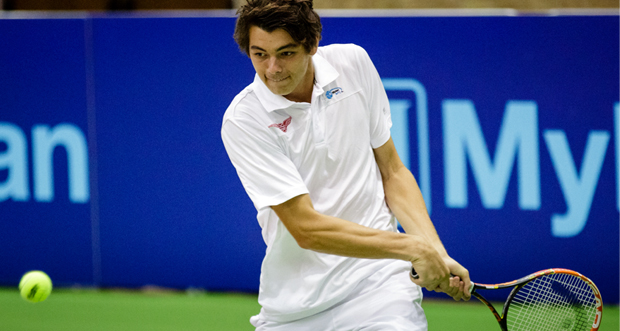
I’m starting to get a bit excited about one Taylor Harry Fritz. Who is Taylor Harry Fritz? He’s an 18-year old American who just lost to Kei Nishikori in the final of the Memphis Open. OK, the Memphis Open is an ATP 250 – small potatoes on the tour. Why am I excited about Fritz? Is it only so I can come up with such a ridiculous term as Fritzmania? (You heard it here first, by the way.) And aren’t I jumping the gun?
Well, let’s consider a few things. As of Monday, February 15, 2016, here are the dozen highest ranked Americans with their current age:
11. John Isner (30)
23. Jack Sock (23)
31. Steve Johnson (26)
58. Donald Young (26)
61. Sam Querrey (28)
65. Denis Kudla (23)
89. Rajeev Ram (31)
102. Taylor Fritz (18)
103. Austin Krajicek (25)
129. Tim Smyczek (28)
130. Ryan Harrison (23)
147. Bjorn Fratangelo (22)
148. Dennis Novikov (22)
As you can see, Fritz is not only the highest ranked American teenager, but the highest ranked American who is not legal to drink alcohol, or even yet 22-years old. After Fritz, here are the next six highest ranked American teenagers:
159. Jared Donaldson (19)
177. Francis Tiafoe (18)
245. Noah Rubin (19)
249. Tommy Paul (18)
334. Ernesto Escobedo (19)
341. Stefan Kozlov (18)
Donaldson, Tiafoe, and Rubin have all gotten some buzz, but as of right now Fritz is the only young American who is on the move and within striking distance of a spot within the Top 100. Donaldson is almost exactly a year older, and has been stagnating for a bit in the 101-200 range, first breaking into the Top 200 a year ago; Tiafoe, on the other hand, is steadily moving up. Kozlov is another who has received some recognition as a prospect, but he’s not playing much. Plus, he (and Tiafoe) only turned 18 just a couple weeks ago, so we can forgive them if they don’t start demanding attention this year.
Who is Taylor Fritz? Well, he played his first ATP tour at the Aegon Open event in June of 2015 at the tender age of 17, winning his first match against Pablo Carreno Busta before losing to Feliciano Lopez. He officially turned pro in September after winning the Junior US Open against Tommy Paul, and then quickly rose hundreds of positions within the rankings by winning multiple Challenger events, finishing his first year at No. 174 in the world.
This year he is showing lots of promise. He beat No. 100 Dudi Sela in the Happy Valley Challenger final, then made it through the Australian Open qualification rounds, losing to No. 22 Jack Sock in the first round, although in five sets. Finally, he just made it to the Memphis Open final, although lost to No. 5 Kei Nishikori.
Understand that this is a kid who is 18 years and 4 months old. Fritz is listed as 6’4”, 185 lbs – a tall kid, although not quite in the range that often entails physical issues (knock on wood). Steve Tignor say of Fritz that he “has an aggressive mindset and his shots have a natural pop,” but also warns that “he doesn’t move or hit as smoothly as [Alexander] Zverev,” comparing him to the German 18-year old prospect.
In my mind, that “aggressive mindset” is particularly encouraging, a quality lacking not only in recent American players, but young players in general. I can live with him not being fully polished at 18, but we’ve seen a lot of talented and smooth-playing young players over the last few years without the requisite mindset to be a champion – Grigor Dimitrov comes most readily to mind, but consider other and older underachieving talents like Ernest Gulbis, Richard Gasquet, and David Nalbandian.
The other aspect that excites me is the American factor. We have not seen a Top 5 American player since Andy Roddick, and he couldn’t quite live up to the great Americans of the 90s – namely Pete Sampras, Andre Agassi, and Jim Courier. Since the retirement of Agassi, American men’s tennis has been a shadow of its former dominance in the 70s, 80s, and 90s. After Roddick we’ve seen Mardy Fish, John Isner, and disappointments like Sam Querrey, Donald Young, and Ryan Harrison. But no perennial Top 10 players and no Slam winners since Roddick’s 2003 US Open title.
Fritz is actually now No. 98 in the live rankings and poised to move up with a good showing at the Delray Beach ATP 250. If he wins the tournament he’s on the verge of the Top 50. But let’s not get ahead of ourselves yet.
Regardless, the point is that Fritz is rising fast. Even if he goes out early at Delray, he’s still situated where he is likely to continue rising quickly. Being in the Top 100 means more than just bragging rights; it also means a player bypasses qualifications and enters the first round of Grand Slam events.
Let’s assume that Fritz not only makes it into but stays in the Top 100. He would do so at the age of 18, although would end the year at age 19. Here are the American teenagers who have finished the year in the Top 100 during the ATP rankings era (1973-present):
2011: Ryan Harrison (#79, 19) 2007: Donald Young (#100, 18) 2001: Andy Roddick (#14, 19) 1991: Michael Chang (#15, 19) 1990: Pete Sampras (#5, 19), Michael Chang (#15, 18) 1989: Michael Chang (#5, 17), Andre Agassi (#7, 19), Jim Courier (#24, 19), Pete Sampras (#81, 18) 1988: Andre Agassi (#3, 18), Michael Chang (#30, 16), Jim Courier (#43, 18), Pete Sampras (#97, 17) 1987: Andre Agassi (#25, 17) 1986: Aaron Krickstein (#26, 19), Andre Agassi (#91, 16) 1985: Aaron Krickstein (#29, 18) 1984: Aaron Krickstein (#12, 17), Jimmy Brown (#100, 19) 1983: Jimmy Brown (#45, 18), Aaron Krickstein (#94, 16) 1982: Jimmy Brown (#97, 17) 1978: John McEnroe (#4, 19), Eliot Teltscher (#42, 19) 1977: John McEnroe (#21, 18)
That list covers 43 years of ATP rankings and includes 11 American players who have ranked in the year-end Top 100 as teenagers. As you can see, a promising American teenager wasn’t uncommon from the 70s into the 90s, but after the great 90s generation of Agassi, Sampras, Courier, and Chang, we’ve only seen a few – and only Roddick turned into an elite player.
Fritz will almost certainly be the 12th American teenager to finish a year in the Top 100, with at least Tiafoe having a good chance of being the 13th.
Of those 11, we have:
3 All-time Greats: McEnroe, Agassi, Sampras
3 Slam winners: Courier, Chang, Roddick
2 Good Players: Teltscher, Krickstein
3 Mediocre Players: Brown, Young, Harrison
So of those 11, most (6) have gone on to win at least one Slam and three won 7 or more; 8 of the 11 were at least good players, with only three being mediocre.
It should go without saying that we cannot really predict Fritz’s future performance based simply upon his ranking relative to his age. By that logic, he could just as easily be another Ryan Harrison as he could be Pete Sampras, or more likely somewhere in-between. But what we can say is that Fritz is joining a small group of Americans, most of whom went on to be at least good players and more than half of whom won Slams. So just on that there’s room for optimism. And perhaps most of all, Taylor Harry Fritz is – as of this writing – the most promising young American men’s tennis player since Andy Roddick.
Finally.
Addendum
Fritz is one of several young players—including Zverev—who I’m watching and am excited about. After I finish up my Open Era Generation series, look for a blog or two about this new generation, and the quest for the next great men’s tennis player.