Tag: steffi graf

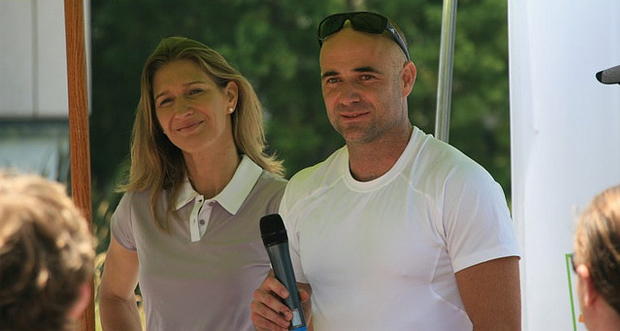
  • Andre Agassi and Stefanie Graf on the Mysteries of Success

    Andre Agassi and Stefanie Graf on the Mysteries of Success

    “It is an illusion to think that setting goals and achieving them makes you happy.”

    By Stefan Wagner.

    Reprinted with permission from The Red Bulletinredbull-com-logo 80

    [divider]

    THE RED BULLETIN: Together you’ve won 30 Grand Slam tournaments, earned fortunes, achieved worldwide popularity and business success.  You raise millions for children’s charities, look after young tennis players, have a strong marriage and are bringing up happy children.  Everything you touch seems to be successful, but what was it like after the end of your tennis careers?  Did you have to relearn what success is? A tennis tournament begins on a Monday, the goal is victory in the finals on Sunday:  that’s relatively straightforward.

    STEFANIE GRAF: And on the Monday you get the new rankings, which tell you where you stand. When I was still playing tennis, a friend once said to me, “You’re so lucky, you can say that you are the best in something.” Today I understand better than ever what he meant. This phrase provides a certain kind of security. A doctor or a therapist never knows exactly how good he really is, there’s always the question of whether or not he could be better.

    Was it easier for you playing sport than it was afterwards?

    SG: No, there were different questions.  For example, whether the success that you have achieved is actually what you wanted to achieve. For a sports player these questions go even deeper with age.

    ANDRE AGASSI: I have my own view of success.

    Which is?

    AA: I believe success is an illusion.

    But you won all four Grand Slams, over $31 million in prize money and were world number one. That is an illusion?

    AA: Success in itself, as an end in itself, is an illusion. Whether it’s in sport or a charitable foundation. Let me put it this way: in the last year, Stefanie has helped 1,000 children with her Children for Tomorrow foundation – and even if it were 2,000, there are still umpteen thousand out there that she can’t help.  Would you describe that as success?

    It would be crazy not to.

    AA: It wouldn’t, because you describe something as success that isn’t actually success. In tennis I learned that the final isn’t the goal, it can’t be. That would have meant, ‘Shit, on Monday it all starts again.’

    Following your logic, Roger Federer isn’t a successful tennis player.

    AA: He is, of course – but not because he’s won the most Grand Slam titles, but because he’s the all-time best, which he is beyond a doubt, and yet he still tries to develop. True excellence is the person who understands that success won’t come sometime in the future, but rather here, now. As soon as I understood that, a few important things became clear: it’s not what I do that’s important, it’s how I do it. I won’t accept not giving my best.  I won’t accept not wanting to be better.  Every day, I have to try to be better, no matter what the scoreboard says or what the world rankings say, or how much I’ve raised in donations.

    But you can’t separate ‘success’ from goals which are objectively set and attained.

    AA: Yes you can. In fact you have to. Try it! Set yourself a goal, work hard to achieve it – will it make you happy? No. It’s an illusion to think that setting goals and achieving them makes you happy.

    How much money have you raised in the last 15-20 years for your charity projects?

    SG: I concentrate on the necessary amount year by year. In total it’s millions, many millions.

    AA: For me, over the years it’s been almost exactly $175 million.

    And do you know how many children you’ve helped?

    SG: In the past year it was 1,000 children, which was our highest number for 15 years.

    AA: Recently we had 1,300 children per year in our academy.

    But you must regard that as success?

    AA: Success isn’t what comes out, but what you put in. Doing things completely or not at all. Caring about what you do. When it comes to charity:  invest yourself in your project. Find out how you can make something exceptional out of it. Does your fame help? Do you have to collect donations yourself? Will you have to spend time away from your children to give interviews? Then you have to do it with all your heart. When it comes to tennis: find out what you’re responsible for, and concentrate on that. Work on your fitness, on your stroke. Don’t lie to yourself and look for shortcuts. Success isn’t a result. Success is a way of living you choose for yourself.

    So success is subjective, not objective?

    SG: Absolutely.

    AA: When you see success as a goal, you’ll never be successful. Because it becomes like an addiction, you can never have enough. Never.

    But how do you measure success?

    SG: By how you feel when you go to bed at night.

    More and more tennis pros come to you in Las Vegas to learn from you.  What can you teach these players, some of whom are world class?

    SG: Actually sometimes it is about technique. Not the basics, sure, but there’s often room for tips.

    You once said that you could teach a young player in 10 minutes what you learnt in 10 years. What would happen in those 10 minutes?

    AA: There are a few things that are important to me, simple things. For example, that there is only one important point you play in life, that is, the next one. And that you should concentrate on the things that you can influence –you can control your attitude, your work ethic, your concentration. If it’s windy or hot or something aches or you’re tired from the match yesterday, then you have to accept it. I also try to teach young players that tennis isn’t a sport where you’ll get perfection. There’s no 100 per cent tennis. There is only the 100 per cent that is within you on the day. It’s all about bringing out your own 100 per cent.

    SG: I can’t put it as succinctly as Andre, I couldn’t fit it all in 10 minutes. Also I see my task a little differently:  I don’t give life lessons. I prefer listening to talking.

    Feature_AgassiGraf_EN-1 125

    In Open [Agassi’s gripping and brutally honest autobiography], there are descriptions of depressive episodes, even after winning Wimbledon and becoming number one in world rankings. Was the pain of losing really stronger than the joy of triumph?

    AA: Yes, and that still applies.

    How do you deal with it?

    AA: I’ve learned to enjoy every moment.  A good day with a major final, that’s a good moment. But you have to learn to value all the moments before that led to it. The moment of victory can’t be better than the moment of preparation. Learning that is pretty much a question of survival for a tennis player.

    SG: Andre’s right. The feeling you have after a victory fades so quickly. What we call success has a terribly short half-life.  You would have been amazed if you’d seen Andre or me after a major victory.  There was some relief, maybe, but no rejoicing or excitement. After a major victory there’s an emptiness, a routine, ‘Let’s go home, we’re done here.’

    That sounds really sad.

    AA: Oh, it is. Learning to see things differently is utterly essential. The day in the weight room, on the training court– that has to count just as much as finals day at Wimbledon. Not understanding that can be dangerous, because you make bad mistakes. So you think, for instance, that money is important, but money is nothing more than an expansion of opportunities for spending your time. Money can’t make you happy. When you’re happy with the opportunities that come with less money, money completely loses its significance. Money is a means to an end, not an end in itself. Exactly the same as what you’ve been describing as success: Success isn’t an end in itself. Success doesn’t mean winning.

    Not many world-famous sportspeople would say that. How does an athlete come to think like that?

    SG: Life is a good teacher, whether you’re a tennis player or not. You just have to ask yourself one question and answer it honestly: is the life I live the life that I want to live?

    Did you already have that attitude during your career?

    AA: At 27 I was number one in the world, I had won Grand Slams, I had taken drugs, I was divorced, I fell to number 141. I was unhappy.  And I had to make a decision: do I keep playing tennis or not? That was the moment when I thought, even if I didn’t choose tennis for myself, because my father did that for me, perhaps tennis will give me the opportunity to get my life together. To do that I needed some meaning in my life. The school I built was that meaning. And so tennis had a purpose, tennis allowed me to create and maintain something which is really important. Suddenly it was all completely simple:  tennis became a tool with which I could do something I really wanted to do.

    You said that fear is a great motivator.  Given your life story, what you suffered as a child through fear and pressure – did you really mean that?

    AA: The fear of losing is an important motivator. Fear of not making the best of a situation.

    It seems as if you raise your children without fear. With your charities you try to make the lives of others easier.

    AA: But the fear of losing stays. That doesn’t go away. Ignoring the fear doesn’t help. I have a fear of failing my children: that fear is good and right, because it keeps me alert.

    Is there such a thing as a life without fear?

    AA: We humans can love and hate, we feel joy and fear, all these emotions are within us. It would be wrong to try and turn one of them off. Quite apart from the fact that it would be impossible.

    Can you raise a child to be successful in the conventional sense of the word?

    SG: No.

    AA: But you can screw it up.

    SG: That’s something we’re really afraid of, that we screw up with our kids.

    AA: You can teach someone to put the scoreboard ahead of everything. But that would be wrong. Children have to learn to push themselves every day.  For themselves, not for anyone else, certainly not for a scoreboard. When you see the result on the scoreboard, that’s a bonus. But what’s on the scoreboard shouldn’t be the meaning of life. Life is bigger than any scoreboard.

    www.childrenfortomorrow.de

    www.agassifoundation.org

    Photography: Longines
  • Monica Seles Stabbing: Steffi Graf’s Legacy

    Monica Seles Stabbing: Steffi Graf’s Legacy

    Monica Seles
    Monica Seles

    On April 20th 1993, during a Quarter Final with Magdalena Maleeva in Hamburg, the World Number 1 of Ladies Tennis, Monica Seles was stabbed between the shoulders with a boning knife by Gunther Parche, a crazed fan of Seles’s main rival Steffi Graf.

    The incident shocked the tennis world, as did the leniency shown to Parche who bizarrely did not end up in prison, instead receiving probation and a psychology treatment course as punishment.

    The knife wound healed within a couple of weeks, but it would take a further two years before Seles was able to overcome the psychological impact of the attack and return to the sport.

    It is now 20 years since Parche’s crazed attack, and in line with the 20th anniversary of the attack, there have been a numerous articles and commentaries reflecting back on the episode.

    Many of those have queried what Monica Seles would have achieved if the attack had never taken place, reassessing her place in the game and the major tournaments she may have won.

    The flip side is that much of the commentary has also focused on what Steffi Graf would or indeed wouldn’t have won, together with a reassessment of her open-era record slam count of 22 major titles.

    Two particular quotes stood out. One attributed to Pam Shriver – “She [Seles] was dominating Steffi Graf, who, prior to Seles, dominated everyone else.” A second quote, regurgitated from back in 2001 courtesy of Sports Ilustrated’s Frank Deford, questioned, “Was Graf the best female player of all time? She wasn’t even the best in the heart of her career.“[divider]

    So how secure is Steffi Graf’s legacy?

    Other commentators, bloggers, and fans have tried to analyse  Monica Seles’s career trajectory had the frenzied attack by Parche never occurred, thus sizing up the impact it would have made on the contents of the Graf trophy cabinet. So let’s take a look at the match-up between these two greats and analyze with a little more rigour, the major titles that Steffi Graf actually won during the course of her career.

    Step 1: Breaking Down the Graf/Seles Head-to-Head

    Let’s break it down and take a look at how Monica and Steffi fared in their individual head to head matchup.  Is Pam Shriver right? Was Seles the dominant player in this category?

    [box type=”shadow” align=”alignleft” width=”100%” ]

    Lifetime: Graf 10 v Seles 5
    Before the stabbing: Graf 6 v Seles 4
    After the stabbing: Graf 4 v Seles 1
    During Seles years where she was year end #1 (91 & 92): Graf 3 v Seles 1
    During Seles entire reign as World #1: (91,92, part 93):  Graf 3 v Seles 2
    Matches in Majors prior to the stabbing: Graf 3 v Seles 3

    [/box]

    Steffi Graf
    Steffi Graf

    Pam Shriver and the Urban Myth

    However you analyse this match-up, Shriver’s analysis that Graf was being dominated by Seles is clearly inaccurate.

    On the contrary, Graf had the edge in the Head to Head, before and after the stabbing, before and during Seles tenure as World Number 1 and over the course of their careers.

    Monica Seles ascended to the top by dominating the rest of the field. No question. However, she did not dominate Steffi Graf.  There are similar parallels with the period where Roger Federer dominated the entire field but failed to dominate arch-rival Rafael Nadal.  In fact, Graf actually has a better winning percentage over Seles than Nadal has over Federer.

    Inspecting the numbers exposes Pam Shriver’s take on the rivalry to little more than reaffirming an urban myth.
    [divider]

    Step 2: The Steffi Graf Major Count

    Steffi Graf finished with 22 majors, an open era record and second only to the great Australian Margaret Court when factoring in all eras. Monica finished her career with 9 major titles. In discussions online and offline a popular pastime among tennis fans and observers is to undertake some fictional re-assessment and revised slam counts for both players based on the What if… theory. Typically, these discussions can attract wild assessments – often revising Graf’s major count down significantly and awarding Monica hypothetical titles she never won on court.

    So let’s take a look at each of Graf’s major successes and see if the count bears merit…

    Steffi Graf had already won 11 grand slam titles before the stabbing including a golden grand slam (all 4 majors and the Olympic title) in 1988. She had also completed a career grand slam twice over (winning all four majors at least twice). These successes alone put her among the greatest players ever.

    Banked: 11 Majors
    [divider]
    So we are secure that at this stage, Graf already has 11 majors in the bank.

    After the stabbing incident, she won an addititional 3 Wimbledon titles (1993, 1995 1996). I’d suggest these should be added to our bank without further question.  Seles was not a top grass court player and in her two grass court meetings with Graf she had been trounced 6-0, 6-1 and 6-2, 6-1. The latter drubbing occurred while Seles was ranked #1.

    There is no relevant argument to be made in suggesting those titles would have been banked by Seles if the stabbing had never occurred.

    Banked: 14 Majors
    [divider]
    We now have a further 8 majors to dissect, so let’s continue with the least likely ones where a case to be made in favor of Monica Seles.

    In my opinion, this begins with the 1999 French Open.

    Graf faced off against Seles in the semi-final and prevailed 6-7 6-3 6-4. This was six years after the stabbing and a match Seles went into as not only favorite, but carrying a higher ranking than Graf. Steffi was playing out her last year on the tour and made history by becoming the first player in the open era to defeat the first, second, and third ranked players in the same Grand Slam tournament.   This one belongs to Graf who defeated her younger rival during her WTA swansong.

    Banked: 15 Majors.
    [divider]

    Steffi Graf
    Steffi Graf

    This leaves 7 majors on the list:

    Four of these took place when Seles was out of the sport following the stabbing:
    1993 French Open, 1993 US Open, 1994 Australian Open, 1995 French Open

    Another three took place after Seles had returned to the sport.
    1995 US Open, 1996 French Open, 1996 US Open

    Looking first at the US Opens, it’s fair to say, Monica Seles was a superlative player on hardcourts, in particular on the slower hardcourt surfaces such as the Rebound Ace at the Australian Open. However, the faster the court got, the more it suited Steffi Graf.

    During the 1995 and 1996 US Open Championships, Graf actually beat Seles, and this — compounded by the fact that during their career rivalry, the German never lost a match to Seles on faster hardcourts — makes it very difficult to lean toward the Serb.

    Did the 1995 and 1996 US Opens reflect the real Monica Seles?

    She ripped through the field as in her best years without dropping a single set in either tournament only to have to square off against her main rival Graf in both finals. She had won her previous US Opens in similar fashion, but without having to face Graf in final.

    The judgement is that these US Opens stay with Graf. If Graf had not made those finals (as had been the case during Seles’s rise to prominence) then Monica would have won 3 majors in just over a year (including her Australian title) – not unlike her major  gathering rampages during 1991 and 1992.

    The 1993 US Open also remains with Graf on the same basis. Monica never beat Steffi Graf at Flushing Meadows or on a fast hardcourt during their career – before or after the stabbing. There is no hard evidence to support Monica Seles beating Steffi Graf in a US Open Final.  Not enough at least to give them hypothetically to Seles.

    Banked: 18 Majors
    [divider]
    This leaves us with the 1993 French Open, 1994 Australian Open, 1995 French Open and the 1996 French Open.

    Monica was #2 seed going into the 1996 French Open but suffered a surprise exit in the Quarter Finals. She also struggled throughout the earlier rounds. The background to the story was that she had suffered a shoulder injury in Tokyo shortly after winning the Australian Open. This severely hampered her preparations for Roland Garros.  Indeed, she only started playing tennis a week before the French Open began and there were concerns she’d not be be able to play at all. In a nutshell, she was both coming back from injury and rusty. Needless to say, this had nothing to do with the stabbing three years earlier.

    Again, this is Steffi Graf’s title.

    Banked: 19 Majors
    [divider]
    This leaves us the final three tournaments –  The 1993 French Open, 1994 Australian Open and the 1995 French Open.

    These, I would suggest are the only three titles that should really be up for discussion; tournaments where a genuinely justified case for Monica Seles could be made.

    Personally I’m loathe to even consider hypothetically taking titles away from a great champion like Steffi Graf, particularly since they were won on court rather than via conversations on message boards, bars and commentary booths, but if I had to tip a wink to Monica Seles, it would be here.  So therein lies the question…

    Banked: 19 Majors + ?   or 22 – ? 

    [divider]

    Monica Seles Career Trajectory

    Many commentators, analysts, fans make a dangerous assumption that Monica Seles would have continued her superb form for years thereafter.  This is freezing time and entering the realms of a parallel universe.  If John McEnroe had been stabbed in 1984, people would have given him a bunch of hypothetical titles thereafter.  Likewise, Nadal at the end of 2010.  The real winners would never have got their real kudos.  Mats Wilander is another prime example of a player who in 1988 won three majors in a single year.  He never won another.

    Monica’s weight gain and future injuries are additional oversights. In her book, she acknowledged her biggest battle was with her own weight.  Another major event occurred in Monica’s life with her father and coach passing away to cancer.  Monica highlighted a spiraling depression and subsequent weight gain.  At one point she had put on 40 lbs.  This was another telling factor in her decline following the comeback.

    [divider]

    Conclusion

    Monica Seles’s stabbing at the hands of a crazed Graf fanatic robbed us of a great player at her best.  It robbed her of two prime years, and interrupted a rivalry that was going from strength to strength.  It  probably robbed her of some additional majors.

    This piece has been written more in relation to the legacy of Steffi Graf.  Of course, Monica may have added to her silverware at Graf’s expense, but I think upon further analysis, the opportunities were far less than casually reported.

    She probably would have also added additional titles from competitions where Graf wasn’t a factor.

    In short, she would likely have won more… but it doesn’t take much away from Graf’s overall legacy.  Both were great players and well deserving of their places in the Hall of Fame.

    Click here to discuss on our tennis forum with fellow fans.