Tag: stefan kozlov

  • American Hope – Is Men’s Tennis in the US on the Rise?

    American Hope – Is Men’s Tennis in the US on the Rise?

    taylor_fritz_def_benjamin_becker_qf_memphis_12feb2016_13

    A few years ago I wrote a couple blog articles on the sad state of American tennis, one a bit more straightforward—Houston, We Have a Problem—and one a bit more mythological: American Men’s Tennis and the Cycle of Ages. At the time of those writings, August of 2013, there wasn’t a lot to be excited about.  Andy Roddick had retired and the last truly great American men’s player, Andre Agassi, had retired in 2006. The top American players at the time of the former article were (with their ages at the time in parentheses):

    14. John Isner (28)
    29. Sam Querrey (25)
    87. Jack Sock (20)
    92. Michael Russell (35)
    97. Ryan Harrison (21)
    100. James Blake (33)

    Sock and Harrison looked vaguely promising, but Harrison (now 24) continued to stagnate and is ranked #90, and Sock (now 23) slowed his development and seems to have peaked as a top 20-30 type.

    Here’s an update, the 2016 year-end top 100 Americans:
    19. John Isner (31)
    23. Jack Sock (24)
    31. Sam Querrey (29)
    33. Steve Johnson (26)
    76. Taylor Fritz (19)
    88. Donald Young (27)
    90. Ryan Harrison (24)

    As you can see, it doesn’t look much better than three years ago. Isner remains the top American and he’s just barely hanging on to a top 20 ranking. There’s a bit more meet in the middle, with four Americans in or close to the top 30, where three years ago there were only two. And there’s Fritz, who is the brightest young American player in years. On the surface it looks like Sock was only a year older but ranked similarly to Fritz, but in actuality he was almost two years older, so Fritz’s ranking is far more impressive.

    But the top 100 only tells part of the story. Let’s compare the top ranked Americans age 21 and under in 2016 with those in the year-end in 2013:

    2013
    100. Ryan Harrison (21)
    102. Jack Sock (21)
    114. Denis Kudla (21)
    306. Bjorn Fratangelo (20)
    437. Christian Harrison (19)
    476. Mitchell Krueger (19)
    573. Marcus Giron (20)
    594. Evan King (20)

    2016
    76. Taylor Fritz (19)
    105. Jared Donaldson (20)
    108. Frances Tiafoe (18)
    116. Stefan Kozlov (18)
    141. Ernesto Escebedo (20)
    198. Michael Mmoh (18)
    200. Noah Rubin (20)
    204. Reilly Opelka (19)

    I picked eight players for each to give a sense of the depth of 2016’s field. As you can see, there is much more to be excited about now than there was three years ago. Looking solely on my “Pace of Greatness” theory, Fritz and Tiafoe have already accomplished the first benchmark: ranking in the top 100 as 18-year olds. Kozlov is very close, and Mmoh has an outside chance. But the main point is that even if none of these eight players become true greats, there is a lot more talent there than in 2013.

    https://www.youtube.com/watch?v=iciaF8VryAU
    Let’s go back a bit further. Starting in the late 90s and into the early 00s, there was a talented group of young Americans: James Blake, Andy Roddick, Taylor Dent, Mardy Fish, and Robby Ginepri. Ginepri and Dent had decent but unspectacular careers: Ginepri won an ATP 500 and reached the 2005 US Open semifinal, ranking as high as #15, and Dent won four titles and ranked as high as #21. Fish was better, finishing 2011 #8 in the world and reaching several Slam quarterfinals and Masters finals, but never winning more than an ATP 250 level tournament (he won six); his career was marred and shortened by a heart condition. Roddick was a Slam winner and #1, and perhaps the player who suffered most from Roger Federer’s dominance. James Blake had some good years, peaking in his late 20s, and was probably slightly better than Fish, and thus the distance second behind Roddick among this group.

    After the group who came of age in the early 2000s, you get to players like John Isner, Sam Querrey, Brian Baker, and Donald Young. Isner is the best of the bunch, a third tier player who has spent many years in the top 20 but only just barely sniffed the top 10. Querrey is something of a disappointment, looking promising in his early 20s but stagnating; Baker never amounted to much, and the fact that I used Young as the emblematic player of the generation of players born from 1989-93 should speak volumes. I think we can safely say that the current crop of young Americans is the best such group that we’ve seen in at least fifteen years.

    Going back before Roddick’s era, the mid-to-late 90s also didn’t see much in the way of American talent, with players like Vince Spadea, Jan-Michael Gambill and Justin Gimelstob being the top ranked young Americans.  Gambill and Spadea were solid players who spent some time in the top 20, but never in the top 10 or with major titles.

    We have to go all the way back to the early 90s to find a generation of truly great young Americans. Check out the American men age 21 and under in the top 100 in 1990:

    1990
    4. Andre Agassi (20)
    5. Pete Sampras (19)
    15. Michael Chang (18)
    25. Jim Courier (20)
    27. David Wheaton (21)
    93. MaliVai Washington (21)

    Sampras and Agassi are, along with Jimmy Connors and John McEnroe, two of four truly great American men’s players of the Open Era. Jim Courier won four Slams and remains the youngest player (at age 22 years and 11 months) to have appeared in the finals of all four Slams, and was #1 for 58 weeks; Michael Chang was also a Slam winner and perennial top 10 player, with 34 titles and 7 Masters to his name. Even David Wheaton won the prestigious Grand Slam Cup title and ranked as high as #12, and Washington is known for his run at the 1996 Wimbledon (he lost to Richard Krajicek in the final). Overall we probably haven’t seen a crop of this kind of talent coming up at the same time from any country.

    In Conclusion
    Let me be clear: I am not predicting that the current crop of young Americans is on par with that group from 1990, but what I am saying is that we have to go back to 1990 to find a more promising group of Americans in terms of youth and rankings. If you go back to that 2016 21-and-under rankings list, there probably isn’t an Andre Agassi or Pete Sampras in that group, but there could be an Andy Roddick, a Michael Chang, even a Jim Courier, or at least several players akin to Todd Martin or Mardy Fish. In other words, American men’s tennis is on the rise and looks more promising now than it has in at least 15 years, and possibly more like 25 years.

    There is hope!

    Cover photo from Wikimedia Commons courtesy of the Creative Commons License.


  • NextGen 2016 in Review and 2017 Outlook — Part Two: The Sun Also Rises (1997-2000)

    NextGen 2016 in Review and 2017 Outlook — Part Two: The Sun Also Rises (1997-2000)

    2015_us_open_tennis_-_qualies_-alexander_zverev_ger_2_def-_nils_langer_ger_21124934580

    In Part One we looked at the players born from 1993 to 1996, with a resulting outlook which was pretty grim. There are several players who should be good players, even possible Slam contenders, but in general they continue a trend of weak talent from the 1989-92 group, with no clear future elite players. Let’s take a look at the players born in 1997 to 2000, the teenagers who turned 16 to 19 in 2016.

    CLASS OF ’97
    24. Alexander Zverev
    76. Taylor Fritz
    156. Andrey Rublev
    204. Reilly Opelka
    205. Alexander Bublik

    The sun will always rise. Here we see arguably the brightest young player in the game: Alexander Zverev. If I had to put money on any one young player being a future multi-Slam winner, it would be Zverev. He may or may not be a future great, but he should at the least be very, very good. Consider that the last players to finish their age 19 season ranked in the top 25 were Novak Djokovic and Andy Murray in 2006, ranked #16 and #17, respectively. In other words, Zverev is the first teenager to finish in the top 25 in ten years. In fact, the list of teenagers in the Open Era who have finished in the top 25 is a relatively short one:

    2016: Alexander Zverev (24)
    2006: Novak Djokovic (16), Andy Murray (17)
    2005: Rafael Nadal (2), Richard Gasquet (16)
    2001: Andy Roddick (14)
    2000: Lleyton Hewitt (7), (Roger Federer 29)
    1999: Marat Safin (24), Lleyton Hewitt (25)
    1995: Marcelo Rios (25)
    1993: Andrei Medvedev (6)
    1992: Andrei Medvedev (24)
    1991: Michael Chang (15)
    1990: Pete Sampras (5), Goran Ivanisevic (9), Michael Chang (15)
    1989: Michael Chang (5), Andre Agassi (7), Jim Courier (24)
    1988: Andre Agassi (3), Guillermo Perez Roldan (18)
    1987: Kent Carlsson (12), Guillermo Perez-Roldan (19), Andre Agassi (25)
    1986: Boris Becker (2), Kent Carlsson (13)
    1985: Stefan Edberg (5), Boris Becker (6)
    1984: Pat Cash (10), Aaron Krickstein (12), Stefan Edberg (20)
    1983: Mats Wilander (4), Jimmy Arias (6)
    1982: Mats Wilander (7), Jimmy Arias (20)
    1980-81: Insufficient data
    1979: Ivan Lendl (21)
    1978: John McEnroe (4)
    1977: John McEnroe (21)
    1975: Bjorn Borg (3)
    1974: Bjorn Borg (3)
    1973: Bjorn Borg (18)

    That’s 26 individual players in the ATP Era (1973-2016) who have finished a year ranked in the top 25 as a teenager. That may seem like quite a few players, and certainly there are several players on that list who didn’t have exactly stellar careers, but the majority of them were very good, and every applicable 6+ Slam winner—those who were teenagers during the ATP Era—is there, all except one: Roger Federer, who finished 2000—the year he turned 19—ranked #29; so he was close.

    Furthermore, consider the aging of the tour: In the last 26 years, a teenager has ranked in the top 25 only 13 times  by 11 players; in the previous 28 years (1973-1990) it was done 28 times by 16 players. Zverev is the first player in ten years to accomplish this.

    All of this is to point out that Zverev’s accomplishment is quite rare. Secondly, it points to likely future success. Of those 26 players, 20 of the went on to win at least one Slam (77%), 14 won multiple Slams (54%), and 10 won 6+ Slams (38%). The Slamless players are Krickstein, Carlsson, Perez-Roldan, Medvedev, Rios, and Gasquet. Of those six only Krickstein, Perez-Roldan, and Gasquet didn’t win at least a Masters. If we look at only the last 26 years, of the ten players previous to Zverev, only three didn’t win Slams (Medvedev, Rios, Gasquet), five won 1-3 Slams (Chang, Hewitt, Safin, Roddick, Murray) and two became truly great players (Nadal, Djokovic). Going purely on percentages, that’s a 70% probability of at least one Slam title and a 50% probability of at least two. Of course this isn’t enough data to go on, but it gives us a sense of possible outcomes.

    All that said, Zverev had a very good year, going from #83 to #24, and winning his first ATP title in his third final of the year, defeating Stanislas Wawrinka in three sets in St. Petersburg, an ATP 250 event. He didn’t make it past the third round of a Slam, but he had consistent results overall and situated himself to be seeded in Slams going forward.

    Among the other players, Taylor Fritz is another exciting young player to watch. After starting the year ranked #174, he surged in early 2016, winning an early Challenger title and then gaining larger attention by a strong run at the ATP 250 Memphis Open, defeating second-seeded Steve Johnson en route (#29) to the final, which he lost to Kei Nishikori. He rose as high as #53 in late August, including a memorable three-set loss to Roger Federer at the Mercedes Cup, but then faded a bit later in the year, finishing at #76.

    No Title

    No Description

    The big disappointment for me is Andrey Rublev, who is exactly the same age as Fritz but after winning his first Challenger title in March, stalled out and didn’t progress, going from #185 in 2015 to #156 in 2016. Big server Reilly Opelka shows some promise and could be the next John Isner. He rose from virtually unranked in 2015 (#981) to #204, including his first Challenger title in November.

    2017 Outlook: After going from #83 to #24, including his first title, I’d like to say that Zverev—who turns 20 in April—is poised to enter the elite. But I think we’ll be talking that way more likely a year from now. In 2017 I predict stabilization and further modest gains, with an outside chance of sneaking into the top 10 and a World Tour Final berth, but more likely finishing in the 10-15 range. Look for him to be win more low level titles, maybe even compete for a Masters. More importantly, he needs to go deeper into Slams; he still hasn’t made it past the third round, which he made it to at both Roland Garros and Wimbledon. While 2018 might be the year he breaks through into the true elite and Slam contention, he is going to be a dangerous opponent in 2017, and not someone the elite will take for granted. I think that at some point this year, there will be a tournament that we look back on as breakthrough. It may be a second week run at a Slam, or a Masters final – but at some point this year, the big boys will take notice of him.

    Fritz is exactly half a year younger than Zverev, and is probably more like a year behind him developmentally; expect to see him do in 2017 what Zverev did in 2016. His gains might be a bit more modest, but he should be in the top 40 by the end of the year, if not higher, and is a good candidate to win his first title. Fritz also will start getting more and more attention as he starts to upset top 20 players, and going deeper in tournaments.

    I do expect both Rublev and Opelka to reach the top 100 this year; they just seem a year or so behind their two more successful peers. I do still hope that Rublev figures it out; he seems the type that could do it quickly, but his candidacy as a future elite is now greatly reduced. I see him more as a potential tier two or three player, which is still pretty good.

    CLASS OF ’98
    108. Francis Tiafoe
    116. Stefan Kozlov
    143. Duck Hee Lee
    198. Michael Mmoh
    209. Stefanos Tsitsapis
    231. Casper Ruud

    This is a subtly strong group, with no players that look like future greats but at least six—those listed above—who could be top 40 types. The jury is still out on Tiafoe; he made good strides this year, and some see him as a future star, but others are worried about his erratic serve and play. I don’t have much to say about Lee except that he continues to progress. Kozlov looks promising and between the first and final draft of this piece, moved up thirty ranks on account of winning his first Challenger title, which was the fifth won by an American teenager in 2016, after Fritz, Tiafoe, Opelka, and Mmoh, who is another promising young American. In those five players, the United States has the most talented group of young players since at least 2003, when Andy Roddick, Mardy Fish, Taylor Dent, and Robby Ginepri were all 22 or younger and ranked 33 or better. But more on that in another article.

    Tsitsapis, a #1 ITF Junior, made good progress, as did Ruud. Another player to keep an eye on is Mikael Ymer (#492), who missed most of the year to injury but still holds promise.

    2017 Outlook: These players are still quite young so expectations should be modest, but we could see several of them enter the top 100 in 2017, maybe even win a title. Of all of the “classes,” this one has perhaps the deepest talent—at least that we can see so far—so bears watching in 2017. Tiafoe, Kozlov, and Lee should all reach the top 100 sooner than later, and I wouldn’t be surprised to see Mmoh, Tsitsipas, and Ruud all approach the top 100 by year’s end. If Ymer stays healthy, he could rise quickly and be on the cusp of the top 100 as well. So that is at least seven players who bear watching.
    CLASS OF ’99
    250. Denis Shapovalov
    354. Alex De Minaur
    519. Corentin Moutet
    806. Miomir Kecmanovic
    926. Yibing Wu

    Denis Shapovalov is the big revelation here, with none of the others standing out yet. Shapovalov won his first Junior Slam at Wimbledon, defeating De Minaur, and also won three Futures titles, but it was at the Rogers Cup that he garnered more attention, upsetting Nick Kyrgios in the first round before losing to Grigor Dimitrov in the second.

    2017 Outlook: Look for Shapovalov to move steadily up the rankings as he focuses on the Challenger tour. Good progress would be for him to reach the #100-150 range by year’s end, winning a Challenger title or two. It is possible that he breaks into the top 100 as soon as this year, although that is probably unlikely.

    CLASS OF ’00
    601. Felix Auger Aliassime
    789. Nicola Kuhn
    925. Yshai Oliel
    1063. Rudolf Molleker
    1066. Alen Avidzba

    It is hard not to be excited about Felix Auger Aliassime, who just turned 16 in August shortly before winning the Junior title at the US Open, as well as winning his first Futures title just a couple weeks ago. And how about this: his birthday is August 8, the same day as a certain Swiss great you might have heard of….although Aliassime is 19 years younger than Federer. To put that in context, when Aliassime was born on August 8, 2000, Roger Federer was ranked #38 in the world and rising.

    Aliassime is, by all accounts, an immense talent. There is also some room for concern, as it was revealed earlier this year that he has a heart condition that will almost certainly impact his career, although the question is to what degree (for reference, Mardy Fish had a similar condition). Let us cross our fingers and hope.

    As for the others on the list, there isn’t a lot to know right now—but they’re the top players born in 2000. But chances are this list will look very different in  year, when we should have a better sense who the true prospects of this year are.

    2017 Outlook: Given that these players enter 2017 as 16-year olds, there isn’t much to expect and we just don’t know enough about any of them except for Aliassime, so we’ll have to revisit this group in a year or two. But Aliassime does bear watching, both because of his prodigious talent but also his health concerns. Aliassime will focus on the Junior tour and should be dominant; look for him to win a Slam or two, and start playing in more Futures. A year-end ATP ranking in the 200s is not out of the question.


    Cover Photo by Steven Pisano from Wikimedia Commons, Courtesy of Creative Commons License

  • 15 Up-and-Coming Players to Watch in 2015 / Jonathan Northrop

    15 Up-and-Coming Players to Watch in 2015 / Jonathan Northrop

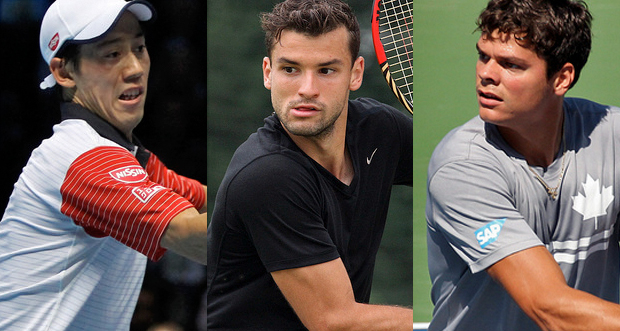
    Kei Nishikori Grigor Dimitrov Milos Raonic

    As the first tournaments of 2015 wrap up, it is almost shocking to think that the Australian Open is just around the corner on January 19. As always, we’ll all be watching the top players with the usual questions: How healthy will Rafael Nadal be and will it be enough to supplant Novak Djokovic at the top of the rankings? Can Novak maintain his focus? Will Father Time catch up with Roger Federer, who turns 34 later this year? Can Andy Murray find his 2012-13 form again? Will Juan Martin del Potro be healthy enough to rise again? And so on.

    But what about the rest of the pack? We focus so much on the “Big Four” and a few dark-horse candidates, while there are a lot of interesting stories and players beyond the big name elite. Let’s take a look at these other players, in particular those who bear watching in 2015 for whatever reason – but mainly as players poised to rise in the rankings. Some may be knocking at the door of the elite, while others may simply be establishing themselves as players to know, while others yet might be potential future stars.

    There are, of course, many other players worth watching – but I wanted to highlight these fifteen as particularly interesting, for a variety of reasons. Let’s take a look.

    [divider]

    Click here to discuss “15 Up-and-Coming Players to Watch in 2015” in the discussion forum.

    [divider]

    THE ALMOST BIG THREE
    Grigor Dimitrov

    Let’s start with Grigor Dimitrov, who may have been so overrated in the past in terms of expectations that he’s now being underrated (although his recent Brisbane demolishing at the hands of Federer is not exactly encouraging). Let us not forget that Grigor has improved in each year he’s been on tour; consider his year-end rankings since 2008: 493, 288, 106, 76, 48, 23, 11. Notice the trend? If Grigor keeps it up in 2015 he will possibly make it as high as the edge of the Top 5. But of course at some point he’s going to even out, and it is hard to imagine him supplanting Novak, Rafa, or even Roger. But it seems that he can beat anyone else, or at least remain competitive among the rest of the near-elites of the game. The problem with Grigor seems to be that, while he’s very good at almost every facet of the game, he doesn’t have any truly killer weapons – and seemingly lacks a killer instinct altogether.

    Prediction: The book is still open for Grigor. He needs something else — a killer shot and perhaps more of a killer instinct — to fully actualize his potential, otherwise he’ll remain more of a pretty player to watch, but not a true elite. In 2015 I think we’ll see continued incremental gains as Grigor creeps into the Top 10. He’ll continue to go deeper in Slams, being relevant at Masters tournaments, with a chance of winning one late in the year (Paris?), eventually earning his way to the World Tour Finals next November.

    Kei Nishikori
    On one hand, we may have seen the best of Kei in 2014. On the other, he seems to keep getting better and better, and of the rest of the field seems like he has what it takes to upset one of the Big Three. Kei is now a legit candidate to win a Masters and a dark horse at the Slams. Whether he has the stamina to make it through remains to be seen; despite his strong year, it should be remembered that he still only made it to the second week once.

    Prediction: Kei settles in within the second half of the Top 10. For some reason Nikolay Davydenko comes to mind – a player that never really challenged at Slams, but won a couple Masters and was always around. Perhaps Kei will have a similar peak.

    Milos Raonic
    At first I excluded Mighty Milos from this list but then I decided that it would be unfair. The big Yugo-Canadian is, quite frankly, a bit underrated at this point. Like Dimitrov it is hard to imagine him beating any of the Top 3 when it really counts, but he did just that versus Roger Federer at the Paris Masters. Milos continues to make small gains, as evidenced by his year-end rankings: 373, 156, 31, 13, 11, 8. If the pattern holds he’ll finish 2015 in the No. 5-6 range. At the least, though, I think Milos is a fixture to hand out in the latter half of the Top 10 for years to come, playing a similar role in the next half decade as Tsonga and Berdych have for the last half decade.

    Prediction: Something good for Milos in 2015. Will it be a Masters? A Slam even? Hard to imagine, but he’s knocking at the door. I think he wins several titles in 2015, maybe even a Masters. He feels close.

    DON’T FORGET ABOUT THE OTHER TWO
    Jiri Vesely & Dominic Thiem

    For some reason I pair these two players. Well, the reasons are pretty clear: they’re of a similar age, on the younger side of “Generation Raoshitrov”; Vesely’s advancement was steady but perhaps a bit disappointing, going from No. 85 to No. 66, while Thiem jumped 100 ranks from No. 139 to No. 39.

    Prediction: I expect continued steady progress from both. Both, I think, will fully establish themselves in the Top 40, and Thiem might even challenge for the Top 20. I think we’re still a couple years away from their peaks, but both should eventually be fixtures in the Top 20 and may even challenge for the Top 10 as players like Ferrer, Berdych, Wawrinka, and Tsonga age themselves out of it. But that’s probably a couple years away.

    THE BOYS ARE GROWING UP
    Nick Kyrgios

    The first of two up-and-comers to beat Rafael Nadal in 2014. Nick Kyrgios is a big kid (6’4”) with a big game and a big serve (14.8 ace %, good for No. 6 among the Top 50); I can’t help but think of Juan Martin del Potro when I see him out there. Ironically enough, the last time a teenager upset the world No. 1 at a Grand Slam was Rafa over Roger Federer at the 2005 French Open. Anyhow, great things are ahead for the Australian – he finished the year at No. 52 up from No. 182 in 2013, so he made quite a jump. He turns 20 years old in April, so still has some room to grow.

    Prediction: Nick makes steady progress but doesn’t quite jump into the elite. That said, he fights for, and at least comes close to, a year-end Top 20 ranking. While he may play the spoiler in 2015 again, he probably won’t be in the mix for big titles until 2016.

    Borna Coric
    No young player has me quite as excited as Borna Coric. I just see him having the highest upside of any player currently on the radar (that is, in the Top 300 or so). We all know him for taking out Rafael Nadal at Basel, but let’s not forget that he also beat Ernests Gulbis in that tournament and lost to red-hot David Goffin in three sets. Coric is for real and his advancement should be steady from here on, although at this point we should remain patient – he did just turn 18 a couple months ago, after all.

    That said, it is important to note that most truly elite players were ranked somewhere in the second half of the Top 100 or so at Coric’s age, and most jumped into the Top 20 the year after. Compare the year-end rankings for recent all-time greats at age 18 and 19:

    Djokovic: 78, 16
    Nadal: 51, 2
    Federer: 64, 29
    Sampras: 81, 5
    Agassi: 3, 7

    (Prior greats – starting with Agassi, but including Becker, Edberg, Wilander, etc., tended to have their break-out a year earlier, with age 17 being the first in the Top 100 and age 18 the big jump; one could speculate that perhaps we’re going ahead another year, with Nick Kyrgios’ trajectory being closer to the norm for elite players – first year in the Top 100 at age 19, big jump at age 20).

    Now compare the next tier down:
    Del Potro: 92, 44
    Murray: 65, 17
    Roddick: 156, 14
    Hewitt: 25, 7
    Kuerten: NA, 188
    Kafelnikov: 275, 102
    Courier: 43, 24

    As you can see, the next tier tends to rise a bit later, or at least more slowly.

    The point here is that if Coric is going to be great—as in an all-time great—then he needs to rise fast. Given the fact that players seem to be taking longer to develop these days with later peaks, I think we can go a bit easier on him and not expect a Rafa-like or Pete-like rise, but for me the benchmark would be a Top 40 or 50 ranking by year’s end. If he makes it into the upper half of the Top 100, then I think it is a sign that he has a chance to be special, even a truly great player. If he sticks around No. 100 or slips out of the Top 100, then we might need to temper our expectations a bit.

    Prediction: Borna will continue to rise, with some bumps in the road, but his overall trajectory will be clear. He finishes somewhere in the No. 40-50 range, although I would be surprised if he wins anything more than maybe an ATP 250.

    Alexander Zverev
    The second youngest player on this list, 17-year-old Zverev finished the year ranked No. 136. That might not sound all that impressive, but consider that of the active players who have ranked in the Top 10, only Tomas Berdych (No. 103), Lleyton Hewitt (No. 100), and Rafael Nadal (No. 49) ranked higher at the end of the year they turned 17. Novak was No. 186, Roger No. 301, and many players weren’t even on tour yet. While we should be moderate in our expectations at this point, it is hard not to get excited about this kid. If Nick Kyrgios and Borna Coric are the top two candidates to be the next elite players, then Zverev is No. 3 and not far behind.

    Prediction: Baby steps. Zverev doesn’t turn 18 until April, so has a lot of room to grow – both as a human body and as a player. I think he has a good shot at the Top 100 this year, but I wouldn’t expect much more than a year-end No. 80-100 ranking.

    OTHERS TO KEEP AN EYE ON
    Ernests Gulbis:
    Long viewed as an underachiever, Ernests (named after Hemingway) had his best year, challenging at one point for the Top 10. But questions remain: After an erratic career, can he maintain his current level? Can he take it a step higher? Or is he in the vein of up-and-down perennial underachievers like Alexandr Dolgopolov and Richard Gasquet? Who knows with Ernests. I suspect he’ll have more upsets like the fourth round French Open victory over Roger Federer, but not be consistent enough to break into the elite. That said, I think he’ll flirt with the Top 10 and maybe dip into it briefly, but then fall back and finish somewhere in the latter half of the Top 20. I’d prefer not to be so specific in my predictions, but for some reason No. 15-18 sounds about right.

    Jack Sock: While it is hard to become too excited about a 22-year old ranked No. 42 and with no titles to his name, consider that Sock is now the fourth highest ranked American and only one of five in the Top 100. Not only that, he’s the youngest American ranked in the Top 200, just a month younger than No. 121 Denis Kudla, and a few months younger than No. 190 Ryan Harrison. But here is where there is some hope: Sock’s rise has been strong and steady – consider his year-end rankings from 2010 to the present: 878, 381, 150, 102, 42. We probably can’t expect Sock to be the next Andy Roddick, but he could be the next John Isner or Mardy Fish.

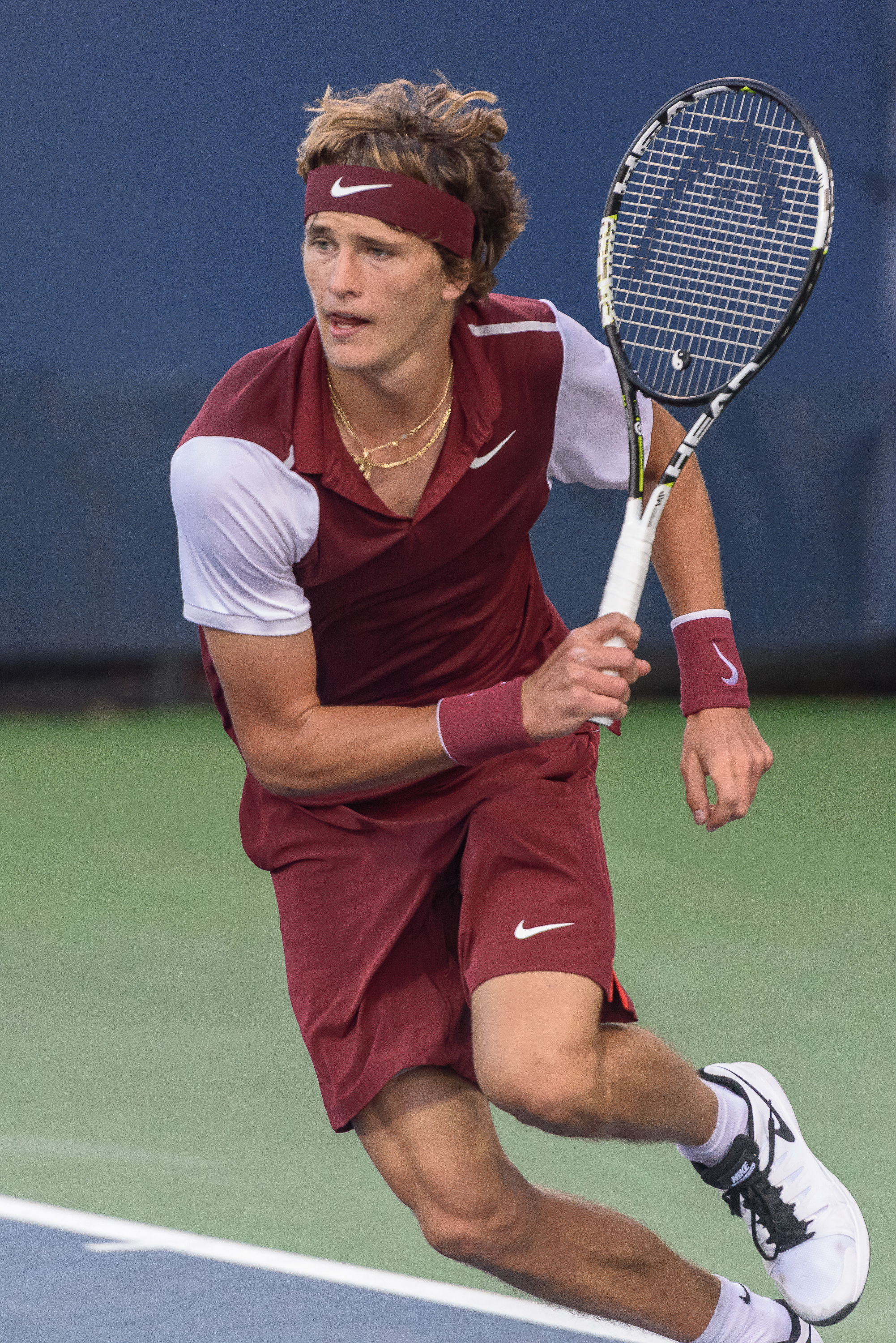
    Stefan Kozlov: Stefan who? Well, a year or two from now he could be front and center in our minds. Who is Stefan Kozlov, you ask? He’s the youngest player to finish in the Top 500 this year at No. 468. No. 468?! Who cares? Well, I care – because Stefan Kozlov was born in 1998. Yes, 1998. Kozlov is 16-years old, turns 17 in February. He hasn’t done much yet, but he did play in the qualification rounds of the US Open, defeating his first round opponent, Mitchell Frank, before losing in three sets to “old man” Borna Coric. Kozlov is a long way away, but I wanted to introduce him as he’s a player worth keeping an eye on. Oh yeah, and best of all, while he’s Macedonia-born, he’s technically American (I know, it feels like cheating – but tell that to the Canadians re: Milos).

    Yoshihito Nishioka: In the shadow of similarly named (at least to a Westerner) top-ranked and fellow Japanese player, Kei Nishikori, Nishioka is 19 years old and ranked No. 156, and could be a real sleeper to break into the Top 100 next year and a player to watch.

    Thanasi Kokkinakis: Another member of the “Class of ’96,” which is turning out to have some talent. Kokkinakis is the third highest ranking teenager at No. 150, behind only Coric and Zverev. Another Australian to watch.

    Jared Donaldson: Ranked all the way down at No. 261, 18-year-old Jared Donaldson is worth mentioning not as much because he’s the sixth highest ranking teenager, but mainly because he’s the highest ranking American teenager; actually, he’s the highest ranking American age 21 or younger, which makes him arguably America’s Great Hope to return to relevance. But let’s check in next year to see where he is.

    Hyeon Chung: Korean-born, the fourth member of the Class of ’96 on this list (along with Coric, Kokkinakis, and Donaldson). I don’t know what his upside is but at No. 173 he’s the highest ranked Korean by a good margin, and well-situated on the career trajectory towards a strong career.

    ADDENDUM: Another 15 to the Mix
    I’d like to add a few more names to keep an eye on. Again, remember that the above list is not meant to be comprehensive, but a the same time I’d be remiss not to give at least an honorable mention to a few others.

    Roberto Bautista Agut: A surprising rise from No. 58 to No. 15 in 2014, can he maintain a top 20 ranking for a few years?
    David Goffin: After a disappointing 2013, Goffin had a tremendous rise in 2014, going from No. 110 to No. 22.
    Jerzy Janowicz: Let’s not forget about Jerzy, but’s he fast becoming a cautionary tale, a least for those of us that got excited a year or two ago. He’s still young enough to turn it around.
    Pablo Carreno Busta: It seemed that he was a cult favorite to be excited about a year ago, but after only a moderate rise in 2014–to a solid No. 49–I think expectations have cooled. Still, he’s a name to get used to as he could be a regular in the top 40 for years to come.
    Dusan Lajovic: Best known for making it the 4R at Roland Garros where he lost to Rafa, but not before beating Delbonis and Sock to get there. I think he’s a sleeper to be a solid player.
    Bernard Tomic: Oh Bernie, it is hard to root for you. You’re like a playboy superstar that isn’t a star. Time to grow up if you want a decent career.
    Victor Estrella Burgos: In contrast to Tomic, how can we not cheer for this guy? Starting on the ATP tour at age 33-34, and he made it as high as No. 65! Who knows what’s ahead but I’m cheering him on.
    Lucas Pouille: Another sleeper – seems talented.
    Luke Saville: Ditto. These guys aren’t future elites, but they are probably future top 50 players.
    Diego Schwartzman: At 5’7″ you’ve got our attention. Seems like another sleeper.
    Elias Ymer, Christian Garin, Roman Safiullin, Andrey Rublev, Gianluigi Quinzi: More young ‘uns to keep an eye on, all born in 1996-97.

    OK, that’s it. The problem with trying to be semi-comprehensive with this second list is that there is no way to draw the line. No Vasek Pospisil? Federico Delbonis? Well, I had to draw the line somewhere and it is “15 + another 15.”