Tag: stefan edberg

  • Open Era Generations, Part Nine: Gen 7 (1964-68) – Mats, Stefan, and Boris

    Open Era Generations, Part Nine: Gen 7 (1964-68) – Mats, Stefan, and Boris

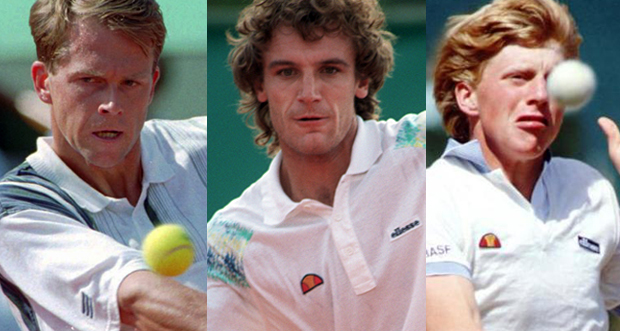
    Stefan Edberg Mats Wilander Boris Becker

    Where the last generation had two all-time greats, this generation had three: Mats Wilander, Stefan Edberg, and Boris Becker, each with very different careers – as we will discuss in a moment. This is the generation that rose in the early 80s and peaked from the mid-80s through the early 90s, although there was only a short gap of years between the reigns of McEnroe/Lendl and Sampras in which they were the dominant generation in the sport.

    [divider]

    Click here to discuss “Open Era Generations, Part Nine: Gen 7 (1964-68) – Mats, Stefan, and Boris” in the discussion forum.

    [divider]

    Best Players by Birth Year
    1964: Mats Wilander (SWE, 7), Jimmy Arias (USA), Miroslav Mecir (CZE/SLO), Henrik Sundstrom (SWE), Jakob Hlasek (SUI)
    1965: Pat Cash (AUS, 1), Guy Forget (FRA), Karel Novacek (CZE), Emilio Sanchez (ESP)
    1966: Stefan Edberg (SWE, 6), Jay Berger (USA), Andrei Chesnokov (USSR/RUS)
    1967: Boris Becker (GER, 6), Thomas Muster (GER, 1), Aaron Krickstein (USA)
    1968: Michael Stich (GER, 1), Petr Korda (CZE, 1), Kent Carlsson (SWE)

    As you can see, seven different players won 23 Slams in all – the most in both categories since the 1934-38 generation.

    Mats Wilander followed in Bjorn Borg’s footsteps, with Sweden winning at least one Slam in every year from 1974 to 1985, and all but two years until 1992 – the end of the Swedish reign and co-dominance with the United States. Wilander was a tender 17-years old at the 1982 French Open and clearly benefited from the absence of Borg. His early rise was quick and fierce; while he only finished No. 1 once, his three-Slam 1988, he was ranked No. 7 or higher from 1982-88, and No. 4 or higher in all but 1982. Wilander’s 1988 was a swan song after which he declined quickly, never even making another Slam final or ranking in the Top 10 until he retired after 1996 – one of the worst declines of any great tennis player.

    Edberg and Becker will likely be forever linked. They are players of very similar career accomplishments, as we will discuss more in a moment when we look at the best players of the era.

    Underachievers and Forgotten Players
    Miroslav Mecir is probably one of the most talented players in Open Era history never to win a Slam. His career was short and bright; if it had been longer, he really could have added a Slam trophy. He played only eight years on tour, from 1983-90, made it to two Slam finals–losing to Ivan Lendl in both–won three Grand Prix (Masters) tournaments and the 1988 Olympics. Perhaps the highlight of his career was winning the WCT Finals in 1987 against John McEnroe.

    Aaron Krickstein was a promising young player who never fulfilled his early success. In 1984 he finished No. 12 at the age of 17. But his career stalled out for several years, until he reached his highest ranking of No. 6 in February of 1990. Krickstein would go on to win six titles but never better than a semifinal result at a Slam. If we look at all players in the Open Era, Krickstein’s career could be the most disappointing relative to his ranking as a 16-17 year old, as we will see in a moment…

    Did You Know?
    Aaron Krickstein was the youngest player to win an ATP title at the age of 16 years and 2 months when he won Tel Aviv in 1983, a record that remains to this day. He is also one of only three players in the ATP Era (1973-present) to finish in the top 100 as 16-year olds, along with Andre Agassi and Michael Chang, and one of only four to finish in the Top 20 as 17-year olds along with Agassi, Chang, and Borg.

    Top Ten Players of the Generation

    1. Boris Becker
    2. Stefan Edberg
    3. Mats Wilander
    4. Thomas Muster
    5. Michael Stich
    6. Petr Korda
    7. Pat Cash
    8. Miroslav Mecir
    9. Guy Forget
    10. Aaron Krickstein

    Honorable Mentions: Emilio Sanchez, Andrei Chesnokov, Karol Novacek, Jakob Hlasek, Jimmy Arias

    Ranking the top three is difficult, with valid arguments for any of them to be at the top. Wilander had the best year in 1988, and won one more Slam than the other two, but declined very young. Becker had the longest range of Slam titles but was less consistent year in and year out than Edberg, and never finished the year as the No. 1 player. Their match-up is “Fedalian” in terms of how lopsided it was (Becker led it 25-10), but Edberg held the edge in Slams (3-1) and ATP finals (1-0) and of course had two year-end No. 1 rankings.

    Really it is 1a, 1b, and 1c, or perhaps 1a, 1b and 3, with Wilander a step behind the others. These three players peaked during one of the most competitive eras in men’s tennis, when Connors, McEnroe, and Lendl were still elite players, and Sampras, Agassi, and Courier were rising to the top. When I started writing this series I gave Edberg the edge, but have since given it to Becker because, if you look below the surface, Becker has the edge in a number of ways. While both won six Slams, Boris had two more years in the Top 10 than Stefan, and also won two more ATP finals and five more Grand Prix/Super 9 (Masters equivalent) tournaments, with a superior overall record in title finals: 49-28 compared to Edberg’s 42-38. Becker was also a much better player against Top 10 opponents, with a career 65.1% vs. Edberg’s 45.7%.

    To put the comparison of the three graphically, I used one of my various statistic systems called “Title Shares,” which imagines that the big tournaments–all four Slams, the tour finals, and the Masters–equal 100 total shares for a given year, or 14 for each Slam, 8 for the ATP year-end championships, and 4 for each Masters. This system then adds 1 point per other title (ATP 250 and 500), and in the case of the WCT year-end championships, 5 extra points; consider these all to be “extra credit.” Now this system makes more sense in recent years, as the ATP structure has been more consistent, but it gives you an idea of the different trajectories of the three players and their relative dominance:

    20151229052337

    As you can see, Wilander was more dominant overall through 1988, which turned out to be a final supernova after which his career sputtered and faded. Edberg was a force from 1985 on, with his best phase in the early 90s. Becker was also relatively strong from 1985 on, but where Edberg faded in 1993, Boris had a resurgence from 1994-96 that strengthened his overall legacy.

    After the Big Three, there’s a steep drop-off to Thomas Muster, but he’s a solid No. 4. Muster is best known for being both a great clay-court player but also an incredible competitor in finals. He has an overall 44-10 record in ATP finals, or 81.5% – far ahead of anyone else. Nikolay Davydenko is number two with a 21-7 (75%) record in ATP finals; Borg has the best among all-time greats, with a 64-24 (72.7%) record.

    Michael Stich was a very good player for, unfortunately, a rather short length of time. He is best known for upsetting Boris Becker in the 1991 Wimbledon final. A comparable recent player would be Juan Martin del Potro. Pat Cash is solidly No. 6, and then Korda and Mecir are harder to rank. Korda has the one Slam but Mecir was probably a better player. He was, in some ways, the Robin Soderling of his generation – very good for a too-short period of time, his career ended prematurely by injury. The last two spots go to Forget and Krickstein, with Emilio Sanchez and Andrei Chesnokov just missing the cut.
  • National Tennis Careers – Part Two: Sweden

    National Tennis Careers – Part Two: Sweden

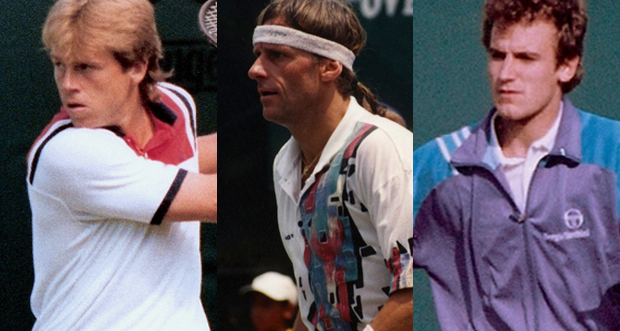
    Stefan Edberg Bjorn Borg Mats Wilander

    ONCE UPON A VIKING…

    Of the five great tennis nations covered in this series, three are no longer what they were: the United States, Australia, and Sweden. Whereas American dominance spread out over the majority of the Open Era in two great, interconnected eras, Swedish dominance was comparatively short – but equally dominant, at least for a time. It started with the rise of Bjorn Borg, who won his first major in 1974 and became the game’s top player by 1978, and ended with Stefan Edberg’s last Slam title in 1992. Outside of that range, only one Slam title belongs to a Swede: quintessential one-Slam wonder Thomas Johansson’s Australian Open in 2002.

    Let’s take a look at the Swedish career:

    Sweden Career

    As you can see, I split the chart differently than with the United States. The top chart includes the careers of Borg and Wilander, and ends with the last Slam won by Edberg. The bottom half sees the swift decline of Swedish tennis, with that lone major title in 2002.

    Swedish tennis was almost entirely ruled by three players: Bjorn Borg, Mats Wilander, and Stefan Edberg who, together, account for 24 of the 25 Slams. But they weren’t the only talented players during the 1980s in particular. Henrik Sundstrom, Anders Jarryd, Joakim Nystrom, and Mikael Pernfors all finished in the Top 10 at least once. Once we get to the 1990s we have players like Thomas Johansson, Magnus Gustafsson, Magnus Larsson, Jonas Bjorkman, Magnus Norman, and Thomas Enqvist.

    In the early 2000s, several promising young Swedes emerged: Andreas Vinciguerra, Joachim Johansson, and Robin Soderling. Vinciguerra is a name that you might not know, but he came of age around the turn of the millennium with other promising players born in the early 80s. If you look at the 1999 rankings, there were five teenagers who finished the year in the Top 100: Marat Safin (No. 24), Lleyton Hewitt (No. 25), Juan Carlos Ferrero (No. 42), Roger Federer (No. 64), and Vinciguerra (No. 98). Whereas the other four went on to win Slams and be No. 1s, Vinciguerra—still on pace to be a great player in 2001, rising as high as No. 33 at the age of 20—saw his career derailed by a back injury.

    [divider]

    Click here to discuss “National Tennis Careers – Part Two: Sweden” in the discussion forum.

    [divider]

    Similarly, Joachim Johansson rose as high as No. 9 and finished 2004 at No. 11 at the age of 22, but struggled with a shoulder injury and eventually retired in 2008. We are all more familiar with Soderling, who is one of only two men to defeat Rafael Nadal at Roland Garros, and unlike Novak Djokovic this year, Rafa was in his prime in 2009. From 2009 into 2011, Soderling was lingering on the edge of the Big Four, but was hit by mononucleosis and hasn’t played since late 2011, although has not officially retired. So in the post-Edberg/Wilander world of Swedish tennis, Thomas Johansson’s Australian Open title in 2002 was a lone bright spot, with lesser glimmers of unfulfilled promise by several Swedes in the last fifteen years.

    Ten Greatest Swedish Players of the Open Era
    1. Bjorn Borg
    2. Stefan Edberg
    3. Mats Wilander
    4. Thomas Enqvist
    5. Thomas Johansson
    6. Robin Soderling
    7. Jonas Bjorkman
    8. Magnus Norman
    9. Anders Jarryd
    10. (tie) Joakim Nystrom and Magnus Gustafsson

    Honorable mentions: Magnus Larsson, Jonas Svensson, Henrik Sundstrom, Mikael Pernfors, Kent Carlsson, and Joachim Johansson.

    The top three are not really debatable, although some would quibble with ranking Edberg over Wilander. Wilander had a higher peak, namely the 1988 season, and of course has one more Slam than Edberg. But both made 11 Slam finals, Edberg just lost one more, and this is more than balanced out by Edberg’s five more Semifinals and much greater consistency in the rankings. Wilander had one year-end No. 1 ranking, Edberg two; Wilander had seven to Edberg’s ten Top 10 rankings and eight to Edberg’s thirteen Top 20 rankings.

    There’s a big drop after the Tre Stora, and here is where the debate can come in. The system I used likes Enqvist quite a bit better than the rest, but some would prefer Thomas Johansson’s Slam title or Robin Soderling’s higher peak. Certainly if Soderling hadn’t gotten mono he’d probably be fourth on this list. Some might also prefer Jonas Bjorkman at fourth, who like Anders Jarryd was a No. 1 ranked doubles player, but it is hard to argue with Enqvist’s 19 titles versus Bjorkman’s six. Jarryd, Norman, Nystrom, and Gustafsson are almost too close to rank.

    The Future?
    Consider that since 2008, Robin Soderling has been the only Swede ranked in the year-end Top 100. Yes, that’s right. Since 2012 there have been no Swedes in the Top 100.

    But there’s hope, and his name is Elias Ymer. He’s 19 years old and as of this writing, currently ranked No. 130. Interestingly enough, Ymer isn’t your typical blond-locked Scandinavian; he’s of Ethiopian descent. Along with 23-year-old Christian Lindell (No. 188), he’s the only Swede ranked in the Top 400. Elias’ 16-year-old brother, Mikael, is also worth storing in your memory banks, but he’s a long ways off.

    Elias Ymer qualified for his first Slam main draw at Roland Garros this year, losing to Lukas Rosol in straights in the first round. Yet here is something promising: at the ATP 500 Barcelona, he beat Thiemo de Bakker and Nick Kyrgios before losing to David Ferrer in the round of 16. Kyrgios, No. 41 at the time, remains the highest ranked player he has defeated.

    So Ymer bears watching, although we should temper our expectations – there is no new Swedish golden age of Borg, Wilander, and Edberg on the horizon, but at least there’s someone. According to Magnus Norman, Swedish tennis has reached rock bottom and can only go up. Truly, there’s nowhere else it can go.

    [divider]

    Cover Photo (Creative Commons License): Carine06 / MadMarlin / Carine06

  • The Wave of New Coaches on the ATP Tour: A Breath of Fresh Air for 2014

    The Wave of New Coaches on the ATP Tour: A Breath of Fresh Air for 2014

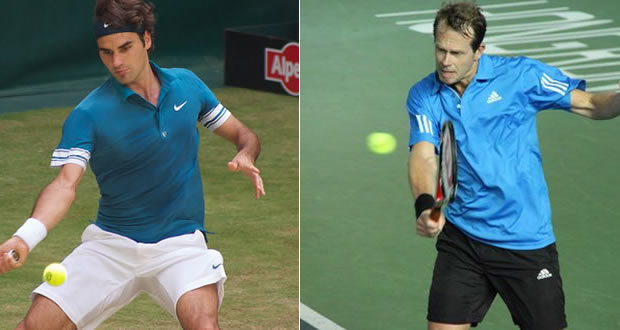
    Edberg and Federer

    It is with lots of interest in all media especially social media that we read of the new additions on the men’s side. What is striking is the fact that all of the coaches that are hired were superstars from the 80′s and 90′s. It started with Murray hiring Ivan Lendl and we can clearly see the improvement since Lendl joined the Murray camp. Now Roger Federer has hired Stefan Edberg, former number 1 serve and volley expert from Sweden, and Boris Becker is hired by Novak Djokovic, another specialist at the serve and volley game. Connors was hired some years back by Roddick and lately Connors briefly worked with Sharapova.

    As a former Top 10 player, I have firsthand knowledge of all of these guys since I played them many, many times. In fact, I predicted that Boris Becker will win Wimbledon in 1985 after he beat me in the finals of Queens in London. He did. I beat Stefan Edberg at Wimbledon when he was making his debut from the juniors, although that win was in five sets and one of my best ever comebacks from two sets down. I lost to Lendl in the 1986 semis at the French Open so I have intimate knowledge of their games and being around them for decades, one gets to know their thinking…

    You may ask yourself, why are these top guys hiring guys who played totally different styles than them? Here are my answers:

    1. Besides a new fresh pair of eyes, it is exciting to have a new guy at your side, which brings the desire up to perform and that is hugely important. Desire is a must!

    2. The men’s tour has become so brutally physical that players are thinking about how to shorten points. These coaches played 90% of their points “short”. Meaning serve and volley, chip and charge, etc. That was their state of mind. Roger and Novak are looking for some of that. (More on this aspect later in this blog.)

    3. Publicity for the “team” brings a whole new flavor to their camp. It is all good! Their sponsors like it, the fans like it, and with the explosion of “immediate news” on social media, it is all good!

    I will break down the different “celebrity” coaches here from Connors to the sudden hiring of Edberg and Becker.

    Connors is an absolute icon in our sport. A tough guy, with a very hard edge, who won more ATP tournaments than any man on this planet! It was the perfect “American story” for Andy Roddick to have hired Jimmy when Andy was on the verge of being more dominant. The heartbreaking final against Roger at Wimbledon was perhaps the moment that extinguished that “flame”. None of us will know when it happens but I suspect that match really affected Andy. That type of relationship has very little to do with a new “technical improvement” rather the player is looking for that extra mental boost that may help them reach a little higher. No guarantees that would happen.

    Ivan Lendl joining Andy Murray was the perfect fit in my opinion. Andy Murray was “bridesmaid” to Roger and Rafa for a number of years, and it was beginning to look like he would not be able to get “over the hump” mentally at Majors in particular.

    Ivan was in that same position for years. He was in the finals of eight Majors before he won his first! Remember Brad Gilbert, who coached Andre Agassi with great success and was hired by Murray via the LTA in England to help Murray? It did not work! Why? Murray did not have the same respect for Gilbert as he has for Lendl. It was so obvious that it was embarrassing at times at tournaments and the relationship ended shortly after that. Lendl helped Murray understand what it will take mentally to get his first Major win and he did! Now Murray has a US Open, an Olympic gold medal, and a Wimbledon title under his belt. Murray also just came off back surgery so he has issues physically. He may have to start thinking about shortening points…

    Federer hiring Stefan Edberg is another smart move after a long stint with another serve and volley expert, Paul Annacone. But since Roger slid in the rankings to No. 7, it was the right time for a change of scenery. It happens all the time. Edberg is the consummate gentleman of our sport. An eight time Grand Slam champion, he knows how to move forward to the net and is a very cool cucumber. A perfect mental fit to help Roger understand how to shorten points and what it takes to perhaps serve and volley a little more. It is all about finding that “little edge”. None of these coaches are hired for a new forehand or backhand, but certainly could be of great assistance in the volley area, movement, and reading skills at the net, and how to be a little smarter about attacking at the right time and the surprise effect of coming to the net. This is a great fit for Roger. I think Roger bends his elbow too much on his backhand volley and gives it too much “chop” at contact. It would be interesting to see if Edberg helps him shorten his backhand volley preparation to be more solid. There, I criticized Roger!… 🙂

    Djokovic hiring Becker was another surprise! I was with Becker and Edberg at Richard Branson’s fundraiser on Necker Island a few weeks ago, and had a conversation with both of them. None of them let on what they were up to for 2014.

    Novak is an incredibly gifted athlete that has all the stuff physically and mentally. His volleys are not his stronger shots but again, I think him hiring Becker points to a “fresh” start with new excitement in trying to be more aggressive with a new team member. It is all about finding that extra mental edge at this high level. Novak is looking to be No. 1 again after Rafa snatched it back at the end of the season.

    David Ferrer just fired his longtime mentor/coach. Perhaps the best player out there today who may never win a Major unless he adds a little more risk in coming to the net. Ferrer has all the stuff mentally. His serve has improved but I think he can still improve on his serve a little and coming forward will be necessary. Like they say, no risk, no reward. I am a huge fan of Ferrer. I certainly hope he can add a Major to his mantle. But it will require him to risk a lot more and to throw the “kitchen sink” at those moments in big matches where he used to play “not to lose” and then did lose. Perhaps play closer in to the baseline and risk blistering shots down the line from closer in and follow it in… Again, no guarantees but that is the only way to get the rewards.

    Rafa needs no “celebrity” coach. He is a simple thinker, is perhaps the best “self-motivator” out there. Uncle Toni is there and I do not see any changes in the family set-up. They “tinker” with his game all the time, and I suspect that if the Nadal camp see improvements from Roger and Novak in shortening points, they will follow suit.

    I, for one, will be watching closely in 2014. Adding these coaches will be interesting to see if any changes “sank in” and will bear fruit! Go at it, guys!

  • Federer and Edberg Hook Up (Now Official)

    Federer and Edberg Hook Up (Now Official)

    Stefan Edberg has officially joined the Roger Federer coaching team for the 2014 season. The Swedish legend will travel with the Federer camp for around 10 weeks during the forthcoming year.

    Federer has described Edberg’s role in the context of providing inspiration and bringing a fresh pair of eyes to the camp rather than providing specific coaching.

    “I am sure he can bring a different angle to my game which is interesting,” stated Federer.

    Edberg, 47, is a former world No. 1 who won six singles and three doubles Majors, and has been described as a “childhood idol” by Federer during his formative years.

    The appointment comes on the heels of Novak Djokovic hiring Boris Becker as head coach. A third legend of the period, Ivan Lendl, has already had considerable success coaching within the Andy Murray camp.

    Edberg will join Federer initially in Australia. The appointment coincides with the Swiss maestro’s decision to try a racquet with a bigger frame at his first Brisbane International.