Tag: stan wawrinka

  • Barclays ATP World Tour Finals – Day 3 – Schedule of Play and Results

    Barclays ATP World Tour Finals – Day 3 – Schedule of Play and Results

    WTF - Day 3

    Barclays ATP World Tour Finals – Day 3: Schedule of Play (Scores added as known)

    CENTER COURT — Start 12:00 P.M.

    [6] David Marrero (ESP) / Fernando Verdasco (ESP) d [7] Leander Paes (IND) / Radek Stepanek (CZE) — 6-4, 7-6(5)

    Not Before 14:00

    [1] Rafael Nadal (ESP) d [7] Stanislas Wawrinka (SUI) — 7-6(5), 7-6(6)

    Not Before 18:00

    [2] Alexander Peya (AUT) / Bruno Soares (BRA) d [4] Marcel Granollers (ESP) / Marc Lopez (ESP) — 3-6, 6-4 [10-5]

    Not Before 20:00

    [5] Tomas Berdych (CZE) d [3] David Ferrer (ESP) — 6-4, 6-4

  • Barclays ATP World Tour Finals – Day 1 – Schedule of Play and Results

    Barclays ATP World Tour Finals – Day 1 – Schedule of Play and Results

    2152191568_4dd68fbdda_z e

    Barclays ATP World Tour Finals – Day 1: Schedule of Play (Scores added as known)

    CENTER COURT — Start 12:00

    [8] Mariusz Fyrstenberg (POL) / Marcin Matkowski (POL) d [5] Aisam-Ul-Haq Qureshi (PAK) / Jean-Julien Rojer (NED) — 6-3, 7-6(8)

    Not Before 14:00

    [7] Stanislas Wawrinka (SUI) d [6] Tomas Berdych (CZE) — 6-3, 6-7(0), 6-3

    Not Before 18:00

    [6] David Marrero (ESP) / Fernando Verdasco (ESP) d [3] Marcel Granollers (ESP) / Marc Lopez (ESP) — 6-1, 6-4

    Not Before 20:00

    [4] Juan Martin Del Potro (ARG) d [8] Richard Gasquet (FRA) — 6-7(4), 6-3, 7-5

    Cover Photo (Creative Commons License): Mark Spurgeon

  • Small Miracles

    Small Miracles

    Paris SF Rafa Roger Novak Ferrer

    Paris Masters, Quarterfinals

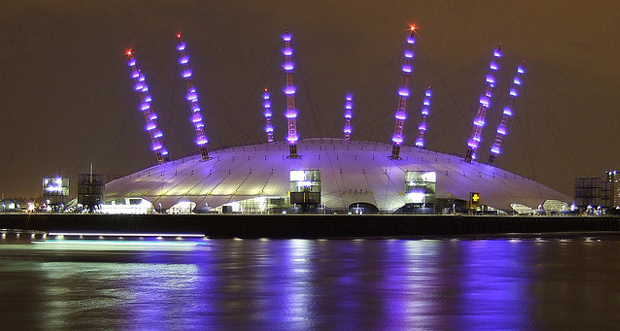
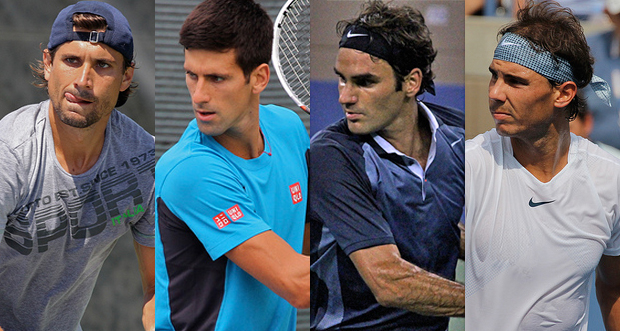
    It is rare at any level for the top eight seeds to populate the quarterfinal stage of a tournament, a result that was guaranteed the moment Rafael Nadal defeated Jerzy Janowicz in the last of the Paris Masters fourth round matches. At Masters level this hadn’t occurred in over four years. More intriguing still was the fact that the last eight men remaining at the Palais Omnisports de Paris-Bercy were the same eight who’ll descend upon London’s O2 Arena next week for the World Tour Finals.

    Apparently such a miracle has never happened before, although if it was going to, this was probably the year for it. Coming in to this week, three qualification spots remained open, meaning that a number of men had every reason not only to turn up but to give their best effort, which is precisely the kind of effort that can be lacking at this tournament. Added interest came in the form of Roger Federer, who was prominent among those yet to qualify. By winning his first round match against Kevin Anderson he took care of that, and yet another comfortable victory over Philipp Kohlschreiber saw him attain the quarterfinals. By joining him at that stage both Stanislas Wawrinka and Richard Gasquet ensured their spots in London as well, although whether they’ll do much more than make up the numbers is a nice question. The very best players seem uncharacteristically committed this year.

    Novak Djokovic lost to Sam Querrey in strange circumstances last year, withdrew the year before after proving he cannot lose to Viktor Troicki under any circumstances, and fared badly against Michael Llodra the year before that. Yet this week he has hardly looked like losing or withdrawing. Indeed, through the first set of his quarterfinal against Wawrinka he seemed reluctant to give up points. The Swiss had an early chance to recover an even earlier break, didn’t take it, and was reduced to spectating for the next twenty minutes. The second set was tighter, especially at the start, but Djokovic always had it well in hand.

    Nadal often doesn’t turn up in Paris at all, as a culmination of his disinclination to contest any of the other European indoor events that precede it. One can understand his disinterest, given that conditions don’t suit his game, and he hardly needs the points. He has won precisely one indoor hard-court title in his career (Madrid 2005). But in a season in which he cleaned up the American summer and went undefeated on hard courts until September, who is to say he cannot win the Paris Masters? Gasquet certainly had little say in the matter, thrashed four and one in just over an hour. There was a belief that the last three rounds in Bercy would provide a preview of what to expect in London. It seems that this is the case.

    Many are convinced Nadal will not only win Paris, but the World Tour Finals as well, thereby tripling his collection of indoor titles. One viewer took the trouble to email Sky Sports to that effect, adding, however, that she would be equally happy if Federer never won another match. Marcus Buckland and Barry Cowan professed themselves shocked by this, suggesting neither man spends much time on the internet, which is largely powered by schadenfreude and self-importance, and is thus self-sustaining. Wishing catastrophe on total strangers based on perceived minor transgressions is an even more popular online hobby than charmless grandiosity, though the two are easily combined.

    Cowan confessed he did not understand how anyone could actively dislike watching Federer play, even if for whatever reason you do not care for him off the court. Buckland invited the viewer to email in their reasons, which they naturally did. It turned out to be the usual tedious guff about arrogance and poor losing. Ho-hum. Cowan still didn’t get it. To his credit I’ll hazard that the reason for his confusion is that he fundamentally doesn’t grasp how many ostensible tennis fans are a fan of a particular player more than they’re a fan of the sport. For all Cowan’s manifold shortcomings as a commentator and a player, the fact that he was a professional sportsman means that only a tiny portion of his engagement with tennis concerns any particular player. For the fan who emailed in, and many others just like her, the opposite is true. Their approach to professional tennis is primarily concerned with the deification of their favourite player, and the revilement of whichever players they’ve been taught are diametrically opposed. You’ll observe that fanatics always reserve their unkindest hopes for rivals. No one wastes time wishing Ivo Karlovic never wins another match.

    It was another reminder, as if more were needed, that many sports fans are dullards who cannot function without a depressing little assortment of heroes and villains, and that these roles are by necessity cast within very tight parameters. Thus, say, the soft-spoken and sardonic Robin Soderling is a villain, held by some to be morally on par with Timothy McVeigh. The reality is that most of us encounter considerably worse people than any professional tennis player every time we leave the house, or even when we don’t. You can hear the squalid thoughts of the ethically bankrupt merely by switching on commercial radio, and after listening to many politicians speak you’ll want to take a dip in the septic tank just to feel comparatively clean. Remember the supposed falling out between Federer and Nadal at the beginning of last year over the ATP Player Council? I must have attended half a dozen more acrimonious meetings than that in the last month, and am daily obliged to shake hands with far bigger wankers than any man in the Top 10. As far as I can make out, and for all that it matters, all the top players seem like pretty nice people.

    The fan who’d emailed Sky Sports can’t have been happy with Cowan’s mystified response, and was surely brought to a high simmer by the subsequent coverage, which was unabashedly Federer-centric. “I’m not even looking at del Potro right now,” declared Andrew Castle in commentary as the second quarterfinal commenced, “All my focus is on Federer!” He went on to add that for him Federer was the story of the next twelve to eighteen months in men’s tennis, which seemed rather disrespectful to Philipp Kohlschreiber, who is poised to commence his audacious run to the No. 1 ranking. (Mark my words.) It was also somewhat disrespectful to del Potro, who has been in tremendous form of late, and will be a legitimate title-contender in London next week. He at least deserved a look-in.

    It was clear as the first set proceeded that Federer wasn’t about to give him one. Federer was quite magnificent, hitting seventeen winners to just four errors and comprehensively shutting down the forecourt. It was almost enough to justify the presumption that Federer would was eager for another shot at del Potro so soon after the Basel final. His success against tall, powerful players traditionally entailed exploiting their lack of agility with constant variations of spin, width, and depth. Del Potro admittedly moves superbly for a man his height, but compelling him to lunge, dip, and pivot is still a wiser strategy than trying to trade lusty blows from the baseline. Federer’s first set was a testament to this: 47% of his backhands were slices, the kind of figure he used to post when dispatching the arch-villain Soderling. Unaccountably he went back to hitting over his backhand more in the second, although until 4-5 he remained untroubled on serve. Del Potro so far had had an awful day on return, but at this moment unleashed his biggest forehand, and subsequently broke to take the set. The third set was patchier, with a string of breaks each way. Federer steadied quicker, and eventually served it, to his evident relief and the visceral disgust of at least one fan. Del Potro didn’t appear particularly fazed. If anything he’d looked a trifle fatigued as the match wore on, and I imagine the longer rest will do him a power of good.

    Federer has now posted just his second win over a Top 10 player for the season, offset by five loses. Andrew Castle reminded viewers that by the end of next week he might conclude his season with a more respectable win-loss tally of 9:5, assuming he defeats Djokovic in the semifinals, Nadal (probably) in the final, then everyone in London. This seems rather a generous assumption to make, even by Castle’s standards. We were also reminded that Federer has now beaten at least one Top 5 opponent at least once in each of the last fifteen years. It seemed a strange point to belabour, since he is after all Roger Federer. He is not Philipp Kohlschreiber, although soon Philipp Kohlschreiber won’t be, either. Mark my words.

  • Djokovic Outlasts Wawrinka in the Semifinals; Sets Up Nadal Rematch

    Djokovic Outlasts Wawrinka in the Semifinals; Sets Up Nadal Rematch

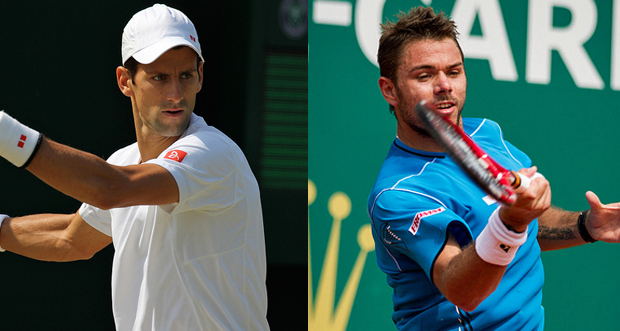
    Novak Djokovic overcame an overall lackluster performance, and an onslaught from Stanislaw Wawrinka to prevail in a thrilling 5-set match, 2-6, 7-6(4), 3-6, 6-3, 6-4.

    It was a roller-coaster ride of a semifinal.  Wawrinka, the still-but-perhaps-not-for-long Swiss No. 2 came out strong and broke Djokovic three times in the first set.  He went up a break in the second, but Djokovic broke back, and sent the set into a tiebreak, which the world No. 1 snatched up.  The Swiss took the third set on one break, and Djokovic the fourth via the same.  Also in the fourth set, Wawrinka had a medical timeout for an injury to his upper-thigh, and did seem to be hampered the rest of the match.

    [divider]

    Click here to discuss the Nadal/Djokovic final in our discussion forum.

    Click here to discuss the Nadal/Gasquet semifinal in our discussion forum.

    Click here to discuss the Djokovic/Wawrinka semifinal in our discussion forum.

    [divider]

    The stakes were raised in the fifth set.  At 1-1, with Wawrinka serving, they played a nearly 21-minute, 30-point game.  It was taken to deuce 12 times, with Djokovic having five break chances.  In the end, Wawrinka held, but it seemed to be all he had left.  Djokovic broke at 2-2 and ran away with it.

    After the match, Djokovic said:  “I think it was obvious Stan played more aggressive; he played better tennis over all,” adding, “I was glad I was able to find my best tennis when I needed it.”

    In the second semifinal of the day, Rafael Nadal beat Richard Gasquet with his B-Game, 6-4, 7-6(1), 6-2.  While Gasquet came up with some showy tennis at times, and Nadal was having trouble finding the lines, the best Gasquet can say is that he broke Nadal’s serve for the first time in the tournament.

    The win assures Djokovic that he holds his No. 1 ranking for the time being, and sets up his 37th match with his rival Nadal — an Open Era record for most matches played.  The Spaniard currently leads the head-to-head 21-15.  They will play for the trophy on Monday.

  • Masterclass Match of the Day: Novak Djokovic vs. Stanislas Wawrinka

    Masterclass Match of the Day: Novak Djokovic vs. Stanislas Wawrinka

    A Breath of Fresh Air, Or The Same Old Song?

    As we approach the business end of the US Open, some of the same top names appear in the semifinal matches.  Race to London leader and world No. 2  Rafael Nadal continues to be on a tear, and the current No. 1 player in the world, Novak Djokovic, marches on.  But their opponents are in rather new territory.  Current world No. 8, Richard Gasquet, has never made it past the Round of 16 at the US Open, and has only made it to the semifinals of a major once in his career at Wimbledon 2007.  He has the tough task of taking on Rafael Nadal.  Stanislas Wawrinka has never made it past the quarterfinals of any major and faces Novak Djokovic, but I believe Stan’s recent play this year warrants him having a fair chance of upsetting the world No. 1 of the last two years.

    Let me put it this way: I wouldn’t put my own money on this match if I were a betting man.  But if I had some money given to me, I would put it on Stan Wawrinka and hope he plays as well as he did against Andy Murray.

    [divider]

    Discuss this article and the match with fellow tennis fans in the forum.

    [divider]

    Novak Djokovic has certainly dominated their head-to-head in the past, but every match is different.

    Based on their prior record, few if any would have picked Stan to come as close as he did in Australia to removing the three-time Plexicushion prize-winner from the premises.

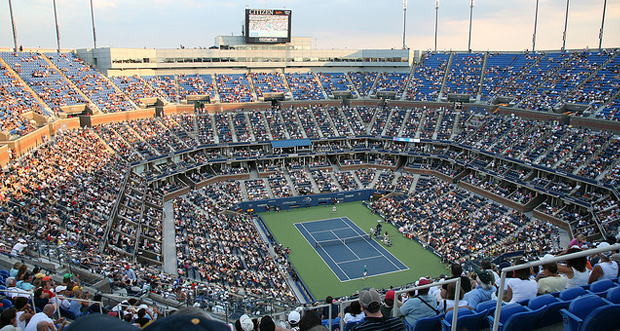
    I think these days the US Open Arthur Ashe Stadium surface unfortunately plays only slightly faster than the Australian Open’s Rod Laver Arena.  It seems to have a little less grit and not quite as high a bounce.  I don’t see Djokovic sliding as much in New York as in Melbourne.  I think this will reduce Novak’s ability to defend as well as he does down under.

    Novak has been prone to concentration lapses this year.  Hard courts are no longer a bastion of certainty as they had been for the most part since 2011.  How has he done on hard courts this year?

    He started out extremely well by winning the Australian Open and Dubai.  But then something happened.  He allowed Juan Martin Del Potro to come from behind and beat him in the semifinals at Indian Wells, and followed that up with a Round of 16 straight-set loss to Tommy Haas.  His next hard court tourney was in Montreal, where he lost to Nadal in three sets in the semifinals, and followed that up with a three-set loss in Cincinnati to John Isner.

    Again, every match is different.  But Djokovic’s recent trend does not bode as well for him.

    Thus far at the US Open, he has not played any difficult opponents, easily beating unseeded opponents Berankis, Becker, Sousa, Granollers, and No. 21 seed Mikhail Youzhny in four sets.  I think the rather weak draw thus far might not be to his benefit.

    Wawrinka had not played that much on hard courts this year, choosing to focus on clay.  Aside from his Round of 16 loss to Djokovic at the Australian Open, he lost a tough one to Federer in the Round of 16 in three sets at Indian Wells, and lost to Paire and Robredo in the Round of 32 at both Montreal and Cincinnati.  So his preparation for the US Open definitely has been light.

    However, thus far in the US Open, his path has been rather difficult, and I believe it has only benefited him and he has improved his play as the tournament has progressed.  He beat Stepanek while dropping a set, defeated a tough Karlovic in a not so easy three sets, held off a tenacious Baghdatis in four sets, stepped it up another level to down Berdych who had been playing very well, and, as many saw, played a very intelligent and strong match to down Andy Murray in three sets. Thus, I feel Stan Wawrinka is much better prepared in terms of his play for this match with Djokovic.

    I think the match up is quite similar as to the one with Andy.  Stan must play with variety to Djokovic as he did with Murray, and not let Djokovic get into any good rhythm.  I think Stan would do better to go to body serves against Djokovic, since he stretches so well to get to balls.  Nole must try to get Stan into a power struggle from the baseline for him to have a good chance.

    Andy beat Novak last year in five sets at the US Open.  Stan beat Andy this year in three sets.

    I believe Stan could force Nole out in three or four sets if he plays like he has been considering the level of opponents they have both played and their level during this tournament, and if he can use similar tactics and execution as he did against Murray.

    The only problem with Stan is lack of a strong mental stability.  He has been known to suddenly go walkabout or get down on himself and go away in a match.  Additionally, one cannot be certain that he will not have a bit of  letdown after beating Andy.  These are the chief reasons why I would not bet money on the match, if I were a betting man.  Also, Nole has been known to raise his game occasionally and refuse to lose.  So though I stick by my call, I would never be surprised to see Novak Djokovic win.

    As always I hope for a good, entertaining match and wish good luck to both players and their fans!

  • All Manner of Absurdity

    All Manner of Absurdity

    US Open, Quarterfinals Recap

    The US Open, an entity which I contend boasts not only impish sentience but an eye for proportion, thoughtfully balanced a pair of men’s quarterfinals that more or less lived down to expectations with two others that could have hardly conformed less. Two predictable blowouts and two extravagant upsets: what could be more formally elegant? There was a brief period in the last of these encounters, as Mikhail Youzhny stole a set from a momentarily unfocussed Novak Djokovic, when I feared this graceful symmetry might be fractured, or, more worryingly, that I might have to rewrite this opening paragraph. Fortunately the world number one steadied magnificently, and I was able to salvage my broader point, such as it is. For all that I would have enjoyed an audacious comeback from Youzhny almost as much as the tennis-starved punters in Arthur Ashe Stadium, I’d prefer it didn’t cost me whole minutes of work.

    [divider]

    Click here to discuss “All Manner of Absurdity” and more in our discussion forum.

    [divider]

    It’s a nice question whether Richard Gasquet defeating David Ferrer in five sets constitutes a more surprising upset than Stanislas Wawrinka beating Andy Murray in straights, leaving to one side the question of which was the more upsetting surprise. If one were writing a screenplay, which result would cause viewers suddenly to rediscover their disbelief, and simply walk out? Cinema audiences will put up with all manner of absurdity – midi-chlorians, Nicholas Cage – but there are limits. This is the US Open, not Wimbledon. It would probably be more convincing had the scores been swapped: Wawrinka might have prevailed in a tough grind, while an incandescent Gasquet might conceivably have swept the formless Ferrer aside quickly.

    (2) Nadal d. (19) Robredo, 6-0, 6-2, 6-2

    It was always likely that Rafael Nadal would make short work of his quarterfinal, given his exalted hardcourt form and Roger Federer’s exit in the fourth round. But the fact that he was facing a veteran who’d never progressed beyond this stage of a Major in several dozen attempts put it almost beyond doubt. Realisation that this veteran was a compatriot of Nadal’s removed even that modicum of uncertainty. Add in a single-handed backhand and it was hard to see how the encounter would stretch far beyond eighty-minutes. The opponent was Tommy Robredo, who’d done such a sterling job two days earlier in providing a sturdy platform for Federer to ritually disembowel himself on. Robredo brought a similar commitment into his match with Nadal – standing way back, looping groundstrokes, and retrieving like a terrier – with the result that he won five whole points in the opening set. These points sadly weren’t clumped such that they equated to a whole game. Forget eighty minutes — maybe it wouldn’t last the hour.

    The next two sets were marginally more competitive, but such terms are relative, and it was never a contest. Before the match Nadal had somehow maintained a straight face while declaring that in order to have any chance at beating Robredo he’d have to play his best. As it happened Nadal did play somewhere near his best, with the result that Robredo had no chance whatsoever. Nadal has moved through to the semifinals, an outcome he subsequently described as “unbelievable”, which I think translates as “very believable”, considering he has made it at least that far in New York every year since 2007, apart from last year when he didn’t reach the first round.

    For a refreshing contrast he will next face a tour veteran to whom he has never lost, who employs a single-handed backhand, and prefers to operate ten feet behind the baseline. This player is Richard Gasquet, and to say that Nadal has never lost to the Frenchman is slightly misleading. Gasquet actually beat Nadal fourteen years ago, in juniors. This result has no material bearing on their upcoming US Open semifinal except that Gasquet brought it up in his press conference, thereby proving that it’s no longer possible for a professional sportsperson to make a joking aside without having it over-analysed to death. Nadal was naturally quizzed about this during his post-match interview, and astonished everyone by recounting the match in granular detail. Even Brad Gilbert was left momentarily speechless. Jason Goodall reliably wasn’t, joking, “I suppose he’s out for revenge in the semifinal, then.”

    (8) Gasquet d. (4) Ferrer, 6-3, 6-1, 4-6, 2-6, 6-3

    It is hard to imagine he won’t get it, but then it’s pretty hard to believe that Gasquet is there at all. Even to reach the quarterfinals he required five sets, and had to overcome one of the worst fourth round Major records in history (0-11 since Wimbledon 2007). Admittedly that was only against Milos Raonic, who himself had never progressed beyond the round of sixteen. In the quarterfinal Gasquet faced the fourth seeded David Ferrer, thus pitting a man who rarely beats those ranked above him against a guy who seldom loses to those ranked lower, a guy whose constant presence in Major semifinals has ceased to elicit surprise even if it is destined never to gain acceptance. Ferrer will presumably drop out of the top four long before everyone stops wrongly assuming that his quarter of the draw is the one fated to collapse. It was once again to everyone’s chagrin that the only quarterfinal match-up that panned out according to seedings was Ferrer’s, although I do maintain that it was only by the grace of Dmitry Tursunov’s delicate thighs that this was possible.

    Gasquet took the first two sets in fairly convincing fashion, and it seemed likely that a perfunctory upset was underway. This would have been surprising in a sense, though hardly in the league of Federer’s loss to Robredo. Ferrer has been horribly short on form, and sometimes Gasquet is simply unplayable. It happens. But then Ferrer fought back, and levelled the match at two sets each. Gasquet was no longer anything like unplayable, and Ferrer wasn’t playing that badly. The scene – an idyllic French farm setting circa 1917 – was precisely the kind of one into which the Frenchman will typically plummet in a tangle of flaming wreckage. But somehow he remained aloft, mostly due to his serve. Despite his appalling record in fourth rounds, Gasquet has also never lost in the quarterfinals. But nor has he won a semifinal.

    (9) Wawrinka d. (3) Murray, 6-4, 6-3, 6-2

    Murray’s seppuku was only marginally less extravagant than Federer’s, though it was characteristically louder, and given he was facing a superior opponent on a bigger stage, it all worked out looking about the same. By losing to Wawrinka, Murray has failed to reach the final at a Major for the first time since Roland Garros last year (he didn’t play Paris this year). Indeed, aside from last year’s French Open he had reached at least the semifinals at the last nine Majors he had entered, going back to the 2010 US Open, where he lost in the third round to, as fortune would have it, Wawrinka. A mere coincidence, of course, though Murray’s many fans are no doubt right to be dismayed by the connection, since their man is supposed to have moved on from flaccid efforts like this.

    Perhaps they can find some comfort in the suggestion that this new Wawrinka is a categorically superior version to the old one. The addition of Magnus Norman to his team appears to have worked a similar trick for the Swiss that it did for Robin Soderling a few years ago, although it’s worth bearing in mind that Wawrinka was still coach-less when he almost beat Djokovic in Melbourne, so far the season’s finest match. Any changes that Norman has wrought in Wawrinka’s game – the focus appears heavily to be on buttressing his sense of self-belief more than anything technical – are a refinement to the course he’d already set. Wawrinka’s faith in his own capacity to match top ten players was amply displayed against Tomas Berdych in the last round, and reprised today.

    History, in the guise of countless mid-match collapses against Federer, had previously taught all discerning fans that it is rarely a question of whether Wawrinka will collapse in a high-stakes tennis match. It is merely a question of when, which in turn propels one onward to the gasping query of why (for the love of god). So it was today, when Eurosport’s English commentators tirelessly awaited a reversal that never came, even to the end. Wawrinka opened his final service game with a double-fault, then watched unperturbed as Murray smacked a return winner past him. From there it was all Wawrinka, all aggression – including a tremendous bounce-smash winner from the baseline – all the way to the end.

    The defending champion is out.
  • US Open Men’s Semifinals Schedule of Play: Saturday, Sept. 7

    US Open Men’s Semifinals Schedule of Play: Saturday, Sept. 7

    [Scores added as known.]

    Arthur Ashe Stadium — 12:00 P.M.

    Men’s Singles – Semifinals
    Novak Djokovic (SRB) (1) d. Stanislas Wawrinka (SUI) (9) — 2-6, 7-6(4), 3-6, 6-3, 6-4

    Not Before: 2:50 P.M.

    Men’s Singles – Semifinals
    Rafael Nadal (ESP) (2) d. Richard Gasquet (FRA) (8) — 6-4, 7-6(1), 6-2

    Women’s Doubles – Final
    Andrea Hlavackova (CZE) (5) / Lucie Hradecka (CZE) (5) d. Ashleigh Barty (AUS) (8) / Casey Dellacqua (AUS) (8) — 6-7(4), 6-1, 6-4

    [divider]

    Click here to discuss the Nadal/Gasquet semifinal in our discussion forum.

    Click here to discuss the Djokovic/Wawrinka semifinal in our discussion forum.

    [divider]

  • Wawrinka Shocks Murray in New York

    Wawrinka Shocks Murray in New York

    Andy Murray’s reign as the US Open champion was brought to an abrupt end in New York by the Swiss Stanislas Wawrinka.

    Wawrinka dominated the encounter in Arthur Ashe stadium, prevailing in straight sets 6-4, 6-3, 6-2.

    [divider]

    Discuss this match and more with fellow tennis fans on the Tennis Frontier forums.

    [divider]

    It was a lacklustre performance by the third seeded Scot.  He failed to earn a single break point opportunity on the Wawrinka serve throughout the entire match, and lost the first set after being 40-0 up at 4-5.  In a critical game, lasting over 15 minutes, the Swiss finally converted his sixth set point to take the opening stanza.

    Murray’s woes continued in set two, as Wawrinka got even better, hitting winners from both wings in an impressive display of controlled aggression that Murray seemingly had no answer for.

    Devoid of energy, the Scot found himself a double break down and could not recover as Wawrinka served out the set to take a comfortable lead.

    The third set continued in the same fashion. Murray’s game was littered with uncharacteristic errors and his second serve was being attacked with impunity by the Swiss.  Wawrinka secured another early break to jump out to a 1-3 lead.  A second break to go 2-5 all but ended the Scot’s title defense.

    After 2 hours and 15 minutes, Wawrinka wrapped the match up by first executing a powerful overhead to set up match point, and then a netted Murray return secured it. He won 107 points to Murray’s 78 — a clear reflection of his dominant display.

    Post-match, Murray stated: “He played exceptional tennis and served very, very well. He hit a lot of lines on big points, went for his shots, and they all went in today. He played too well.”

    Wawrinka, seeded 9, will meet the winner of Novak Djokovic and Mikhail Youzhny for a place in the final.

    Cover Photo: Marianne Bevis (Creative Commons)

  • US Open Men’s Quarterfinals Schedule of Play: Thursday, Sept. 5

    US Open Men’s Quarterfinals Schedule of Play: Thursday, Sept. 5

    [Scores added as known.]

    Arthur Ashe Stadium – 12:00 P.M.

    Men’s Doubles – Semifinals
    Leander Paes (IND) (4) / Radek Stepanek (CZE) (4) d. Bob Bryan (USA) (1) / Mike Bryan (USA) (1) — 3-6, 6-3, 6-4

    Not Before: 1:30 P.M.

    Men’s Singles – Quarterfinals
    Stanislas Wawrinka (SUI) (9) d. Andy Murray (GBR) (3) — 6-4, 6-3, 6-2

    Not Before: 8:00 P.M.

    Men’s Singles – Quarterfinals
    Novak Djokovic (SRB) (1) d. Mikhail Youzhny (RUS) (21) — 6-3, 6-2, 3-6, 6-0

    [divider]

    Click here to discuss the Murray/Wawrinka quarterfinal in our discussion forum.

    Click here to discuss the Djokovic/Youzhny quarterfinal in our discussion forum.

    [divider]

    Louis Armstrong Stadium — Not Before: 12:30 P.M.

    Women’s Doubles – Quarterfinals
    Serena Williams (USA) / Venus Williams (USA) d. Sara Errani (ITA) (1) / Roberta Vinci (ITA) (1) — 6-3, 6-1

    Men’s Doubles – Semifinals
    Alexander Peya (AUT) (2) / Bruno Soares (BRA) (2) d. Ivan Dodig (CRO) (10) / Marcelo Melo (BRA) (10) — 7-5, 6-4

    Women’s Doubles – Semifinals
    Ashleigh Barty (AUS) (8) / Casey Dellacqua (AUS) (8) d. Sania Mirza (IND) (10) / Jie Zheng (CHN) (10) — 6-2, 6-2

  • The Other Upset – Lleyton Hewitt and The New Toe

    The Other Upset – Lleyton Hewitt and The New Toe

    Click here to discuss this and more with fellow tennis fans.

    [divider]

    While the tennis world reeled over Steve Darcis taking out Rafael Nadal in the first round of Wimbledon, Lleyton Hewitt scored arguably the “other” upset of the day.  Hewitt is 32, ranked 70 in the world, and he took out Stan Wawrinka, the 11th seed, 10th ranked player in the world, and one who’s been having a very fine year.  And he did it in straight sets:  6-4, 7-5, 6-3.

    Hewitt is a former Wimbledon champion (2002, as well as winner of the USO, 2001), and former world #1, but he has been hampered by injuries over more than a few years.  Grass, however, can sometimes keep him in the game.  He beat Roger Federer in the final at Halle as recently as 2010.  For that reason, tennis fans looked at this to be a barn-burner of a first round match.  The shock wasn’t completely that Hewitt pulled it off, but that it didn’t go to 4 or 5 sets.

    The reason may be Hewitt’s most recent, and most radical surgery.  He revealed last month that he’s had his left toe reconstructed and irreversibly surgically fused.  He is now pain-free in his push-off foot, but he had the surgery knowing that it was possible that he’d never play tennis again.  According to his team, this allows him to return full-time to the tour, which he still has ambitions about.  And Lleyton Hewitt is an ambitious man.  Moreover, he has reason to fancy his chances on grass.  He’s unlikely to go very deep in this Wimbledon, but a few players in his direct path over the next couple of rounds would be right to be nervous.

    [divider]

    In Tues. results, both #1’s got through in straights:  Serena cruised, while Novak was tested by a game Florian Mayer.  British hope Laura Robson upset #10 seed Maria Kirilenko, while another Brit, Heather Watson, lost to the US’s Madison Keys.  And another US hopeful, Brittany Mattek-Sands, fell to the #7, Angelique Kerber.