Tag: stan wawrinka

  • Wabi-Sabi and Spider Bites

    Wabi-Sabi and Spider Bites

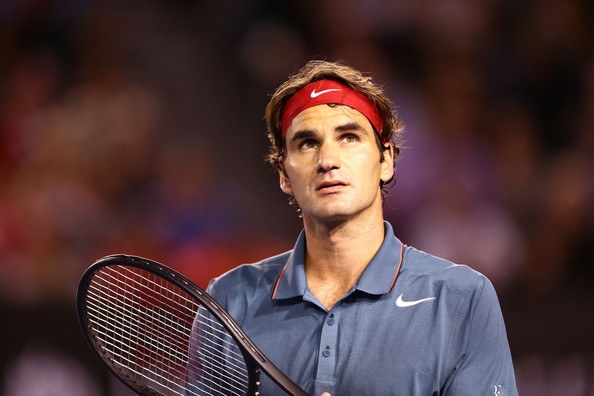
    Roger+Federer+2014+Australian+Open+Day+12+Wn7S9KclWuCl

    The Australian Open 2014 Men’s Semifinals

    Stanislas Wawrinka [8] def. Tomas Berdych [7] 6-3, 6-7(1), 7-6(3), 7-6(4)
    Rafael Nadal [1] def. Roger Federer [6] 7-6(4), 6-3, 6-3
     

    The redback spider, Latrodectus hasselti, is a species of venomous spider indigenous to Australia. By way of dinner preparation, the redback uses her fangs to inject a neurotoxin into the vulnerable flesh of her prey, liquefying its insides before binding it thoroughly in silk and sautéing it lightly under the hot Australian sun. Lucky for me, I was able to see a redback—at delightfully close range— on my very first evening in Australia, right about dinnertime, in fact. There she was: sleek and elegant, with a bright red stripe running down her back, and lethal as hell. My Australian hosts took no small pleasure in explaining that recent research indicates the people who’ve been killed by a redback bite actually died from the pain, not the venom. But not to worry, they cheerfully reassured me, should I be bitten by a redback, I’d simply be rushed to hospital, injected with an anti-venom serum, and then pumped full of morphine for a few days to prevent pain-induced organ failure. Easy.

    Now, I won’t go so far as to compare World No. 1 Rafael Nadal to the Latrodectus hasselti, but I will go so far as to say that beating him at tennis isn’t easy, and losing to him looks like it hurts. Both these points were amply demonstrated by Grigor Dimitrov in his 6-3, 6-7(3), 6-7(7), 2-6 quarterfinal loss to the Spaniard. The Bulgarian shed tears after the match. But, at 22 years-of-age, Dimitrov is still very much a player in-process. The 32-year-old Roger Federer, on the other hand, has been declared dead, buried, and resurrected at least a dozen times by now. He already is who he will be, at least on the tennis court. (But after he retires, Federer might want to consider a second career in necromancy.) Maybe this is why it can be so painful to watch the Swiss superstar lose, yet again, to Nadal. There is a sense that instead of getting closer to deciphering the trick to making Rafa’s forehand disappear, Federer’s chances are getting ever more remote.

    This is not to say that Federer will never beat Nadal again. He probably will, possibly soon. But he will never discover the magic serum that allows him to avoid the pain of fending off a fusillade of Rafa forehands—all exploding into his backhand corner like hollow-point bullets—with only one hand on his tennis racquet. (And he will especially not discover the special serum if he persists on approaching into Nadal’s lethal side.) Roger Federer will never gain anything like ownership over their head-to-head, which Nadal now leads 23-10.

    There is not much new to say about this latest encounter, which was a comprehensive and familiar-feeling victory for the Spaniard, though it was Nadal’s first win in straight sets at a major since the French Open in 2008. As anticipated, Nadal arrived with almost none of the unsettled confusion he showed against Dimitrov two days earlier. From his serve, to his forehand, to his clenched jaw, Rafa looked muscular in his determination. Yes, he was blistered, but he was also callous. [Sorry, couldn’t help it.] There are those of us who imagine it causes Rafael Nadal some degree of internal pain to pummel the great Roger Federer. But that doesn’t stop him from doing it. And, really, those forehands are so much fun to see. 

    Watching Federer, I wasn’t quite sure what I felt. Wabi-sabi comes to mind, The Japanese aesthetic wherein impermanence, incompleteness, and imperfection are prized. The flaw highlights the beauty, and objects become more treasured as they become more worn. Besides, he’ll always have those 17 Major titles, 300-odd weeks at No. 1, and et cetera, et cetera on which to rest his weary, single-handed laurels.

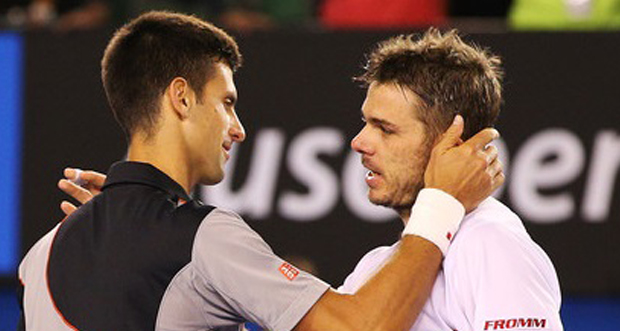
    Watching the other Swiss semifinalist, the new Swiss No. 1, I knew exactly how I felt: “really happy,” just as Stanislas Wawrinka described himself. Considering this was the first Australian Open semifinal for either Wawrinka or the Czech seventh-seed Tomas Berdych, and that three of their four sets were decided by tiebreakers, the match was oddly flat. This might have had something to do with the fact that while Berdych and Wawrinka own no major titles, the players in the other semifinal have thirty between them. It might also have something to do with the fact that Wawrinka and Berdych took turns tightening up abysmally in the breakers. Stan went first, losing all but one point of the second set tiebreak. Then it was Berdych’s turn, and he double-faulted left and right in the second set breaker, which could be seen as ironic, since his tremendous serve was the whole reason the set had reached a tiebreak in the first place.

    But the real problems started for Berdych when he failed to remember, at the very end of the fourth set—which turned out to be the end of the match— that it was meant to be Wawrinka’s turn to screw up the tiebreak. So, after selfishly mishitting the same volley twice, Berdych went on to miss some more serves, make a few errors off the ground, and before we knew it—but not before three-and-a-half hours had elapsed—the match was over. Stanislas Wawrinka had done what no ATP player has done since Tomas Berdych did it at Wimbledon in 2010. He’d earned himself a spot in a slam final while seeded outside the top four. In fact, Wawrinka became the first No. 8 seed to reach the Australian Open final since Brian Teacher did it 34 years ago, which was so long ago, even Roger Federer wasn’t born.

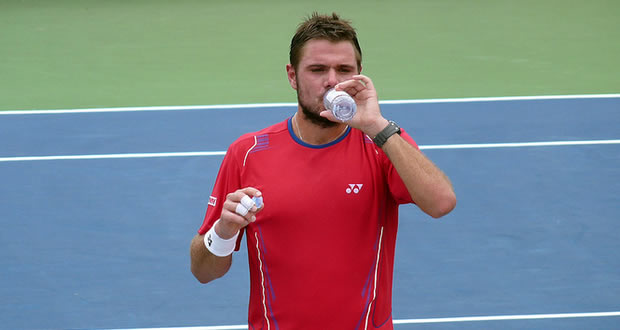
    I don’t want to give the impression that this semifinal, which almost felt like an undercard show compared with the hype surrounding Fedal XXXIII, wasn’t a quality match. It was, and one aggressively played; it just wasn’t a great one. The contest had its moments: Wawrinka hit approximately twelve dozen exciting forehand winners, and exactly two even-more-exciting backhand winners down the line (or possibly three, stats is not my strong suit). Berdych did serve exceptionally, except for when it counted most. And, beginning in the second set, Wawrinka also developed an interesting, slightly frustrating habit of ceding the first 15 points of his service games to his opponent. So, his games were infused with a little extra tension, thus giving the crowd more reason cry out Stanimal! in loving, pleading tones.

    But the real outpouring of emotion came directly after match point was won. The stadium went all warm and loudly fuzzy with joy. Wawrinka earned the affection of the Australian crowd last year, with his valiant five-set loss to the 2013 champion, Novak Djokovic. He doubled that affection by beating Djokovic in five in the quarterfinals this week. The Swiss also happens to be modest, open-hearted, and articulate in his interviews. In the on-court interview after Thursday’s match, Jim Courier asked Wawrinka if Stan’s young daughter understands what her father does for a living. Wawrinka replied she only understands that if he loses, she gets to see him sooner. Then he apologized to her, on camera, that he wouldn’t be home for another couple days yet. He was brimming over with emotion, and I admit, when he said the bit about his daughter, I got a little teary, too.

    Rafael Nadal defeated a series of one-handed backhands—Philipp Kohlschreiber, Tommy Robredo, and Richard Gasquet—to reach the most recent major final, the 2013 US Open. Now, in 2014, he’s already defeated Dimitrov and Federer, and will get a shot at a third one-handed backhand and a second Australian Open title on Sunday. It’s likely he’ll win it. But, I hope, not too easily.
  • 2014 – Out With The Old, In With The New (But Some Things Don’t Change)

    2014 – Out With The Old, In With The New (But Some Things Don’t Change)

    2014 Masterclass

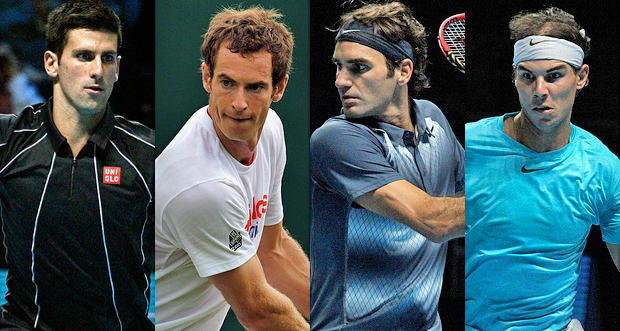
    2013 is clearly behind us, but it’s worth taking a glance back at some of the successes and some surprises at the top of the tennis world. Just when it looked like Mr. Novak Djokovic and Mr. Andy Murray had ascended as the two top players in the sport, dethroning Mr. Rafael Nadal and Mr. Roger Federer, with a one-two finish at the 2013 Australian Open,  Mr. Nadal defied the odds and came back after a seven month respite, and rather amazingly achieved top form quicker than anyone had a right to expect. He not only achieved it, he maintained it, and continued it for the rest of the slam season and was the year end No. 1 player on the ATP tour,  winning two out of three of the Grand Slam events he played, including his record eighth title on the red clay of Roland Garros and his second US Open victory. In doing so, he removed Novak Djokovic from his pedestal, defeating him at the Roland Garros semifinal and the US Open final.

    It was not only in majors where Rafael Nadal had success. He won 10 titles and was a finalist in two others out of 13 events from February to September, his only misstep being a first time first round exit in a major at the Wimbledon Championships to Steve Darcis, No. 135 in the world. That shock loss, after the previous year’s second round shock loss to Lukas Rosol, had many people wondering if Rafa had again suffered some injury. But he quickly recovered from the slippery turf, and returned with a vengeance, recovering his form on the hard courts of North America and captured the rare triple in the Canada and Cincinnati Masters series and the US Open trophy. He finished the year very respectably, albeit without a title, making two semifinals, and two finals including the season ending tournament at the World Tour Finals in London where he lost to a resurgent Novak Djokovic.

    Though the Return of Rafa was undoubtedly the story of the year, the highlight was probably Andy Murray’s Wimbledon Championships triumph, the first one by a gentleman from Great Britain’s soil in 77 years when Fred Perry won the event. After winning, Mr. Andy Murray also received the rank as an Officer of the Most Excellent Order of the British Empire (OBE). Andy defeated a game Novak Djokovic in the final who had just endured a titanic struggle with the Tower of Tandil,  Mr. Juan Martin del Potro from Argentina. With this win, Andy basically said he had achieved his ultimate dream. Unfortunately for him, later in the year, after being unable to defend his 2012 US Open title, losing to an improved and confident Stanislas Wawrinka, Mr. Murray, OBE, left the tour for back surgery.

    Novak Djokovic started 2013 in fine form, winning the Australian Open for the third consecutive, and fourth time in all, over Andy Murray. Though he would not win another major, Novak was very consistent the whole year.  He won six other titles including three of the Masters 1000 series in Monte Carlo, Shanghai, and Paris, and continued his run at the final event of the year at the World Tour Finals in London. He made two other Grand Slam finals at Wimbledon and the US Open, and lost a close match in the semifinals at Roland Garros to Rafael Nadal. It was an excellent year by anyone’s standards, even if somewhat disappointing to his fans.

    Roger Federer perhaps had the most surprising and disappointing year of the “Big Four”. After his outstanding run in late 2011 to the summer of 2012 where he won nine titles, including Wimbledon and extended his weeks at No. 1 to 302, Federer only captured the Halle title in 2013, was ousted in the second round at Wimbledon by Stakhovsky, and to Robredo in the fourth round of the US Open, and only made one semifinal early at the Australian Open. But in retrospect, should we have been surprised? Federer clearly said 2013 was going to be a transitional year at the start. Not many bothered to ask what that meant, but it was evident that he was going to ease up somewhat from the year before. Also, he suffered a back injury rather early in the season at Indian Wells, which he said bothered him until around Hamburg, just before the US Open, preventing him from playing well and perhaps more importantly, training properly. But for his fans, and fans of tennis around the world, he did not leave the tour. He was still playing events, drawing crowds and audiences on television, perhaps realizing just how important he is to the tennis world.  So one has to credit him for sticking in there, even when the going was tough and while taking a lot of criticism. By the end of the year, Roger had slipped from No. 2 to No. 6, and many people were saying he was in full decline and were even calling for him to retire, again. But Federer said he was happy playing,  enjoying the tennis life, his health was better,  and that he expected 2014 to be a much better year. This writer, for one, will never count Mr. Federer out as long as he plays. He’s simply a magician on the court, and at his best, can still beat any player in the world. Those moments may not come as often as they once did, but one believes his remaining time on tour should be cherished like the last bottles of vintage wine from the cellar, to be sipped slowly, filled with memories of past glory, savoring each of his remaining better performances until the end of his career.

    Other notable player performances of 2013 have to include those of Mr. Juan Martin del Potro who challenged the very best during the year and won four titles and was a semifinalist at Wimbledon losing gamely in a close five set match with Novak Djokovic, which may have been the second best match of the year. The best match of the year was likely the fourth round of the Australian Open between Mr. Stanislas Wawrinka and Novak Djokovic, where the Swiss No. 2 had the best performance of his career, and was so close to winning, but was finally beaten 12-10 in the fifth and deciding set by the No. 1 player in the world. Wawrinka would later make the semifinals at the US Open after beating Andy Murray in the quarterfinals, but was again beaten by Djokovic in a hard fought five sets. Stan only won one title, but obviously played consistently throughout the year to earn his placing in the World Tour Finals in London among the best eight in the world, where he made it to the semifinals, losing again to the eventual winner, Novak Djokovic.

    The 23-and-under players finally made an impact, with Canadian Milos Raonic finishing at No. 11. The future also appears bright for Jerzy Janowicz from Poland, who finished at No. 21 and made it to his first major semifinal, at the Wimbledon Championships, finally losing to Andy Murray in four sets. Bulgarian rising star Grigor Dimitrov was close behind him at No. 23 in the world as he became more consistent, going deeper into tournaments, losing in competitive battles to the very best players. Vasek Pospisil, also from Canada, finished the year at No. 32 after starting at No. 125. Pablo Carreno-Busta of Spain finished at No. 64 after starting the year at No. 654. One would likely expect to see more from these players in the next two to four years.

    [divider]

    Now it’s a new year of high expectations and hopes. Many players would like to pick up from where they left off last year, while many want to throw out last year and start anew. We have new tennis coaches for some of the top players, highly successful players from the old days, as players have probably been influenced by the Ivan Lendl effect on Andy Murray. They are Boris Becker for Djokovic, Stefan Edberg for Federer, Michael Chang for Kei Nishikori. Not surprisingly, world No. 1 Nadal has not changed, keeping his trusted coach and family member, Toni Nadal. From what we’ve seen so far, it seems that we are in for an interesting year in men’s tennis.

    The story of the Australian Open for the men so far has been the scintillating success of Stan Wawrinka, who has continued his fine play from 2013 and defeated no less than No. 2 Novak Djokovic in the quarterfinal, and No. 7 Tomas Berdych in the semifinal to make his first Grand Slam final. The popular Swiss player finally overcame Djokovic in the fifth set 9-7, after losing two tough battles in the Australian Open and US Open in 2013. He has his first chance to win it all on the major stage. One wishes him the best. Some may say that Novak Djokovic may have had too easy a draw up to Stan and was undercooked, but others would say that it was just Stan’s moment.

    In the other half of the draw it seems that some things never change. Once again, we have a match between Roger Federer and Rafael Nadal, this time in the semifinal. Federer, who had been dismissed by many as a fading force after his admittedly weak 2013 results (for him), appears to have had a resurgence and is in his best form in at least a year or more. In arguably one of the tougher draws in the tournament, he has emerged from the problematic path relatively unscathed and hardened, dropping only one set. Along the way, he has steadily improved his play, beating Jo-Wilfried Tsonga, with whom he had played a tough five-set match last year, in a relatively easy three sets, and Andy Murray, to whom he had lost in the semifinal last year, in a slightly more difficult four sets. His serve has been excellent, only being broken twice along the entire way with a key high percentage of second serves won. He is definitely more aggressive, coming to net 41 times in the Tsonga match with 84% success, and 66 times in the Murray match with 74%  success. One has to believe that his additional part-time coach, Stefan Edberg, has been a positive and effective influence so far.

    Federer’s play against Murray in the first two sets and nine games was impeccable. Murray didn’t reach a break point on the Federer serve and looked lost as to what to do to turn things around. However, Roger suffered a little hiccup in the tenth game where his first service percentage dipped a bit, Murray stepped up to take full advantage, and Federer failed to serve for the match at 5-4, and failed to convert two match points in the tiebreak to lose the third set. However, it was also encouraging for him to recover from that setback to come back and win the fourth. He changed tactics, and made the match more of a physical effort, extending Murray’s service games, one of them to 10 deuce points, and it paid off as Murray visibly tired as the set wore on. In Murray’s defense, he came into the Australian Open with only two tour matches since he left the tour for back surgery just after the 2013 US Open. He had a very easy first four rounds, facing nobody in the Top 25, and was simply not ready for as tough and determined an opponent as Federer.

    Rafael Nadal has come through, albeit not quite as smoothly. Though his initial draw looked tough, it opened up a bit. Bernard Tomic suffered an injury early in their first round match and retired after one set. Then the next top seed in Nadal’s quarter, Juan Martin del Potro, lost to Roberto Bautista Agut in the second round. Nadal’s third round opponent, No. 25, Gael Monfils, didn’t play well at all. Nadal’s fourth round and quarterfinal were rather tight affairs, with Nishikori losing in two tiebreaks and 7-5. In the quarterfinal, Nadal was hampered by a bandage for a blister on his palm, but he played just well enough to win in four sets, winning two tiebreaks, and was fortunate to win the one in the third set where Dimitrov sailed a easy set point long. Dimitrov couldn’t recover after that. Nadal did not look comfortable in the match, hitting many balls short, and was errant with his usually dependable forehand.

    One looks forward to their 33rd meeting on Friday. Roger will need to continue to play at the excellent level he displayed in the Tsonga and Murray matches to have a good chance. Has he left his old 2013 form totally behind and brought in a new outlook via his new coach, Stefan Edberg? Rafa will have to improve his level from his last match and when he meets Roger, he usually does. Will he be able to contend with the new, more aggressive Roger? Weather may be a factor as Friday’s forecast calls for relatively cool and rainy conditions during the day, though the rain may be over by the time they play. In any case, the tennis world awaits the latest chapter in their long history. Some things don’t change. But whomever wins will have to face a new player in the final in this new year. One hopes that more new and exciting results await in 2014. May the best players win.

    [divider]

    Discuss this article with fellow tennis fans in the tennis forums

    [divider]

  • An Elemental Truth

    An Elemental Truth

    The 2014 Australian Open Men’s Quarterfinals, and Other Observations

    Tomas Berdych [7] def. David Ferrer [3] 6-1, 6-4, 2-6, 6-4

    Stanislas Wawrinka [8] def. Novak Djokovic [2] 2-6, 6-4, 6-2, 3-6, 9-7

    Rafael Nadal [1] def. Grigor Dimitrov [22] 6-3, 7-6(3), 7-6(7), 6-2

    Roger Federer [6] def. Andy Murray [4] 6-3, 6-4, 6-7(7), 6-3

    Speaking from the expertise of over week’s worth of days in south Australia, I can say there are a lot of great things about Australians, not least of which is a penchant for friendly abbreviations. Here, on this vaster than vast continent, language lovers can discover more diminutives than Merriam and Webster ever imagined possible. Chocolate becomes ‘choco’ or even ‘choc,’ special becomes ‘spesh,’ documentaries are ‘docos,’ a renovation is a ‘reno,’ mosquitos are ‘mozzies,’ Stanislas Wawrinka is, well, ‘Stanimal,’ and the 2014 Australian Open becomes, simply, ‘The Tennis.’

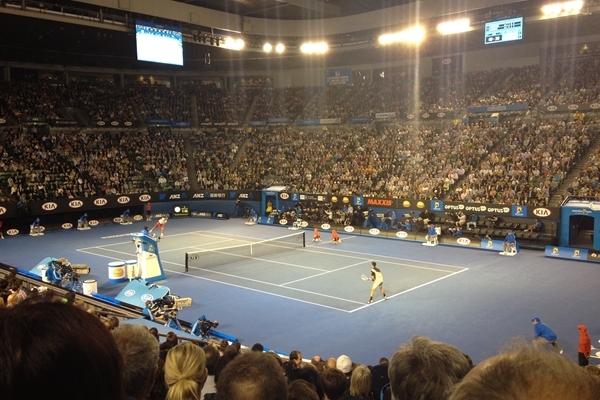
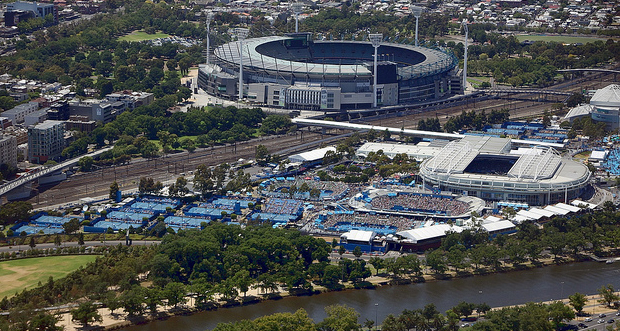
    Television announcers tell you “the Channel 7 News will be aired following the tennis.” The gate staff at Melbourne Park will tell you to “have a great day at the tennis!” And if you clap your hands very, very loudly when Mikhail Youzhny wins a point in men’s doubles, the elderly lady next to you will whisper to her husband in an tolerant, amused tone, “She really enjoys the tennis, doesn’t she?” ‘The tennis’ is endowed with such easy intimacy, and it’s wonderfully, unabashedly tennisy. “Are you going to the tennis today?” is a question I’ve been asked by everyone from friends, to fellow tram passengers, to complete strangers. Even the Uniqlo brand-representative standing outside the Uniqlo pop-up store hopes I’ve been enjoying my time at the tennis.

    Uniqlo is newly arrived in Melbourne, and the line outside this particular location—on bustling Swanston Street, not far from Federation Square—zigged and zagged across the wide sidewalk so many times I was all but sure I’d find Novak Djokovic perched at its end, signing autographs, or maybe doing his best Boris Becker impersonation. When I asked the Uniqlo representative where they’d put Novak, he explained that the long line had less to do with the tennis than it had to do with free underwear. In honor of the brand’s entrance to the Melbourne market, Uniqlo was giving away underclothes to all comers. And not just any underclothes, “AIRism” undershirts. Equally as philosophical as it is sartorial, the entire AIRism line is hand-woven from molecules of pure, organic oxygen. “No matter what you wear it under, the AIRism will keep you cool,” the Uniqlo representative told me with a friendly smile. (The AIRism is also worn by Novak Djokovic, on the rare occasion when his opponents require him to sweat.) 

    If I’d waited in line I could’ve tested that theory, because the temperature rose into well into the 40s (approximately 2,012 F) before lunchtime on that day. But I didn’t wait in line, because it’s nonsense to wait in a 40-minute line in the 40-degree heat for what is essentially a white tank top. Besides, I was on my way to the tennis. Since arriving in Australia I’ve done all sorts of southern-hemisphere type activities. I’ve gone swimming in the South Sea, kangaroo spotting on a suburban golf course, to the Queen Victoria Market to ogle barrels of ground spices and buy myself one of those hats with the corks hanging off the brim to keep the mozzies away. But most of all, I’ve gone to the tennis.

    clouds

    And not unlike the hours spent frolicking in the ocean waves, the tennis has been an immersive experience. To keep on with the elemental metaphors, my Australian Open experience reminds me of going to the Musée de l’Orangerie—which I did for the first time years ago, on an August day in Paris hot enough to melt my unfashionable American tennis shoes— and standing very, very close to Monet’s water lilies to admire the rainbow of color on the surface of all that blue water. Looking at a Monet up that close is a textural and evocative experience, the brush strokes brim with feeling, but it’s damn near impossible to distinguish anything like structure or form, let alone plants, in all that scribbled mess.

    That’s what the first week at the Australian Open was like for me. I was submerged in the experience of colorfully garbed athletes—Adidas blues, Lacoste sea foam green, Asics pink, Nike teal, and shades of Uniqlo sand—skittering across a sea of blue concrete. But, unlike trying to discern les nymphéas at close range, if you stay at a tennis tournament long enough, allowing your gaze to soften and the pace of your thoughts to slow until it matches the rhythmic chanting of Bulgarian tennis enthusiasts, you will begin to discover the lilies. And one of those lilies will have a gilded backhand, and his Aussie name will be Stanimal.

    Stanislas Wawrinka’s surprising upset of the Australian Open defending champion, and the champion of defending, Uniqlo’s Novak Djokovic, was far and away the best match of the tournament, and will likely feature as one of the best of 2014. And I was there. And I did not take a single bathroom break. Granted, it was a relatively quick five-setter, for all that the score was 9-7 in the final set. The first set went by all too quickly for those of us hoping Wawrinka would put up the kind of fight that gave us their tremendous five-set, five-hour encounter in the 2013 Australian Open fourth round. I confess to being one of those tennis fans who thought this year’s sequel would fail to live up to the hype. (I felt the same about the second edition of Sloane Stephens vs. Victoria Azarenka, especially because that matchup wasn’t even particularly close last year, just controversial.) Imagine how elated I was to be wrong.

    Throughout the first set, and for a good portion of the second, I mostly marveled at what seemed like the sheer impossibility of hitting a tennis ball to a place on the court not occupied by the World No. 2. Djokovic’s defense is uncanny, for its impenetrability, but also for its strategy. He has a habit of accelerating into his forehand when least expected, and the placement on his return is downright cruel. If Wawrinka landed a competent first serve, the Swiss was likely to find the ball bouncing off his shoelaces a second later, or buried into the farthest corner of the court. Wawrinka’s response to the confidence-killing Djokovic return seemed to be to avoid serving the ball anywhere near the service box. Likewise, the Swiss response to the Serb’s forward-moving, attacking defense was to retreat well beyond the baseline and try (and fail) to fire winners from behind the Melbourne sign.

    But, as the second set wore on, Wawrinka kept forcing himself back up to the baseline, willing himself to try again, to fail better. Being there, I could imagine that I, too, felt the depth of his effort. I suspect many others in the crowd would agree with me, because the stadium was enthusiastically, warm-heartedly behind the scruffy, barrel-chested No. 8 seed. Objectively speaking, the second set featured some of the best tennis of the match, as the upward arc of Wawrinka’s tennis intersected with the vaguely downward trajectory of Djokovic’s game. But it was the fifth set that was most thrilling.

    After Wawrinka somehow won the second and then the third sets, my spectating companion—a fellow tennis-writer whose humor plays equally as well live as it does on the page—remarked that now we were at least guaranteed five sets. And Djokovic did win the fourth, though he didn’t run away with it as I’d thought he might. There was also a moment in the fourth, somewhere nearer the end of the set than the beginning—one of the things about getting caught up in the creative flow of live tennis is that, for me, time loses some of its linearity—when Wawrinka left a ball he should have hit, thinking it would float wide. It was a decision clouded by hope, and the Swiss looked utterly deflated afterward. It was one of those moments that could have marked a turning point in the match. Indeed, I noted it with an eye toward mentioning it here, as evidence of the difference between the unwavering concentration of tennis’s demi-gods and the emotional force that rules the lives of mere mortals.

    But as the fifth set opened, Djokovic’s nerves were every bit as jangled as Wawrinka’s, and the set was a wild ride. As they had been in the second set, the rallies in the fifth were sometimes stunning, and stunningly long, with booming backhands from both men, and those wonderful, dramatically angled flat forehands from Stan. But there were also plenty of cautious, tentative rallies, with both players trying to wait out the other. Wawrinka’s serve came in and out of focus, as did Djokovic’s forehand wing, which often flapped fitfully at his side, all out of sync with the rest of his body. The Serb’s primal scream, however, remained as richly articulated as ever. I wish I could tell you exactly how the final two games unfolded, but the details are lost in the massive emotional wave that crashed through Rod Laver Arena after Djokovic’s attempt to serve and volley away match point went quietly, strangely awry. Even the AIRism underclothes weren’t enough to keep Novak’s head cool in the moment, and he pushed a relatively routine forehand volley wide. 

    can tell you that by the time we got to 5-5 in the fifth I was feeling intensely for both men, who were so clearly giving the match their all. The stakes felt sky high. There was a moment—again, I’m not sure when it was, maybe in the 7-7 game—wherein Wawrinka landed an excellent first serve, and saw it come back to him made even more dangerous by the Serb’s return. For few points before this one, Wawrinka had been playing tight, tentative tennis. But as the defending champion’s service return came flying back at his feet it seemed as if something clicked inside the Swiss. He went after the ball, really went after it, as if he finally realized he could only win if he put his whole heart into it. And he won the point, and then, miraculously, the match. Afterward, he said he felt really, really, really happy. It showed.

    None of the other quarterfinals were near the quality of this one, though they were all exciting in their way. I somehow found myself watching most of Berdych’s upset of Ferrer on a muted television screen under Rod Laver Arena in the players’ cafe, surrounded by tennis people who all seemed to agree that Ferrer was out of form. They also agreed that while Berdych’s serve might often rise to the level of unplayable, his T-shirt is downright unwearable. 

    Federer’s four set win over Andy Murray, which I did not see live, should have been over in three. As Federer told Courier afterward, he knows he’s better at earning break points than converting them. And as high as the stakes felt for Djokovic and Wawrinka, the Federer-Murray encounter was relatively tensionless (unless you count the tension Murray managed to work into his grimaces, which was, as per usual, tremendous). It is good to have the Scot back on tour after his back surgery, but it was also evident that he’s not yet fully returned to form. As a spectator, and a Jo sympathizer, I preferred Federer’s fourth round win over Tsonga. It was a sumptuous match, and so easy to admire for the beauty of the brushstrokes. Sure, there was never much sense that the Frenchman might win a set, let alone the match, but there were so many points to be enjoyed as stand-alone creations, like the public art that decorates the urban landscape here in Melbourne.

    As a Rafael Nadal fan, and one who would also be pleased to see the Bulgarian Grigor Dimitrov take up residence somewhere nearer the Top 10, I’d hoped to enjoy their quarterfinal match more than I actually did. Maybe it was the fact that my seat was positioned in the midst of twenty or so spectators who’d disembarked from a cruise ship that morning and felt compelled to compare notes on the wall décor in their various cabins (very similar, it turns out). Or maybe it was that Dimitrov’s serves were either astonishing or terrible. Or that Nadal’s forehand was like Dimitrov’s serve, and that the Bulgarian’s return of serve was nearly non-existent. Maybe it was because I was aware Mikhail Youzhny and Max Mirnyi were losing their doubles match out on Court 2. Or—and, this is just a guess—it might be that I’d already watched 20 hours of tennis in the past two days.

    As close as Nadal came to not winning the two tiebreak sets, I didn’t worry much that he’d fail to win the entire match. His champions’ fire was too well lit. And, as Rafa said when it was all over, he also got very, very lucky. Taken together, the No. 1 and 2 seed’s quarterfinal matches reinforced both sides of an essential, conflicting reality: Most of the time, the better player wins the match, especially when the better player is one of the Big Four. But, it’s tennis, which also means anything can happen, anything can be. Call it an elemental truth, call it a TRUEism if you like—or just call it another great day at the tennis.

  • Lessons Learned

    Lessons Learned

    Australian Open, Quarterfinals

    (8) Wawrinka d. (2) Djokovic, 2-6, 6-4, 6-2, 3-6, 9-7

    It presumably surprised no one when Channel 7’s hype-department went into overdrive at the prospect of another blockbuster match between Novak Djokovic and Stanislas Wawrinka. As with all commercial television networks, Australia’s tennis broadcaster subscribes to the crude conceit that any memorable event must inevitably be repeated if even a few of its defining conditions are present. In this case the defining conditions were the players involved and the best-of-five format. These men played two five-set classics last year, and according to Channel 7 this ensured their next effort was destined to be another. Being steadier and wiser, I wasted no opportunity to inform anyone near me – family members, buskers, stalkers – that there is more to professional tennis than the Majors, and that Djokovic easily dispatched Wawrinka twice at the end of last year, in Paris and London. Only an unredeemed ignoramus, I maintained, would expect another classic. Djokovic would win easily. My son, who has decided that he and Djokovic are going to become friends, was particularly thrilled by this news. As it transpired, the match was a classic. Channel 7 was right, and I was wrong. That may not be the hardest sentence I’ve ever had to write – “Mr Becker, I regret to inform you that your brain condition is inoperable.” – but it’s certainly on the shortlist.

    At least for the first set, it looked as though I’d be proved right. Djokovic was looking exactly like the guy who hadn’t lost a match of any kind since the US Open final in September, who was currently enjoying the second longest Grand Slam semifinal streak in the Open Era. Wawrinka, meanwhile, looked like he couldn’t quite work out where his baseline was, or why it was important that he position himself closer to it. He figured it out in the second set, however, though it still came as a surprise to everyone in the stadium when he finally broke Djokovic, and served it out.

    Crowd sympathy within Rod Laver Arena had slightly favoured Djokovic as the players sauntered on to court, though it could have been that the Serbian fans were more punctual. By the time Wawrinka broke in the third set, twice, there was no doubt which man the crowd preferred. Djokovic was too content to rally with the Swiss, especially crosscourt on the backhand, and rediscovered that this shot doesn’t break down the way other single-handers can. Nonetheless, Djokovic took the fourth comfortably, and broke at the start of the fifth. A reprise of their US Open appeared more likely than their extravagant 12-10 effort from Melbourne last year.

    Then, for reasons ungraspable by rational minds, Djokovic compiled a service game of cosmic awfulness, sturdily mounted on four forehand errors, and was broken back. Both men settled into a long sequence of holds, interrupted briefly by a rain delay. Djokovic went back to holding comfortably. Wawrinka did it harder, but, somehow, legs and mind constricted, he did it. Blithely ignoring the concept of momentum, he finally broke Djokovic with the Serb serving to stay in the match for the fourth time, at 7-8. Djokovic’s brain-wave to serve-volley on match point down has already blossomed into legend. To volley was, to put it mildly, a rash choice, and it was rashly played. He swung at it, pushed it wide, and the three-time defending champion was out. He left the court to a wave of warm regard, which heated to radiant affection once Wawrinka took his chance to speak. He pronounced himself “very, very, very, very happy.” He’d proved me wrong, but in the moment I found it hard to begrudge him his joy. My son was less impressed when I told him the result, but learned a vital first lesson in parental fallibility. It had to happen some time. I won’t complain if he gains something of Djokovic’s perfect grace in defeat, but I do dream he’ll somehow acquire a backhand like Wawrinka’s.

    (1) Nadal d. (22) Dimitrov, 3-6, 7-6(3), 7-6(7), 6-2

    If he falls in with a bad crowd, he may end up with a backhand more like Grigor Dimitrov’s, a doom no parent would wish upon their child. For the first set of today’s match between Dimitrov and Rafael Nadal, the Bulgarian did an excellent job of shielding his backhand wing from the Spaniard’s merciless attention. Mostly he did this by breaking early and serving well.

    This was an unusual match, easily the strangest of the round; not particularly enjoyable to watch, nor, from what I could tell, to play. It boasted little of the drama of Djokovic’s loss to Wawrinka, and none of the quality. Nadal began poorly and never hit full stride. Dimitrov began well, but immediately subsided into woeful inconsistency. He broke early, but thereafter could barely land a return, and saw out the first set on the strength of his first serve alone. Breaks were donated and whimsically re-gifted in the second set. Nadal sought to fire himself up, and succeeded in whipping the crowd into some sort of startled frenzy through the sheer force of his personality, or at any rate the lustiness of his bellows, which for duration and incongruity were a fitting homage to the departed Djokovic. Either man could have taken the second set, but naturally only Nadal did, with a lovely combination of passes.

    The third set was more or less the second set with all the settings dialed up. Breaks each way, flailing inefficiency from both men – Nadal’s serve in particular was heavily affected by a blister on his left hand, which Channel 7 took great delight in showing in dynamic detail, with Spidercam swooping in – an expertly curated selection of beautifully framed forehands, and the inability of both men to sustain pressure. This point from the third set tiebreak encapsulates the overall dynamic quite perfectly: Dimitrov’s tweener lob is the brilliant moment fated to resonate, but observe how once he has re-established himself in the rally he undoes his good work with a sequence of weak, short backhands. Nevertheless, Dimitrov had three set points in total, including one on his own serve. It was a big serve, too – 205kph out wide – leaving him with an attractively pristine acre of court to hit into, or out of, as it transpired. That forehand miss will certainly stay with him for a long time. It was certainly still on his mind in the press conference, as he shed hot tears of frustration. Nadal later admitted to Jim Courier that he’d simply been lucky in that moment, with a relief that had hardly faded in the intervening hour. The fourth set saw Dimitrov fade in the usual manner. He hadn’t played especially well, though he had fought well, and his tournament was over. If he’d been able to land those forehands it might have been a different match, though probably not a different result. If he’d been able to regulate the depth on his backhand better, it certainly would have been.

    (6) Federer d. (4) Murray, 6-3, 6/4, 6/7(7), 6/3

    Nadal will face Roger Federer in the second semifinal, another installment in the most famous rivalry in the sport, an exalted status reflected in its recourse to Roman numerals. This will be their XXXIIIth meeting. Whereas last year’s matches were dominated by Nadal, there is some reason to believe that Friday’s meeting will be more competitive. Federer, with his new racquet and mended back, is back to playing the kind of aggressive tennis he was once famed for, at least for the opening sets of each match. After that his boldness erodes sharply. Two rounds ago he tore through Blaz Kavcic in fearsome fashion, before the third set devolved into an unnecessary dogfight. The same pattern threatened to recur in the fourth round against Jo-Wilfried Tsonga; that it didn’t owed mostly to the Frenchman’s sense of timing, which is not commensurate with his sense of occasion. Tsonga left his run too late, and Federer was permitted to coast over the line. Andy Murray almost committed the same mistake, only coming truly to life as Federer served for the match at 5-4 in the third set.

    Federer commenced in majestic fashion, his forehand and serve both devastating, his backhand impenetrable, and his excursions into the forecourt frequent and decisive. Murray had ambled to the quarterfinals thanks to the most generous draw since, well, his last Australian Open. Federer was thus his first true test, not only of the tournament, but since last year’s US Open. He missed four months of tennis, and last night appeared fatally short of big match practice. I’m not sure anyone besides those ardent Federer fans who exist in a state of perpetual anxiety truly expected Murray to maintain a high level for long enough, in perfect contrast to last year’s semifinal. On paper it was the most appealing of all the men’s quarterfinals, but when it came down to it the stakes somehow didn’t feel very high.

    The Scot finally found his feet in the second set, like Wawrinka the night before forcing himself to venture up onto his baseline. Federer continued to be aggressive, and this was probably the best period in the match, until Murray threw in a poor game to be broken. We can put this lapse down to shortage of match play, but Djokovic had already proved that even the best players don’t really need a reason. Federer served out the set. The third was much the same, with the Swiss entirely untouchable on serve, at least until he stepped up to serve for the match, and thoughtfully reminded us that pressure has internal obligations of its own. Federer tried to coast over the line, but Murray, to his enormous credit, was having no part of it. Invited to step in, he did, heavily augmenting the pace on his groundstrokes, and forcing Federer into error. Federer gained a couple of match points in the tiebreak, and once more reverted into passivity, and was made to pay.

    The fourth set began in much the same manner – Murray’s first service game lasted about a quarter of an hour, and saw Federer gain half a dozen break points, which he mistook for an ideal opportunity to work on his sliced forehand returns. His personal challenge appeared to be to see how many of them he could bunt onto Murray’s service line. It turned out to be a lot. Murray by this point was largely spent, his first serve shorn of pace, and his movement to the forehand corner sluggish. But he was rarely stretched, and made the most of his opportunities to move forward. Federer finally attacked a forehand return on a break point late in the set, and was presumably the only person surprised to learn that this markedly enhanced his chance of winning the subsequent rally. Obliged once more to serve it out, he fell quickly to 0-30, but extricated himself with a bold rally and a brave second serve, before taking the match a few points later.

    Afterwards, forced to explain himself to Courier, he sounded about as relieved as Nadal had, though one was left to wonder if he realises just how weighed-down he lately seems by pressure. At times this tournament he has looked like his old self, not merely the statesman who returned to No. 1 in 2012, but the reckless youth who dominated the world in 2006. At other times, however, he has looked exactly like a man who has learned by heart the lesson that all things must pass, that one’s moments of greatness don’t become less precious the more of them you’ve accumulated, but more precious the fewer of them you have left.

  • Australian Open Day 11 Semifinals Schedule of Play / Scores: Thursday, January 23

    Australian Open Day 11 Semifinals Schedule of Play / Scores: Thursday, January 23

    8400686329_87fccfe721_z e

    [Scores added as known.]

    Rod Laver Arena — 11:00 A.M.    

    Men’s Doubles – Semifinals
    Eric Butorac (USA) / Raven Klaasen (RSA) d. Daniel Nestor (CAN) (8) / Nenad Zimonjic (SRB) (8) — 6-2, 6-4

    Not Before: 1:30 P.M.

    Women’s Singles – Semifinals
    Na Li (CHN) (4) d. Eugenie Bouchard (CAN) (30) — 6-2, 6-4

    Women’s Singles – Semifinals
    Dominika Cibulkova (SVK) (20) d. Agnieszka Radwanska (POL) (5) — 6-1, 6-2

    Not Before: 7:30 P.M.

    Men’s Singles – Semifinals
    Stanislas Wawrinka (SUI) (8) d. Tomas Berdych (CZE) (7) — 6-3, 6-7(1), 7-6(3), 7-6(4)

    [divider]

    Margaret Court Arena — Not Before: 12:30 P.M.

    Men’s Doubles – Semifinals
    Lukasz Kubot (POL) (14) / Robert Lindstedt (SWE) (14) d. Michael Llodra (FRA) (13) / Nicolas Mahut (FRA) (13) — 6-4, 6-7(12), 6-3

    Mixed Doubles – Quarterfinals
    Sania Mirza (IND) (6) / Horia Tecau (ROU) (6) d. Julia Goerges (GER) / Aisam-Ul-Haq Qureshi (PAK) — 6-3, 6-4

    Mixed Doubles – Quarterfinals
    Kristina Mladenovic (FRA) / Daniel Nestor (CAN) d. Daniela Hantuchova (SVK) / Leander Paes (IND) — 6-3, 6-3

    Cover Photo (Creative Commons License): pasukaru76

  • Wawrinka Stuns Djokovic in 5 Set Thriller

    Wawrinka Stuns Djokovic in 5 Set Thriller

    Stanislas Wawrinka


    Stanislas Wawrinka produced the performance of his career to stun defending champion Novak Djokovic and march into the semifinals of the Australian Open.  The pair had met in two Majors last year with Djokovic triumphing in five sets on both occasions.  This time, the Swiss World No. 8 was not to be denied.

    Djokovic got off to a flying start by breaking Wawrinka twice to secure the opening frame 6-2. The Swiss finally made a breakthrough at 3-3 in the second set, capitalizing on a break point opportunity by unleashing a monstrous backhand that just clipped the line. The remainder of the set went with serve, allowing Wawrinka to level the match. It was the first set Djokovic had dropped during the entire tournament.

    An inspired Wawrinka broke twice in succession early in the third set to wrestle control of the match. He served it out and now the pressure was on his Serb opponent to match his intensity.

    The fourth set was a tightly contested affair before Djokovic broke the Wawrinka serve in the ninth game after coming back from 40-0 down.

    In common with their last three meetings at Grand Slam tournaments, this was going to a fifth and final deciding set.

    Both players had opportunities in the fifth and traded early breaks. The defining moment came at 7-8 on the Djokovic serve where the Serb shepherded a volley out of the court for Wawrinka to break and take the match in a nail-biting finish.

    [divider]

    Cover Photo: karlnorling, Creative Commons License

  • Wawrinka Dominates at Chennai Open

    Wawrinka Dominates at Chennai Open

    WTF SF - Wawrinka

    Stanislas Wawrinka of Switzerland won the Chennai Open today, beating Edouard Roger-Vasselin of France 7-5, 6-2, not having dropped a set in the tournament. It was Wawrinka’s fifth career title, taking the world No. 8 into the Australian Open with a strong tailwind. In that Major last year, the Swiss played one of last year’s best matches, losing to eventual winner Novak Djokovic in a five-set thriller. It’s a fair wager that none of the top seeds will be happy to see Stan in their quarter when the draw comes out at the end of the week.

    [divider]

    Photo credit:  Marianne Bevis (Creative Commons License)

  • Djokovic Defeats Wawrinka to Set Showdown With Nadal

    Djokovic Defeats Wawrinka to Set Showdown With Nadal

    WTF SF - Djokovic

    In his most convincing win of this ATP World Tour Finals, the Serbian Novak Djokovic beat Stan Wawrinka of Switzerland to set up the final that most had anticipated, with Rafael Nadal having won his semifinal earlier in the day.

    The 28-year-old Swiss has been enjoying the most successful year of his career, and was making his debut at the ATP World Tour Finals.  He came out looking to start strong, threatening Djokovic’s first serve, and breaking his second. But the Serbian broke back immediately, and then seemed to kick things up a notch to counter any significant threats that Wawrinka threw at him.  In the end, Djokovic blew past him, 6-3, 6-3.

    The final will be played in London’s O2 Arena tomorrow at 8pm GMT.  It will be the 38th meeting between Djokovic and Nadal, a record, and their sixth match of 2013.  Nadal leads on the year 3-2, though the most recent win went to the Serb.

    Photo credit:  Marianne Bevis (Creative Commons License)

  • Barclays ATP World Tour Finals – Semifinals – Schedule of Play and Results

    Barclays ATP World Tour Finals – Semifinals – Schedule of Play and Results

    WTF SFs

    Barclays ATP World Tour Finals – Day 7 – Semifinals: Schedule of Play (Scores added as known)

    CENTER COURT — Start 12:00

    [6] David Marrero (ESP) / Fernando Verdasco (ESP) d [3] Ivan Dodig (CRO) / Marcelo Melo (BRA) — 7-6(10), 7-5

    Not Before 14:00

    [1] Rafael Nadal (ESP) d [6] Roger Federer (SUI) — 7-5, 6-3

    Not Before 18:00

    [1] Bob Bryan (USA) / Mike Bryan (USA) d [2] Alexander Peya (AUT) / Bruno Soares (BRA) — 4-6, 6-4 [10-8]

    Not Before 20:00

    [2] Novak Djokovic (SRB) d [7] Stanislas Wawrinka (SUI) — 6-3, 6-3

  • Barclays ATP World Tour Finals – Day 5 – Schedule of Play and Results

    Barclays ATP World Tour Finals – Day 5 – Schedule of Play and Results

    WTF - Day 5

    Barclays ATP World Tour Finals – Day 5: Schedule of Play (Scores added as known)

    CENTER COURT — Start 12:00

    [4] Marcel Granollers (ESP) / Marc Lopez (ESP) d [7] Leander Paes (IND) / Radek Stepanek (CZE) — 4-6, 7-6(5) [10-8]

    Not Before 14:00

    [7] Stanislas Wawrinka (SUI) d [3] David Ferrer (ESP) — 6-7(3), 6-4, 6-1

    Not Before 18:00

    [2] Alexander Peya (AUT) / Bruno Soares (BRA) d [6] David Marrero (ESP) / Fernando Verdasco (ESP) — 6-3, 7-5

    Not Before 20:00

    [1] Rafael Nadal (ESP) d [5] Tomas Berdych (CZE) — 6-4, 1-6, 6-3