Tag: Roger Federer

  • Roger Federer Arrives in Italy for the Rome Masters

    Roger Federer Arrives in Italy for the Rome Masters

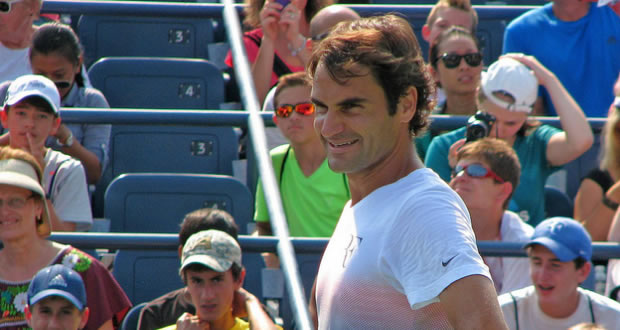
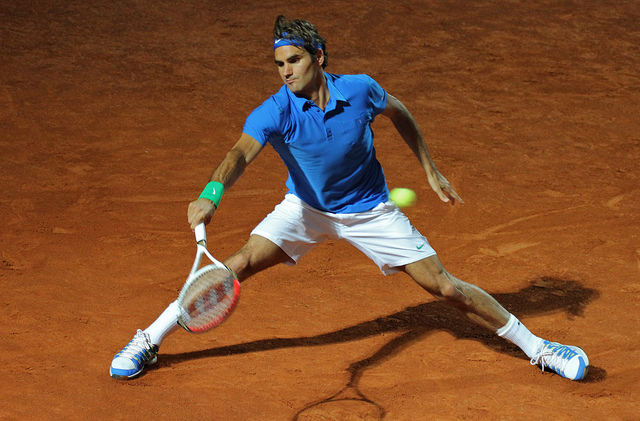
    Roger Federer on red clay - 01

    Roger Federer has confirmed his arrival in Italy via Twitter to the delight of his fans.

    The 17-time Major winner had withdrawn from the Madrid Masters to spend time with his family following the birth of twin sons Lenny and Leo.

    His agent Tony Godsick previously said the former world No. 1 would make a last minute decision to play the Internazionali BNL d’Italia. Following Federer’s arrival in Italy, this now looks almost certain. His scheduled opening match is a second round clash with Jeremy Chardy.

  • Federer Family Welcome New Additions

    Federer Family Welcome New Additions

    Roger Federer

    Roger and Mirka Federer are celebrating the birth of two new additions to the family.

    Twins, Leo and Lenny were born on the evening of the 6th May.

    “Mirka and I are so incredibly happy to share that Leo and Lenny were born this evening! Twins again.. miracle!” came the announcement from the former World No. 1.

    Federer pulled out of the Madrid Masters to spend time with his family.

    [divider]

    Cover Photo: Kenneth Hong, (Creative Commons License)

  • Rafael Nadal – From Peak to Plateau

    Rafael Nadal – From Peak to Plateau

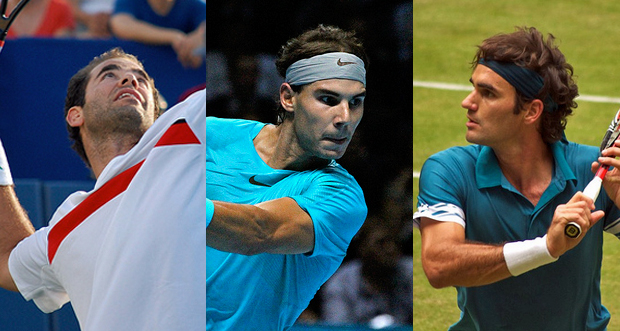
    Sampras Nadal Federer

    All good things come to an end. It is the inevitable tragedy of life, although of course it also allows for greater appreciation of the moments we do have. And so it is with tennis greats, whether the current twilight years of Roger Federer or, as is the focus of this piece, the inevitable decline of Rafael Nadal from an unstoppable force of nature to merely a great, but beatable, player.

    Before you protest that all players have their ups and downs, let us consider the simple fact that Rafael Nadal is in an age window when most great players drop a notch; even if he’s not dropping yet, it is inevitable that at some point soon he will. But a notch from his peak level still makes him one of the best players in the game – just as in Roger’s “twilight years” he is still probably the third greatest player on tour.

    [divider]

    Click here to discuss this in the Tennis Frontier discussion forum.

    [divider]

    Perhaps by understanding the career trajectories of other great players we can better understand where Nadal might be in his own career, and what might be ahead. For a player of Nadal’s stature there are few peers – we have to look at players who were for a significant portion of their careers considered the best in the game. Going back through Open Era history, we have Roger Federer, Pete Sampras, Ivan Lendl, John McEnroe, Bjorn Borg, and Rod Laver. With apologies to other dominant players such as Novak Djokovic, Andre Agassi, Boris Becker, Stefan Edberg, Mats Wilander, and Jimmy Connors, I’m looking at players who were the best for an extended period of time (Djokovic is close, but he’s younger than Nadal so doesn’t really qualify). Borg also has to be taken out of the equation as he retired at 25.

    That leaves us with Federer, Sampras, Lendl, McEnroe, and Laver. Considering that Nadal turns 28 this year, let’s keep in mind the year those five turned 28 for a reference point:

    • Federer: 2009
    • Sampras: 1999
    • Lendl: 1988
    • McEnroe: 1987
    • Laver: 1966

    As I’ve suggested elsewhere, most players follow a career pattern in four major phases (with general age averages): development (17-21), peak (22-26), plateau (27-31), and decline (32-). Obviously players veer out of those ranges, but those are typical. I would maintain that one way to define the peak phase is that it is the period of a player’s career in which their results, especially winning percentage, are solidly over their career average, while the plateau phase is more around the career average or a bit below. Now the question at hand in this context is whether or not Rafael Nadal is transitioning from his peak to plateau phase, which is a step below peak but still very high.

    Let’s take a look at the five players and see at what point they transitioned from peak to plateau. To get a sense of that, we’ll be focusing on their Grand Slam results and match winning percentage.

    Roger Federer

    The Swiss Maestro was clearly in his peak from 2004 to 2007. When he actually dropped a notch into his plateau phase is a bit unclear, however. Many consider the great 2008 Wimbledon match as when Roger passed the baton to Rafa for greatest player in the game. But not only was that match a complete toss-up, but Roger went out and won the next Slam and four out of the next six. Rather, I would maintain that what the 2008 Wimbledon marked was Nadal joining Federer as the best in the game, a partnership which was maintained–some some passing of the baton back and forth–until 2010 when two things happened: Rafa had probably his best year and Roger dropped a notch, leaving Rafa as the sole king of the tour.

    Regardless of when Federer’s skills began to erode, greatness is always defined relative to others, thus the results offer a reliable barometer for his drop in performance. Looking at the statistical record, Roger’s career definitely dropped a solid step after the 2010 Australian Open, his penultimate Slam victory (so far, at least). Whereas Roger won a remarkable 16 of 27 Grand Slams from Wimbledon 2003 to the 2010 Australian Open, playing in a perhaps even more remarkable 22 of 27 Finals, from 2010 Roland Garros to the present, Roger has won only 1 and played in 2 Finals of 16 Slams. He is still a very, very good player, but clearly a step down from his previous peak.

    Looking at Roger’s winning percentage confuses the matter a bit, as he dropped quite a bit from 88% in 2007 to 81% in 2008, and then equalized in the 83-86% range from 2009 to 2012, and then plummeting to 73% in 2013 before rising to 87% (so far) in 2014. But winning percentage is only part of the equation, the other being Slam results, and Roger remained pretty dominant through the Australian Open in 2010 so I would argue that he entered his plateau phase around Roland Garros in 2010 – when he was 28 years old, turning 29 a few months later.

    Pete Sampras

    Pistol Pete was the No. 1 ranked player in the game for an unparalleled six years in a row, from 1993-1998, the year he turned 27. While Pete was No. 1 as late as November 2000 when he was 29 years old, his reign of dominance had clearly ended, or at least diminished.

    In 1998, Pete’s last year at No. 1, his winning percentage had dropped for the second straight year and, at 78.2%, was about at his career average (77.4%). But then in 1999 it shot up again to 83.3%, the highest it had been since 1996 and the fourth highest of his career. Yet it dropped again in 1999 to 76.4% and continued to drop over his last couple years.

    So in one sense we could say that Pete was as good as ever in 1999, the year he turned 28, yet on the other it was in far fewer matches than usual – he only played 48, the fewest he had played since 1989, and far fewer than his average of 81 per year from 1990-98.

    Regardless, it seems clear that Pete entered his plateau phase sometime between 1998 and 1999. He lost the No. 1 ranking in late March of 1998 after holding it for 102 weeks straight. He did regain it again before the end of the year so that he still finished No. 1, but I think at that point the writing was on the wall. So I’d maintain that he transitioned into his plateau phase around age 27.

    Ivan Lendl

    Some might take issue with Lendl’s inclusion, as his early career was overshadowed by Borg, McEnroe, and Connors, and later on he vied with Wilander, Becker, Edberg, and then Sampras and Agassi. (Actually, as an aside, Lendl may be one of the most underrated players in tennis history because of all great players—at least during the Open Era—no one else played alongside other greats playing at or near their peaks, and Lendl held his own, and then some.) Let us remember that Lendl finished three years in a row, 1985-87, at No. 1, and a fourth year in 1989. He also finished in the Top 3 for nine straight years and the Top 8 for thirteen straight years, both of which only Roger Federer has equalled since (Fed finished in the Top 3 for ten straight years and assuming he finished 2014 in the Top 8, will equal Lendl’s thirteen straight years in the Top 8).

    Lendl’s fall to his plateau is relatively easy to determine. In 1989, his last year finishing No. 1, he had a winning percentage of 92% which fell to his career average of 82% in 1990, which was also the last year he won a Slam, and then 75% in 1991. So the fall came between 1989 and 1990 – perhaps after his last Slam at the Australian Open in 1990, so when he was 29, almost 30 years old.

    John McEnroe

    Johnny Mac is a bit of an outlier to this group because his later career was marred by personal issues. But he was still a similarly dominant player as the others on this list during the first half of his 20s, ranked No. 1 for four years in a row, and the only player to be considered the great Bjorn Borg’s equal, even surpassing the great Swede towards the end of their rivalry.

    Anyhow, McEnroe’s drop is quite clear. His very greatest year was 1984 when he had an amazing 96% winning percentage (82-3). Yet 1985—despite not winning any Slams—was also great, with an 89% winning percentage and far above his career average of 81.5%. But then he missed a lot of time in 1986-87 and never came back even close to peak form, so we could say that there’s a clear separation between peak and plateau/decline between the years 1985 and 1986. Johnny Mac turned 27 in early 1986, so the drop was at age 26-27.

    Rod Laver

    I include Laver with some hesitancy considering that he played in the mists of ancient tennis history. Yet he was a similarly dominant player to Nadal and Federer, and had his last great year in the Open Era.

    It is more difficult to example the statistical records from before the ATP era (1973), but from what the statistical record shows us, Laver maintained a peak level of performance throughout his 20s and through his great year in 1969 when he won all four Grand Slams. He turned 31 that year.

    Laver remained a good player for a few more years, but was never the same. So his peak ended quite late – at age 31.

    Summary

    So when we look at our five comparable greats to Nadal, we see the age that they transitioned from peak to plateau form as follows:

    • Federer: ~28
    • Sampras: ~27
    • Lendl: ~29
    • McEnroe: ~26
    • Laver: ~31

    Looking back over the last year or so, Rafa was playing at a very high level through the summer of 2013. After dominating the North American section of the tour by winning the US Open and both the Canadian and Cincinnati Masters, Nadal slowed down a bit, not winning a tournament for the rest of the year. He started 2014 by winning the Qatar Open, although then lost in the Australian Open final, partially due to injury. He also won his second tournament of the year in Rio, but both his wins so far are relatively minor (an ATP 250 and 500, respectively), and he hasn’t won any of the three Masters and just lost in Barcelona in the quarterfinal. His 91% winning percentage in 2013 was the best of his career, while his 82% so far this year is actually a bit below his career average of 83.6%, so there is cause for concern.

    Nadal will turn 28 years old in a little over a month, so he is certainly within range of the norm for transitioning from peak to plateau. Right now he is the same age that Roger Federer was when he won the 2009 Wimbledon and when Sampras won the 1998 Wimbledon. At Rafa’s current age, both Roger and Pete won three more Slams; Lendl won only two more, but had fewer total.

    So if we want to guess what is before Rafa, we can look at Federer and Sampras in particular. If Rafa truly is transitioning from his peak to his plateau—and it seems likely, in my opinion—he still has many good years ahead of him. And if I were to guess how many more Slams he will win, like Federer and Sampras at the same age, three is as good a guess as any. Both Roger and Pete won two more at their best Slam (Wimbledon) and one more at another. Perhaps, then, an educated guess would be that Rafa will win two more French Opens and one more on another court, which would bring him to a total of 16 for his career – one shy of Roger Federer’s current total, but more than anyone else.

    But of course there are always exceptions to the rule, and Rafa is as good a candidate to be one as any other. Every player has a different career trajectory; but if he follows the typical trajectory of a great player, while he would truly be transitioning into his plateau phase now, he also likely has a few good years—and a few Slam titles—left in him.
  • The Eighth Wonder of the Learned Alchemists

    The Eighth Wonder of the Learned Alchemists

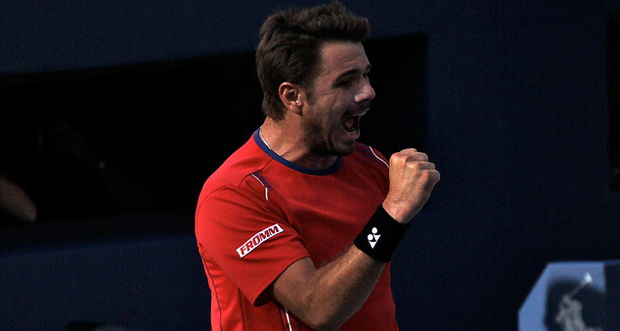
    Wawrinka

    Monte Carlo Masters 2014: A round-about wrap-up & some psychology.

    Near the middle of the day, near the middle of last week, I opened my internet browser to the news that Gabriel Garcia Márquez had died at the age of 87.

    Aww, no,” I exclaimed to no one in particular.

    A colleague—a fellow psychologist who happened to be within earshot—responded to my expression of disappointment with concern. “What’s wrong?”

    “Gabriel Garcia Márquez is dead.”

    Aww, no,” her expression was resonant with compassion. Therapists learn, almost without intention, to pack our monosyllabic murmurings with rich, affirming emotion. I felt immediately understood, and my colleague and I shared a moment of heavy silence as I pondered the impermanence of all things, including authors (and also my lunch, which I’d forgotten on my kitchen counter before work that morning). But, as the sad seconds ticked by and my colleague continued to honor my feelings with quiet empathy, I decided I ought to say something to lighten the mood. After all, it’s not like the Nobel-Prize-winning author was a friend of mine. 

    “Truth be told,” said I, “until this moment I wasn’t aware he was still alive.” 

    “Well,” said my colleague, “truth be told, until this moment, I’d never been aware of him at all. Who is he?”

    It’d been one of those days at work. In fact, it’d been one of those weeks— one of those months. We were both tired and worn-down. The sudden, mutual realization that my colleague and I were sharing grief over the death of a man neither of us had known was alive…well, it was just too much. We burst into fits of irrational laughter. Then—once I regained control of my capacity to inhale—I told her I thought she’d enjoy Márquez’s novel, One Hundred Years of Solitude, she replied that maybe she’d give it a try, and we got back to work, both of us feeling much lighter at heart than before we were saddened by the death of one the literary world’s greats.

    Rafael Nadal’s straight-sets defeat at the hands of David Ferrer in the Monte Carlo quarterfinals took place in the middle of the California night, and I slept straight through it. When I woke up to news of the loss, I was both surprised and not. My reaction was more Hrmm than Aww. Whether it’s mental (as Nadal says it is), or physical (as he might prefer not to discuss with the media), or both (as the two are often intertwined), whatever is going on for Rafa is familiar. We’ve been here before. Nobody rises from the ashes quite like Rafael Nadal, but once he’s risen—once his muscular wings are fully spread, with Nike microfiber plumage shining in the sunlight as he perches at the summit of a mountain made entirely of ranking points and the broken racquets of his shattered opponents—he gets a tad bit uncomfortable. From where I sit, on the summit of my sofa pillows, it seems that something (a significant something) inside Nadal’s psyche prefers to fight the powers that be rather than be one— or at least, prefers not to be World No. 1.

    Unfortunately for (what I am assuming is) Nadal’s conflicted relationship with his own greatness, Novak Djokovic, the current World No. 2, has a wrist injury that looks to keep him sidelined for no small amount of time. The Serb’s injury is a real shame, considering the stunning performance Djokovic delivered in the Miami final. He looked, then, as if nothing would suit him better than an extended, dusty turf war for the No. 1 ranking.

    For now, unless Djokovic’s wrist manages a miraculous Easter recovery, Rafael Nadal is stranded at the top. Unless the King of Clay is suffering physically, or unless he has an abiding desire to abandon tennis for the gambling table, I expect Rafa to be able to convince himself—if not the tennis world at large—that he’s not the favorite to win every title contested on the dirt, thereby freeing himself to do just that. He might even get things sorted this week in the relative shade of Barcelona’s 500-level tournament. Or, the process might take months and he won’t run the metaphorical clay tables again until 2015. Either way, I’ll leave him to it for the moment and turn my attention to the No. 3 and 4 players in the world, who also happen to be the Swiss No. 1 and No. 2.

    [3] Stanislas Wawrinka def. [4] Roger Federer 4-6, 7-6(5), 6-2

    During the 2014 Monte Carlo final—which began very early in the California morning, and spanned three sets containing many brilliant points and scintillating shots but never quite constellated into a beautiful match—and as I watched Roger Federer fend off a break point in the third set with a threaded backhand down-the-line followed by a fearsome overhead smash, I was suddenly moved to pull my copy of One Hundred Years of Solitude down from its resting place on the bookshelf in my living room. It’s probably been fifteen years since I last read the novel, but a passage in the opening paragraph brought much of the story flooding back: “The world was so recent that many things lacked names, and in order to indicate them it was necessary to point.” It’s a passage that lets the reader know the story will begin at the very beginning—in an Eden of wonder—and move in circles from there. What is old is also new. It’s also a sentence that made me think of enraptured tennis fans at a Federer match.

    What Roger Federer does, he’s been doing for well over a decade, but when he does it well, it still feels impossible to replicate. It’s still so new—so recent—that it’s necessary to point. And to gasp. And maybe even to exclaim in an elongated monosyllable resonant with deep emotion. Toward the end of the first set of Federer’s semifinal win over Novak Djokovic, while Federer was struggling to hold his nerves together and Djokovic’s arm was beginning to fall apart, the commentators opened the familiar chapter of the unresolvable GOAT debate. Can Roger Federer truly be called the greatest of all time, or even of his time, since he doesn’t hold a winning record over Nadal or Murray? 

    A half-hour later the Swiss could boast an 18-16 record over the Serb, but he’s still 10-11 against Murray, and 10-23 against Nadal. There was a silence in the booth as those numbers sank in, and then somebody—it might have been Nick Lester—said, somewhat sheepishly, “Aww, I still think he’s the best.” And everyone else agreed with him. Because he’s Federer; and because they know how it feels to watch and to be reduced to wordless gestures, when what you’re paid to do is talk. Márquez’s fascinating gypsies from Solitude might put the Swiss right up there with the invention of magnets, which, they tell us, were originally known as “the eighth wonder of the learned alchemists.” He is a little bit magic.

    Still, as supernatural as Federer’s tennis can be, and as healed as his back appears to be, he’s still struggling with the reality of closing out big points, and big matches. If you spend any time at tournaments with avid Federer fans—something I’ve done on multiple occasions already this year—they will be able to tell you the very instant the typically aggressive Swiss player goes passive. But they will not be able to tell you why. Instead, they will probably ask you, or, if they’ve got a powerful set of lungs, him: “Why didn’t he follow that ball in?”, “Why did he chip that return?”, “Why does he approach to Nadal’s forehand? He’s going to get killed doing that!”, “Why?!?” I don’t know. Maybe he truly believes it’s a good idea to approach Rafa’s forehand, or to remain passively in the backcourt. Or maybe he’s busy thinking about how quickly his daughters are growing up; or whether his capped shirt-sleeves mightn’t be a bit preppy, even for him; or the fact that he’s about to be father three times over; or about the tragic impermanence of the lunch-hour. It could be a thousand things. All we can do is guess. So here’s mine: 

    At the trophy ceremony after the final, Federer told the crowd that he hoped to be back in Monte Carlo for “many, many years.” Thirty-two is by no means old, but there’s no denying that Federer is nearer the end of his career than the beginning, probably much nearer. One day, hopefully many, many, many years from now, when Federer is well past 87, someone will read the news and say, “Aww, Roger Federer died today.” And someone else will respond, “Aww … Who is he?”

    Recognition—the experience human beings crave most— is an impermanent experience. It shifts and alters, as we do, even if you are the most wonderful attraction of the tennis world has ever seen. And when we struggle against accepting inevitable endings and limitations, we start to get confused about what we can control in life and what we can’t. We panic. We try to stem impossible tides instead of focusing on making good decisions about where to place an approach shot, or when not to get too cute with the drop shots. We try to tell ourselves we have all the time in the world, while we secretly freak out that our time might have already come and gone. From my vantage point—again the sofa cushions—Federer looks to me like a man trying to win titles without falling into a mind-twisting pothole of panic. He does just fine, as long as he doesn’t catch a glimpse of the abyss. But, I think it’s possible that if Federer can let go of the need for “one more great run” he’ll have one. Or several. At the very least he’ll stop fading away in deciding sets. Federer might not have “many, many years” left on tour, but he’s got time. And he still inspires plenty of wordless, gestural wonders.

    If trying to prevent the inevitable is a task doomed to failure, then attempting to recover from it is another story altogether—which is why Stanislas Wawrinka’s week at Monte Carlo had the psychologist in me thrilled to her fingertips. There’s little that is more fundamental to life (and therefore tennis) than loss. We all lose in the end. For those of us interested in infant attachment theory (or biblical studies, for that matter) we lose in the beginning, too. But when were able to survive these losses—whether it’s a five-hour, five-set loss to the World No. 1 on center court at a slam; or a seven-hour Davis Cup defeat; or 13 losses to the Eighth Wonder of the World; or a brief loss of dignity along the way to your first slam victory—that’s when change becomes possible, if only we’re helped to keep at it. (Please, somebody tell Jo-Wilfried Tsonga to consider a cozy stay at Magnus Norman’s academy in Sweden.)

    For the most part, substantive change happens gradually, intermittently, with great effort, and only eventually, with easy grace—which pretty much sums up the trajectory of the Monte Carlo final for Stanislas Wawrinka. He started off tense, making easy errors, and losing the first set to the combined force of Federer and his nerves. But, gradually, intermittently, and with a few effortful bellows, Wawrinka began to recover. Watching him clear a channel for his talent to flow was an almost palpable experience. Essentially, this is the kind of stuff I spend my days helping people do. I help people learn how to learn. Yet, whenever I watch somebody integrate intention with action, or insight with experience, becoming more himself along the way, it’s like I’m seeing it happen for the first time. I’m enthralled. 

    By the time the newly made Swiss No. 1 arrived at the third set he was standing well within the baseline, powering through the court with one audacious forehand after another. His serving was equally imperious (if my count is accurate, he dropped only four points on serve in the third set), and his backhand potent. In breaking Federer in the first and third games of the final set, Wawrinka played very much as he had when he nearly bagelled David Ferrer in the semifinals, or when he did bagel Marin Cilic in the second round — which is to say, wonderfully well. 

    Fittingly, Wawrinka closed the match, earning his first-ever Masters title, on a forehand winner. It was this shot that Stan used most aggressively all week. Also fittingly, Roger Federer gave his younger countryman a warm hug and congratulations at the net. A moment of recognition from one learned alchemist to another.

    Cover Photo (Creative Commons License): Marianne Bevis

  • Wawrinka Reigns in Monte Carlo

    Wawrinka Reigns in Monte Carlo

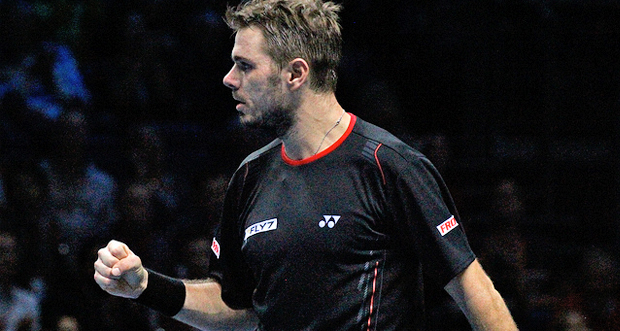
    AO ATP Winner - Stan 2

    Backing up his first Major title in Australia in January, Stanislas Wawrinka, of Switzerland, beat his countryman Roger Federer to win his first Masters 1000 title in Monaco today, 4-6, 7-6(5), 6-2.

    As the two men are friends, Davis Cup teammates, and co-winners of the 2008 Olympic gold medal in doubles, the match started a little tentatively, and rather lacking in kill shots. Federer took the first set on the strength of one early break. In the second, Wawrinka drew the first break, but Federer broke back immediately, and so it was decided in a tiebreak, which Stan took hold of with the first mini-break and never relinquished control from there. He carried that aggressive attitude into the third set, going up two breaks immediately, for a 4-0 lead before Federer held serve. Wawrinka served it out at 5-2.

    With the win, Wawrinka retains the No. 3 slot in the world rankings, as well as his claim to the Swiss No. 1 spot.

  • The Big Four by Winning Percentage

    The Big Four by Winning Percentage

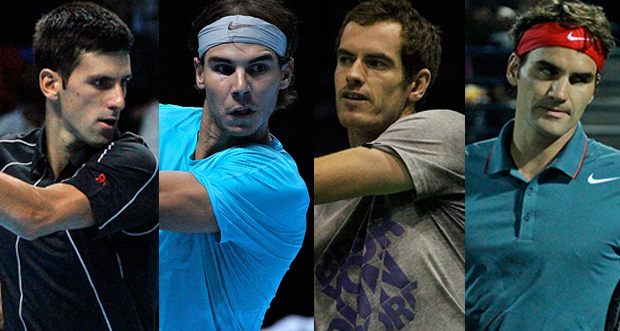
    Novak Djokovic Rafael Nadal Andy Murray Roger Federer

    I was looking at Wikipedia pages for a variety of players and was surprised to notice that Roger’s win percentage this year is the same as 2012, which supports the notion that he’s really resurged well. Certainly he’s only played 23 matches this year, but that’s already more than a third of his total from last year (62) so gives us a large enough sample size to get a sense of his performance level so far. For comparison, through Indian Wells last year he was 13-4 (76%).

    Anyhow, this isn’t meant to be about Roger but the Big Four, and to look at their careers through the lens of win percentage.  Without further ado, here’s a chart:

    20140322063149
    A few notes on each player:

    Roger Federer – this chart really displays a clear peak in 2004-06, with the downturn beginning in 2007, although this could also be because by 2007 both Djokovic and Murray were on the map, with year-end rankings of No. 3 and No. 11, respectively, although Roger had winning records against both Nadal (3-2) and Djokovic (3-1), with no matches against Murray in 2007, so his overall win percentage without those two only goes down a few percentage points.

    Anyhow, the big thing to notice about Roger now is that he’s playing at a similar clip this year as he did in 2012. Hopefully this means we’re back to “post-peak plateau Roger,” as he’s been relatively consistent in terms of winning percentage since 2008, ranging between 81% and 86%, except for 2013’s 73%.

    Rafael Nadal – The thing that really stands out for me is just how consistent Rafa has been in his win percentage since 2005, never dipping below 82% or rising above 91%. In other words, no matter his ups and downs and injuries, he’s been consistent and steady in his performance level. His dip in 2009 is well chronicles because of Robin Soderling and injury, and then in 2011 it was entirely due to Novak’s 6-0 record against him that year. Remove those six matches and he’s at 88% for the year.

    Novak Djokovic – The most interesting part of this chart for Novak is what happened between 2009 and 2011. In 2009 he had finished his third straight year as the clear third best player in the game, and then in 2010 – while he retained his No. 3 ranking – he slipped a bit, winning only two titles and appearing in only four finals. And then 2011 happened. Was it going gluten free or something else? Regardless, it is easily the best year other than Roger’s three great seasons, and in many ways rivals those – certainly one of the ten best seasons in Open Era history. His fans may be disappointed that he’s dropped a notch since, but this chart shows that his level has remained very high – and that he’s been a better player after his career year than he was before.

    Andy Murray – the red-headed stepchild in the family of contemporary greats, both the least loved and least hated of the Big Four – perhaps because he’s the clear No. 4. This chart brought out a couple of minor, but interesting, points. First of all, he had the best debut year by win percentage of the four. It isn’t by much, and it isn’t all that significant, but it’s worth mentioning. Secondly, I was surprised to notice that in 2009 he had the highest win percentage of the Big Four. While 2012 or 2013 are certainly considered his best years because of his Slam wins, in 2009 he won six titles (a career high) and lost only 11 matches, winning 66 (again, a career high).

    Anyhow, it will be interesting to see what this chart looks like by year’s end.

    [divider]

    Image courtesy of rainycat via Creative Commons license

  • One Hope Too Many

    One Hope Too Many

    Novak Djokovic

    Indian Wells Masters 1000, Final

    (2) Djokovic d. (7) Federer, 3-6, 6-3, 7-6(3)

    Novak Djokovic has won the 2014 Indian Wells Masters, embedding himself even more firmly in that group of men who are able to generate endless copy thanks to their records alone. With the great champions, it gets to a point where you can find yourself just going on about the numbers. Arguably the greatest of these was across the net for today’s final, and looked for a time as though he would be the man to triumph once more, thus increasing many of his various records by one. In the end, but only in the end, Djokovic held off the resurgent Roger Federer to claim his third consecutive Masters 1000 title, going back through the Paris Indoors and Shanghai last year. It is also his third Indian Wells title, and seventeenth Masters title overall, and places him equal-third with Andre Agassi on the all-time leader board. As I say, eventually the numbers speak for themselves.

    Aside from the final, the story of the tournament was surely Alexandr Dolgopolov. He startled everyone by beating Rafael Nadal in a third set tiebreak, then delivered an arguably more profound shock by not going down meekly in the following round. I have no statistics at hand, but it has become standard practice to follow up a stunning upset with a dismal loss. Ever the iconoclast, Dolgopolov continued to outpace custom by handily upending Fabio Fognini and Milos Raonic, both in straight sets. Custom finally caught up with him in his first Masters semifinal, when the shreds he was blown to by Federer’s artillery whipped fitfully in the insistent breeze. Nevertheless, the Ukrainian’s ranking has risen from No. 31 to No. 23, with almost nothing to defend for the foreseeable future. Higher seedings beckon, but he’ll always be a dangerous floater. Being Dolgopolov, there’s no sound reason to believe that three strong tournaments in a row and a win over Nadal necessarily mean anything has changed. All in all, enjoy him for what he is worth, for you’ll rarely see his like. Just don’t bank on it lasting.

    Reaching the final guaranteed Federer’s re-ascent to the Top 5, while a victory in the final would have seen him leap over David Ferrer back into the Top 4. Alas, he lost, and languishes about a hundred points adrift. The odds are strong that he will return sooner rather than later, however. Ferrer has finalist points to defend in Miami next week, and one doubts, given his injuries, whether his defence will be sufficiently stout to prevent a tumble from the elite group. Federer didn’t play Miami last year, and thus would likely return to the Top 4 even if he skipped it again this year, an amusing yet not especially significant quirk of the 52-week ranking system.

    Andy Murray, currently ranked at No. 6, will seek to defend the Miami title. After yet another disappointing performance at Indian Wells – he fell to Raonic with all due fuss – it would be easy enough to insist Murray won’t fare any better in Miami than Ferrer. But there’s just no knowing what the Scot will do at the moment, and his perennially execrable level in California no longer necessarily presages similar form in Florida. All that is certain is that his return from surgery has been less smooth than had been anticipated. With the clay season about to commence, now would be a good time to give up expecting too much from Murray for a while. Let any strong results be a pleasant surprise. Come Wimbledon there will be ample opportunity to pile the pressure back on.

    There was a time when John Isner was considered to be his nation’s sturdiest hope on clay, based largely on a few strong Davis Cup performances, and once taking Nadal to five sets at Roland Garros. This probably revealed more about America’s bleak chances on dirt – as an Australian I’m hardly crowing from the high ground – than anything about Isner’s actually prowess. Indian Wells, however, seems to suit him well. Mechanically, it’s no stretch to see why. The thin air and grippy surface combine to render one of the sport’s mightiest weapons if anything more potent: it cuts through the air faster, and explodes off the surface. The desperate home crowd support certainly doesn’t hurt, as opposed to Miami, where North American players come a distant second to those from South America. Nor does the best-of-three format hurt, which ensures Isner cannot indulge his self-defeating passion for endless exertion.

    Still, the stark spectre of impending national irrelevance haunts the US men at every home tournament these days. They (and therefore we) are constantly reminded of the possibility that for the first time no US male might, say, make it to the third round, or be seeded, or ranked in the Top 20. (Again, it’s a wide trail the Australian men blazed years ago.) It usually falls to Isner to save the day, and often he does. Once the smoke has cleared, and Ryan Harrison has provided a meticulous explanation for his latest early round loss, Isner is generally the last one towering, toiling away, interleaving all-American service games with a return style so passive it induces Gilles Simon to yawn. He’s a mystery. Sometimes he perks up and blasts a few big forehand returns, but never for long. Djokovic was less than thrilled when Isner pulled this trick several times as the Serb tried to serve out their semifinal yesterday. Isner then tore through the second set tiebreak, briefly twitterpating the locals. Djokovic only had himself to blame. Once he’d finished admonishing himself he pushed through the third set without hassle. Djokovic hasn’t played well all week, but he has been very good at maintaining his equilibrium. This, more than anything, is probably why he’s the one hoisting the trophy.

    Calmness was fundamental again today in the key moments. There were the usual assortment of bellows, exultant or frustrated as the situation allowed, but when the match coiled tightest he was a picture of equanimity. After a patchy first set, in which Federer played all over him, Djokovic tightened his game up considerably in the second set, doubtless in the hope that if he hung around long enough something fruitful might eventuate. He was rewarded by a poor service game from Federer at 3-4, broke, and then served out the set. He broke early in the third set when Federer’s forehand went momentarily haywire, and rode that almost all the way until the end. As with Isner in the semifinal, however, Djokovic was broken while serving for the match, this time at 5-4. If he erred in this case, though, it was only in attempting greater margin. Federer put together his finest return game of the match, broke lustily to 15, and then held once more to love. From 3-5, he’d won fifteen of sixteen points. Djokovic must have been more than a touch rattled, but maintained his composure beautifully, and, vitally, held comfortably for the tiebreak.

    There was a reasonable hope that what had thus far been a fine and dramatic final might conclude with a fine and dramatic breaker, but this turned out to be one reasonable hope too many. The game whereby Djokovic had held for 6-6 seemingly broke Federer’s momentum, and the Swiss was never to regain it. Djokovic, meanwhile, confined his mood to that narrow band between over-attentiveness and exuberance, and made a virtue out of simply executing the shots he was meant to. The match ended with a weak pair of Federer errors, the first of which put them level on 98 points apiece, the second of which put Djokovic ahead. Statistically it was a terrifically close match – both had even winner/error ratios, served in the mid-sixties, and produced six aces – but it was Djokovic who won two sets to one.

    Both men spoke graciously on the dais. Federer broke new ground by praising the camera operators. Perhaps he was impressed by the new ‘FreeD’ images, although one cannot imagine he was half as impressed as the commentators. I haven’t heard Robbie Koenig sound so enthusiastic since they began measuring the RPMs on Nadal’s forehand. Federer also admitted he was overall pretty pleased with his own form. As exciting as his third set resurgence was today, his resurgence across the first few months of 2014 has mattered more, especially given his poor 2013. Greg Rusedski suggested Federer might be intending to peak for Roland Garros and Wimbledon. It’s the kind of thing Rusedski is, for some reason, paid to say.

    Djokovic for his part conceded that it was “an incredible match – an incredibly difficult match.” For all that it cleaved to the usual format – with Federer leaping out early and Djokovic gradually reeling him back – the subtleties and contrasts inherent to the match-up as ever inspired some great tennis. I find it to be the most consistently interesting of the elite rivalries (others will certainly disagree). Djokovic plays Federer differently to how he plays just about everyone else, which is a testament to his versatility, as is the fact that, despite never consistently playing at his highest level, he is once against the Indian Wells champion.

    [divider]

    Cover Photo (Creative Commons License): Marianne Bevis

  • Djokovic Survives Federer in Desert Classic at Indian Wells

    Djokovic Survives Federer in Desert Classic at Indian Wells

    Novak Djokovic

    Indian Wells is considered by many to be the “Fifth Slam” — arguably the most important of the ATP 1000 tournaments. This year’s edition featured upsets (Nadal and Murray), and the emergence of some of men’s tennis’s more promising younger players (Dolgopolov, Gulbis, and Dimitrov). However, when all was shaken out, it still came down to two stalwarts: Djokovic and Federer.  The complete overhaul of the men’s game will have to wait.

    The set-up was big: Federer was playing a renewed game with his bigger racquet, and Djokovic was having his worst start of the year since 2006. Roger, who had beaten Novak in Dubai, and gone on to win the title, was having a far better start to his year than last, when he won only one title, a 500-level tournament, in Halle. The prevailing wisdom was that Djokovic needed the win more than Federer.

    In the first set, Federer came out aggressive and tricky. He was all over the court, and up at the net often, which clearly had Djokovic off-balance. The Serb started slowly, with a shaky serve, and the Swiss broke his first service game. Federer continued the attack, and won the first set 6-3.

    The second set saw a steadier Djokovic, and a less-aggressive Federer. The Serb’s serve was much stronger, and he was making inroads into the Federer serve, which had dropped considerably. Also, Federer had faded from his attacking stance, preferring to go toe-to-toe at the baseline with Djokovic, who broke in the seventh game of the set for 5-3. Federer’s first serve was abandoning him at this point, while Djokovic’s was getting better. He won the second set 6-3.

    The third set held all of the intrigues that the match warranted. Djokovic broke Federer’s serve in the third game, but the Serb failed to serve it out at 5-4. Federer seemed to remember that the attacking game had gotten him the first set, but rather too late. Though he got the match to a tiebreak, Djokovic’s stronger serving and better baseline game got him the trophy. Final score:  3-6, 6-3, 7-6(3.)

    [divider]

    Cover Photo (Creative Commons License): Marianne Bevis

  • Federer Wins Record Sixth Dubai Title

    Federer Wins Record Sixth Dubai Title

    Roger Federer

    Roger Federer rebounded from a set and a break deficit to defeat Tomas Berdych 3-6, 6-4, 6-3 for the trophy at the Dubai Duty Free Championships.  It was a topsy-turvy affair, with several swings in momentum and breaks of serve. As Berdych’s first serve percentage dropped, however, Federer’s came up, and the Swiss overall had more winners and fewer unforced errors than the Czech (25-23 v. 20-29.)

    Federer defeated Novak Djokovic yesterday to secure his place in the final and the victory today sees him at at 14-2 win-loss start to the year, which seems to bode well, after a less-than-stellar 2013 for the great champion. ‘Things definitely went my way out here tonight,” Federer said. ”I’ve had a lot of tough matches in the last year and a half so it was nice to get a lucky break again.”

    Berdych recently the saw the end to his even longer drought, winning the title in Rotterdam three weeks ago, ending an 18-month streak without a trophy. ”He’s the greatest player of all time and he’ll never give up and give you anything for free,” Berdych said. ”I knew that and thought I was ready for it, but my execution wasn’t good enough to hold it to the end.”

    The win gives Federer his 78th career title, putting him one above John McEnroe, and alone at third on the all-time list behind Jimmy Connors (109) and Ivan Lendl (94). In addition, as his first title of 2014 (first since Halle last June), the win in Dubai means that Roger has won at least one title in each of the last 14 years.

    [divider]

    Cover Photo (Creative Commons License): Marianne Bevis

  • Federer Commits to Davis Cup Action

    Federer Commits to Davis Cup Action

    Roger Federer

    Roger Federer will join the Australian Open champion and new Swiss No.1 Stanislas Wawrinka in their Davis Cup first-round tie against Serbia.

    “I can confirm that Roger is in Serbia and will play in the Davis Cup,” stated Sandra Perez of the Swiss Tennis Federation.

    It is the first time since 2012 that Federer has made the commitment to play Davis Cup and the last time he played a first round tie was back in 2005.

    The Swiss will begin the tie as favorites with Serbia missing Novak Djokovic and Janko Tipsarevic. The makeshift Serbian team will provisionally feature Dusan Lajovic (ranked No. 102) and Filip Krajinovic (No. 280) in singles, with Nenad Zimonjic and Ilija Bozoljac pairing up for the doubles.

    The tie will be played on an indoor hard court in Novi Sad.

    [divider]

    Cover Photo: Kenneth Hong, (Creative Commons License)