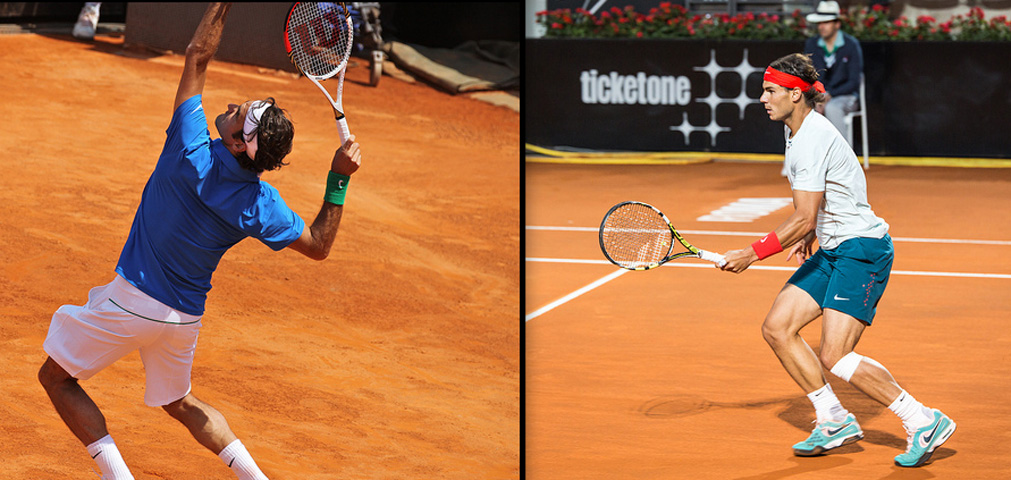
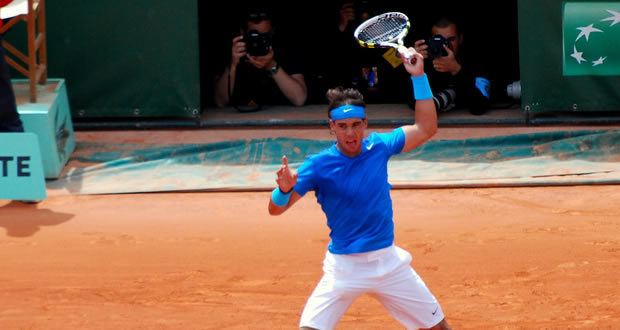
It’s that time of the year again. The sun is shining over Europe – at least in theory – and the tennis season heats up accordingly. To many, it’s the most fascinating part of the tennis calendar. More exciting yet is the fact that in many ways, the energy of the European clay court season doesn’t necessarily culminate at the French Open. Instead, it extends itself to the grass courts of Wimbledon, which, due to the unfortunate lack of proper “grass court season,” seems to have become the climax of the European spring/summer, and a natural expansion of the clay season — as if the sport’s most prestigious tournament needed added cachet.
Beyond the changes in continents, seasons, and scenery, the clay season has, for the longest time, marked a momentary shift in dynamics at the top of men’s tennis. Serves were suddenly returned with more frequency, rallies extended, players sliding all over the baseline, umpires abandoning the comfort of their chairs to examine ball marks, and the term “specialist” coined with near tiresome regularity. Most noticeably, the dominant forces were no longer quite as supreme once their feet hit the dirt. That’s when you knew that for about three months or so, the tennis world would be different. At some point in the 90’s, clay court tennis nearly became its own entity.
The homogenization of the courts at the turn of the millennium made the change a little less extreme, and baseline tennis gradually became an all-surface norm. That, however, did not spell an end to the clay-induced hierarchical restructures at the top of the game. Like Pete Sampras before him, Roger Federer, the new tennis golden boy, struggled to make his mark on the red stuff early on. And while the number of true “specialists” around him was slowly decreasing, he was soon left with a far greater challenge to surmount. As Federer finally began to adapt his game to the courts he reportedly grew up on, a new specialist emerged – one so good that he exceeded the term itself; one whose game (and results) was too good to be that of a mere specialist. A king of clay had emerged, and the clay court season became the time of the year when Rafael Nadal sits, runs, grunts, and slides his way across his clay-covered throne.
It didn’t matter whether Federer was enjoying near unthinkable runs of dominance, Novak Djokovic was breaking out in spectacular fashion to win his first Grand Slam, or Nadal himself was riding eleven months title droughts, come the Monte Carlo Masters, the Spanish bull was the man to beat. In fact, at some point, he became the man to avoid, as other top players made it a habit to skip the tournament altogether. In fairness, their decisions were certainly motivated by other, more important factors, but the inevitability of the outcome couldn’t have helped. Eventually, Rafael Nadal winning the tournament year after year ceased being special, despite the outrageous nature of the accomplishment. It simply became the tournament where Nadal reminded the world who the winner of the next major was going to be, just in case they’d forgotten.
Nadal’s near absolute dominance on the surface was not without the occasional blemish, but his very few clay court losses were considered to be anomalies. Any intrigue created by his loss to Federer at Hamburg in 2007 was quickly killed off three weeks later when he vanquished his rival in Paris once more, while his shocking 2nd round exit in Rome the following year was largely blamed on blisters, with next to no mention of the man who beat him (it was Juan Carlos Ferrero, just in case you’re wondering). And why wouldn’t people so easily dismiss his losses when Nadal made sure to quickly restore order at the following tournament? His 2009 loss to Federer in Madrid received similar treatment, with Federer himself quickly playing down the significance of his win. After all, we had seen Federer and Nadal square off in enough French Open finals to know how their eventual meeting was going to unfold.
Then, that loss happened. On a surreal Sunday afternoon in Paris, Robin Soderling produced what could well be the biggest upset in tennis history and handed Nadal his first loss at Roland Garros. The world was in shock, and it took Roger Federer finally completing his career slam to provide the tennis universe with a different subject to touch on, before the attention shifted back to Nadal once again when the words “knee injury” were uttered. The clay court season, as if there was any doubt, had become the Nadal season, in triumph or disaster. He was the one constant variable; the man whose wins are praised, and losses overshadow other players’ victories.
In fact, 2009 was the year that proved just how reluctant we are to accept change. We might openly yearn for it or secretly wish it, but we only want it on our terms. There is a reason the post-Sampras/pre-Federer days are not remembered fondly. For as much as many complain about a status quo, they prefer it to chaos. People might enjoy upsets when they happen, but they want official “passing of the torch” moments, as opposed to “flukes.” People so willingly accepted Nadal as the best player in the world following his 2008 Wimbledon final triumph over Federer because they knew he was here to stay, and had already seen the signs a year before. We desire big picture narratives – moments which we look back on and pinpoint as an official changing of the guard, as opposed to wondering, “How the hell did he lose to that guy?”
The neutrals wouldn’t want Nadal to dominate on clay forever, how could they? But as exciting as huge upsets are, they generally mean little in the long run. Those who wish for Nadal’s clay court dominance to cease would likely prefer to see the King of Clay removed from his throne, as opposed to momentarily pushed aside. When Nadal bounced back the following year to storm through the clay court season undefeated, the tennis world almost collectively embraced the familiarity of it all. Nadal stomped Soderling in the French Open final, the previous year’s debacle was put to rest, and all was right in the world.
Enter Novak Djokovic…
The man tipped to be Fedal’s (that’s Federer and Nadal, for the two of you who are unfamiliar with the term) successor for three years had finally gotten back on track, and this time, he wasn’t going anywhere. An unprecedented start to the season saw Djokovic clinch every tournament he participated in, and racked up a combined five victories over Federer and Nadal in the process, but the big question remained whether his dominance would translate to clay. Djokovic chose to skip Monte Carlo, and Nadal was handed his usual winner’s trophy and shook Prince Albert’s hand for the umpteenth time. However, two clay court victories over Nadal later, Djokovic had shown he meant business. He was far and away the best player in the world, and entered the French Open with a gigantic wave of momentum. For the first time in six years, Rafael Nadal was not the overwhelming favorite to win Roland Garros.
And yet, as always, when it comes to attention and headlines, the clay court season remained all about Nadal. As Djokovic was silently making quick work of his early round opponents, Nadal was conducting melodramatic press conferences in which he was asked to make sense of his losses to Djokovic as well as going five sets (for the first time ever at Roland Garros) with big serving American John Isner. Nadal bizarrely sounded like a man burned out with tennis, and it looked increasingly likely that Djokovic would strike a lethal blow. Unfortunately for the Serb, a cruel twist of irony would dictate otherwise, as Roger Federer rolled back the years with a breathtaking display to bring Djokovic’s winning streak to a halt, essentially handing Nadal another “Coupe de Mousquetaires” in the process. Sure enough, Nadal was taking a trademark bite off of his favorite trophy two days later. The following year, Nadal enjoyed a far more peaceful European spring, steamrolling through the competition in typical fashion, while recording three victories over Djokovic to boot. The King of Clay was not to be dethroned yet.
While injury soon put Nadal on shelf for seven months, a strong return indicated that the Spaniard would be picking up right where he left off. After a great display at Indian Wells and a wise scheduling choice to skip Miami, Nadal entered the Monte Carlo Masters as a strong favorite. Uncertainty surrounding Novak Djokovic’s participation due to an ankle injury further intensified Nadal’s status, but a sensational display in the final reminiscent of their 2011 matches saw Djokovic become the first man in nine years to hand Nadal a defeat in Monte Carlo. To state the obvious: the win was monumental.
For the next month, this will be Nadal’s season. His wins will be cherished, his losses will be over-analyzed, and his comments will be beaten to death. However, more so than any other time, his status as the undisputed King of Clay is in jeopardy. If Djokovic is able to replicate his 2011 wins over Nadal at the upcoming Masters 1000 events, it could officially spell the end of an era. People might be reluctant to accept change, but for the past two years, Novak Djokovic has given them little choice but to. If the world number one finally puts an end to Nadal’s French Open monopoly, the changing of the guard that first started on other surfaces in 2011 would be completed at last. One could think of easier tasks, though…
Click here to discuss this and more with fellow tennis fans on our discussion boards.