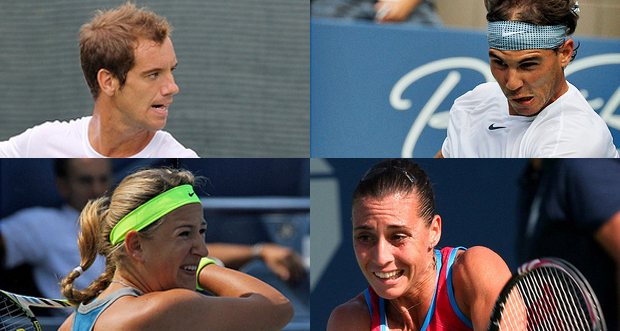
Tag: richard gasquet

  • US Open Men’s Semifinals Schedule of Play: Saturday, Sept. 7

    US Open Men’s Semifinals Schedule of Play: Saturday, Sept. 7

    [Scores added as known.]

    Arthur Ashe Stadium — 12:00 P.M.

    Men’s Singles – Semifinals
    Novak Djokovic (SRB) (1) d. Stanislas Wawrinka (SUI) (9) — 2-6, 7-6(4), 3-6, 6-3, 6-4

    Not Before: 2:50 P.M.

    Men’s Singles – Semifinals
    Rafael Nadal (ESP) (2) d. Richard Gasquet (FRA) (8) — 6-4, 7-6(1), 6-2

    Women’s Doubles – Final
    Andrea Hlavackova (CZE) (5) / Lucie Hradecka (CZE) (5) d. Ashleigh Barty (AUS) (8) / Casey Dellacqua (AUS) (8) — 6-7(4), 6-1, 6-4

    [divider]

    Click here to discuss the Nadal/Gasquet semifinal in our discussion forum.

    Click here to discuss the Djokovic/Wawrinka semifinal in our discussion forum.

    [divider]

  • Age Has the Edge (Mostly) at the US Open in the SF/QFs

    Age Has the Edge (Mostly) at the US Open in the SF/QFs

    Day 9 of the US Open featured more than a few 30-somethings in the mid-late rounds of men’s and women’s singles. Flavia Pennetta, 31, upset countrywoman Roberta Vinci, 30.  Pennetta, who had fallen down to being the fourth ranked Italian, behind Errani, the best Italian, and Vinci, one of her erstwhile doubles partners.  While Pennetta is currently ranked No. 85,  she dominated Vinci, 6-4, 6-1, to reach her first ever semifinal of a Major.

    The “youngster” of the day, Victoria Azarenka, 24, beat 30-year-old Daniela Hantuchova, 6-2, 6-3.  The hope is this sets up a meeting with Serena Williams in a final, the two women who are the greatest rivals at this point in the women’s game, though Azarenka still has to beat Flavia Pennetta.  For them to meet, however, Williams will have to beat the great Chinese star and fellow 31-year-old, Li Na.

    On the men’s side, Richard Gasquet emerged as the winner of a 5-set battle with David Ferrer, another 31-year-old.  Gasquet dominated the first two sets, in a surprise over the No. 4 seed, who has had a lackluster summer.  Ferrer evened the match to 2-sets a piece, but Gasquet fulfilled the aggression he brought to the beginning of the match, and closed it out for 6-3, 6-1, 4-6, 2-6, 6-3.

    The Frenchman Gasquet is 27 — on the younger edge of today’s players — and he will meet Rafael Nadal, also 27, who beat his countryman, Tommy Robredo, 31, the vanquisher of Roger Federer in the Round of 16.  Robredo went down without seriously troubling Nadal.  Final score:  6-0, 6-2, 6-2.  Nadal has yet to drop his serve the entire tournament.

    That so many 31-year-olds have lasted so long in this tournament, one has to say that 1981-82 must have been a great vintage for tennis players, if a somewhat late-maturing grape.

    [divider]

    Click here to discuss the Nadal/Robredo quarterfinal in our discussion forum.

    Click here to discuss the Ferrer/Gasquet quarterfinal in our discussion forum.

    Click here to discuss the Azarenka/Hantuchova quarterfinal in our discussion forum.

    Click here to discuss the Vinci/Pennetta quarterfinal in our discussion forum.

    [divider]

  • Luck of the Draw: US Open 2013

    Luck of the Draw: US Open 2013

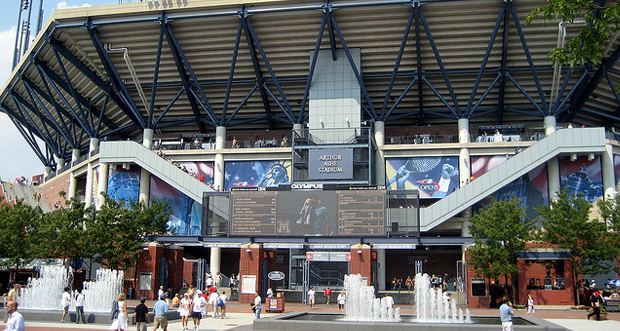
    The draw for the US Open has been released in the traditional fashion, which is to write the names of every eligible player on little slips of paper, place them all in an antique cannon in the middle of Arthur Ashe Stadium, and fire them straight up. From there the strong prevailing winds take over, and a player’s placement is determined by where in the tri-state area his name flutters to rest. It is for this reason, one presumes, that the year’s final Major is always contested during hurricane season. Sadly, the USTA has announced that in 2017 there will be roofs over the main stadiums at the Billy Jean King National Tennis Center. The US Open will have to find a new way of conducting the ceremony (since it is unthinkable that something as momentous as populating a tournament draw could be achieved without due pomp). It’s always a shame when old traditions disappear.

    [divider]

    Discuss this article, the match and lots more with fellow tennis fans in the forums.

    [divider]

    Of subsidiary interest, the placement of the very highest seeds is decided by where their names fall in relation to David Ferrer’s. As it happened, Rafael Nadal was the luckiest one. We can safely ignore scurrilous rumours that the slips of paper bearing the two Spaniards’ names had been stuck together with adhesive. Meanwhile, Novak Djokovic’s name turned up in Stamford, Connecticut. It could have been worse, I suppose.

    Once again we’re invited to marvel at the vagaries of the ATP rankings, especially the situation whereby Andy Murray, reigning US Open (and Wimbledon) champion and eternal saviour of British tennis, is ranked number three in the world. This is one place lower than Nadal, who holds only a single Major (Roland Garros), lost in the first round at Wimbledon, and didn’t even play at the others. It is two places lower than Novak Djokovic, who holds only the Australian Open. As a result the Scot is seeded lower than both those men at the upcoming US Open. As far as the population of the small island positioned off the extreme western coast of the Eurasian landmass is concerned, this is nothing short of a cosmic injustice.

    Although Sky Sports have never attained the febrile derangement of their compatriots at the Daily Mail, they have nonetheless elevated cheerleading on Murray’s behalf into something of an art form, and will reliably ascend to heights of outrage when they feel he’s been hard-done-by. While raucous advocacy presumably doesn’t reflect management’s official position, it certainly isn’t discouraged, and any failure to address Britain’s top player in sufficiently rapturous terms presumably results in disciplinary action. (This policy, incidentally, isn’t limited to Sky: word is that John McEnroe received a stern talking-to from ESPN after he repeatedly excoriated American players on air during last year’s US Open. He and his brother really did go to town on Donald Young one evening. Here in Australia, failure to sing the praises of either Lleyton Hewitt or Bernard Tomic will earn the offender a baleful visit from John Newcombe.) Anyway, Peter Fleming pronounced the latest rankings to be “crazy”. Marcus Buckland suggested it “seemed unfair”. Others were less circumspect, in each case betraying a deliberate ignorance of how the rankings actually work. It is understandable that the average punter’s knowledge of the sport ends with the Majors – we shouldn’t necessarily be thrilled at this, and American coverage in particular can grow pathetically grateful at any public interest at all – but for those paid good money to follow professional tennis from week to week, the Majors should merely be the start. There is no mystery why Nadal is ranked higher than Murray: there’s more to tennis than Grand Slam events.

    Anyway, the reason why the second and third seedings matter so much at this US Open is that David Ferrer is seeded fourth. There are probably kinder ways to say it, but the reality is that even when Ferrer was in decent form he represented a more benign semifinal opponent than whomever the alternative happened to be. Right now, however, he is in execrable form, and still troubled by a lingering injury. Not only that, but these are the potential quarterfinal match-ups based on seedings:

    • Djokovic – del Potro
    • Murray – Berdych
    • Nadal – Federer
    • Ferrer – Gasquet

    Which of these is not like the others? Any one of Berdych, del Potro, or Federer could have fallen in Ferrer’s quarter, and in each case would have been favoured to reach the last weekend. Alas, it wasn’t to be. So it goes. Let’s just call Ferrer’s quarter a grand opportunity for someone. There are nine qualifiers in this quarter, and four of them are facing each other. I’m going to venture out on an especially shaky limb, and suggest that Dmitry Tursunov’s time has arrived. Seeded thirty-two, the Russian won’t encounter anyone ranked higher until the third round at the earliest. By wisely choosing to be drawn in Ferrer’s quarter, he has ensured that he won’t face anyone truly terrifying until the semifinals. So pencil him in for that. Gasquet is in there, too, of course, seeded eighth. I could pencil him in for a quarterfinal, but history suggests that would be a waste of graphite. On the small chance that Tursunov doesn’t push all the way through to Super Saturday, I suspect either Milos Raonic or Jerzy Janowicz will. Or Ernests Gulbis, who is now seeded and can thus stop thinking of himself as the world’s most dangerous floater, since it was frankly getting him nowhere. But really it’s anyone’s guess.

    Ryan Harrison’s appalling luck at Grand Slam level continues. He has once again drawn a lofty seed early on, in this case Nadal in the opening round. Last year in New York he faced Juan Martin del Potro in the second round. The upshot is that even last year’s modest points will almost certainly go undefended. It’s rotten luck, undoubtedly, though one shouldn’t pretend there aren’t other reasons why Harrison isn’t ranked high enough to elude this kind of misfortune. It’s bound to be a featured night match, and thus a test of McEnroe’s generosity. It’s hard to imagine either Nadal or Federer will suffer upsets before they meet in the quarterfinals, unlike at Wimbledon, where I totally foresaw those early losses to Steve Darcis and Sergiy Stakhovsky, but didn’t want to spoil the surprise.

    Only one first round match really stands out – setting to one side the possibility that those qualifiers will entertainingly pulverise each other in fifth set tiebreaks – which is the one between Lleyton Hewitt and Brian Baker. Joints creaking and metal pins clanking, they’ll contest the chance to play del Potro. Whoever comes out of all that, it’ll be a triumph for medical science.

    Credits: Cover Photo: Wallyg, (Creative Commons License)

  • Wimbledon Day 6: Saturday, June 29 – Order of Play & Scores

    Wimbledon Day 6: Saturday, June 29 – Order of Play & Scores

    [divider]

    Click here to discuss Men’s Day 6 action with fellow tennis fans.

    Click here to discuss Women’s Day 6 action with fellow tennis fans.

    [divider]

    Centre Court – 1:00 PM

    GENTLEMEN’S SINGLES – THIRD ROUND
    Bernard Tomic (AUS) d Richard Gasquet (FRA) (9) — 7-6(7), 5-7, 7-5, 7-6(5)

    LADIES’ SINGLES – THIRD ROUND
    Sabine Lisicki (GER) (23) d Samantha Stosur (AUS) (14) — 4-6, 6-2, 6-1

    GENTLEMEN’S SINGLES – THIRD ROUND
    Novak Djokovic (SRB) (1) v Jeremy Chardy (FRA) (28) — 6-3, 6-2, 6-2

    LADIES’ SINGLES – THIRD ROUND
    Serena Williams (USA) (1) d Kimiko Date-Krumm (JPN) — 6-2, 6-0

    [divider]

    No. 1 Court – 1:00 PM

    LADIES’ SINGLES – THIRD ROUND
    Petra Kvitova (CZE) (8) d Ekaterina Makarova (RUS) (25) — 6-3, 2-6, 6-3

    GENTLEMEN’S SINGLES – THIRD ROUND
    Tomas Berdych (CZE) (7) d Kevin Anderson (RSA) (27) — 3-6, 6-3, 6-4, 7-5

    GENTLEMEN’S SINGLES – THIRD ROUND
    David Ferrer (ESP) (4) d Alexandr Dolgopolov (UKR) (26) — 6-7(6), 7-6(2), 2-6, 6-1, 6-2

    [divider]

    No. 2 Court – 11:30 AM

    GENTLEMEN’S SINGLES – THIRD ROUND
    Mikhail Youzhny (RUS) (20) d Viktor Troicki (SRB) — 6-3, 6-4, 7-5

    LADIES’ SINGLES – THIRD ROUND
    Laura Robson (GBR) d Marina Erakovic (NZL) — 1-6, 7-5, 6-3

    GENTLEMEN’S SINGLES – THIRD ROUND
    Tommy Haas (GER) (13) d Feliciano Lopez (ESP) — 4-6, 6-2, 7-5, 6-4

    LADIES’ DOUBLES – SECOND ROUND
    Anna-Lena Groenefeld (GER) (7) / Kveta Peschke (CZE) (7) d Lisa Raymond (USA) / Laura Robson (GBR) — 6-4, 6-4

    [divider]

    No. 3 Court – 11:30 AM

    GENTLEMEN’S SINGLES – THIRD ROUND
    Fernando Verdasco (ESP) d Ernests Gulbis (LAT) — 6-2, 6-4, 6-4

    LADIES’ SINGLES – THIRD ROUND
    Sloane Stephens (USA) (17) d Petra Cetkovska (CZE) — 7-6(3), 0-6, 6-4

    LADIES’ SINGLES – THIRD ROUND
    Agnieszka Radwanska (POL) (4) d Madison Keys (USA) — 7-5, 4-6, 6-3

    LADIES’ SINGLES – THIRD ROUND
    Na Li (CHN) (6) d Klara Zakopalova (CZE) (32) — 4-6, 6-0, 8-6

    MIXED DOUBLES – FIRST ROUND
    Jean Julien Rojer (NED) / Vera Dushevina (RUS) v Jamie Murray (GBR) / Su-Wei Hsieh (TPE) — Postponed

    [divider]

    Court 12 – 11:30 AM

    GENTLEMEN’S SINGLES – THIRD ROUND
    Kenny De Schepper (FRA) d Juan Monaco (ARG) (22) — 6-4, 7-6(8), 6-4

    LADIES’ SINGLES – THIRD ROUND
    Monica Puig (PUR) d Eva Birnerova (CZE) — 4-6, 6-3, 6-4

    GENTLEMEN’S SINGLES – THIRD ROUND
    Juan Martin Del Potro (ARG) (8) d Grega Zemlja (SLO) — 7-5, 7-6(3), 6-0

    MIXED DOUBLES – FIRST ROUND
    Dominic Inglot (GBR) / Johanna Konta (GBR) d Nicolas Almagro (ESP) / Maria-Teresa Torro-Flor (ESP) — 4-6, 6-3, 19-17

    [divider]

    Court 18 – 11:30 AM

    GENTLEMEN’S SINGLES – THIRD ROUND
    Lukasz Kubot (POL) d Benoit Paire (FRA) (25) — 6-1, 6-3, 6-4

    LADIES’ SINGLES – THIRD ROUND
    Roberta Vinci (ITA) (11) d Dominika Cibulkova (SVK) (18) — 6-1, 6-4

    GENTLEMEN’S SINGLES – THIRD ROUND
    Ivan Dodig (CRO) d Igor Sijsling (NED) — 6-0, 6-1, 1-0 Ret.

    LADIES’ DOUBLES – SECOND ROUND
    Liezel Huber (USA) (6) / Sania Mirza (IND) (6) d Flavia Pennetta (ITA) / Andrea Petkovic (GER) — 7-6(6), 3-6, 6-2

    MIXED DOUBLES – FIRST ROUND
    Fabio Fognini (ITA) / Flavia Pennetta (ITA) d Jamie Delgado (GBR) / Tara Moore (GBR) — 7-6(2), 6-3

    [divider]

    Court 5 – 11:30 AM

    GENTLEMEN’S DOUBLES – SECOND ROUND
    Leander Paes (IND) (4) / Radek Stepanek (CZE) (4) d Jamie Delgado (GBR) / Matthew Ebden (AUS) — 6-4, 6-4, 6-3

    GENTLEMEN’S DOUBLES – SECOND ROUND
    Aisam Qureshi (PAK) (5) / Jean-Julien Rojer (NED) (5) d Xavier Malisse (BEL) / Ken Skupski (GBR) — 6-3 6-7(1), 6-3, 6-7(5), 8-6

    LADIES’ DOUBLES – SECOND ROUND
    Jelena Jankovic (SRB) / Mirjana Lucic-Baroni (CRO) d Kirsten Flipkens (BEL) / Magdalena Rybarikova (SVK) — 6-3, 4-6, 6-3

    LADIES’ DOUBLES – SECOND ROUND
    Nadia Petrova (RUS) (3) / Katarina Srebotnik (SLO) (3) d Varvara Lepchenko (USA) / Saisai Zheng (CHN) — 7-5, 6-3

    [divider]

    Court 6 – 11:30 AM

    MIXED DOUBLES – FIRST ROUND
    Rajeev Ram (USA) / Francesca Schiavone (ITA) d Raven Klaasen (RSA) / Anastasia Rodionova (AUS) — 7-6(6), 4-6, 6-4

    LADIES’ DOUBLES – SECOND ROUND
    Su-Wei Hsieh (TPE) (8) / Shuai Peng (CHN) (8) d Stephanie Foretz Gacon (FRA) / Eva Hrdinova (CZE) — 4-6, 6-3, 6-4

    LADIES’ DOUBLES – SECOND ROUND
    Ekaterina Makarova (RUS) (4) / Elena Vesnina (RUS) (4) d Christina McHale (USA) / Tamira Paszek (AUT) — 7-6(8), 6-1

    GENTLEMEN’S DOUBLES – SECOND ROUND
    Lukasz Kubot (POL) (15) / Marcin Matkowski (POL) (15) d Marinko Matosevic (AUS) / Frank Moser (GER) — 2-6, 4-6, 6-2, 6-2, 6-1

    [divider]

    Court 7 – 11:30 AM

    GENTLEMEN’S DOUBLES – SECOND ROUND
    Jesse Levine (CAN) / Vasek Pospisil (CAN) d Santiago Gonzalez (MEX) (10) / Scott Lipsky (USA) (10) — 4-6, 7-6(3), 6-4, 3-6, 6-3

    GENTLEMEN’S DOUBLES – SECOND ROUND
    Max Mirnyi (BLR) (7) / Horia Tecau (ROU) (7) d Samuel Groth (AUS) / Chris Guccione (AUS) — 6-4, 6-7(6), 7-6(2), 7-5

    MIXED DOUBLES – FIRST ROUND
    James Blake (USA) / Donna Vekic (CRO) d Jaroslav Levinsky (CZE) / Liga Dekmeijere (LAT) — 6-4, 6-1

    [divider]

    Court 8 – 11:30 AM

    GENTLEMEN’S DOUBLES – SECOND ROUND
    Mahesh Bhupathi (IND) (8) / Julian Knowle (AUT) (8) d Nicholas Monroe (USA) / Simon Stadler (GER) — 3-6, 6-4, 6-4, 6-2

    MIXED DOUBLES – FIRST ROUND
    Andy Ram (ISR) / Abigail Spears (USA) d Daniele Bracciali (ITA) / Galina Voskoboeva (KAZ) — 6-4, 6-7(6), 6-2

    MIXED DOUBLES – FIRST ROUND
    John Peers (AUS) / Ashleigh Barty (AUS) d Julian Knowle (AUT) / Shuai Zhang (CHN) — 6-7(7), 6-3, 6-3

    MIXED DOUBLES – FIRST ROUND
    Martin Emmrich (GER) / Julia Goerges (GER) d Juan-Sebastian Cabal (COL) / Bojana Jovanovski (SRB) — 7-5, 6-2

    [divider]

    Court 10 – 11:30 AM

    GENTLEMEN’S DOUBLES – SECOND ROUND
    Treat Huey (PHI) (16) / Dominic Inglot (GBR) (16) d Andre Begemann (GER) / Martin Emmrich (GER) — 6-3, 6-7(2), 7-5, 7-6(3)

    GENTLEMEN’S DOUBLES – SECOND ROUND
    Alexander Peya (AUT) (3) / Bruno Soares (BRA) (3) d Paul Hanley (AUS) / John-Patrick Smith (AUS) — 4-6 6-1 6-7(6) 7-5, 10-8

    LADIES’ DOUBLES – SECOND ROUND
    Julia Goerges (GER) (16) / Barbora Zahlavova Strycova (CZE) (16) d Alize Cornet (FRA) / Pauline Parmentier (FRA) — 6-4, 6-0

    MIXED DOUBLES – FIRST ROUND
    Robert Farah (COL) / Darija Jurak (CRO) d Paul Hanley (AUS) / Hao-Ching Chan (TPE) — 6-2, 6-4

    MIXED DOUBLES – FIRST ROUND
    Eric Butorac (USA) / Alize Cornet (FRA) d Michal Mertinak (SVK) / Vladimira Uhlirova (CZE)  — 6-4, 3-6, 6-3

    [divider]

    Court 14 – 11:30 AM

    GENTLEMEN’S SINGLES – THIRD ROUND
    Andreas Seppi (ITA) (23) d Kei Nishikori (JPN) (12) — 3-6, 6-2, 6-7(4), 6-1, 6-4

    LADIES’ SINGLES – THIRD ROUND
    Tsvetana Pironkova (BUL) d Petra Martic (CRO) — 6-1, 4-6, 6-2

    LADIES’ SINGLES – THIRD ROUND
    Kaia Kanepi (EST) d Alison Riske (USA) — 6-2, 6-3

    GENTLEMEN’S DOUBLES – SECOND ROUND
    Bob Bryan (USA) (1) / Mike Bryan (USA) (1) d David Marrero (ESP) / Andreas Seppi (ITA) — 6-3, 7-5, 6-4

    [divider]

    Court 16 – 11:30 AM

    GENTLEMEN’S DOUBLES – SECOND ROUND
    Colin Fleming (GBR) (9) / Jonathan Marray (GBR) (9) d Frantisek Cermak (CZE) / Michal Mertinak (SVK) — 6-3, 6-4, 7-6(7)

    MIXED DOUBLES – FIRST ROUND
    Johan Brunstrom (SWE) / Katalin Marosi (HUN) d James Cerretani (USA) / Mona Barthel (GER) — 3-6, 6-3, 6-3

    LADIES’ DOUBLES – SECOND ROUND
    Shuko Aoyama (JPN) / Chanelle Scheepers (RSA) d Raluca Olaru (ROU) / Olga Savchuk (UKR) — 5-7, 6-3, 6-2

    GENTLEMEN’S DOUBLES – SECOND ROUND
    Julien Benneteau (FRA) (11) / Nenad Zimonjic (SRB) (11) d Grigor Dimitrov (BUL) / Frederik Nielsen (DEN) — 6-7(3), 6-3, 5-7, 6-2, 8-6

    [divider]

    Court 19 – 11:30 AM

    GENTLEMEN’S DOUBLES – FIRST ROUND
    James Blake (USA) / Jurgen Melzer (AUT) d Jamie Murray (GBR) / John Peers (AUS) — 3-6, 6-3, 6-4, 3-6, 14-12

    GENTLEMEN’S DOUBLES – SECOND ROUND
    Rohan Bopanna (IND) (14) / Edouard Roger-Vasselin (FRA) (14) d Daniel Brands (GER) / Lukas Rosol (CZE) — 6-3, 5-7, 7-6(4), 6-7(8), 6-4

    MIXED DOUBLES – FIRST ROUND
    Jonathan Marray (GBR) / Heather Watson (GBR) d Robin Haase (NED) / Alicja Rosolska (POL) — 6-3, 7-5

    LADIES’ DOUBLES – SECOND ROUND
    Eugenie Bouchard (CAN) / Petra Martic (CRO) d Cara Black (ZIM) (11) / Marina Erakovic (NZL) (11) — 7-6(6), 7-6(4)
  • Inside Out: The Era of Forehand and Movement

    Inside Out: The Era of Forehand and Movement

    As Rafael Nadal and Roger Federer prepared for their thirtieth meeting, a familiar sense of nostalgia grew inside tennis fans. Still very much among the top three best players in the game – rankings notwithstanding – Federer and Nadal were once the undisputed rulers of the tennis world. They’ve given us classics, drama, and dominance, and their rivalry transcended the sport. Despite the lack of animosity, it has been so universally appealing in large part due to the contrast in styles. Beyond how they look, dress, and act, it was the way they play that was so different, and therefore, so captivating.

    And yet, despite the multiple nuances in their games, the different attributes, and the very few weaknesses, both Federer and Nadal made a living off one particular weapon – the forehand. Their games couldn’t be more different: Federer was always more complete, more aggressive-minded, had a better serve, took more offensive court positioning, and attacked the net; Nadal was a one-of-a-kind physical specimen, a defensive wall, stood farther behind the baseline, and took control of points through engaging in longer rallies where he would gradually wear out his opponent. None of that changes the fact that, regardless of the adjustments they’ve made throughout the years – Nadal has become more aggressive and well-rounded; Federer had to readjust some aspects of his game to better operate with age – when push came to shove, they cemented their spots in tennis history due to their respective forehands.

    Like the rest of their games, their forehands bore very few similarities: Different grips, different spins, and a different follow-through. And yet, whether Federer was running around his backhand to hit an inside out winner, or Nadal was pummeling his opponent’s weaker wing relentlessly, the result was often the same. In what will inevitably go down as the “Fedal era,” one of the most memorable phases in tennis history will be defined by one shot.

    Increased racquet technology, homogenization of the surfaces, and the rise of a new breed of phenomenal athletes have altered the game considerably, with serve and volley taking a backseat to a noticeable shift towards baseline tennis. The change has been characterized by a strong emphasis on the forehand. In fact, it is hardly a coincidence that the last couple of world number one’s before the Federer era were Juan Carlos Ferrero and Andy Roddick, two men who, in their heyday, possessed two of the most lethal forehands on tour. And yet, fearsome as those shots were, they paled by comparison to the brilliance that the Swiss Maestro’s racquet would later produce.

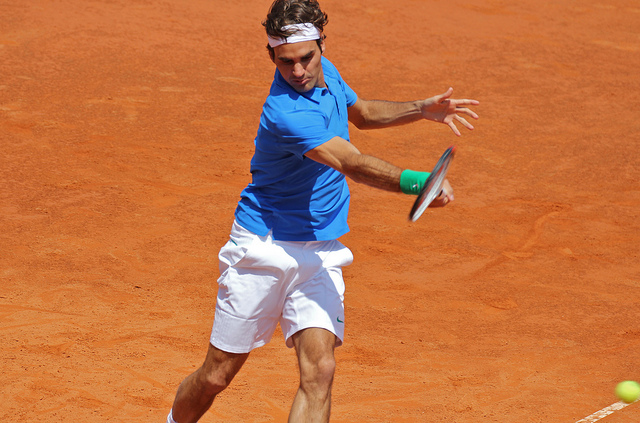
    Simply put, Roger Federer’s forehand revolutionized the sport. Widely tipped to be the greatest ground stroke in tennis history, Federer re-set the standards of what constitutes a world-class forehand. It wasn’t merely his ability to fire winners off that side that set him apart – after all, James Blake, Fernando Gonzalez, and Andy Roddick hardly struggled to rip out inside-out bullets – but rather, Federer’s combination of power, spin, versatility, taking the ball early, and the ability to hit it on the run that made him a nightmare to deal with.

    None of this would be possible had it not been for Federer’s most characteristic trait: his otherworldly movement. Federer’s ability to glide effortlessly on a tennis court was poetry in motion. He always put himself in perfect position to take the ball precisely when he meant to, and the results were devastating. The mixture of movement, precision, and taking the ball on the rise rendered his forehand near unplayable. Lleyton Hewitt had laid the foundations a couple of years earlier by running circles around his opponents, but he lacked the necessary weapons and offensive tools. Federer, on the other hand, didn’t.

    In fairness, cat-like quickness wasn’t exclusive to Federer, as the man who previously dominated the world of tennis, Pete Sampras, remains one of the best athletes the sport has ever seen. Meanwhile, the likes of Davydenko, Blake, the above mentioned Hewitt, and others were all great movers in their own right. However, Federer’s footwork was so utterly unique in its fluidity, quickness, smoothness, and efficiency.

    Then came Rafael Nadal, arguably the greatest pure athlete in tennis history. He redefined the word “speed,” covered every inch of the court like nobody before him, displayed unprecedented levels of explosiveness, and showed a level of physicality that no one else could match. When he first burst onto the scene, Nadal’s game was, to put it bluntly, fairly limited. His serve was harmless, his backhand was solid but, ultimately, did little offensive damage — beyond the trademark open-stance passing shots — and his return of serve was meant to neutralize points above anything else (which applies even today).

    If there is a prime example of how great movement and an elite forehand dominate today’s men’s game, it’s Nadal. Better than anyone in history, he was able to mask his weaknesses with a dominant forehand and unparalleled movement. Even more so than Federer, Nadal based much of his game around running around his backhand wing. However, the Spaniard lacked his rival’s serve and variety, making his forehand an even more integral part of his game.

    His entire early success is attributed almost entirely to his forehand and movement. Even as his game developed into something far more polished, Nadal’s bread-and-butter remained intact. Unlike anyone else, Federer included, Nadal is able to find his forehand wing time and time again. The amount of effort required to run around his backhand at every possible opportunity meant the Mallorcan had to work particularly hard in each rally, but Nadal was all too willing to make the effort. Like Federer, his forehand is actually deadlier from his backhand wing, where he can put it pretty much anywhere on the court. Once Nadal is able to find a forehand early in the rally, unless your name was Novak Djokovic, Nikolay Davydenko, and a select others, you weren’t wrestling the point away from him.

    No Title

    No Description

    The man who ultimately broke the Fedal monopoly was, unsurprisingly, Novak Djokovic. Long tipped to be the future of tennis, the Serb may have differed from his great rivals in that he possessed one of the best backhands the games has ever seen — a shot many deem to be his strongest. However, it wasn’t until Djokovic recaptured the magic on his forehand side that he became the world’s finest player. Following a very strong 2008, Djokovic’s results became increasingly inconsistent. The reasons were numerous, from struggles with fitness, focus, and serve, but above all else, it was his forehand that grew more erratic, and the results underwhelmed accordingly.

    Djokovic moves as well as anyone on a tennis court, but the quality of his backhand provides him with far more options, therefore, he doesn’t need to run around that shot as frequently as Federer and Nadal. And yet, you often see him doing just that these days, to great effect. Good as his backhand is, the basic mechanics of the forehand mean he has more options off that wing. Additionally, Djokovic’s backhand being his better shot often clouds the fact that his forehand is easily one of the best on tour, and when playing well, it is the side that does the bigger damage. Yes, it remains the shot that is more likely to break down and fail him when things go south, as opposed to his always rock solid backhand, but offensively, it is slowly becoming his most potent shot.

    A quick look at today’s top 10 players shows just how essential it is to possess a great forehand. Beyond the aforementioned players, almost all of the world’s elite players share a world-class forehand: Ferrer, Berdych, Tsonga, Del Potro, etc. Naturally, there are exceptions, but even those, quite ironically, reinforce the rule. Richard Gasquet, for instance, was initially thought to be destined for greatness, only to fail to live up to the hype, in large part due to his unreliable forehand. Even previous one-of-a-kind shot-makers like Nalbandian and Davydenko occasionally suffered due to an inconsistent forehand.

    The most notable aberration, of course, is current world number 2, Andy Murray. Far from being a bad shot, Murray’s forehand remains nevertheless below the level of Federer, Nadal, or Djokovic. However, the Brit is able to make amends through fantastic movement, tennis IQ, tactical awareness, counter-punching, and a backhand that is easily among the very best in the men’s game. Nevertheless, it is hard not to attribute some of his shortcomings to his main rivals’ ability to expose his forehand. Djokovic has repeatedly dominated Murray in forehand-to-forehand cross-court exchanges and drew short replies, Nadal’s flattened-out cross-court backhands and inside out forehand have historically troubled Murray on faster surfaces — surprisingly enough — while Federer’s offensive onslaught has robbed Murray of three additional grand slam titles to his resume.

    A quick glance at the current crop of up-and-coming players shows no real candidate that fits the description of a modern day champion — a great mover with a world-class forehand. For now, at least, the status quo at the top of the men’s game seems safe.

    Click here to discuss this and more with fellow tennis fans on our discussion boards.