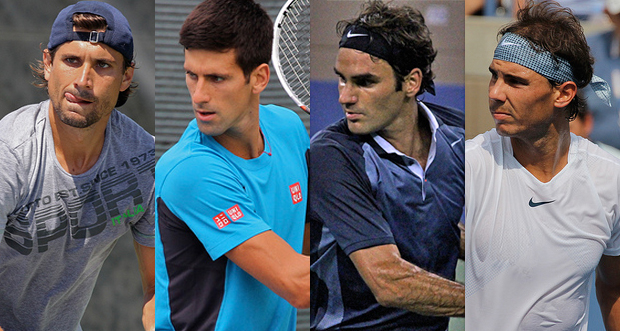
Tag: rafael nadal

  • Direction and Magnitude

    Direction and Magnitude

    WTF Winner - Djokovic 1

    World Tour Finals, Final

    (2) Djokovic d. (1) Nadal, 6-3, 6-4

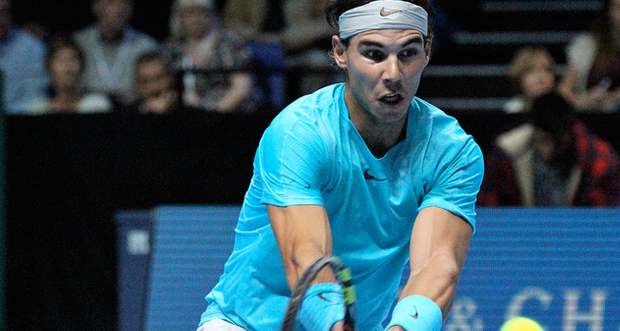
    Novak Djokovic tonight defeated Rafael Nadal in the final of the World Tour Finals, an unlovely sentence to commemorate a forgettable match. It was the third time in the last four years that the top two players have closed out the ATP season, but the first time it has been these two. I suppose it had to happen eventually, since they seem to have played finals everywhere else. Consequently everyone knew what to expect, especially given the glacial surface: an extended defensive slog based around the repetition of readily identifiable patterns. As with minimalism – which people persistently confuse with simplicity – great complexity is achieved by the reiteration of basic blocks, not to mention great length. No one expected it to be simple, and no one expected it to be quick.

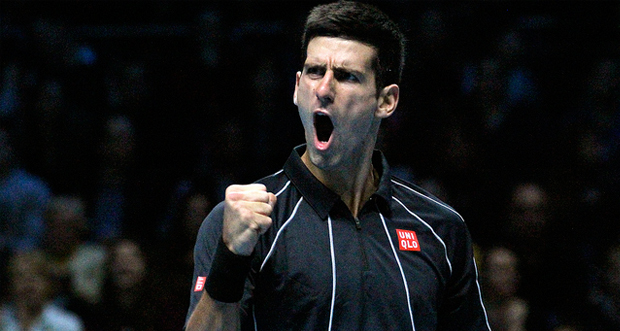
    I confess to feeling some relief when everyone was proved wrong, at least when it came to length. When two players face each other thirty-nine times – an Open Era record – it’s inevitable that not all of them with be classics, although one hoped that the last match of a memorable season would turn out to be a bit less forgettable. Alas, Nadal commenced nervously and never entirely settled. Meanwhile, Djokovic was fierce initially – tearing out to a 3-0 lead – then meek for a while, and then forceful all the way until the end. He seemed to hold break points in most of Nadal’s service games, but only reciprocated the favour once to be broken back in the first set. Whatever hope this kindled of a competitive match was lessened by the consideration that the quality wasn’t high enough that you’d necessarily want to see more of it, then doused entirely when Djokovic lifted again. The point with which he re-broke Nadal to claim the eighth game ranks among the finest defensive efforts I have ever seen, a masterpiece of thrust, parry, loft, and touch. Djokovic’s bellow afterwards was long and lusty, and certainly justified. Most of us will never do anything nearly so masterful in that atmosphere for those stakes.

    Djokovic broke early in the second set – more shouting – and threatened to do so repeatedly as the set wore down. Insurance breaks are nice, but aren’t necessary if you never face calamity (like all insurance, really). The Serb was never again threatened on serve, rarely conceded the baseline, and ended up with atypically excellent numbers at the net. Nadal was almost always on the move, and even when he could set his feet on a forehand found it hard to shift his opponent for long. The length on his groundstrokes was a constant problem, except for Djokovic.

    In truth Djokovic was the real problem. Afterwards Nadal conceded that his opponent had simply been too good. On this surface, playing at his best, Djokovic truly is. The homogenisation of the court surfaces has helped ensure that these two end up facing each other at nearly every tournament everywhere, and that when they do they barely have to alter their basic game, but between them the surface still matters. Nadal is better on clay, and Djokovic is superior on hard court, assuming both men play at their best. In both cases the gap is closing, but it is still there.

    Since the beginning of his career, Nadal fading through the late part of the season, has come to feel like a structural requirement of men’s tennis, although it says a lot about his magisterial 2013 season that losing in the final of the year end championships can be construed as a letdown. It is also a testament to his evolving mastery of all surfaces that one’s definition of “late” has had to be pushed further and further back as the years rolled by. Initially that late part of Nadal’s year kicked off very early — once the main clay tournaments were over. Admittedly that was long ago, when he was very young. Soon he learned to commence fading after Wimbledon, with the results petering out by the US Open. In 2008 he became a factor in the later stages in New York, and has never since failed to reach at least the semifinals, assuming he turns up at all.

    Yet the period after the year’s final Major – pollen-choked Australians find it difficult to call this the “fall season” – has remained unaccountably lean. In his entire career he has won just two titles after the US Open, and one of those was in 2005 in Madrid, enabled by an extravagant collapse from Ivan Ljubicic. That remains Nadal’s only indoor title, since the Ariake Coliseum roof remained open through his Tokyo title run in 2010, his other career title in what northern hemisphere fans obdurately refuse to term “the Australian Spring”. But this year one could be forgiven for assuming the usual rules don’t apply, especially on hard courts. Up to and including the US Open, Nadal hadn’t lost a tournament on that surface. After that he contested four events – the same ones as Djokovic – and for all that he seemed more determined than ever to capture the few important titles that have eluded him, and didn’t win any. That’s nothing to be ashamed of, of course. Winning these things is really, really hard.

    Djokovic, of course, won them all, though in the process lost his No. 1 ranking. The extent to which those two events are connected is open for debate. Some felt that losing the top spot firmed his resolve. There’s probably something to this. After a strong start to the year Djokovic’s form grew patchy, even within matches. Transcendent sets would be interleaved with uncharacteristic dreck, as he would unaccountably lose his way. Since Beijing, however, these periods have grown fewer – there was a bizarre one in the Shanghai final – and he has looked more like the Djokovic who swept through the first two thirds of the 2011 season. (Surgically combining the first part of his 2011 season with the last part of his 2013 yields a year of near perfection.) One shouldn’t forget he almost did exactly the same thing last year, but for that strange loss to Sam Querrey in Bercy. Last year he was chasing down Federer for the No. 1 spot, successfully as it turned out. Grand purposes certainly sharpen his focus.

    On the other hand, it’s probably pointless to search for additional reasons for Djokovic to play superbly on hard courts. At his best he is without question the world’s best player on that surface. His current streak of twenty-two matches isn’t the longest by any means, but it is hard to top for quality. It includes twelve victories over the current Top 10 (aside from the injured Murray), including two wins each against Nadal, Federer, and Wawrinka, and eight in less than two weeks. That’s hard to top. The appropriately renamed Brad Drewett Trophy, bedecked with blue streamers and bestowed amidst a blizzard of confetti, was a fitting reward.

    Thus ends the latest edition of the World Tour Finals. It certainly wasn’t the most memorable installment, from any point of view. Perhaps it was the absence of Murray, but the entire week has felt slightly deflated. The Sky Sports commentary was certainly less demented as a direct result. Recall their tedious tut-tutting during last year’s semifinal over the London crowd’s divided loyalties, particularly Sir Ian McKellen’s unforgivable decision to sit in the Federer box. Sir Ian was nowhere to be seen this year. No doubt he’s chasing monsters in New Zealand. One wonders whether the Scot’s absence was a deciding factor in keeping other celebrities away. Last year there was a cameraman tasked with capturing Kevin Spacey’s every facial tic, and apparently no one could get enough of Pippa Middleton. This year there were endless footballers and one of the mannequins from One Direction. Still, you can’t have everything.

    Photo credit:  Marianne Bevis (Creative Commons License)
  • Djokovic Tops Nadal in London to Win Year-End Title

    Djokovic Tops Nadal in London to Win Year-End Title

    WTF Winner - Djokovic 2

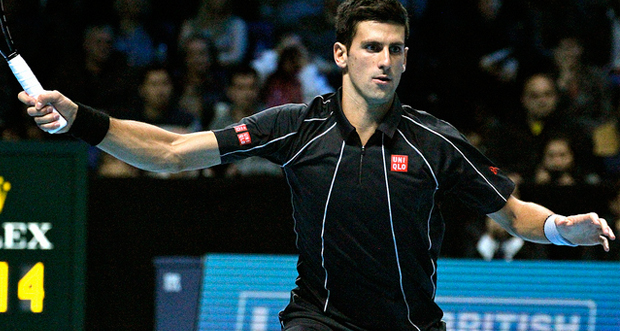
    Novak Djokovic, who has rediscovered his drive and motivation since losing his world No. 1 ranking seven weeks ago, exacted revenge again today against the man who took it from him by beating Rafael Nadal convincingly, 6-3, 6-4, to take the ATP World Tour Finals title.  This was Djokovic’s third title at the year-end tournament, and Nadal’s second loss in a final, having never taken this trophy.

    The Serbian came out strong from the start, while the Spaniard started looking nervous, and was broken in his opening service game.  Nadal got the break back, but was committing too many unforced errors on his trusty forehand side, and too many double-faults, trying for a bit too much to combat, futilely, in the end, the Djokovic A-game.

    Djokovic, looking nimble and assured throughout, broke again early in the second set.  Nadal kept his nerve, fending off championship points in each of the last two games.  He held serve despite having been down, and got Djokovic to deuce at the last, but couldn’t hold off the inevitable any longer.  Djokovic served an ace, and then a Nadal shot sailed wide to end the match.

    The win evens their head-to-head this year to two wins a piece, and closes the gap on the overall to 22-17.  It also sends a big salvo across the bow at Nadal for the season to come.  Djokovic is gunning for him again.

    [divider]

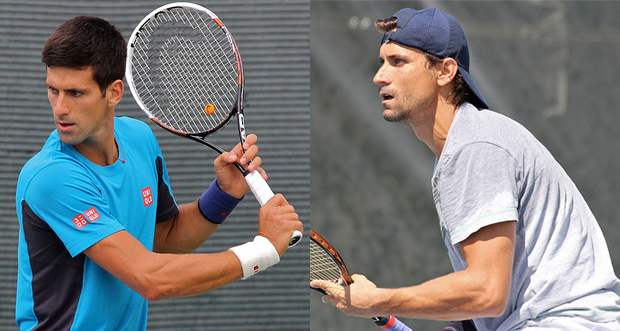
    Fernando Verdasco and David Marrero beat Mike and Bob Bryan for the doubles title:  7-5, 6-7(3), 10-7.  They were the surprise Spanish duo to pull it off, passing the higher-ranked Spanish team of Granollers/Lopez, who beat the Bryans at this tournament last year.

    Photo credit:  Marianne Bevis (Creative Commons License)

  • Nadal Denies Federer in London

    Nadal Denies Federer in London

    WTF SF - Nadal

    In the 32nd meeting of this storied rivalry, Rafael Nadal prevailed over Roger Federer, 7-5, 6-3.

    The first semifinal of the day started with each man playing well and holding serve.  They traded breaks three times in succession in the 9th-11th games of the set, which Nadal served out at 6-5. The second set was more squarely on Nadal, who broke Federer’s serve in the 6th game, and again with the Swiss serving in the final game at 3-5, to close out the match.  It was the Spaniard’s first win over the former No. 1 on indoor hard courts.

    This was Federer’s 12th consecutive year playing in the ATP World Tour Finals, which he has won six times.  For Nadal, it is his fifth appearance, and only his second time to make the finals.  He lost in the finals to Federer in 2010.

    Photo credit:  Marianne Bevis (Creative Commons License)
  • Barclays ATP World Tour Finals – Semifinals – Schedule of Play and Results

    Barclays ATP World Tour Finals – Semifinals – Schedule of Play and Results

    WTF SFs

    Barclays ATP World Tour Finals – Day 7 – Semifinals: Schedule of Play (Scores added as known)

    CENTER COURT — Start 12:00

    [6] David Marrero (ESP) / Fernando Verdasco (ESP) d [3] Ivan Dodig (CRO) / Marcelo Melo (BRA) — 7-6(10), 7-5

    Not Before 14:00

    [1] Rafael Nadal (ESP) d [6] Roger Federer (SUI) — 7-5, 6-3

    Not Before 18:00

    [1] Bob Bryan (USA) / Mike Bryan (USA) d [2] Alexander Peya (AUT) / Bruno Soares (BRA) — 4-6, 6-4 [10-8]

    Not Before 20:00

    [2] Novak Djokovic (SRB) d [7] Stanislas Wawrinka (SUI) — 6-3, 6-3

  • Barclays ATP World Tour Finals – Day 5 – Schedule of Play and Results

    Barclays ATP World Tour Finals – Day 5 – Schedule of Play and Results

    WTF - Day 5

    Barclays ATP World Tour Finals – Day 5: Schedule of Play (Scores added as known)

    CENTER COURT — Start 12:00

    [4] Marcel Granollers (ESP) / Marc Lopez (ESP) d [7] Leander Paes (IND) / Radek Stepanek (CZE) — 4-6, 7-6(5) [10-8]

    Not Before 14:00

    [7] Stanislas Wawrinka (SUI) d [3] David Ferrer (ESP) — 6-7(3), 6-4, 6-1

    Not Before 18:00

    [2] Alexander Peya (AUT) / Bruno Soares (BRA) d [6] David Marrero (ESP) / Fernando Verdasco (ESP) — 6-3, 7-5

    Not Before 20:00

    [1] Rafael Nadal (ESP) d [5] Tomas Berdych (CZE) — 6-4, 1-6, 6-3

  • Barclays ATP World Tour Finals – Day 3 – Schedule of Play and Results

    Barclays ATP World Tour Finals – Day 3 – Schedule of Play and Results

    WTF - Day 3

    Barclays ATP World Tour Finals – Day 3: Schedule of Play (Scores added as known)

    CENTER COURT — Start 12:00 P.M.

    [6] David Marrero (ESP) / Fernando Verdasco (ESP) d [7] Leander Paes (IND) / Radek Stepanek (CZE) — 6-4, 7-6(5)

    Not Before 14:00

    [1] Rafael Nadal (ESP) d [7] Stanislas Wawrinka (SUI) — 7-6(5), 7-6(6)

    Not Before 18:00

    [2] Alexander Peya (AUT) / Bruno Soares (BRA) d [4] Marcel Granollers (ESP) / Marc Lopez (ESP) — 3-6, 6-4 [10-5]

    Not Before 20:00

    [5] Tomas Berdych (CZE) d [3] David Ferrer (ESP) — 6-4, 6-4

  • Barclays ATP World Tour Finals – Day 2 – Schedule of Play and Results

    Barclays ATP World Tour Finals – Day 2 – Schedule of Play and Results

    WTF - Day 2

    Barclays ATP World Tour Finals – Day 2: Schedule of Play (Scores added as known)

    CENTER COURT — Start 12:00

    [7] Leander Paes (IND) / Radek Stepanek (CZE) d [2] Alexander Peya (AUT) / Bruno Soares (BRA) — 6-3, 5-7, 10-8

    Not Before 14:00

    [1] Rafael Nadal (ESP) d [3] David Ferrer (ESP) — 6-3, 6-2

    Not Before 18:00

    [4] Ivan Dodig (CRO) / Marcelo Melo (BRA) d [1] Bob Bryan (USA) / Mike Bryan (USA) — 3-6, 6-3 [10-8]

    Not Before 20:00

    [2] Novak Djokovic (SRB) d [5] Roger Federer (SUI) — 6-4, 6-7(2), 6-2

  • Ferrer Stuns Nadal in Paris – Sets Sights on Djokovic in Final

    Ferrer Stuns Nadal in Paris – Sets Sights on Djokovic in Final

    Paris Final - Djokovic Ferrer

    David Ferrer will have a chance to defend his title in Paris after upsetting world No. 1 Rafael Nadal today in straight sets: 6-3, 7-5.  It was only Ferrer’s fifth win over his fellow countryman in 25 meetings, but it was really all Ferrer today.  He will meet No. 2 Novak Djokovic in the final tomorrow, after the Serb overcame a shaky start in his own semifinal to beat Roger Federer: 4-6, 6-3, 6-2.

    Djokovic’s victory, coupled with Nadal’s loss, keeps his hopes alive of regaining the No. 1 ranking by year’s end, though he will need to win tomorrow, and get further assistance from the Spaniard at the World Tour Finals next week in London.

    The loss also dashed Nadal’s hope of becoming the first man to win six Masters 1000 titles in a single season.

    In tomorrow’s final, Ferrer will be hoping to improve on his disadvantageous 5-10 head-to-head record against Djokovic.

  • Small Miracles

    Small Miracles

    Paris SF Rafa Roger Novak Ferrer

    Paris Masters, Quarterfinals

    It is rare at any level for the top eight seeds to populate the quarterfinal stage of a tournament, a result that was guaranteed the moment Rafael Nadal defeated Jerzy Janowicz in the last of the Paris Masters fourth round matches. At Masters level this hadn’t occurred in over four years. More intriguing still was the fact that the last eight men remaining at the Palais Omnisports de Paris-Bercy were the same eight who’ll descend upon London’s O2 Arena next week for the World Tour Finals.

    Apparently such a miracle has never happened before, although if it was going to, this was probably the year for it. Coming in to this week, three qualification spots remained open, meaning that a number of men had every reason not only to turn up but to give their best effort, which is precisely the kind of effort that can be lacking at this tournament. Added interest came in the form of Roger Federer, who was prominent among those yet to qualify. By winning his first round match against Kevin Anderson he took care of that, and yet another comfortable victory over Philipp Kohlschreiber saw him attain the quarterfinals. By joining him at that stage both Stanislas Wawrinka and Richard Gasquet ensured their spots in London as well, although whether they’ll do much more than make up the numbers is a nice question. The very best players seem uncharacteristically committed this year.

    Novak Djokovic lost to Sam Querrey in strange circumstances last year, withdrew the year before after proving he cannot lose to Viktor Troicki under any circumstances, and fared badly against Michael Llodra the year before that. Yet this week he has hardly looked like losing or withdrawing. Indeed, through the first set of his quarterfinal against Wawrinka he seemed reluctant to give up points. The Swiss had an early chance to recover an even earlier break, didn’t take it, and was reduced to spectating for the next twenty minutes. The second set was tighter, especially at the start, but Djokovic always had it well in hand.

    Nadal often doesn’t turn up in Paris at all, as a culmination of his disinclination to contest any of the other European indoor events that precede it. One can understand his disinterest, given that conditions don’t suit his game, and he hardly needs the points. He has won precisely one indoor hard-court title in his career (Madrid 2005). But in a season in which he cleaned up the American summer and went undefeated on hard courts until September, who is to say he cannot win the Paris Masters? Gasquet certainly had little say in the matter, thrashed four and one in just over an hour. There was a belief that the last three rounds in Bercy would provide a preview of what to expect in London. It seems that this is the case.

    Many are convinced Nadal will not only win Paris, but the World Tour Finals as well, thereby tripling his collection of indoor titles. One viewer took the trouble to email Sky Sports to that effect, adding, however, that she would be equally happy if Federer never won another match. Marcus Buckland and Barry Cowan professed themselves shocked by this, suggesting neither man spends much time on the internet, which is largely powered by schadenfreude and self-importance, and is thus self-sustaining. Wishing catastrophe on total strangers based on perceived minor transgressions is an even more popular online hobby than charmless grandiosity, though the two are easily combined.

    Cowan confessed he did not understand how anyone could actively dislike watching Federer play, even if for whatever reason you do not care for him off the court. Buckland invited the viewer to email in their reasons, which they naturally did. It turned out to be the usual tedious guff about arrogance and poor losing. Ho-hum. Cowan still didn’t get it. To his credit I’ll hazard that the reason for his confusion is that he fundamentally doesn’t grasp how many ostensible tennis fans are a fan of a particular player more than they’re a fan of the sport. For all Cowan’s manifold shortcomings as a commentator and a player, the fact that he was a professional sportsman means that only a tiny portion of his engagement with tennis concerns any particular player. For the fan who emailed in, and many others just like her, the opposite is true. Their approach to professional tennis is primarily concerned with the deification of their favourite player, and the revilement of whichever players they’ve been taught are diametrically opposed. You’ll observe that fanatics always reserve their unkindest hopes for rivals. No one wastes time wishing Ivo Karlovic never wins another match.

    It was another reminder, as if more were needed, that many sports fans are dullards who cannot function without a depressing little assortment of heroes and villains, and that these roles are by necessity cast within very tight parameters. Thus, say, the soft-spoken and sardonic Robin Soderling is a villain, held by some to be morally on par with Timothy McVeigh. The reality is that most of us encounter considerably worse people than any professional tennis player every time we leave the house, or even when we don’t. You can hear the squalid thoughts of the ethically bankrupt merely by switching on commercial radio, and after listening to many politicians speak you’ll want to take a dip in the septic tank just to feel comparatively clean. Remember the supposed falling out between Federer and Nadal at the beginning of last year over the ATP Player Council? I must have attended half a dozen more acrimonious meetings than that in the last month, and am daily obliged to shake hands with far bigger wankers than any man in the Top 10. As far as I can make out, and for all that it matters, all the top players seem like pretty nice people.

    The fan who’d emailed Sky Sports can’t have been happy with Cowan’s mystified response, and was surely brought to a high simmer by the subsequent coverage, which was unabashedly Federer-centric. “I’m not even looking at del Potro right now,” declared Andrew Castle in commentary as the second quarterfinal commenced, “All my focus is on Federer!” He went on to add that for him Federer was the story of the next twelve to eighteen months in men’s tennis, which seemed rather disrespectful to Philipp Kohlschreiber, who is poised to commence his audacious run to the No. 1 ranking. (Mark my words.) It was also somewhat disrespectful to del Potro, who has been in tremendous form of late, and will be a legitimate title-contender in London next week. He at least deserved a look-in.

    It was clear as the first set proceeded that Federer wasn’t about to give him one. Federer was quite magnificent, hitting seventeen winners to just four errors and comprehensively shutting down the forecourt. It was almost enough to justify the presumption that Federer would was eager for another shot at del Potro so soon after the Basel final. His success against tall, powerful players traditionally entailed exploiting their lack of agility with constant variations of spin, width, and depth. Del Potro admittedly moves superbly for a man his height, but compelling him to lunge, dip, and pivot is still a wiser strategy than trying to trade lusty blows from the baseline. Federer’s first set was a testament to this: 47% of his backhands were slices, the kind of figure he used to post when dispatching the arch-villain Soderling. Unaccountably he went back to hitting over his backhand more in the second, although until 4-5 he remained untroubled on serve. Del Potro so far had had an awful day on return, but at this moment unleashed his biggest forehand, and subsequently broke to take the set. The third set was patchier, with a string of breaks each way. Federer steadied quicker, and eventually served it, to his evident relief and the visceral disgust of at least one fan. Del Potro didn’t appear particularly fazed. If anything he’d looked a trifle fatigued as the match wore on, and I imagine the longer rest will do him a power of good.

    Federer has now posted just his second win over a Top 10 player for the season, offset by five loses. Andrew Castle reminded viewers that by the end of next week he might conclude his season with a more respectable win-loss tally of 9:5, assuming he defeats Djokovic in the semifinals, Nadal (probably) in the final, then everyone in London. This seems rather a generous assumption to make, even by Castle’s standards. We were also reminded that Federer has now beaten at least one Top 5 opponent at least once in each of the last fifteen years. It seemed a strange point to belabour, since he is after all Roger Federer. He is not Philipp Kohlschreiber, although soon Philipp Kohlschreiber won’t be, either. Mark my words.

  • BNP Paribas Paris Masters Semifinals – Scores and Schedule of Play – Saturday, November 2

    BNP Paribas Paris Masters Semifinals – Scores and Schedule of Play – Saturday, November 2

    Order of Play – Saturday, November 2 (Scores added as known.)

    COURT CENTRAL — Not Before 2:30 P.M.

    [2] Novak Djokovic (SRB) d [5] Roger Federer (SUI) — 4-6, 6-3, 6-2

    Not Before 5:00 P.M.

    [3] David Ferrer (ESP) d [1] Rafael Nadal (ESP) — 6-3, 7-5