Tag: rafael nadal

  • Nadal Ousted in Monte Carlo

    Nadal Ousted in Monte Carlo

    AO ATP Winner - Nadal 1

    David Ferrer did what is one of the tougher tasks in tennis today by handing Rafael Nadal a loss in Monte Carlo. Only yesterday, Nadal marked his 50th win in the principality, as well as his 300th win overall on clay. Nadal lost to Guillermo Coria in 2003 when he was 16 years old, then went on to win the title here a record eight times consecutively, before having his streak snapped last year in the final by Novak Djokovic.

    Today the world No. 1 was uncharacteristically error-prone (27 in the first set, 44 total unforced errors), while his fellow Spaniard was focused and committed to attacking the Nadal backhand. The first set was long and hard-fought, with breaks of serve traded, but Nadal lost the tiebreak at 1, after an 85 minute first set. Ferrer was up by two service breaks in the second set before Rafa got one back, but couldn’t fight off Ferrer on his next attempt to serve out the match, which he did to win 7-6 (1), 6-4.  Ferrer next faces Stan Wawrinka and will be looking to win his second Masters 1000 title.

  • A Deflating Innovation

    A Deflating Innovation

    Miami Masters 1000, Final

    (2) Djokovic d. (1) Nadal, 6/3 6/3

    Novak Djokovic today won the Miami Masters for the fourth time, a mere two weeks after winning Indian Wells, thus re-establishing his pre-eminence on hardcourts just in time for the clay season, and leaving the rest of us with almost nothing new to say. Any point made after Indian Wells remains more or less true after Miami, if not more so. The finalists in California had appeared divinely favoured as all foreseeable impediments were removed from their path. In Florida the gods left even less to chance, excising the draw of likely threats by the quarterfinals, and then striking down both semifinalists before another ball was struck.

    Having both semifinals decided via walkover proved to be a deflating innovation, one that went unappreciated by the local crowd. They booed lustily at the news of Tomas Berdych’s default, although one imagines a large portion of the disapproval can be attributed to the discovery that no tickets refunds were forthcoming. Word is Berdych had a crook gut. Nishikori is notorious for withdrawals and retirements anyway, and his default grew more or less inevitable after he posted a pair of marathon upsets over David Ferrer and Roger Federer. The vexing hypothetical question of what would have happened had Berdych and Nishikori been drawn to face each other and then withdrawn was duly raised. Is there a rule, and if so should it be changed? This matter was addressed by Peter Fleming with devastating practicality. He pointed out that after the first guy withdraws, the second keeps his mouth shut and takes the free passage to the next round. It’s a question of whoever blinks first. Faced with Nadal and Djokovic in rampant form, however, it was probably a pretty easy decision.

    And so it came down to yet another final between this pair, the seven hundred and fourteenth overall, yet, somehow, the first of this year. The hadn’t met since the final of the World Tour Finals, a best of three hardcourt match that Djokovic won quite comfortably. Today’s best-of-three hardcourt match didn’t feel functionally very different. I can only repeat what I said last time they met. Surface homogenisation has eroded the concept of surface specialists, but not entirely. At their best, Nadal is still better on clay and Djokovic is better on a hardcourt. Today Nadal wasn’t really at his peak, but that was mostly thanks to Djokovic, who was.

    The only vaguely fraught moment came early in the first set, when Djokovic fended off a break point, although it was early enough that he would have fancied his chances to break back. As it happened, he didn’t need to, and set about running the Spaniard hither and yon beneath the Miami sun. The air was presumably as thick up Djokovic’s end of the court, but he seemed to be moving more easily through it, and his shots certainly penetrated it more readily. His crosscourt backhand was particularly dangerous. Djokovic’s technical excellence is such that when he is playing this well it’s hard to believe he cannot go on playing like this indefinitely, in stark contrast to the million moving parts of Nadal’s technique, which seems mostly miraculous in that it doesn’t desynchronise more. Today even Djokovic’s rare errors looked purposeful.

    Nadal was broken at the start of the second set, and thereafter the only tension seemed to accrue in his following service games, as he grimly held on to remain only one break behind. Djokovic was typically marvellous on return. Has anyone ever been so good at consistently landing returns within a foot of the baseline? Nadal won only 59% of first serve points for the match. He tried at various points to get the crowd into it, with some success, but it didn’t affect the outcome. A fine final point saw them both finish up at the net, though Djokovic was the one who collapsed in triumph. He sprang up soon enough, and shared a handshake with Nadal that lacked any outward sign of warmth. The world number one looked like he really didn’t want to hang around.

    Fortunately he didn’t have to, since the trophy ceremony was abbreviated for American television. No doubt there was some pressing commitment to broadcast amateur sport played by university students. There were the usual bubbles, confetti and crystal trophies, and that was that. Sky Sports had nowhere else to be, though. Annabel Croft asked Djokovic whether at a certain point today he could feel that he’d broken Nadal’s spirit. ‘Of course,’ responded the champion, and began to riff on the concept of confidence from a position of plenty. He was probably justified in feeling a little cocky.

    The imperious manner in which Djokovic smothers and thereby neutralises those parts of Nadal’s game that have tormented the tour for a decade have been amply catalogued, although there have been few occasions in which the Serb has showcased it better. One such was the first set of last year’s Monte Carlo final, which Sky Sports handily demonstrated by showing highlights of after today’s final. Network programmers have learned to set aside at least four hours for any best-of-three match between Nadal and Djokovic. When today’s final concluded in a mere 83 minutes, there was time to kill, and Greg Rusedski – mercifully – can only go on for so long.

    Djokovic and Nadal between them now hold all nine Masters 1000 events, as well at the World Tour Finals and two of the four Majors. If this isn’t unprecedented, it’s awfully close. (In 2006 Federer and Nadal held all four Majors, the Tennis Masters Cup and six of the nine Masters. I’ll leave it to others to rank these achievements.) Six of the nine Masters 1000 events are played back-to-back, in three groups of two. It has almost grown commonplace for a single player to grab a pair. Last year Nadal won Madrid and Rome in consecutive weeks, and Canada and Cincinnati. In 2011 Djokovic won Indian Wells and Miami consecutively, as well as Madrid-Rome. This doesn’t speak to the modesty of the achievement, but to the high quality of the players achieving it. Winning two of these things in a row – especially Indian Wells and Miami with their absurd 96 draws, abrupt shift from desert to swamp, and over-reliance on Kiss-Cam – is still a mighty accomplishment.

    Overall, it is Djokovic’s eighteenth Masters title, which puts him one clear of Andre Agassi at third on the all-time winner list, trailing only Nadal and Federer. Speaking of Federer, the Swiss has returned to the top four, while David Ferrer by failing to defend his runner-up points has fallen to number six, which should hopefully ensure a few more balanced draws in the coming months. Andy Murray, who was defending champion but lost early, has fallen to number eight. Nadal remains at number one, though his margin has been more than halved in recent weeks. Djokovic, champion in Indian Wells and now Miami, is right on his heels.

  • Djokovic Sweeps Past Nadal in Miami

    Djokovic Sweeps Past Nadal in Miami

    Novak Djokovic

    Playing at top form, Novak Djokovic took out Rafael Nadal in the Sony Open final, 6-3, 6-3.  Nadal had a break point in Djokovic’s first service game, but failed to convert, where Djokovic broke the world No. 1 in the sixth game of the first set, and again in the first game of the second. The Spaniard had a point to break back in the second, but Djokovic held on. He won the second set and the championship by breaking Nadal again at 3-5.

    The Serbian has now won the last four Masters Series 1000 titles; additionally, he and Nadal combine to currently hold all nine.

    [divider]

    Cover Photo (Creative Commons License): Marianne Bevis


  • The Big Four by Winning Percentage

    The Big Four by Winning Percentage

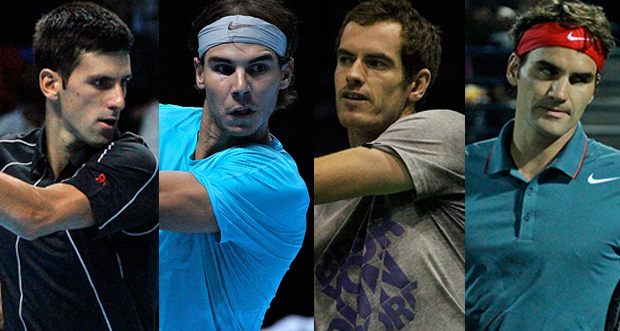
    Novak Djokovic Rafael Nadal Andy Murray Roger Federer

    I was looking at Wikipedia pages for a variety of players and was surprised to notice that Roger’s win percentage this year is the same as 2012, which supports the notion that he’s really resurged well. Certainly he’s only played 23 matches this year, but that’s already more than a third of his total from last year (62) so gives us a large enough sample size to get a sense of his performance level so far. For comparison, through Indian Wells last year he was 13-4 (76%).

    Anyhow, this isn’t meant to be about Roger but the Big Four, and to look at their careers through the lens of win percentage.  Without further ado, here’s a chart:

    20140322063149
    A few notes on each player:

    Roger Federer – this chart really displays a clear peak in 2004-06, with the downturn beginning in 2007, although this could also be because by 2007 both Djokovic and Murray were on the map, with year-end rankings of No. 3 and No. 11, respectively, although Roger had winning records against both Nadal (3-2) and Djokovic (3-1), with no matches against Murray in 2007, so his overall win percentage without those two only goes down a few percentage points.

    Anyhow, the big thing to notice about Roger now is that he’s playing at a similar clip this year as he did in 2012. Hopefully this means we’re back to “post-peak plateau Roger,” as he’s been relatively consistent in terms of winning percentage since 2008, ranging between 81% and 86%, except for 2013’s 73%.

    Rafael Nadal – The thing that really stands out for me is just how consistent Rafa has been in his win percentage since 2005, never dipping below 82% or rising above 91%. In other words, no matter his ups and downs and injuries, he’s been consistent and steady in his performance level. His dip in 2009 is well chronicles because of Robin Soderling and injury, and then in 2011 it was entirely due to Novak’s 6-0 record against him that year. Remove those six matches and he’s at 88% for the year.

    Novak Djokovic – The most interesting part of this chart for Novak is what happened between 2009 and 2011. In 2009 he had finished his third straight year as the clear third best player in the game, and then in 2010 – while he retained his No. 3 ranking – he slipped a bit, winning only two titles and appearing in only four finals. And then 2011 happened. Was it going gluten free or something else? Regardless, it is easily the best year other than Roger’s three great seasons, and in many ways rivals those – certainly one of the ten best seasons in Open Era history. His fans may be disappointed that he’s dropped a notch since, but this chart shows that his level has remained very high – and that he’s been a better player after his career year than he was before.

    Andy Murray – the red-headed stepchild in the family of contemporary greats, both the least loved and least hated of the Big Four – perhaps because he’s the clear No. 4. This chart brought out a couple of minor, but interesting, points. First of all, he had the best debut year by win percentage of the four. It isn’t by much, and it isn’t all that significant, but it’s worth mentioning. Secondly, I was surprised to notice that in 2009 he had the highest win percentage of the Big Four. While 2012 or 2013 are certainly considered his best years because of his Slam wins, in 2009 he won six titles (a career high) and lost only 11 matches, winning 66 (again, a career high).

    Anyhow, it will be interesting to see what this chart looks like by year’s end.

    [divider]

    Image courtesy of rainycat via Creative Commons license

  • Nadal Wins Inaugural Rio Open 500

    Nadal Wins Inaugural Rio Open 500

    Rafael Nadal

    Everything old is new again. As Rio de Janeiro brings ATP 500 tennis back to the Carioca city, Rafael Nadal defeated Alexandr Dolgopolov of the Ukraine, 6-3, 7-6(3) in the inaugural Rio Open. The old was Nadal winning on clay. The new was the tournament, and the renewed play by Dolgopolov of the Ukraine, who has been a rising star, though with troubles along the way.

    The Ukrainian upset David Ferrer and Nicolas Almagro to get to the final. His quirky style of play may have been recently served by joining forces with another “eccentric” player, Fabrice Santoro, the Frenchman who is also known as “The Magician.”  It seems a coaching choice made in heaven. A Kiev native, Dolgopolov wore a black ribbon on his chest, and spoke in his final remarks of the struggles of the people in his country, to sustained applause. Brazil has also suffered unrest in recent months.

    For Nadal, it was his 62nd title, his 43rd on clay. After a huge battle with Pablo Andujar in the semifinals yesterday, it was not completely clear that Nadal would win today. But some things never change. Nadal wins again on clay, but Dolgopolov comes out of it with renewed encouragement.

    [divider]

    In the women’s final, Kurumi Nara defeated the No. 1 seed, Klara Zakopalova, 6-1, 4-6, 6-1.  It was the first WTA title for the 22-year-old Japanese player.

    [divider]

    Cover Photo (Creative Commons License): Marianne Bevis

  • So Many Yangs

    So Many Yangs

    Ernests Gulbis

    Marseilles, Final

    (3) Gulbis d. (2) Tsonga, 7-6(5), 6-4

    It is a strange quirk that Ernests Gulbis, that least reliable of professional tennis players, somehow boasts a perfect record in tour finals, a record he kept intact today in Marseille. He has now won five ATP titles without losing one, a kind of scruffy yin to so many proven yangs, such as Gael Monfils or Julien Benneteau. Gulbis didn’t get to play either Monfils or Benneteau this week, though that wasn’t his fault, since the former wasn’t here and the latter was defeated early on in another part of the draw. As the truism goes, you don’t get to choose which Frenchmen you face in tennis. You can only defeat the ones who are placed in front of you.

    It was, fittingly, a non-Frenchman Gulbis struggled with. His toughest test came against Roberto Bautista Agut in the second round, although this wasn’t strictly a surprise. (The surprise was that having eluded defeat the Latvian went on winning.) Bautista Agut has distinguished himself this season with several scrapping, aggressive, and defiant efforts, though this week he also distinguished himself by being just about the only Spanish man with a tennis racquet who didn’t show up in Rio. Consider this: there were more Spaniards in Rafael Nadal’s half of the Rio draw than there were Frenchmen in the entire Marseille draw. Once Gulbis had survived that early round struggle, he set about beating any locals he could lay his hands on, starting with Nicolas Mahut, continuing with Richard Gasquet, and concluding today with Jo-Wilfried Tsonga.

    It wasn’t a particularly exciting final as these things are measured, and certainly not compared to last year’s decider between Tsonga and Tomas Berdych. As you’d imagine when two big men face each other on a fast indoor court, the service dominated, though better returning would have helped it dominate less. Gulbis had not been broken since the second round, and Tsonga today could engineer only two opportunities, which he characteristically flubbed. Gulbis, on the other hand, was in plenty of the Frenchman’s service games, although he was no more effective at converting break points, ending the match with a rather  memorable 1/11. The Frenchman generally saved them with muscular play, and managed to do the same with a few match points in the second tiebreak. Gulbis served it out with an ace, before commencing a victory routine from which he’d carefully expunged any trace of exaltation. It made Marat Safin’s celebrations look flamboyant by comparison. You’d think Gulbis wins these things every other week.

    Actually, that’s not far off. He usually wins these things in this week every other year. Last year he won Delray Beach as a qualifier, and his maiden title came at that tournament in 2010. It may seem surprising that he hasn’t returned to Florida this year, but his failure to show up for title defences is another of the few infuriatingly consistent things about him. So far in his career he has never once graced a tournament the year after he has won it. Look for him in Rio next year, or at least anywhere but Marseille.

    Rio de Janeiro, Final

    (1) Nadal d. Dolgopolov, 6-3, 7-6(3)

    Owing to a minor calendar shake-up, Nadal will next week find himself in the rare position of having two titles to defend, in Acapulco and Sao Paulo. Taking a leaf from Gulbis’ playbook, he has chosen to skip both, preferring instead to win this week’s inaugural Rio event. After all, opportunities to be the first name on a new trophy don’t come round every week, presuming there’s a trophy upon which names can be inscribed.

    Nadal almost surprised us all by not winning the tournament, though got there in the end. The direst moment came against Pablo Andujar in the semifinal, a match that saw the world No. 1 recover from a set down, and finally take it in a mighty third set tiebreak, saving a pair of match points along the way. For once the bromidic phrase “he found a way to win,” usually uttered at the first faint whiff of adversity, was actually merited. Usually the way he finds entails being better at tennis than his opponent, but against an inspired Andujar there were stretches of the match in which Nadal was emphatically outplayed. Indeed, Andujar won more points overall. Alas for him, he lacked either the savagery or the cold precision necessary to claim the points that mattered most. He has thus been relegated to a statistical anomaly – this was the first time Nadal has won from match point down since beating Troicki in Tokyo in 2010.

    Alex Dolgopolov’s half of the Rio draw had, for a wonder, boasted only two Spaniards, but they were two of the toughest in David Ferrer and Nicolas Almagro, although the latter has lately learned to be as disappointing on South American clay as he perennially is on the European variety. Throw in Fabio Fognini, and plenty of reasons to be distracted by events back home, and Dolgopolov’s run to the Rio final proved to be a minor masterpiece of tightrope-sprinting. He’d been marvellous, in his dicey weird way. I wouldn’t go so far as to say that there’s no better player to watch when he’s on. Indeed, to say that would be to confess to fetishism. He has a game only a mother could love, but there’s no denying the excitement he delivers, especially for those of us drawn to unpredictable, aggressive tennis.

    Regardless, the betting markets, history, and the general opinion of the person on the street were unanimous in believing that it wouldn’t be enough to get by Nadal in the final. The only exceptions were those subsets of Nadal fandom which insisted that Nadal’s flat performance against Andujar would be sustained into the final: a passionately misguided belief in Nadal’s frangibility has meant some fans fail to absorb the lesson that he very rarely plays badly, and almost never plays badly twice in a row. As ever with Dolgopolov the interest lay in discovering whether the strobes of brilliance could be spaced with sufficient proximity so as to provide consistent luminescence. So far this week they had. His only real chance for the final, however, was to hope they joined up to form a band of light so incandescent it might sear the retinas from Nadal’s head. Dolgopolov lacks anything resembling a bread-and-butter game. Whether through technique or temperament, he appears incapable of sustaining discernible, or at any rate reliable, patterns of play. He is hell to play when he’s playing well. The trick, as far as I can tell, is to force him to have to play well or else, thus ensuring that he probably won’t.

    Nadal, as ever, had the luxury of being able to achieve this by deploying any number of established patterns, knowing that most, if not all, of these would likely guarantee him victory. Today’s patterns involved nothing fancier than the judicious application of just enough pressure to provoke Dolgopolov into over-hitting. This was particularly apparent in the first set, in which Nadal himself hit only one winner, which was the ace he served to seal it. The Spaniard broke early in the second set (as he had in the first), and looked likely to coast it out. Dolgopolov, after all, had not broken Nadal, not merely in this match, but in any of the four other matches they’ve contested.

    It therefore came as something of a surprise when an apparently nervous Nadal lost his way while trying to serve it out at 5-4, the break sealed with yet another scything Dolgopolov crosscourt backhand into the top seed’s forehand corner. I recall how effective this tactic was for Troicki in Tokyo three years ago, thus providing a lesson that Novak Djokovic subsequently learned by rote. You can go crosscourt to Nadal’s forehand, but you have to take the ball very early, and go there flat and with tremendous pace. Dolgopolov went there time and again today with great success, but it’s a dicey way to live, especially on clay, where Nadal is inexorable. He was certainly inexorable in the eventual tiebreak, and Dolgopolov proved all over again that risky tennis only looks good when it comes off. The flashes of light were now spaced too far apart, and soon they went out entirely.

    Nadal won’t be the last Rio champion, but he’ll always be the first. The trophy, worthy of a European indoor event in its determination to reference anything but a trophy, was handed over by the universally beloved Gustavo Kuerten. It’s a kind of lattice-worked wave arrangement, and thus provided plenty of spots for Nadal’s teeth to find purchase. (Marseille, ironically, has a perfectly ordinary trophy, which Gulbis did not bite.) Both men brought up Ukraine’s current situation in their speeches, Nadal graciously and Dolgopolov with all his heart.

    [divider]

    Cover Photo (Creative Commons License): Marianne Bevis

  • Australian Open Final Review: Wawrinka v Nadal

    Australian Open Final Review: Wawrinka v Nadal

    AO ATP Winner - Stan 2

    What an amazing final it was. I know it wasn’t such an epic on court. More of a drama of sorts but as a culmination of an amazing path to glory it was a real feat of Tennis.

    Stan swept past three Top 10 players to clinch the trophy. Beating the No. 1 and 2 players in the world. En route he overcame the reigning champion of three years and swept aside a former champion in the final. He weathered the extreme heat and changeable conditions like everyone else but he managed to do all this without getting injured. Still standing and strutting until the end.

    What I had forgotten was that I was at their last match at the World Tour Finals. I know exactly what it is like to see both men in full flight. I can appreciate just what Stan has achieved and how he did it.

    I had been wondering over Christmas just how close Stan had come to the Top 4. I had completely forgotten the score line at the O2. Had I not then I really would have favoured Stan much more given his consistent progress during 2013.

    The seeds were there in the Millennium Dome. Stan pushed Rafa as hard as he possibly could without winning a set, with the score being 7-6(5), 7-6(6) to Rafa. It truly was one of those results where the score does not reflect the story of the match. Stan broke Rafa twice. At times he literally owned him. You could see he was starting to realise that the very top players like Rafa actually fear him because their strength plays into his strength.

    Rafa particularly likes to get the ball high to an opponent through his spin. That troubles most people but not Stan. That is just where he wants it. Put it high to his backhand and he couldn’t thank you enough. You’ve served him his favourite opportunity on a platter.

    Stan doesn’t need to run around his backhand like his colleagues in the Top 10. He loves a chance to express his creative skills with his beautifully-crafted technique. He just steps up to it and releases his aggression through the ball, trusting his well-honed technique. The rest is just a blur.

    So from this spectacular experience in London I can testify to how big Stan hits. Only Berdych rivals him in the Top 8 for pure power. They’re both just powerhouses. The type that have had wins against Rafa his whole career. It is only now that they are both realising just what this could mean for them in their best years.

    So the result on Sunday wasn’t as much as a surprise to those who have seen Stan play, particularly those who still remembered last year’s match against Novak. He pushed the eventual winner of this trophy right to the wire. If he had won the match then a route to the final was open. This time he did and it was. So let us see where this leads.

    Nadal still impressed me and I think won many new followers. Clearly injured he pressed on. I’ve always wondered what is best in this case. Should he just surrender and proclaim Stan champion? Does he have that right? I’ve read many of the debates with the issue getting cloudier and more complex instead of clearer.

    Though now, if Tennis is to proclaim itself a profession then I like to draw parallels from other professions to gain some perspective. If a chief executive were struggling during negotiations with a migraine, severe back trouble or whatever, then they would take painkillers or anything prescribed to get through. Taking a rest some other time. Peoples’ jobs and the future of the company are at stake. What is the difference here with a tennis player?

    This of course isn’t an answer; it’s more a question. Yet it simply places each player as CEO of their brand providing a performance for their company on the biggest stage possible. The fans have played their part, paying their money and making their own sacrifices to be there. They have a right to see the match they paid for.

    That is what made Nadal’s effort respectful. He gave all he could. Enough to win a set, in fact. He gave the crowd and his opponent the best of himself. Getting on with his job and doing it as best he could.

    I learnt a lot more about Rafa from this match and I liked it. I still don’t know what is best when a player is injured, but I am learning that the show must go on. Rafa didn’t steal the limelight and showed deep respect throughout, by treating others as he would like to be treated. He was professional.

    On his worst days as much as on his best he is a professional to admire. He, and the band of brothers he tours the globe with on this Tennis tour, are bringing an impressive breed of professionalism to the tour. As a professional myself it’s nice to see.

    A truly exciting time for the tour. An exceptional start to 2014.

    Cover Photo (Creative Commons License): Marianne Bevis

  • Tears and Laughter

    Tears and Laughter

    Stanislas+Wawrinka+Australian+Open+2014+Men+eaKRCvehVMHl e

    The 2014 Australian Open Finals

    Li Na [4] def. Dominika Cibulkova [20] 7-6(3), 6-0

    Stanislas Wawrinka [8] def. Rafael Nadal [1] 6-2, 6-3, 3-6, 6-3

    At some point in the twelve months between the day Swiss player Stanislas Wawrinka lost a five-set, five-hour tennis match to defending champion Novak Djokovic at the Australian Open, and the night when he won a five-set Australian Open match against the again-defending champion Djokovic, Wawrinka got a tattoo on his forearm. A motivational tattoo courtesy of Samuel Beckett’s Worstward Ho: “Ever tried. Ever failed. No matter. Try again. Fail again. Fail better.”

    Tennis players see a lot of their forearms. If Wawrinka ever forgot to try, or forgot how important it is to fail in life, all he had to do was glance downward and Mr. Beckett could remind him of the game plan. Keep going! I remember deploying the same passage on my site, Extreme Western Grip in early 2012, after Rafael Nadal lost a grueling six-hour Australian Open final, also to Novak Djokovic. After falling to Djokovic in umpteen straight finals, Nadal had, I believed, finally failed better—a lot better. And, indeed, next time Djokovic and Nadal met in a tournament final, Rafa won. But that’s Rafa; getting badly burned and then rising majestically, muscularly from the ashes—fist-pumping and vamos-ing in six directions at once—is what he does. He almost did it this past Sunday, despite carrying a back injury so severe he required a medical timeout and repeated visits from the trainer.

    I ought to have realized, from the evidence of the permanent marker he’d injected into his very being, that Stanislas Wawrinka was very also serious about rising like a scruffy phoenix from the ashes. Instead, I was surprised when he pulled himself together, after a very shaky first set against Djokovic in last week’s quarterfinal match, to win in five. I was impressed to see the Swiss force himself, time and time again, to cling to the baseline when it was clear as the stripes on Berdych’s T-shirt that his instinct was to retreat to the comparative emotional safety of the backcourt. I was relieved when he didn’t let down in the next round, defeating Tomas Berdych and earning his first chance to play for a slam title. But he’d never taken a set off Rafael Nadal, not in 26 tries, so all I expected—hoped—for him was that he keep trying again, and again. I hoped he’d get a set, or maybe even two. I hoped the loss wouldn’t hurt too much. 

    In fact, I suspected that the match might unfold in much the way the women’s final did, with the underdog putting up an admirable fight but succumbing in the end to the better, more experienced player. Despite being billed on Channel 7 as a Bond-girl-esque battle between “Lethal Li and Dominika the Dominator,” the attention during coverage of the women’s match remained, and fittingly so, on the tennis. (So far as I can recall, Eugenie Bouchard’s impending marriage to Justin Bieber was not mentioned even once.) It was good tennis, with a happy ending. During the trophy speeches, Li Na’s comic timing was, as usual, impeccable—much like her backhand in the second set— and the smile on her face was unguarded and wonderful to see. But Cibulkova, despite the tears coursing down her face, also seemed honestly happy to be there. It’s not that she was “just” happy to be there, Cibulkova obviously wanted to win. (And if she can keep playing the kind of tennis she played throughout the Open, win she will.) Yet her 6-7(3), 0-6 loss—that second set was closer than it sounds—hadn’t obliterated her awareness of how much she’d accomplished before it.

    Dominika+Cibulkova+2014+Australian+Open+Day+pMzpaSOaaYKl

    Watching the two pose for trophy photos, I was hard-pressed to remember another time when the person left holding the runner-up plate looked so, well, radiant. It’s a shame it doesn’t happen more often. Being No. 2 out of 128 is an achievement to be proud of, but tennis doesn’t work that way. It’s a psychologically harsh sport. Take a tune-up tournament for example. Thirty-two players enter the Sydney draw, but only one gets to go on to the Australian Open with a victory fresh on her mind. Others might win a match or two, or possibly even three, but the last experience will be of loss. No wonder it’s the nihilistic Samuel Beckett and not, say, Ram Dass, to whom tennis players turn to for their inspirational tattoos. 

    After watching Wawrinka defeat Djokovic, I expected that Wawrinka, like Cibulkova, would put up a good fight in the final. I didn’t think he would win. But more important, I didn’t think he’d win playing the way he did: first, so spectacularly, and then so very anxiously. The first set and a half from Wawrinka—regardless of whether Nadal was already injured or not—was magnificent on all fronts. After the match he called it the best tennis he’s ever played. He served well, returned well, and drove his backhand down the line in a way that made Roger Federer look almost frail. Wawrinka’s forehand might be the stroke most vulnerable to a dip in form (he occasionally forgets he has knees to bend), but the winners he strikes off that side are likely to cause sharp, admiring intakes of breath from onlookers. (Or, at least from me.) If only he’d kept it up after he knew Nadal was hurt, like Rafa would have done himself.

    For all that Nadal is kind to children, afraid of puppies, and modest on the podium, he’s ruthless when it comes time to drive the dagger home. Stanislas Wawrinka, on the other hand, is more like the rest of us. As he said after the match, it was hard for him to know that his friend and rival was hurting, hard to stay focused on what he needed to do. Well, it was also hard for me to watch. I was at Indian Wells in 2013 when Wawrinka managed to lose to an injured Roger Federer in much the same way that Wawrinka played the third set of the Australian Open final. He obligingly hit half-paced balls directly to his opponent’s racquet so that the poor guy with the bad back didn’t have to run. It was painful to watch. The next round, which pitted the wounded Federer against Rafael Nadal wasn’t a barrel of fun either, but it was a relief to see Rafa move swiftly to put his ailing opponent out of his misery.

    There is another passage from Beckett, this time from Molloy, which could describe the spiral of psychological struggle that became the men’s final: “I did my best to go in a circle, hoping in this way to go in a straight line.” It was difficult to watch Wawrinka wrestle with himself to keep his aggressive game turned outward against his opponent, and not against himself. It was difficult to watch Nadal struggle to keep himself in the match, knowing that he would (or should) lose, and painful to see his tears when it was done. It would have been Rafael Nadal’s 14th slam title, equaling Pete Sampras’ tally, and the American was on hand to present the trophy. If there was ever doubt about the psychological law of diminishing returns, all that needs to be done is to compare the crestfallen face of Rafael Nadal to the brimming smile of Dominika Cibulkova. Success is nothing if not relative.

    But if the 2014 Men’s Final was messy, Wawrinka’s joy at winning it was sublime. With this title he becomes the new Swiss No. 1 and World No. 3, and he, like many of us, couldn’t quite believe it, saying he’d find out the next morning whether or not he was dreaming. For me, the disappointment of the final two sets gave way to a vicarious experience of Wawrinka’s happiness in a matter of hours. By the early hours of Monday morning, as I waited in line at the airport to board my flight to New Zealand, it was not only the pleasure of the smiles of two new Australian Open champions, and two wonderful weeks spent in Melbourne that was on my mind, but also the loss of an ending. I didn’t want it to be over. Samuel Beckett once wrote, “tears and laughter, they are so much Gaelic to me.” It’s a sad sentence, not suitable for inspirational body art. Tears and laughter are without clear meaning, and of the past. But I mention it now because tears and laughter are also of a piece. In tennis, there’s no winner without a runner-up plate. And there’s no beginning to a holiday down under without its ending. 

    I’ll see you all back in California.

  • Speechless Saying That

    Speechless Saying That

    Australian Open, Final

    (8) Wawrinka d. (1) Nadal, 6/3 6/2 3/6 6/3

    Stanislas Wawrinka has won the 2014 Australian Open, thereby proving wrong those who’d maintained he couldn’t, a group in which he himself was often prominent. At a single broad stroke, which began in his coiled shoulders and uncurled through that mighty backhand, he has become a Major champion, soared into the top three, and stopped Rafael Nadal from becoming the first man in the Open Era to claim a career Grand Slam twice. Due in part to the circumstance and in part to the innate preposterousness of what he had achieved, Wawrinka’s initial reaction was one of muted disbelief, a response that he managed to sustain through the trophy ceremony, and the endless interviews he subsequently granted to all of the world’s main broadcasters. For all I know he is still wearing an expression of bemused incredulity. He wouldn’t be the only one. It was with unabashed wonder that Brad Gilbert on ESPN declared that Wawrinka actually was the Australian Open champion, adding that he was ‘still kinda speechless saying that.’

    To say that Wawrinka was a little lucky is a little redundant. No one wins a Major without some luck, least of all those who aren’t lucky enough to be Roger Federer, Nadal, Novak Djokovic or Andy Murray, collectively known as the big four. Since the 2004 French Open, only three men besides those four have contrived to win a Major – a sequence of thirty-nine tournaments – and in no case was the eventual winner permitted to amble through a wide open draw. At the 2005 Australian Open Marat Safin defeated the first (Federer) and third (Hewitt) seeds. At the 2009 US Open, Juan Martin del Potro also beat the first (Federer) and third (Nadal) seeds. Wawrinka is the first man to see off the first (Nadal) and second (Djokovic) seeds to win a Major since Sergi Bruguera at the 1993 French Open.

    Boris Becker insisted when probed that he would never concede any side of a draw is easier than the other, but then the words that tumble out of Becker’s mouth often bear no trace of a supervising intellect. Perhaps they should have probed him more thoroughly, or with a sharper implement. Wawrinka’s half of the draw was certainly friendlier than the other half, and he was unquestionably helped by a retirement in the first round (Golubev) and a walkover in the third (Pospisil), especially since it limited his exposure to the apocalyptic conditions of the first week. But that merely helped him survive the early rounds, and no draw is benign that brings one up against Djokovic, especially in Melbourne.

    From the quarterfinal until the second set of the final, when events lurched into a strange place, Wawrinka was mostly majestic. As he did with Robin Soderling, Magnus Norman has performed wonders with Wawrinka, and in a relatively short time has ensconced himself among the coaching elite. Unfortunately, even Norman hadn’t anticipated the sharp dip the final would take – a slow turn through the S-bend – and thus couldn’t have known to prepare his charge accordingly. Perhaps he’d figured that the concept of hitting the ball away from an immobile opponent was too obvious to need saying. It turns out nothing is too obvious in a Slam final. It might have been worth a professional code violation to belatedly deliver this complicated message. Marching onto court and smacking Wawrinka upside the head probably would have risked a default, but Norman must have been sorely tempted. I know I was. I suspect even Nadal was by the end.

    Nadal’s back injury inevitably obliges one to wonder what might have transpired had he remained fit, though I confess I don’t find such speculation worthwhile. There was one set in which both players looked fine, and Wawrinka dominated it, but this was his first Major final and there is little reason to think he could have sustained that level indefinitely. One suspects Nadal eventually would have pegged him back. In any case, Nadal’s injuries are a misted, shifting quagmire in which even well-provisioned expeditions are liable to be waylaid and careen over a precipice. Mountains spring from molehills, or at any rate, blisters become volcanoes. Writers who toil hard to maintain a veil of impartiality can fall to anxious weeping the moment Nadal stumbles. There was a moment when he might have twisted his ankle against Kei Nishikori. It soon turned out that he hadn’t, though not soon enough for some alleged professionals to demonstrate that there are in fact fifty-four stages of grief, and that they’re all boring. By the same token, those insisting that Nadal was not injured are certainly wrong, and in many cases have taken their insistence to contemptible lengths. They are also beyond convincing, being possessed by a special kind of mania. As I say, a quagmire, and not worth the trouble.

    Others have insisted they noticed something awry with Nadal early in the first set, if not in the hit-up. Perhaps I’m obtuse, or I was busy staring awestruck at the fearless guy up the other end, but I confess I didn’t see anything wrong. I did remark to my companions that Nadal appeared to have fallen into the trap he used to with David Nalbandian, which was to pay a famous backhand too much respect. Wawrinka’s backhand is, without doubt, a superb shot, one by which I am often reduced to envy. But his forehand remains the more potent shot, and it’s from that wing that most of his groundstroke winners originate. The semifinal was an especially fine showcase for this. Tomas Berdych heard countless forehands hum past. I suppose it hardly mattered, Wawrinka was fearsome from both sides through the first set. It’s worth remembering that this was the first set he ever took from Nadal, though he nearly didn’t. He fell down 0-40 while serving for it, halfway through a sequence of six missed first serves. Nadal then failed to put another second serve return into play, and it’s easy enough to belief his later claim that his back was already bothering him. Something was wrong somewhere.

    The matched changed completely in the second set, which Wawrinka opened in grand fashion by breaking to love. It wasn’t long after this that Nadal evinced clear signs of distress, leaning over and clutching his back, and at 1/2 availed himself of a long off-court medical timeout. Wawrinka, left in the dark on the bright court, took his frustration out on Carlos Ramos, and was only slightly mollified when tournament referee Wayne McKewan emerged with an explanation. There was some concern that the Swiss was thereby squandering valuable energy. Magnus Norman looked on serenely. Nadal re-emerged, encountering lusty boos from the Rod Laver Arena crowd, behaviour that what won’t go down as its finest. (Nadal later said he understood their frustration, though unlike Bernard Tomic he didn’t call a separate press conference to explain himself.) Nadal’s face looked exactly the way it had in the 2011 Australian Open quarterfinal, when an injury early in the first set combined with a ruthless David Ferrer to destroy his at chance at the ‘Rafa Slam’. Wawrinka worked out his vestigial frustration with a brace of aces, while Nadal commenced lobbing serves over at about 140kmh. Before long Wawrinka had won his second set against Nadal. There was speculation that Nadal would default. I didn’t think he would, but believed that the match was essentially over, assuming Wawrinka would do the smart thing and make the Spaniard run.

    This turned out to be a rather large assumption to make. Although physicists have yet to isolate the mechanism by which this process works, injured players will sometimes transform into a kind of localised gravity-well, drawing every ball inexorably towards them. The only reliable way for the opponent to avoid this effect is to launch their shots ten feet out. For the next set and a half Wawrinka tried both these approaches, with limited success. It recalled Albert Montanes’ flailing and dispiriting loss to a crippled Fabio Fognini at Roland Garros three years ago, and Mikhail Kukushkin’s near-implosion against Gael Monfils at the Australian Open. In both cases the latter player could barely move, and was reduced to windmilling his arms at any ball that strayed within reach, generally to devastating effect. In much the same mood, Nadal hardly bothered running for any ball more than a few metres away, but swung lustily at any that landed nearby, which, somehow, was nearly all of them. Thus we discovered yet again that the world number one in a reckless mood is perfectly capable of striking fabulous winners off both sides from neutral balls, leaving some of us to wish that he’d play like this more often. Nadal still missed plenty, however, enabling Wawrinka to achieve multiple breakpoints in every other game, whereupon Wawrinka’s return would explore the bottom of the net or the unscuffed part of the court beyond the Melbourne sign. Nadal’s pace and mobility began gradually to improve, and he won the third set. Wawrinka took to shouting at himself, but not in English. Magnus Norman looked on serenely.

    A match that began electrifyingly for Wawrinka, and continued dismally for Nadal, now spiralled into absurdity for both. Nadal, by his own admission, was mainly continuing for the fans who’d paid a lot of money to be there, but he must have wondered if he wouldn’t be doing them a kindness to end it immediately. Then again, I imagine by this time he was harbouring a few desperate dreams of victory. Aside from his first serve, which Wawrinka could barely return anyway, the Spaniard was starting to play a great deal better. On the other hand, Wawrinka, aside from his serve, had lost all coherence, and his eyes grew clouded with dread. The 2004 French Open final was invoked – always a sure sign that the ropes binding reality together had begun to fray. Jim Courier in commentary pointed out, astutely, that Wawrinka could have lost the final in straight sets and still regarded the tournament as a triumph, but to lose it from this point would be a fiasco. Wawrinka was playing like someone aware of no other fact. He somehow broke, but followed up this accomplishment, monumental in the circumstances, with the worst service game of the modern era, and lost his serve to love. He broke again, more decisively. The crowd went crazy – demented might be a better word – having stared once too often into the abyss. Wawrinka served it out to love, the way exactly no one assumed he would. In deference to his wounded opponent, his celebration was diffident. Magnus Norman leapt to his feet, exultant, and threw his arms around Severin Luthi. Nadal had been granted an unlooked-for hour on court to come to terms with the near-certainty of defeat, but he still looked quite stricken, a look he retained throughout the trophy ceremony.

    Thomas Oh, Kia Motor’s ineffable representative, was so moved by what he’d seen that he kept his speech down to a few minutes, instead of its usual hour. Both players spoke well, though their efforts hardly compared to Li Na’s masterpiece from the night before. Where before they’d booed him, the RLA crowd now hurled their adoration down on Nadal, who fought to quell his tears but lost. Pete Sampras was on hand to dole out the silverware. The official reason for this was because it is the twentieth anniversary of his first Australian Open title. No one failed to grasp the deeper significance, however, which was that, had Nadal won, the world number one would have equalled the American’s Major tally of fourteen. It brought to mind the 2009 final, in which Federer failed to win his expected fourteenth Major. We were in turn reminded that the French Open is only months away. I doubt whether anyone believes Nadal won’t surpass Sampras before long.

    For now, however, the important number isn’t fourteen, but one. Stan Wawrinka, who at some point regressed down the evolutionary chain from being ‘Stan the Man’ to became the ‘Stanimal’, has won his first Major, and has earned his place among the sport’s elite. I, too, feel kind of speechless saying that.
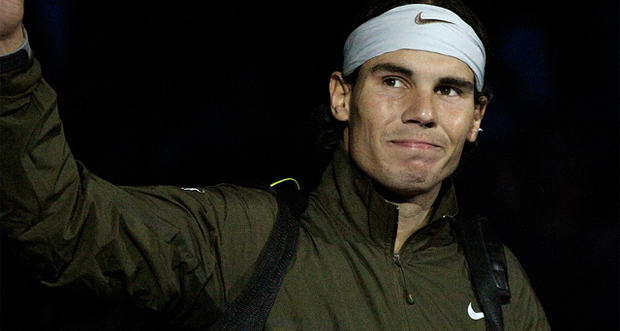
  • Stunner Down Under – Wawrinka Wins Australian Open

    Stunner Down Under – Wawrinka Wins Australian Open

    AO ATP Winner - Stan

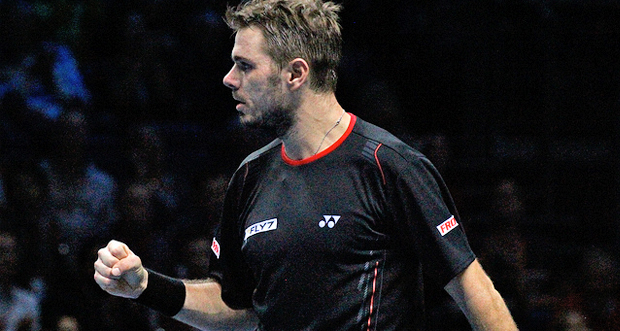
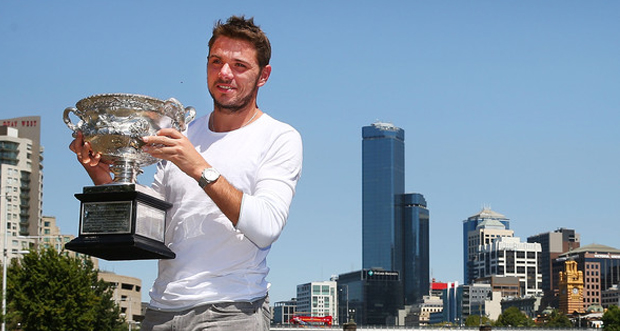
    Stan Wawrinka, erstwhile Swiss No. 2, shocked Rafael Nadal and the tennis world by taking the trophy in Melbourne over the world No. 1:  6-3, 6-2, 3-6, 6-3. In doing so, he became the rare player to win a Major outside of the Top 4 in what has otherwise been nearly decade of dominance by (mostly) Federer and Nadal, an ardent Djokovic, and a sprinkling of Murray.  (Oh, yes, and one by Juan Martin del Potro.)

    Wawrinka was ranked No. 8 going into the tournament, and will be No. 3 when the rankings come out on Monday. He’s spent a good deal of his career under the shadow of Roger Federer, but he has emerged into the sunshine today. He toppled the defending champion, Novak Djokovic, in the quarterfinals, and bested the top seed today, becoming the only man to beat Djokovic and Nadal in the same Slam.

    He started the match with a great calm and focus, and took the first set handily, despite not having a great first serve percentage. Then he broke Nadal at love in the first game of the second. He held for a 2-0 lead, when, on his own service game, Nadal seemed to tweak his back. He held serve, but went off the court for a medical timeout. When he came back, his movement and serve were clearly compromised. Speculation rose as to whether the Spaniard might retire. Wawrinka won the set 6-2.

    However, in the third set, Nadal loosened, while Wawrinka tightened. The Swiss had 19 unforced errors when the set was done, and had basically handed it to Nadal:  6-3.

    The fourth set was on serve until Wawrinka broke in the sixth game, but Nadal broke straight back, raising the stakes, and the hopes that it might actually go the distance. But Wawrinka found his nerve, and broke again for 5-3, then served out the match.

    Nadal had been gunning for a lot of history in this final, but it was not to be. Stan the Man, as he’s known, or the “Stanimal,” made his own bit of history today.

    Photo credit:  Marianne Bevis (Creative Commons License)