Tag: rafael nadal

  • Roland Garros French Open Day 5

    Roland Garros French Open Day 5

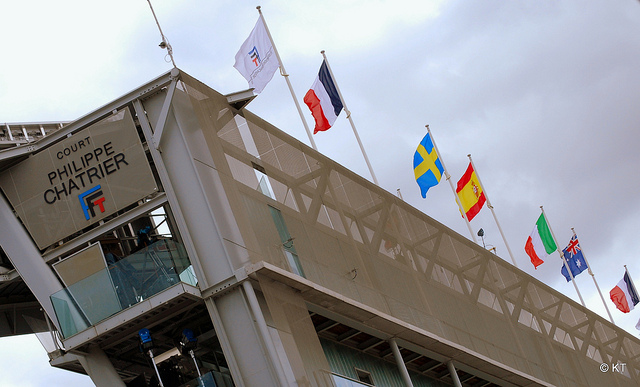
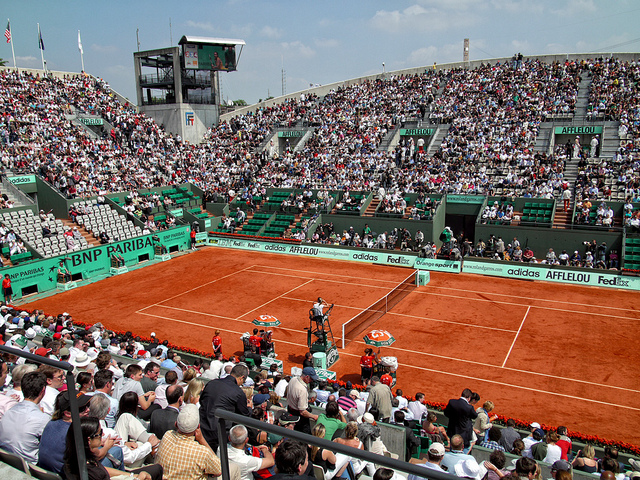
    Eight-time champion and World No. 1 Rafael Nadal (ESP) plays the young, Austrian rising star Dominic Thiem on Court Philippe Chatrier on Day Five of the French Open, at Roland Garros. Former champion Ana Ivanovic (SRB) will play Elina Svitolina, of the Ukraine.

    On Court Suzanne Lenglen, last year’s finalist and the No. 5 seed David Ferrer (ESP) faces off against the veteran Italian Simone Bolelli. The 2011 Wimbledon champion Petra Kvitova (5) plays Marina Erakovic, of New Zealand.

    The American Sloane Stephens will play Polona Hercog (SLO) on Court 1. Later, Andy Murray, the No. 7 seed and defending Wimbledon champion, will meet the Australian Marinko Matosevic. The final match on Court 1 will be the talented Romanian Simona Halep (4) playing Heather Watson (GBR).

    The full schedule for Day 5 is listed below (Results to follow)…

    [divider]

    Court Philippe Chatrier – 11:00 A.M.    

    Women’s Singles – Round 2
    Jelena Jankovic (SRB) (6) d. Kurumi Nara (JPN) — 7-5, 6-0

    Men’s Singles – Round 2
    Rafael Nadal (ESP) (1) d. Dominic Thiem (AUT) — 6-2, 6-2, 6-3

    Men’s Singles – Round 2
    Richard Gasquet (FRA) (12) d. Carlos Berlocq (ARG) — 7-6(5), 6-4, 6-4

    Women’s Singles – Round 2
    Ana Ivanovic (SRB) (11) d. Elina Svitolina (UKR) — 7-5, 6-2

    [divider]

    Court Suzanne Lenglen – 11:00 A.M.    

    Men’s Singles – Round 2
    David Ferrer (ESP) (5) d. Simone Bolelli (ITA) — 6-2, 6-3, 6-2

    Women’s Singles – Round 2
    Kristina Mladenovic (FRA) d. Alison Riske (USA) — 7-6(5), 3-6, 6-3

    Women’s Singles – Round 2
    Petra Kvitova (CZE) (5) d. Marina Erakovic (NZL) — 6-4, 6-4

    Men’s Singles – Round 2
    Gael Monfils (FRA) (23) d. Jan-Lennard Struff (GER) — 7-6(4), 6-4, 6-1

    [divider]

    Court 1 – 11:00 A.M.  

    Women’s Singles – Round 2
    Sloane Stephens (USA) (15) d. Polona Hercog (SLO) — 6-1, 6-3

    Men’s Singles – Round 2
    Guillermo Garcia-Lopez (ESP) d. Adrian Mannarino (FRA) — 6-4, 6-3, 4-6, 6-0

    Men’s Singles – Round 2
    Andy Murray (GBR) (7) d. Marinko Matosevic (AUS) — 6-3, 6-1, 6-3

    Women’s Singles – Round 2
    Simona Halep (ROU) (4) d. Heather Watson (GBR) — 6-2, 6-4

    [divider]

    Court 2 – 11:00 A.M.    

    Women’s Singles – Round 2
    Svetlana Kuznetsova (RUS) (27) d. Camila Giorgi (ITA) — 7-6(5), 6-3

    Women’s Singles – Round 2
    Paula Ormaechea (ARG) d. Monica Niculescu (ROU) — 2-6, 7-5, 6-2

    Women’s Singles – Round 2
    Sara Errani (ITA) (10) d. Dinah Pfizenmaier (GER) — 6-2, 6-4

    Men’s Singles – Round 2
    Fernando Verdasco (ESP) (24) d. Pablo Cuevas (URU) — 4-6, 6-7(6), 7-5, 6-4, 6-3

    [divider]

    Court 3 – 11:00 A.M.    

    Men’s Singles – Round 2
    Donald Young (USA) d. Feliciano Lopez (ESP) (26) — 6-3, 7-6(1), 6-3

    Men’s Singles – Round 2
    Andreas Seppi (ITA) (32) d. Juan Monaco (ARG) — 6-2, 6-4, 6-4

    Women’s Singles – Round 2
    Sorana Cirstea (ROU) (26) d. Teliana Pereira (BRA) — 6-2, 7-5

    Men’s Singles – Round 2
    Fabio Fognini (ITA) (14) d. Thomaz Bellucci (BRA) — 6-3, 6-4, 7-6(2)

    [divider]

    Court 4 – 12:00 P.M.    

    Women’s Singles – Round 2
    Maria-Teresa Torro-Flor (ESP) d. Magdalena Rybarikova (SVK) — 6-2, 2-6, 6-2

    Women’s Doubles – Round 1
    Shuko Aoyama (JPN) / Renata Voracova (CZE) d. Amandine Hesse (FRA) / Mathilde Johansson (FRA) — 6-1, 6-4

    Women’s Doubles – Round 1
    Dominika Cibulkova (SVK) / Kirsten Flipkens (BEL) d. Julia Goerges (GER) (8) / Anna-Lena Groenefeld (GER) (8) — 7-5, 2-6, 7-5

    Mixed Doubles – Round 1
    Sania Mirza (IND) / Horia Tecau (ROU) d. Kveta Peschke (CZE) (4) / Marcin Matkowski (POL) (4) — 4-6, 6-3 [10-7]

    [divider]

    Court 5 – 11:00 A.M.    

    Women’s Singles – Round 2
    Kiki Bertens (NED) d. Anastasia Pavlyuchenkova (RUS) (24) — 5-7, 6-4, 3-0 Ret.

    Women’s Singles – Round 2
    Ekaterina Makarova (RUS) (22) d. Coco Vandeweghe (USA) — 6-4, 6-3

    Women’s Doubles – Round 1
    Yung-Jan Chan (TPE) / Hao-Ching Chan (TPE) d. Kurumi Nara (JPN) / Anna Schmiedlova (SVK) — 7-5, 6-0

    Women’s Doubles – Round 1
    Julie Coin (FRA) / Pauline Parmentier (FRA) d. Irina Buryachok (UKR) / Vladimira Uhlirova (CZE) — 6-3, 6-3

    [divider]

    Court 6 – 11:00 A.M.    

    Women’s Singles – Round 2
    Julia Glushko (ISR) d. Kirsten Flipkens (BEL) (21) — 6-4, 3-6, 6-4

    Women’s Singles – Round 2
    Lucie Safarova (CZE) (23) d. Casey Dellacqua (AUS) — 6-1, 5-7, 6-3

    Men’s Singles – Round 2
    Philipp Kohlschreiber (GER) (28) d. Denis Istomin (UZB) — 6-3, 7-6(5), 6-2

    Women’s Doubles – Round 1
    Kristina Mladenovic (FRA) (12) / Flavia Pennetta (ITA) (12) d. Alize Cornet (FRA) / Caroline Garcia (FRA) — 3-6, 6-1, 6-2

    [divider]

    Court 7 – 11:00 A.M.    

    Men’s Singles – Round 2
    Kevin Anderson (RSA) (19) d. Axel Michon (FRA) — 6-2, 6-3, 6-2

    Women’s Singles – Round 2
    Pauline Parmentier (FRA) d. Yaroslava Shvedova (KAZ) — 1-6, 6-3, 6-3

    Women’s Singles – Round 2
    Andrea Petkovic (GER) (28) d. Stefanie Voegele (SUI) — 6-2, 4-6, 6-2

    Men’s Singles – Round 2
    Jack Sock (USA) d. Steve Johnson (USA) — 7-5, 6-4, 6-2

    Men’s Doubles – Round 2
    Bob Bryan (USA) (1) / Mike Bryan (USA) (1) d. Jonathan Eysseric (FRA) / Marc Gicquel (FRA) — 6-3, 6-3

    [divider]

    Court 8 – 11:00 A.M.    

    Mixed Doubles – Round 1
    Arantxa Parra Santonja (ESP) / Santiago Gonzalez (MEX) d. Lisa Raymond (USA) / John Peers (AUS) — 7-6(2), 6-2

    Men’s Doubles – Round 1
    Treat Huey (PHI) (7) / Dominic Inglot (GBR) (7) d. Santiago Giraldo (COL) / Alejandro Gonzalez (COL) — 6-3, 3-6, 6-3

    Not Before: 2:00 PM

    Men’s Doubles – Round 2
    Daniel Nestor (CAN) (3) / Nenad Zimonjic (SRB) (3) d. Roberto Bautista Agut (ESP) / Igor Sijsling (NED) — 6-3, 6-7(5), 6-3

    Mixed Doubles – Round 1
    Cara Black (ZIM) / Robert Farah (COL) d. Alla Kudryavtseva (RUS) / Treat Huey (PHI) — 6-4, 6-4

    Men’s Doubles – Round 2
    Marcel Granollers (ESP) (12) / Marc Lopez (ESP) (12) d. Guillermo Garcia-Lopez (ESP) / Philipp Oswald (AUT) — 4-6, 6-0, 6-3

    [divider]

    Court 9 – 12:00 P.M.

    Women’s Doubles – Round 1
    Raquel Kops-Jones (USA) (6) / Abigail Spears (USA) (6) d. Sandra Klemenschits (AUT) / Yvonne Meusburger (AUT) — 6-3, 6-3

    Women’s Doubles – Round 1
    Gabriela Dabrowski (CAN) / Alicja Rosolska (POL) d. Ajla Tomljanovic (CRO) / Shuai Zhang (CHN) — 6-1, 6-3

    Women’s Doubles – Round 1
    Garbine Muguruza (ESP) / Carla Suarez Navarro (ESP) d. Mirjana Lucic-Baroni (CRO) / Sloane Stephens (USA) — 7-5, 6-4

    Women’s Doubles – Round 1
    Ekaterina Makarova (RUS) (3) / Elena Vesnina (RUS) (3) d. Alix Collombon (FRA) / Chloe Paquet (FRA) — 6-2, 6-3

    [divider]

    Court 10 – 11:00 A.M.  

    Mixed Doubles – Round 1
    Liezel Huber (USA) / Juan Sebastian Cabal (COL) d. Stephanie Foretz Gacon (FRA) / Edouard Roger-Vasselin (FRA) — 6-3, 6-2

    Men’s Doubles – Round 2
    Jean-Julien Rojer (NED) (13) / Horia Tecau (ROU) (13) d. Nicholas Monroe (USA) / Simon Stadler (GER) — 6-3, 6-0

    Women’s Doubles – Round 1
    Su-Wei Hsieh (TPE) (1) / Shuai Peng (CHN) (1) d. Svetlana Kuznetsova (RUS) / Samantha Stosur (AUS) — 6-2, 6-4

    Women’s Doubles – Round 1
    Klara Koukalova (CZE) (14) / Monica Niculescu (ROU) (14) d. Monica Puig (PUR) / Yanina Wickmayer (BEL) — 6-7(1), 6-0, 6-3

    [divider]

    Court 11 – 12:00 P.M.   

    Women’s Doubles – Round 1
    Cara Black (ZIM) (5) / Sania Mirza (IND) (5) d. Daniela Hantuchova (SVK) / Shahar Peer (ISR) — 6-3, 6-3

    Women’s Doubles – Round 1
    Irina-Camelia Begu (ROU) / Karin Knapp (ITA) d. Mona Barthel (GER) / Virginie Razzano (FRA) — 6-4, 6-3

    Women’s Doubles – Round 1
    Ashleigh Barty (AUS) (7) / Casey Dellacqua (AUS) (7) d. Polona Hercog (SLO) / Paula Ormaechea (ARG) — 6-2, 6-3

    Mixed Doubles – Round 1
    Anna-Lena Groenefeld (GER) / Jean-Julien Rojer (NED) d. Jie Zheng (CHN) / Scott Lipsky (USA) — 7-5, 6-3

    [divider]

    Court 14 – 12:00 P.M.   

    Men’s Doubles – Round 2
    Lukasz Kubot (POL) (9) / Robert Lindstedt (SWE) (9) d. Jeremy Chardy (FRA) / Oliver Marach (AUT) — 6-4, 6-1

    Men’s Singles – Round 2
    Dusan Lajovic (SRB) d. Jurgen Zopp (EST) — 6-2, 6-4, 6-4

    Mixed Doubles – Round 1
    Raquel Kops-Jones (USA) / Raven Klaasen (RSA) d. Anastasia Rodionova (AUS) / Colin Fleming (GBR) — 3-6, 6-3 [10-8]

    Women’s Doubles – Round 1
    Andrea Petkovic (GER) / Magdalena Rybarikova (SVK) d. Claire Feuerstein (FRA) / Alize Lim (FRA) — 6-1, 6-3

    [divider]

    Court 16 – 11:00 A.M.    

    Men’s Singles – Round 2
    Ivo Karlovic (CRO) d. Andreas Haider-Maurer (AUT) — 7-5, 6-3, 6-4

    Men’s Doubles – Round 2
    Jonathan Erlich (ISR) / Marcelo Melo (BRA) d. Rohan Bopanna (IND) (6) / Aisam-Ul-Haq Qureshi (PAK) (6) — 6-3, 6-4

    Women’s Doubles – Round 1
    Kimiko Date-Krumm (JPN) / Barbora Zahlavova Strycova (CZE) d. A. Medina Garrigues (ESP) (11) / Yaroslava Shvedova (KAZ) (11) — 6-4, 6-2

    Women’s Doubles – Round 1
    Sara Errani (ITA) (2) / Roberta Vinci (ITA) (2) d. Timea Babos (HUN) / Varvara Lepchenko (USA) — 6-1, 6-3

    [divider]

    Court 17 – 11:00 A.M.    

    Women’s Singles – Round 2
    Silvia Soler-Espinosa (ESP) d. Yanina Wickmayer (BEL) — 6-2, 6-4

    Men’s Singles – Round 2
    Leonardo Mayer (ARG) d. Teymuraz Gabashvili (RUS) — 6-2, 4-6, 6-4, 6-4

    Men’s Doubles – Round 1
    Andre Begemann (GER) / Robin Haase (NED) d. Fabrice Martin (FRA) / Hugo Nys (FRA) — 6-3, 4-6, 6-3

    Women’s Doubles – Round 1
    Jarmila Gajdosova (AUS) / Janette Husarova (SVK) d. Karolina Pliskova (CZE) / Kristyna Pliskova (CZE) — 1-6, 6-3, 6-3

    Men’s Doubles – Round 1
    Feliciano Lopez (ESP) / Jurgen Melzer (AUT) d. Pierre-Hugues Herbert (FRA) / Albano Olivetti (FRA) — 7-6(4), 6-3
  • Roland Garros French Open Day 2

    Roland Garros French Open Day 2

    Day Two of the French Open kicks off with former champion Maria Sharapova playing Ksenia Pervak, a fellow Russian. Novak Djokovic, of Serbia, will begin his run to capture the elusive title in Paris by facing off against the young Portuguese Joao Sousa.

    The record eight-time Roland Garros champion Rafael Nadal will play the American veteran Robby Ginepri. Also in action on Monday will be Australian Open winner Stan Wawrinka, who is looking to become the first man to win back-to-back Majors in Australia and Paris since Jim Courier, in 1992.

    The full schedule for Day 2 is listed below (Results to follow)…

    [divider]

    Court Philippe Chatrier – 12:00 P.M.

    Women’s Singles – Round 1
    Maria Sharapova (RUS) (7) d. Ksenia Pervak (RUS) — 6-1, 6-2

    Men’s Singles – Round 1
    Novak Djokovic (SRB) (2) d. Joao Sousa (POR) — 6-1, 6-2, 6-4

    Women’s Singles – Round 1
    Alize Cornet (FRA) (20) d. Ashleigh Barty (AUS) — 6-2, 6-1

    Men’s Singles – Round 1
    Guillermo Garcia-Lopez (ESP) d. Stan Wawrinka (SUI) (3) — 6-4, 5-7, 6-2, 6-0

    [divider]

    Court Suzanne Lenglen – 12:00 P.M.

    Women’s Singles – Round 1
    Dominika Cibulkova (SVK) (9) d. Virginie Razzano (FRA) — 7-5, 6-0

    Men’s Singles – Round 1
    Gilles Simon (FRA) (29) d. Ante Pavic (CRO) — 6-1, 6-1, 6-3

    Men’s Singles – Round 1
    Rafael Nadal (ESP) (1) d. Robby Ginepri (USA) — 6-0, 6-3, 6-0

    Women’s Singles – Round 1
    Petra Kvitova (CZE) (5) d. Zarina Diyas (KAZ) — 7-5, 6-2

    [divider]

    Court 1 – 12:00 P.M.

    Men’s Singles – Round 1
    Martin Klizan (SVK) d. Kei Nishikori (JPN) (9) — 7-6(4), 6-1, 6-2

    Men’s Singles – Round 1
    Facundo Bagnis (ARG) d. Julien Benneteau (FRA) — 6-1, 6-2, 1-6, 3-6, 18-16

    Women’s Singles – Round 1
    Sloane Stephens (USA) (15) vs. Shuai Peng (CHN) — Canceled

    [divider]

    Court 2 – 12:00 P.M.

    Men’s Singles – Round 1
    Mikhail Kukushkin (KAZ) d. Nicolas Mahut (FRA) — 6-3, 6-7(4), 6-3, 6-4

    Women’s Singles – Round 1
    Samantha Stosur (AUS) (19) d. Monica Puig (PUR) — 6-1, 6-1

    Men’s Singles – Round 1
    Dominic Thiem (AUT) d. Paul-Henri Mathieu (FRA) — 6-4, 7-6(3), 6-2

    Women’s Singles – Round 1
    Svetlana Kuznetsova (RUS) (27) vs. Sofia Shapatava (GEO) — Canceled

    [divider]

    Court 3 – 12:00 P.M.

    Men’s Singles – Round 1
    Kenny De Schepper (FRA) d. Albert Montanes (ESP) — 3-1 Ret.

    Men’s Singles – Round 1
    Jurgen Melzer (AUT) d. David Goffin (BEL) — 6-4, 5-7, 7-5, 6-4

    Men’s Singles – Round 1
    Ernests Gulbis (LAT) (18) d. Lukasz Kubot (POL) — 4-6, 6-4, 7-5, 6-1

    [divider]

    Court 4 – 12:00 P.M.

    Men’s Singles – Round 1
    Tobias Kamke (GER) d. Miloslav Mecir (SVK) — 7-5, 7-6(2), 7-6(1)

    Women’s Singles – Round 1
    Paula Ormaechea (ARG) d. Romina Oprandi (SUI) — 7-5, 6-2

    Men’s Singles – Round 1
    Leonardo Mayer (ARG) d. James Duckworth (AUS) — 5-7, 6-2, 6-4, 7-6(2)

    [divider]

    Court 5 – 12:00 P.M.

    Women’s Singles – Round 1
    Mona Barthel (GER) d. Karin Knapp (ITA) — 6-4, 6-0

    Women’s Singles – Round 1
    Eugenie Bouchard (CAN) (18) d. Shahar Peer (ISR) — 6-0, 6-2

    Men’s Singles – Round 1
    Thomaz Bellucci (BRA) d. Benjamin Becker (GER) — 6-2, 6-4, 3-6, 4-6, 6-2

    Women’s Singles – Round 1
    Teliana Pereira (BRA) vs. Luksika Kumkhum (THA) — Canceled

    [divider]

    Court 6 – 12:00 P.M.

    Women’s Singles – Round 1
    Sabine Lisicki (GER) (16) d. Fiona Ferro (FRA) — 6-1, 7-5

    Men’s Singles – Round 1
    Tommy Robredo (ESP) (17) d. James Ward (GBR) — 4-6, 6-4, 6-2, 6-4

    Women’s Singles – Round 1
    Karolina Pliskova (CZE) d. Mathilde Johansson (FRA) — 6-1, 7-6(5)

    Women’s Singles – Round 1
    Andrea Petkovic (GER) (28) d. Misaki Doi (JPN) — 6-3, 6-3

    Men’s Singles – Round 1
    Kevin Anderson (RSA) (19) vs. Stephane Robert (FRA) — Canceled

    [divider]

    Court 7 – 12:00 P.M.

    Men’s Singles – Round 1
    Benoit Paire (FRA) d. Alejandro Falla (COL) — 6-3, 6-4, 7-6(4)

    Women’s Singles – Round 1
    Pauline Parmentier (FRA) d. Roberta Vinci (ITA) (17) — 3-6, 6-3, 6-2

    Men’s Singles – Round 1
    Fabio Fognini (ITA) (14) d. Andreas Beck (GER) — 6-4, 6-4, 6-1

    Women’s Singles – Round 1
    Jelena Jankovic (SRB) (6) vs. Sharon Fichman (CAN) — To finish: 5-7, 5-1

    [divider]

    Court 8 – 12:00 P.M.

    Women’s Singles – Round 1
    Tamira Paszek (AUT) d. Alison Van Uytvanck (BEL) — 6-2, 7-6(5)

    Men’s Singles – Round 1
    Marcel Granollers (ESP) d. Ivan Dodig (CRO) — 2-2 Ret.

    Men’s Singles – Round 1
    Teymuraz Gabashvili (RUS) d. Vasek Pospisil (CAN) (30) — 6-4, 6-2, 6-3

    Women’s Singles – Round 1
    Julia Goerges (GER) d. Michelle Larcher De Brito (POR) — 6-2, 6-3

    [divider]

    Court 9 – 12:00 P.M.

    Women’s Singles – Round 1
    Timea Bacsinszky (SUI) d. Maryna Zanevska (UKR) — 6-1, 6-4

    Men’s Singles – Round 1
    Alejandro Gonzalez (COL) d. Michael Russell (USA) — 6-2, 6-4, 6-7(6), 6-1

    Men’s Singles – Round 1
    Donald Young (USA) d. Dudi Sela (ISR) — 6-1, 2-6, 6-1, 6-0

    [divider]

    Court 10 – 12:00 P.M.

    Men’s Singles – Round 1
    Jiri Vesely (CZE) d. Lukas Rosol (CZE) — 6-2, 7-6(6), 7-5

    Men’s Singles – Round 1
    Roberto Bautista Agut (ESP) (27) d. Paolo Lorenzi (ITA) — 6-3, 7-5, 6-2

    Women’s Singles – Round 1
    Kurumi Nara (JPN) d. Anna Tatishvili (USA) — 6-1, 6-4

    Women’s Singles – Round 1
    Polona Hercog (SLO) vs. Jana Cepelova (SVK) — Canceled

    [divider]

    Court 14 – 12:00 P.M.

    Men’s Singles – Round 1
    Robin Haase (NED) d. Nikolay Davydenko (RUS) — 7-5, 6-4, 6-2

    Men’s Singles – Round 1
    Feliciano Lopez (ESP) (26) d. Damir Dzumhur (BIH) — 6-3, 7-6(8), 6-3

    Women’s Singles – Round 1
    Marina Erakovic (NZL) d. Nadiya Kichenok (UKR) — 6-2, 6-1

    Women’s Singles – Round 1
    Bojana Jovanovski (SRB) vs. Camila Giorgi (ITA) — Canceled

    [divider]

    Court 16 – 12:00 P.M.

    Men’s Singles – Round 1
    Marin Cilic (CRO) (25) d. Pablo Andujar (ESP) — 6-0, 6-3, 7-6(6)

    Women’s Singles – Round 1
    Elena Vesnina (RUS) (32) d. Christina McHale (USA) — 7-6(0), 4-6, 6-3

    Women’s Singles – Round 1
    Taylor Townsend (USA) d. Vania King (USA) — 7-5, 6-1

    Men’s Singles – Round 1
    Axel Michon (FRA) vs. Bradley Klahn (USA) — Canceled

    [divider]

    Court 17 – 12:00 P.M.

    Women’s Singles – Round 1
    Flavia Pennetta (ITA) (12) d. Patricia Mayr-Achleitner (AUT) — 6-2, 6-2

    Women’s Singles – Round 1
    Yaroslava Shvedova (KAZ) d. Lauren Davis (USA) — 3-6, 7-5, 6-4

    Women’s Singles – Round 1
    Stefanie Voegele (SUI) d. Anna-Lena Friedsam (GER) — 6-7(3), 7-5, 6-2

    Men’s Singles – Round 1
    Adrian Mannarino (FRA) d. Yen-Hsun Lu (TPE) — 6-2, 6-1, 6-1

    Women’s Singles – Round 1
    Sorana Cirstea (ROU) (26) vs. Aleksandra Wozniak (CAN) — Canceled

  • 2014 French Open Roland Garros Men’s Draw

    2014 French Open Roland Garros Men’s Draw

    The men’s draw for the 2014 French Open at Roland Garros is out. Rafael Nadal (#1) and Stan Wawrinka (#3) are in the top half; Novak Djokovic (#2) and Roger Federer (#4) are in the bottom.

    Rafael Nadal (ESP) (1)
    Robby Ginepri (USA)

    Paul-Henri Mathieu (FRA)
    Dominic Thiem (AUT)

    Qualifier
    Leonardo Mayer (ARG)

    Teymuraz Gabashvili (RUS)
    Vasek Pospisil (CAN) (30)

    Nicolas Almagro (ESP) (21)
    Jack Sock (USA)

    Steve Johnson (USA)
    Qualifier

    Dusan Lajovic (SRB)
    Federico Delbonis (ARG)

    Jurgen Zopp (EST)
    Tommy Haas (GER) (16)

    Grigor Dimitrov (BUL) (11)
    Ivo Karlovic (CRO)

    Qualifier
    Daniel Brands (GER)

    Axel Michon (FRA)
    Bradley Klahn (USA)

    Stephane Robert (FRA)
    Kevin Anderson (RSA) (19)

    Andreas Seppi (ITA) (32)
    Santiago Giraldo (COL)

    Juan Monaco (ARG)
    Lucas Pouille (FRA)

    Qualifier
    Qualifier

    Igor Sijsling (NED)
    David Ferrer (ESP) (5)

    [divider]

    Stan Wawrinka (SUI) (3)
    Guillermo Garcia-Lopez (ESP)

    Adrian Mannarino (FRA)
    Yen-Hsun Lu (TPE)

    Donald Young (USA)
    Dudi Sela (ISR)

    Qualifier
    Feliciano Lopez (ESP) (26)

    Gael Monfils (FRA) (23)
    Victor Hanescu (ROU)

    Albano Olivetti (FRA)
    Jan-Lennard Struff (GER)

    Benjamin Becker (GER)
    Thomaz Bellucci (BRA)

    Qualifier
    Fabio Fognini (ITA) (14)

    Richard Gasquet (FRA) (12)
    Bernard Tomic (AUS)

    Lleyton Hewitt (AUS)
    Carlos Berlocq (ARG)

    Matthew Ebden (AUS)
    Pablo Cuevas (URU)

    Michael Llodra (FRA)
    Fernando Verdasco (ESP) (24)

    Philipp Kohlschreiber (GER) (28)
    Pere Riba (ESP)

    Sergiy Stakhovsky (UKR)
    Denis Istomin (UZB)

    Marinko Matosevic (AUS)
    Dustin Brown (GER)

    Andrey Golubev (KAZ)
    Andy Murray (GBR) (7)

    [divider]

    Tomas Berdych (CZE) (6)
    Qualifier

    Somdev Devvarman (IND)
    Aleksandr Nedovyesov (KAZ)

    Alejandro Falla (COL)
    Benoit Paire (FRA)

    Qualifier
    Roberto Bautista Agut (ESP) (27)

    Tommy Robredo (ESP) (17)
    Qualifier

    Albert Montanes (ESP)
    Kenny De Schepper (FRA)

    Nicolas Mahut (FRA)
    Mikhail Kukushkin (KAZ)

    Pierre-Hugues Herbert (FRA)
    John Isner (USA) (10)

    Mikhail Youzhny (RUS) (15)
    Pablo Carreno Busta (ESP)

    Radek Stepanek (CZE)
    Facundo Arguello (ARG)

    Qualifier
    Julien Benneteau (FRA)

    Lukasz Kubot (POL)
    Ernests Gulbis (LAT) (18)

    Dmitry Tursunov (RUS) (31)
    Qualifier

    Filippo Volandri (ITA)
    Sam Querrey (USA)

    Qualifier
    Qualifier

    Lukas Lacko (SVK)
    Roger Federer (SUI) (4)

    [divider]

    Milos Raonic (CAN) (8)
    Nick Kyrgios (AUS)

    Lukas Rosol (CZE)
    Jiri Vesely (CZE)

    Michael Russell (USA)
    Alejandro Gonzalez (COL)

    Qualifier
    Gilles Simon (FRA) (29)

    Alexandr Dolgopolov (UKR) (20)
    Albert Ramos (ESP)

    Ivan Dodig (CRO)
    Marcel Granollers (ESP)

    Robin Haase (NED)
    Nikolay Davydenko (RUS)

    Martin Klizan (SVK)
    Kei Nishikori (JPN) (9)

    Jo-Wilfried Tsonga (FRA) (13)
    Edouard Roger-Vasselin (FRA)

    David Goffin (BEL)
    Jurgen Melzer (AUT)

    Jarkko Nieminen (FIN)
    Michal Przysiezny (POL)

    Victor Estrella Burgos (DOM)
    Jerzy Janowicz (POL) (22)

    Marin Cilic (CRO) (25)
    Pablo Andujar (ESP)

    Qualifier
    Tobias Kamke (GER)

    Jeremy Chardy (FRA)
    Daniel Gimeno-Traver (ESP)

    Joao Sousa (POR)
    Novak Djokovic (SRB) (2)

  • His Heart’s His Mouth

    His Heart’s His Mouth

    Rome Masters, Men’s Final

    [2] Novak Djokovic def. [1] Rafael Nadal 4-6, 6-3, 6-3

    “He would not flatter Neptune for his trident,
    Or Jove for’s power to thunder. His heart’s his mouth:
    What his breast forges, that his tongue must vent;
    And, being angry, does forget that ever
    He heard the name of death.”

    Not for a moment did today’s final in Rome fail to command my attention. It felt, until almost the very finish, as if the match could have gone either way. It was—not unexpectedly, but nonetheless interestingly— less a game of inches or strategy, than it was one of fear and resolve. But, as raptly as the spectacle fixed my attention in the present, my thoughts couldn’t resist ranging back over the week of tennis in the Foro Italico to marvel at the processes by which both Rafael Nadal and Novak Djokovic made their way through their respective sides of the draw. The World Nos. 1 and 2 seemed to progress toward the final as if through a painstaking annealing process. From Simon to Youzhny, to Murray (what a match!) for Nadal; from Kohlschreiber to Ferrer, to Raonic for Djokovic—each match three-sets long— the tennis and passions of both men were heated and cooled, and eventually pounded into supreme toughness, seemingly in preparation for Sunday’s final battle.

    This mid-match association of mine—to the effortful forging of the tools of tennis warfare—downed the mental drawbridge to an onslaught of martial metaphors. My mind was quickly conquered by hawkish language, as was my field of vision. (War metaphors are almost as dangerous to a sports-writer as getting lost on a sea of superlatives, or reveries about ballet.) Every winner off Novak Djokovic’s racquet suddenly looked like a bullet ricocheting off the dusty pitch of battle. Each time Rafa charged the net, head down, shoulders pulling forward, he became a human siege-engine. The Spaniard’s yellow Babolat racquet was no longer decorated with red-clay-colored stripes in a gimmicky marketing ploy to move merchandise. No, it dripped with the blood of his vanquished foes. The annoyed glance Djokovic shot a toddler (who had himself thrown an ill-timed tantrum behind the Serb’s baseline) became as awesome and terrible as Saturn’s devouring glare. I even imagined I could hear the stirring melody of “Chariots of Fire” rising with the sun over the Northern California hills. Clearly, I needed to clear my head.

    Breakfast, I was sure, would do the trick.

    So, armed with a butter knife—with eyes still fixed on the action on TV— I commenced slaughtering a bagel. Just as I was about to deliver the killing blow to my gluten-rich prey, and while Rafa returned serves from the way, way back, I was visited by a vision of Tom Hiddleston. He was clad as a battle-weary but triumphant Roman general. Now, it’s possible the British actor came to mind simply because any warm-blooded woman who enjoys an eloquent tough guy—regardless of whether he wields words or racquets—is likely to think of Tom Hiddleston at some point during the day, such as while attacking her breakfast. [In case you’ve not heard, Hiddleston has been conquering leading actor roles the way Nadal and Djokovic have been claiming ATP rankings points; that is to say, rapaciously.] But, frankly, it’s probably more to do with the martial metaphors that were on the march through the caffeinated neuronal tangles of my mind. Because last time I saw Tom Hiddleston he was putting on a masterful performance of the Roman general Coriolanus in Shakespeare’s tragedy of the same name—and now here he was again, dressed in his bloodied toga, watching me watch Roman tennis and chew on a sesame bagel from the Boogie-Woogie Bagel Boy. The synchronous significance of all but the Boogie-Woogie bagel could not be ignored (though the BWBB does make a quality bagel if you’re ever in the neighborhood).

    It’d be an exaggeration to say that my vision of Coriolanus-slash-Tom-Hiddleston spoke to me. He didn’t. He just stood there in the cheerful morning sunshine, looking martial. But the visitation did remind me that I occasionally enjoy thieving lines from Shakespeare and reapplying them to tennis. Moreover, there is a passage from Coriolanus—and about Coriolanus—that makes a fitting description of the way both Nadal and Djokovic play tennis. Not only that, but it makes a suitably heroic post title: “His heart’s his mouth.” His body is his soul. His game is unfiltered. For better and for worse, nothing is held back.

    Thus did my Hiddlestonian Vision make for a relaxing moment in an otherwise tense morning of tennis-watching. Partly because Tom Hiddleston has a soothing gaze, but mostly because I was aware my quotation-inspired post heading would do equally well for whomever won the tournament. I had my title even if I did not yet know who had Rome’s.

    At the start of this post I wrote that the outcome of Nadal and Djokovic’s 41st meeting turned more on fear and resolution than it did on strategy and execution, which isn’t to say that strategy and execution are unimportant. On the contrary, the strategy is everything— and nothing without execution. It’s just that both players know the strategy, and are fully capable of executing. Not a lot had changed since last time, or the time before last.* Therefore, today wasn’t as much about whose strategy broke his opponent’s game, but who flinched, and when—

    Even in the first set—while Djokovic was still either tense or enervated (it’s sometimes hard to tell the difference with him) and Rafa’s game-plan was working fairly well, his deep shots drawing relatively easy errors from the Serb’s forehand—even then, there were signs of anxiety from Nadal. The kind of anxiety we’ve been seeing less and less of as we moved through the last two weeks, but that is still visible, especially in his small hesitations. For instance, when Nadal was serving up 4-1, but down a break point, he hit a good body serve and earned a weak reply. Instead of driving the ball at Djokovic’s forehand, which was at that point still wobbly, he hesitated and then settled on a rally ball to the Serb’s backhand. Djokovic promptly broke serve with an angled backhand winner. Rafa was still ahead in the match, but he still looked uncertain of himself, while Djokovic looked like he was just beginning to take heart.

    In the second set, in the 2-3 game, Nadal handed Djokovic the break with a nervous double-fault. I know it was an especially nervous double-fault because it’s been text-validated. (As in, before he hit the second serve a fellow Rafa-fan and I crossed texts that formally announced our guy was about to “DF :(” We could feel it coming. This is the kind of highly scientific research I conduct on Sunday mornings after receiving visitations from celebrities dressed in togas.) Djokovic, who was by now playing pretty, and pretty fearless, tennis, took the break and ran with it, closing out the second set three games later with an ace.

    But like I said, the Serb didn’t run away with the championship. Rafa was in the second and third sets until the end. By now you’ve probably read various technical accounts of the match, and know all about the importance of Nadal’s poor second serve stats and Djokovic’s improved forehand (which has been improved for quite some time as far as I can tell). However, the two moments I found most significant in the third set were—surprise, surprise—largely psychological. The first of the two arrived on Rafa’s serve at 1-3, 30-15, when he and Djokovic found themselves in cozy quarters near net after a let-cord, which had set up a relatively easy put-away for the Serb. This time it was Djokovic who hesitated. For a split-second his humanity—or maybe it was simply good manners— broke through the warrior casing. It looked almost as if the Serb felt he didn’t deserve to hit the winner. If it hadn’t been for the let-cord, Djokovic knew he wouldn’t have been in the position to win the point. So, instead of going at Nadal with the shot, he tried to lob. Rafa wasted no time in putting the ball away.

    Indeed, the Spaniard used this hard-fought service hold to haul himself back into the final set. After winning game point, Nadal let out a tremendous fist-pumping bellow. At that moment his heart was in his mouth, and on his sleeve. (And Tom Hiddleston and I were up out of our seats clapping. Yes, Tom was still with me. I’d given him half my bagel.) Rafa followed the hold with an immediate break of serve. But—and I believe this was crucial—in the process of breaking, Rafa again found himself opposite Novak at the net. This time he had the easy ball to put away. Nadal could have passed Djokovic, but instead he went at him. The unspoken message—ordinarily one I’d favor—was that he would give no quarter. It was the move of a consummate warrior.

    Unfortunately for Nadal, the lasting impact of his aggressive play was to make Djokovic just a little bit angry, and to remind the Serb that he was also a ruthless warrior, also meant to show no mercy—or, for that matter, fear. And from that point on, he didn’t. “And, being angry, does forget that ever He heard the name of death…” For the final three games of the match, Novak Djokovic was suitably heroic. He broke back immediately, and his two championship points were brought up with a service return that polished the baseline. He couldn’t have struck the ball more aggressively had he hit it with a battle axe. Then, after shaking the hand of his rival, the newly named Champion of Rome used his racquet to draw a massive heart in the clay. (No doubt Tom Hiddleston had visited him on a changeover.)

    Rafael Nadal claims to be encouraged by his performance in the final, and I don’t have difficulty believing him. He usually means what he says. Sure, he won Madrid, but he played better in Rome. And if the past is any indication of the future, the types of niggling fears and hesitations that undermined Nadal in Rome are exactly the type of fears he most enjoys pummeling into oblivion. Should he and Djokovic meet again in the final at Roland Garros I wouldn’t call Nadal the favorite (that would be upsetting for him), but neither would I call him not the favorite.

    As far as Djokovic is concerned, there was much to admire this week. His is a harder character to decipher than Nadal’s. Sometimes Djokovic seems like exactly the kind of guy who would flatter Neptune for his trident, or sweet talk Jove out of his thunder. But on court his ambition is easy to read. When he goes for his shots like he did today, when his game shows so much complexity in terms of pace and spin, it’s exciting to see. And there’s no questioning how hard he tries, even after the match is done.

    The Rome trophy presentation was an oddly pieced together ceremony. The strangest aspect was probably that the winner was asked to give his speech before the runner-up spoke, but there was also an extended period of time before the talking bits when both men were left standing on stage with their trophies while a recording of “Chariots of Fire” really did play—maybe a few times over— in the background. It made for a long Kodak-moment that was more awkward than inspiring. Glancing almost cautiously around the stadium, and sensitive to the crowd vibe, Djokovic did a quick hip-shaking jig in time with the music. This is one of the best tennis players on earth, and he puts almost all his heart into his game—except for that little bit he reserves for our comic relief.

    * For his part, Nadal needs to target Djokovic’s forehand, drive his own down the line, serve well and with variety, and stand somewhere in the approximate vicinity of the baseline. Novak Djokovic must pin Rafa to his forehand side, redirect his own backhand, return well, and take time from Nadal by flattening out his groundstrokes and going for winners early. It’s this element that gives Djokovic the strategic advantage. Nadal depends on taking his time (which might be why he gets so anxious serving in the face of Djokovic’s blistering returns). If the Serb is able to flatten out that acutely-angled crosscourt backhand as well as his signature shot down the line, Nadal has nowhere to hide, and, more importantly, no time to get there. Yet, despite this strategic advantage, Djokovic can still lose if Rafa plays close to his best (especially on the rare occasion when Rafa flattens out his own shots for winners, as he did at last year’s US Open).

  • Djokovic Topples Nadal in Rome

    Djokovic Topples Nadal in Rome

    Novak Djokovic

    Novak Djokovic overcame a slow and sloppy start to take down his arch-rival Rafael Nadal at the Internazional BNL d’Italia today in Rome, 4-6, 6-3, 6-3. This is his third title overall in the Italian capital, and the second at the direct expense of Nadal, who was the defending champion.

    The first set saw both players a bit tentative, but Nadal got the first break in the third game, and then again in game five to race ahead to a 4-1 lead. Djokovic got one break back in the next game for 2-4, held quickly, and nearly broke Nadal again at 4-3, but the Spaniard fought him off for the hold, and eventually served the set out. Djokovic had 17 unforced errors for the set to Nadal’s 8.

    The rest of the match saw a better level from both, and the momentum swung back and forth a few times, though it was the Serbian who found a very high level and rarely saw it drop again. In the second set, Djokovic broke Nadal in his first service game with a laser-like passing shot, and raced quickly to 3-0. In the fifth game of the set, Nadal broke his opponent to put the set back on serve, but was immediately handed the break back by Djokovic, which was all the lead he needed for the remainder of the set.

    The world No. 2 broke the No. 1 again in the first game of the deciding set, but Nadal battled for the break back in the sixth game of the set, only to be broken once again in his next service game. With Nadal serving at 3-5, Djokovic broke yet again to regain the Italian title, and move himself within 650 rankings points of taking back the No. 1 spot from Nadal.

    [divider]

    Cover Photo (Creative Commons License): Marianne Bevis

  • Sterner Stuff

    Sterner Stuff

    Kei Nishikori

    Madrid Open, Men’s Final

    [1] Rafael Nadal def. [10] Kei Nishikori 2-6, 6-4, 3-0

    There are many reasons I enjoy watching tennis, not least among them is that tennis is a form of theater. The drama is frequently compelling, the staging appealingly straightforward, and tennis has, of course, its varied cast of players. As such, yesterday’s production of the Men’s Madrid Final had the makings of a thoroughly engaging show: It was performed on traditional red clay, featured one of the world’s most renowned clay-courters, co-starred one of the sport’s rising stars, had a supporting cast of beautiful, belted extras (all with the word “Pull” emblazoned over the right breast and “Bear” over the left as if declaring some bold, yet alluringly vague, nymphet creed), and it took place inside a box-shaped theater of Magic.

    And it did turn out to be an interesting production, but not an altogether satisfying one. Both players experimented—with more and less success—by moving outside their typical range. Kei Nishikori executed the Djokovic Method with tremendous flair, going hard and fast at Nadal’s forehand and taking his own backhand audaciously early, changing the direction of the ball with seeming ease. Rafael Nadal, on the other hand—who was recently dubbed “Sir Rafa, Bloodless Warrior Prince” by the friendly-faced Queen of Spain—forwent dictating with his forehand out of his backhand corner in favor of scrambling, committing errors (some tentative and forced, others entirely out of his control), and reciting brief, but intensely self-critical soliloquies between points. (In my opinion, for such a fine performer, the groundstroke errors were a mistake—many mistakes, actually—but the monologues were excellent. Nadal projected his troubled emotional state exceptionally well. I didn’t even need to understand the words to comprehend the force of his meaning: the warrior prince was distinctly displeased.)

    ESPN coverage of the final ended traditionally enough, with Rafa chomping yet another trophy. This Madrid victory is Nadal’s 27th Masters Title, one for every year he’s been alive, and five more than anyone else has got. The trophy itself looks like it might have once done a stint as Iago’s favorite cudgel. [I can’t help but think that the runner-up plate should actually be a set of brass knuckles adorned with diamond-studded tennis balls.] Nonetheless, seeing the sadistic-looking scepter held aloft in the bandaged hands of the defending champion, reigning World No. 1, knighted bloodless warrior, and anointed King of Clay made everything feel back to normal, if not quite all right.

    One obvious source of emotional dissonance was the fact that the curtain dropped on this particular Madrid production midway through the third act. This left me with a feeling of –surprise, surprise—incompleteness. The other wrong note sounded from the fact that I wasn’t really surprised by the way things played out, or failed to play out, as the case might be. I expected Nadal to win, I expected him not to be at his best, and I expected Nishikori to be somehow injured. What I had not expected was Nishikori to play so incredibly well before succumbing so suddenly to injury. It was disappointing to watch, and it must have been nightmarish to experience firsthand. 

    Kei Nishikori has a very entertaining game, solid all-around, and starring a forehand that’s big and flashy without being the least reckless. The Japanese No. 1today the first Japanese man ever to enter the Top 10—also has a nuanced grasp of strategy that seems only to be improving. For instance, yes, Nishikori required ten match points to see off David Ferrer in the semifinals (the match of the tournament), but it’s worth noting that Ferrer outplayed Nishikori for most of the first and a good portion of the second set. Ferrer returned exceptionally well in Madrid, most notably while launching himself into the air after John Isner’s exploding kick-serves (the tall American only won 30 out of 50 points behind his massive first serve in his third round loss to the Spaniard). But Nishikori found his way around Ferrer’s uncanny return, choosing his spots carefully and hitting them well (especially his serve down the T on the ad side, which broke away from a lunging Ferrer over and over again). 

    It wasn’t his strategy but his courage that wavered at the close, as Nishikori started to miss his first serves and send smothered forehands into the net cord (that, and Ferrer played his guts out). But, although Nishikori’s heart missed a few beats, it didn’t fail him. After three sets, ten match points—the first coming nearly an hour before the next nine—and almost three hours of tennis, Nishikori had earned his first role as a Masters-level finalist. This new battle-hardened Nishikori pleased me (he won the Barcelona title in April, his first on clay), as I assume he pleased many other tennis fans wondering who besides Wawrinka might come into his own on the ATP tour this year. Kei Nishikori is 24-years-old, his tennis is textured and exciting, and he seems like a nice fellow. We could do much worse.

    The question is whether Nishikori can stay healthy. Unfortunately, he has a pattern following up a big win or a promising run with an injury retreat (hence my expectation that he’d pull up lame in yesterday’s final). There might be nothing at all that can be done for what ails Nishikori’s body. The repetitive nature of tennis doesn’t allow much space for the healing of certain wounds, and carrying an injury makes a player more susceptible to injury. Still, there was something about the storyline of yesterday’s match, in the way the balance of power shifted from Nishikori to Nadal that felt, for lack of a better word, familiar. And where there is familiarity, it’s a good bet there’s also psychology. 

    Nishikori won the first set in stunningly dominant fashion, making the Warrior Price look unsettlingly ordinary. Then, to the dismay of the Spanish crowd, Nishikori kept it up in the second set, breaking immediately for 1-0. That’s when the structure began to crumble for Nishikori, at the very moment he found himself up a set and a break on the greatest clay-courter of our time. Was it simply his injury beginning to bother him? Or was this the moment when he started to think about the possibility of actually winning? Did he somehow prompt the other shoe to drop? And did that shoe, perhaps, land directly on his wounded back? Did Nishikori start to worry his body wouldn’t hold out for long enough to secure the win? Or did he worry that hed backed one of the games most deadly competitors into a corner and that this competitor was now going to box him about the ears with his forehand cudgel? 

    Or maybe—most likely—it was a mix of all of the above and more. Because Nishikori immediately went down 0-40 on his serve, and although he managed to fend off the break, he didn’t look even close to as settled as he had in the first nine games. Then, while still leading 3-1 in the second set, Nishikori asked the umpire to quiet the partisan crowd, thereby insuring stoney silence in La Caja Mágica whenever he won a point, and, more crucially, letting Nadal know he was a bundle of anxiety underneath all that tremendous ball-striking.

    At the 4-3 changeover Nishikori received a massage from the trainer. Another note of encouragement to his opponent, who is—we all know—not the type of player to shy away from attacking an injured foe. Sure enough, Rafa broke the very next game, looking, for the first time in the match, like the bloodless Warrior Prince version of his self. The word “roar” is overused as it applies to Rafael Nadal, but it’s the still the best one to describe his reaction when Nishikori’s let-cord sailed long, leveling the set at 4-4. Rafa roared. The commentators took the opportunity to observe that not only is Nadal “a mental fortress,” he was also aiming to get in Nishikori’s grill and “rattle his cage.” Nishikori, for his part, took the opportunity to call for the trainer. His grill was rattled. 

    Nadal has been without his full-on game for months now. The walls of his mental fortress are in need of a good spackling. But he is still Rafael Nadal, and therefore nobody knows just when and where he’ll get his game back. He waits only for the tournament, or the match, or even the lone point, on which to turn his fate, and rekindle his desire to devour every available tennis trophy. This potential energy, ever on the verge of becoming searingly kinetic, frightens people standing opposite him. Indeed, it was Nadal’s big cudgel forehand that earned him the crucial break point in the second set, but it was also the point that seemed to break Nishikori’s body and spirit—he turned an ankle trying to cope with Nadal’s attack, and nothing turned out well for him after that.

    By the time the first game of the third set had elapsed, it was obvious Nadal would win the match. Nishikori’s capitulation was complete, which meant, interestingly, that Nadal’s victory was not, or at least not quite yet. As faithful as both players were to their assigned roles—the underdog put up a good fight, but went out meekly in the end, and the leading man got the trophy (and all the girls)—the script failed to convince. Both Nishikori and Nadal have more to offer, and—one hopes— more to prove. Fortunately, in the tennis version of theater, the script is rewritten each week anew, and the play has already begun at the Foro Italico. In Rome, as a famous playwright once noted, ambition should be made of sterner stuff.

  • Nadal Takes Madrid Title as Nishikori Retires

    Nadal Takes Madrid Title as Nishikori Retires

    Rafael-Nadal

    In a stunning turn of events at the Mutua Madrid Open, Kei Nishikori went from dominating the defending champion Rafael Nadal, to struggling to serve or even walk, and finally throwing in the towel in the third set. Nadal was rather gifted over the title, 2-6, 6-4, 3-0 Ret.

    Nishikori, who will become the first Japanese man ever in the men’s Top 10 when the rankings come out tomorrow, had a game plan against the world No. 1, and he was executing it for a full set and a half. Nadal, for his part, was helping his opponent’s cause with a rash of uncharacteristic errors. After having won the first set, and up a break in the second, before serving at 4-2 up, Nishikori called for the trainer. He’d been seen by the trainer for his back in the long semifinal yesterday against Ferrer. After that, he clearly struggled on serve and was broken by Nadal to even the set at 4-4. Nadal won the second, but Nishikori was clearly not the player he had been, and in the third set, he could hardly move, and had to concede the match. The win is Nadal’s fourth in Madrid, and third since it has been contested on clay.

    [divider]

    Cover Photo (Creative Commons License): Marianne Bevis

  • Rafael Nadal – From Peak to Plateau

    Rafael Nadal – From Peak to Plateau

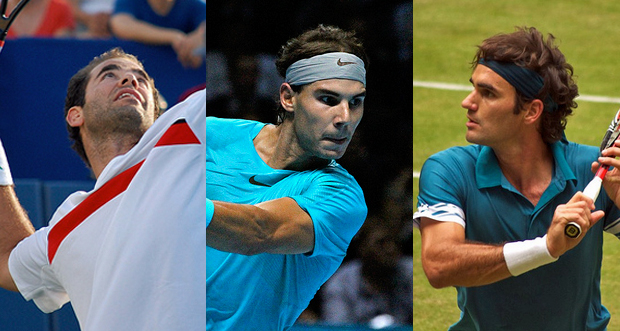
    Sampras Nadal Federer

    All good things come to an end. It is the inevitable tragedy of life, although of course it also allows for greater appreciation of the moments we do have. And so it is with tennis greats, whether the current twilight years of Roger Federer or, as is the focus of this piece, the inevitable decline of Rafael Nadal from an unstoppable force of nature to merely a great, but beatable, player.

    Before you protest that all players have their ups and downs, let us consider the simple fact that Rafael Nadal is in an age window when most great players drop a notch; even if he’s not dropping yet, it is inevitable that at some point soon he will. But a notch from his peak level still makes him one of the best players in the game – just as in Roger’s “twilight years” he is still probably the third greatest player on tour.

    [divider]

    Click here to discuss this in the Tennis Frontier discussion forum.

    [divider]

    Perhaps by understanding the career trajectories of other great players we can better understand where Nadal might be in his own career, and what might be ahead. For a player of Nadal’s stature there are few peers – we have to look at players who were for a significant portion of their careers considered the best in the game. Going back through Open Era history, we have Roger Federer, Pete Sampras, Ivan Lendl, John McEnroe, Bjorn Borg, and Rod Laver. With apologies to other dominant players such as Novak Djokovic, Andre Agassi, Boris Becker, Stefan Edberg, Mats Wilander, and Jimmy Connors, I’m looking at players who were the best for an extended period of time (Djokovic is close, but he’s younger than Nadal so doesn’t really qualify). Borg also has to be taken out of the equation as he retired at 25.

    That leaves us with Federer, Sampras, Lendl, McEnroe, and Laver. Considering that Nadal turns 28 this year, let’s keep in mind the year those five turned 28 for a reference point:

    • Federer: 2009
    • Sampras: 1999
    • Lendl: 1988
    • McEnroe: 1987
    • Laver: 1966

    As I’ve suggested elsewhere, most players follow a career pattern in four major phases (with general age averages): development (17-21), peak (22-26), plateau (27-31), and decline (32-). Obviously players veer out of those ranges, but those are typical. I would maintain that one way to define the peak phase is that it is the period of a player’s career in which their results, especially winning percentage, are solidly over their career average, while the plateau phase is more around the career average or a bit below. Now the question at hand in this context is whether or not Rafael Nadal is transitioning from his peak to plateau phase, which is a step below peak but still very high.

    Let’s take a look at the five players and see at what point they transitioned from peak to plateau. To get a sense of that, we’ll be focusing on their Grand Slam results and match winning percentage.

    Roger Federer

    The Swiss Maestro was clearly in his peak from 2004 to 2007. When he actually dropped a notch into his plateau phase is a bit unclear, however. Many consider the great 2008 Wimbledon match as when Roger passed the baton to Rafa for greatest player in the game. But not only was that match a complete toss-up, but Roger went out and won the next Slam and four out of the next six. Rather, I would maintain that what the 2008 Wimbledon marked was Nadal joining Federer as the best in the game, a partnership which was maintained–some some passing of the baton back and forth–until 2010 when two things happened: Rafa had probably his best year and Roger dropped a notch, leaving Rafa as the sole king of the tour.

    Regardless of when Federer’s skills began to erode, greatness is always defined relative to others, thus the results offer a reliable barometer for his drop in performance. Looking at the statistical record, Roger’s career definitely dropped a solid step after the 2010 Australian Open, his penultimate Slam victory (so far, at least). Whereas Roger won a remarkable 16 of 27 Grand Slams from Wimbledon 2003 to the 2010 Australian Open, playing in a perhaps even more remarkable 22 of 27 Finals, from 2010 Roland Garros to the present, Roger has won only 1 and played in 2 Finals of 16 Slams. He is still a very, very good player, but clearly a step down from his previous peak.

    Looking at Roger’s winning percentage confuses the matter a bit, as he dropped quite a bit from 88% in 2007 to 81% in 2008, and then equalized in the 83-86% range from 2009 to 2012, and then plummeting to 73% in 2013 before rising to 87% (so far) in 2014. But winning percentage is only part of the equation, the other being Slam results, and Roger remained pretty dominant through the Australian Open in 2010 so I would argue that he entered his plateau phase around Roland Garros in 2010 – when he was 28 years old, turning 29 a few months later.

    Pete Sampras

    Pistol Pete was the No. 1 ranked player in the game for an unparalleled six years in a row, from 1993-1998, the year he turned 27. While Pete was No. 1 as late as November 2000 when he was 29 years old, his reign of dominance had clearly ended, or at least diminished.

    In 1998, Pete’s last year at No. 1, his winning percentage had dropped for the second straight year and, at 78.2%, was about at his career average (77.4%). But then in 1999 it shot up again to 83.3%, the highest it had been since 1996 and the fourth highest of his career. Yet it dropped again in 1999 to 76.4% and continued to drop over his last couple years.

    So in one sense we could say that Pete was as good as ever in 1999, the year he turned 28, yet on the other it was in far fewer matches than usual – he only played 48, the fewest he had played since 1989, and far fewer than his average of 81 per year from 1990-98.

    Regardless, it seems clear that Pete entered his plateau phase sometime between 1998 and 1999. He lost the No. 1 ranking in late March of 1998 after holding it for 102 weeks straight. He did regain it again before the end of the year so that he still finished No. 1, but I think at that point the writing was on the wall. So I’d maintain that he transitioned into his plateau phase around age 27.

    Ivan Lendl

    Some might take issue with Lendl’s inclusion, as his early career was overshadowed by Borg, McEnroe, and Connors, and later on he vied with Wilander, Becker, Edberg, and then Sampras and Agassi. (Actually, as an aside, Lendl may be one of the most underrated players in tennis history because of all great players—at least during the Open Era—no one else played alongside other greats playing at or near their peaks, and Lendl held his own, and then some.) Let us remember that Lendl finished three years in a row, 1985-87, at No. 1, and a fourth year in 1989. He also finished in the Top 3 for nine straight years and the Top 8 for thirteen straight years, both of which only Roger Federer has equalled since (Fed finished in the Top 3 for ten straight years and assuming he finished 2014 in the Top 8, will equal Lendl’s thirteen straight years in the Top 8).

    Lendl’s fall to his plateau is relatively easy to determine. In 1989, his last year finishing No. 1, he had a winning percentage of 92% which fell to his career average of 82% in 1990, which was also the last year he won a Slam, and then 75% in 1991. So the fall came between 1989 and 1990 – perhaps after his last Slam at the Australian Open in 1990, so when he was 29, almost 30 years old.

    John McEnroe

    Johnny Mac is a bit of an outlier to this group because his later career was marred by personal issues. But he was still a similarly dominant player as the others on this list during the first half of his 20s, ranked No. 1 for four years in a row, and the only player to be considered the great Bjorn Borg’s equal, even surpassing the great Swede towards the end of their rivalry.

    Anyhow, McEnroe’s drop is quite clear. His very greatest year was 1984 when he had an amazing 96% winning percentage (82-3). Yet 1985—despite not winning any Slams—was also great, with an 89% winning percentage and far above his career average of 81.5%. But then he missed a lot of time in 1986-87 and never came back even close to peak form, so we could say that there’s a clear separation between peak and plateau/decline between the years 1985 and 1986. Johnny Mac turned 27 in early 1986, so the drop was at age 26-27.

    Rod Laver

    I include Laver with some hesitancy considering that he played in the mists of ancient tennis history. Yet he was a similarly dominant player to Nadal and Federer, and had his last great year in the Open Era.

    It is more difficult to example the statistical records from before the ATP era (1973), but from what the statistical record shows us, Laver maintained a peak level of performance throughout his 20s and through his great year in 1969 when he won all four Grand Slams. He turned 31 that year.

    Laver remained a good player for a few more years, but was never the same. So his peak ended quite late – at age 31.

    Summary

    So when we look at our five comparable greats to Nadal, we see the age that they transitioned from peak to plateau form as follows:

    • Federer: ~28
    • Sampras: ~27
    • Lendl: ~29
    • McEnroe: ~26
    • Laver: ~31

    Looking back over the last year or so, Rafa was playing at a very high level through the summer of 2013. After dominating the North American section of the tour by winning the US Open and both the Canadian and Cincinnati Masters, Nadal slowed down a bit, not winning a tournament for the rest of the year. He started 2014 by winning the Qatar Open, although then lost in the Australian Open final, partially due to injury. He also won his second tournament of the year in Rio, but both his wins so far are relatively minor (an ATP 250 and 500, respectively), and he hasn’t won any of the three Masters and just lost in Barcelona in the quarterfinal. His 91% winning percentage in 2013 was the best of his career, while his 82% so far this year is actually a bit below his career average of 83.6%, so there is cause for concern.

    Nadal will turn 28 years old in a little over a month, so he is certainly within range of the norm for transitioning from peak to plateau. Right now he is the same age that Roger Federer was when he won the 2009 Wimbledon and when Sampras won the 1998 Wimbledon. At Rafa’s current age, both Roger and Pete won three more Slams; Lendl won only two more, but had fewer total.

    So if we want to guess what is before Rafa, we can look at Federer and Sampras in particular. If Rafa truly is transitioning from his peak to his plateau—and it seems likely, in my opinion—he still has many good years ahead of him. And if I were to guess how many more Slams he will win, like Federer and Sampras at the same age, three is as good a guess as any. Both Roger and Pete won two more at their best Slam (Wimbledon) and one more at another. Perhaps, then, an educated guess would be that Rafa will win two more French Opens and one more on another court, which would bring him to a total of 16 for his career – one shy of Roger Federer’s current total, but more than anyone else.

    But of course there are always exceptions to the rule, and Rafa is as good a candidate to be one as any other. Every player has a different career trajectory; but if he follows the typical trajectory of a great player, while he would truly be transitioning into his plateau phase now, he also likely has a few good years—and a few Slam titles—left in him.

  • Nadal Bombs Out in Barcelona

    Nadal Bombs Out in Barcelona

    Nadal

    After ten straight defeats at the hands of Rafael Nadal, Nicolas Almagro found his game and his nerve to beat the World No. 1 on the clay at the Conde de Godó in Barcelona, while Nadal continues to struggle with his form and confidence. Nadal broke Almagro in the first game of the first set, but was broken straight back. However, Rafa broke twice more to take the first comfortably, 6-2.

    In the second set, Nadal seemed to be finding his form, but failed to convert several break chances. In the tiebreak, it was Almagro who prevailed to take only his third set off Nadal in the history of their head-to-head.

    Rafa started strong in the third, going up 3-1, before Almagro won three consecutive games. Nadal broke back in the eighth game, evening things up at 4-4. It seemed he had regained control of the match, however Almagro immediately broke back at love, going up 5-4. Serving for the match, he quickly went down 15-40, but Nadal failed to convert both break points. The situation got tricky when Nadal saved the first match point, but a determined Almagro won it on his second, closing out the match 2-6, 7-6(5), 6-4.

    It was the World No. 1’s second clay-court loss in a week, following his defeat to Ferrer in Monte Carlo. It was the first time he has lost in Barcelona since 2003. After losing in the quarterfinals in two consecutive tournaments which he has won eight times each, many questions now surround his ability to defend Roland Garros.

    Cover Photo (Creative Commons License): Marianne Bevis

  • The Eighth Wonder of the Learned Alchemists

    The Eighth Wonder of the Learned Alchemists

    Wawrinka

    Monte Carlo Masters 2014: A round-about wrap-up & some psychology.

    Near the middle of the day, near the middle of last week, I opened my internet browser to the news that Gabriel Garcia Márquez had died at the age of 87.

    Aww, no,” I exclaimed to no one in particular.

    A colleague—a fellow psychologist who happened to be within earshot—responded to my expression of disappointment with concern. “What’s wrong?”

    “Gabriel Garcia Márquez is dead.”

    Aww, no,” her expression was resonant with compassion. Therapists learn, almost without intention, to pack our monosyllabic murmurings with rich, affirming emotion. I felt immediately understood, and my colleague and I shared a moment of heavy silence as I pondered the impermanence of all things, including authors (and also my lunch, which I’d forgotten on my kitchen counter before work that morning). But, as the sad seconds ticked by and my colleague continued to honor my feelings with quiet empathy, I decided I ought to say something to lighten the mood. After all, it’s not like the Nobel-Prize-winning author was a friend of mine. 

    “Truth be told,” said I, “until this moment I wasn’t aware he was still alive.” 

    “Well,” said my colleague, “truth be told, until this moment, I’d never been aware of him at all. Who is he?”

    It’d been one of those days at work. In fact, it’d been one of those weeks— one of those months. We were both tired and worn-down. The sudden, mutual realization that my colleague and I were sharing grief over the death of a man neither of us had known was alive…well, it was just too much. We burst into fits of irrational laughter. Then—once I regained control of my capacity to inhale—I told her I thought she’d enjoy Márquez’s novel, One Hundred Years of Solitude, she replied that maybe she’d give it a try, and we got back to work, both of us feeling much lighter at heart than before we were saddened by the death of one the literary world’s greats.

    Rafael Nadal’s straight-sets defeat at the hands of David Ferrer in the Monte Carlo quarterfinals took place in the middle of the California night, and I slept straight through it. When I woke up to news of the loss, I was both surprised and not. My reaction was more Hrmm than Aww. Whether it’s mental (as Nadal says it is), or physical (as he might prefer not to discuss with the media), or both (as the two are often intertwined), whatever is going on for Rafa is familiar. We’ve been here before. Nobody rises from the ashes quite like Rafael Nadal, but once he’s risen—once his muscular wings are fully spread, with Nike microfiber plumage shining in the sunlight as he perches at the summit of a mountain made entirely of ranking points and the broken racquets of his shattered opponents—he gets a tad bit uncomfortable. From where I sit, on the summit of my sofa pillows, it seems that something (a significant something) inside Nadal’s psyche prefers to fight the powers that be rather than be one— or at least, prefers not to be World No. 1.

    Unfortunately for (what I am assuming is) Nadal’s conflicted relationship with his own greatness, Novak Djokovic, the current World No. 2, has a wrist injury that looks to keep him sidelined for no small amount of time. The Serb’s injury is a real shame, considering the stunning performance Djokovic delivered in the Miami final. He looked, then, as if nothing would suit him better than an extended, dusty turf war for the No. 1 ranking.

    For now, unless Djokovic’s wrist manages a miraculous Easter recovery, Rafael Nadal is stranded at the top. Unless the King of Clay is suffering physically, or unless he has an abiding desire to abandon tennis for the gambling table, I expect Rafa to be able to convince himself—if not the tennis world at large—that he’s not the favorite to win every title contested on the dirt, thereby freeing himself to do just that. He might even get things sorted this week in the relative shade of Barcelona’s 500-level tournament. Or, the process might take months and he won’t run the metaphorical clay tables again until 2015. Either way, I’ll leave him to it for the moment and turn my attention to the No. 3 and 4 players in the world, who also happen to be the Swiss No. 1 and No. 2.

    [3] Stanislas Wawrinka def. [4] Roger Federer 4-6, 7-6(5), 6-2

    During the 2014 Monte Carlo final—which began very early in the California morning, and spanned three sets containing many brilliant points and scintillating shots but never quite constellated into a beautiful match—and as I watched Roger Federer fend off a break point in the third set with a threaded backhand down-the-line followed by a fearsome overhead smash, I was suddenly moved to pull my copy of One Hundred Years of Solitude down from its resting place on the bookshelf in my living room. It’s probably been fifteen years since I last read the novel, but a passage in the opening paragraph brought much of the story flooding back: “The world was so recent that many things lacked names, and in order to indicate them it was necessary to point.” It’s a passage that lets the reader know the story will begin at the very beginning—in an Eden of wonder—and move in circles from there. What is old is also new. It’s also a sentence that made me think of enraptured tennis fans at a Federer match.

    What Roger Federer does, he’s been doing for well over a decade, but when he does it well, it still feels impossible to replicate. It’s still so new—so recent—that it’s necessary to point. And to gasp. And maybe even to exclaim in an elongated monosyllable resonant with deep emotion. Toward the end of the first set of Federer’s semifinal win over Novak Djokovic, while Federer was struggling to hold his nerves together and Djokovic’s arm was beginning to fall apart, the commentators opened the familiar chapter of the unresolvable GOAT debate. Can Roger Federer truly be called the greatest of all time, or even of his time, since he doesn’t hold a winning record over Nadal or Murray? 

    A half-hour later the Swiss could boast an 18-16 record over the Serb, but he’s still 10-11 against Murray, and 10-23 against Nadal. There was a silence in the booth as those numbers sank in, and then somebody—it might have been Nick Lester—said, somewhat sheepishly, “Aww, I still think he’s the best.” And everyone else agreed with him. Because he’s Federer; and because they know how it feels to watch and to be reduced to wordless gestures, when what you’re paid to do is talk. Márquez’s fascinating gypsies from Solitude might put the Swiss right up there with the invention of magnets, which, they tell us, were originally known as “the eighth wonder of the learned alchemists.” He is a little bit magic.

    Still, as supernatural as Federer’s tennis can be, and as healed as his back appears to be, he’s still struggling with the reality of closing out big points, and big matches. If you spend any time at tournaments with avid Federer fans—something I’ve done on multiple occasions already this year—they will be able to tell you the very instant the typically aggressive Swiss player goes passive. But they will not be able to tell you why. Instead, they will probably ask you, or, if they’ve got a powerful set of lungs, him: “Why didn’t he follow that ball in?”, “Why did he chip that return?”, “Why does he approach to Nadal’s forehand? He’s going to get killed doing that!”, “Why?!?” I don’t know. Maybe he truly believes it’s a good idea to approach Rafa’s forehand, or to remain passively in the backcourt. Or maybe he’s busy thinking about how quickly his daughters are growing up; or whether his capped shirt-sleeves mightn’t be a bit preppy, even for him; or the fact that he’s about to be father three times over; or about the tragic impermanence of the lunch-hour. It could be a thousand things. All we can do is guess. So here’s mine: 

    At the trophy ceremony after the final, Federer told the crowd that he hoped to be back in Monte Carlo for “many, many years.” Thirty-two is by no means old, but there’s no denying that Federer is nearer the end of his career than the beginning, probably much nearer. One day, hopefully many, many, many years from now, when Federer is well past 87, someone will read the news and say, “Aww, Roger Federer died today.” And someone else will respond, “Aww … Who is he?”

    Recognition—the experience human beings crave most— is an impermanent experience. It shifts and alters, as we do, even if you are the most wonderful attraction of the tennis world has ever seen. And when we struggle against accepting inevitable endings and limitations, we start to get confused about what we can control in life and what we can’t. We panic. We try to stem impossible tides instead of focusing on making good decisions about where to place an approach shot, or when not to get too cute with the drop shots. We try to tell ourselves we have all the time in the world, while we secretly freak out that our time might have already come and gone. From my vantage point—again the sofa cushions—Federer looks to me like a man trying to win titles without falling into a mind-twisting pothole of panic. He does just fine, as long as he doesn’t catch a glimpse of the abyss. But, I think it’s possible that if Federer can let go of the need for “one more great run” he’ll have one. Or several. At the very least he’ll stop fading away in deciding sets. Federer might not have “many, many years” left on tour, but he’s got time. And he still inspires plenty of wordless, gestural wonders.

    If trying to prevent the inevitable is a task doomed to failure, then attempting to recover from it is another story altogether—which is why Stanislas Wawrinka’s week at Monte Carlo had the psychologist in me thrilled to her fingertips. There’s little that is more fundamental to life (and therefore tennis) than loss. We all lose in the end. For those of us interested in infant attachment theory (or biblical studies, for that matter) we lose in the beginning, too. But when were able to survive these losses—whether it’s a five-hour, five-set loss to the World No. 1 on center court at a slam; or a seven-hour Davis Cup defeat; or 13 losses to the Eighth Wonder of the World; or a brief loss of dignity along the way to your first slam victory—that’s when change becomes possible, if only we’re helped to keep at it. (Please, somebody tell Jo-Wilfried Tsonga to consider a cozy stay at Magnus Norman’s academy in Sweden.)

    For the most part, substantive change happens gradually, intermittently, with great effort, and only eventually, with easy grace—which pretty much sums up the trajectory of the Monte Carlo final for Stanislas Wawrinka. He started off tense, making easy errors, and losing the first set to the combined force of Federer and his nerves. But, gradually, intermittently, and with a few effortful bellows, Wawrinka began to recover. Watching him clear a channel for his talent to flow was an almost palpable experience. Essentially, this is the kind of stuff I spend my days helping people do. I help people learn how to learn. Yet, whenever I watch somebody integrate intention with action, or insight with experience, becoming more himself along the way, it’s like I’m seeing it happen for the first time. I’m enthralled. 

    By the time the newly made Swiss No. 1 arrived at the third set he was standing well within the baseline, powering through the court with one audacious forehand after another. His serving was equally imperious (if my count is accurate, he dropped only four points on serve in the third set), and his backhand potent. In breaking Federer in the first and third games of the final set, Wawrinka played very much as he had when he nearly bagelled David Ferrer in the semifinals, or when he did bagel Marin Cilic in the second round — which is to say, wonderfully well. 

    Fittingly, Wawrinka closed the match, earning his first-ever Masters title, on a forehand winner. It was this shot that Stan used most aggressively all week. Also fittingly, Roger Federer gave his younger countryman a warm hug and congratulations at the net. A moment of recognition from one learned alchemist to another.

    Cover Photo (Creative Commons License): Marianne Bevis