Tag: rafael nadal

  • Rafael Nadal Wins the US Open

    Rafael Nadal Wins the US Open

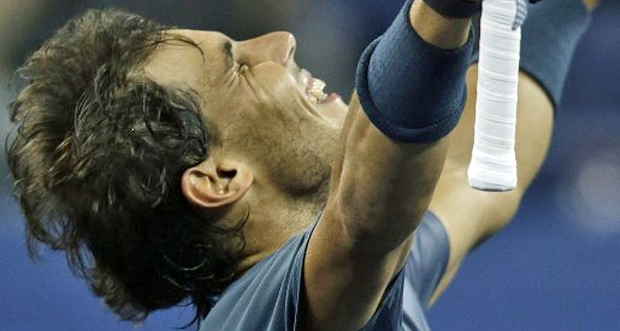
    Takes his second US Open singles title, 6-2, 3-6, 6-4, 6-1 over Novak Djokovic.

    [divider]

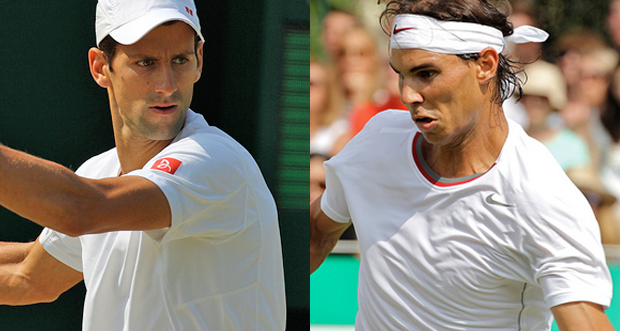
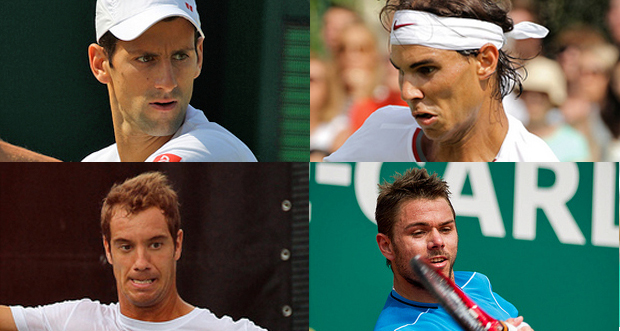
    In what was widely set up as a battle for dominance at the end of this year, Rafael Nadal beat Novak Djokovic in a four-set war.  Most of their battles seem to involve blood, and this was no different, even though it failed to go the distance.

    [divider]

    Click here to discuss the Nadal/Djokovic USO final in our discussion forum.

    [divider]

    Both seemed to start sharp in the first.  Djokovic may have been feeling the effects of the five-set semifinal he played against Stan Wawrinka two days ago, and failed to meet Nadal’s intensity.  The Spaniard won the first set, 6-2, with two breaks of serve.

    In the second, Djokovic broke early, but Nadal broke straight back.  However, the Serbian No. 1 found the intensity he had been lacking and began to run the No. 2 around the court.  He broke again at 3-4 to serve for it at 5-3, and won the set.  All momentum at this point was in his favor.

    To open the third, Djokovic broke at love.  While Djokovic seemed to be in control in the early part of the set, Nadal kept up the pressure, broke back, and finally snuck the set out at the last minute:  6-4.

    Djokovic initially pressured on the Nadal serve at the beginning of the fourth set, but the Spaniard eventually ran away with it to win the title: 6-1 in the fourth.

    Previous to this match, each had won one title at the USO, so the balance now falls in Rafa’s favor.  Nadal also lifts his unbroken streak on hard courts this year to 22-0.  And, while Djokovic retains his No. 1 status for a short while longer, Nadal has crept up to within 920 points of Novak, with nothing to defend for the rest of the year.  The shift at the top seems only a matter of time.


  • Djokovic Outlasts Wawrinka in the Semifinals; Sets Up Nadal Rematch

    Djokovic Outlasts Wawrinka in the Semifinals; Sets Up Nadal Rematch

    Novak Djokovic overcame an overall lackluster performance, and an onslaught from Stanislaw Wawrinka to prevail in a thrilling 5-set match, 2-6, 7-6(4), 3-6, 6-3, 6-4.

    It was a roller-coaster ride of a semifinal.  Wawrinka, the still-but-perhaps-not-for-long Swiss No. 2 came out strong and broke Djokovic three times in the first set.  He went up a break in the second, but Djokovic broke back, and sent the set into a tiebreak, which the world No. 1 snatched up.  The Swiss took the third set on one break, and Djokovic the fourth via the same.  Also in the fourth set, Wawrinka had a medical timeout for an injury to his upper-thigh, and did seem to be hampered the rest of the match.

    [divider]

    Click here to discuss the Nadal/Djokovic final in our discussion forum.

    Click here to discuss the Nadal/Gasquet semifinal in our discussion forum.

    Click here to discuss the Djokovic/Wawrinka semifinal in our discussion forum.

    [divider]

    The stakes were raised in the fifth set.  At 1-1, with Wawrinka serving, they played a nearly 21-minute, 30-point game.  It was taken to deuce 12 times, with Djokovic having five break chances.  In the end, Wawrinka held, but it seemed to be all he had left.  Djokovic broke at 2-2 and ran away with it.

    After the match, Djokovic said:  “I think it was obvious Stan played more aggressive; he played better tennis over all,” adding, “I was glad I was able to find my best tennis when I needed it.”

    In the second semifinal of the day, Rafael Nadal beat Richard Gasquet with his B-Game, 6-4, 7-6(1), 6-2.  While Gasquet came up with some showy tennis at times, and Nadal was having trouble finding the lines, the best Gasquet can say is that he broke Nadal’s serve for the first time in the tournament.

    The win assures Djokovic that he holds his No. 1 ranking for the time being, and sets up his 37th match with his rival Nadal — an Open Era record for most matches played.  The Spaniard currently leads the head-to-head 21-15.  They will play for the trophy on Monday.

  • The Ebb and Flow of Talent in the ATP Era

    The Ebb and Flow of Talent in the ATP Era

    2645577395_fed7784140_o

    Photo provided by rainycat (Creative Commons license)

    When looking at the different periods of tennis history, the late 1970s to early 1980s is often considered the “Golden Era,” highlighted by what must be the greatest rivalry in tennis history: Bjorn Borg versus John McEnroe. We could say that this era began in 1978 when the young American upstart McEnroe surprised the tennis world by beating Bjorn Borg at the Stockholm Open, the first of 14 matches they played against each other, each winning seven. The natural end of this era, then, would be their last match: the 1981 US Open, when McEnroe solidified his usurpation as the top player in the world by beating Borg in the final, and also Borg’s last Grand Slam contest.

    [divider]

    Click here to discuss “The Ebb and Flow of Talent in the ATP Era” in our discussion forum.

    [divider]

    So from the very end of 1978 to late into the 1981 season was a great era of men’s tennis, dominated by Borg and McEnroe, with older but still excellent Jimmy Connors and Guillermo Vilas rounding out the elite and, in the last half of that span, young Ivan Lendl coming onto the scene. Yet the question that arises is this: Was it the most talent-rich period of tennis history or merely the most celebrated? This set me to doing some research; for the sake of ease I stuck to the Open Era and, in particular, the period of ATP rankings, 1973 to the present. So we can fine-tune the question a bit and ask: How has “talent-richness” changed over the last 40 years of men’s tennis?

    I decided to look at only those players who could be considered “all-time greats.” My criteria were flexible, but included all players who had won three or more Slams in the Open Era, or were likely to win three or more, and at more than one venue. This means that I excluded Gustavo Kuerten, who won three Slams at Roland Garros, but included Andy Murray, who has won two Slams at different venues, and seems likely to win at least one more.

    I came up with a list of nineteen players; here is a chart that shows their year-end rankings (click on chart for better viewing):

    Greats ATP Ranking

    Just looking at that chart gives us a sense of the ebbs and flows of upper echelon talent in men’s tennis, although of course it is important to point out that I’m only looking at the very greatest players and not the “near-elites” or players that might have been great for a short period of time (e.g. Lleyton Hewitt, Michael Stich, etc.). The purpose here is to focus on truly great talent and in what density it has shown up over the last four decades.

    I then separated those nineteen players into three groups or tiers by their total Slam count, to differentiate levels of greatness:

    Tier One (10+ Slams): Rosewall, Laver, Borg, Sampras, Federer, Nadal

    Tier Two (6-9 Slams): Newcombe, Connors, McEnroe, Lendl, Wilander, Edberg, Becker, Agassi, Djokovic

    Tier Three (5 or fewer Slams): Ashe, Vilas, Courier, Murray

    I think we can safely say, without too much quibbling, that the above list represents the 19 greatest players of the Open Era, roughly arranged in levels of greatness. Strike that; I’m sure there will be quibbling, and I can imagine the protests of, say, Andy Murray’s inclusion but not Gustavo Kuerten’s or Marat Safin’s or Patrick Rafter’s or Ilie Nastase’s. But I think we can at least agree on most of that list; in other words, if we want to quibble about Murray or Ashe or Vilas or Courier, fine, but the other fifteen are clearly all-time greats, and of the four “Tier Three” players we can, at the least, say that they’re deserving of consideration and at least as deserving as anyone else.

    That aside, I won’t go into exact numbers for the sake of avoiding complexity and confusion, but I then assigned different points for different rankings, with Tier One getting roughly twice the points of Tier Three, and Tier Two halfway in between. Players would get points for different levels of ranking – #1, #2-5, #6-10, #11-20, etc. Finally, I counted up the points from each year for the above 19 players, from 1973 to 2012, arriving at a number which is meant to indicate “talent-richness” of any given year.

    Let me be clear and re-emphasize what I just wrote: This number indicates (or describes); it does not seek to definitively finalize or give us any more than a sense of talent-richness. To get a more accurate, comprehensive picture we’d have to look much deeper than the above nineteen players. What this does show us in a relatively accurate manner is how dense or rich the level of truly great talent has been in any given year. In other words, it tells us for any given year what level of all-time great talent was playing at a high level; it doesn’t tell us the total depth and breadth of talent.

    The next chart shows us that number over time:

    20130907054418


    There are a few things that stand out for me:

    One, there’s an interesting two-year window in 1974-75 which, according to this calculation, were the two most talent-rich years in the last 40 years. The reason for this is that a few of the top players of the 1960s—Laver, Rosewall, and Ashe—were still playing at a high level; at the same time, you had Newcombe in his prime, a young Connors and Vilas, and a teenage Borg establishing himself as an elite player. The number dropped as the older players faded away; in 1976, for instance, Laver finished the year at No. 76 compared to No. 10 the year before.

    Secondly, we can see that the 1978-81 period—while talent-rich—is not as much so as the late 1980s when you had three generations all playing at or near their peaks. This is not to say that the ’78-81 period wasn’t talent rich; but this certainly supports the idea that its appellation as the “golden era” of men’s tennis has more to do with the great Borg-McEnroe rivalry than it does with a clear supremacy of talent over other periods.

    Moving on, there is an obvious and massive decline in the mid-90s. Wilander and Connors were done as elite players by 1990, McEnroe retired in ’92, Lendl a couple years later, and then Edberg and Becker faded just after that, and Jim Courier—like Wilander—peaked and faded at a young age, so during the mid-to-late 90s there were only two clear elite players, Agassi and Sampras, and Sampras started fading in the late 90s.

    The absolute nadir of Open Era talent seems to be 2000. The talent-level began to rise with the arrival of Roger Federer, and then jumped when Rafael Nadal stormed through Roland Garros in 2005. From 2008 through 2012 it has “flat-lined,” with four players dominating the field in a way previously unseen.

    Before ending, allow me to indulge in some speculation. It seems clear that Roger Federer has slipped out of the elite; perhaps the best we can hope for is him hanging around the Top 10 for another couple years. Nadal, Djokovic, and Murray should be around for some time, but the big concern is that there are no obvious candidates to join the above list, to turn that list of 19 into 20 or more. Of course we will see more elite players, but it’s hard to imagine Milos Raonic or Jerzy Janowicz or Grigor Dimitrov winning three or more Slams and earning a spot on this list. Who knows? I could be wrong–I certainly hope I am!–but my sense is that for that next great player, we’re going to have to wait two to three years or more before we even know who he (or they) will be.

    With Federer unlikely to finish in the Top 5, that number is going to drop for 2013. Not by much, but probably by five points. I could see it holding steady in the upper 40s for another year or two, but after that it all depends upon whether we start seeing signs of that next great player and/or how quickly the current Big Three will decline. The decline of all players is inevitable, and we’re likely going to start seeing signs of the decline of the Big Three within the next two or three years, as they enter their late 20s and are more frequently beaten by the hungry near-elite players below them.

    In conclusion, talent ebbs and flows and no era is quite like any other. Neither of the above charts shows a clear pattern or cycle; it would seem that each new era is different and that all we can be certain of is change itself. One of the great joys of tennis, at least for myself, is waiting and watching for the next generation of talent to arise, to try to understand who the next great player will be, and what match – like Stockholm in 1978 – will signal the changing of an era. So I will continue to watch and wait. Meanwhile, we can sit back and enjoy the great tennis play of today.

  • All Manner of Absurdity

    All Manner of Absurdity

    US Open, Quarterfinals Recap

    The US Open, an entity which I contend boasts not only impish sentience but an eye for proportion, thoughtfully balanced a pair of men’s quarterfinals that more or less lived down to expectations with two others that could have hardly conformed less. Two predictable blowouts and two extravagant upsets: what could be more formally elegant? There was a brief period in the last of these encounters, as Mikhail Youzhny stole a set from a momentarily unfocussed Novak Djokovic, when I feared this graceful symmetry might be fractured, or, more worryingly, that I might have to rewrite this opening paragraph. Fortunately the world number one steadied magnificently, and I was able to salvage my broader point, such as it is. For all that I would have enjoyed an audacious comeback from Youzhny almost as much as the tennis-starved punters in Arthur Ashe Stadium, I’d prefer it didn’t cost me whole minutes of work.

    [divider]

    Click here to discuss “All Manner of Absurdity” and more in our discussion forum.

    [divider]

    It’s a nice question whether Richard Gasquet defeating David Ferrer in five sets constitutes a more surprising upset than Stanislas Wawrinka beating Andy Murray in straights, leaving to one side the question of which was the more upsetting surprise. If one were writing a screenplay, which result would cause viewers suddenly to rediscover their disbelief, and simply walk out? Cinema audiences will put up with all manner of absurdity – midi-chlorians, Nicholas Cage – but there are limits. This is the US Open, not Wimbledon. It would probably be more convincing had the scores been swapped: Wawrinka might have prevailed in a tough grind, while an incandescent Gasquet might conceivably have swept the formless Ferrer aside quickly.

    (2) Nadal d. (19) Robredo, 6-0, 6-2, 6-2

    It was always likely that Rafael Nadal would make short work of his quarterfinal, given his exalted hardcourt form and Roger Federer’s exit in the fourth round. But the fact that he was facing a veteran who’d never progressed beyond this stage of a Major in several dozen attempts put it almost beyond doubt. Realisation that this veteran was a compatriot of Nadal’s removed even that modicum of uncertainty. Add in a single-handed backhand and it was hard to see how the encounter would stretch far beyond eighty-minutes. The opponent was Tommy Robredo, who’d done such a sterling job two days earlier in providing a sturdy platform for Federer to ritually disembowel himself on. Robredo brought a similar commitment into his match with Nadal – standing way back, looping groundstrokes, and retrieving like a terrier – with the result that he won five whole points in the opening set. These points sadly weren’t clumped such that they equated to a whole game. Forget eighty minutes — maybe it wouldn’t last the hour.

    The next two sets were marginally more competitive, but such terms are relative, and it was never a contest. Before the match Nadal had somehow maintained a straight face while declaring that in order to have any chance at beating Robredo he’d have to play his best. As it happened Nadal did play somewhere near his best, with the result that Robredo had no chance whatsoever. Nadal has moved through to the semifinals, an outcome he subsequently described as “unbelievable”, which I think translates as “very believable”, considering he has made it at least that far in New York every year since 2007, apart from last year when he didn’t reach the first round.

    For a refreshing contrast he will next face a tour veteran to whom he has never lost, who employs a single-handed backhand, and prefers to operate ten feet behind the baseline. This player is Richard Gasquet, and to say that Nadal has never lost to the Frenchman is slightly misleading. Gasquet actually beat Nadal fourteen years ago, in juniors. This result has no material bearing on their upcoming US Open semifinal except that Gasquet brought it up in his press conference, thereby proving that it’s no longer possible for a professional sportsperson to make a joking aside without having it over-analysed to death. Nadal was naturally quizzed about this during his post-match interview, and astonished everyone by recounting the match in granular detail. Even Brad Gilbert was left momentarily speechless. Jason Goodall reliably wasn’t, joking, “I suppose he’s out for revenge in the semifinal, then.”

    (8) Gasquet d. (4) Ferrer, 6-3, 6-1, 4-6, 2-6, 6-3

    It is hard to imagine he won’t get it, but then it’s pretty hard to believe that Gasquet is there at all. Even to reach the quarterfinals he required five sets, and had to overcome one of the worst fourth round Major records in history (0-11 since Wimbledon 2007). Admittedly that was only against Milos Raonic, who himself had never progressed beyond the round of sixteen. In the quarterfinal Gasquet faced the fourth seeded David Ferrer, thus pitting a man who rarely beats those ranked above him against a guy who seldom loses to those ranked lower, a guy whose constant presence in Major semifinals has ceased to elicit surprise even if it is destined never to gain acceptance. Ferrer will presumably drop out of the top four long before everyone stops wrongly assuming that his quarter of the draw is the one fated to collapse. It was once again to everyone’s chagrin that the only quarterfinal match-up that panned out according to seedings was Ferrer’s, although I do maintain that it was only by the grace of Dmitry Tursunov’s delicate thighs that this was possible.

    Gasquet took the first two sets in fairly convincing fashion, and it seemed likely that a perfunctory upset was underway. This would have been surprising in a sense, though hardly in the league of Federer’s loss to Robredo. Ferrer has been horribly short on form, and sometimes Gasquet is simply unplayable. It happens. But then Ferrer fought back, and levelled the match at two sets each. Gasquet was no longer anything like unplayable, and Ferrer wasn’t playing that badly. The scene – an idyllic French farm setting circa 1917 – was precisely the kind of one into which the Frenchman will typically plummet in a tangle of flaming wreckage. But somehow he remained aloft, mostly due to his serve. Despite his appalling record in fourth rounds, Gasquet has also never lost in the quarterfinals. But nor has he won a semifinal.

    (9) Wawrinka d. (3) Murray, 6-4, 6-3, 6-2

    Murray’s seppuku was only marginally less extravagant than Federer’s, though it was characteristically louder, and given he was facing a superior opponent on a bigger stage, it all worked out looking about the same. By losing to Wawrinka, Murray has failed to reach the final at a Major for the first time since Roland Garros last year (he didn’t play Paris this year). Indeed, aside from last year’s French Open he had reached at least the semifinals at the last nine Majors he had entered, going back to the 2010 US Open, where he lost in the third round to, as fortune would have it, Wawrinka. A mere coincidence, of course, though Murray’s many fans are no doubt right to be dismayed by the connection, since their man is supposed to have moved on from flaccid efforts like this.

    Perhaps they can find some comfort in the suggestion that this new Wawrinka is a categorically superior version to the old one. The addition of Magnus Norman to his team appears to have worked a similar trick for the Swiss that it did for Robin Soderling a few years ago, although it’s worth bearing in mind that Wawrinka was still coach-less when he almost beat Djokovic in Melbourne, so far the season’s finest match. Any changes that Norman has wrought in Wawrinka’s game – the focus appears heavily to be on buttressing his sense of self-belief more than anything technical – are a refinement to the course he’d already set. Wawrinka’s faith in his own capacity to match top ten players was amply displayed against Tomas Berdych in the last round, and reprised today.

    History, in the guise of countless mid-match collapses against Federer, had previously taught all discerning fans that it is rarely a question of whether Wawrinka will collapse in a high-stakes tennis match. It is merely a question of when, which in turn propels one onward to the gasping query of why (for the love of god). So it was today, when Eurosport’s English commentators tirelessly awaited a reversal that never came, even to the end. Wawrinka opened his final service game with a double-fault, then watched unperturbed as Murray smacked a return winner past him. From there it was all Wawrinka, all aggression – including a tremendous bounce-smash winner from the baseline – all the way to the end.

    The defending champion is out.

  • US Open Men’s Semifinals Schedule of Play: Saturday, Sept. 7

    US Open Men’s Semifinals Schedule of Play: Saturday, Sept. 7

    [Scores added as known.]

    Arthur Ashe Stadium — 12:00 P.M.

    Men’s Singles – Semifinals
    Novak Djokovic (SRB) (1) d. Stanislas Wawrinka (SUI) (9) — 2-6, 7-6(4), 3-6, 6-3, 6-4

    Not Before: 2:50 P.M.

    Men’s Singles – Semifinals
    Rafael Nadal (ESP) (2) d. Richard Gasquet (FRA) (8) — 6-4, 7-6(1), 6-2

    Women’s Doubles – Final
    Andrea Hlavackova (CZE) (5) / Lucie Hradecka (CZE) (5) d. Ashleigh Barty (AUS) (8) / Casey Dellacqua (AUS) (8) — 6-7(4), 6-1, 6-4

    [divider]

    Click here to discuss the Nadal/Gasquet semifinal in our discussion forum.

    Click here to discuss the Djokovic/Wawrinka semifinal in our discussion forum.

    [divider]

  • Age Has the Edge (Mostly) at the US Open in the SF/QFs

    Age Has the Edge (Mostly) at the US Open in the SF/QFs

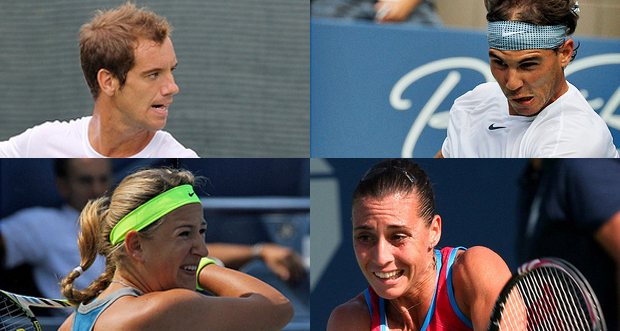
    Day 9 of the US Open featured more than a few 30-somethings in the mid-late rounds of men’s and women’s singles. Flavia Pennetta, 31, upset countrywoman Roberta Vinci, 30.  Pennetta, who had fallen down to being the fourth ranked Italian, behind Errani, the best Italian, and Vinci, one of her erstwhile doubles partners.  While Pennetta is currently ranked No. 85,  she dominated Vinci, 6-4, 6-1, to reach her first ever semifinal of a Major.

    The “youngster” of the day, Victoria Azarenka, 24, beat 30-year-old Daniela Hantuchova, 6-2, 6-3.  The hope is this sets up a meeting with Serena Williams in a final, the two women who are the greatest rivals at this point in the women’s game, though Azarenka still has to beat Flavia Pennetta.  For them to meet, however, Williams will have to beat the great Chinese star and fellow 31-year-old, Li Na.

    On the men’s side, Richard Gasquet emerged as the winner of a 5-set battle with David Ferrer, another 31-year-old.  Gasquet dominated the first two sets, in a surprise over the No. 4 seed, who has had a lackluster summer.  Ferrer evened the match to 2-sets a piece, but Gasquet fulfilled the aggression he brought to the beginning of the match, and closed it out for 6-3, 6-1, 4-6, 2-6, 6-3.

    The Frenchman Gasquet is 27 — on the younger edge of today’s players — and he will meet Rafael Nadal, also 27, who beat his countryman, Tommy Robredo, 31, the vanquisher of Roger Federer in the Round of 16.  Robredo went down without seriously troubling Nadal.  Final score:  6-0, 6-2, 6-2.  Nadal has yet to drop his serve the entire tournament.

    That so many 31-year-olds have lasted so long in this tournament, one has to say that 1981-82 must have been a great vintage for tennis players, if a somewhat late-maturing grape.

    [divider]

    Click here to discuss the Nadal/Robredo quarterfinal in our discussion forum.

    Click here to discuss the Ferrer/Gasquet quarterfinal in our discussion forum.

    Click here to discuss the Azarenka/Hantuchova quarterfinal in our discussion forum.

    Click here to discuss the Vinci/Pennetta quarterfinal in our discussion forum.

    [divider]

  • US Open Quarterfinals Schedule of Play/Scores: Wednesday, Sept. 4

    US Open Quarterfinals Schedule of Play/Scores: Wednesday, Sept. 4

    [Scores added as known.]

    Arthur Ashe Stadium – 12:00 P.M.

    Women’s Singles – Quarterfinals
    Flavia Pennetta (ITA) d. Roberta Vinci (ITA) (10) — 6-4, 6-1

    Men’s Singles – Quarterfinals
    Richard Gasquet (FRA) (8) d. David Ferrer (ESP) (4) — 6-3, 6-1, 4-6, 2-6, 6-3

    Not Before 7:00 P.M.

    Women’s Singles – Quarterfinals
    Victoria Azarenka (BLR) (2) d. Daniela Hantuchova (SVK) — 6-2, 6-3

    Men’s Singles – Quarterfinals
    Rafael Nadal (ESP) (2) d. Tommy Robredo (ESP) (19) — 6-0, 6-2, 6-2

    [divider]

    Click here to discuss the Nadal/Robredo quarterfinal in our discussion forum.

    Click here to discuss the Ferrer/Gasquet quarterfinal in our discussion forum.

    Click here to discuss the Azarenka/Hantuchova quarterfinal in our discussion forum.

    Click here to discuss the Vinci/Pennetta quarterfinal in our discussion forum.

    [divider]

    Louis Armstrong Stadium — 11:00 A.M.

    Men’s Doubles – Quarterfinals
    Ivan Dodig (CRO) (10) / Marcelo Melo (BRA) (10) d. Treat Huey (PHI) (16) / Dominic Inglot (GBR) (16) — 7-5, 6-3

    Women’s Doubles – Quarterfinals
    Sania Mirza (IND) (10) / Jie Zheng (CHN) (10) d. Su-Wei Hsieh (TPE) (4) / Shuai Peng (CHN) (4) — 6-4, 7-6(5)

    Mixed Doubles – Semifinals
    Abigail Spears (USA) / Santiago Gonzalez (MEX) d. Anabel Medina Garrigues(ESP)(5) / Bruno Soares(BRA)(5) — 6-3, 6-1

    Not Before: 4:30 P.M.

    Women’s Doubles – Round 3
    Serena Williams (USA) / Venus Williams (USA) d. Anastasia Pavlyuchenkova (RUS) (11) / Lucie Safarova (CZE) (11) — 6-1, 7-6(3)

    [divider]

    Grandstand — 12:00 P.M.

    Women’s Doubles – Quarterfinals
    Andrea Hlavackova (CZE) (5) / Lucie Hradecka (CZE) (5) d. Nadia Petrova (RUS) (3) / Katarina Srebotnik (SLO) (3) — 4-6, 6-4, 7-5

    Not Before: 2:00 P.M.

    Women’s Doubles – Quarterfinals
    Ashleigh Barty (AUS) (8) / Casey Dellacqua (AUS) (8) d. Ekaterina Makarova(RUS)(2) / Elena Vesnina(RUS)(2) — 6-2, 6-3

    Not Before: 5:00 P.M.

    Mixed Doubles – Semifinals
    Andrea Hlavackova (CZE) (7) / Max Mirnyi (BLR) (7) d. Kristina Mladenovic (FRA) / Daniel Nestor (CAN) — 7-5, 6-7(4), 12-10

    Credits: Cover Photo: kbrinker (Creative Commons License)

  • A Precarious Position

    A Precarious Position

    US Open 2013, Men’s Fourth Round

    [19] Tommy Robredo def [7] Roger Federer 7-6(3), 6-3, 6-4
    [2] Rafael Nadal def [22] Philipp Kohlschreiber 6-7(4), 6-4, 6-3, 6-1

    This morning, as the sun broke open over Northern California, I woke with Federer and Nadal on my mind (a little bit of Kohlschreiber, Robredo, Gasquet, and Ferrer, too, but mostly Roger and Rafa). And there they stayed. As the September sunshine warmed my shoulders, I made my way to my favorite cooperative bakery for a croissant (typical behavior for a Northern Californian on a Tuesday morning) and wondered if you, my readers, would forgive me for recycling a sentence I stole, stripped, and re-purposed for tennis once already.

    A year and a week ago I quoted Jorge Luis Borges in a post about the 2012 US Open draw. In his essay The Superstitious Ethics of the Reader, Borges wrote, “the perfect page, the page in which no word can be altered without harm, is the most precarious of all.” As I took my place in the bakery line—eying the cheese Danish with affection—I couldn’t help but think Borges’s well-crafted sentence was the perfect way to describe my experience of watching Roger Federer lose in straight sets to Tommy Robredo in Louis Armstrong Stadium last night.

    As it happened, the young woman ahead of me in line wasn’t in the market for baked goods so much as she was wanting employment baking goods. And she was mucking it up royally. All she needed to do was turn in her application and cover letter and walk out of the shop, but she could not stop talking. She asked what her chances were; she explained how willing she’d be to work early in the morning; and to stay in the position at least a year; and how fond she was of bread; and cookies, too; and when, she wondered, might she find out if she would be called for an interview? She spoke quickly and bounced on her heels as she talked, and reminded me of nothing so much as the cringe-inducing answering machine scene from Swingers.

    No sooner did she—finally—turn to leave the counter than did she turn back, “I hope my cover letter is OK!” She bounced. I stared, openly eavesdropping at this point. Ohmygod, please stop, I thought. Just go! Quit while you’re ahead, or at least before you make it worse!

    She continued, “I worked a long time on it, but I’m still not sure if it’s good. But there’s a lot in it! I hope it’s OK. It’s like a list.”

    The Amish-bearded baker behind the counter paused before answering. He spoke in a soothing voice, “Remember what Borges said: ‘Every list abounds with meaning.’”

    The young woman was quiet for at least a second, maybe even two. “What? Who?”

    “Borges, he was a writer. From Argentina. He said: ‘Every list abounds with meaning.’” The baker paused again, touching his fingertips to his beard, “So, it’s important you wrote the letter. It’s meaningful.”

    “Oh.” She bounced again. “That’s great! And it’s so true, too, isn’t it? Wait, what was it again??”

    “Every list abounds with meaning.”

    “Right! That’s great. Who said it?”

    “Borges.”

    “Oh, right. Well, thank you! When will I find out about the interview again?”

    When it came to be my turn at the counter I refrained from sharing my tennis thoughts with the bearded baker-sage. He’d listened enough for one morning. But I did tell him that I’d been thinking about a line from Borges on my way over, and we marveled together at the coincidence of so much Jorge Luis on a Tuesday morning. He recommended that I listen to Borges’s Harvard lectures, “This Craft of Verse,” which the author delivered from memory in the 1960’s when he was nearly blind. I said I would, and then I bought breakfast.

    On my way home, happily chewing on my croissant, I also chewed over thoughts about lists and meanings. It seemed to me that the baker was trying to reassure the young woman that her act of writing the cover letter—the declaration of personal intent—could never be time wasted, whether or not the finished product was anything like perfection. This led me back to thoughts about Roger Federer …

    Thousands of fans on Armstrong, who’d all waited out a rain delay to see Federer play for a spot opposite Rafael Nadal in the quarterfinals, must have felt their time had been wasted, or worse. If it hurt to watch on television, it had to have been more difficult in person, where the lack of sting off the Swiss’ miniature racquet would have been even more apparent.

    From where I sat, Tommy Robredo looked to be Roger’s pink elephant. Federer could not seem to help hitting directly to him. Volleys, approach shots, passing shorts, rally balls — all went toward Robredo’s racquet, and often to his forehand. And when Federer’s shots didn’t find the nineteenth seed, neither did they find the tennis court. And the break points —only 2 of 16 for Federer— those were the most painful points of all. I imagine many spectators were having thoughts like mine in the bakery this morning: Ohmygod, please stop. Just go! Quit while you’re ahead, or at least before you make it worse!

    Robredo’s tennis was more than competent— and he was psychologically rock-solid— but his performance wasn’t half as special as it should have needed to be to beat the five-time US Open champion. Many tennis fans, including a few with the last name of Nadal, think that Roger Federer’s best level is as close to perfection as mere mortals can get. In fact, there are many who believe The Mighty Fed’s mortal guise is merely that:  a way to dress down his divinity. (Another way is to wear royal blue shorts that don’t quite match one’s polo shirt.) But dressed-down is one thing; diminished is another. Divine beings are not supposed to perish, especially not in straight sets in the fourth round after a near-immaculate performance in the third. In his essay, Borges goes on to say that perfection “consists of those delicate fringes that are so easily worn away.” Last night Federer was without his fringes, a king without his miniver collar.

    ESPN aired Roger Federer’s press conference side-by-side with Rafael Nadal’s highly entertaining four-set win over Philipp Kohlschreiber. There was an especially poignant moment when Federer confessed he’d been looking forward to the intimacy of playing on Armstrong, and to the experience of the crowd being enthusiastically with him. As he spoke on the right-hand side of my TV screen, Rafael Nadal was in the process of gaining a stranglehold on the entire Arthur Ashe Stadium on the left. Roger looked ready to cry; Rafa looked ready to shred concrete with his teeth.

    Like Federer, Nadal lost the first set of his fourth-round match in a tiebreaker. As did his longtime rival, Nadal also struggled to convert break points (5 of 21 overall). But there the resemblance ended. Kohlschreiber played beautifully from first point to the third-to-last —excepting that disastrous overhead in the fourth set— but all his intricacy and angles weren’t nearly enough to overcome Nadal, whose brutality was especially evident on his drop shots and backhand-passing winners. The Spaniard has only faced six break points in the tournament, and has yet to lose a single one.

    If you’re like me, a Rafa-fan with a healthy appreciation for Kohlschreiber’s shot-making, you will have found it a delightful match. Nadal got better all the way through, while the German hardly got worse. In my opinion, Sloane Stephens and Kohlschreiber are now tied for the most entertaining breadstick-set losses of the tournament.

    If you’re a Federer fan, watching the commanding victory of his rival might not have done much to ease the ache of the evening. Maybe there was comfort to be had in Ferrer’s grinding triumph over Tipsarevic, or, more likely, in the eventual victory of Gasquet’s one-handed backhand over his own history at Majors. There’s no doubt Federer finds himself in a precarious position. How meaningful was this latest loss? There’s also no telling, with any degree of certainty, what the future will bring for the player whose game is so often called poetry-in-motion.

    In another essay, this one titled “History of Angels,” Jorge Luis Borges wrote:

    …No poetry, however modern, is unhappy to be a nest of angels and to shine brightly with them. I always imagine them at nightfall, in the dusk of a slum or a vacant lot, in that long, quiet moment when things are gradually left alone, with their backs to the sunset, and when colors are like memories or premonitions of other colors. We must not be too prodigal with our angels; they are the last divinities we harbor, and they might fly away.

    In other words, it’s a bummer Fed lost. Let’s hope he’s not ready to fly away.

    [divider]

    Click here to discuss “A Precarious Position” in our discussion forum.

  • US Open Day 8 Schedule of Play / Scores: Monday, Sept. 2

    US Open Day 8 Schedule of Play / Scores: Monday, Sept. 2

    [Scores added as known.]

    Arthur Ashe Stadium – 11:00 A.M.

    Women’s Singles – Round 4
    Daniela Hantuchova (SVK) d. Alison Riske (USA)  — 6-3, 5-7, 6-2

    Women’s Singles – Round 4
    Victoria Azarenka (BLR) (2) vs. Ana Ivanovic (SRB) (13) — Canceled

    Not Before: 7:00 P.M.

    Men’s Singles – Round 4
    Rafael Nadal (ESP) (2) d. Philipp Kohlschreiber (GER) (22) — 6-7(4), 6-4, 6-3, 6-1

    Men’s Doubles – Quarterfinals
    Bob Bryan (USA) (1) / Mike Bryan (USA) (1) d. Colin Fleming (GBR) (12) / Jonathan Marray (GBR) (12) — 7-6(7), 6-4

    [divider]

    Click here to discuss the Men’s matches in our discussion forum.

    Click here to discuss the Women’s matches in our discussion forum.

    [divider]

    Louis Armstrong Stadium – 11:00 A.M.

    Women’s Singles – Round 4
    Flavia Pennetta (ITA) d. Simona Halep (ROU) (21)  — 6-2, 7-6(3)

    Not Before 5:00 P.M.

    Men’s Singles – Round 4
    Tommy Robredo (ESP) (19) d. Roger Federer (SUI) (7) — 7-6(3), 6-3, 6-4

    Women’s Doubles – Round 3
    Anastasia Pavlyuchenkova (RUS) (11) / Lucie Safarova (CZE) (11) vs. Serena Williams (USA) / Venus Williams (USA) — Canceled

    [divider]

    Grandstand — 12:00 P.M.

    Women’s Singles – Round 4
    Roberta Vinci (ITA) (10) d. Camila Giorgi (ITA) — 6-4, 6-2

    Men’s Singles – Round 4
    David Ferrer (ESP) (4) d. Janko Tipsarevic (SRB) (18) — 7-6(2), 3-6, 7-5, 7-6(3)

    [divider]

    Court 17 — 11:00 A.M.

    Men’s Doubles – Round 3
    Aisam-Ul-Haq Qureshi (PAK) (5) / Jean-Julien Rojer (NED) (5) d. Yen-Hsun Lu (TPE) / Divij Sharan (IND) — 7-6(6), 3-6, 6-3

    Men’s Singles – Round 4
    Richard Gasquet (FRA) (8) d. Milos Raonic (CAN) (10) — 6-7(4), 7-6(4), 2-6, 7-6(9), 7-5

    [divider]

    Court 13

    Men’s Doubles – Round 3
    Ivan Dodig (CRO) (10) / Marcelo Melo (BRA) (10) d. Sergiy Stakhovsky (UKR) / Mikhail Youzhny (RUS) — 6-7(7), 6-4, 6-4

    Women’s Doubles – Round 3
    Ekaterina Makarova (RUS) (2) / Elena Vesnina (RUS) (2) vs. Cara Black (ZIM) (13) / Marina Erakovic (NZL) (13) — Canceled

    Mixed Doubles – Quarterfinals
    Abigail Spears (USA) / Santiago Gonzalez (MEX) vs. Liezel Huber(USA)(8) / Marcelo Melo(BRA)(8) — Canceled

    [divider]

    Court 11 — 11:00 A.M.

    Men’s Doubles – Round 3
    Alexander Peya (AUT) (2) / Bruno Soares (BRA) (2) d. Pablo Cuevas (URU) / Horacio Zeballos (ARG) — 6-3, 7-6(1)

    Men’s Doubles – Round 3
    Treat Huey (PHI) (16) / Dominic Inglot (GBR) (16) d. Marcel Granollers (ESP) (3) / Marc Lopez (ESP) (3) — 7-6(2), 6-0

    Women’s Doubles – Round 3
    Su-Wei Hsieh (TPE) (4) / Shuai Peng (CHN) (4) vs. Jelena Jankovic (SRB) (15) / Mirjana Lucic-Baroni (CRO) (15) — Canceled

    Mixed Doubles – Quarterfinals
    Hao-Ching Chan (TPE) / Martin Emmrich (GER) vs. Kristina Mladenovic (FRA) / Daniel Nestor (CAN) — Canceled

    [divider]

    Court 4 — Not Before 4:30 P.M.

    Women’s Doubles – Round 3
    Andrea Hlavackova (CZE) (5) / Lucie Hradecka (CZE) (5) d. Polona Hercog (SLO) / Lisa Raymond (USA) — 6-3, 7-6(4)

    Women’s Doubles – Round 3
    Sara Errani (ITA) (1) / Roberta Vinci (ITA) (1) vs. Anabel Medina Garrigues (ESP) (16) / Flavia Pennetta (ITA) (16) — Canceled

    Mixed Doubles – Quarterfinals
    Kveta Peschke (CZE) (4) / Marcin Matkowski (POL) (4) vs. Andrea Hlavackova (CZE) (7) / Max Mirnyi (BLR) (7) — Canceled

    Mixed Doubles – Quarterfinals
    Anabel Medina Garrigues (ESP) (5) / Bruno Soares (BRA) (5) vs. Lucie Hradecka (CZE) / Frantisek Cermak (CZE) — Canceled

    Credits: Cover Photo: wchuang (Creative Commons License)

  • US Open Day 6 Schedule of Play / Scores: Saturday, August 31

    US Open Day 6 Schedule of Play / Scores: Saturday, August 31

    [Scores added as known.]

    Arthur Ashe Stadium – 11:00 A.M.

    Women’s Singles – Round 3
    Ana Ivanovic (SRB) (13) d. Christina McHale (USA) — 4-6, 7-5, 6-4

    Not Before: 1:00 P.M.

    Men’s Singles – Round 3
    Rafael Nadal (ESP) (2) d. Ivan Dodig (CRO) — 6-4, 6-3, 6-3

    Not Before: 3:00 P.M.

    Women’s Doubles – Round 2
    Serena Williams (USA) / Venus Williams (USA) d. Raquel Kops-Jones (USA) (7) / Abigail Spears (USA) (7) — 6-4, 6-4

    Not Before 7:00 P.M.

    Women’s Singles – Round 3
    Camila Giorgi (ITA) d. Caroline Wozniacki (DEN) (6) — 4-6, 6-4, 6-3

    Men’s Singles – Round 3
    Roger Federer (SUI) (7) d. Adrian Mannarino (FRA) — 6-3, 6-0, 6-2

    [divider]

    Click here to discuss the Men’s matches in our discussion forum.

    Click here to discuss the Women’s matches in our discussion forum.

    [divider]

    Louis Armstrong Stadium – 11:00 A.M.

    Women’s Singles – Round 3
    Simona Halep (ROU) (21) d. Maria Kirilenko (RUS) (14) — 6-1, 6-0

    Women’s Singles – Round 3
    Victoria Azarenka (BLR) (2) d. Alize Cornet (FRA) (26) — 6-7(2), 6-3, 6-2

    Men’s Singles – Round 3
    Philipp Kohlschreiber (GER) (22) d. John Isner (USA) (13) — 6-4, 3-6, 7-5, 7-6(5)

    Men’s Singles – Round 3
    Tommy Robredo (ESP) (19) d. Daniel Evans (GBR) — 7-6(6), 6-1, 4-6, 7-5

    [divider]

    Grandstand — 11:00 A.M.

    Men’s Singles – Round 3
    David Ferrer (ESP) (4) d. Mikhail Kukushkin (KAZ) — 6-4, 6-3, 4-6, 6-4

    Not Before: 1:00 P.M.

    Men’s Singles – Round 3
    Janko Tipsarevic (SRB) (18) d. Jack Sock (USA) — 3-6, 7-6(1), 6-1, 6-2

    Men’s Doubles – Round 2
    Pablo Cuevas (URU) / Horacio Zeballos (ARG) d. Austin Krajicek (USA) / Denis Kudla (USA) — 5-7, 6-3, 7-6(10)

    Women’s Singles – Round 3
    Roberta Vinci (ITA) (10) d. Karin Knapp (ITA) — 6-4, 6-3

    [divider]

    Court 17 — 11:00 A.M.

    Women’s Singles – Round 3
    Alison Riske (USA) d. Petra Kvitova (CZE) (7) — 6-3, 6-0

    Men’s Singles – Round 3
    Milos Raonic (CAN) (10) d. Feliciano Lopez (ESP) (23) — 6-7(4), 6-4, 6-3, 6-4

    Men’s Singles – Round 3
    Richard Gasquet (FRA) (8) d. Dmitry Tursunov (RUS) (32) — 6-3, 2-6, 6-4, 4-2 Ret.

    Women’s Doubles – Round 2
    Liezel Huber (USA) (9) / Nuria Llagostera Vives (ESP) (9) d. Melanie Oudin (USA) / Alison Riske (USA) — 3-6, 7-6(6), 6-1

    [divider]

    Court 13 — 11:00 A.M.

    Men’s Doubles – Round 2
    Jonathan Erlich (ISR) / Andy Ram (ISR) d. Yen-Hsun Lu (TPE) / Divij Sharan (IND) — 6-4, 5-7, 7-6(2)

    Women’s Doubles – Round 2
    Andrea Hlavackova (CZE) (5) / Lucie Hradecka (CZE) (5) d. Sandra Klemenschits (AUT) / Andreja Klepac (SLO) — 7-5, 6-3

    Not Before: 1:30 P.M.

    Women’s Doubles – Round 2
    Sania Mirza (IND) (10) / Jie Zheng (CHN) (10) d. Katalin Marosi (HUN) / Megan Moulton-Levy (USA) — 6-3, 7-5

    Women’s Doubles – Round 2
    Ekaterina Makarova (RUS) (2) / Elena Vesnina (RUS) (2) d. Alize Cornet (FRA) / Caroline Garcia (FRA) — 6-2, 6-2

    [divider]

    Court 11 — 11:00 A.M.

    Women’s Singles – Round 3
    Flavia Pennetta (ITA) d. Svetlana Kuznetsova (RUS) (27) — 7-5, 6-1

    Women’s Singles – Round 3
    Daniela Hantuchova (SVK) d. Julia Glushko (ISR) — 3-6, 7-5, 7-6(4)

    Not Before: 1:30 P.M.

    Men’s Doubles – Round 2
    Alexander Peya (AUT) (2) / Bruno Soares (BRA) (2) d. Christopher Kas (GER) / Oliver Marach (AUT) — 6-3, 6-2

    Women’s Doubles – Round 2
    Su-Wei Hsieh (TPE) (4) / Shuai Peng (CHN) (4) d. Svetlana Kuznetsova (RUS) / Samantha Stosur (AUS) — 7-5, 4-6, 6-3

    Mixed Doubles – Round 2
    Anabel Medina Garrigues (ESP) (5) / Bruno Soares (BRA) (5) d. Kimiko Date-Krumm (JPN) / David Marrero (ESP) — 6-3, 7-5

    [divider]

    Court 4 — 11:00 A.M.

    Women’s Doubles – Round 2
    Nadia Petrova (RUS) (3) / Katarina Srebotnik (SLO) (3) d. Vania King (USA) / Magdalena Rybarikova (SVK) — 6-3, 3-6, 6-1

    Men’s Doubles – Round 2
    Brian Baker (USA) / Rajeev Ram (USA) d. Julien Benneteau (FRA) (7) / Nenad Zimonjic (SRB) (7) — 6-4, 6-2

    Women’s Doubles – Round 2
    Anastasia Pavlyuchenkova (RUS) (11) / Lucie Safarova (CZE) (11) d. Jill Craybas (USA) / Coco Vandeweghe (USA) — 7-6(6), 6-4

    Mixed Doubles – Round 2
    Kristina Mladenovic (FRA) / Daniel Nestor (CAN) d. Katarina Srebotnik (SLO) (2) / Nenad Zimonjic (SRB) (2) — 6-1, 7-6(3)

    Mixed Doubles – Round 1
    Lisa Raymond (USA) (6) / Jean-Julien Rojer (NED) (6) d. Megan Moulton-Levy (USA) / Eric Butorac (USA) — 6-3, 3-6, 10-7

    [divider]

    Court 7 — 11:00 A.M.

    Men’s Doubles – Round 2
    Leander Paes (IND) (4) / Radek Stepanek (CZE) (4) d. Daniel Brands (GER) / Philipp Oswald (AUT) — 4-6, 6-3, 6-4

    Men’s Doubles – Round 2
    Rohan Bopanna (IND) (6) / Edouard Roger-Vasselin (FRA) (6) d. Nikolay Davydenko (RUS) / Mikhail Elgin (RUS) — 7-6(2), 7-6(0)

    Women’s Doubles – Round 2
    Anabel Medina Garrigues (ESP) (16) / Flavia Pennetta (ITA) (16) d. Sharon Fichman (CAN) / Aleksandra Wozniak (CAN) — 6-2, 6-4

    Mixed Doubles – Round 2
    Andrea Hlavackova (CZE) (7) / Max Mirnyi (BLR) (7) d. Yung-Jan Chan(TPE) / Robert Lindstedt(SWE) — 6-3, 6-4

    [divider]

    Court 8 — 11:00 A.M.

    Women’s Doubles – Round 2
    Jelena Jankovic (SRB) (15) / Mirjana Lucic-Baroni (CRO) (15) d. Mona Barthel (GER) / Liga Dekmeijere (LAT) — 7-6(4), 6-2

    Men’s Doubles – Round 2
    Marcel Granollers (ESP) (3) / Marc Lopez (ESP) (3) d. Chris Guccione (AUS) / Bernard Tomic (AUS) — 1-2 Ret.

    Mixed Doubles – Round 2
    Kveta Peschke (CZE) (4) / Marcin Matkowski (POL) (4) d. Janette Husarova (SVK) / Filip Polasek (SVK) — 6-3, 6-4

    Mixed Doubles – Round 2
    Lucie Hradecka (CZE) / Frantisek Cermak (CZE) d. Ashleigh Barty(AUS) / John Peers(AUS) — 7-6(10), 7-6(5)

    [divider]

    Court 10 — 11:00 A.M.

    Men’s Doubles – Round 2
    Aisam-Ul-Haq Qureshi (PAK) (5) / Jean-Julien Rojer (NED) (5) d. Roberto Bautista Agut (ESP) / Daniel Gimeno-Traver (ESP) — 6-2, 6-3

    Men’s Doubles – Round 2
    Sergiy Stakhovsky (UKR) / Mikhail Youzhny (RUS) d. Jaroslav Levinsky (CZE) / Jiri Vesely (CZE) — 6-2, 6-4

    Women’s Doubles – Round 2
    Polona Hercog (SLO) / Lisa Raymond (USA) d. Julia Goerges (GER) (12) / Barbora Zahlavova Strycova (CZE) (12) — 5-7, 6-4, 7-5

    Credits: Cover Photo: zoolien (Creative Commons License)