Tag: Philipp Kohlschreiber

  • Kohlschreiber Triumphant in Dusseldorf

    Kohlschreiber Triumphant in Dusseldorf

    Philipp Kohlscreiber

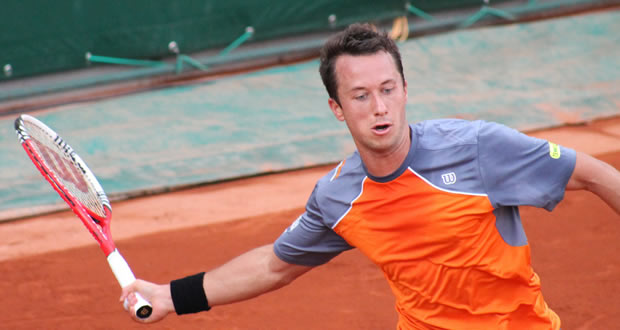
    Philipp Kohlschreiber picked up his fifth ATP career title after triumphing on the clay courts of Dusseldorf.

    The 30-year-old German cruised to victory over big serving Ivo Karlovic of Croatia 6-2, 7-6 (4) in 1 hour, 13 minutes.

    “I’ll be taking [ATP] points, self-confidence and a sense of fun to Paris, it’s simply a great feeling” stated Kohlschreiber after the match. He evened his career head-to-head against Karlovic to 2-2.

    He will next face Pere Riba of Spain in the opening round of the French Open at Roland Garros.

    [divider]

    Photo courtesy of si.robi (Creative Commons)

  • A Precarious Position

    A Precarious Position

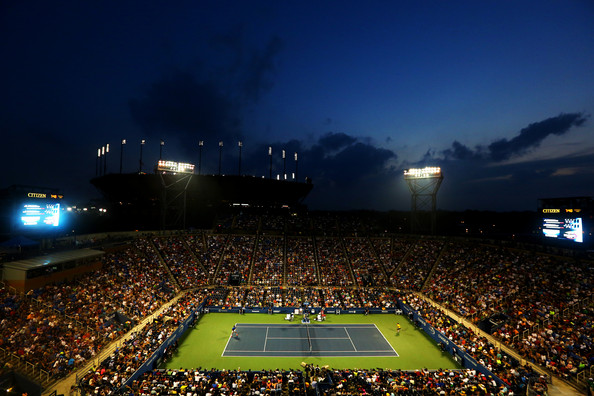
    US Open 2013, Men’s Fourth Round

    [19] Tommy Robredo def [7] Roger Federer 7-6(3), 6-3, 6-4
    [2] Rafael Nadal def [22] Philipp Kohlschreiber 6-7(4), 6-4, 6-3, 6-1

    This morning, as the sun broke open over Northern California, I woke with Federer and Nadal on my mind (a little bit of Kohlschreiber, Robredo, Gasquet, and Ferrer, too, but mostly Roger and Rafa). And there they stayed. As the September sunshine warmed my shoulders, I made my way to my favorite cooperative bakery for a croissant (typical behavior for a Northern Californian on a Tuesday morning) and wondered if you, my readers, would forgive me for recycling a sentence I stole, stripped, and re-purposed for tennis once already.

    A year and a week ago I quoted Jorge Luis Borges in a post about the 2012 US Open draw. In his essay The Superstitious Ethics of the Reader, Borges wrote, “the perfect page, the page in which no word can be altered without harm, is the most precarious of all.” As I took my place in the bakery line—eying the cheese Danish with affection—I couldn’t help but think Borges’s well-crafted sentence was the perfect way to describe my experience of watching Roger Federer lose in straight sets to Tommy Robredo in Louis Armstrong Stadium last night.

    As it happened, the young woman ahead of me in line wasn’t in the market for baked goods so much as she was wanting employment baking goods. And she was mucking it up royally. All she needed to do was turn in her application and cover letter and walk out of the shop, but she could not stop talking. She asked what her chances were; she explained how willing she’d be to work early in the morning; and to stay in the position at least a year; and how fond she was of bread; and cookies, too; and when, she wondered, might she find out if she would be called for an interview? She spoke quickly and bounced on her heels as she talked, and reminded me of nothing so much as the cringe-inducing answering machine scene from Swingers.

    No sooner did she—finally—turn to leave the counter than did she turn back, “I hope my cover letter is OK!” She bounced. I stared, openly eavesdropping at this point. Ohmygod, please stop, I thought. Just go! Quit while you’re ahead, or at least before you make it worse!

    She continued, “I worked a long time on it, but I’m still not sure if it’s good. But there’s a lot in it! I hope it’s OK. It’s like a list.”

    The Amish-bearded baker behind the counter paused before answering. He spoke in a soothing voice, “Remember what Borges said: ‘Every list abounds with meaning.’”

    The young woman was quiet for at least a second, maybe even two. “What? Who?”

    “Borges, he was a writer. From Argentina. He said: ‘Every list abounds with meaning.’” The baker paused again, touching his fingertips to his beard, “So, it’s important you wrote the letter. It’s meaningful.”

    “Oh.” She bounced again. “That’s great! And it’s so true, too, isn’t it? Wait, what was it again??”

    “Every list abounds with meaning.”

    “Right! That’s great. Who said it?”

    “Borges.”

    “Oh, right. Well, thank you! When will I find out about the interview again?”

    When it came to be my turn at the counter I refrained from sharing my tennis thoughts with the bearded baker-sage. He’d listened enough for one morning. But I did tell him that I’d been thinking about a line from Borges on my way over, and we marveled together at the coincidence of so much Jorge Luis on a Tuesday morning. He recommended that I listen to Borges’s Harvard lectures, “This Craft of Verse,” which the author delivered from memory in the 1960’s when he was nearly blind. I said I would, and then I bought breakfast.

    On my way home, happily chewing on my croissant, I also chewed over thoughts about lists and meanings. It seemed to me that the baker was trying to reassure the young woman that her act of writing the cover letter—the declaration of personal intent—could never be time wasted, whether or not the finished product was anything like perfection. This led me back to thoughts about Roger Federer …

    Thousands of fans on Armstrong, who’d all waited out a rain delay to see Federer play for a spot opposite Rafael Nadal in the quarterfinals, must have felt their time had been wasted, or worse. If it hurt to watch on television, it had to have been more difficult in person, where the lack of sting off the Swiss’ miniature racquet would have been even more apparent.

    From where I sat, Tommy Robredo looked to be Roger’s pink elephant. Federer could not seem to help hitting directly to him. Volleys, approach shots, passing shorts, rally balls — all went toward Robredo’s racquet, and often to his forehand. And when Federer’s shots didn’t find the nineteenth seed, neither did they find the tennis court. And the break points —only 2 of 16 for Federer— those were the most painful points of all. I imagine many spectators were having thoughts like mine in the bakery this morning: Ohmygod, please stop. Just go! Quit while you’re ahead, or at least before you make it worse!

    Robredo’s tennis was more than competent— and he was psychologically rock-solid— but his performance wasn’t half as special as it should have needed to be to beat the five-time US Open champion. Many tennis fans, including a few with the last name of Nadal, think that Roger Federer’s best level is as close to perfection as mere mortals can get. In fact, there are many who believe The Mighty Fed’s mortal guise is merely that:  a way to dress down his divinity. (Another way is to wear royal blue shorts that don’t quite match one’s polo shirt.) But dressed-down is one thing; diminished is another. Divine beings are not supposed to perish, especially not in straight sets in the fourth round after a near-immaculate performance in the third. In his essay, Borges goes on to say that perfection “consists of those delicate fringes that are so easily worn away.” Last night Federer was without his fringes, a king without his miniver collar.

    ESPN aired Roger Federer’s press conference side-by-side with Rafael Nadal’s highly entertaining four-set win over Philipp Kohlschreiber. There was an especially poignant moment when Federer confessed he’d been looking forward to the intimacy of playing on Armstrong, and to the experience of the crowd being enthusiastically with him. As he spoke on the right-hand side of my TV screen, Rafael Nadal was in the process of gaining a stranglehold on the entire Arthur Ashe Stadium on the left. Roger looked ready to cry; Rafa looked ready to shred concrete with his teeth.

    Like Federer, Nadal lost the first set of his fourth-round match in a tiebreaker. As did his longtime rival, Nadal also struggled to convert break points (5 of 21 overall). But there the resemblance ended. Kohlschreiber played beautifully from first point to the third-to-last —excepting that disastrous overhead in the fourth set— but all his intricacy and angles weren’t nearly enough to overcome Nadal, whose brutality was especially evident on his drop shots and backhand-passing winners. The Spaniard has only faced six break points in the tournament, and has yet to lose a single one.

    If you’re like me, a Rafa-fan with a healthy appreciation for Kohlschreiber’s shot-making, you will have found it a delightful match. Nadal got better all the way through, while the German hardly got worse. In my opinion, Sloane Stephens and Kohlschreiber are now tied for the most entertaining breadstick-set losses of the tournament.

    If you’re a Federer fan, watching the commanding victory of his rival might not have done much to ease the ache of the evening. Maybe there was comfort to be had in Ferrer’s grinding triumph over Tipsarevic, or, more likely, in the eventual victory of Gasquet’s one-handed backhand over his own history at Majors. There’s no doubt Federer finds himself in a precarious position. How meaningful was this latest loss? There’s also no telling, with any degree of certainty, what the future will bring for the player whose game is so often called poetry-in-motion.

    In another essay, this one titled “History of Angels,” Jorge Luis Borges wrote:

    …No poetry, however modern, is unhappy to be a nest of angels and to shine brightly with them. I always imagine them at nightfall, in the dusk of a slum or a vacant lot, in that long, quiet moment when things are gradually left alone, with their backs to the sunset, and when colors are like memories or premonitions of other colors. We must not be too prodigal with our angels; they are the last divinities we harbor, and they might fly away.

    In other words, it’s a bummer Fed lost. Let’s hope he’s not ready to fly away.

    [divider]

    Click here to discuss “A Precarious Position” in our discussion forum.
  • Reliably Inspirational

    Reliably Inspirational

    A fine third day at the Cincinnati Masters yielded the best selection of professional men’s tennis matches in months. As ever in North America this wondrous congregation of talent was witnessed by a formidable array of half-empty stands. Even by the night-match, which featured Roger Federer, the stadium appeared barely two-thirds full. For some reason, Americans collectively find it hard to get excited by a tennis tournament until the later rounds, an apathy shared by their main television networks. CBS doesn’t even show up to the US Open until the last weekend, which it then more or less ruins for everyone. It won’t grace Cincinnati until the last Sunday, while even ESPN won’t trouble itself until Thursday. In the meantime there’s the redoubtable Tennis Channel, as ever a mixed blessing. On the one hand live coverage is hard to fault. On the other hand there’s Justin Gimelstob.

    It could be that the long decades of dominance have taught the American sporting public to assume that their countrymen will always feature in the later stages. Why trouble yourself earlier? We Australians long ago learned to cease making such assumptions. If we want to see our compatriots, we tune in early, preferably for qualifying. Now that there are no American men inside the top twenty, it might be wise for them to do the same. Of course, it could be that from my current vantage, precisely one Pacific Ocean and half a continent away, I’m totally misreading it and Cincinnati’s stands are actually jam-packed. Perhaps it’s merely a trick of the telecast: as well as adding twenty pounds, the camera subtracts a thousand spectators.

    [divider]

    Dimitrov d. Baker, 6-3, 6-2

    CBS and ESPN viewers certainly won’t catch any sight of the reliably inspirational Brian Baker, who today went down easily to Grigor Dimitrov. This is a shame, since he’s worth watching and hasn’t been spotted in months. Having cruelly fallen in the second round of this year’s Australian Open – on a day of sustained carnage his injury was at once the worst and the least surprising – Baker was away from professional tennis for almost seven months. Numerically-gifted readers will note that this is the same amount of time that Rafael Nadal missed. Baker’s absence generated considerably less interest. Of course, Baker being absent from the men’s tour is hardly remarkable; it has been one of the constants of professional tennis for the last decade, like top four domination, or the microwave radiation that saturates the cosmos. The anomaly wasn’t that Baker was away, but that he had – and has – returned.

    Naturally, I’m pleased he has, since I enjoy the way he plays: at his best slightly reminiscent of Nikolay Davydenko in a way that Davydenko himself rarely is anymore. Beyond that, though, I enjoy the way Baker encourages me in my fantasy that he’s a club player on history’s greatest roll. The truth of the matter is decidedly different, if not completely opposite – he is a talented pro who has had to do everything the hardest way, and whose body boasts only slightly less metal than Wolverine’s. But I still experience a slight thrill every time he puts away a simple volley. Good for him, I think, knowing I might well have duffed it into the back fence.

    Sadly today he missed too many simple volleys against Grigor Dimitrov, along with just about everything else. It was probably to be expected. Given his modest earnings over the years, it’s not as though he could afford authentic adamantium for his metal joints. He was compelled to go with cheaper base metals. Rust was thus inevitable. As is often the case it doesn’t cause a consistent loss of quality so much as wildly oscillating inconsistency. Baker comfortably saw off Denis Istomin yesterday, but might not have today given the chance. Instead he faced Dimitrov, for whom the phrase “wildly oscillating inconsistency” might well have been coined. Still, he was on his game today, and looked a clear class above his opponent. Baker will get better. For now it’s just a pleasure to see him back, and a pleasant surprise to see he still boasts a full complement of limbs. His matches are only ever one mishap away from recreating the Omaha Beach scene from Saving Private Ryan.

    [divider]

    (3) Ferrer d. Harrison, 7-6(5), 3-6, 6-4

    Speaking of Private Ryan, or at any rate Senior Cadet Ryan, Harrison managed to lose his nineteenth straight match to a top ten opponent a short while later, against a curiously vulnerable David Ferrer. The Spaniard’s lofty ranking was only apparent from the number next to his name, and not from the quality of his play. The Spaniard has been injured for some time, and has barely looked himself since Roland Garros. If ever Harrison was going to beat him, it was today. Still, the American might take some solace from getting so close: he led by a break in the third set, and was briefly magnificent in breaking back late in the match. One doubts whether he will be consoled by that, however, since he continues to give a strong impression that he hates losing far too much to find it merely instructive. The game in which Harrison was broken back in the final set featured an ace clocked at 152 mph, as they measure such things in the Cayman Islands, or 244 kph as measured elsewhere. If this was an accurate reading, then it would be the seventh fastest serve of all time. But I doubt whether it was an accurate reading. The serve even had topspin on it.

    [divider]

    (5) Federer d. Kohlschreiber, 6-3, 7-6(7)

    Roger Federer rounded out the schedule by defeating Philipp Kohlschreiber for the seventh time, so far without a loss. Neither man appeared to be brimming with confidence, and based on their combined unforced error of sixty-five they had every reason not to be. Federer thoughtfully commemorated each of his previous six victories over Kohlschreiber with a squandered break point early in the first set: performance art of the very highest order, as Robbie Koenig might say. But he mostly served well himself, and broke in Kohlschreiber’s next game. Even if Federer somehow defends his Cincinnati title, he won’t be reprising last year’s heroic effort, in which he took the event without ever dropping serve. He gifted a non-crucial break away in the second set, a favour the ever-courteous German repaid immediately. They went back to scrappy holds. Mercifully this couldn’t continue indefinitely, and the tiebreak came around. A match that had been defined mostly by forehand errors thus found its apotheosis. Federer led by 5-2, then saved a set point at 7-8 with an out serve. He finally took the match on his second match point, ironically with a forehand that landed in, a development so miraculous in the circumstances than Kohlschreiber could merely stare at it, dumbfounded.

    [divider]

    In other news, Feliciano Lopez won his first Masters level match this year, over Kei Nishikori. Milos Raonic, the first Canadian player ever to enter the top ten, nearly became the first top ten player to lose to Jack Sock. Mikhail Youzhny and Ernest Gulbis turned up dressed identically, a deplorable faux pas that left the crowd aghast. All twenty-five of them.

  • Tommy Haas takes Munich title

    Tommy Haas takes Munich title

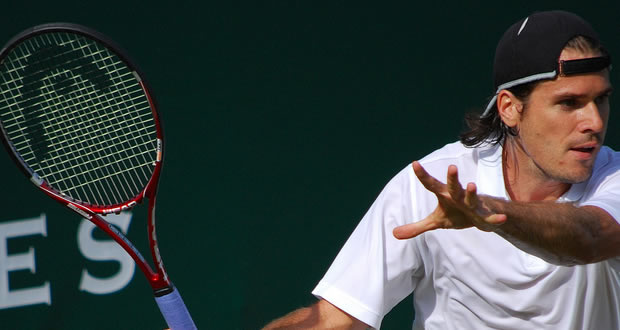
    Tommy Haas won his 14th ATP title on Sunday by defeating two-time former champion Philipp Kohlschreiber at the BMW Open in Munich.

    Haas won the match in straight sets 6-3 7-6 taking 83 minutes.

    “It’s a little dream,” said Haas, a German now residing in California.

    Tommy will rise to 13th in the ATP World Rankings, and the 35 year old is enjoying a fine year, having already beaten World #1 Novak Djokovic in Miami and making the finals at San Jose.

    “Tommy played outstanding tennis, without any mistakes – almost a perfect match,” said Kohlschreiber.

    It was Haas’s fourth title on German soil.

    Click here to discuss the Munich Open with fellow tennis fans in our message board forums.