Tag: Pancho Gonzales

  • Tennis Generations, Part Two: Before the Open Era

    Tennis Generations, Part Two: Before the Open Era

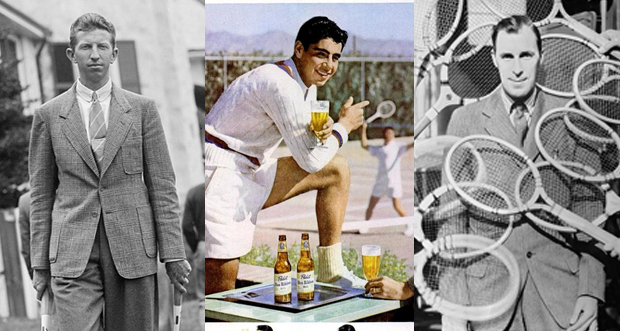
    Don Budge Pancho Gonzales Bill Tilden

    If we were to look at each tennis generation as a player with a count of Major titles—either pro, amateur, or Open Era Grand Slams—by far the greatest would be the generation born from 1934 to 1938, mainly on account of two players: Ken Rosewall and Rod Laver. This generation was, in many ways, the generation that brought tennis from the amateur/pro split into the modern Open Era in 1968.

    But tennis didn’t begin with this generation. Before focusing further on the First Generation of the Open Era, let’s take a brief look at what came before…

    Generations before the Open Era
    The oldest player in terms of birth year to win a Slam was John Hartley, born in 1849 – he won the third Wimbledon in 1879; the first Wimbledon in 1877 belongs to Spencer Gore, born a year later in 1850. This makes the first tennis generation of the entirety of its history being those players born in 1849-53, with possibly older players playing but none winning a major. Given that there were at least seventeen generations before Rosewall’s and Laver’s, this makes the current youngest generation–those players born 1994-98 like Nick Kyrgios, Borna Coric, and Alexander Zverev–the 30th five-year generation in tennis history. We are just starting to see players of the 31st generation, born in 1999-2003, appear deep in the rankings. As of this writing, the highest ranked player of Gen. 31 is No. 757, Felix Auger Aliassime, born in August of 2000.

    The main point here is that while modern tennis can be seen to have begun with the Open Era in 1968, it was actually past the mid-point of tennis history as a whole. Or to put that chronologically, we’re in the 48th year of the Open Era, which began in the 92nd year of Wimbledon, thus the Open Era began almost exactly two-thirds of the way into tennis history as a whole.

    I will not attempt to detail every generation, but thought it worthwhile to list some of the better players as they arrange within pre-Open Era generations, with their Slam title count—including Amateur and Pro—in parentheses:

    1849-53: John Hartley (2), Spencer Gore (1)
    1854-58: Frank Hadow (1)
    1859-63: William Renshaw (7), Richard Sears (7), Andre Vacherot (4), Henry Slocum (2), Ernest Renshaw (1)
    1864-68: Arthur Gore (3)
    1869-73: William Larned (7), Reginald Doherty (4), Paul Aymé (4), Robert Wrenn (4), Wilfred Baddeley (3), Oliver Campbell (3)
    1874-78: Lawrence Doherty (6), Norman Brookes (3), Malcolm Whitman (3)
    1879-83: Anthony Wilding (9), Max Decugis (8), Maurice Germot (3)
    1884-88: Rodney Heath (2)
    1889-93: Bill Tilden (15), Maurice McLoughlin (2), R Norris Williams (2), Robert Lindley Murray (2), Pat O’Hara Wood (2)
    1894-98: Jean Borotra (4), William Johnston (3), Gerald Patterson (3), James Anderson (3)
    1899-1903: Henri Cochet (11)
    1904-08: Frank Crawford (6), Rene Lacoste (7)
    1909-13: Fred Perry (10), Ellsworth Vines (8), Hans Nusslein (6), Adrian Quist (3), Gottfried von Cramm (2)
    1914-18: Don Budge (10), Bobby Riggs (6), Frank Parker (4), John Bromwich (2), Don McNeill (2)
    1919-23: Jack Kramer (5), Pancho Segura (4), Jaroslav Drobný (3), Vic Seixas (2), Ted Schroeder (2)
    1924-28: Pancho Gonzales (17), Frank Sedgman (7), Budge Patty (2), Dick Savitt (2)
    1929-33: Tony Trabert (7), Neale Fraser (3), Mervyn Rose (2), Nicola Pietrangeli (2)

    I tried to account for every Slam winner, although if I missed someone I apologize to their grand- or great-grandchildren.

    Top 10 Greatest Players Before the Open Era
    1. Pancho Gonzales
    2. Bill Tilden
    3. Don Budge
    4. Fred Perry
    5. William Renshaw
    6. William Larned
    7. Ellsworth Vines
    8. Anthony Wilding
    9. Henri Cochet
    10. Jack Kramer

    Honorable Mentions: Laurence Doherty, Bobby Riggs, Frank Sedgman, Reggie Doherty, Pancho Segura, Jack Crawford, Tony Trabert, Rene Lacoste, Hans Nusslein, Jean Borotra, Bill Johnston, Gottfried Von Cramm, Jaroslav Drobný, Vic Seixas, and many others.

    This is a hard list to compile, because it spans about a hundred years. But it is relatively easy to rank Gonzales and Tilden as No. 1 and No. 2, respectively, both being among the very best players in tennis history – on the short list of GOAT candidates. Tilden had a remarkable career that spanned three decades. He didn’t win his first Major until he was 27 years old, and won his last in his early 40s, making the 1945 US Pro semifinal at the age of 52. Pancho Gonzales remains one of the most underappreciated greats in the history of the game, perhaps largely because historical memory tends to be shallow and only notices “two Grand Slams” in his tally. But Gonzales also won 12 Pro Slams and 3 of the 4 Tournament of Champions, which are consider Majors by some – so he has a total of 17 Major titles, tied with Roger Federer and behind only Ken Rosewall and Rod Laver. He was, by a significant margin, the greatest player of the 1950s before Rosewall took over in the later part of the decade.

    Don Budge is perhaps best known as the only player other than Rod Laver to win the Calendar Slam. While he won all of his 10 Majors during a relatively short six-year span, he was as dominant in the late 30s as any player has ever been over a few-years span. Perry and Renshaw round out the Top 5, and then it becomes tricky to rank players, as the context of the game was so different and we can’t look at tennis records of, say, the 30s and 40s with the same criteria as we can the Open Era. But regardless, the above 10 are probably the 10 greatest players before the Open Era, with a handful of honorable mentions fleshing out the list.

    Up next, we’ll look at the great generation of players, born between 1934 and 1938, who dominated tennis from the late 50s into the early 70s, and the dawn of the Open Era.

    [divider]

    Cover Photo (Creative Commons License): boston_public_library / killingtime2 / boston_public_library
  • Roger Federer’s Yesterdays and Tomorrows – A Champion’s Fate

    Roger Federer’s Yesterdays and Tomorrows – A Champion’s Fate

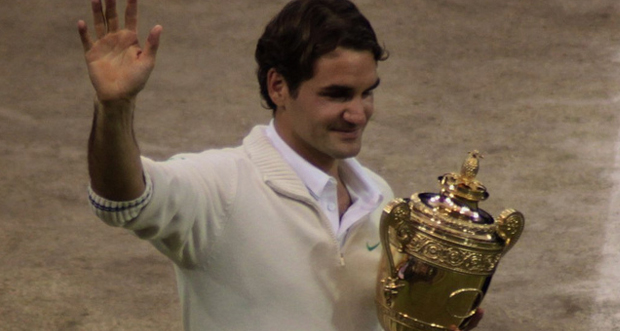
    Roger Federer has achieved so much in his career it boggles the mind. He holds or shares hundreds of records, achievements, and awards in tennis. Led by his record 17 Major titles in the Grand Slam arena, and over 300 weeks ranked the No. 1 player in the world, one wonders what is left for him to do in the future? What is his motivation to continue? He has said he loves the sport, so one might think he will play as long as he is physically able to play, within the limits of his family priorities, and as long as he is happy playing.

    [divider]

    Discuss this article with fellow tennis fans in the tennis forums

    [divider]

    I would not be surprised to see Roger play more doubles as he ages.  I think it benefits and compliments his particular game. There is much more precision required in doubles, including serving and returns.  If played correctly, it obviously helps one’s net play and confidence at the net. Quick thinking tactics and execution are extremely important to set up a winner. Quick footwork and agility are more at a premium in doubles than pure side-to-side movement.

    Overall, I think some more doubles play would help him accentuate his strengths and improve some of his weaknesses.

    Doubles obviously doesn’t require nor would it help much with fitness or endurance, but Federer’s game was never really based on that, and at this stage in his career, I don’t see that changing.  He doesn’t have to change his game to a grinding style and constantly rally for 15+ shots as that isn’t his strength. My guess is that he will work on as many of his strengths as his health allows. These strengths are what set him apart and made him the competitor he is.

    First, he can work on his serve. According to the ATP’s Match Facts statistics, as recently as 2012, he won 91% of his service games, third highest on the tour, while playing 80 matches. (Raonic was first with 93%, and Isner second with 92% but playing fewer matches — 62 and 60, respectively.)  Federer’s 91% last year was higher than his career average of 88%, and the second highest in his career (92% in 2004).  This year, Federer has won 88% of his service games. Yes, it is his career average, but I think it needs to be higher to have an edge these days.  And if one looks inside the numbers, the biggest difference is his second serve winning percentage. Last year, he topped all players on tour with an excellent 60% of second serves won.  (Nadal was second with 57%.)  So far this year, Federer has dropped to 56% (his career avg.-2nd), while Nadal is second with 57% (his career avg.- 1st) and Djokovic leads with 59% (career avg. 55%-6th).  Interestingly, Murray and Berdych are 26th and 27th with only 52% (also their career avg.).  These percentage differences may look small, but the differences are small among the top players and any edge is vital.  Finally, serving well gives Federer confidence in the rest of his game. Confidence is obviously important.

    Second, Federer undoubtedly realizes that he needs to focus on the key points more. His break points converted (39%) and break points saved (65%) this year have both dipped. Last year, they were 42% and 69%. Career wise, he has averaged 41% and 67%.

    Curiously, his return statistics this year are about the same as last year and for his career, maybe even very slightly better.

    Federer does have to have enough fortitude to have the patience when required to set up a point and then go for the clean winner when there is an opening.  But even then, his tactics and execution have to improve from some of the play he has recently exhibited.  He can’t set up the point perfectly, and then hit right back to the opponent instead of the open court.  The “hit behind the player” tactic should be used more sparingly to surprise a player. He also can’t bungle shots when he has the opponent at his mercy.  He did this kind of thing against Robredo, and it cost him the match as he admittedly self-destructed.

    Despite that result, I don’t think he is far off the mark; just more inconsistent and a bit below normal. Perhaps that can partially be explained by his not playing as much this year.  His back appears to have bothered him more during the year.  He also announced that this would be a transition year (whatever that means), so perhaps some of this is self-imposed.

    Will Roger Federer turn it around in 2014?  Only time will tell.  One day, no one can say for sure when, he won’t be able to play at a high enough level to win big tournaments or remain near the top.  Some believe it has already happened this year, and perhaps it has, but only history will tell us for sure.  I, for one, believe it’s pretty unreasonable to say that “he is finished” less than a year after he was No. 1 in the world. After all, people have been predicting his imminent demise since 2008 when he “only” won one Major and again in 2011, when he hadn’t won a Major since the 2010 Australian Open, and look what happened in 2012.  Though he could win anywhere with some fortune, one would think that the Wimbledon lawn is his best chance to win another Major. The competitive ability on it is more sparse, the surface suits his game, especially if it is not too sun-baked and high bouncing, and he is co-record holder along with Pete Sampras with seven winner’s trophies.

    Still, he is 32 years old and has some high mileage, fifth (only 21 matches short of Agassi) in the Open Era in matches played, and what is certain is that nobody plays men’s singles on this tour forever.

    But even when Roger Federer can no longer reach the highest levels consistently, what is wrong with Roger playing on for the love of the game?  Unfortunately, I believe that there are too many these days that cannot accept or appreciate performances that don’t continuously match or exceed a player’s best.  Media, fans, and even the tour promoters alike seem only too eager to look at the most recent results – in a “what have you done lately” syndrome – and bury champions that still have exciting moments to give to the sport. In this writer’s eyes that is just plain wrong.

    One mustn’t forget that some of the great players in the game have risen to the heights on occasion, even in the dimming twilight of their careers.

    In my fading memories, I still recall a nervous almost 42-year-old Richard “Pancho” Gonzalez beating 1969 Grand Slam Champion Laver in a winner-take-all best-of-five set match in 1970 at Madison Square Garden.  Gonzalez said that night he was always frightened of playing there, because it was frightening to think he might play a bad match at MSG.

    Gonzalez taping his fingers before Laver MSG match

    I recall 36-year-old Ken Rosewall winning the 1971 Australian Open against a strong field (he would win again at 37, but against a very depleted field), beating Emerson in the quarterfinals, Okker in the semifinals, and Ashe in straight sets in the final.  At 41 and 42, in 1976 and 1977, Rosewall would make it to the semifinals in Australia.

    1971 Australian Open Final – Rosewall beats Arthur Ashe

    And who can forget 39-year-old Jimmy Connors’s run in the 1991 US Open coming from two sets to one down to beat Aaron Krickstein in the deciding set tiebreaker in the fourth round, then playing Paul Haarhuis at night in the quarterfinals, and whipping the crowd into a frenzy behind some incredible defending to break Haarhuis serving for a 2-0 lead, to tie the set, and eventually win the match in four sets. He finally succumbed to Jim Courier in the semifinal, but it was a most memorable run.

    1991 US Open – Amazing point where Connors breaks Haarhuis in the second set to begin comeback

    Enjoy them all while you still can. Like our children, they learn, they play, they struggle, they succeed to our delight much more than they fail to our sorrow, and finally they get older and leave our admiring gaze.  ‘Tis ever a champion’s fate.

    Credits: Cover Photo: anonlinegreenworld (Creative Commons License)

  • American Men’s Tennis and the Cycle of Ages

    American Men’s Tennis and the Cycle of Ages

    5638812812_0691415a18_o

    Photo by Neon Tommy (Creative Commons License)

    Consider the following as an addendum, or second part, to the previous blog in which I looked at the decline of American men’s tennis. In this entry we’ll look at the big historical trajectory of men’s tennis, and from a slightly different perspective: that of mythology.

    Various mythologies throughout the world – such as Greek, Indian, and Mesoamerican – hold that the world passes through great ages of time. While there are differences between these myths, they are also remarkably similar in that all start with some kind of paradisiacal “Golden Age” from which there is a “fall” and further decline into successively lesser ages. The Golden becomes the Silver, then the Bronze, and finally the Iron or Dark Age. Some of these mythologies hold that this process is cyclical, so that the Dark Age will eventually transition into a new cycle, even a new Golden Age.

    It struck me how American men’s tennis has gone through its own cycle of ages over the last four decades (and perhaps before).

    The Golden Age (1974-1984) had its beginnings in the early 70s with the elder statesmen Arthur Ashe and Stan Smith, but did not truly arrive until the peak of Jimmy Connors, the first truly dominant American male player since Pancho Gonzales. American men dominated the rankings from the mid-70s into the mid-80s. Perhaps the most dominant year was 1979 when the #2-5 players were all American (Sweden’s Bjorn Borg was #1), and seven of the top 10 were American. From 1974 to 1984, an American held the #1 ranking for all but two years, in 1979-80 when the great Swede was at the top of the game.

    9097572979_78970c3289_o

    Photo by University of Salford (Creative Commons license)

    There was a slight lull as the ages shifted when the two greatest players of the Golden Age, Jimmy Connors and John McEnroe, were in decline, and before the next generation of American greats arose. 1985-1988 saw no American man win a Grand Slam event, the first time since 1973 that at least one American man hadn’t won a Slam. While Connors and McEnroe were both in the top 5 in 1985, Connors was the highest ranked American in 1986 at #8, and no American male finished the year in the top 2 until Jim Courier in 1991.

    The Silver Age (1989-1999) began when 17-year old Michael Chang won his first and only Grand Slam event in 1989 at the French Open. American men began another streak of years with Grand Slam winners. Chang was joined by Sampras in 1990, Courier in 1991, Courier and Agassi in 1992, and then the reign of Pete Sampras from 1993 and beyond. While American men’s tennis was still strong in the late 80s–at least relative to the current era–it returned to dominance in the early 90s. It was not the Golden Age of the late 70s and early 80s in that while Sampras and Agassi reigned, the field was not as deep. Thus the 90s were truly a Silver Age, with two Americans – Sampras and Agassi – the most dominant players of the decade.

    502317961_f09eb6acf7_o

    Photo by pandemia (Creative Commons license)

    I mark the end of the Silver Age as 1999, when Andre Agassi was #1 and Sampras had dropped to #3. Agassi remained a dominant player for a few more years but Sampras faded quickly.

    The Bronze Age was, in some ways, a transitional era, and thus difficult to demarcate. But I’d offer that it began right after the end of the Silver Age, in 2000, which was the first year since 1991 that an American didn’t hold the #1 ranking. Sampras remained a strong player for a few years but was in obvious decline. Andre Agassi still played at a high level, even reaching #1 at the venerable age of 33 in 2003, the year that young Andy Roddick finished #1 and the last time an American held the #1 ranking. Americans hoped to see Roddick take the mantle from Agassi and Sampras, but it wasn’t to be – partially because his game was simply too one-dimensional to be a truly elite player, but also because of the rise of a Swiss player by the name of Roger Federer, who took the #1 ranking from Roddick in early 2004. Roddick went from being the top player for a short period of time at the end of 2003, to one of a few near-elites vying for the scraps left behind by Federer and, shortly after, Rafael Nadal.

    The Bronze Age was a short period, fading in the mid-Aughties, suitably without a distinct ending. Perhaps it ended when it became clear that no active American male would win a Grand Slam or be #1. This could be 2006 when Roddick dropped out of the top 5, or it could be 2011 when he dropped out of the top 10 – or 2012 when he retired.  No one stepped up to carry the mantle of American spokesman. I’m considering 2005 as the last year of the Bronze Age, for it was the final full season of the last truly great American tennis player, Andre Agassi, who finished the year at #7. Andre played a few tournaments in 2006 but didn’t win any and finished the year #150.

    Legg Mason Tennis Tournament 08/08/09

    Photo by Keith Allison (Creative Commons license)

    We are currently in the Dark Age of American men’s tennis, with no player in the top 10, and no elite player on the horizon. While the present and foreseeable future of American men’s tennis looks bleak, we must remember that the wheel turns and a new Golden Age may come around again. 1961 saw the last Slam win by Pancho Gonzales, the greatest American men’s tennis player of the couple decades before the Open Era, and probably the greatest overall player of the 1950s. In a way we could say that Gonzales was to the pre-Open Era what Sampras was to the Open Era – the leading player of a Silver Age. Early in his career and before him saw other American greats such as Jack Trabert, Pancho Segura, Jack Kramer, and Bobby Riggs, and some years before them you have Ellsworth Vines and Don Budge, and before them the great Bill Tilden.

    The point being, American tennis did not begin with Jimmy Connors, but it was with Connors that it returned to dominance. The late 1950s to early 1970s was dominated by Australian greats Rod Laver, Ken Rosewall, Lew Hoad, Roy Emerson, and John Newcombe. When Arthur Ashe won the 1968 US Open he was the first American to win a Slam, amateur or pro, since Chuck McKinley won Wimbledon in 1963. So the mid-60s were a dark period for the Americans, and only slowly did that Dark Age transition into the new Golden Age. In other words, we could see a transitional, or “Dawn Age” from 1968 through 1973, when Arthur Ashe and Stan Smith were among the best in the game, but not dominant on the level of Gonzales in the 1950s or Connors in the 1970s.

    So Americans can hope that this current Dark Age will transition into a Dawn Age. If history repeats itself, as it often does, then the first signs of transition will be the appearance of lesser luminaries akin to Arthur Ashe and Stan Smith – not truly dominant players, but winners, or at least serious contenders, of Grand Slams. So we will watch and wait for a 21st century Arthur Ashe to usher the way towards that next Golden Age of American men’s tennis. But we might have some time to go. And given the more international nature of the game and world, it seems likely that the next Golden Age of American men’s tennis will not be as dominant, not shine as brightly as even in the early 90s. Some relativity is involved and we must think modestly; the next Golden Age might not see the United States returning to dominance, just re-joining the elite of the game.

    3875104029_0c669ebe14_o

    Photo by freezr (Creative Commons license)

    [divider]

    Click here to discuss “American Men’s Tennis and the Cycle of Ages” in our discussion forum.

    [divider]