Tag: novak djokovic

  • Australian Open – Men’s Draw

    Australian Open – Men’s Draw

    AO Draw - ATP

    Rafael Nadal and Andy Murray are in the top half; David Ferrer and Novak Djokovic in bottom half.

    Click here to discuss the Australian Open Men’s Draw in our discussion forum.

    The full draw:

    First Quarter

    Rafael Nadal (ESP) (1)
    Bernard Tomic (AUS)

    Thanasi Kokkinakis (AUS)
    Igor Sijsling (NED)

    Tobias Kamke (GER)
    Jack Sock (USA)

    Ryan Harrison (USA)
    Gael Monfils (FRA) (25)

    Andreas Seppi (ITA) (24)
    Lleyton Hewitt (AUS)

    Robin Haase (NED)
    Donald Young (USA)

    Qualifier
    Lucas Pouille (FRA)

    Marinko Matosevic (AUS)
    Kei Nishikori (JPN) (16)

    Milos Raonic (CAN) (11)
    Daniel Gimeno-Traver (ESP)

    Qualifier
    Victor Hanescu (ROU)

    Qualifier
    Yen-Hsun Lu (TPE)

    Bradley Klahn (USA)
    Grigor Dimitrov (BUL) (22)

    Benoit Paire (FRA) (27)
    Qualifier

    Nick Kyrgios (AUS)
    Benjamin Becker (GER)

    Roberto Bautista Agut (ESP)
    Tim Smyczek (USA)

    Qualifier
    Juan Martin Del Potro (ARG) (5)
    [divider]

    Second Quarter
    Andy Murray (GBR) (4)
    Go Soeda (JPN)

    Qualifier
    Qualifier

    Qualifier
    Michael Llodra (FRA)

    Somdev Devvarman (IND)
    Feliciano Lopez (ESP) (26)

    Philipp Kohlschreiber (GER) (21)
    Aljaz Bedene (SLO)

    Michal Przysiezny (POL)
    Horacio Zeballos (ARG)

    Qualifier
    Federico Delbonis (ARG)

    Qualifier
    John Isner (USA) (13)

    Jo-Wilfried Tsonga (FRA) (10)
    Filippo Volandri (ITA)

    Qualifier
    Julian Reister (GER)

    Marin Cilic (CRO)
    Marcel Granollers (ESP)

    Daniel Brands (GER)
    Gilles Simon (FRA) (18)

    Fernando Verdasco (ESP) (31)
    Qualifier

    Teymuraz Gabashvili (RUS)
    Sergiy Stakhovsky (UKR)

    Radek Stepanek (CZE)
    Blaz Kavcic (SLO)

    James Duckworth (AUS)
    Roger Federer (SUI) (6)

    [divider]

    Third Quarter
    Tomas Berdych (CZE) (7)
    Aleksandr Nedovyesov (KAZ)

    Di Wu (CHN)
    Kenny De Schepper (FRA)

    Jan Hajek (CZE)
    Qualifier

    Ivo Karlovic (CRO)
    Ivan Dodig (CRO) (32)

    Kevin Anderson (RSA) (19)
    Jiri Vesely (CZE)

    Qualifier
    Joao Sousa (POR)

    Carlos Berlocq (ARG)
    Edouard Roger-Vasselin (FRA)

    Guillermo Garcia-Lopez (ESP)
    Tommy Haas (GER) (12)

    Mikhail Youzhny (RUS) (14)
    Jan-Lennard Struff (GER)

    Florian Mayer (GER)
    Qualifier

    Albert Ramos (ESP)
    Pablo Andujar (ESP)

    Jordan Thompson (AUS)
    Jerzy Janowicz (POL) (20)

    Jeremy Chardy (FRA) (29)
    Jesse Huta Galung (NED)

    Qualifier
    Alexandr Dolgopolov (UKR)

    Steve Johnson (USA)
    Adrian Mannarino (FRA)

    Alejandro Gonzalez (COL)
    David Ferrer (ESP) (3)

    [divider]

    Fourth Quarter

    Stanislas Wawrinka (SUI) (8)
    Andrey Golubev (KAZ)

    Alejandro Falla (COL)
    Mikhail Kukushkin (KAZ)

    Nicolas Mahut (FRA)
    Matthew Ebden (AUS)

    Samuel Groth (AUS)
    Vasek Pospisil (CAN) (28)

    Tommy Robredo (ESP) (17)
    Lukas Rosol (CZE)

    Pablo Carreno Busta (ESP)
    Julien Benneteau (FRA)

    Nikolay Davydenko (RUS)
    Lukasz Kubot (POL)

    Qualifier
    Richard Gasquet (FRA) (9)

    Fabio Fognini (ITA) (15)
    Alex Bogomolov Jr. (RUS)

    Dudi Sela (ISR)
    Jarkko Nieminen (FIN)

    Santiago Giraldo (COL)
    Sam Querrey (USA)

    Juan Monaco (ARG)
    Ernests Gulbis (LAT) (23)

    Dmitry Tursunov (RUS) (30)
    Michael Russell (USA)

    Marcos Baghdatis (CYP)
    Denis Istomin (UZB)

    Leonardo Mayer (ARG)
    Albert Montanes (ESP)

    Lukas Lacko (SVK)
    Novak Djokovic (SRB) (2)

  • Djokovic Wins Abu Dhabi Invitational

    Djokovic Wins Abu Dhabi Invitational

    Novak Djokovic has opened the new season by defeating Spain’s David Ferrer 7-5, 6-2 at the Abu Dhabi Exhibition tournament in 82 minutes.

    Ferrer who came into the final on the back of a victory over World No. 1 Rafael Nadal had led 4-2 in the first set but a succession of unforced errors proved his undoing as Djokovic took control of the match and swept to victory.

    “I’m very satisfied with the way I played and I always enjoy coming back here,” stated the Serb, who added $250,000 to his bank balance in the process.

    New coach Boris Becker was in attendance, and will be encouraged by the Djokovic’s early season form.

    In the third place playoff match, Nadal defeated Jo-Wilfried Tsonga 7-6, 6-3.

  • David, Rafa and Nole’s Excellent Adventure in South America

    David, Rafa and Nole’s Excellent Adventure in South America

    Adventure

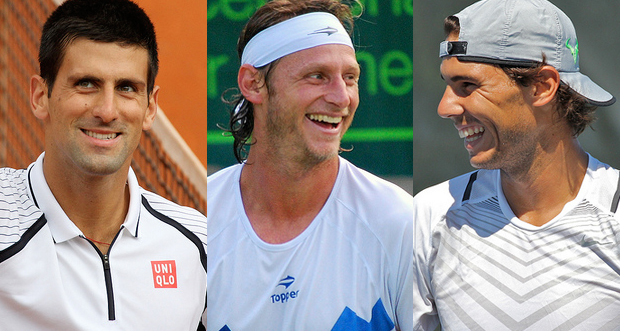
    This part of the off-season is about sending off David Nalbandian, and to a lesser extent, Nicolas Massú. Nadal and Djokovic, the world’s numbers 1 and 2, have joined in for exhibition matches and festivities. Here’s some of the news from the front in the Spanish-language press.

    The red-carpet was rolled out in Chile. The tennis players were received by President Sebastian Piñera. Nicolas Massú, who has also retired this year, was quoted as saying, “To have the honor of sharing this with Rafa, Novak, and David is a pleasure for anyone who cares about tennis.” Massú has now signed on as the Chilean Davis Cup captain. Chilean future hopeful Christian Garin was also in attendance. Also while in Chile, during a presser with Djokovic, Nalbandian, and Massú, Rafael Nadal offered to translate for Novak, and, hilariously, started restating what Nole said…in English. He had to be reminded that he was speaking English. He excused himself in Spanish, then saying, “At this point, I think English is my first language.” Likely it’s his first “press-conference” language, anyway.

    [divider]

    They also played some tennis in Córdoba, Nalbandian’s home town. Massú beat Nalbandian, 6-4, 6-2, and Djokovic got it over Nadal 7-6(3), 6-4. According to the Chilean press: “That never seemed like an exhibition, except for in the second set, where they joked about some fantastic points.” Otherwise the press in Spanish reckoned that they took it very seriously, for a “friendly.” The only break of serve came in the penultimate game of the second set. Interesting. I guess it’s not so easy for them to leave all the competitiveness aside.

    In his home town, Nalbandian also beat Nadal 6-4, 7-6(6).

    This is a particularly great point from the match:

    [divider]

    In between the exhibitions, Nalbandian and Nadal appeared together on the Susana Gutierrez show, a major talk show in Argentina. King David looked tanned and relaxed, and sartorially resplendent in a navy shirt, pink jacket, and red shoes. Nadal, according to the hostess, looked surprising tall. (“They always tell me that,” he said.) The conversation was light and full of humor. When asked about some of the longest matches they’d ever played, Nalbandian mentioned the six-and-a-half hour doubles match he’d played vs. Russia in Davis Cup. “Even I got bored,” said Nalbandian, to much laughter. Nadal said his was in Australia, lasting six hours, vs. Djokovic. “You must have won,” says la Susana. “No, I lost,” admitted Nadal, with a smile.

    When the hostess told David that everyone was heartbroken that he was retiring, he said, “Don’t be sad. Anyway, it was a great excuse to get Rafa to Argentina.” The two do seem to be very genial friends.

    You can see the videos of their appearance on the show here:

    [divider]

    Before everyone got back together in Buenos Aires, Nadal and Djokovic met in Patagonia for a hit-around with the glaciers as background. They took part in an exhibition on Friday, hitting on a barge in front of the Perito Moreno Glacier, near the southern extremity of Argentina. From Nadal: “I’ve just been in one of the most spectacular places that I’ve ever seen before, the Perito Moreno! Really amazing!”

    [divider]

    Novak and Rafa also got to hit goals in the Boca stadium in Buenos Aires. Not sure why River couldn’t get their attention, but:

    In the rematch between Nadal and Djokovic in Buenos Aires, Nadal prevailed, 6-4, 7-5.

    (Listening to Djokovic’s speech in Spanish, it seems clear he was coached by Rafa, because he used the Spanish idioms!)

    Nadal and Djokovic then combined to play doubles against Nalbandian and Monaco. By all accounts, they had a very good laugh. At one point, Djokovic threw himself to the ground so as not to be hit by Rafa’s serve. Nalbandian feigned arguments with the chair, and Monaco tried to hit his opponents at the net.

    Clearly, Nalbandian was well sent-off. The Chilean and Argentinian fans were greatly entertained, and Rafa and Novak seemed to have more-than-a-little fun. An Excellent Adventure, indeed.

  • An Effect So Poetic

    An Effect So Poetic

    8705873194_103e921be4_z e

    Davis Cup, Final

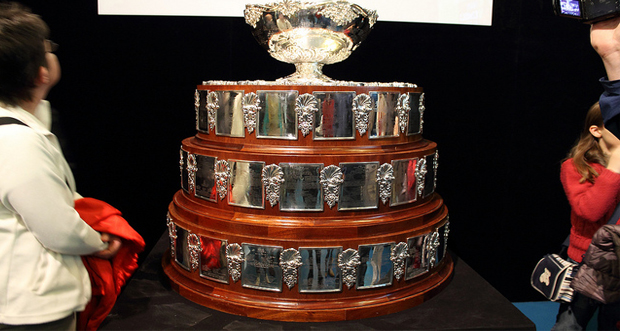
    Until last year the tiny proportion of the Czech Republic concentrated in its Davis Cup team had not won the Davis Cup since 1980. They’ve now won it for the second year in a row, by fielding the same two-man squad of Tomas Berdych and Radek Stepanek. Last year they accounted for Spain, the most successful Davis Cup nation of recent years. This year they defeated Serbia, who won the title in 2010, spearheaded by the formidable Novak Djokovic. Yet while the two finals were broadly alike in outline – even the configuration of results was vaguely similar – they could hardly have diverged more in detail. Last year’s final was historically significant, and thrilling from first to last. This year’s was frankly a bore from beginning to end, thus neatly summarising a long season in which a tournament’s last match was seldom its best.

    Last year’s final usefully proved that even Spain is heavily diminished without its best player, while Serbia has now proved you cannot rely only on your best player, especially if he doesn’t play doubles. In neither final did the Czech Republic boast the best player – in both finals Tomas Berdych was soundly beaten by the opposition number one in the reverse singles – but Davis Cup ties typically aren’t decided by who has the best player, but by who has the least worst. Live fifth rubbers are always contested between the number two players, which is why they so often feature as the hero in close ties. Djokovic was impeccable in the 2010 final, walloping any Frenchman placed before him, but it was Victor Troicki’s dismissal of Michael Llodra in the fifth rubber that is destined to be remembered. Or recall Mikhail Youzhny’s defeat of Paul-Henri Mathieu in the 2002 final. More pertinently, remember Radek Stepanek’s dashing defeat of Nicolas Almagro last year. Janko Tipsarevic’s withdrawal several days before this year’s final was thus catastrophic for the Serbian team – Bogdan Obradovic likened his absence to playing tennis on one leg – and removed any tangible doubt about the eventual result. Knowing how things turn out subtracts significantly from the fascination of watching them unfold. There was some chatter as to whether Lukas Rosol should have played instead of Stepanek on the opening day in order to preserve the older man for the hardships to come. The upshot was that really it didn’t matter.

    Anyone who doubts the inherent value of chaos was hopefully reassured by this year’s final. This is what sport looks like in a deterministic world. The weekend unfurled with devastating predictability, like those irritating fight scenes in Guy Ritchie’s Sherlock Holmes films, in which Iron Man and Moriarty hardly bother getting down to fisticuffs because they’ve already mapped out how it’s going to go down. Every match went according to prediction, and none of them went beyond three sets. It was rare for the winning player or team even to cede break points, let alone a break. The closest we came to an upset was Berdych attaining 4-4 in the first set against Djokovic via a series of desperate holds. “Anyone with a hat should be donning it for Berdych!” insisted the Eurosport commentator who wasn’t Frew McMillan. Perhaps he meant “doff”, but his yawns affected his diction.

    What interest there was was confined to the doubles, as is frequently the case. In last year’s final the Czech team encountered a Spanish duo that had just won the World Tour Finals, yet cleaned them up in four sets. This year Berdych and Stepanek’s opposition proved less fearsome in Nenad Zimonjic and Ilija Bozoljac. After the heady thrill of Boise, where Bozoljac performed magnificently to see off the Bryan brothers, and the semifinal in which he and Zimonjic fought gallantly in a marathon loss, the final was a disappointment. One could term it a reality check, but that’s an unkind thing to say about a player like Bozoljac who subsists primarily on the Challenger and Futures tours, where every week is a reality check. He did his best, and it isn’t as though Zimonjic set the stadium alight.

    The pressing issue was whether Djokovic would have done any better. It’s not much of an issue, but given that it is almost the sole point of contention in a searingly uneventful weekend of tennis, it is the issue that is being discussed at length. I’m not convinced it matters. Djokovic doesn’t have much of a doubles record, although he is at present the finest singles player on the planet, especially on an indoor hard court, and that’s historically a recipe for doubles success. Whether it would have been enough to snatch victory is another matter. Word was that after London he was all but spent; winning everything all the time is undoubtedly fabulous, but it does ensure you’re playing all the time. A long doubles match might have hobbled Djokovic for the reverse singles, although admittedly it would have hobbled Berdych as well. The real issue is that Stepanek and Berdych are an excellent doubles combination, and were they to pair up regularly one imagines they would enjoy tremendous success throughout the season. Alas the rigours of the singles tour preclude that possibility. Stepanek of course is a doubles specialist (it ranks highly on his list of endorsed skills on LinkedIn), and has won multiple Majors.

    It turns out he is also a specialist at closing out Davis Cup finals – he now is the third player in history to win two live fifth rubbers at this stage of the competition – whether it is against Nicolas Almagro or Dusan Lajovic. Unlike Almagro, who was left alone and forlorn for far too long by his compatriots after last year’s defeat, no one anywhere holds Lajovic’s loss against him, and his team was lavish with its consolation. It had been a very big ask. No doubt a Davis Cup final is a tremendous opportunity for a young player to make his name, but there are limits. Sink or swim is beside the point when you’re thrown in with crocodiles. Stepanek was as relentless as the tide, attacking without pause, and gave the youngster nothing.

    Afterwards he was overrun by his teammates, while the Czech contingent in the stands went justifiably berserk. Defending a Davis Cup title is considerably rarer than winning one. Stepanek soon extricated himself from the pile of bodies and set to vaulting the net, to the delight of the Czech fans, and no doubt the bemusement of the Serbs. Later he proffered the tactful opinion that not playing Djokovic in the doubles had been akin to “leaving your Ferrari in the garage”, ensuring that for some bemusement was transformed into outrage.

    Berdych later failed to mollify his hosts by asking why Djokovic wasn’t at the post-final dinner, enquiring whether the world number two was still in the “garage”? It gave most of us something to be mildly amused by, and a certain species of plodding moraliser something to get really worked up at, which they duly did. Thus did a forgettable final weekend conclude with a modicum of interest. If only there’d been some tennis to match it. As I said last week, you cannot have everything. If you’re the Czech Republic, however, you can have the Davis Cup — again.

  • Czech Republic Repeats in Davis Cup

    Czech Republic Repeats in Davis Cup

    8705871692_1c393ac441_z e

    For the second straight year, the Czechs have won the Davis Cup trophy, this year defeating the host team Serbia, 3-2.

    The Serbian team was hamstrung by the losses of Janko Tipsarevic (injury) and Victor Troicki (serving a ban for missing a drug test), forcing them to play the unknown No. 117-ranked Dusan Lajovic in two of the singles matches.  Having the world No. 2 Novak Djokovic on their side was not enough for Serbia to repeat their 2010 victory.

    For the Czech Republic, it was again their stalwarts, Tomas Berdych and Radek Stepanek, who were the two-man show all weekend, as they had been in defeating Spain this time last year.  When the teams split the singles rubbers on Friday, the Czech’s decided to press Berdych-Stepanek, a proven combination (14-1 total Davis Cup record as a doubles team) into service again on Saturday, when it seemed that the doubles might decide the eventual winner, given the weakness and inexperience of Lajovic.  Somewhat controversially, Djokovic was not substituted in to play with Nenad Zimonjic (at 37, the oldest man ever to play in a Davis Cup final), who teamed with Ilija Bozoljac, in what was indeed a losing effort against the crafty Czech pair.  Today, Djokovic defeated Berdych to assure a live rubber for the 5th match.  And just as he did last year, Stepanek clinched for his team.

    [divider]

    Scores:

    Novak Djokovic d. Radek Stepanek: 7-5, 6-1, 6-4

    Tomas Berdych d. Dusan Lajovic: 6-3, 6-4, 6-3

    Berdych/Stepanek d. Bozoljac/Zimonjic: 6-2, 6-4, 7-6 (4)

    Djokovic d. Berdych: 6-4, 7-6 (5), 6-2

    Stepanek d. Lajovic: 6-3, 6-1, 6-1

    Photo credit:  elPadawan (Creative Commons License)

  • What’s Next?

    What’s Next?

    WTF Winner - Djokovic 3

    The Barclay’s ATP World Tour Finals, Final

    [2] Novak Djokovic def [1] Rafael Nadal 6-3, 6-4

    [6] Verdasco/Marrero def [1] Bryan/Bryan 7-5, 6-7 (3), 10-7


    Hello.

    I know. It’s been awhile. And I’m sorry about that. But I did bring excuses. Some of them are even good ones. Others are distinctly less good-– such as, for instance, would you believe that a few days after the US Open final a convocation of eagles flew in through my office window and made off with my laptop? Or that in October a lamentation of swans invaded my living room and ate the TV? A bevy of larks broke in last week and took off with all my pens? Or, wait, here’s one: How about that I kept trying to watch Asian Swing tennis after work but the Tennis Channel was only showing matches from 2012? (Bingo!) See, a whole flock of excuses. But suffice it for now to say: I’m back, and just in time to say goodbye to another tennis season, to close the book on a heroic tale so many tennis fans fervently hope is only half-finished. That’s right — I’m talking about Fernando Verdasco’s doubles career.

    The Spaniard and his compatriot, David Marrero, defeated the No. 1 ranked Bryan brothers 10-7 in the super tiebreak to claim the WTF beribboned doubles cup. The celebration and victory speech from the Spanish pair could hardly have been more emotional and touching, even by Verdasco’s extraverted, emoticoned standards. I only got home to my TV (a special swan-proof model) in time to see Verdasco win the final point of the match (a serve), and even without knowing anything about the dramatic arc of the match, I was immediately caught up in the exuberance of the moment. First, Verdasco fell joyfully to the ground. Then he got back up, leapt into his partner’s arms and hugged him with all four limbs before running to the sidelines to hug an entire century’s worth of Spaniards. Verdasco then wrote twelve stanzas of free verse poetry on the TV camera lens, and joined forces with Marrero—who became emotionally overcome while dedicating the victory to his late grandfather—to give the season’s most heartwarming acceptance speech. It was a lovely moment, and made me wish I’d seen the tennis that inspired it. (After the trophy presentation both men were stripped from the waist up, interviewed, and made to declare their intention to, first put clothes on, and then go eat Spanish food in South Kensington. Huzzah.)

    I did, however, see all the points of the thirty-ninth chapter in the Nadal v. Djokovic rivalry. So far as tennis rivalries go, it’s hard to fathom how anybody could still argue against this one being among the very best. The pair has met fifteen times since 2011, and all but two of those encounters were tournament finals. (Both other meetings were semifinals:  Roland Garros and Beijing in 2013. The match on the Paris clay was made of such high-quality drama that I wouldn’t be surprised if, going forward, it’s frequently misremembered as the tournament final.) Sure, the six-hour-long Australian Open final in 2012 could be accused of being a too-drawn-out slug-fest, but the rivalry has matured considerably over the past two years, with both players (and their ever-present support squads) devising new and more intricate ways to torture each other on the tennis court.

    Unfortunately, no matter how good the rivalry, an individual tennis match tends not to soar to the outer-reaches of greatness when one half of the participants forgets to bring his forehand to the court. Novak Djokovic, ever the generous competitor, tried to make up for Rafael Nadal’s absentmindedness by playing super incredibly well from pretty much everywhere on the court, but no matter how hard he tried, he couldn’t quite compensate for Rafa’s missing forehand. (Even Djokovic isn’t quick enough to return his own serves.)

    The world No. 2 held easily to open the match, then broke fairly easily, then held again. By the time we reached 3-0 in the opening set Novak had won 12 points to Nadal’s four, and Rafa’s game was looking as if his second serve might have run off with his forehand (probably to South Kensington to eat gambas al ajillo with Fernando). When Djokovic nearly broke the Spaniard again in the fourth game, the Serb decided he had to change tactics if there was any hope of elevating this edition of The Rivalry off the plywood floor. So, Djokovic started to make strange errors on his own forehand wing, and the backhand one, too. And it worked like a charm. Rafa held, and then broke back, and then held again.

    By now—we’re at 3-3 in the first, in case you’ve lost count—Djokovic realized that if he went on smothering his forehand and forcing his backhand wide, he might actually not win the match, especially considering that Nadal had begun to play somewhat more assertively and that wary, feral gleam was now visible in the Spaniard’s eyes. Since losing the final of the Barclay’s ATP World Tour Finals would have been no good at all for Djokovic’s twenty-something match win streak (tennis players tend to prefer their streaks to their rivalries), he resumed playing incredibly well and quickly went back to winning the match.

    The highlight of the day came on break point at 3-4 on Nadal’s serve. The point, which you must watch if you haven’t seen it, featured stunning movement and hands from both men. But it was Djokovic who hit the eye-popping lob and Djokovic who won the point, and therefore it was the Serb who was entitled to claim the bonus loot, aka “the manna of destiny.” In the next game, Nadal won a point almost as good to go up 30-15 on Djokovic’s serve—Rafa slammed a muscular forehand down-the-line and followed it up by a no-look jumping backhand volley winner—but Djokovic got a lucky net cord the very next point and therefore collected double manna, which he promptly cashed in for an ace on set point.

    From there the Serb looked like he was made of starswhile Rafael Nadal kept on fending off break points like a man who refused to be forced to earth. (Nadal defended 8 of 11 break points, compared with Novak’s 2 of 3.) But despite Nadal’s best psychological efforts, and perhaps because of several forehand errors, Djokovic still managed to break early in the second set. It should be said that Rafa brought his full measure of grit to the contest—fighting off two championship points before sending one of his trademark forehands just wide on the third— but he simply did not have the game today, while Djokovic had more than plenty. The final score was a surprisingly straightforward 6-3, 6-4.

    After the match, as I waited patiently for the ATP Steering Committee to take their places near the trophy table, and for a nice lady named Rebecca to walk the trophy out onto the court, I took a moment to reflect on the state of men’s tennis today. Yesterday’s WTF semifinals featured Federer, Nadal, Djokovic, and Stanislas Wawrinka. Federer has career 77 titles, Nadal has 60, Djokovic now has 41. The 27-year-old Wawrinka has collected four. Nadal eased by Federer in the first semifinal, despite being outplayed in throughout most of the first set. Wawrinka was psychologically overmatched from the start and didn’t offer Djokovic anything like the fight he showed in Australia or New York. And while I agree with Darren Cahill that Roger Federer is likely to have a better 2014 than his 2013, he is 32 years old. Who’s next?

    Even if Nadal didn’t play anything like his best tennis today, both men belonged in the final ATP match of the year. They’ve been several cuts above the competition for the majority of the season. Nadal will finish the “most emotional season” he’s had as the No. 1 ranked player in the world. Djokovic will be right behind him, at No. 2, with a Major title to defend in two months’ time. As exciting as it’s going to be to watch and see where 2014 takes this rivalry, it’s hard to imagine who is going to be able to hang in there with these two. Healthy versions of Murray, Federer, and del Potro? Pierre-Hugues Herbert? Martin Alund? Whomever he is, he’s going to need to be very good at tennis, and even better at summoning destiny.

    When Novak Djokovic accepted his WTF trophy, he thanked the London crowd for coming out all week to watch tennis. “Thank you for appreciating what we do,” he said. “It means a lot to us.” This isn’t the first time Djokovic has thanked a crowd for hanging in there through a tournament or a match. He has a way of sounding not only grateful, but also surprised that people turn up to watch him—one of the greatest tennis players in the game—play great tennis. Nadal and Djokovic will both take home more than a million dollars for their London efforts, but it’s still the human recognition that counts. That’s heartwarming. Not quite a Fernando-Verdasco-hug level heartwarming, but nice nonetheless.

    It’s also why I would like somebody to tell Djokovic—and Rafa and the rest—that I have plans to fly all the way across the Pacific Ocean to turn up to watch them play tennis at the Australian Open. I’m sure it will mean a lot to them. It also means that I will be able to write to you all about it. And that means a lot to me.

    Cover Photo (Creative Commons License): Marianne Bevis
  • Direction and Magnitude

    Direction and Magnitude

    WTF Winner - Djokovic 1

    World Tour Finals, Final

    (2) Djokovic d. (1) Nadal, 6-3, 6-4

    Novak Djokovic tonight defeated Rafael Nadal in the final of the World Tour Finals, an unlovely sentence to commemorate a forgettable match. It was the third time in the last four years that the top two players have closed out the ATP season, but the first time it has been these two. I suppose it had to happen eventually, since they seem to have played finals everywhere else. Consequently everyone knew what to expect, especially given the glacial surface: an extended defensive slog based around the repetition of readily identifiable patterns. As with minimalism – which people persistently confuse with simplicity – great complexity is achieved by the reiteration of basic blocks, not to mention great length. No one expected it to be simple, and no one expected it to be quick.

    I confess to feeling some relief when everyone was proved wrong, at least when it came to length. When two players face each other thirty-nine times – an Open Era record – it’s inevitable that not all of them with be classics, although one hoped that the last match of a memorable season would turn out to be a bit less forgettable. Alas, Nadal commenced nervously and never entirely settled. Meanwhile, Djokovic was fierce initially – tearing out to a 3-0 lead – then meek for a while, and then forceful all the way until the end. He seemed to hold break points in most of Nadal’s service games, but only reciprocated the favour once to be broken back in the first set. Whatever hope this kindled of a competitive match was lessened by the consideration that the quality wasn’t high enough that you’d necessarily want to see more of it, then doused entirely when Djokovic lifted again. The point with which he re-broke Nadal to claim the eighth game ranks among the finest defensive efforts I have ever seen, a masterpiece of thrust, parry, loft, and touch. Djokovic’s bellow afterwards was long and lusty, and certainly justified. Most of us will never do anything nearly so masterful in that atmosphere for those stakes.

    Djokovic broke early in the second set – more shouting – and threatened to do so repeatedly as the set wore down. Insurance breaks are nice, but aren’t necessary if you never face calamity (like all insurance, really). The Serb was never again threatened on serve, rarely conceded the baseline, and ended up with atypically excellent numbers at the net. Nadal was almost always on the move, and even when he could set his feet on a forehand found it hard to shift his opponent for long. The length on his groundstrokes was a constant problem, except for Djokovic.

    In truth Djokovic was the real problem. Afterwards Nadal conceded that his opponent had simply been too good. On this surface, playing at his best, Djokovic truly is. The homogenisation of the court surfaces has helped ensure that these two end up facing each other at nearly every tournament everywhere, and that when they do they barely have to alter their basic game, but between them the surface still matters. Nadal is better on clay, and Djokovic is superior on hard court, assuming both men play at their best. In both cases the gap is closing, but it is still there.

    Since the beginning of his career, Nadal fading through the late part of the season, has come to feel like a structural requirement of men’s tennis, although it says a lot about his magisterial 2013 season that losing in the final of the year end championships can be construed as a letdown. It is also a testament to his evolving mastery of all surfaces that one’s definition of “late” has had to be pushed further and further back as the years rolled by. Initially that late part of Nadal’s year kicked off very early — once the main clay tournaments were over. Admittedly that was long ago, when he was very young. Soon he learned to commence fading after Wimbledon, with the results petering out by the US Open. In 2008 he became a factor in the later stages in New York, and has never since failed to reach at least the semifinals, assuming he turns up at all.

    Yet the period after the year’s final Major – pollen-choked Australians find it difficult to call this the “fall season” – has remained unaccountably lean. In his entire career he has won just two titles after the US Open, and one of those was in 2005 in Madrid, enabled by an extravagant collapse from Ivan Ljubicic. That remains Nadal’s only indoor title, since the Ariake Coliseum roof remained open through his Tokyo title run in 2010, his other career title in what northern hemisphere fans obdurately refuse to term “the Australian Spring”. But this year one could be forgiven for assuming the usual rules don’t apply, especially on hard courts. Up to and including the US Open, Nadal hadn’t lost a tournament on that surface. After that he contested four events – the same ones as Djokovic – and for all that he seemed more determined than ever to capture the few important titles that have eluded him, and didn’t win any. That’s nothing to be ashamed of, of course. Winning these things is really, really hard.

    Djokovic, of course, won them all, though in the process lost his No. 1 ranking. The extent to which those two events are connected is open for debate. Some felt that losing the top spot firmed his resolve. There’s probably something to this. After a strong start to the year Djokovic’s form grew patchy, even within matches. Transcendent sets would be interleaved with uncharacteristic dreck, as he would unaccountably lose his way. Since Beijing, however, these periods have grown fewer – there was a bizarre one in the Shanghai final – and he has looked more like the Djokovic who swept through the first two thirds of the 2011 season. (Surgically combining the first part of his 2011 season with the last part of his 2013 yields a year of near perfection.) One shouldn’t forget he almost did exactly the same thing last year, but for that strange loss to Sam Querrey in Bercy. Last year he was chasing down Federer for the No. 1 spot, successfully as it turned out. Grand purposes certainly sharpen his focus.

    On the other hand, it’s probably pointless to search for additional reasons for Djokovic to play superbly on hard courts. At his best he is without question the world’s best player on that surface. His current streak of twenty-two matches isn’t the longest by any means, but it is hard to top for quality. It includes twelve victories over the current Top 10 (aside from the injured Murray), including two wins each against Nadal, Federer, and Wawrinka, and eight in less than two weeks. That’s hard to top. The appropriately renamed Brad Drewett Trophy, bedecked with blue streamers and bestowed amidst a blizzard of confetti, was a fitting reward.

    Thus ends the latest edition of the World Tour Finals. It certainly wasn’t the most memorable installment, from any point of view. Perhaps it was the absence of Murray, but the entire week has felt slightly deflated. The Sky Sports commentary was certainly less demented as a direct result. Recall their tedious tut-tutting during last year’s semifinal over the London crowd’s divided loyalties, particularly Sir Ian McKellen’s unforgivable decision to sit in the Federer box. Sir Ian was nowhere to be seen this year. No doubt he’s chasing monsters in New Zealand. One wonders whether the Scot’s absence was a deciding factor in keeping other celebrities away. Last year there was a cameraman tasked with capturing Kevin Spacey’s every facial tic, and apparently no one could get enough of Pippa Middleton. This year there were endless footballers and one of the mannequins from One Direction. Still, you can’t have everything.

    Photo credit:  Marianne Bevis (Creative Commons License)

  • Djokovic Tops Nadal in London to Win Year-End Title

    Djokovic Tops Nadal in London to Win Year-End Title

    WTF Winner - Djokovic 2

    Novak Djokovic, who has rediscovered his drive and motivation since losing his world No. 1 ranking seven weeks ago, exacted revenge again today against the man who took it from him by beating Rafael Nadal convincingly, 6-3, 6-4, to take the ATP World Tour Finals title.  This was Djokovic’s third title at the year-end tournament, and Nadal’s second loss in a final, having never taken this trophy.

    The Serbian came out strong from the start, while the Spaniard started looking nervous, and was broken in his opening service game.  Nadal got the break back, but was committing too many unforced errors on his trusty forehand side, and too many double-faults, trying for a bit too much to combat, futilely, in the end, the Djokovic A-game.

    Djokovic, looking nimble and assured throughout, broke again early in the second set.  Nadal kept his nerve, fending off championship points in each of the last two games.  He held serve despite having been down, and got Djokovic to deuce at the last, but couldn’t hold off the inevitable any longer.  Djokovic served an ace, and then a Nadal shot sailed wide to end the match.

    The win evens their head-to-head this year to two wins a piece, and closes the gap on the overall to 22-17.  It also sends a big salvo across the bow at Nadal for the season to come.  Djokovic is gunning for him again.

    [divider]

    Fernando Verdasco and David Marrero beat Mike and Bob Bryan for the doubles title:  7-5, 6-7(3), 10-7.  They were the surprise Spanish duo to pull it off, passing the higher-ranked Spanish team of Granollers/Lopez, who beat the Bryans at this tournament last year.

    Photo credit:  Marianne Bevis (Creative Commons License)

  • Djokovic Defeats Wawrinka to Set Showdown With Nadal

    Djokovic Defeats Wawrinka to Set Showdown With Nadal

    WTF SF - Djokovic

    In his most convincing win of this ATP World Tour Finals, the Serbian Novak Djokovic beat Stan Wawrinka of Switzerland to set up the final that most had anticipated, with Rafael Nadal having won his semifinal earlier in the day.

    The 28-year-old Swiss has been enjoying the most successful year of his career, and was making his debut at the ATP World Tour Finals.  He came out looking to start strong, threatening Djokovic’s first serve, and breaking his second. But the Serbian broke back immediately, and then seemed to kick things up a notch to counter any significant threats that Wawrinka threw at him.  In the end, Djokovic blew past him, 6-3, 6-3.

    The final will be played in London’s O2 Arena tomorrow at 8pm GMT.  It will be the 38th meeting between Djokovic and Nadal, a record, and their sixth match of 2013.  Nadal leads on the year 3-2, though the most recent win went to the Serb.

    Photo credit:  Marianne Bevis (Creative Commons License)

  • Barclays ATP World Tour Finals – Semifinals – Schedule of Play and Results

    Barclays ATP World Tour Finals – Semifinals – Schedule of Play and Results

    WTF SFs

    Barclays ATP World Tour Finals – Day 7 – Semifinals: Schedule of Play (Scores added as known)

    CENTER COURT — Start 12:00

    [6] David Marrero (ESP) / Fernando Verdasco (ESP) d [3] Ivan Dodig (CRO) / Marcelo Melo (BRA) — 7-6(10), 7-5

    Not Before 14:00

    [1] Rafael Nadal (ESP) d [6] Roger Federer (SUI) — 7-5, 6-3

    Not Before 18:00

    [1] Bob Bryan (USA) / Mike Bryan (USA) d [2] Alexander Peya (AUT) / Bruno Soares (BRA) — 4-6, 6-4 [10-8]

    Not Before 20:00

    [2] Novak Djokovic (SRB) d [7] Stanislas Wawrinka (SUI) — 6-3, 6-3