Tag: novak djokovic

  • 2015 Australian Open Men’s Draw

    2015 Australian Open Men’s Draw

    Australian Open

    The men’s draw for the 2015 Australian Open was released today. In the top half are the No. 1 seed, Novak Djokovic (SRB), and the No. 4 seed, Stan Wawrinka (SUI). In the bottom half are the No. 2 seed, Roger Federer (SUI), and the No. 3 seed, Rafael Nadal (ESP).

    [divider]

    Click here to discuss the 2015 Australian Open Men’s Draw in the discussion forum.

    [divider]

    First Quarter

    Novak Djokovic (SRB) (1)
    Aljaz Bedene (SLO)

    Andrey Kuznetsov (RUS)
    Albert Ramos-Vinolas (ESP)

    Go Soeda (JPN)
    Elias Ymer (SWE)

    James Ward (GBR)
    Fernando Verdasco (ESP) (31)

    John Isner (USA) (19)
    Jimmy Wang (TPE)

    Laurent Lokoli (FRA)
    Andreas Haider-Maurer (AUT)

    Pablo Carreno Busta (ESP)
    Gilles Muller (LUX)

    Dominic Thiem (AUT)
    Roberto Bautista Agut (ESP) (13)

    Feliciano Lopez (ESP) (12)
    Denis Kudla (USA)

    Blaz Rola (SLO)
    Adrian Mannarino (FRA)

    Hiroki Moriya (JPN)
    Jerzy Janowicz (POL)

    Lucas Pouille (FRA)
    Gael Monfils (FRA) (17)

    Julien Benneteau (FRA) (25)
    Benjamin Becker (GER)

    Lleyton Hewitt (AUS)
    Ze Zhang (CHN)

    Donald Young (USA)
    Tim Puetz (GER)

    Illya Marchenko (UKR)
    Milos Raonic (CAN) (8)

    [divider]

    Second Quarter

    Stan Wawrinka (SUI) (4)
    Marsel Ilhan (TUR)

    Marius Copil (ROU)
    Pablo Andujar (ESP)

    Jarkko Nieminen (FIN)
    Andrey Golubev (KAZ)

    Matthias Bachinger (GER)
    Pablo Cuevas (URU) (27)

    Alexandr Dolgopolov (UKR) (21)
    Paolo Lorenzi (ITA)

    Sam Querrey (USA)
    Vasek Pospisil (CAN)

    Guillermo Garcia-Lopez (ESP)
    Peter Gojowczyk (GER)

    Alejandro Gonzalez (COL)
    Fabio Fognini (ITA) (16)

    David Ferrer (ESP) (9)
    Thomaz Bellucci (BRA)

    Sergiy Stakhovsky (UKR)
    Dusan Lajovic (SRB)

    Marcel Granollers (ESP)
    Stephane Robert (FRA)

    Robin Haase (NED)
    Gilles Simon (FRA) (18)

    Santiago Giraldo (COL) (30)
    Jan Hernych (CZE)

    Kyle Edmund (GBR)
    Steve Johnson (USA)

    Ivan Dodig (CRO)
    Joao Souza (BRA)

    Nicolas Almagro (ESP)
    Kei Nishikori (JPN) (5)

    [divider]

    Third Quarter

    Tomas Berdych (CZE) (7)
    Alejandro Falla (COL)

    Jurgen Melzer (AUT)
    Victor Estrella Burgos (DOM)

    Jiri Vesely (CZE)
    Viktor Troicki (SRB)

    John Millman (AUS)
    Leonardo Mayer (ARG) (26)

    Philipp Kohlschreiber (GER) (22)
    Paul-Henri Mathieu (FRA)

    Tobias Kamke (GER)
    Bernard Tomic (AUS)

    Sam Groth (AUS)
    Filip Krajinovic (SRB)

    Thanasi Kokkinakis (AUS)
    Ernests Gulbis (LAT) (11)

    Kevin Anderson (RSA) (14)
    Diego Schwartzman (ARG)

    Ricardas Berankis (LTU)
    Igor Sijsling (NED)

    Blaz Kavcic (SLO)
    James Duckworth (AUS)

    Carlos Berlocq (ARG)
    Richard Gasquet (FRA) (24)

    Lukas Rosol (CZE) (28)
    Kenny De Schepper (FRA)

    Jan-Lennard Struff (GER)
    Dudi Sela (ISR)

    Luke Saville (AUS)
    Tim Smyczek (USA)

    Mikhail Youzhny (RUS)
    Rafael Nadal (ESP) (3)

    [divider]

    Fourth Quarter

    Andy Murray (GBR) (6)
    Yuki Bhambri (IND)

    Alexander Kudryavtsev (RUS)
    Marinko Matosevic (AUS)

    Jordan Thompson (AUS)
    Joao Sousa (POR)

    Tatsuma Ito (JPN)
    Martin Klizan (SVK) (32)

    David Goffin (BEL) (20)
    Michael Russell (USA)

    Marcos Baghdatis (CYP)
    Teymuraz Gabashvili (RUS)

    Maximo Gonzalez (ARG)
    Lukas Lacko (SVK)

    Dustin Brown (GER)
    Grigor Dimitrov (BUL) (10)

    Tommy Robredo (ESP) (15)
    Edouard Roger-Vasselin (FRA)

    Malek Jaziri (TUN)
    Mikhail Kukushkin (KAZ)

    Federico Delbonis (ARG)
    Nick Kyrgios (AUS)

    Ruben Bemelmans (BEL)
    Ivo Karlovic (CRO) (23)

    Jeremy Chardy (FRA) (29)
    Borna Coric (CRO)

    Andreas Seppi (ITA)
    Denis Istomin (UZB)

    Juan Monaco (ARG)
    Simone Bolelli (ITA)

    Yen-Hsun Lu (TPE)
    Roger Federer (SUI) (2)

    [divider]

    Cover Photo (Creative Commons License): skamaica

  • Has Rafa Improved Since He Was 19? / Jonathan Northrop

    Has Rafa Improved Since He Was 19? / Jonathan Northrop

    Rafael Nadal

    The Spanish Meteor
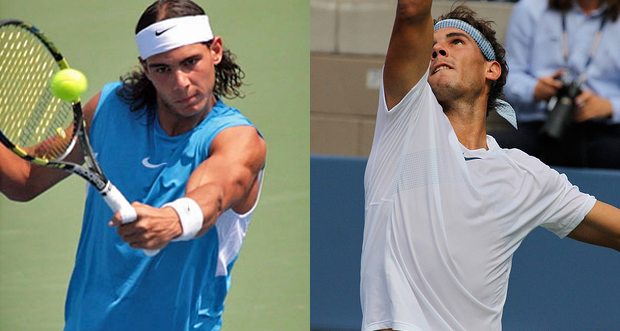
    I realize the question must seem silly and/or rhetorical, but bear with me. As I was reading through some conversations about Rafael Nadal on the Tennis Frontier discussion forums and looking at his career statistics page on Wikipedia, as I often do when discussion of a specific player comes up, I noticed something about Rafa. It is well-known that he had a meteoric rise to the top at a very young age, without the usual long developmental phase that most players go through. He went from around No. 50 in the rankings for a couple years to No. 2 the year he turned 19 years old. Think about that for a moment – that would be like 19-year-old Nick Kyrgios being the No. 2 player in the world right now, or Borna Coric next year — or Grigor Dimitrov four years ago!

    [divider]

    Click here to discuss “Has Rafa Improved Since He Was 19?” in the discussion forum.

    [divider]

    But that wasn’t anything new. The thought, or question, that came to me is whether or not, or to what degree, Rafa has improved since that amazing 2005 season? I had noticed his pattern before, but I hadn’t given much thought to it, so I decided to investigate a bit and see what the data tells us.

    Developmental Patterns
    To start, let’s compare his developmental pattern to those of the other three of the four very greatest players of the last 25 years (I’m deliberately ignoring Andre Agassi because his developmental rise–while early–was extremely unusual and fraught with “off court” issues, and I’m not looking before this era because the further back you go, the less similar the game is).

    Player: Year-end Rank From Age 18-22
    Nadal: 51, 2, 2, 2, 1
    Federer: 64, 29, 13, 6, 2
    Djokovic: 78, 16, 3, 3, 3
    Sampras: 81, 5, 6, 3, 1

    Notice how all four were ranked roughly similarly at age 18, all between No. 51 and No. 81. But starting with age 19 we can pair Rafa and Pete on one hand, and Roger and Novak on the other. The former pair went straight from the latter half of the Top 100 to the Top 5. To put that in a current context, that would be as if Borna Coric–who will finish this year ranked No. 91–rises into the Top 5, or at least Top 10 next year. We can only hope, but it seems extremely unlikely.

    Roger and Novak, on the other hand, had a kind of “beachhead” year – Roger rising to No. 29 at age 19, Novak to No. 16. Actually, Roger had a second beachhead year, finishing his age 20 season at No. 13, and a “semi-beachhead” year at age 21, finishing No. 6. Roger’s rise to greatness was notoriously gradual, at least compared to other all-time greats. He didn’t win a Slam until just before his 22nd birthday; consider that Rafa won his fourth Slam just after turning 22.

    These rankings are, of course, merely a reflection of performance, so if we look at titles Rafa was extremely successful in 2005, winning 11 titles – the most of his career. And this wasn’t a lightweight title season: not only did he win his first of nine French Opens, but he also won four Masters tournaments.

    But those were surely all clay court tournaments, right? Actually, no. Of the four Masters titles, two were on hard courts: the Rogers Cup, in which he beat a 35-year-old Andre Agassi, 16 years older than Nadal; and the Madrid Masters, the indoor hard-court version that was replaced by the Shanghai Masters in 2009. So even in 2005, Rafa was able to perform at an elite level outside of the clay courts. This was further solidified in 2006 at the Slams. After he won his second French Open that year, he was going into Wimbledon with only two second-week Slam appearances, his two Roland Garros titles. But then he made it to the Wimbledon final and the US Open quarterfinal, cementing his all-surface elite status.

    Let us turn our gaze to winning percentage. Take a look at the four players, from age 18 to 27 (I stop at 27 because all four have played through that age, and beyond isn’t really relevant):

    Here we see four subtly, but still distinctly different developmental patterns. All jumped in performance level from age 18-19. But as you can see, Rafa was pretty steady from that point onward (and off the chart is 2014, in which he had an 81% – his worst since 2004, but still roughly within range of the rest of this chart). He fluctuated, of course, but whereas the others all had some variation of rise, peak, and plateau, Rafa’s pattern has been more up and down within an early peak-plateau range. Also, notice how the 2005-14 range has no winning percentages in the 84-87 range; it is either a “down” year of 81-83 or an “up” year of 88-91.

    Roger’s is a classic curve: a steady rise, high peak, and then descent to an up-and-down late-career plateau that continues to this day. Sampras was kind of a hybrid of Nadal and Federer: a quick rise, long peak-plateau, then decline. Novak has an interesting early plateau in his early 20s, and then a rise at age 24, his legendary 2011 season.

    Putting It All Together
    So what does this data tell us? First, what it can’t tell us are all the changes to Rafa’s game, whether we’re talking micro-adjustments or larger ones. We know, for instance, that his serve improved in 2010, probably his best overall year, but then has slipped again over the last few years. But the numbers don’t tell us about his real game, the sweat and focus and will that happens on court. But what it does tell us is that regardless of how his game has changed, his overall performance level has been very similar since breaking through as an elite player in 2005 at the tender age of 19.

    That said, there is another–perhaps more nuanced–narrative that should be brought forth, which is that while he was great from 2005-07, he was still “unfinished” and, in particular, learning to establish himself off clay. His 2005 winning percentage is inflated by the fact that he played 52 matches on clay, or 58.4% of his total matches, compared to 26 in 2006 (36.6%) and 32 in 2007 (37.6%). So while his overall winning percentage dipped, a lot of that was because of fewer clay courts (although interestingly enough, his record on hards was actually better in 2005 than 2006-07).

    To continue the narrative, Rafa was still developing in 2005-07 and then came more fully into his own in 2008 at the age of 21-22, when we saw a more “complete” Rafa. This was Rafa in his prime, finally and fully. 2009 saw two bumps in the road, one being injury and the other being Robin Soderling. Yet he regained his balance in 2010, having his best year of all. And then in 2011 Novak Djokovic had a season for the ages, and while Rafa was probably just as good as he had been the previous year, he couldn’t get around Novak. In 2010 Rafa was 2-0 against the Serb, but in 2011 he was 0-5. Now here’s where it gets very interesting: If we take those matches out of his record for both years, we get the exact same record. Take a look:

    2010 – with Novak: 71-10 (88%), without Novak: 69-10 (87%)
    2011 – with Novak: 69-15 (82%), without Novak: 69-10 (87%)

    In other words, Rafa was virtually the same in 2011 as he had been in 2010; it is just that Novak had his number. Rafa turned the tables in 2012 and they’ve been relatively even since, with Rafa having a slight edge at 7-6 since 2012. Aside from his rivalry with Novak, after his injury in 2012 Rafa rose again in 2013 and then struggled in 2014.

    In summarizing Rafa’s trajectory, we see a quick rise to elite status in 2005 and then a kind of plateau as he worked on aspects of his game, rising to the very top in 2008. From that point on, he was on a higher level of play, but suffered various setbacks that reduced his overall performance level and thus lend credence to the argument that he reached his peak level in 2005 and hasn’t improved since. But I think the answer to the original question is that yes, he has improved since he was 19 in 2005, although perhaps not as much as players like Roger Federer and Novak Djokovic, both of whom have followed more traditional “curved” career patterns.

    In a way, Rafael Nadal was like some kind of Mediterranean demigod, born (nearly) fully formed, (nearly) perfect. Yet like the demigods of myth, he has suffered hardship and challenges, and the end results fluctuated with life’s trials and tribulations.

    Addendum: Rafa’s Alleged “Decline”
    Rafa’s demise has been long-prophesied but never fulfilled. He has always managed to comeback, to rise again as if from the ashes and reclaim his status as one of the very best in the game, certainly the best at times. Yet we cannot ignore the fact that time catches up to us all. Rafa turns 29 years old next year and at some point, the gentle fluctuation of his career pattern won’t rise back up from a fall in performance. I am not saying that this will happen in 2015 – in truth, I don’t think it will – but we should be prepared for it.

    While we don’t know when it will happen, there might be signs beforehand. If you take one more look at the graph above you can notice that in Rafa’s career, there have been four dips, four “downward fluctuations” – in 2006-07, 2009, 2011, and one in 2014 off the chart. But as I pointed out above, the 2006-07 dip was mainly a matter of adjusting to a less clay-heavy schedule, so in truth the only downward turns were in 2009, 2011, and 2014 – his three injury-plagued years. And therein lies the key, and this is no surprise: Can Rafa remain healthy? If he can, I see no reason why he can’t remain on top for several more years. But if not, well, for those of us over three decades of age, we all know how it gets harder and harder to recover. We can hope, though, as fans of Rafa, fans of tennis (if not fans of Roger!) that we’ll see at least one more rise to the top from the great Spanish Meteor.

    Cover Photo (Creative Commons License): James Marvin Phelps / Marianne Bevis
  • Federer Withdraws From World Tour Final; Djokovic Wins By Default

    Federer Withdraws From World Tour Final; Djokovic Wins By Default

    Roger Federer

    According to Reuters, six-time World Tour Finals champion Roger Federer has withdrawn before the final, giving Novak Djokovic his third year-end title in a row.

    The tournament’s website has posted: “His opponent, Novak Djokovic, will play a pro set (first to eight) against Andy Murray. Murray will then team with John McEnroe in a doubles exhibition against Tim Henman and Pat Cash.”

    On court, Federer said, “Unfortunately, I’m not match fit to play the match tonight. Clearly I wish it wasn’t so. I tried all year to be ready for the [Barclays] ATP World Tour Finals, and I didn’t want it to end this way. I tried everything I could last night, also today – painkillers, treatment, rest, so forth, warm-up, until the very end – but I just can’t compete at this level with Novak. It would be too risky at my age to do this right now and I hope you understand.

    “I wanted to come out personally and excuse myself. It’s been a great week for me. I played some great tennis and I love coming to The O2 and to London, and there’s been so many great memories for me here. Congrats of course to Novak, who’s played an amazing season, and an amazing tournament here as well. I hope we can play some more great matches, hopefully next year.

    “Thanks to all you guys for making it special to come out and play tennis all around the world. I know you guys travel, as well, and spend a lot of money on tickets and so forth. We really, really appreciate it – me in particular. It keeps me going, it makes me tick, especially at this age. Hopefully, I can come back next year and get another chance to compete for the title here. So thank you very much and I’ll see you soon. I appreciate it.”

    [divider]

    Click here to discuss Federer’s withdrawal from the ATP World Tour Final in the discussion forum.

    [divider]

    Cover Photo (Creative Commons License): Marianne Bevis

  • Barclays ATP World Tour Finals: Final – Order of Play & Scores

    Barclays ATP World Tour Finals: Final – Order of Play & Scores

    Roger Federer Novak Djokovic

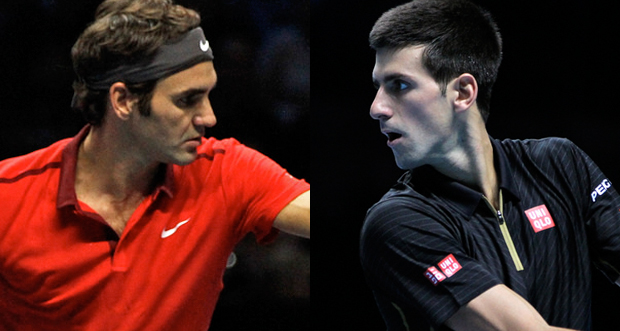
    On Sunday, November 16, in the final of the Barclays ATP World Tour Finals, World No. 1 and defending champion Novak Djokovic will face World No. 2 and six-time year-end championship winner Roger Federer. In the doubles final, the Bryan brothers will play the team of Ivan Dodig and Marcelo Melo for the title.

    [Scores added as known. All times are local.]

    [divider]

    Doubles — 3:30 P.M.
    Bryan/Bryan vs Dodig/Melo

    Singles — 6:00 P.M.
    Djokovic vs Federer

    [divider]

    Click here to discuss the Djokovic/Federer final in the discussion forum.

    [divider]

    Cover Photo (Creative Commons License): Marianne Bevis

  • Barclays ATP World Tour Finals – Semifinals – Order of Play & Scores

    Barclays ATP World Tour Finals – Semifinals – Order of Play & Scores

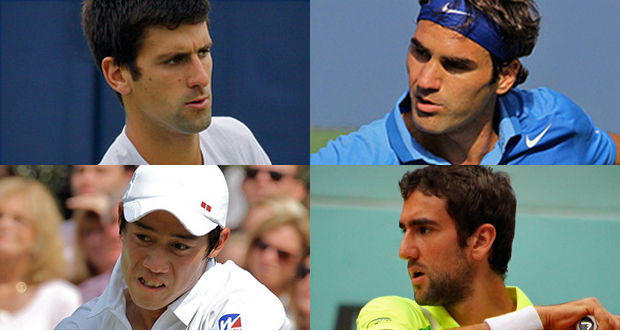
    Roger Federer Stan Wawrinka Novak Djokovic Kei Nishikori

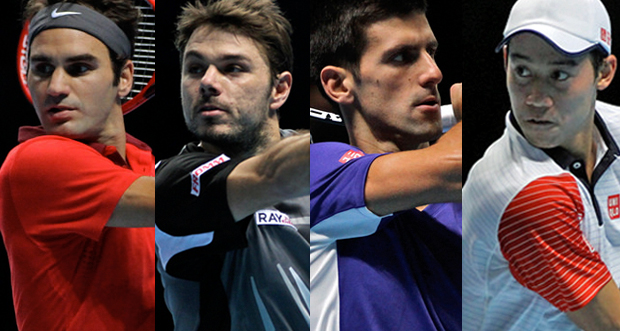
    The semifinals of the Barclays ATP World Tour Finals will take place on Saturday, November 15. The afternoon session pits Novak Djokovic, who just secured the year-end No. 1 ranking, against the US Open finalist Kei Nishikori. The evening session features 17-time Grand Slam titlist Roger Federer, who will face his compatriot Stan Wawrinka, this year’s Australian Open champion.

    [Scores added as known. All times are local.]

    [divider]

    Afternoon Session:

    Doubles — 12:00 P.M.
    Dodig/Melo d Kubot/Lindstedt — 4-6, 6-4, 10-6

    Singles — 2:00 P.M.
    Djokovic d Nishikori — 6-1, 3-6, 6-0

    [divider]

    Evening Session:

    Doubles — 6:00 P.M.
    Bryan/Bryan d Benneteau/Roger-Vasselin — 6-0, 6-3

    Singles — 8:00 P.M.
    Federer d Wawrinka — 4-6, 7-5, 7-6(6)

    [divider]

    Click here to discuss the Barclays ATP World Tour Finals semifinals in the discussion forum.

    [divider]

    Cover Photo (Creative Commons License): Marianne Bevis

  • Barclays ATP World Tour Finals – Day 6 – Order of Play & Scores

    Barclays ATP World Tour Finals – Day 6 – Order of Play & Scores

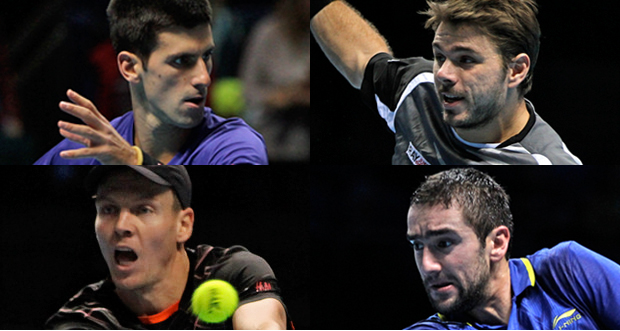
    Novak Djokovic Stan Wawrinka Tomas Berdych Marin Cilic

    Round robin play at the Barclays ATP World Tour Finals concludes on Friday, November 14. The afternoon session features World No. 1 and the defending champion Novak Djokovic, facing off against the Czech Tomas Berdych. The evening session will conclude with Australian Open champion Stan Wawrinka playing the US Open champion Marin Cilic.

    [Scores added as known. All times are local.]

    [divider]

    Afternoon Session:

    Doubles — 12:00 P.M.
    Kubot/Lindstedt d Rojer/Tecau — 6-5, 7-6(4)

    Singles — 2:00 P.M.
    Djokovic d Berdych — 6-2, 6-2

    [divider]

    Evening Session:

    Doubles — 5:45 P.M.
    Bryan/Bryan d Peya/Soares — 7-6(3), 7-6(2)

    Singles — 8:00 P.M.
    Wawrinka d Cilic — 6-3, 4-6, 6-3

    [divider]

    Click here to discuss the Day 6 matches in the discussion forum.

    [divider]

    Cover Photo (Creative Commons License): Marianne Bevis

  • Slam Results – Consistency and Era

    Slam Results – Consistency and Era

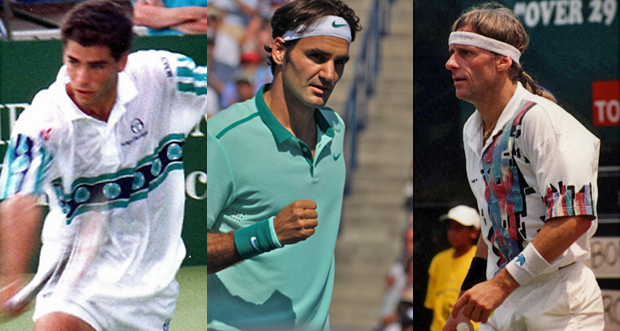
    Roger Federer Pete Sampras Bjorn Borg

    I have often been struck by how amazingly consistent some of the contemporary great players are, and how it seems they are far more consistent in terms of Slam results than in past eras. I wanted to see if my hunch was correct, so I looked at all players who had won 4+ Slams in the Open Era (except for Ken Rosewall), plus Andy Murray added in the mix (as the player currently active with the best chance at 4+ Slams). I came up with a list of 16 players, who I then checked for a few statistics: total Slams, Quarterfinal appearances, % of Slams that were QF or better, Streaks of QF appearances at Slams, and years in which the player was in the QF of all Slams he appeared in (minimum 2 appearances).

    The results were somewhat surprising. First of all, when I compared the Big Four to the previous generation of greats, namely Sampras and Agassi, but also Courier, I found that the Big Four are far more consistent. Here are those players:

    QF% (longest QF streak, years of all QF)
    Murray: 62% (15, 4)
    Djokovic: 75% (22, 5)
    Nadal: 69% (11, 4)
    Federer: 69% (36, 8)
    Sampras: 56% (11, 2)
    Agassi: 59% (6, 5)
    Courier: 36% (5, 0)

    As you can see, the recent greats–in particular Djokovic and Federer–have been more consistent. Rafa’s QF% is the same as Roger’s, but his penchant for occasionally going out earlier has reduced his overall consistency. What really stands out for me in this list are two things:  Novak’s amazing QF%, and Roger’s ridiculous streak of 36 straight Slams, plus his eight years of making at least the QF in all Slams.

    Let’s dial back to another generation plus:
    Becker: 50% (5, 1)
    Edberg: 48% (5, 1)
    Wilander: 45% (7, 2)
    Lendl: 60% (13, 5)
    McEnroe: 58% (10, 4)

    As always, Becker and Edberg are neck-and-neck. Wilander was great in spurts, but bad in other years. Lendl was remarkably consistent in a very competitive era. Overall it seems the numbers are in line with Agassi and Sampras.

    One more jump:
    Borg: 78% (12, 6)
    Vilas: 39% (8, 3)
    Connors: 72% (27, 12)
    Newcombe: 55% (8, 2)

    Clearly Borg’s numbers are skewed by his shortened career. Connors’s numbers are surprisingly good, but we need to remember that in a lot of years he (and Borg) only played two or three Slams, which is easier to make it far in every appearance.

    So while it seems that the current group of greats are historically more consistent than most eras, there’s a range across the decades, so it doesn’t seem clear that the factors of the game today allow for greater consistency (the so-called court homogeneity), or if it simply could be that the current crop is just so damn good. I imagine its a combination of both.

    What do you think?

    Click here to discuss “Slam Results – Consistency and Era” in the discussion forum.

    [divider]

  • Not In My House – Djokovic Wins a Fifth Beijing Championship

    Not In My House – Djokovic Wins a Fifth Beijing Championship

    Novak Djokovic

    Truly, it seems that with this fifth championship, Novak has made Beijing his home.  It was one of those matches where Berdych’s easy power was returned with interest as Djokovic was dialed in and hitting as well as any fan could hope.

    At 15-15 in the first game, he hit a backhand down-the-line return that was a portent of how the rest of the match would unfold.  Novak would return booming serves dropping them near (or on) the baseline.  There were some very good rallies early on, but just when you thought Berdych had a winner, it came back.

    Berdych ended the first set having landed only 48% of his first serves with two double faults.  There were few opportunities to find a foothold.  Down 0-3, he blistered a winner to get up on Djokovic at 0-30, but the Serb served his way out of trouble.  Then again at 0-4, 40-15 he had game points to get on the board.  Novak went into his Gumby defense (aided and abetted by the slower courts) and replied with a scorching backhand down-the-line winner off an excellent forehand crosscourt from Tomas.

    A few moments later he found himself down a break point, fought back to deuce, only to see it all slip away due to the laser-sharp shot-making of his opponent.  Outclassed and discouraged, Berdych’s error count surged, losing the first set without winning a game, and the first two games of the second set without winning one point.

    Berdych had his moments.  A beautiful backhand down-the-line shot at 0-3, 0-40.  In the fifth game, down 0-15, they had an incredible rally using every corner of the court.  Novak hit a sharply angled crosscourt forehand pulling Tomas off the court.  The Czech flicked his racquet for a beautiful forehand down-the-line winner to win the point.

    The people loved it.  I so appreciate the Beijing crowd.  They’re polite and attentive, but not at all jaded.  As these guys would rally, hitting one unbelievable shot after another, the oohs and aahs would get louder and louder — then they would explode when the point finished.

    Novak didn’t even blink, and fired more winners of his own.  Suddenly it was 5-0 in the second set, and Novak was serving for the championship.  Tomas was fighting to avoid eating two bagels, and managed to see his first break points of the match, capitalizing on the second to get his first game.  He then held serve for the first time all day, before Djokovic closed it out on his serve.

    It was an entertaining match for the most part, and the scoreline should take nothing away from Berdych’s play this week.  This was just one of those days when Djokovic was on his game; he even said later that it was the best final he has ever played.  It’s his house for another year.

    [divider]

    Click here to the discuss the Djokovic/Berdych final in our Discussion Forum.

    [divider]

    Cover Photo (Creative Commons License): Marianne Bevis

  • US Open Day 13: Men’s Semifinals – Order of Play & Scores

    US Open Day 13: Men’s Semifinals – Order of Play & Scores

    2014 US Open SF Men

    Novak Djokovic and Roger Federer, the #1 and #2 seeds, respectively, will be hoping to set up the anticipated re-match of the Wimbledon final.  Kei Nishikori and Marin Cilic will be hoping to spoil the party.

    The full schedule for Day 13 is listed below (Results to follow).  All times are local.

    [divider]

    Arthur Ashe Stadium — 12:00 P.M.

    Men’s Singles – Semifinals
    Kei Nishikori (JPN) (10) d. Novak Djokovic (SRB) (1) — 6-4, 1-6, 7-6(4), 6-3

    Not Before: 1:30 P.M.

    Men’s Singles – Semifinals
    Marin Cilic (CRO) (14) d. Roger Federer (SUI) (2) — 6-3, 6-4, 6-4

    Not Before: 3:00 P.M.

    Women’s Doubles – Final
    Ekaterina Makarova (RUS) (4) / Elena Vesnina (RUS) (4) d. Martina Hingis (SUI) / Flavia Pennetta (ITA) — 2-6, 6-3, 6-2

    [divider]

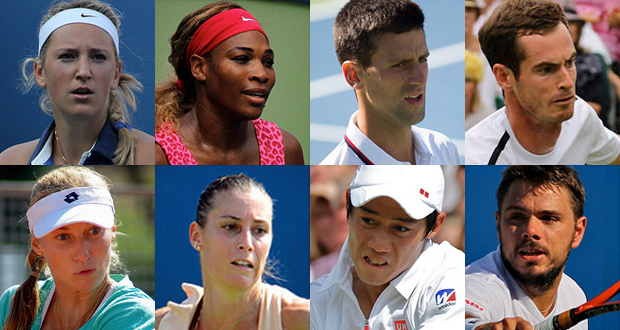
  • US Open Day 10: Men’s & Women’s Quarterfinals – Order of Play & Scores

    US Open Day 10: Men’s & Women’s Quarterfinals – Order of Play & Scores

    2014 US Open QF 1

    Day 10 brings the quarterfinal clashes in the top halves of both the women’s and men’s draws, with three former US Open champions in action.  Defending champion and overall 5 times winner here, Serena Williams, will face Flavia Pennetta, while Victoria Azarenka, last year’s finalist, will play Ekaterina Makarova.  On the men’s side, one of the matches features two former champs.  Novak Djokovic, 2011 winner and last year’s runner-up will play Andy Murray, the 2012 winner.  And this year’s Australian Open winner, Stan Wawrinka will battle Kei Nishikori for a slot in the semi-finals.

    The full schedule for Day 10 is listed below (Results to follow).  All times are local.

    [divider]

    Arthur Ashe Stadium — 11:00 A.M. 

    Mixed Doubles – Semifinals
    Abigail Spears (USA) (10) / Santiago Gonzalez (MEX) (10) d. Taylor Townsend (USA) / Donald Young (USA) — 6-3, 6-4

    Not Before: 12:30 P.M.

    Women’s Singles – Quarterfinals
    Ekaterina Makarova (RUS) (17) d. Victoria Azarenka (BLR) (16) — 6-4, 6-2

    Not Before: 3:00 P.M.

    Men’s Singles – Quarterfinals
    Kei Nishikori (JPN) (10) d. Stan Wawrinka (SUI) (3) — 3-6, 7-5, 7-6(7), 6-7(5), 6-4

    Not Before: 7:00 P.M.

    Women’s Singles – Quarterfinals
    Serena Williams (USA) (1) d. Flavia Pennetta (ITA) (11) — 6-3, 6-2

    Men’s Singles – Quarterfinals
    Novak Djokovic (SRB) (1) d. Andy Murray (GBR) (8) — 7-6(1), 6-7(1), 6-2, 6-4

    [divider]

    Louis Armstrong Stadium — 11:00 A.M.  

    Men’s Doubles – Quarterfinals
    Marcel Granollers (ESP) (11) / Marc Lopez (ESP) (11) d. Alexander Peya (AUT) (2) / Bruno Soares (BRA) (2) — 7-6(3), 6-4

    Women’s Doubles – Quarterfinals
    Kimiko Date-Krumm (JPN) / Barbora Zahlavova Strycova (CZE) d. Andrea Hlavackova (CZE) (8) / Jie Zheng (CHN) (8) — 6-3, 4-6, 6-3

    Men’s Doubles – Quarterfinals
    Ivan Dodig (CRO) (4) / Marcelo Melo (BRA) (4) d. Carlos Berlocq (ARG) / Leonardo Mayer (ARG) — 3-6, 6-4, 6-2

    Mixed Doubles – Semifinals
    Sania Mirza (IND) (1) / Bruno Soares (BRA) (1) d. Yung-Jan Chan (TPE) / Ross Hutchins (GBR) — 7-5, 4-6, 10-7

    [divider]