Tag: novak djokovic

  • Roland Garros/French Open Day 9, June 3: Scores

    Roland Garros/French Open Day 9, June 3: Scores

    [divider]

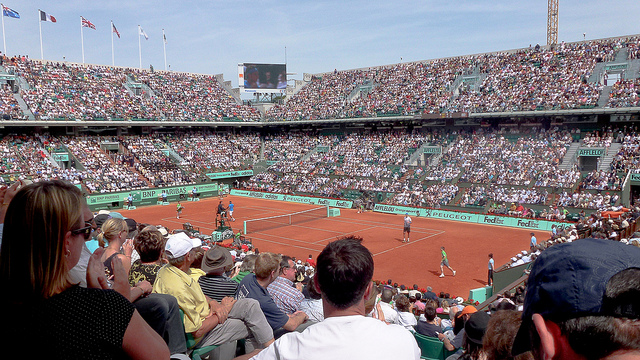
    Court Philippe Chatrier – 11:00 AM

    Victoria Azarenka (BLR) (3) def. Francesca Schiavone (ITA) 6-3 6-0

    Novak Djokovic (SRB) (1) def. Philipp Kohlschreiber (GER) (16) 4-6 6-3 6-4 6-4

    Rafael Nadal (ESP) (3) def. Kei Nishikori (JPN) (13) 6-6 6-1 6-3

    Maria Sharapova (RUS) (2) def. Sloane Stephens (USA) (17) 6-4 6-3

    [divider]

    Court Suzanne Lenglen – 11:00 AM

    Tommy Haas (GER) (12) def. Mikhail Youzhny (RUS) (29) 6-1 6-1 6-3

    Maria Kirilenko (RUS) (12) def. Bethanie Mattek-Sands (USA) 7-5 6-4

    Stanislas Wawrinka (SUI) (9) def. Richard Gasquet (FRA) (7) 6-7(5) 4-6 6-4 7-5 8-6

    Jelena Jankovic (SRB) (18) def. Jamie Hampton (USA) 6-0 6-2

    [divider]

    Court 1 – 11:00 AM

    Andrea Hlavackova (CZE) (2) / Lucie Hradecka (CZE) (2) def. Shuai Zhang (CHN) (13) / Jie Zheng (CHN) (13) 6-3 7-6(0)

    Alexander Peya (AUT) (7) / Bruno Soares (BRA) (7) def. Grigor Dimitrov (BUL) / Frederik Nielsen (DEN) 6-3 7-5

    Michael Llodra (FRA) / Nicolas Mahut (FRA) def. Treat Huey (PHI) / Dominic Inglot (GBR) 6-3 6-4

    Kristina Mladenovic (FRA) (5) / Daniel Nestor (CAN) (5) def. Katarina Srebotnik (SLO) (3) / Nenad Zimonjic (SRB) (3) 7-5 6-4

    [divider]

    Court 2 – Not Before: 12:00 PM

    Kristina Mladenovic (FRA) (10) / Galina Voskoboeva (KAZ) (10) def. Svetlana Kuznetsova (RUS) / Flavia Pennetta (ITA) 7-5 6-7(6) 6-0

    Cara Black (ZIM) / Marina Erakovic (NZL) def. Francesca Schiavone (ITA) / Samantha Stosur (AUS) 6-4 7-5

    Tomasz Bednarek (POL) / Jerzy Janowicz (POL) def. Roberto Bautista Agut (ESP) / Daniel Gimeno-Traver (ESP) 6-4 6-4

    [divider]

    Court 3 – Not Before: 12:00 PM

    Varvara Lepchenko (USA) / Saisai Zheng (CHN) def. Alla Kudryavtseva (RUS) / Anastasia Rodionova (AUS) 7-6(3) 6-3

    Sara Errani (ITA) (1) / Roberta Vinci (ITA) (1) def. Julie Coin (FRA) / Pauline Parmentier (FRA) 6-0 6-1

    Lucie Hradecka (CZE) / Frantisek Cermak (CZE) def. Natalie Grandin (RSA) / Filip Polasek (SVK)  7-6(3) 3-6 [10-5]

    Cara Black (ZIM) / Aisam-Ul-Haq Qureshi (PAK) vs. Nadia Petrova (RUS) / Juan Sebastian Cabal (COL) 7-6(5) 6-3

    [divider]

    Court 7 – 11:00 AM

    David Marrero (ESP) (8) / Fernando Verdasco (ESP) (8) def. Feliciano Lopez (ESP) / Andre Sa (BRA) 6-2 6-2

    Pablo Cuevas (URU) / Horacio Zeballos (ARG) def. Aisam-Ul-Haq Qureshi (PAK) (6) / Jean-Julien Rojer (NED) (6) 5-7 6-3 7-6(5)

    Marcel Granollers (ESP) (2) / Marc Lopez (ESP) (2) def. Juan Sebastian Cabal (COL) / Robert Farah (COL) 6-3 6-4

    Bethanie Mattek-Sands (USA) (7) / Sania Mirza (IND) (7) def. Lauren Davis (USA) / Megan Moulton-Levy (USA) 1-6 6-3 6-0

    [divider]

    Click here to discuss the Men’s Day 9 results, and more with fellow tennis fans on our discussion boards.

    Click here to discuss the Women’s Day 9 results, and more with fellow tennis fans on our discussion boards.

  • Roland Garros/French Open Day 7, June 1: Scores

    Roland Garros/French Open Day 7, June 1: Scores

    Scores will be added as known.

    [divider]

    Court Philippe Chatrier – 11:00 AM

    Victoria Azarenka (BLR) (3) def. Alize Cornet (FRA) (31) 4-6 6-3 6-1

    Maria Sharapova (RUS) (2) def. Jie Zheng (CHN) 6-1 7-5

    Rafael Nadal (ESP) (3) def. Fabio Fognini (ITA) (27) 7-6(5) 6-4 6-4

    Novak Djokovic (SRB) (1) def. Grigor Dimitrov (BUL) (26) 6-2 6-2 6-3

    [divider]

    Court Suzanne Lenglen – 11:00 AM

    Kei Nishikori (JPN) (13) def. Benoit Paire (FRA) (24) 6-3 6-7(3) 6-4 6-1

    Francesca Schiavone (ITA) def. Marion Bartoli (FRA) (13) 6-2 6-1

    Richard Gasquet (FRA) (7) def. Nikolay Davydenko (RUS) 6-4 6-4 6-3

    Jelena Jankovic (SRB) (18) def. Samantha Stosur (AUS) (9) 3-6 6-3 6-4

    [divider]

    Court 1 – 11:00 AM

    Sloane Stephens (USA) (17) def. Marina Erakovic (NZL)  6-4 6-7(5) 6-3

    Bethanie Mattek-Sands (USA) def. Paula Ormaechea (ARG) 4-6 6-1 6-3

    Tommy Haas (GER) (12) def. John Isner (USA) (19) 7-5 7-6(4) 4-6 6-7(10) 10-8

    [divider]

    Court 2 – 11:00 AM

    Anastasia Pavlyuchenkova (RUS) (11) / Lucie Safarova (CZE) (11) def. Caroline Garcia (FRA) / Mathilde Johansson (FRA) 6-2 6-4

    Michael Llodra (FRA) / Nicolas Mahut (FRA) def. Max Mirnyi (BLR) (5) / Horia Tecau (ROU) (5) 4-6 7-6(3) 7-5

    Not Before: 2:00 PM

    Maria Kirilenko (RUS) (12) def. Stefanie Voegele (SUI) 7-6(3) 7-5

    Stanislas Wawrinka (SUI) (9) def. Jerzy Janowicz (POL) (21) 6-3 6-7(2) 6-3 6-3

    [divider]

    Court 3 – 11:00 AM

    Oksana Kalashnikova (GEO) / Alicja Rosolska (POL) def. Su-Wei Hsieh (TPE) (8) / Shuai Peng (CHN) (8) 4-6 6-0 6-4

    Andrea Hlavackova (CZE) (2) / Lucie Hradecka (CZE) (2) def. Sorana Cirstea (ROU) / Ayumi Morita (JPN) 7-5 1-6 6-0

    Julien Benneteau (FRA) (13) / Nenad Zimonjic (SRB) (13) def. Pablo Andujar (ESP) / Tommy Robredo (ESP) 4-6 6-3 6-3

    Natalie Grandin (RSA) / Filip Polasek (SVK) def. Kirsten Flipkens (BEL) / Colin Fleming (GBR) 6-4 7-5

    Katarina Srebotnik (SLO) (3) / Nenad Zimonjic (SRB) (3) def. Caroline Garcia (FRA) / Marc Gicquel (FRA) 6-2 7-5

    [divider]

    Court 6 – 12:30 PM

    Treat Huey (PHI) / Dominic Inglot (GBR) def. Mikhail Elgin (RUS) / Denis Istomin (UZB) 6-3 7-6(5)

    Svetlana Kuznetsova (RUS) / Flavia Pennetta (ITA) def. Dominika Cibulkova (SVK) / Barbora Zahlavova Strycova (CZE) 6-2 6-3

    Feliciano Lopez (ESP) / Andre Sa (BRA) def. Philipp Marx (GER) / Florin Mergea (ROU) 6-2 3-6 7-6(5)

    [divider]

    Court 7 – 11:00 AM

    Ivan Dodig (CRO) (12) / Marcelo Melo (BRA) (12) def. Marc Gicquel (FRA) / Edouard Roger-Vasselin (FRA) 6-4 4-6 6-3

    Bob Bryan (USA) (1) / Mike Bryan (USA) (1) def. Eric Butorac (USA) / Jack Sock (USA) 7-5 7-6(2)

    Not Before: 2:00 PM

    Mikhail Youzhny (RUS) (29) def. Janko Tipsarevic (SRB) (8) 6-4 6-4 6-3

    Jamie Hampton (USA) def. Petra Kvitova (CZE) (7) 6-1 7-6(7)

    Philipp Kohlschreiber (GER) (16) def. Victor Hanescu (ROU) 6-0 7-6(0) 6-1

    [divider]

    Court 8 – 12:30 PM

    Sara Errani (ITA) (1) / Roberta Vinci (ITA) (1) def. Lourdes Dominguez Lino (ESP) / Garbine Muguruza (ESP) 6-3 3-6 6-2

    Hao-Ching Chan (TPE) (15) / Darija Jurak (CRO) (15) def. Silvia Soler-Espinosa (ESP) / Carla Suarez Navarro (ESP) 6-1 6-3

    Varvara Lepchenko (USA) / Saisai Zheng (CHN) def. Irina-Camelia Begu (ROU) / Magdalena Rybarikova (SVK) 3-6 7-6(9) 6-3

    Anna-Lena Groenefeld (GER) (6) / Horia Tecau (ROU) (6) def. Julie Coin (FRA) / Nicolas Mahut (FRA) 6-3 1-6 [10-5]

    [divider]

    Court 14 – 12:30 PM

    David Marrero (ESP) (8) / Fernando Verdasco (ESP) (8) def. Frantisek Cermak (CZE) / Michal Mertinak (SVK) 7-6(5) 6-3

    Cara Black (ZIM) / Marina Erakovic (NZL) def. Angelique Kerber (GER) / Andrea Petkovic (GER) 6-2 6-1

    Lucie Hradecka (CZE) / Frantisek Cermak (CZE) def. Ashleigh Barty (AUS) / Rohan Bopanna (IND) 6-4 6-4

    Su-Wei Hsieh (TPE) / Frederik Nielsen (DEN) def. Sorana Cirstea (ROU) / David Marrero (ESP) 7-6(5) 6-4

    [divider]

    Court 16 – 11:00 AM

    Vania King (USA) / Monica Niculescu (ROU) def. Mona Barthel (GER) / Liga Dekmeijere (LAT) 6-0 6-4

    Aisam-Ul-Haq Qureshi (PAK) (6) / Jean-Julien Rojer (NED) (6) def. Aljaz Bedene (SLO) / Grega Zemlja (SLO) 7-5 6-1

    [divider]

    Court 17 – 11:00 AM

    Kristina Mladenovic (FRA) (5) / Daniel Nestor (CAN) (5) def. Abigail Spears (USA) / Scott Lipsky (USA) 6-2 6-4

    Pablo Cuevas (URU) / Horacio Zeballos (ARG) def. Jurgen Melzer (AUT) (9) / Leander Paes (IND) (9) 5-7 6-4 7-6(6)

    Andreas Seppi (ITA) / Viktor Troicki (SRB) def. Paul-Henri Mathieu (FRA) / Lucas Pouille (FRA) 6-2 6-0

    Anastasia Rodionova (AUS) / Santiago Gonzalez (MEX) def. Casey Dellacqua (AUS) (7) / Mahesh Bhupathi (IND) (7) 6-4 1-6 [11-9]

    Alize Lim (FRA) / Jeremy Chardy (FRA) def. Heather Watson (GBR) / Jonathan Marray (GBR) 6-4 6-7(8) [14-12]

    [divider]

    Click here to discuss the Men’s Day 7 results, and more with fellow tennis fans on our discussion boards.

    Click here to discuss the Women’s Day 7 results, and more with fellow tennis fans on our discussion boards.

  • Roland Garros/French Open Day 5, May 30: Scores

    Roland Garros/French Open Day 5, May 30: Scores

    [divider]

    Court Philippe Chatrier – 11:00 AM

    Samantha Stosur (AUS) (9) def. Kristina Mladenovic (FRA) 6-4 6-3

    Novak Djokovic (SRB) (1) def. Guido Pella (ARG) 6-2 6-0 6-2

    Maria Sharapova (RUS) (2) vs. Eugenie Bouchard (CAN) To Finish 6-2 4-2

    [divider]

    Court Suzanne Lenglen – 11:00 AM

    Grigor Dimitrov (BUL) (26) def. Lucas Pouille (FRA) 6-1 7-6(4) 6-1

    Victoria Azarenka (BLR) (3) def. Annika Beck (GER) 6-4 6-3

    [divider]

    Court 1 – 11:00 AM

    Bethanie Mattek-Sands (USA) def. Na Li (CHN) (6) 5-7 6-3 6-2

    Benoit Paire (FRA) (24) def. Lukasz Kubot (POL) 7-6(2) 6-2 6-4

    [divider]

    Court 2 – 11:00 AM

    Kei Nishikori (JPN) (13) def. Grega Zemlja (SLO) 6-1 5-7 6-1 6-4

    Alize Cornet (FRA) (31) def. Silvia Soler-Espinosa (ESP) 6-1 6-3

    [divider]

    Court 3 – 11:00 AM

    Jelena Jankovic (SRB) (18) def. Garbine Muguruza (ESP) 6-3 6-0

    Fabio Fognini (ITA) (27) def. Lukas Rosol (CZE) 6-2 7-6(3) 2-6 6-1

    Kaia Kanepi (EST) vs. Stefanie Voegele (SUI) To Finish 6-5

    [divider]

    Court 4 – 11:00 AM

    Catalina Castano (COL) / Katalin Marosi (HUN) def. Renata Voracova (CZE) / Klara Zakopalova (CZE) 1-6 6-3 7-6(5)

    Andrea Hlavackova (CZE) (2) / Lucie Hradecka (CZE) (2) def. Alize Lim (FRA) / Aravane Rezai (FRA) 6-0 6-3

    [divider]

    Court 5 – 11:00 AM

    Jie Zheng (CHN) def. Melanie Oudin (USA) 6-3 6-1

    Irina-Camelia Begu (ROU) / Magdalena Rybarikova (SVK) def. Raquel Kops-Jones (USA) (6) / Abigail Spears (USA) (6) 1-6 6-2 7-5

    [divider]

    Court 6 – 11:00 AM

    Philipp Kohlschreiber (GER) (16) def. Yen-Hsun Lu (TPE) Walkover

    Sloane Stephens (USA) (17) def. Vania King (USA) 6-1 6-3

    Petra Kvitova (CZE) (7) def. Shuai Peng (CHN) 6-4 6-3

    Ashleigh Barty (AUS) vs. Maria Kirilenko (RUS) (12) To Finish 3-3

    [divider]

    Court 7 – 11:00 AM

    Marina Erakovic (NZL) def. Dominika Cibulkova (SVK) (16) 6-2 2-6 6-4

    Stanislas Wawrinka (SUI) (9) vs. Horacio Zeballos (ARG) To Finish 6-2 7-6(2) 3-3

    [divider]

    Court 8 – 11:00 AM

    Victor Hanescu (ROU) def. Dmitry Tursunov (RUS) 6-4 6-6(3) Ret.

    Not Before: 12:30 PM

    Varvara Lepchenko (USA) / Saisai Zheng (CHN) def. Sofia Arvidsson (SWE) / Johanna Larsson (SWE) 6-1 7-6(3)

    Sara Errani (ITA) (1) / Roberta Vinci (ITA) (1) vs. Lourdes Dominguez Lino (ESP) / Garbine Muguruza (ESP) To Finish 6-3 3-4

    [divider]

    Court 9 – 12:30 PM

    Roberto Bautista Agut (ESP) / Daniel Gimeno-Traver (ESP) def. Albano Olivetti (FRA) / Maxime Teixeira (FRA) 6-4 6-2

    Lauren Davis (USA) / Megan Moulton-Levy (USA) vs. Madison Keys (USA) / Melanie Oudin (USA) To Finish 6-4 3-6 2-1

    [divider]

    Court 10 – 11:00 AM

    Feliciano Lopez (ESP) / Andre Sa (BRA) def. Colin Fleming (GBR) (10) / Jonathan Marray (GBR) (10) 7-6(4) 6-7(3) 7-5

    Marc Gicquel (FRA) / Edouard Roger-Vasselin (FRA) vs. Daniel Brands (GER) / Frank Moser (GER) To Finish 3-6 6-3 3-1

    [divider]

    Court 11 – 12:30 PM

    Nadia Petrova (RUS) / Juan Sebastian Cabal (COL) def. Mandy Minella (LUX) / Alexander Peya (AUT) 6-4 7-5

    Vera Dushevina (RUS) / Alexandra Panova (RUS) vs. Anastasia Pavlyuchenkova (RUS) (11) / Lucie Safarova (CZE) (11) To Finish 6-4 0-1

    [divider]

    Court 14 – 11:00 AM

    Oksana Kalashnikova (GEO) / Alicja Rosolska (POL) def. Irina Buryachok (UKR) / Heather Watson (GBR) 3-6 6-4 7-5

    Treat Huey (PHI) / Dominic Inglot (GBR) def. Tobias Kamke (GER) / Florian Mayer (GER) 7-6(5) 6-4

    Kristina Mladenovic (FRA) (10) / Galina Voskoboeva (KAZ) (10) vs. Maria-Teresa Torro-Flor (ESP) / Lesia Tsurenko (UKR) To Finish 6-2 5-4

    [divider]

    Court 16 – 11:00 AM

    Nina Bratchikova (POR) / Tamarine Tanasugarn (THA) def. Jana Cepelova (SVK) / Karolina Pliskova (CZE) 6-4 7-5

    Not Before: 12:30 PM

    Janette Husarova (SVK) / Sabine Lisicki (GER) def. Eva Hrdinova (CZE) / Bojana Jovanovski (SRB) 4-6 6-1 6-4

    [divider]

    Court 17 – 11:00 AM

    Paula Ormaechea (ARG) def. Yaroslava Shvedova (KAZ) (27) 6-4 7-6(6)

    Jamie Hampton (USA) def. Anna Karolina Schmiedlova (SVK) 7-5 6-2

    [divider]

    Click here to discuss the Men’s Day 5 results, and more with fellow tennis fans on our discussion boards.

    Click here to discuss the Women’s Day 5 results, and more with fellow tennis fans on our discussion boards.

  • Roland Garros/French Open Day 3, May 28: Scores

    Roland Garros/French Open Day 3, May 28: Scores

    [divider]

    Court Philippe Chatrier – 11:00 AM

    Marion Bartoli (FRA) (13) def. Olga Govortsova (BLR) 7-6(8) 4-6 7-5
    Novak Djokovic (SRB) (1) def. David Goffin (BEL) 7-6(5) 6-4 7-5

    [divider]

    Court Suzanne Lenglen – 11:00 AM

    Tommy Haas (GER) (12) def. Guillaume Rufin (FRA) 7-6(4) 6-1 6-3
    Alize Cornet (FRA) (31) def. Maria Joao Koehler (POR) 7-5 6-2
    Benoit Paire (FRA) (24) vs. Marcos Baghdatis (CYP) To Finish 3-6 7-6(1) 4-3

    [divider]

    Court 1 – 11:00 AM

    Samantha Stosur (AUS) (9) def. Kimiko Date-Krumm (JPN) 6-0 6-2
    Nikolay Davydenko (RUS) def. Florent Serra (FRA) 6-3 6-4 7-5
    Stanislas Wawrinka (SUI) (9) def. Thiemo De Bakker (NED) 7-5 6-3 6-7(1) 7-5

    [divider]

    Court 2 – 11:00 AM

    Jelena Jankovic (SRB) (18) def. Daniela Hantuchova (SVK) 6-4 7-6(7)
    Kristina Mladenovic (FRA) def. Lauren Davis (USA) 6-0 7-5
    Fernando Verdasco (ESP) def. Marc Gicquel (FRA) 6-2 6-3 6-1

    [divider]

    Court 3 – 11:00 AM

    Jack Sock (USA) def. Guillermo Garcia-Lopez (ESP) 6-2 6-2 7-5
    Philipp Kohlschreiber (GER) (16) def. Jiri Vesely (CZE) 7-6(3) 1-6 7-5 6-2

    [divider]

    Court 4 – 11:00 AM

    Federico Delbonis (ARG) def. Julian Reister (GER) 6-7(2) 6-1 6-0 6-4
    Silvia Soler-Espinosa (ESP) def. Irina-Camelia Begu (ROU) 6-3 6-2

    [divider]

    Court 5 – 11:00 AM

    Yaroslava Shvedova (KAZ) (27) def. Coco Vandeweghe (USA) 6-0 3-6 6-2
    Guido Pella (ARG) def. Ivan Dodig (CRO) 4-6 6-4 6-3 2-6 12-10

    [divider]

    Court 6 – 11:00 AM

    Victor Hanescu (ROU) def. Bernard Tomic (AUS) 7-5 7-6(8) 2-1 Ret.
    Denis Istomin (UZB) def. Florian Mayer (GER) (28) 4-6 6-3 7-5 Ret.
    Marina Erakovic (NZL) def. Elena Baltacha (GBR) 6-3 6-0

    [divider]

    Court 7 – 11:00 AM

    Lucas Pouille (FRA) def. Alex Kuznetsov (USA) 6-1 7-6(2) 6-2
    Philipp Marx (GER) / Florin Mergea (ROU) def. Gael Monfils (FRA) / Josselin Ouanna (FRA) 6-3 7-6(4)
    Lukasz Kubot (POL) vs. Maxime Teixeira (FRA) To Finish 6-4 5-7 3-1

    [divider]

    Court 8 – 11:00 AM

    Mariana Duque-Marino (COL) def. Kristyna Pliskova (CZE) 6-2 6-0
    Mariusz Fyrstenberg (POL) (16) / Marcin Matkowski (POL) (16) def. Jan Hajek (CZE) / Radek Stepanek (CZE) 7-5 6-3
    Vasek Pospisil (CAN) vs. Horacio Zeballos (ARG) To Finish 6-7(9) 4-6 7-6(4) 4-1

    [divider]

    Court 10 – 11:00 AM

    Alexander Peya (AUT) (7) / Bruno Soares (BRA) (7) def. James Cerretani (USA) / Lukas Lacko (SVK) 6-2 3-6 6-1
    Frantisek Cermak (CZE) / Michal Mertinak (SVK) def. Benjamin Becker (GER) / Philipp Petzschner (GER) 6-2 2-1 Ret.
    Juan Sebastian Cabal (COL) / Robert Farah (COL) def. Xavier Malisse (BEL) / Ken Skupski (GBR) 6-4 4-6 6-3

    [divider]

    Court 11 – 11:00 AM

    Aljaz Bedene (SLO) / Grega Zemlja (SLO) def. Lukas Dlouhy (CZE) / Rajeev Ram (USA) 4-6 6-4 6-4
    Christopher Kas (GER) / Oliver Marach (AUT) def. Robin Haase (NED) / Igor Sijsling (NED) 6-7(5) 6-4 6-3
    Tomasz Bednarek (POL) / Jerzy Janowicz (POL) def. Mahesh Bhupathi (IND) (4) / Rohan Bopanna (IND) (4) 7-5 6-4

    [divider]

    Court 14 – 11:00 AM

    Mikhail Youzhny (RUS) (29) def. Pablo Andujar (ESP) 4-6 6-4 6-2 6-3
    Jonathan Erlich (ISR) / Andy Ram (ISR) def. Daniele Bracciali (ITA) (14) / Fabio Fognini (ITA) (14) 7-6(3) 6-4

    [divider]

    Court 16 – 11:00 AM

    Dmitry Tursunov (RUS) def. Alexandr Dolgopolov (UKR) (22) 7-6(7) 6-4 7-6(7)
    Jurgen Melzer (AUT) (9) / Leander Paes (IND) (9) def. Pierre-Hugues Herbert (FRA) / Nicolas Renavand (FRA) 6-3 6-3
    Dominika Cibulkova (SVK) (16) def. Lesia Tsurenko (UKR) 6-1 6-4

    [divider]

    Court 17 – 11:00 AM

    Grigor Dimitrov (BUL) (26) def. Alejandro Falla (COL) 6-4 1-0 Ret.
    Yen-Hsun Lu (TPE) def. Simone Bolelli (ITA) 6-4 6-4 2-1 Ret.
    Bob Bryan (USA) (1) / Mike Bryan (USA) (1) def. Jonathan Eysseric (FRA) / Fabrice Martin (FRA) 6-3 6-4

    [divider]

    Click here to discuss the Men’s Day 3 results, and more with fellow tennis fans on our discussion boards.

    Click here to discuss the Women’s Day 3 results, and more with fellow tennis fans on our discussion boards.

  • Djokovic: 2011-13…signs of concern?

    Djokovic: 2011-13…signs of concern?

    OK, I’m exaggerating but it got your attention! That said, while I don’t think anyone expected Novak to ever have a year like 2011 again (few players have), it seems that he’s even a step behind 2012, at least to date.

    First of all, it should be noted that Nadal is now #1 in the Race to London rankings – despite missing the Australian Open. But let’s take a look at Novak’s performances in the last three years through Rome:

    2011:
    Slams: W
    ATP 1000: W, W, A, W, W

    2012:
    Slams: W
    ATP 1000: SF, W, F, QF, F

    2013:
    Slams: W
    ATP 1000: SF, 4R, W, 2R, QF

    So as you can see, his ATP 1000 record is quite diminished; as in 2012, he had a W, SF, and QF, but in 2012 he had two Final losses to a 4R and 2R loss in 2013. That’s the difference.

    A cause for concern? I don’t think so. But A) I do think that Rafa needs to be taken seriously for the #1 ranking this year, and B) The gap between Novak and everyone else might not be as large as previously thought. In 2011 he was the clear #1, last year he and Federer were about even, and this year it seems that he and Rafa are going to duke it out for best in the game.

    If Rafa wins Roland Garros it should be a very interesting dog-fight to the finish. Rafa would really need to win Wimbledon as well, which he has a better chance at than the US Open. If Novak wins one of the French Open or Wimbledon I think he’s got it.

    Click here to discuss this and more on our Tennis Forums

  • Mens French Open Draw: Djokovic and Nadal destined to meet in semis.

    Mens French Open Draw: Djokovic and Nadal destined to meet in semis.

    Defending French Open champion Rafael Nadal was drawn in the same half as Word Number 1 Novak Djokovic today at Roland Garros.

    A dream final between the two is no longer possible with the pair destined to clash in semi-finals should they navigate the earlier rounds.

    The full draw is as follows:

    QUARTER 1:

    Novak Djokovic (SRB) (1)
    David Goffin (BEL)

    Ivan Dodig (CRO)
    Guido Pella (ARG)

    Alex Kuznetsov (USA)
    Lucas Pouille (FRA)

    Alejandro Falla (COL)
    Grigor DiMitrov (BUL) (26)

    Alexandr Dolgopolov (UKR) (22)
    Dmitry Tursunov (RUS)

    Bernard Tomic (AUS)
    Victor Hanescu (ROU)

    Simone Bolelli (ITA)
    Yen-Hsun Lu (TPE)

    Qualifier
    Philipp Kohlschreiber (GER) (16)

    Tommy Haas (GER) (12)
    Guillaume Rufin (FRA)

    Qualifier
    Guillermo Garcia-Lopez (ESP)

    Andrey Kuznetsov (RUS)
    Ryan Harrison (USA)

    Carlos Berlocq (ARG)
    John Isner (USA) (19)

    Mikhail Youzhny (RUS) (29)
    Pablo Andujar (ESP)

    Federico Delbonis (ARG)
    Qualifier

    Fernando Verdasco (ESP)
    Marc Gicquel (FRA)

    Nicolas Mahut (FRA)
    Janko Tipsarevic (SRB) (8)

    [divider]

    QUARTER 2:

    Rafael Nadal (ESP) (3)
    Daniel Brands (GER)

    Martin Klizan (SVK)
    Michael Russell (USA)

    Qualifier
    Lukas Rosol (CZE)

    Qualifier
    Fabio Fognini (ITA) (27)

    Benoit Paire (FRA) (24)
    Marcos Baghdatis (CYP)

    Lukasz Kubot (POL)
    Qualifier

    Grega Zemlja (SLO)
    Santiago Giraldo (COL)

    Jesse Levine (CAN)
    Kei Nishikori (JPN) (13)

    Stanislas Wawrinka (SUI) (9)
    Thiemo De Bakker (NED)

    Qualifier
    Horacio Zeballos (ARG)

    Kenny De Schepper (FRA)
    Robin Haase (NED)

    Albert Ramos (ESP)
    Jerzy Janowicz (POL) (21)

    Florian Mayer (GER) (28)
    Denis Istomin (UZB)

    Florent Serra (FRA)
    Nikolay Davydenko (RUS)

    Qualifier
    Qualifier

    Sergiy Stakhovsky (UKR)
    Richard Gasquet (FRA) (7)

    [divider]

    QUARTER 3:

    Tomas Berdych (CZE) (5)
    Gael Monfils (FRA)

    Ernests Gulbis (LAT)
    Rogerio Dutra Silva (BRA)

    Igor Sijsling (NED)
    Jurgen Melzer (AUT)

    Jurgen Zopp (EST)
    Tommy Robredo (ESP) (32)

    Andreas Seppi (ITA) (20)
    Leonardo Mayer (ARG)

    Blaz Kavcic (SLO)
    Qualifier

    Martin Alund (ARG)
    Edouard Roger-Vasselin (FRA)

    Qualifier
    Nicolas Almagro (ESP) (11)

    Milos Raonic (CAN) (14)
    Xavier Malisse (BEL)

    Qualifier
    Michael Llodra (FRA)

    Qualifier
    Evgeny Donskoy (RUS)

    Qualifier
    Kevin Anderson (RSA) (23)

    Marcel Granollers (ESP) (31)
    Feliciano Lopez (ESP)

    Joao Sousa (POR)
    Go Soeda (JPN)

    Qualifier
    Albert Montanes (ESP)

    Marinko Matosevic (AUS)
    David Ferrer (ESP) (4)

    [divider]

    QUARTER 4:

    Jo-Wilfried Tsonga (FRA) (6)
    Aljaz Bedene (SLO)

    Jarkko Nieminen (FIN)
    Paul-Henri Mathieu (FRA)

    Roberto Bautista Agut (ESP)
    Gilles Muller (LUX)

    Benjamin Becker (GER)
    Jeremy Chardy (FRA) (25)

    Juan Monaco (ARG) (17)
    Daniel Gimeno-Traver (ESP)

    Viktor Troicki (SRB)
    James Blake (USA)

    Radek Stepanek (CZE)
    Nick Kyrgios (AUS)

    Philipp Petzschner (GER)
    Marin Cilic (CRO) (10)

    Gilles Simon (FRA) (15)
    Lleyton Hewitt (AUS)

    Adrian Mannarino (FRA)
    Pablo Cuevas (URU)

    Jan Hajek (CZE)
    Qualifier

    Lukas Lacko (SVK)
    Sam Querrey (USA) (18)

    Julien Benneteau (FRA) (30)
    Ricardas Berankis (LTU)

    Tobias Kamke (GER)
    Paolo Lorenzi (ITA)

    Qualifier
    Qualifier

    Qualifier
    Roger Federer (SUI) (2)

    Click here to discuss the French Open draw, and more with fellow tennis fans on our discussion boards.

  • Inside Out: The Era of Forehand and Movement

    Inside Out: The Era of Forehand and Movement

    As Rafael Nadal and Roger Federer prepared for their thirtieth meeting, a familiar sense of nostalgia grew inside tennis fans. Still very much among the top three best players in the game – rankings notwithstanding – Federer and Nadal were once the undisputed rulers of the tennis world. They’ve given us classics, drama, and dominance, and their rivalry transcended the sport. Despite the lack of animosity, it has been so universally appealing in large part due to the contrast in styles. Beyond how they look, dress, and act, it was the way they play that was so different, and therefore, so captivating.

    And yet, despite the multiple nuances in their games, the different attributes, and the very few weaknesses, both Federer and Nadal made a living off one particular weapon – the forehand. Their games couldn’t be more different: Federer was always more complete, more aggressive-minded, had a better serve, took more offensive court positioning, and attacked the net; Nadal was a one-of-a-kind physical specimen, a defensive wall, stood farther behind the baseline, and took control of points through engaging in longer rallies where he would gradually wear out his opponent. None of that changes the fact that, regardless of the adjustments they’ve made throughout the years – Nadal has become more aggressive and well-rounded; Federer had to readjust some aspects of his game to better operate with age – when push came to shove, they cemented their spots in tennis history due to their respective forehands.

    Like the rest of their games, their forehands bore very few similarities: Different grips, different spins, and a different follow-through. And yet, whether Federer was running around his backhand to hit an inside out winner, or Nadal was pummeling his opponent’s weaker wing relentlessly, the result was often the same. In what will inevitably go down as the “Fedal era,” one of the most memorable phases in tennis history will be defined by one shot.

    Increased racquet technology, homogenization of the surfaces, and the rise of a new breed of phenomenal athletes have altered the game considerably, with serve and volley taking a backseat to a noticeable shift towards baseline tennis. The change has been characterized by a strong emphasis on the forehand. In fact, it is hardly a coincidence that the last couple of world number one’s before the Federer era were Juan Carlos Ferrero and Andy Roddick, two men who, in their heyday, possessed two of the most lethal forehands on tour. And yet, fearsome as those shots were, they paled by comparison to the brilliance that the Swiss Maestro’s racquet would later produce.

    Simply put, Roger Federer’s forehand revolutionized the sport. Widely tipped to be the greatest ground stroke in tennis history, Federer re-set the standards of what constitutes a world-class forehand. It wasn’t merely his ability to fire winners off that side that set him apart – after all, James Blake, Fernando Gonzalez, and Andy Roddick hardly struggled to rip out inside-out bullets – but rather, Federer’s combination of power, spin, versatility, taking the ball early, and the ability to hit it on the run that made him a nightmare to deal with.

    None of this would be possible had it not been for Federer’s most characteristic trait: his otherworldly movement. Federer’s ability to glide effortlessly on a tennis court was poetry in motion. He always put himself in perfect position to take the ball precisely when he meant to, and the results were devastating. The mixture of movement, precision, and taking the ball on the rise rendered his forehand near unplayable. Lleyton Hewitt had laid the foundations a couple of years earlier by running circles around his opponents, but he lacked the necessary weapons and offensive tools. Federer, on the other hand, didn’t.

    In fairness, cat-like quickness wasn’t exclusive to Federer, as the man who previously dominated the world of tennis, Pete Sampras, remains one of the best athletes the sport has ever seen. Meanwhile, the likes of Davydenko, Blake, the above mentioned Hewitt, and others were all great movers in their own right. However, Federer’s footwork was so utterly unique in its fluidity, quickness, smoothness, and efficiency.

    Then came Rafael Nadal, arguably the greatest pure athlete in tennis history. He redefined the word “speed,” covered every inch of the court like nobody before him, displayed unprecedented levels of explosiveness, and showed a level of physicality that no one else could match. When he first burst onto the scene, Nadal’s game was, to put it bluntly, fairly limited. His serve was harmless, his backhand was solid but, ultimately, did little offensive damage — beyond the trademark open-stance passing shots — and his return of serve was meant to neutralize points above anything else (which applies even today).

    If there is a prime example of how great movement and an elite forehand dominate today’s men’s game, it’s Nadal. Better than anyone in history, he was able to mask his weaknesses with a dominant forehand and unparalleled movement. Even more so than Federer, Nadal based much of his game around running around his backhand wing. However, the Spaniard lacked his rival’s serve and variety, making his forehand an even more integral part of his game.

    His entire early success is attributed almost entirely to his forehand and movement. Even as his game developed into something far more polished, Nadal’s bread-and-butter remained intact. Unlike anyone else, Federer included, Nadal is able to find his forehand wing time and time again. The amount of effort required to run around his backhand at every possible opportunity meant the Mallorcan had to work particularly hard in each rally, but Nadal was all too willing to make the effort. Like Federer, his forehand is actually deadlier from his backhand wing, where he can put it pretty much anywhere on the court. Once Nadal is able to find a forehand early in the rally, unless your name was Novak Djokovic, Nikolay Davydenko, and a select others, you weren’t wrestling the point away from him.

    No Title

    No Description

    The man who ultimately broke the Fedal monopoly was, unsurprisingly, Novak Djokovic. Long tipped to be the future of tennis, the Serb may have differed from his great rivals in that he possessed one of the best backhands the games has ever seen — a shot many deem to be his strongest. However, it wasn’t until Djokovic recaptured the magic on his forehand side that he became the world’s finest player. Following a very strong 2008, Djokovic’s results became increasingly inconsistent. The reasons were numerous, from struggles with fitness, focus, and serve, but above all else, it was his forehand that grew more erratic, and the results underwhelmed accordingly.

    Djokovic moves as well as anyone on a tennis court, but the quality of his backhand provides him with far more options, therefore, he doesn’t need to run around that shot as frequently as Federer and Nadal. And yet, you often see him doing just that these days, to great effect. Good as his backhand is, the basic mechanics of the forehand mean he has more options off that wing. Additionally, Djokovic’s backhand being his better shot often clouds the fact that his forehand is easily one of the best on tour, and when playing well, it is the side that does the bigger damage. Yes, it remains the shot that is more likely to break down and fail him when things go south, as opposed to his always rock solid backhand, but offensively, it is slowly becoming his most potent shot.

    A quick look at today’s top 10 players shows just how essential it is to possess a great forehand. Beyond the aforementioned players, almost all of the world’s elite players share a world-class forehand: Ferrer, Berdych, Tsonga, Del Potro, etc. Naturally, there are exceptions, but even those, quite ironically, reinforce the rule. Richard Gasquet, for instance, was initially thought to be destined for greatness, only to fail to live up to the hype, in large part due to his unreliable forehand. Even previous one-of-a-kind shot-makers like Nalbandian and Davydenko occasionally suffered due to an inconsistent forehand.

    The most notable aberration, of course, is current world number 2, Andy Murray. Far from being a bad shot, Murray’s forehand remains nevertheless below the level of Federer, Nadal, or Djokovic. However, the Brit is able to make amends through fantastic movement, tennis IQ, tactical awareness, counter-punching, and a backhand that is easily among the very best in the men’s game. Nevertheless, it is hard not to attribute some of his shortcomings to his main rivals’ ability to expose his forehand. Djokovic has repeatedly dominated Murray in forehand-to-forehand cross-court exchanges and drew short replies, Nadal’s flattened-out cross-court backhands and inside out forehand have historically troubled Murray on faster surfaces — surprisingly enough — while Federer’s offensive onslaught has robbed Murray of three additional grand slam titles to his resume.

    A quick glance at the current crop of up-and-coming players shows no real candidate that fits the description of a modern day champion — a great mover with a world-class forehand. For now, at least, the status quo at the top of the men’s game seems safe.

    Click here to discuss this and more with fellow tennis fans on our discussion boards.
  • Rome, Rome, go away

    Rome, Rome, go away

    In a stunning upset, Novak Djokovic, the No. 1 seed, was beaten in the quarterfinals of the Italian Open by the Czech Tomas Berdych 2-6, 7-5, 6-4.

    The Serb won the first set comfortably. In the second, he was up 5-2, serving for the match, just two points from victory, when things fell apart.

    Djokovic had his chances in the third set, but Berdych held strong. It was only his second win against Djokovic, and the first since 2010.

    Click here to discuss this and more with fellow tennis fans on our discussion board.

  • Dimitrov shocks Djokovic in Madrid

    Dimitrov shocks Djokovic in Madrid

    Twenty-one-year-old Bulgarian Grigor Dimitrov defeated World Number 1 Novak Djokovic in the second round of the Mutua Madrid Open, prevailing 7-6 (8-6), 6-7 (8-10), 6-3 in a shock upset.

    A tight first set saw the young Bulgarian save a set point at 5-4, with Djokovic sportingly challenging a poor line call on behalf of his opponent. Dimitrov held serve before going on to clinch the tiebreaker, where he had to save further set points coming from 4-6 down to win the breaker 8-6.

    The second set was equally hard fought, with both players exchanging breaks before the Serb #1 won a closely contested tiebreak (10-8).

    Heading into the third set decider, the momentum was with Djokovic, but only very briefly. Roared on by the Spanish crowd, Dimitrov made his big statement, breaking Djokovic early, and hanging on to take the set 6-3, claiming his biggest career scalp to date.

    Dimitrov, an accomplished junior who won both the US Open and Wimbledon junior titles in 2008, has long been considered a future star of the sport. Recently, he laid down a marker of intent by pushing Rafael Nadal all the way in a tough match in Monte Carlo.

    Today he went one better, in what will be seen as a significant breakthrough.

    Click here to discuss this and more with fellow tennis fans on our discussion board.

  • The (King Of) Clay Season

    The (King Of) Clay Season

    It’s that time of the year again. The sun is shining over Europe – at least in theory – and the tennis season heats up accordingly. To many, it’s the most fascinating part of the tennis calendar. More exciting yet is the fact that in many ways, the energy of the European clay court season doesn’t necessarily culminate at the French Open. Instead, it extends itself to the grass courts of Wimbledon, which, due to the unfortunate lack of proper “grass court season,” seems to have become the climax of the European spring/summer, and a natural expansion of the clay season — as if the sport’s most prestigious tournament needed added cachet.

    Beyond the changes in continents, seasons, and scenery, the clay season has, for the longest time, marked a momentary shift in dynamics at the top of men’s tennis. Serves were suddenly returned with more frequency, rallies extended, players sliding all over the baseline, umpires abandoning the comfort of their chairs to examine ball marks, and the term “specialist” coined with near tiresome regularity. Most noticeably, the dominant forces were no longer quite as supreme once their feet hit the dirt. That’s when you knew that for about three months or so, the tennis world would be different. At some point in the 90’s, clay court tennis nearly became its own entity.

    The homogenization of the courts at the turn of the millennium made the change a little less extreme, and baseline tennis gradually became an all-surface norm. That, however, did not spell an end to the clay-induced hierarchical restructures at the top of the game. Like Pete Sampras before him, Roger Federer, the new tennis golden boy, struggled to make his mark on the red stuff early on. And while the number of true “specialists” around him was slowly decreasing, he was soon left with a far greater challenge to surmount. As Federer finally began to adapt his game to the courts he reportedly grew up on, a new specialist emerged – one so good that he exceeded the term itself; one whose game (and results) was too good to be that of a mere specialist. A king of clay had emerged, and the clay court season became the time of the year when Rafael Nadal sits, runs, grunts, and slides his way across his clay-covered throne.

    It didn’t matter whether Federer was enjoying near unthinkable runs of dominance, Novak Djokovic was breaking out in spectacular fashion to win his first Grand Slam, or Nadal himself was riding eleven months title droughts, come the Monte Carlo Masters, the Spanish bull was the man to beat. In fact, at some point, he became the man to avoid, as other top players made it a habit to skip the tournament altogether. In fairness, their decisions were certainly motivated by other, more important factors, but the inevitability of the outcome couldn’t have helped. Eventually, Rafael Nadal winning the tournament year after year ceased being special, despite the outrageous nature of the accomplishment. It simply became the tournament where Nadal reminded the world who the winner of the next major was going to be, just in case they’d forgotten.

    Nadal’s near absolute dominance on the surface was not without the occasional blemish, but his very few clay court losses were considered to be anomalies. Any intrigue created by his loss to Federer at Hamburg in 2007 was quickly killed off three weeks later when he vanquished his rival in Paris once more, while his shocking 2nd round exit in Rome the following year was largely blamed on blisters, with next to no mention of the man who beat him (it was Juan Carlos Ferrero, just in case you’re wondering). And why wouldn’t people so easily dismiss his losses when Nadal made sure to quickly restore order at the following tournament? His 2009 loss to Federer in Madrid received similar treatment, with Federer himself quickly playing down the significance of his win. After all, we had seen Federer and Nadal square off in enough French Open finals to know how their eventual meeting was going to unfold.

    Then, that loss happened. On a surreal Sunday afternoon in Paris, Robin Soderling produced what could well be the biggest upset in tennis history and handed Nadal his first loss at Roland Garros. The world was in shock, and it took Roger Federer finally completing his career slam to provide the tennis universe with a different subject to touch on, before the attention shifted back to Nadal once again when the words “knee injury” were uttered. The clay court season, as if there was any doubt, had become the Nadal season, in triumph or disaster. He was the one constant variable; the man whose wins are praised, and losses overshadow other players’ victories.

    In fact, 2009 was the year that proved just how reluctant we are to accept change. We might openly yearn for it or secretly wish it, but we only want it on our terms. There is a reason the post-Sampras/pre-Federer days are not remembered fondly. For as much as many complain about a status quo, they prefer it to chaos. People might enjoy upsets when they happen, but they want official “passing of the torch” moments, as opposed to “flukes.” People so willingly accepted Nadal as the best player in the world following his 2008 Wimbledon final triumph over Federer because they knew he was here to stay, and had already seen the signs a year before. We desire big picture narratives – moments which we look back on and pinpoint as an official changing of the guard, as opposed to wondering, “How the hell did he lose to that guy?”

    The neutrals wouldn’t want Nadal to dominate on clay forever, how could they? But as exciting as huge upsets are, they generally mean little in the long run. Those who wish for Nadal’s clay court dominance to cease would likely prefer to see the King of Clay removed from his throne, as opposed to momentarily pushed aside. When Nadal bounced back the following year to storm through the clay court season undefeated, the tennis world almost collectively embraced the familiarity of it all. Nadal stomped Soderling in the French Open final, the previous year’s debacle was put to rest, and all was right in the world.

    Enter Novak Djokovic…

    The man tipped to be Fedal’s (that’s Federer and Nadal, for the two of you who are unfamiliar with the term) successor for three years had finally gotten back on track, and this time, he wasn’t going anywhere. An unprecedented start to the season saw Djokovic clinch every tournament he participated in, and racked up a combined five victories over Federer and Nadal in the process, but the big question remained whether his dominance would translate to clay. Djokovic chose to skip Monte Carlo, and Nadal was handed his usual winner’s trophy and shook Prince Albert’s hand for the umpteenth time. However, two clay court victories over Nadal later, Djokovic had shown he meant business. He was far and away the best player in the world, and entered the French Open with a gigantic wave of momentum. For the first time in six years, Rafael Nadal was not the overwhelming favorite to win Roland Garros.

    And yet, as always, when it comes to attention and headlines, the clay court season remained all about Nadal. As Djokovic was silently making quick work of his early round opponents, Nadal was conducting melodramatic press conferences in which he was asked to make sense of his losses to Djokovic as well as going five sets (for the first time ever at Roland Garros) with big serving American John Isner. Nadal bizarrely sounded like a man burned out with tennis, and it looked increasingly likely that Djokovic would strike a lethal blow. Unfortunately for the Serb, a cruel twist of irony would dictate otherwise, as Roger Federer rolled back the years with a breathtaking display to bring Djokovic’s winning streak to a halt, essentially handing Nadal another “Coupe de Mousquetaires” in the process. Sure enough, Nadal was taking a trademark bite off of his favorite trophy two days later. The following year, Nadal enjoyed a far more peaceful European spring, steamrolling through the competition in typical fashion, while recording three victories over Djokovic to boot. The King of Clay was not to be dethroned yet.

    While injury soon put Nadal on shelf for seven months, a strong return indicated that the Spaniard would be picking up right where he left off. After a great display at Indian Wells and a wise scheduling choice to skip Miami, Nadal entered the Monte Carlo Masters as a strong favorite. Uncertainty surrounding Novak Djokovic’s participation due to an ankle injury further intensified Nadal’s status, but a sensational display in the final reminiscent of their 2011 matches saw Djokovic become the first man in nine years to hand Nadal a defeat in Monte Carlo. To state the obvious: the win was monumental.

    For the next month, this will be Nadal’s season. His wins will be cherished, his losses will be over-analyzed, and his comments will be beaten to death. However, more so than any other time, his status as the undisputed King of Clay is in jeopardy. If Djokovic is able to replicate his 2011 wins over Nadal at the upcoming Masters 1000 events, it could officially spell the end of an era. People might be reluctant to accept change, but for the past two years, Novak Djokovic has given them little choice but to. If the world number one finally puts an end to Nadal’s French Open monopoly, the changing of the guard that first started on other surfaces in 2011 would be completed at last. One could think of easier tasks, though…

    Click here to discuss this and more with fellow tennis fans on our discussion boards.