Tag: novak djokovic

  • Tracking All Those Streaks

    Tracking All Those Streaks

    Shanghai Masters, Final

    (1) Djokovic d. (6) del Potro, 6-1, 3-6, 7-6(3)

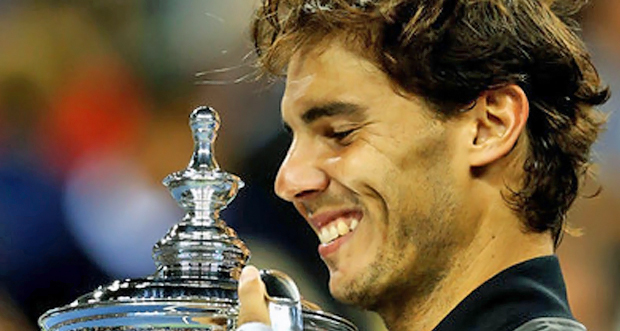
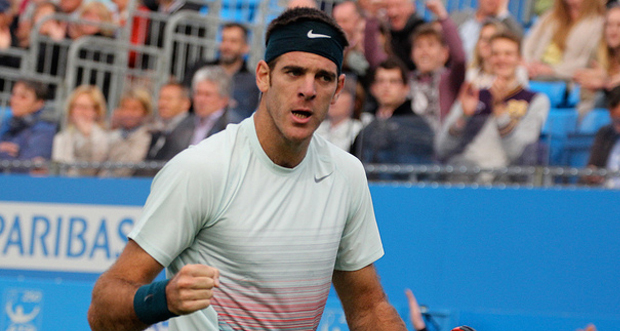
    Novak Djokovic this evening won his second straight Shanghai title, and fifteenth Masters title overall. It was also his twentieth consecutive victory in China. He was of course thrilled, though it’s tough to ascertain which particular achievement meant the most to him. Perhaps, in the moment, it was just winning this one fine match. Either way, it’s hard to quell one’s sense of scepticism when he insists that losing the No. 1 ranking has not steeled his resolve. It’s also hard not to feel sympathetic towards Juan Martin del Potro, who fell agonisingly short of claiming his first Masters title, and didn’t seem consoled by the knowledge that he’s never looked closer. His runner-up streak at this level now stands at three.

    Djokovic this week also extended his winning streak against Frenchman to twenty-eight, despite Gael Monfils’s best efforts to abbreviate it. There was also a two-game period in the first set of the first semifinal when Jo-Wilfried Tsonga looked threatening, and really showed us what he can do. He was out-rallying Djokovic from the backhand, pushing him around with his forehand, and moving beautifully. Then came a much longer stretch of games in which Tsonga demonstrated that he can’t do it often or for long enough. Thus was dispelled any  lingering mystery of why he isn’t ranked No. 1 or 2 in the world, and has yet to claim a Major.

    Djokovic, on the other hand, is ranked No. 1 or 2 in the world, and was hardly fazed by his opponent’s brief resurgence. He hasn’t lost to Tsonga in three and a half years, and learned long ago that these little spots of brilliance soon tarnish. The second set was closer – breaks were traded, lovingly – but even as a tiebreak hove gradually into view it never much felt like Tsonga would win it. As it happened, the tiebreak never arrived. Djokovic broke late, and that was that: his nineteenth straight victory in China, and eighth in a row against Tsonga. More streaks.

    I’ve no doubt various others were augmented, as well. We are living through an era in which records both grand and minor tumble every other week. It turns out there’s such a thing as milestone fatigue. It can be taxing to get too excited for the more trivial of these. Those achieved in a particular country or against citizens of a different country are about my limit. It’s conceivable that I might one day regale grandchildren with tales of where I was when, say, Jerzy Janowicz captured the calendar Grand Slam (I predict I’ll be at home debating whether I should buy some bread or just keep spooning marmalade from the jar). I haven’t yet decided whose grandchildren they will be; boring random kids will be my right as a lonely old loon in a shopping mall. Whoever they are, I doubt they’ll stand still while I explain that Djokovic went unbeaten throughout his career while facing left-handed Canadians in Paraguay.

    It’s also conceivable they won’t really care that for just the second time in 2012, Rafael Nadal failed to reach the final of an event in which he was entered. (The first time was, of course, at Wimbledon, when he fell in straight sets to Steve Darcis. Mentioning that one will surely result in stunned disbelief from all future generations, notwithstanding the carefully preserved documentary evidence.) Nadal, by his own admission, played fine, but was unlucky to run afoul of Juan Martin del Potro in truly fearsome touch. The first set in particular was astonishing from the Argentine. The second was merely very, very good. Nadal’s peculiar post-US Open record continues. Since 2005 he has claimed only one title in this part of the season, which was in Tokyo three years ago. You can bet the grandkids will hear about that.

    Del Potro no doubt extracted a healthy portion of hope from his semifinal performance, not to mention his excellent run to the Tokyo title last week. He was thus well-placed to relearn the lesson that when faced with Djokovic (in China) hope sometimes provides no more nourishment than a mouthful of ashes. Del Potro admittedly didn’t reproduce his level from the day before – faced with a superior returner he was compelled to go after more first serves, and thus missed a lot – but he was still decent. He has won plenty of matches playing worse. The difference was that the bludgeoning groundstrokes that pushed Nadal around left Djokovic unmoved, and were faultlessly redirected up the line. Twice Djokovic gained a point for the first set bagel, but didn’t take either, though he served it out in the next game.

    The change came in the second game of the next set. Djokovic has shown a tendency in those parts of the season staged outside China for his focus to waver. It would be tempting to say something similar happened here, but the issue really seemed more physical than mental. Perhaps it was spiritual. Whatever it was, suddenly Djokovic forgot how to use his feet when hitting forehands, at a very fundamental level. He was lurching all over the place, spraying balls everywhere, as though someone had spiked his magic tennis player water. “Bambi on ice” was Marcus Buckland’s apt description. This enabled del Potro to break. Improved serving helped him eventually hold for the set.

    Last year’s Shanghai final was superb for two sets, then rather faded away in the third as Andy Murray’s legs and will gave way. Today’s final, by contrast, only really got going in the third. As these things go, this is probably the more memorable configuration. Djokovic had by now untangled his feet, while del Potro continued to blast away with that forehand. Finally, the best two players of this year’s Asian swing were playing well at the same time. Break points came and went for both, and in nearly every case were saved with heroic, fearless play. Djokovic gained a couple of match points at 4-5, with del Potro serving, but wasted one with a tight return, and as punishment was obliged to hand back the other as well. The tiebreak never felt inevitable, but it arrived anyway, and once it did it felt fitting. Sadly for Argentine hopes, once it started it was almost entirely Djokovic. There seemed to be hundreds of Argentines present in the Qizhong Forest Sports City Arena, most of whom had ignored the signs at the entrance warning them to abandon all hope. It didn’t help that the signs were written in Serbian. They looked terribly disappointed, but tearfully and rightfully proud of their man, who’d made a mighty effort.

    Djokovic sealed it with a last backhand winner up the line, his 47th winner of the match, whereupon he and his opponent availed themselves of their usual hug at the net. Del Potro wandered to his chair and buried his face in his towel. Djokovic launched himself into more extravagant celebrations. Until 2012 the Shanghai Masters had never produced a great final. Now it’s threatening to become a habit. Its streak of great finals is now two, and counting. I hope you’re all keeping track. This stuff is important.
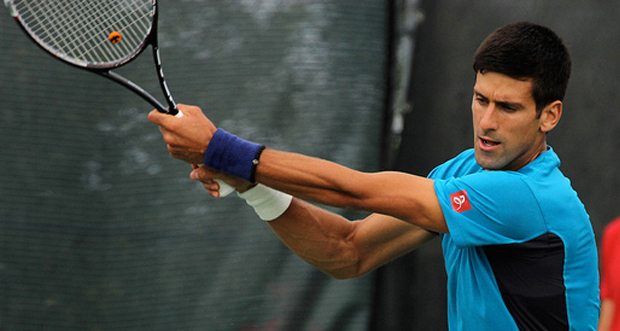
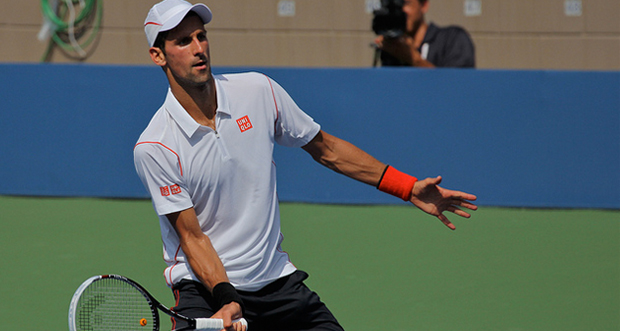
  • Novak Djokovic Wins the Shanghai Masters

    Novak Djokovic Wins the Shanghai Masters

    Novak Djokovic has won the Shanghai Rolex Masters by defeating Juan Martin Del Potro 6-1, 3-6, 7-6 (3) in a close final played out over 2 hours and 32 minutes.

    Djokovic was in full command throughout the opening stanza, breaking the Argentine twice en route to grabbing the first set 6-1.

    Del Potro, the conqueror of World No. 1 Rafael Nadal in the semifinals, began to find his rhythm in the second set and dictated early proceedings behind his monstrous forehand. He broke Djokovic and held on to level the match.

    In a hard fought final set decider that went all the way to a tiebreak, Djokovic finally pulled clear to seize opportunities in the breaker to win 7-3 and wrap up the match.

    Djokovic has now won 20 consecutive matches in China, having won the 2012-2013 Beijing titles, and the 2012-2013 Shanghai trophies. He extended his personal head-to-head record with Del Potro to 10-3.

    Doubles

    Ivan Dodig and Marcelo Melo won the mens doubles defeating David Marrero and Fernando Verdasco 7-6, 6-7, (10-2).  It rounded off an impressive week for the pair who also defeated the top ranked Bryan brothers in the semifinals.

    [divider]

    Discuss the Shanghai Open in the Tennis Frontier Forums.

    [divider]

    Cover Photo: Marianne Bevis, Creative Commons License

  • The Blue Shift

    The Blue Shift

    Beijing, Final

    (1) Djokovic d. (2) Nadal, 6-3, 6-4

    Until yesterday, the only hard-court tournaments that Rafael Nadal hadn’t won this year were ones he didn’t enter. It doesn’t take much to mar a perfect record – just one loss to a rampant Novak Djokovic – though falling short of perfection hardly precludes greatness, and Nadal’s 2013 season is nothing if not great. It isn’t done with yet; weeks remain in which it can become greater still.

    Consider this: Nadal has just reclaimed the No. 1 ranking despite accruing zero points at two Majors (Melbourne and Wimbledon), three Masters (Shanghai, Paris, and Miami), and the World Tour Finals. Staggering, indeed, and it suggests that the gap between him and his nearest rivals will widen to a chasm before it begins to close. Djokovic is already making the right noises about regaining the top spot, but he’ll need to win Shanghai, the World Tour Finals, and the Australian Open merely to maintain the points he has. Barring catastrophe or a precipitous waning of interest, Nadal will be No. 1 in the world for a long while yet.

    [divider]

    Click here to discuss The Blue Shift in our discussion forum.

    [divider]

    Last week was Djokovic’s 101st at No. 1, which strands him one week short of Nadal at equal-eighth on the all-time list, though not for long. This week will be Nadal’s 103rd. (Next week will be his 104th. I think you grasp the sophisticated mathematics involved.) I do wonder how many men have lost the No. 1 ranking by winning a tournament, in the final defeating the very man who would supplant them. It cannot be that common. (Still, if it was going to happen, this would be the pair to manage it. They’ve now faced off something like fourteen thousand times. The ATP made a desultory effort to drum up some interest for yesterday’s final with yet another historical retrospective, but given that their previous encounter was a Major final, and that the new survey mostly reprised the last one, it was hard to get too worked up.)

    Nor, however, is it particularly significant. Rankings are based on twelve months’ of results, not two hours’ worth, and Djokovic in Beijing is coming to feel like Djokovic in Melbourne. Just arriving there lofts his form into low orbit. There’s no shame at all in losing to him, no matter what you’re ranked. This week he looked better than he has since January, savaging Richard Gasquet in the semifinals, and comprehensively shutting Nadal out of the final. Much has rightly been made of his serving, which was superb. But his returning was typically accomplished – Nadal won twenty-five percent of points behind second serve in the first set – and his groundstrokes reflected a boldness that is unfortunately atypical in this rivalry. The swift, low bounce didn’t hurt.

    Meanwhile, Nadal wasn’t overly convincing. Generous souls suggested he was experimenting with aspects of his game this week. Perhaps they’re right. He did take time to test just how far behind Fabio Fognini he could fall without looking in real peril of losing. It turned to be quite a long way: a set and 1/4. Conditions also did not favour him, though rather too much was made of this: conditions don’t favour most players most of the time. Whatever the cause, level-headed types had predicted Djokovic would take the final, though few predicted straight sets. The Serb has looked all tournament like he did in the second set of the US Open final, which is to say like the best hard-court player going around.

    But in order to be ranked as the best player one must sustain it for longer than a set, or even a week. Djokovic hadn’t won a tournament since April, and was on borrowed time. Those level heads were correct this week, but they’ve also been predicting losses for Nadal all year, and so far none had gotten it right. Broken clocks have a better rate of success. To be fair Nadal’s losses have been as unpredictable as they’ve been rare, and as curious. Who realistically believed that the third man to defeat Nadal in a clay court final would be Horacio Zeballos, contesting his first tour final, outmuscling the Spaniard in a deciding set? Or that Nadal’s only loss on European clay would come in Monte Carlo in straight sets, the first of which was very nearly a bagel? Or that Steve Darcis would remove him from Wimbledon in the first round? Or that . . . Or that there wouldn’t be any others, and none on a hard court?

    As much as the scarcity of the defeats, the comprehensiveness and plenitude of the victories have been telling. Nadal’s more ardent fans can fan themselves into orgasmic dread whenever he steps on court, and afterwards are eager to peddle the conceit that his victories are testament to an ineffable warrior spirit, but realistically there have been barely a handful of matches this year in which he has looked at all like losing. Mostly he wins because he’s better than everyone else. This is precisely as it should be for the world No. 1.

  • Djokovic Wins Beijing, but Nadal Regains No. 1 Ranking

    Djokovic Wins Beijing, but Nadal Regains No. 1 Ranking

    Novak Djokovic lost his spot atop the ATP World Rankings, but played a nearly flawless match to beat Rafael Nadal for the title in China, his fourth, 6-3, 6-4.   He broke the Spaniard at the start of both sets, and never dropped his own serve.

    Nadal, however, will retake the No. 1 slot when the rankings come out on Monday.  This is his third climb to the top, since he lost it to Djokovic in July of 2011, and caps off an amazing return-from-injury season, when he came back at No. 5, his lowest ranking since 2005.

    Most weeks at No. 1:

    Roger Federer – 302

    Pete Sampras – 286

    Ivan Lendl – 270

    Jimmy Connors – 268

    John McEnroe – 170

    Bjorn Borg – 109

    Rafael Nadal – 102 (103, as of tomorrow)

    Andre Agassi – 101

    Novak Djokovic – 101

    Lleyton Hewitt – 80

    [divider]

    Juan Martin Del Potro beat Milos Raonic to take the Rakuten Open in Tokyo, his third title of the year, and 16th career trophy. The win raises his ranking to #5.

    Credits: Cover Photo: Marianne Bevis (Creative Commons License)

  • The Drums of War

    The Drums of War

    Davis Cup, World Group Semifinals, and World Group Playoffs

    Which maniac’s idea was it to schedule the Davis Cup semifinals for the week after the US Open? Even in the best years the turnaround is cruelly brief. It is a situation roughly analogous to the situation in Europe after the Great War, when a continent that had narrowly survived the most devastating conflict in world history began tentatively to haul itself from the abyss, only to be dragged back down by an influenza pandemic a year later. I don’t think that’s overstating the case. It’s probably even worse for the players.

    [divider]

    Discuss this article with fellow tennis fans on the tennis forums.

    [divider]

    If anything the situation is more serious with tennis than it was for war-ravished Europe, since ridiculous Monday finals in New York ensure even less opportunity for recovery. (Rafael Nadal was still doing the media rounds in Manhattan while his compatriots assembled in Madrid, rehearsing their favourite motet To Have Any Chance We’ll Have To Play Our Best. Given they were facing Ukraine, it somehow came off as even more ironic than usual.) It’s as though the signing of the Treaty of Versailles had to be pushed back six months, to ensure a spot on CBS’s Spring schedule. Although I cannot say for certain that the current situation will lead irretrievably to another world war, I can vaguely imply it. Rest assured I’ll wax pretty smug if it comes to pass.

    Indeed, there are further intimations that global conflict is not far off. I’ve mentioned it before, but it is surely no coincidence that Australia defeated the United States in the Davis Cup finals of both 1914 and 1939. It is thus with a certain anxiety that one notes Australia’s return to the World Group for the first time in seven years, having ravaged a depleted Poland over the weekend. All eyes will be fixed on the draw for next year’s tournament, to see where Australia and the USA fall. It’s probably a long shot that they’ll meet in the final, though it isn’t an impossibility given the rate and apparent certainty with which Nick Kyrgios, according to his self-devised slogan, is rising. There’s also Bernard Tomic.

    Tomic was Australia’s hero of this weekend, inasmuch as heroism was required. He won both of his singles matches, just as he had against Uzbekistan in the previous round, although this achievement will inevitably be downplayed. The cherished narrative of Tomic as feckless wastrel has by now become so established in its course that there’s no number of Davis Cup victories that will divert it. Think of last year’s World Group qualifying tie against Germany, when Tomic won Australia’s only singles rubber, in contrast with Lleyton Hewitt, who won none. The official line ran that Hewitt was a venerable warrior still giving his all for his country. Meanwhile every Australian tennis luminary with a platform took the opportunity to decry Tomic’s lack of resolve, from Pat Rafter and Tony Roche court side, to John Fitzgerald back in the studio. If anything, Tomic is held in such low regard, even here in Australia, that his exceptional record when representing his nation actually blights the Davis Cup. You can imagine what will happen when he defeats Ryan Harrison in the fifth rubber of next year’s final, annulling the ANZUS treaty at a stroke. Thanks a bunch, Bernie.

    Anyway, Australia wasn’t the only nation to progress to the 2014 World Group. Spain managed it, to no one’s surprise, defeating Ukraine 5-0 in the Caja Magica. Sadly the clay was an uninspired red, but really they could have contested the tie on pink ice cream it wouldn’t have affected the result. The Dutch squad inflicted commensurate misery on Austria, who ran out of players and were forced to wheel out Archduke Franz Ferdinand for the last match, bestowing new meaning on the term “dead rubber”. Apparently Viktor Troicki had rubbed him out back in Monte Carlo, the villain.

    Germany had almost as easy a time seeing off Brazil. There’s a complicated joke lurking somewhere in there. Given what’s coming, I won’t be surprised if they draw the Czech Republic in the first round next year. Great Britain is also through, mainly because of Andy Murray. If history is any guide, then a strong British team will be essential in the years ahead. Japan came from behind to beat Colombia at home, while Israel lost from in front against Belgium away. Amir Weintraub has made his name with desperately fought Davis Cup wins and losses. There’s something about the format that agrees with him. It could be the team environment, though it’s probably more the rare freedom that comes from having other people worry about sundry irritants like food and accommodation, not to mention access to a coach. He battled to an inspiring victory over Ruben Bemelmans on the first day, finishing 10-8 in the fifth. It was a 10-8 in the fifth kind of day. Sadly he lost the deciding rubber to Steve Darcis in a quick and decisive manner. Darcis, it must be said, was superb this weekend.

    Meanwhile, the semifinals proved all over again that although the final score may be the statistic that matters most, beyond the result it can obscure as much as it reveals. Both victorious nations eventually arrived at 3:2 score lines, but they only got there via wildly divergent paths. The Czech Republic, cruising on a futuristic hydrofoil of uncertain origin, had pulled so far ahead of Argentina’s squad that there was no chance they’d be overtaken. Jaroslav Navratil’s mullet streamed out magnificently in his wake, flanked on either side by his chief enforcers: the stern-faced replicant Tomas Berdych, and the wizened homunculus Radek Stepanek. The remainder of the team were confined below-decks, working the bilges, before they were released on the third day and summarily tossed overboard as consolations for the rapacious Argentines trailing astern. This was sold to Jiri Vesely as “experience”. Dead third days are the worst part of Davis Cup. For all that I’m not an advocate of wholesale change to the competition, I pray that any change that does come addresses that problem.

    Serbia entered the home straight trailing Canada, although there was no immediate reason to panic given Novak Djokovic was to kick proceedings off. He wasn’t facing Nadal – he hadn’t faced Nadal in days – and thus could be relied upon to win. He did. It thus all came down to Janko Tipsarevic and Vasek Pospisil. Either man represented a slender thread from which to suspend a nation’s hopes. But for all that Tipsarevic has waned sharply of late, while Pospisil is rising with even greater urgency than Nick Kyrgios, you’d suspect the Serb would see it through, given the not inconsequential advantages of superior experience, a clay surface, and the home crowd. So it proved. Pospisil fought his heart out, although unlike his ankle at least his heart remained more or less intact. He fell heavily on the last point, stabbing at a desperate volley. Tipsarevic ran the ball down, put it away, and joined his opponent on his knees. It was a useful study in contrasts. Pospisil’s teammates rushed over to see if he was okay; Tipsarevic’s teammates rushed over and jumped on him. And why not? They’re through to face the defending champions in what will undoubtedly be the last peacetime Davis Cup final of the modern era.

  • US Open 2013 Review: Men’s Final: Solving Problems

    US Open 2013 Review: Men’s Final: Solving Problems

    I don’t know about you but I am slowly becoming a fan of Rafa. I have always been impressed by him of course but I naively concluded that his game was built on muscle.

    The closer I look the more I notice the attention to detail. I first noticed it early in this year’s US Open. To be a contender Rafa had to serve well.  He did that when he won in 2010 but it put too much strain on his knees, so naturally I wondered whether he would have an answer this time.  It turns out that he does. His answer is to trade pace for spin, saving his knees but creating big problems for his opponents. The extra spin is most obvious on TV in his swinging slice serve. The amount of movement he got looked like he was hitting a forehand for his serve and I liked it. The result of these changes is that in the final we saw that Rafa is currently the player that is better at solving the big problems. He backed up everything we have seen throughout 2013 to cement his claim as the best player of the year.

    Technically and even tactically there really is not that much between the top two players. Rafa has won their two Major meetings this year but Novak has looked dominant many times during these matches. One thing Rafa hasn’t looked is desperate. That was how Djokovic looked for most of the match. Particularly when he was up in the third set. Not a calm man confident of success but a man celebrating as if he has to convince everyone, including himself, of his ability.

    Rafa clearly put in diligent study, tennis R&D, during his seven months out exploring ways to compete with his obvious limitations. He used the injuries to improve his technique and strategy. Now that he is back on tour he is putting the R&D to work and taking the theory and molding it into a polished product.

    What I mean here is that Rafa knows both himself, the tennis court, and his rivals. As a tennis player he knows what is available to both him and his opponents in any given situation. He uses that knowledge to formulate a plan of both attack and defense, where he can attack to setup a winning shot but also defend so that the attack doesn’t expose weakness. That is what I see. The specific shots and technical weaknesses are important mainly because they become the targets at which each player aims their strategy. What I see is that Rafa has built a huge castle around his game where he can rush in and attack yet quickly retreat to safety. He is using time and the art of surprise to his advantage at a level we haven’t seen before.

    I see it most in his serve but it permeates his whole game. He doesn’t just use his shots and the court to apply pressure; he uses time itself. Controlling the rhythm of play can be a very useful weapon. It is complicated to achieve this by changing your effort, how hard you hit the ball because it affects your timing. Spin is one of the best ways to adjust the rhythm of a point without affecting the effort you put in and thus your timing. Rafa is addicted to spin and he has begun to use it to control the rhythm and timing of the point. That is his weapon. Things like his slice backhand can also be a weapon when used effectively to alter the rhythm of a point.

    Like any gladiator it is not necessarily what that weapon is that matters, but how well he masters it. This battle is all about location, location, location. What I see is Rafa varying the pace of every shot through spin to defend when he has a weak position and attack when he has a good position. At the same time spin allows him to hit a very hard, very complicated shot with little risk of missing. The ball may go short or sit up but the effect of the spin creates an extra challenge for his opponent to overcome, adding to the defensive quality of the shot — something we noticed particularly in the fourth set with Novak missing several sitters with heavy spin.

    Rafa also uses slice to slow the point down so that he can retreat to a good position or top spin to speed the point up and rush the ball past Novak. Slice can also keep it low and force Novak to hit up or Rafa’s topspin forehand can get the ball up high and make him stretch.

    The use of spin and its effects are not new in this story between Rafa and Novak; Novak does exactly the same to Rafa and has had great success. What is new is how well Rafa is using the element of time to take the best positions and remove all but the riskiest opportunities. Just like classical warfare it is he who takes the best position most often that is most likely to win. That is what we have seen this tournament and this year.

    Rafa understands more than anyone that odds and averages are everything, and he and Uncle Tony are happy to trawl through any data they can find to shift the odds their way. All the while they are just finding ways to create more pressure on their opponent over time. Attackers like Federer apply a lot of pressure in a short time but often run out of energy or start missing. This is true for mind, body, and spirit. Fed can literally run out of ideas. Rafa applies less pressure but keeps applying it for much longer. Novak is the same. They are used to applying pressure on every point. The physical side isn’t what matters to them; it’s the mental and emotional side.

    Rafa handles that better than anyone. Many have better shots and physical attributes than he does, but no one has a better mind, and since tennis is 90% mental and a game of problem solving that’s the perfect recipe for success.

    Edit September 16th

    I watched the French Open Semi Final match between these two over the weekend. I forgot just how dominant Novak was at times. He was a break up in the fifth set until the eighth game. There are lots of ways to explain the ebbs and flows. The commentators put it all down to who hit the hardest. As a player myself with my own Rafa (Spin master) to train with I find the opposite to be the answer. Both were pushing their attack to its limits throughout the match. When we do that we often push too far and error, often tiring ourselves aswell and getting out of position. Djokovic was just giving lots of points away for this reason. Many more than he was winning with his all out attack. Nadal just defends too well and uses his attack against him.

    Dialling back on the attack even just a couple of percent means you get much more in but also you are ready for the opponents response much sooner. Combine this with the concept of directionals and you see how getting the ball quickly to your opponent while at the same time putting yourself in bad position is giving them the key to open the door to your defence.

    So, my interpretation of the ebbs and flows is that when a player patiently built a point focusing on consistently good position they generally did well. Novak particularly can attack off both wings and when he used this balanced attack he did well. It was much less effort and less risky. However Novak kept panicking and overplaying, often using Federers favourite, the inside out forehand, this is what Rafa wants, it creates a lot of space to aim at in Novaks forehand side and Novak is slow to recover from his big attack. Novak won less of these exchanges than he realises. Rafa won because maintaing position and waiting for the right ball and establishing a pressurising defence instead of risky and exciting attack demands patience and discipline. Two things Rafa did better than Novak in both the French and US open finals.

    I say this mainly because I am finding this a much more efficient way to win. Particularly as I meet higher level opponents. Expecting longer points and having a strategy built for it is powerful. Using the opponents pace and spin against them becomes more and more important and ensures you have an answer even against much higher ranked opponents. They often get lulled into the belief that you don’t possess power and invariably hit harder against you giving you more to work with. I learnt the concepts from Fuzzy Yellow Balls which consider this the sneakiest weapon in tennis. Now I have learnt how to use it I agree and I am using it more and more. Seeing it work at the highest level really shows its value to me.

  • Indefatigable

    Indefatigable

    US Open, Final

    (2) Nadal d. (1) Djokovic, 6-2, 3-6, 6-4, 6-1

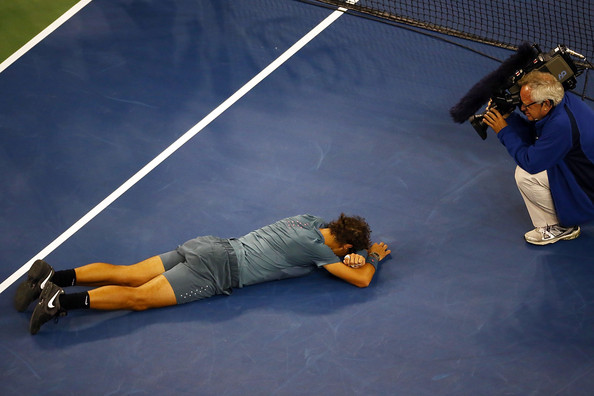
    Rafael Nadal yesterday defeated Novak Djokovic to win his second US Open title, continuing a return to the men’s tour that has surpassed the most ardent hopes of all but of his most ambitious fans. It has been a comeback to beggar belief, an opinion I’ll continue to maintain despite the fact that Greg Rusedski agrees with it. If anything, Rusedski went further, and summarily declared it to be the greatest comeback in sporting history. One questions both the length and breadth of his historical perspective, given he’d earlier insisted the match was well on the way to becoming the greatest US Open final ever played. It certainly wasn’t that, though it undeniably had its moments. The longest of these moments was a 54-stroke rally destined to pad out innumerable highlights packages. The best of them came at the very end as Nadal collapsed in ecstasy to the court, victorious in New York once more.

    [divider]

    Click here to discuss “Indefatigable” in our discussion forum.

    [divider]

    First some numbers, which can as ever be relied upon to render the achievement excitingly comprehensible. This US Open is Nadal’s thirteenth Major overall, which moves him to third on the all-time list of winners, one ahead of Roy Emerson, and trailing only Roger Federer and Pete Sampras. Since returning to the tour in February he has contested thirteen events, reaching the final at all but one of them (Wimbledon), and claiming the title ten times. (This incidentally equals the number of titles Jo-Wilfried Tsonga has won in his entire career.) He has won sixty matches, easily the most on tour, and lost just three. Today he became only the third player ever to sweep the main events comprising the US summer, meaning Canada, Cincinnati, and the US Open (the other two men were Andy Roddick in 2003, and Pat Rafter in 1998). Overall Nadal has compiled an astonishing 22-0 record on hard courts this year, and hasn’t technically lost a hard-court match since Indian Wells last year.

    Nadal’s previous US Open title came in 2010, although I’ll court opprobrium and suggest that today’s title is more convincing, insofar as the convincingness of tournament victories is something that can or should be measured. There was a prevailing sense that his first title, for all that it completed his Career Grand Slam, was a testament to opportunism. The fast New York DecoTurf was generally held to be his worst surface. Meanwhile, the two best hard-courters at the time – Federer and Djokovic – had fought each other to a standstill in the late semifinal, after Nadal had already breezed past a wearied Mikhail Youzhny, having faced no one more threatening before that. Realistically his path to this year’s final hasn’t been much more taxing: replace Verdasco with Robredo, and a weary Youzhny with a weary Gasquet. The difference is that this time round Nadal was deservedly one of the pre-tournament favourites, and, given his recent results and form, it is perverse to pretend he is now anything but entirely suited to outdoor hard courts. Favourites always have an easier draw, since by definition they rarely face anyone they are not expected to defeat. He had a favourable US Open draw for the same reason he had favourable draws at Roland Garros: because he earned them.

    Nadal might have been a favourite, but he was by no means unbacked, especially faced with the other favourite. Djokovic is still the world No. 1, even if it is rare for him to recapture the form of his majestic 2011 season, and rarer still to see him sustain it outside of Australia. It’s been the pattern of his year, and it was his pattern in tonight’s final. When Djokovic played at his best, and more importantly, when he thought at his best, he was the better player. But he couldn’t keep it up. Nadal began exceptionally well, once more employing the tactic that had served him well in the French Open semifinal, of pressing hard up the line with his forehand early in the rallies, invariably catching Djokovic out. Djokovic also reprised his strategy from Paris, which was to eschew tactical clarity of any sort, and to avoid the authoritative backhand up the line that once ranked among the sport’s most fearsome shots. The two players combined for a one-sided 6-2 first set.

    The change came in the second set, and it had little to do with Nadal, who continued to strike his forehand ferociously. Suddenly he was having fewer of them to hit, and he was increasingly obliged to hit them from less stable positions. Djokovic hadn’t started to strike the ball better, but he was now directing it far more intelligently, which enabled him to control the rallies. Then, having established himself, he did start to strike the ball better, and abruptly revealed himself to be the fearsome version of himself from two years ago, the one who would patiently pummel Nadal’s backhand until it cracked, and who would only bring the Spaniard’s forehand into play at a moment of his choosing. Djokovic romped through the latter stages of the second set, and moved ahead a break in the third.

    Then, inexplicably, he abandoned this winning game plan, and returned to scattered hitting. Why he didn’t keep it up, one cannot imagine, although I’ll admit that although Nadal’s backhand seems dramatically less fearsome from a remote vantage, it might not feel so gentle when it’s coming at you. It isn’t a poor shot by any standards – even when he isn’t hitting it that well it remains solid, and today he was hitting it well – but it doesn’t measure up to his forehand. More importantly, it doesn’t measure up to Djokovic’s forehand, which is the match up that matters, or would have mattered if Djokovic had only maintained it. It would be useful to see Hawkeye data on Djokovic’s groundstroke placement for that period when he was ascendant, as compared to his placement for the rest of the match. I suspect it would be sufficiently revealing that even he as a player might take notice. Certainly it would tell us more than blunt instrument stats such as unforced errors. Alas, the presiding powers keep their data close, preferring to use them to generate complicated metrics of use to nobody.

    Nadal is probably the best player I have ever seen at sustaining apparently mortal blows yet remaining unbowed, having proved his resilience in countless matches, especially against Federer. He knows in his armature that while anyone can ascend to stratospheric heights for a time, even the very best must come down for oxygen eventually. If they don’t, then well-played to them, but if they do . . . Djokovic had been soaring into orbit, but the moment his throat constricted, Nadal leaped forward, and planted his foot on it. I suspect this made it hard to think clearly. With his mind gone, Djokovic’s body soon followed. Before long he was spraying balls everywhere, and was broken again to drop the set. The fourth set wasn’t close, although considering the 6-1 scoreline it wasn’t especially short, either. But it wasn’t too long before Nadal was accepting Djokovic’s heartfelt congratulations at the net, while 20,000 onlookers screamed affectionately at them. Nadal moves to an impressive 13-5 in Major finals, while Djokovic falls to 6-6.

    CBS had its usual way with the trophy presentation, just as they’d had their way with the schedule. Having learned the lesson of the 2009 final, after which Juan Martin del Potro selfishly attempted to address his supporters in Spanish, the tournament’s broadcaster ensured today’s ceremony was as brief as it was devoid of interest. The whole thing was over in about five minutes. In Melbourne the indefatigable Kia spokesman would have barely begun his vocal warm-ups. Neither Djokovic nor Nadal bothered to dignify Mary Carillo’s inane questions with anything like an answer. Nor did they manage to look more than mildly appreciative as the lavish cash prizes were rapturously announced. Nadal bit into his silverware, and loyal American viewers were whisked away to confront the recurring enigma of Two and a Half Men (now that the smart-arse kid has grown up, the enduring mystery of the show’s popularity has been augmented with confusion over which of them is actually the half-man).

    Those of us lucky enough to be watching on an alternative network weren’t let off so lightly. Sky Sports had assembled its entire team on the court, though they were still one microphone short. Nadal wandered over for a chat, and hit all his marks: gracious, thoughtful, and clearly keen to be elsewhere. Asked if he was going to take a rest now he responded with a chuckle that he had Davis Cup, and then ambled away. After he’d left Rusedski lamented that they hadn’t asked him whether he would overtake Federer’s Major title record. I can’t imagine what Rusedski thinks Nadal’s response might have been.

    Djokovic will still be world No. 1 when the rankings are released next week, regardless of what happens in Davis Cup, and the week after that. The change will likely come in Asia, assuming Nadal bothers to play. Indeed, given he has precisely zero points to defend until February, Nadal boasts the enviable luxury of being able to choose when and where he retakes the top spot. It must be a pleasant thought. Then again, one imagines that having emphatically claimed his thirteenth Major title, Rafael Nadal hardly requires another reason to feel joy.

  • All The Way Up

    All The Way Up

    The 2013 US Open Men’s Final

    [2] Rafael Nadal def. [1] Novak Djokovic 6-2, 3-6, 6-4, 6-1 

    From the perspective of a psychologist-Rafa-fan-tennis-blogger, there was not a lot wrong with the 2013 US Open men’s final. The trophy ceremony is another story, but the final itself was tremendous—Brobdingnagian, even. From Novak Djokovic’s perspective, the immense beauty of the match was likely diminished by the bevy of unforced errors that contributed to his losing. (The Serb made upwards of four-dozen.) But from where I sat—on a blue yoga ball in my living room —it was not only an exciting final, but also an instructive one. Over the course of nearly four hours, Nadal and Djokovic took turns revealing the frescoed ceiling of what is possible when preternatural talent meets application and deep-seated drive.

    [divider]

    Comment on Arienna’s blog and more in our tennis forums.

    [divider]

    No, the trouble with this final, from my perspective, had nothing to do with the tennis. It was the desire the tennis instilled in me to quote novelists, in particularly, the urge to quote Ernest Hemingway— or as the Gulbis Clan would spell it, Ernests. The problem with quoting the Latvian No. 1’s approximate namesake is twofold. First, when the opportunity arises to connect tennis matches to the American Jazz Age—such opportunities are shockingly few and far between—I prefer to quote F. Scott (or even Zelda) Fitzgerald because they are, well, way jazzier than Ernie. Those two really knew how to make their adjectives sing. Second, and perhaps more important, I’ve already quoted this particular passage of Hemingway here once before.

    Much like Novak Djokovic feeding balls to Nadal’s forehand, re-quoting famous authors is not a pattern I’m looking to fall into. Last week it was Borges, this week Hemingway. Who’s next, Carrie Bradshaw? (Yes, I am 99.9% percent sure I somehow linked Sex & the City to Nadal’s footwork. Or maybe it was David Ferrer’s calves.*) But the fact remains that when Rafael Nadal stole the third set out from under Djokovic’s racquet, and then executed a deep knee-bend accompanied by a lawnmower-style fist-pump, my first thought was a worry that he’d pulled a hamstring. (It was a fist-pump as awkward-looking as it was enthusiastic.) The second thing that popped into my head was Jake’s answer to Robert Cohn in Hemingway’s The Sun Also Rises: “Nobody lives their life all the way up except bull-fighters.” Whether or not the statement is accurate, the sentiment underneath it is true.

    So, to continue in the storied tradition of assembling terminology from other sports into descriptive metaphors about tennis—e.g., boxing, horse racing, ballet, baseball, orienteering, hopscotch, glee club, etc.—this tennis match was a bull-fight. To keep the outcome in question as long as possible, Djokovic and Nadal took turns playing the roles of matador and bull. They traded-off between sets, or on the occasional change of ends. Once in awhile they even switched between individual points, one assumes so they’d have something to do while they waited for that annoying guy in the stands to stop lowing like a wounded herbivore. The 2013 final was a showy spectacle; as brutal as it was beautiful.

    If you saw this tennis fight—maybe from the comfort of your own yoga ball, or even better, from a seat in the stands—you won’t soon forget it. And if you did not watch it, you should. But if you did see it and want to relive it, or if you couldn’t watch, maybe because you forgot what TV channel CBS occupies (I had some trouble with this myself last weekend) here’s how I saw it:

    Nadal was extraordinarily dominant in the first set—100% torero. He served thoughtfully and forcefully, winning 80% of his first serves and nearly 60% of the second. The Mallorcan maintained his aggressive 2013 court positioning; sliced and passed with his backhand; and did all the standard damage, plus a little extra, with his forehand. When Rafa held for 4-2 John McEnroe said, “This first set is highly important, to put it mildly.” I agreed, mildly. Including yesterday’s match, Rafael Nadal is 152-3 when winning the first set at a major.

    Of course, one of those three losses came to Novak Djokovic, on a hard court in Australia, in a match that lasted forty days and forty nights (or at least all the way through a California night). During yesterday’s surprisingly lopsided first set, it looked as if Djokovic was struggling mightily with the wind on Arthur Ashe Stadium, which is known intergalactically as the universe’s largest-ever sporting centrifuge. When Djokovic stretches for a backhand return out wide, or a forehand on the run, he looks like he travels through space and time. It’s uncanny eye-bending stuff. The Serb moves with marvelous quickness and his balance is fantastic, but his footwork can’t quite keep up with the rest of him. Nadal’s form is better there. So is Ferrer’s, for that matter. (Probably because of his calves.**)

    Anyway, as Rafa closed out the first set 6-2, I start to wonder if the combined forces of Nadal’s aggression and Mother Nature’s breath were going to make quicker-than-expected work of this match. It was about that time that Djokovic began to find his footing and take the ritual steps that would transform him into a full-fledged tennis deity. It’s tempting to say the change hinged on the 54-shot rally on break point in the second set. It was a rally that included several pummeled forehands from Rafa, ended with Nadal netting a ball, and was immediately followed by Djokovic lifting his arms in triumph while the stadium erupted in applause. In reality, the change started early in the second set, and would require a few more games to solidify.

    In fact, Nadal broke back immediately to put the set back on serve at 3-4. But then Djokovic broke back again, and Nadal found himself pushed well behind the baseline. The Serb won the second set convincingly, but it wasn’t actually until the beginning of the third set that Djokovic played his best tennis. It’s almost not enough to say he was unplayable, his shots—particularly his return of serve and his forehand crosscourt—were downright untouchable. On the other side of the net, Rafael Nadal hung his head, downtrodden. It was 2011 all over again.

    At 1-1, 4-4, 0-40 on Nadal’s serve, Rafa-fans were experiencing some measure of distress (to put it mildly). Djokovic had won the first point of the game with a brilliant lob, and most all of the Serb’s returns were skimming the baseline. In the process of losing the second point of the game, after hitting a quality forehand that Nadal seemed to have expected to be a winner, Rafael Nadal stumbled on the baseline and went down—swinging. (He was truly trying to hit the tennis ball even as his rear-end hit the concrete.) The Spaniard looked wounded, but in soul more than body. I wondered if he would recover from the indignity of having to stand by helplessly as Djokovic turned the match on its head. I should have known better.

    It’s both tempting and accurate to say that it was at the very moment when Rafa was down triple break point that he turned it all the way up. Nadal saved the first break point with a forehand winner, a better version of the shot that saw him to the seated position just minutes earlier. At 15-40 he slowed the rally to a snail’s pace by slicing his backhand until he drew the error from Djokovic. The third break point he saved with his first ace and fastest serve of the match, at 125 mph. Nadal eventually held with an overhead smashed so hard it bounced into the stands and flattened Edward Norton’s hairdo. Nadal went on to wrest the third set away from Djokovic’s deserving hands, then run away with the fourth, while Novak went back to making unhappy unforced errors.

    The most pronounced moment of tension in the fourth set actually came from the stands, when the crowd was unable to shush itself before championship point. I didn’t have my stopwatch handy, but that had to be the most protracted collective “shhhhhhhh” in the record books. It was, I suspect, longer than the combined time CBS gave Nadal and Djokovic to thank their coaches and families. The match ended, fittingly, with an error from Djokovic.

    Continuing on with his habit of flinging his body against every hard court he conquers, Rafael Nadal immediately stopped, dropped, and rolled—and cried. Nadal and Djokovic shared a warm hug at the net, and then Rafa went back to joyfully rolling around on the court. (Who can blame him? He really has been on fire this season. Rafa now owns 10,860 ranking points as compared with Novak Djokovic’s 10,980.) The trophy ceremony was awkward and rushed. Both Nadal and Djokovic did well to answer the question they should have been asked, rather than the one they were asked. There were also way too many American flags. It’s better not to dwell on it. Instead, I’ve prepared a poignant summation, replete with fitting quotations:

    Last time I mentioned the Hemingway passage from The Sun Also Rises was in a post I wrote before the 2012 US Open. My intention had been to comfort dismayed Nadal fans. Hey, the sun also rises. Buck up, and whatnot. And see, I was right. A lot can change in twelve months’ time. With some trepidation—given my loyalties—I offer the same sentiment to Djokovic fans today. Novak Djokovic will probably be disappointed with this performance, particularly with his play in the first and fourth sets. But in watching both the men’s and women’s finals this year I was mostly struck by the shared capacity of this small group of extraordinary athletes. They fight.

    The other SwissStanislas Wawrinka, authored the most heartwarming storyline at this year’s US Open and I was disappointed not to have a chance to write more about him. I did watch, and cheer for him, and even found myself doing an air-punch fog-horn blast thing whenever he hit a booming backhand winner. (Which none of you saw, right?) So, I think it’s fitting if I let Stan have the last word. When it comes to Djokovic and Nadal—and Serena and Vika—they’re supremely good at tennis, that’s true. But when it comes to effort, will, and intent, they’re seriously “fucking strong.”


    *In case you are wondering, I try to mention David Ferrer’s calves at least once per major tournament. His calf muscles happen to generate dozens upon dozens of Google searches (more even than the number of unforced errors Djokovic hit in the final) and I have decided they’re good for business.

    ~For those of you who do not live in the United States and were deprived of team-ESPN’s commentary, you might be interested to know that Brad Gilbert and Patrick McEnroe tirelessly interviewed each and every American football player who showed up in the stands to gain the best possible understanding of exactly which position Nadal should have played had he ever shown the slightest interest in playing American football. From what I can tell the verdict was split between “running back” and “he’s too f***ing small to play football.”

    **See first footnote.

  • Rafael Nadal Wins the US Open

    Rafael Nadal Wins the US Open

    Takes his second US Open singles title, 6-2, 3-6, 6-4, 6-1 over Novak Djokovic.

    [divider]

    In what was widely set up as a battle for dominance at the end of this year, Rafael Nadal beat Novak Djokovic in a four-set war.  Most of their battles seem to involve blood, and this was no different, even though it failed to go the distance.

    [divider]

    Click here to discuss the Nadal/Djokovic USO final in our discussion forum.

    [divider]

    Both seemed to start sharp in the first.  Djokovic may have been feeling the effects of the five-set semifinal he played against Stan Wawrinka two days ago, and failed to meet Nadal’s intensity.  The Spaniard won the first set, 6-2, with two breaks of serve.

    In the second, Djokovic broke early, but Nadal broke straight back.  However, the Serbian No. 1 found the intensity he had been lacking and began to run the No. 2 around the court.  He broke again at 3-4 to serve for it at 5-3, and won the set.  All momentum at this point was in his favor.

    To open the third, Djokovic broke at love.  While Djokovic seemed to be in control in the early part of the set, Nadal kept up the pressure, broke back, and finally snuck the set out at the last minute:  6-4.

    Djokovic initially pressured on the Nadal serve at the beginning of the fourth set, but the Spaniard eventually ran away with it to win the title: 6-1 in the fourth.

    Previous to this match, each had won one title at the USO, so the balance now falls in Rafa’s favor.  Nadal also lifts his unbroken streak on hard courts this year to 22-0.  And, while Djokovic retains his No. 1 status for a short while longer, Nadal has crept up to within 920 points of Novak, with nothing to defend for the rest of the year.  The shift at the top seems only a matter of time.


  • Djokovic Outlasts Wawrinka in the Semifinals; Sets Up Nadal Rematch

    Djokovic Outlasts Wawrinka in the Semifinals; Sets Up Nadal Rematch

    Novak Djokovic overcame an overall lackluster performance, and an onslaught from Stanislaw Wawrinka to prevail in a thrilling 5-set match, 2-6, 7-6(4), 3-6, 6-3, 6-4.

    It was a roller-coaster ride of a semifinal.  Wawrinka, the still-but-perhaps-not-for-long Swiss No. 2 came out strong and broke Djokovic three times in the first set.  He went up a break in the second, but Djokovic broke back, and sent the set into a tiebreak, which the world No. 1 snatched up.  The Swiss took the third set on one break, and Djokovic the fourth via the same.  Also in the fourth set, Wawrinka had a medical timeout for an injury to his upper-thigh, and did seem to be hampered the rest of the match.

    [divider]

    Click here to discuss the Nadal/Djokovic final in our discussion forum.

    Click here to discuss the Nadal/Gasquet semifinal in our discussion forum.

    Click here to discuss the Djokovic/Wawrinka semifinal in our discussion forum.

    [divider]

    The stakes were raised in the fifth set.  At 1-1, with Wawrinka serving, they played a nearly 21-minute, 30-point game.  It was taken to deuce 12 times, with Djokovic having five break chances.  In the end, Wawrinka held, but it seemed to be all he had left.  Djokovic broke at 2-2 and ran away with it.

    After the match, Djokovic said:  “I think it was obvious Stan played more aggressive; he played better tennis over all,” adding, “I was glad I was able to find my best tennis when I needed it.”

    In the second semifinal of the day, Rafael Nadal beat Richard Gasquet with his B-Game, 6-4, 7-6(1), 6-2.  While Gasquet came up with some showy tennis at times, and Nadal was having trouble finding the lines, the best Gasquet can say is that he broke Nadal’s serve for the first time in the tournament.

    The win assures Djokovic that he holds his No. 1 ranking for the time being, and sets up his 37th match with his rival Nadal — an Open Era record for most matches played.  The Spaniard currently leads the head-to-head 21-15.  They will play for the trophy on Monday.