Tag: nick kyrgios

  • From Small to Big (Titles): When Young Players Breakthrough

    From Small to Big (Titles): When Young Players Breakthrough

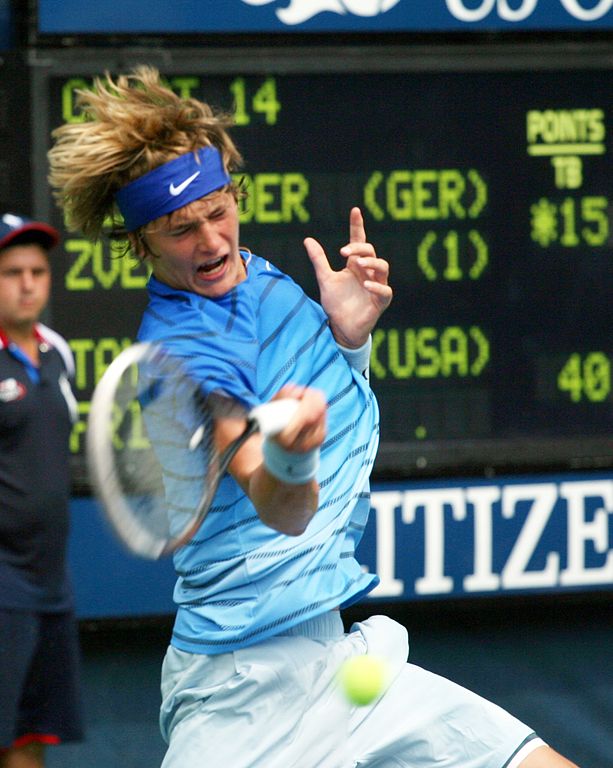
    613px-Alexander_Zverev_(GER)_(9657622842)

    One of the holy grails of tennis speculation is being able to differentiate between those young players who will become stars and those who will not. Right now we’re amidst somewhat of a tide of upcoming  young players: from highly touted Alexander Zverev and Nick Kyrgios, to the large number of young players in or approaching the top 100. Yet how can we possibly tell who will become an elite player and who will plateau somewhere on the way to the top?

    The Pace of Greatness
    There is no easy answer. I have put forth a system of benchmarks that every all-time great (6+ Slam winner) of the Open Era has reached; there is a similar set of benchmarks for multi-Slam winners (2-4 Slams), although these were just greatly expanded by Stan Wawrinka, who reminded us that tennis is always changing and boundaries are meant to be surpassed.

    The first of the benchmarks is entering the top 100 before one’s 19th birthday. Of the young players currently on tour, only a few have accomplished this so far: Alexander Zverev, Frances Tiafoe, Taylor Fritz, Hyeon Chung, and Borna Coric. Missing the mark already are Dominic Thiem, Nick Kyrgios, Karen Khachanov, Daniil Medvedev, Andrey Rublev, Michael Mmoh, Stefan Kozlov, and many others. Now this is a benchmark that all 6+ Slam winners of the Open Era—or at least going back to accurate ATP rankings, so from Bjorn Borg on—have reached. But that doesn’t mean that all future 6+ winners must. And it is also a rather rarified company to begin with; to begin with, we shouldn’t expect more than several players from any generation—and perhaps not even that—to win 6+ Slams.

    Given that the age in which players are peaking may be rising, or at least expanding, and given Stan’s reminder, these benchmarks should probably be considered “probable guidelines” than strict rules. Surely there must be something else we can look for, to try to ascertain who will rise to the top of the sport? I don’t have a clear method, but I did stumble across something that will at least give us something to look for.

    Two Breakthroughs
    When I was working on my “career skyscrapers” tool, I noticed that it did a nice job of illustrating how players develop in their early years. The skyscrapers only include titles and quarterfinal or better Slam appearances so are, intentionally, a snapshot of when a player was at or near elite level. But when we talk about breakthroughs, there are many small stages in that process, but two that I find to be of utmost importance: One, winning a title. This is the rite of passage that every good tennis player must go through. The second is winning a big tournament; by “big” I don’t only mean Slams, but Masters (or their equivalent) or a World Tour Finals. This is the point that a player generally reaches elite status and has shown they can play with the big boys.

    What I noticed was that in almost every case, the true greats went from winning their first title in one year, to their first big tournament within the same year or next. The only exception in the Open Era is Andre Agassi, who won seven minor tournaments over three years (1987-89) before winning his first big tournaments in 1990. But everyone else—from Jimmy Connors to Novak Djokovic—went from winning their first tournament (whether big or small) to a big tournament within a calendar year.

    This gives us another benchmark to look for. Again, it doesn’t mean that it has to happen for a player to become a true great, that it probably will, and the probability is quite high: 12 of 13 6+ Slam winners of the Open Era fit this criteria (interestingly, neither Ken Rosewall or Rod Laver did this; it took them a couple years – but they began their careers in a very different context than the Open Era).

    I think the real important insight gleaned from this is that the pattern seems quite different for lesser Slam winners. Of the seven players winning 3-4 Slams in the Open Era, only three–Guillermo Vilas, Jan Kodes, and Gustavo Kuerten–went from a small to big title in sequential calendar years; Arthur Ashe, Jim Courier, Stan Wawrinka, and Andy Murray all took longer.

    Of the eight two-Slam winners, only three did it: Ilie Nastase, Sergi Bruguera and Marat Safin who, at the time, was considered a probable future great but ended up having a disappointing career. Bruguera was a clay court specialist who played during a time when courts were quite different from each other and specialists–who were otherwise relatively mediocre on other surfaces–could compete for the biggest prizes on their best courts. Nastase was a borderline great player, whose level isn’t adequately expressed by his mere two Slams.

    Of the twenty-four single Slam winners of the Open Era, only six did it: Andres Gimeno, who played much of his career in the very different context before the Open Era, so as with Rosewall and Laver, isn’t that relevant; Mark Edmondson, who is the definition of “one-Slam wonder;” Andres Gomez; Michael Stich; Michael Chang; and Juan Martin del Potro. Stich and Del Potro, like Safin, were considered viable candidates for future greatness, but didn’t reach that mark.

    To sum up, consider who went from their first title to a big title (Masters or greater) within the span of a calendar year, among players who played the bulk of their careers, or won most or all of their Slams, in the Open Era:

    • 12 of 13 (92%)  6+ Slam winners
    • 6 of 15 (40%) of 2-4 Slam winners
    • 6 of 23 (26%) of 1 Slam winners

    As I said above, these numbers start changing if we look before the Open Era, but that was a very different context of play.

    For Whom Is The Clock Ticking?
    There is no clear year that the proverbial “NextGen” starts, although we can say it definitely includes all of those players who will be eligile for the Milan NextGen Finals later this year, so those who don’t turn 22 until December (so generally born in 1996 and later); but for this, we will also look at slightly older players, who are still considered young on today’s tour.

    So who “has to” win a big title in 2017, to reach this benchmark?

    Dominic Thiem won his first title in 2015, but although he improved his performance in 2016, did not win a big title – so he missed this benchmark last year. As I have mentioned elsewhere, his career pattern so far fits that of a second tier player more than a true elite.

    Then we have a group of players: Lucas Pouille, Nick Kyrgios, Karen Khachanov, and Alexander Zverev. These are the four young players who all won their first titles in 2016, and thus have started their “clock” and must win a big title in 2017 to reach this benchmark.

    We should see several other young players win their first ATP titles in 2017, thus “starting the clock” for 2018.

    In Conclusion
    I will say it again: records—and benchmarks—are continually broken. Just as Stan Wawrinka set new benchmarks for multi-Slam winners, winning his first at age 28, so too might we eventually see a future 6+ winner take a delayed career path. Ivan Lendl was an elite player in his early 20s, winning tons of tournaments and even reaching #1 before winning a Slam, but did not win his first Slam until he was 24. Andy Murray was 25 and is arguably the greatest Open Era player with less than six Slams, and he only has three (so far).

    The shape of what is possible is always changing, yet we also have almost five decades of Open Era history to draw upon for trends and trajectories. This study shows that the vast majority (92%) of all-time greats won their first big title (Masters equivalent or greater) within a calendar year of winning their first ATP pro title. It also shows that of 2-4 Slam winners, only 40% accomplished this, and of single Slam winners only about a quarter. This implies that a major defining feature of the truly great is the pace at which they reach their peak. I’ve noted this before, but this study furthers the point: one of the differentiations between the true elites and the second tier, is the rate at which they rise to the top. A group of talented players might show up in the top 100 at similar ages, yet the future elites tend to continue rising quickly, while the future second (top 10ish) and third tier (top 30ish) players tend to stall at various levels, taking longer to climb the ladder to their peak.

    Now poor Alexander Zverev didn’t win his first title until late last year, in September, and Khachanov not until October– so for them the one calendar year gap is especially small – only about an actual year – whereas for Nick Kyrgios, who won his first last April, he has (or has had) a year and a half. So continue watching, and we shall see.

    https://www.youtube.com/watch?v=ihcuD-DnAq0

    Cover photo by robbiesaurus, courtesy of Creative Commons License
  • Why We’ll See A New Slam Winner in 2017

    Why We’ll See A New Slam Winner in 2017

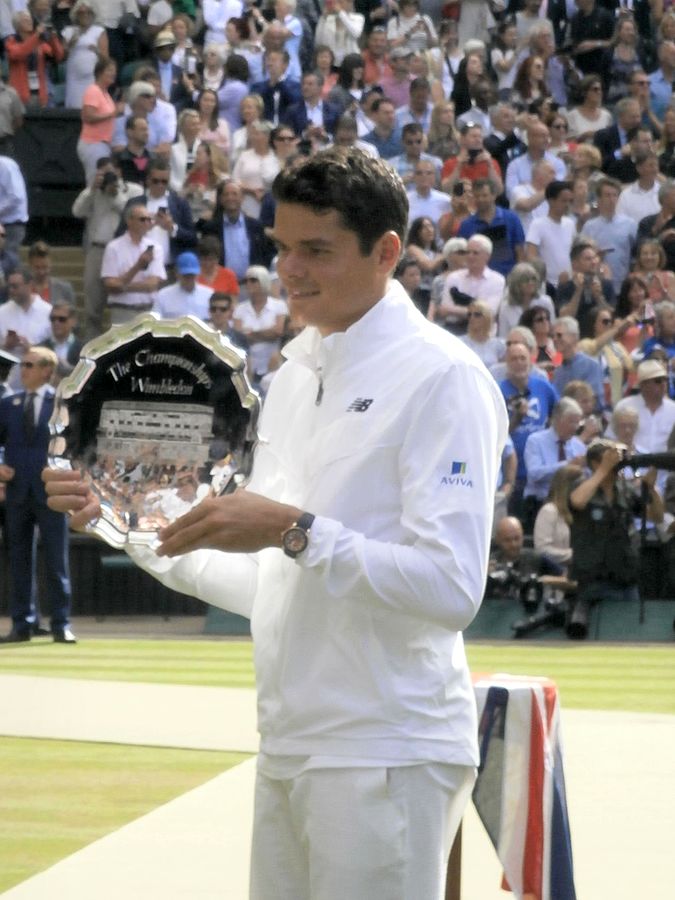
    miloswimbledon2016

    Fact: In the history of Open Era tennis, going back to 1968 through 2016—a span of 49 years and 195 Grand Slam tournaments—there has never been more than two years in a row without a new Slam winner. Of those 49 years, only 15 have been years in which at least one of the Slams wasn’t won by a new winner. To put that another way, in about 70% of the Open Era years, at least one Slam was won by a new Slam champion. The years without a new winner are: 1969, 1973, 1978, 1986, 1993-94, 1999, 2006-07, 2010-11, 2013, and 2015-16.

    You’ll notice that a high percentage of those years are recent; six out of the fourteen are all within the last eleven years. You’ll also note that three out of the four two-year gaps are also within the last eleven years. Clearly this points to the homogeneity of Slam winners in recent years. We can also look at the fact that starting with Rafael Nadal’s first Slam, the 2005 French Open, just seven players have won 47 Slams: Nadal (14), Roger Federer (13 of his 17), Novak Djokovic (12), Juan Martin del Potro (1), Andy Murray (3), Stan Wawrinka (3), and Marin Cilic (1).

    Which brings me to the topic: Going purely on this pattern, there will be a new Slam winner in 2017. Who will it be? Who knows? But if I were to make wagers, here are the players who are most likely, in rough order:

    1. Milos Raonic: The blazing server is coming off his best year in which he finished #3—only the second player after David Ferrer in 2013 to finish in the top three in the last ten years, other than the Big Four. He also reached his first Slam final, losing to Andy Murray at Wimbledon. Raonic doesn’t have the well-balanced game to dominate for an extended period of time, but he does have enough weapons to challenge for a Slam title, being particularly dangerous at Wimbledon.

    2. Dominic Thiem: With Rafa questionable and Novak shaky, Andy having not yet truly dominated clay and Stan Wawrinka always erratic, Roland Garros is up for grabs this year. Now it probably won’t be Thiem, but it is his best surface and if anyone other than the usual suspects wins the French Open, it will probably be Thiem, who has a good chance of being the best clay court player over the next half decade or so.

    3. Nick Kyrgios: If the temperamental Australian starts showing an ounce of composure and maturity, the rest of the tour needs to look out: he can be a very dangerous player, capable of beating anyone on the right day. But he may be two or three years from that level of maturity, if he ever finds it, but with another year of steady rising—and his first three titles—Kyrgios is a player to watch (and watch out for, if you’re a player) in 2017.

    4. Kei Nishikori: I haven’t done the research, but I suspect that Kei may be the best player in Open Era history never to win at least a Master tournament. With just a cursory search, other candidates include Raonic, Richard Gasquet, Fernando Gonzalez, Mikhail Youzhny, Todd Martin, Marc Rosset, Aaron Krickstein, Brad Gilbert, Gene Mayer, Eddie Dibbs, and Alex Metreveli. He’s won 11 tournaments so far, including 6 ATP 500s; he’s reached a Slam final and three Masters finals. It seems inevitable that he’ll win a Masters, although a Slam seems less likely as he hasn’t shown the fortitude that it takes to win seven best-of-five matches in a row. Still, he came very close in 2014 and could conceivably threaten again. If Kei were to reach a final against an exhausted Nadal or Federer, he could pull it off.

    5. Alexander Zverev: It isn’t a matter of if, but when. If there is one player on tour that we can be most certain will eventually win at least one Slam, it is Zverev. But 2017 is probably unlikely; he turns 20 years old in April and has yet to even make it to the fourth round of a Slam. If I were to guess, his first Slam will be in 2018 or 2019. Still, he is talented enough that he should be factored into consideration, especially for later in the year.

    Less Likely Candidates: I’d love to see Jo-Wilfried Tsonga or Tomas Berdych finally win one, but these guys turn 32 in 2017 and both look to be showing signs of decline. I’d give Tsonga a slightly better chance. I almost can’t bear to type his name, but Gael Monfils is exactly the type of brilliant player who could be a one-Slam wonder. Yeah, right. Monfils might be a more likely candidate if it weren’t for his abyssmal record in ATP title finals: 6-19! Another of his ilk is Grigor Dimitrov, who has the talent but not the mentality; still, you just never know.  Lucas Pouille is an unlikely candidate, but at 22 years old and ranked #15 in the world, with two QF Slam appearances in 2016, he’s on the map. I’d like to say that David Goffin has a chance, but he just doesn’t have the upside. Similarly with Jack Sock, who seems to be a similar low-ceiling player as Goffin. One final mention: Karen Khachanov. At 20 years old to start the year and #53 in the world, he’s unlikely in 2017, but he made a big jump up the rankings and is exactly the type of “out-of-nowhere” player that could surprise. But along with every other 21-and-under player not named Zverev and Kyrgios, we have to wait and see before considering him a legit Slam threat.

    So there you have it. Statistically speaking, there should be a new Slam winner in 2017. Now this is far from a certainty, and given the composition of the tour in 2016, it is quite conceivable that we will see our first three-year gap of no new Slam winners. But I think those five are the top candidates, with a few others being distantly possible.

    If it isn’t 2017, it certainly will be 2018. But I’m guessing we’ll see a new champ in 2017. I certainly hope so!

    Addendum: New Slam Winners of the Open Era
    I thought some might like to see the whole list, so here goes:

    2016:
    2015:
    2014: Stan Wawrinka, Marin Cilic
    2013:
    2012: Andy Murray
    2011:
    2010:
    2009: Juan Martin del Potro
    2008: Novak Djokovic
    2007:
    2006:
    2005: Rafael Nadal
    2004: Gaston Gaudio
    2003: Juan Carlos Ferrero, Andy Roddick, Roger Federer
    2002: Thomas Johansson, Albert Costa
    2001: Goran Ivanisevic, Lleyton Hewitt
    2000: Marat Safin
    1999:
    1998: Petr Korda, Carlos Moya
    1997: Gustavo Kuerten, Patrick Rafter
    1996: Yevgeny Kafelnikov, Richard Krajicek
    1995: Thomas Muster
    1994:
    1993:
    1992: Andre Agassi
    1991: Jim Courier, Michael Stich
    1990: Andres Gomez, Pete Sampras
    1989: Michael Chang
    1988:
    1987: Pat Cash
    1986:
    1985: Stefan Edberg, Boris Becker
    1984: Ivan Lendl
    1983: Yannick Noah
    1982: Mats Wilander
    1981: Johan Kriek
    1980: Brian Teacher
    1979: John McEnroe
    1978:
    1977: Roscoe Tanner, Vitas Gerulaitis
    1976: Mark Edmondson, Adriano Panatta
    1975: Manuel Orantes
    1974: Jimmy Connors, Bjorn Borg
    1973:
    1972: Andres Gimeno, Ilie Nastase
    1971: Stan Smith
    1970: Jan Kodes
    1969:
    1968: Arthur Ashe

    Cover image by DanielJCooper from Wikimedia Commons, courtesy of Creative Commons License


  • The Case of Kyrgios: How Good Will the Young Australian Be and Who are His Historical Comparable Players?

    The Case of Kyrgios: How Good Will the Young Australian Be and Who are His Historical Comparable Players?

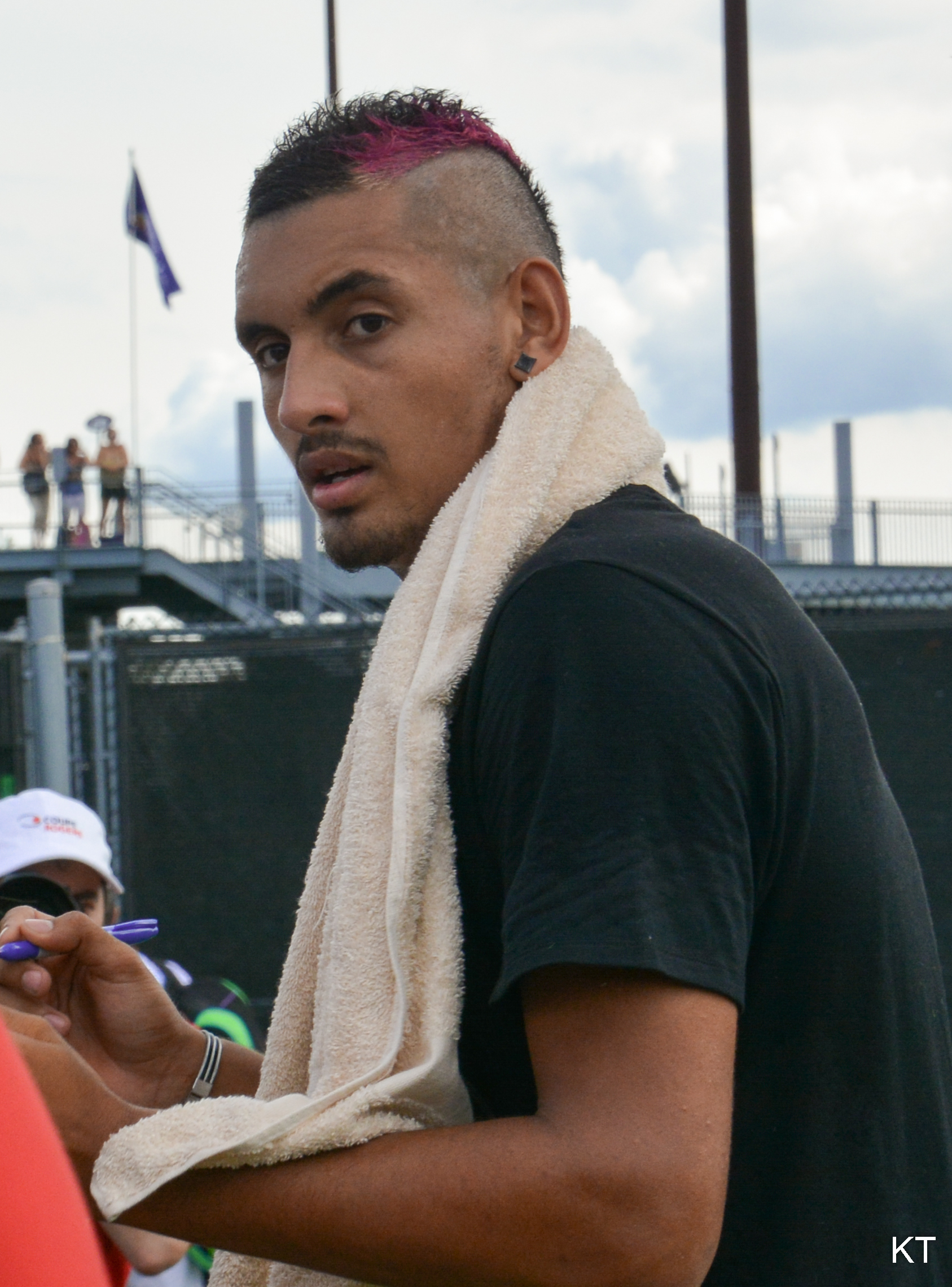
    Bad_Boy_Nick_(20988576545)

    Nick Kyrgios just turned 21 years old on April 27 and, at #20, is currently the highest ranked player age 21 or younger. #15 Dominic Thiem is the highest ranked 22-year old, and the youngest player ranked above Thiem is #11 Milos Raonic at 25-years old; 26-year old Kei Nishikori is the youngest player in the top 10, currently ranked #6, and the only top 10 player under 28. When Novak Djokovic and Andy Murray turn 29 in less than a month, nine out of ten top 10 players will be 29 or older; when Richard Gasquet and Rafael Nadal turn 30 in June, seven out of ten will be 30 or older (assuming the top 10 stays the same, which is by no means a certainty).

    For tennis historians these are shocking numbers, or rather shockingly old numbers, although it is generally well known that the ATP tour has aged, or at least the elite has aged. I won’t go into details here as I want to focus on Kyrgios, but the bottom line is that the elite is the oldest it has been since at least the early 70s, after which the game became younger and younger, with the 80s and early 90s being particularly young (consider that three 17-year olds won Slams in the 80s: Mats Wilander, Boris Becker, and Michael Chang). The sport remained relatively young until the last five years or so, as older stars—the Big Four, but also the secondary cast of characters—grew older and maintained their hold on the sport, with no younger players stepping up.

    As I have discussed elsewhere, there is room for optimism—or at least hope—as the players born in the mid-90s look far more promising than the “lost generation” of players born from 1989-93. One of those promising players is Nick Kyrgios, who first came to my attention in 2013 when the then 18-year old was the highest ranked teenager, finishing the year at #182. 2013 was the last of a particularly dark stretch for young tennis players, with only three teenagers ranking in the year-end top 100 from 2008-13: Kei Nishikori in 2008 (#63 at age 19), Bernard Tomic (#42 at 19) and Ryan Harrison (#79 at 19) in 2011. Compare that to 2003-07, when the top 100 averaged more than three teenagers per year.

    Kyrgios gained wider attention in 2014 when he defeated Rafael Nadal in the fourth round of Wimbledon, displaying a vicious serve and array of weaponry, although lost to Milos Raonic in the quarterfinals. Kyrgios would go on to finish the year ranked #52 and would continue a strong showing in 2015, reaching the Australian Open quarterfinals, although slowing down a bit later in the year, finishing at #30. Kyrgios didn’t quite show the rapid rise that nearly all great players display, so expectations were tempered somewhat.

    https://www.youtube.com/watch?v=K6N0ADhUqok

    But it seems that Nick has taken another step forward this year, winning his first title in Marseille in February, defeating Marin Cilic, and pushing his ranking to #20.

    https://www.youtube.com/watch?v=V-3ngePaErE
    So the question is, what can we expect from Nick going forward? As I mentioned in my last article series, he is actually off what I call the “Pace of Greatness”–a series of benchmarks that all true great players–which I define as 6+ Slam winners–have met in the Open Era, or at least when we have the information. The first such benchmark is reaching the top 100 before turning 19-years old. Nick was #171 when he turned 19 on April 27 of 2014, although would rise up to #66 just two and a half months later after his strong Wimbledon performance. So perhaps we can be a bit lenient on this account.

    But as of his 21st birthday a couple days ago, Nick was ranked #20 in the world and missed another benchmark that all true greats share: a top 10 ranking before turning 21. Now maybe Nick has a strong showing over the next few months and reaches the top 10 this summer—we shall see. But regardless, this leaves us with Kyrgios reaching three of the five benchmarks of true greats so far: a top 50 ranking and Slam QF before turning 20, and his first title before turning 21. Close but no cigar.

    Now as I mentioned in that article series, Stan Wawrinka set new precedents for what I was calling “near-greats,” players who won 2-4 Slams, by not reaching the top 5 or winning his first Slam until age 28. The point being, new precedents can and will be set, and there’s no reason to think that Nick Kyrgios couldn’t be the first (future) true great to have not made it into the top 100 until age 19 and reach the top 10 after turning 21. But we won’t know that for some time, and for now I’d like to focus on what we do know: what Nick has accomplished, what benchmarks he has met, and who his historical comparables are.
    The Kyrgios Criteria
    Nick Kyrgios has met the following three benchmarks, which can call the Kyrgios Criteria:
    A Slam QF at age 19
    A Top 20 ranking at age 20
    A first title at age 20

    So here’s the focus of this inquiry: Who has met those benchmarks and what sort of careers did they have? Now first a caveat: there is a wide margin of error here as there is no easy way to look up which players have met those benchmarks. I did find quite a few, as well as a second group of players who met two out of three.

    So let’s take a look.

    Group A: All-Time Greats
    Considering that the Kyrgios Criteria are enfolded within the Pace of Greatness benchmarks, this includes every true great (6+ Slam winners). Not much to say here other than to refresh your memory as to who the names are, in chronological birth order: Jimmy Connors, Bjorn Borg, John McEnroe, Ivan Lendl, Mats Wilander, Stefan Edberg, Boris Becker, Andre Agassi, Pete Sampras, Roger Federer, Rafael Nadal, and Novak Djokovic—undoubtedly the twelve greatest players who played the entirety of their careers in the Open Era, all of whom were #1 and won at least six Slams.

    Group B: Non-Greats Who Met All Three Kyrgios Criteria
    The next group is comprised of 18 players who met each of the three criteria but aren’t true greats. Of these 18, 11 went on to win at least one Slam, with three winning multiple Slams.

    Multi-Slam winners (3): Jim Courier, Marat Safin, Lleyton Hewitt
    Single Slam winners (8): Pat Cash, Goran Ivanisevic, Michael Chang, Albert Costa, Carlos Moya, Andy Roddick, Marin Cilic, Juan Martin del Potro
    Non-Slam winners (7): Henrik Sundstrom, Jimmy Arias, Alberto Mancini, Guillermo Perez-Roldan, Andrei Cherkasov, Andrei Medvedev, David Nalbandian

    Group C: Non-Greats Who Met Two of Three Kyrgios Criteria
    Finally, in the last group, we have thirteen (and probably more) who met two of the three criteria.

    Multi-Slam winners (2): Sergi Bruguera, Andy Murray
    Single Slam winners (2): Yannick Noah, Thomas Muster
    Non-Slam winners (9): Eliot Teltscher, Aaron Krickstein, Kent Carlsson, Marc Rosset, Mark Philippoussis, Tommy Robredo, Mario Ancic, Tomas Berdych, Richard Gasquet

    Greatest player not on any list: Guillermo Vilas, who met none of the three criteria, reaching the top 20 and winning his first title at 21 and his first Slam QF at 22.

    So in all three groups we have a total of 43 players who met all or most of the three of the Kyrgios Criteria, with the following career results:

    All-time Greats: 12, or 28%
    Multi-Slam winners: 5, or 12%
    Single Slam winners: 10, or 23%
    Slam winners: 27, or 63%
    Non-Slam winners: 16, or 37%

    Some further statistics:

    41 of 43 (95%) players went on to rank in the top 10 (everyone but Cherkasov and Perez-Roldan)
    31 of 43 (72%) went on to rank in the top 5
    19 of 43 (44%) ranked #1 at some point
    37 of 43 (86%) won either a Masters or Slam
    17 of 43 (40%) won multiple Slams

    Now those include the true greats who met benchmarks that Kyrgios did not. If we look at only the 31 players who weren’t true greats, but met all or two of the three Kyrgios Criteria, we get:

    29 of 31 (94%) ranked in top 10
    19 of 31 (61%) ranked in top 5
    7 of 31 (23%) ranked #1
    25 of 31 (81%) won either a Masters or Slam
    5 of 31 (16%) won multiple Slams

    As you can see, the main drop is in #1 and multiple Slams. Almost all went on to rank in the top 10 and win either a Masters or Slam, and most ranked in the top 5.

    The Verdict
    Well, there really is no verdict, although we can make some predictions based upon historical precedents. We can say that Kyrgios almost certainly will rank in the top 10, and probably the top 5. He also will likely win at least one Masters and, if we look only at his 18 nearest comparable players–those who met the three Kyrgios Criteria, but did not meet the other benchmarks of true greatness–he will probably also win at least one Slam. But he probably won’t rank #1 or win multiple Slams.

    Now let me be clear: these are simply historical precedents which are, in a sense, made to be (eventually) broken. I am reminded of a scene from Star Wars:

       C3PO: Sir, the possibility of successfully navigating an asteroid field is approximately 3720 to 1!
       Han Solo: Never tell me the odds!

    Han Solo, of course, successfully navigated the asteroid field.

    Now of course Star Wars is a story, a myth of high drama. Tennis is reality. But in reality, sometimes—often, even—high drama and myth sprinkle in.

    In the case of Nick Kyrgios, we cannot say for certain how good he’ll be, at least not based upon historical precedents. He is already a very good player, is likely to get better and have a successful career, possibly even a nearly-great one, and with a tiny fraction of a chance of being a true great. We can also look at the context in which he will play his best years, which may work for him. He is 21 now, eight years younger than Djokovic and Murray, nine younger than Nadal, and five and a half or more years younger than everyone currently in the top 10. This means that as these players start aging and declining, Kyrgios will be right there to start stealing tournaments from them.

    Cover Photo by Carine06 from Wikimedia Commons, courtesy of Creative Commons License
  • Open Era Generations, Part Fifteen: Gen 13 (1994-98) – A New Hope?

    Open Era Generations, Part Fifteen: Gen 13 (1994-98) – A New Hope?

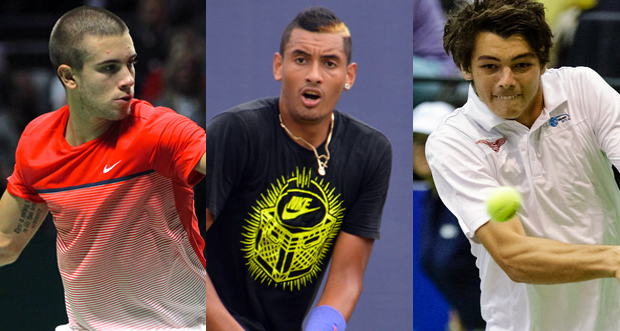
    Borna Coric Nick Kyrgios Taylor Fritz

    The Young Punks
    As the saying goes, history repeats itself. In this case, we see a kind of harmonic in tennis history between these past few generations and the first few generations of the Open Era. The first generation of Rosewall and Laver was extremely strong, followed by one of the very weakest, with only Arthur Ashe winning multiple Slams, then the third—headlined by John Newcombe and Ilie Nastase—was much stronger but still not quite a generation of greats (aside from Newcombe). And so we see a similar pattern with the last few generations: the 1984-88 was (and still is) one of the greatest generations in tennis history; 1989-93 one of the weakest. The verdict is still out on this new young generation of 1994-98, with players ending 2015 at age 17-21, but there are promising signs, as we shall see, and it certainly looks to be stronger than the 89-93 generation.

    I call them the “Young Punks” for two reasons: One, because of the “punkish” attitude of Nick Kyrgios, so far the most successful of the group, and secondly because they carry a kind of swagger that seems to be lacking from the previous generation—which is a good thing.

    Best Players by Birth Year:
    1994: Lucas Pouille (FRA), Kimmer Coppejans (BEL), Jordan Thompson (AUS), Adam Pavlasek (CZE), Luke Saville (AUS), Mathias Bourgue (FRA)
    1995: Nick Kyrgios (AUS), Yoshihito Nishioka (JPN), Kyle Edmund (UK), Matteo Donati (ITA), Mackenzie MacDonald (USA)
    1996: Borna Coric (CRO), Hyeon Chung (KOR), Thanasi Kokkinakis AUS), Jared Donaldson (USA), Quentin Halys (FRA), Elias Ymer (SWE), Noah Rubin (USA), Christian Garin (CHI), Karen Khachanov (RUS)
    1997: Alexander Zverev (GER), Taylor Harry Fritz (USA), Andrey Rublev (RUS), Tommy Paul (USA), Omar Jasika (AUS)
    1998: Frances Tiafoe (USA), Stefan Kozlov (USA), Duckhee Lee (KOR), Mikael Ymer (SWE), Michael Mmoh (USA)

    No Slams yet, with the operative word being “yet.” With this group it is only a matter of time, and we will almost certainly see several multi-Slam winners, if only because the previous generation is so weak, and Novak, Rafa, Andy, and Stan can’t maintain their hold of dominance forever.

    As of this writing, seven players are in the Top 100: Kyrgios, Coric, Zverev, Chung, Fritz, Edmund, and Pouille, with Kokkinakis dropping out due to inactivity. There are another dozen or so in the No. 101-200 range, with several having a chance of entering the Top 100 this year, so by year’s end we could see 10-15% of the Top 100 being players of this generation, finishing the year 18-22 years old.

    While there’s no player that looks like a surefire future great, at least not yet, there are quite a few that are potential future Slam winners, and several that could be multi-Slam winners. Part of this is bolstered by the weakness of the previous generation, but there are also some young players that are the most exciting young talents since Juan Martin del Potro and Marin Cilic.

    1994 is relatively weak with the highest ranked player being Pouille, No. 87 at the ripe age of 22, but then the generation starts becoming stronger in 1995 with Nick Kyrgios, a player whose antics have made him unpopular. But most believe that he’ll eventually be a Slam winner, if he can remain healthy enough. Still, the floor is probably a Berdych-like player and career, but one who peaks in an era with more opportunity than poor Tomas, so with better results. His ceiling might be something like a Juan Martin del Potro, but hopefully with better health. Nishioka and Edmund look like two players who could be future regulars in the Top 40, maybe Top 20 even, but probably not Top 10.

    The generation gets even stronger in 1996, with standouts Coric and Chung, as well as Kokkinakis, Donaldson, Halys, Elias Ymer, Rubin, Khachanov, and Garin showing various degrees of promise. Again, at this age almost every player shows some degree of promise, so it is hard to see now who will continue to rise and who will find a lower level in the rankings and stay there, that is “do a Berankis.” Coric is the player who has risen the quickest, although the feeling on him is mixed. He has stagnated for almost a year now: he broke into the Top 100 in October of 2014, and then climbed further into the Top 50 by May of 2015, but has fluctuated in the 30s and 40s for almost 10 months now. Still, he’s almost certainly going to rise higher, but he may be more of a future Top 10-20 player rather than the future star some pegged him out to be.

    When we get to 1997, we see the two players who look to be the jewels of the generation: Alexander Zverev and Taylor Harry Fritz. Both Zverev and Fritz are getting a good amount of press, with my article about Fritz here. Zverev turns 19 in April and, in my mind—as with Fritz—isn’t far from a big breakout performance. I expect both of these players to win their first titles this year, and make it to the second week of at least one Slam. I think we’re going to see both of these players start head-hunting Top 20 and even some Top 10 players as soon as this year. Andrey Rublev also shows some promise and is eight days older than Fritz, but has yet to make his run at the Top 100. But he did just win his first Challenger title and could rise quickly.

    1998 also has some promising players with Americans Francis Tiafoe and Stefan Kozlov, as well as the Korean Duckhee Lee and the Swede Mikael Ymer, Elias’s younger brother. Of the two Ymer brothers, Mikael may be the more talented. He’s still only 17, however, and still only ranked No. 590, but his is a name to keep in mind.

    2016 will see this generation turning 18-22, so we should start seeing better indicators as to how good they might be, and maybe see a sprinkling of lesser titles. As I’ve written elsewhere, every single all-time great of the Open Era—which I’m defining as players with 6+ Slam titles—has accomplished three things before American drinking age: won an ATP title, reached the second week (QF or better) in at least one Slam, and finished the year in the Top 20. No player of this generation has accomplished all three, and while Kyrgios accomplished reached the second week of a Slam two years ago in 2014 at age 19, he won his first title this year a couple months before turning 21, but has yet to reach the Top 20. That said, I think we can loosen up a bit on those criteria, given the theory that players are taking a bit longer to mature these days. Perhaps two out of three of these criteria is enough to still be a possible future great.

    It should be noted that this generation saw its first title when Nick Kyrgios won Marseille. Consider that 2016 is the equivalent year as 2011 was for the previous generation and 2006 for the 1984-88 generation. In 2011, the previous—and very weak—1989-93 generation won its second title, but wouldn’t start winning multiple titles until 2012. The 84-88 generation starting winning titles in 2004, and won their first Slam and first Masters in 2005 in the name of one Rafael Nadal. It seems likely that the 94-98 generation will be somewhere between the two, although as of this moment they are even behind the weak 89-93 generation. But look for players like Zverev and Fritz to challenge for titles this year.

    Underachievers and Forgotten Players
    It is too soon to tell. If there are any players I’m at all concerned about being underachievers, it is either Lucas Pouille or Christian Garin. At 22, Pouille should be showing a bit more; at this point he’s looking like yet another good-but-not-great Frenchman.

    As for Garin, a couple years ago he was a highly touted junior, defeating Alexander Zverev in the 2013 Junior French Open. While Garin is still only 19, the luster has started to fade a bit as he’s yet to crack the Top 200. Still, we shouldn’t quite give up on him…yet.

    Did You Know?
    I: Alex Zverev’s father was a tennis player, as is his older brother, Mischa.
    II: Andrey Rublev is the name of an illustrious Russian literary figure, and also the title of a film (Andrei Rublev) by the great Russian filmmaker, Andrei Tarkovsky.

    Current Rankings
    27. Nick Kyrgios
    47. Borna Coric
    58. Alexander Zverev
    64. Hyeon Chung
    80. Taylor Fritz
    82. Kyle Edmund
    87. Lucas Pouille
    119. Thanasi Kokkinakis
    122. Kimmer Coppejans
    123. Jordan Thompson

    Other players in the Top 200: Yoshihito Nishioka (No. 124), Adam Pavlasek (No. 134), Karen Khachanov (No. 146), Elias Ymer (No. 152), Jared Donaldson (No. 158), Andrey Rublev (No. 161), Quentin Halys (No. 175), Francis Tiafoe (No. 177), Matteo Donati (No. 181), Luke Saville (No. 186), Matthias Bourgue (No. 187).

    Kyrgios and Coric have been stagnating, although the former has been playing very well of late and should start rising again. Chung has also stagnated, but Zverev and Fritz are both on the rise and should be in the Top 50 shortly.

    Top Ten Players of the Generation (Predicted)
    Right now the most accomplished player of the generation is clearly Nick Kyrgios, the only player with a title and a second week Slam result (he has made a QF twice). But given that their career accomplishments at this point are minimal, and we can see their current rankings above, I’m going to go out on a limb and predict how this list might look 20 years from now. Of course this is impossible to predict, but why not?

    1. Alexander Zverev
    2. Taylor Harry Fritz
    3. Nick Kyrgios
    4. Andrey Rublev
    5. Mikael Ymer
    6. Francis Tiafoe
    7. Borna Coric
    8. Hyeon Chung
    9. Stefan Kozlov
    10. Jared Donaldson

    Honorable Mentions: Elias Ymer, Yoshihito Nishioka, Thanasi Kokkinakis, Kyle Edmund, and just about everyone else.

    This is wild conjecture at this point, but humor me! The top three are safe picks considering their recent performances. After that, I have a feeling about Mikael Ymer and Andrey Rublev, but could be very wrong about one or both. Coric and Tiafoe are paired in my mind, both being somewhat overhyped but both should still be very good players, but again it is just too soon to tell. Chung snuck into the Top 100 by winning a ton of Challengers and Futures, but has yet to do much at more significant tournaments–he’s only made it past the Round of 16 once, at Shenzhen (ATP 250) last year when he lost to Marin Cilic in the QF; the point being, he’s a good “Berankis candidate,” although like all of these players it is too soon to tell. Kozlov is another young American to look out for. After that, Donaldson is a player that I’ve been expecting a breakthrough from for a while now, but haven’t yet seen it.

    Postscript: Gen 14 (1999-03) – Millennials
    Yes, Gen 14 is beginning to show up on the edge of the radar. Right now just a few players are ranked, but as of the end of 2015 we have:

    1999: Corentin Moutet (FRA), Denis Shapovalov (CAN), Alex De Minaur (AUS), Santiago Fa Rodriguez Taverna (ARG)
    2000: Felix Auger Aliassime (CAN), Rayane Roumane (FRA)

    All of the above are ranked between No. 700 to No. 1,000, which basically means they’ve played in Futures but haven’t gone pro yet. And yes, there are players born in 2000 that have ATP rankings. A scary thought. Aliassime has turned some heads and even reached the QF of a Challenger last July when he was 14 years old, before losing to then No. 145 Yoshihito Nishioka—but not before talking the first set from him. He definitely bears watching, but all of this Generation Next are two to three years away from being a serious prospect.

    [divider]

    Cover Photo (Creative Commons License): Marianne Bevis / Carine06 / mirsasha

  • 2015 Rogers Cup Review

    2015 Rogers Cup Review

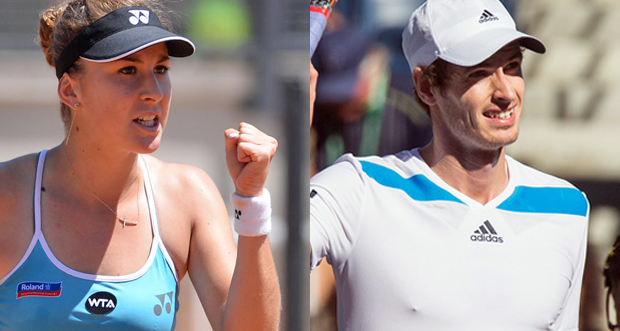
    Andy Murray Belinda Bencic Rogers Cup

    One week ago, as the men began play in Montreal and the women started play in Toronto, the main talking points were about the performances of Novak Djokovic and Serena Williams and how they would start their preparation for the upcoming U.S. Open, as well as the performances of the Canadian stars playing in their home country’s Masters/Premier event. But the tennis fans were treated to a whole lot more than they ever expected this week.

    Finally, At Long Last, About Time!
    The numbers were repeated over and over again. Andy Murray had not beaten Novak Djokovic since his dramatic win at Wimbledon in 2013. The losing streak had built up to eight consecutive losses. Murray would play outstanding tennis in a tournament, only to be turned away time and again by Djokovic. Even when Murray demolished Kei Nishikori in the semifinals, there was still the feeling that Murray may challenge Djokovic but in the end fall short as always. The turning point came in the fifth game of the third set. The 18-minute game went to deuce 10 times and Djokovic had six break points, but on this day Murray refused to surrender. Somehow, he held on to that game. Still, Djokovic fought off three match points serving at 2-5, and then had his own chance to get back on serve in the next game but Murray finally sealed the 6-4, 4-6, 6-3 win on his fifth championship point. A big old monkey jumped off Murray’s back and the upcoming U.S. Open just got a whole lot more interesting.

    A New Star Arrives
    We have another Swiss Superstar coming onto the scene. This may not have been a Grand Slam, but when you defeat the home crowd’s darling and former Wimbledon finalist in round one, a former World No. 1 and the current No. 5 in round two, another former Wimbledon finalist in round three, another former World No. 1 and the current No. 6 in the quarterfinals, the World No. 1 and the holder of all four Grand Slams in the semifinals, and finally a former French Open finalist and World No. 3 in the final, people are going to notice. Belinda Bencic won her second title of the year and will move up to No. 12 in the new rankings. There is no doubt all eyes will be on her at the U.S. Open. Bencic could be the real deal.

    World No. 1’s Denied
    Most expected Djokovic and Serena to come away with the titles this week, but shockingly, both were denied. Djokovic just couldn’t finish off Murray in his usual style, and Serena let Bencic back into the match after dictating things through most of the first set. Still, even though they left town without a title, you get the feeling that they will fine tune their tennis in Cincinnati, and will be raring to go when the year’s last Grand Slam rolls around. They are still the ones to beat and that’s not going to change any time soon.

    Home-Ain’t-So-Sweet Home
    Clicking on the website of the Rogers Cup last week, tennis fans’ computer screens were immediately covered with huge pictures of Milos Raonic and Eugenie Bouchard. Along with Vasek Pospisil and six other wild cards to represent Canada, expectations were there despite Raonic’s recent struggles and Bouchard’s dismal season. Raonic was upset by Ivo Karlovic in his first match, Bouchard lost to eventual champion Bencic in the first round, and the only Canadian wildcard to win a match, Vasek Pospisil, lost in the third round to John Isner. It was a tournament to forget for the Canadians.

    The Walking Wounded
    We’re only halfway through August but there are a disturbing number of absences, dropouts, retirements, and injuries. Both World No. 2’s Roger Federer (cutting back on schedule) and Maria Sharapova (injury) were absent. Simona Halep had to retire in the final set of the women’s final. Kei Nishikori was clearly hampered in his one-sided loss to Murray in the semifinals. Raonic still does not seem to be fully recovered from his foot injury. Stan Wawrinka retired during his infamous match with Nick Kyrgios. Caroline Wozniacki was also struggling with an injury in her early round loss. The hard-court season only gets tougher from here so this could be a chance for some young players to break out of the early rounds and even score some upsets, just as Bencic did in Toronto.

    The Sledge
    How many people really knew what “sledge” meant before this tournament? Everyone has seen multiple reports of what happened whether they wanted to or not. In one of the ugliest matches in recent memory, Kyrgios managed to insult Stan Wawrinka, fellow Australian Thanasi Kokkinakis, a young WTA player from Croatia, and pretty much the entire tennis community. He was fined $10,000, and still could be suspended by the ATP. There are some serious problems with Kyrgios, and it appears that no one really knows what to do with him. Tennis Australia has asked fellow Australian and veteran Lleyton Hewitt to act as an advisor for the young Australian, but boy does Hewitt have his work cut out for him.

    In the End, It’s All About Tennis
    Despite all of the media storm over one comment made by a misguided player, tennis proved to be a sport that wipes away the sludge and the sledges with inspiring performances. With Murray’s spirited effort to finally break through Djokovic and Bencic’s fantastic string of wins, the hard-court season finally seems like it’s here — and it’s only going to get more interesting.

    [divider]

    Cover Photo (Creative Commons License): kulitat / mirsasha

  • National Tennis Careers – Part Six: Summing Up

    National Tennis Careers – Part Six: Summing Up

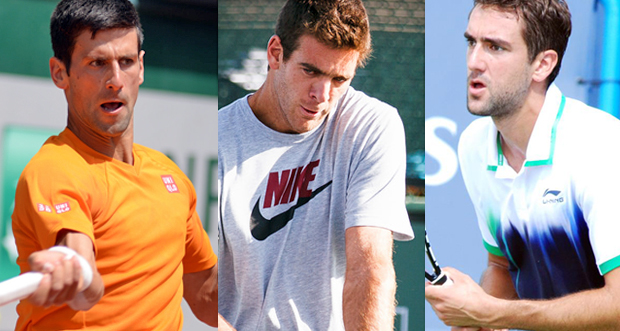
    Novak Djokovic Juan Martin del Potro Marin Cilic

    After surveying Open Era tennis through the five nations with the highest Slam totals, we’re left with a few questions and unexplored areas which I’ll try to tackle in this concluding segment.

    [divider]

    Click here to discuss National Tennis Careers – Part Six: Summing Up in the discussion forum.

    [divider]

    Who’s left?
    The “big five” tennis nations include many, even most, of the all-time greats of the Open Era. Let’s take a look at the other nations and their players by Slam count:

    Czechoslovakia/Czech Republic (12): Ivan Lendl (8), Jan Kodes (3), Petr Korda (1).
    Serbia (9): Novak Djokovic (9)
    Germany/West Germany (7): Boris Becker (6), Michael Stich (1)
    Argentina (6): Guillermo Vilas (4), Gaston Gaudio (1), Juan Martin del Potro (1)
    Russia (4): Yevgeny Kafelnikov (2), Marat Safin (2)
    Brazil (3): Gustavo Kuerten (3)
    Croatia (2): Goran Ivanisevic (1), Marin Cilic (1)
    Romania (2): Ilie Nastase (2)
    South Africa (2): Johan Kriek (2)
    United Kingdom (2): Andy Murray (2)
    Austria (1): Thomas Muster (1)
    Ecuador (1): Andres Gomez (1)
    France (1): Yannick Noah (1)
    Italy (1): Adriano Panatta (1)
    Netherlands (1): Richard Krajicek (1)

    Before Djokovic is through, Serbia’s Slam count should surpass that of the Czechs as a whole.

    Slavic Surge?
    I almost titled this last part “Slavic Surge!” because it would seem that the tennis from Slavic countries has been on the rise. But it wasn’t quite as extreme as I thought. There are some strong Slavic players currently in their peaks, namely Djokovic, Berdych, Cilic, and Karlovic. There are some younger players with some upside, including Damir Dzumhur (23, No. 100), Grigor Dimitrov (24, No. 16), and Jiri Vesely (22, No. 45). But there is only one player that looks like a potential future star, and that is the 18-year-old Croatian Borna Coric, who is currently ranked No. 37. So while Slavic tennis is strong, it is hardly dominant (Novak aside).

    Possible Future Slam Winning Countries
    So who might the next Slam winners be? Specifically, which countries have the most possible future Slam winners? Well, that is for a future study that I’m working on. But I will say that as we’ve seen in the previous segments, there isn’t much on the horizon for Spain or Switzerland, and only really the Ymer brothers in Sweden; in the US there are a few prospects, and Australia at least has “K&K”: Kyrgios and Kokkinakis.

    All in all there doesn’t seem to be a central location for tennis right now or the foreseeable future. We can sum up the Open Era by looking at early dominance by Australians, namely Ken Rosewall, Rod Laver, and John Newcombe, then the rise of Americans in Jimmy Connors and John McEnroe, and Sweden in Bjorn Borg, Mats Wilander, and Stefan Edberg. Along with German Boris Becker and Czech Ivan Lendl, Americans and Swedes dominated tennis from the mid-70s into the early 90s, with Sweden dropping off as Edberg retired, but the United States remained dominant into the 21st century, led by Pete Sampras and Andre Agassi. But then the US dropped off precipitously, and Switzerland and Spain took up the rulership of men’s tennis, with Serbia playing its part.

    What the future will bring, well, it is a truly global world out there. There’s no sign of any of the five great tennis nations regaining their dominance. There are some glimmerings of improvement in Australia, and a bit in the US, but nothing substantial or worthy of the term “future dominance.” We’re going to see a shared effort, it would seem.

    [divider]

    Cover Photo (Creative Commons License): kulitat / mirsasha / Kiu Kaffi

  • 2015 Davis Cup Quarterfinals Review

    2015 Davis Cup Quarterfinals Review

    Davis Cup

    The 2015 Davis Cup quarterfinals were held across the world during July 17-19. As usual, they provided drama, comebacks, upsets, and promise. There was a country crumbling without its injured top players, and a heroic performance by a two-time Major champion playing his last season. There were two brothers carrying the hopes of a country on their shoulders, and a country getting closer to the title it has never won but so desperately wants. It was a great week for the sport of tennis, no matter who was playing.

    Middelkerke, Belgium: Injury-riddled No. 8 Canada loses to Belgium. Canada was the higher seed, but with No. 8 Milos Raonic and No. 30 Vasek Pospisil out with injuries, the Canadians were the clear underdogs. Belgium, led by No. 14 David Goffin, had absolutely no trouble. They dropped only two sets on the way to a 5-0 sweep, allowing Belgium to advance to its first semifinal since 1999.

    Buenos Aires, Argentina: No. 5 Argentina knocks out Djokovic-less No. 4 Serbia. Without Serbia’s World No. 1 Novak Djokovic in the lineup, Serbia and Argentina looked to be pretty evenly matched. It looked like things would be going down to the fifth match on Sunday, but then Delbonis happened. Argentina won the first match of the day but Viktor Troicki looked to have Serbia right back in it when he won the first two sets against the Argentine. Then a Wimbledon flashback occurred: Just as he had done in the fourth round against Pospisil, Troicki couldn’t finish the job, and Delbonis scored a huge comeback win and a massive blow to Serbia’s hopes of getting through without their No. 1 player. Argentina took a surprisingly easy three-set win in the doubles on Saturday, and advanced to their first semifinal since 2013.

    Darwin, Australia: Australia’s youth drop the ball, but the veterans save the day. Australia seemed to have a bright future in Davis Cup at the beginning of the year, but those hopes have taken a bit of a hit lately. Australian No. 1 Bernard Tomic got kicked off the team and then managed to get himself arrested in Miami, Florida, a few days before competition began. Nick Kyrgios carries drama wherever he goes. Aussie Captain Wally Masur, eye firmly on the future, went with his young stars in the first two matches: No. 41 Nick Kyrgios, and No. 69 Thanasi Kokkinakis. They managed to win one set between them. Australia was suddenly staring at a 0-2 hole. Sam Groth and Lleyton Hewitt teamed up to win the doubles point, and now Masur had a decision to make: youth or experience. He went with experience. He ditched Australia’s future for the time being and sent out Groth for the first match. It was very close and a few points would have changed the outcome but Groth gutted out a hard-fought four-set victory to tie everything up at 2-2. Then Lleyton Hewitt took the court. His ranking has dropped to No. 279, and it looked like Australia might be heading home early. But never count out Hewitt. In what could have been his 77th and final Davis Cup match, Hewitt took a first set tiebreak and never looked back, winning in straight sets and sending Australia to their first semifinal since 2006.

    London, England: Standing on the shoulders of Murrays. The No. 1 team in the world, France, with its loaded lineup and Davis Cup experience, had to be thinking this year was going to be the year they finally lifted (or sat on it, actually, since it’s so huge) the Davis Cup for the 10th time, and for the first time since 2001. After splitting the first two matches, Great Britain’s captain Leon Smith decided to go with Andy and Jaime Murray. It was a big gamble but the Brits absolutely needed this doubles match to have a chance. The Murray brothers came through. Jaime, with his world doubles ranking of No. 20 and a recent runner-up finish in the men’s doubles at Wimbledon, led the way and played some inspired tennis to grab the win after dropping the first set. Suddenly, Great Britain had a 2-1 lead and only needing a win by Andy Murray over Gilles Simon on Sunday to beat France for the first time since 1978. Simon had been playing very well lately, with a quarterfinal finish at Wimbledon. For the first two sets, Simon played brilliantly and Murray was tentative, no doubt feeling all the pressure from his home country on his shoulders. With Simon up a set and leading 4-1 in the second set tiebreak, things looked a bit bleak for Great Britain. Then Murray gritted his teeth and somehow, someway took the second set tiebreak. With that behind him, he started playing much better and Simon was the one who became tentative. Murray quickly wrapped up the match in four sets. The enormous pressure finally got to Murray and he broke down on court-side after the match. One thing is for certain: if Great Britain actually wins the Davis Cup this year, they had better send Mama Judy Murray a trophy of her own.

    The semifinals of the 2015 Davis Cup will be on September 18-19, with Great Britain hosting Australia, and Belgium hosting Argentina.

    [divider]

    Cover Photo (Creative Commons License): elPadawan

  • 15 Up-and-Coming Players to Watch in 2015 / Jonathan Northrop

    15 Up-and-Coming Players to Watch in 2015 / Jonathan Northrop

    Kei Nishikori Grigor Dimitrov Milos Raonic

    As the first tournaments of 2015 wrap up, it is almost shocking to think that the Australian Open is just around the corner on January 19. As always, we’ll all be watching the top players with the usual questions: How healthy will Rafael Nadal be and will it be enough to supplant Novak Djokovic at the top of the rankings? Can Novak maintain his focus? Will Father Time catch up with Roger Federer, who turns 34 later this year? Can Andy Murray find his 2012-13 form again? Will Juan Martin del Potro be healthy enough to rise again? And so on.

    But what about the rest of the pack? We focus so much on the “Big Four” and a few dark-horse candidates, while there are a lot of interesting stories and players beyond the big name elite. Let’s take a look at these other players, in particular those who bear watching in 2015 for whatever reason – but mainly as players poised to rise in the rankings. Some may be knocking at the door of the elite, while others may simply be establishing themselves as players to know, while others yet might be potential future stars.

    There are, of course, many other players worth watching – but I wanted to highlight these fifteen as particularly interesting, for a variety of reasons. Let’s take a look.

    [divider]

    Click here to discuss “15 Up-and-Coming Players to Watch in 2015” in the discussion forum.

    [divider]

    THE ALMOST BIG THREE
    Grigor Dimitrov

    Let’s start with Grigor Dimitrov, who may have been so overrated in the past in terms of expectations that he’s now being underrated (although his recent Brisbane demolishing at the hands of Federer is not exactly encouraging). Let us not forget that Grigor has improved in each year he’s been on tour; consider his year-end rankings since 2008: 493, 288, 106, 76, 48, 23, 11. Notice the trend? If Grigor keeps it up in 2015 he will possibly make it as high as the edge of the Top 5. But of course at some point he’s going to even out, and it is hard to imagine him supplanting Novak, Rafa, or even Roger. But it seems that he can beat anyone else, or at least remain competitive among the rest of the near-elites of the game. The problem with Grigor seems to be that, while he’s very good at almost every facet of the game, he doesn’t have any truly killer weapons – and seemingly lacks a killer instinct altogether.

    Prediction: The book is still open for Grigor. He needs something else — a killer shot and perhaps more of a killer instinct — to fully actualize his potential, otherwise he’ll remain more of a pretty player to watch, but not a true elite. In 2015 I think we’ll see continued incremental gains as Grigor creeps into the Top 10. He’ll continue to go deeper in Slams, being relevant at Masters tournaments, with a chance of winning one late in the year (Paris?), eventually earning his way to the World Tour Finals next November.

    Kei Nishikori
    On one hand, we may have seen the best of Kei in 2014. On the other, he seems to keep getting better and better, and of the rest of the field seems like he has what it takes to upset one of the Big Three. Kei is now a legit candidate to win a Masters and a dark horse at the Slams. Whether he has the stamina to make it through remains to be seen; despite his strong year, it should be remembered that he still only made it to the second week once.

    Prediction: Kei settles in within the second half of the Top 10. For some reason Nikolay Davydenko comes to mind – a player that never really challenged at Slams, but won a couple Masters and was always around. Perhaps Kei will have a similar peak.

    Milos Raonic
    At first I excluded Mighty Milos from this list but then I decided that it would be unfair. The big Yugo-Canadian is, quite frankly, a bit underrated at this point. Like Dimitrov it is hard to imagine him beating any of the Top 3 when it really counts, but he did just that versus Roger Federer at the Paris Masters. Milos continues to make small gains, as evidenced by his year-end rankings: 373, 156, 31, 13, 11, 8. If the pattern holds he’ll finish 2015 in the No. 5-6 range. At the least, though, I think Milos is a fixture to hand out in the latter half of the Top 10 for years to come, playing a similar role in the next half decade as Tsonga and Berdych have for the last half decade.

    Prediction: Something good for Milos in 2015. Will it be a Masters? A Slam even? Hard to imagine, but he’s knocking at the door. I think he wins several titles in 2015, maybe even a Masters. He feels close.

    DON’T FORGET ABOUT THE OTHER TWO
    Jiri Vesely & Dominic Thiem

    For some reason I pair these two players. Well, the reasons are pretty clear: they’re of a similar age, on the younger side of “Generation Raoshitrov”; Vesely’s advancement was steady but perhaps a bit disappointing, going from No. 85 to No. 66, while Thiem jumped 100 ranks from No. 139 to No. 39.

    Prediction: I expect continued steady progress from both. Both, I think, will fully establish themselves in the Top 40, and Thiem might even challenge for the Top 20. I think we’re still a couple years away from their peaks, but both should eventually be fixtures in the Top 20 and may even challenge for the Top 10 as players like Ferrer, Berdych, Wawrinka, and Tsonga age themselves out of it. But that’s probably a couple years away.

    THE BOYS ARE GROWING UP
    Nick Kyrgios

    The first of two up-and-comers to beat Rafael Nadal in 2014. Nick Kyrgios is a big kid (6’4”) with a big game and a big serve (14.8 ace %, good for No. 6 among the Top 50); I can’t help but think of Juan Martin del Potro when I see him out there. Ironically enough, the last time a teenager upset the world No. 1 at a Grand Slam was Rafa over Roger Federer at the 2005 French Open. Anyhow, great things are ahead for the Australian – he finished the year at No. 52 up from No. 182 in 2013, so he made quite a jump. He turns 20 years old in April, so still has some room to grow.

    Prediction: Nick makes steady progress but doesn’t quite jump into the elite. That said, he fights for, and at least comes close to, a year-end Top 20 ranking. While he may play the spoiler in 2015 again, he probably won’t be in the mix for big titles until 2016.

    Borna Coric
    No young player has me quite as excited as Borna Coric. I just see him having the highest upside of any player currently on the radar (that is, in the Top 300 or so). We all know him for taking out Rafael Nadal at Basel, but let’s not forget that he also beat Ernests Gulbis in that tournament and lost to red-hot David Goffin in three sets. Coric is for real and his advancement should be steady from here on, although at this point we should remain patient – he did just turn 18 a couple months ago, after all.

    That said, it is important to note that most truly elite players were ranked somewhere in the second half of the Top 100 or so at Coric’s age, and most jumped into the Top 20 the year after. Compare the year-end rankings for recent all-time greats at age 18 and 19:

    Djokovic: 78, 16
    Nadal: 51, 2
    Federer: 64, 29
    Sampras: 81, 5
    Agassi: 3, 7

    (Prior greats – starting with Agassi, but including Becker, Edberg, Wilander, etc., tended to have their break-out a year earlier, with age 17 being the first in the Top 100 and age 18 the big jump; one could speculate that perhaps we’re going ahead another year, with Nick Kyrgios’ trajectory being closer to the norm for elite players – first year in the Top 100 at age 19, big jump at age 20).

    Now compare the next tier down:
    Del Potro: 92, 44
    Murray: 65, 17
    Roddick: 156, 14
    Hewitt: 25, 7
    Kuerten: NA, 188
    Kafelnikov: 275, 102
    Courier: 43, 24

    As you can see, the next tier tends to rise a bit later, or at least more slowly.

    The point here is that if Coric is going to be great—as in an all-time great—then he needs to rise fast. Given the fact that players seem to be taking longer to develop these days with later peaks, I think we can go a bit easier on him and not expect a Rafa-like or Pete-like rise, but for me the benchmark would be a Top 40 or 50 ranking by year’s end. If he makes it into the upper half of the Top 100, then I think it is a sign that he has a chance to be special, even a truly great player. If he sticks around No. 100 or slips out of the Top 100, then we might need to temper our expectations a bit.

    Prediction: Borna will continue to rise, with some bumps in the road, but his overall trajectory will be clear. He finishes somewhere in the No. 40-50 range, although I would be surprised if he wins anything more than maybe an ATP 250.

    Alexander Zverev
    The second youngest player on this list, 17-year-old Zverev finished the year ranked No. 136. That might not sound all that impressive, but consider that of the active players who have ranked in the Top 10, only Tomas Berdych (No. 103), Lleyton Hewitt (No. 100), and Rafael Nadal (No. 49) ranked higher at the end of the year they turned 17. Novak was No. 186, Roger No. 301, and many players weren’t even on tour yet. While we should be moderate in our expectations at this point, it is hard not to get excited about this kid. If Nick Kyrgios and Borna Coric are the top two candidates to be the next elite players, then Zverev is No. 3 and not far behind.

    Prediction: Baby steps. Zverev doesn’t turn 18 until April, so has a lot of room to grow – both as a human body and as a player. I think he has a good shot at the Top 100 this year, but I wouldn’t expect much more than a year-end No. 80-100 ranking.

    OTHERS TO KEEP AN EYE ON
    Ernests Gulbis:
    Long viewed as an underachiever, Ernests (named after Hemingway) had his best year, challenging at one point for the Top 10. But questions remain: After an erratic career, can he maintain his current level? Can he take it a step higher? Or is he in the vein of up-and-down perennial underachievers like Alexandr Dolgopolov and Richard Gasquet? Who knows with Ernests. I suspect he’ll have more upsets like the fourth round French Open victory over Roger Federer, but not be consistent enough to break into the elite. That said, I think he’ll flirt with the Top 10 and maybe dip into it briefly, but then fall back and finish somewhere in the latter half of the Top 20. I’d prefer not to be so specific in my predictions, but for some reason No. 15-18 sounds about right.

    Jack Sock: While it is hard to become too excited about a 22-year old ranked No. 42 and with no titles to his name, consider that Sock is now the fourth highest ranked American and only one of five in the Top 100. Not only that, he’s the youngest American ranked in the Top 200, just a month younger than No. 121 Denis Kudla, and a few months younger than No. 190 Ryan Harrison. But here is where there is some hope: Sock’s rise has been strong and steady – consider his year-end rankings from 2010 to the present: 878, 381, 150, 102, 42. We probably can’t expect Sock to be the next Andy Roddick, but he could be the next John Isner or Mardy Fish.

    Stefan Kozlov: Stefan who? Well, a year or two from now he could be front and center in our minds. Who is Stefan Kozlov, you ask? He’s the youngest player to finish in the Top 500 this year at No. 468. No. 468?! Who cares? Well, I care – because Stefan Kozlov was born in 1998. Yes, 1998. Kozlov is 16-years old, turns 17 in February. He hasn’t done much yet, but he did play in the qualification rounds of the US Open, defeating his first round opponent, Mitchell Frank, before losing in three sets to “old man” Borna Coric. Kozlov is a long way away, but I wanted to introduce him as he’s a player worth keeping an eye on. Oh yeah, and best of all, while he’s Macedonia-born, he’s technically American (I know, it feels like cheating – but tell that to the Canadians re: Milos).

    Yoshihito Nishioka: In the shadow of similarly named (at least to a Westerner) top-ranked and fellow Japanese player, Kei Nishikori, Nishioka is 19 years old and ranked No. 156, and could be a real sleeper to break into the Top 100 next year and a player to watch.

    Thanasi Kokkinakis: Another member of the “Class of ’96,” which is turning out to have some talent. Kokkinakis is the third highest ranking teenager at No. 150, behind only Coric and Zverev. Another Australian to watch.

    Jared Donaldson: Ranked all the way down at No. 261, 18-year-old Jared Donaldson is worth mentioning not as much because he’s the sixth highest ranking teenager, but mainly because he’s the highest ranking American teenager; actually, he’s the highest ranking American age 21 or younger, which makes him arguably America’s Great Hope to return to relevance. But let’s check in next year to see where he is.

    Hyeon Chung: Korean-born, the fourth member of the Class of ’96 on this list (along with Coric, Kokkinakis, and Donaldson). I don’t know what his upside is but at No. 173 he’s the highest ranked Korean by a good margin, and well-situated on the career trajectory towards a strong career.

    ADDENDUM: Another 15 to the Mix
    I’d like to add a few more names to keep an eye on. Again, remember that the above list is not meant to be comprehensive, but a the same time I’d be remiss not to give at least an honorable mention to a few others.

    Roberto Bautista Agut: A surprising rise from No. 58 to No. 15 in 2014, can he maintain a top 20 ranking for a few years?
    David Goffin: After a disappointing 2013, Goffin had a tremendous rise in 2014, going from No. 110 to No. 22.
    Jerzy Janowicz: Let’s not forget about Jerzy, but’s he fast becoming a cautionary tale, a least for those of us that got excited a year or two ago. He’s still young enough to turn it around.
    Pablo Carreno Busta: It seemed that he was a cult favorite to be excited about a year ago, but after only a moderate rise in 2014–to a solid No. 49–I think expectations have cooled. Still, he’s a name to get used to as he could be a regular in the top 40 for years to come.
    Dusan Lajovic: Best known for making it the 4R at Roland Garros where he lost to Rafa, but not before beating Delbonis and Sock to get there. I think he’s a sleeper to be a solid player.
    Bernard Tomic: Oh Bernie, it is hard to root for you. You’re like a playboy superstar that isn’t a star. Time to grow up if you want a decent career.
    Victor Estrella Burgos: In contrast to Tomic, how can we not cheer for this guy? Starting on the ATP tour at age 33-34, and he made it as high as No. 65! Who knows what’s ahead but I’m cheering him on.
    Lucas Pouille: Another sleeper – seems talented.
    Luke Saville: Ditto. These guys aren’t future elites, but they are probably future top 50 players.
    Diego Schwartzman: At 5’7″ you’ve got our attention. Seems like another sleeper.
    Elias Ymer, Christian Garin, Roman Safiullin, Andrey Rublev, Gianluigi Quinzi: More young ‘uns to keep an eye on, all born in 1996-97.

    OK, that’s it. The problem with trying to be semi-comprehensive with this second list is that there is no way to draw the line. No Vasek Pospisil? Federico Delbonis? Well, I had to draw the line somewhere and it is “15 + another 15.”