Tag: NextGen

  • From Small to Big (Titles): When Young Players Breakthrough

    From Small to Big (Titles): When Young Players Breakthrough

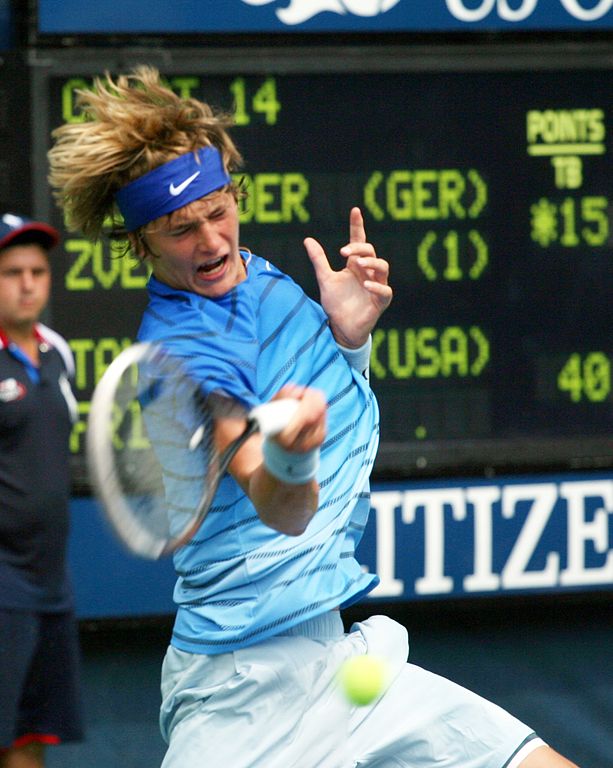
    613px-Alexander_Zverev_(GER)_(9657622842)

    One of the holy grails of tennis speculation is being able to differentiate between those young players who will become stars and those who will not. Right now we’re amidst somewhat of a tide of upcoming  young players: from highly touted Alexander Zverev and Nick Kyrgios, to the large number of young players in or approaching the top 100. Yet how can we possibly tell who will become an elite player and who will plateau somewhere on the way to the top?

    The Pace of Greatness
    There is no easy answer. I have put forth a system of benchmarks that every all-time great (6+ Slam winner) of the Open Era has reached; there is a similar set of benchmarks for multi-Slam winners (2-4 Slams), although these were just greatly expanded by Stan Wawrinka, who reminded us that tennis is always changing and boundaries are meant to be surpassed.

    The first of the benchmarks is entering the top 100 before one’s 19th birthday. Of the young players currently on tour, only a few have accomplished this so far: Alexander Zverev, Frances Tiafoe, Taylor Fritz, Hyeon Chung, and Borna Coric. Missing the mark already are Dominic Thiem, Nick Kyrgios, Karen Khachanov, Daniil Medvedev, Andrey Rublev, Michael Mmoh, Stefan Kozlov, and many others. Now this is a benchmark that all 6+ Slam winners of the Open Era—or at least going back to accurate ATP rankings, so from Bjorn Borg on—have reached. But that doesn’t mean that all future 6+ winners must. And it is also a rather rarified company to begin with; to begin with, we shouldn’t expect more than several players from any generation—and perhaps not even that—to win 6+ Slams.

    Given that the age in which players are peaking may be rising, or at least expanding, and given Stan’s reminder, these benchmarks should probably be considered “probable guidelines” than strict rules. Surely there must be something else we can look for, to try to ascertain who will rise to the top of the sport? I don’t have a clear method, but I did stumble across something that will at least give us something to look for.

    Two Breakthroughs
    When I was working on my “career skyscrapers” tool, I noticed that it did a nice job of illustrating how players develop in their early years. The skyscrapers only include titles and quarterfinal or better Slam appearances so are, intentionally, a snapshot of when a player was at or near elite level. But when we talk about breakthroughs, there are many small stages in that process, but two that I find to be of utmost importance: One, winning a title. This is the rite of passage that every good tennis player must go through. The second is winning a big tournament; by “big” I don’t only mean Slams, but Masters (or their equivalent) or a World Tour Finals. This is the point that a player generally reaches elite status and has shown they can play with the big boys.

    What I noticed was that in almost every case, the true greats went from winning their first title in one year, to their first big tournament within the same year or next. The only exception in the Open Era is Andre Agassi, who won seven minor tournaments over three years (1987-89) before winning his first big tournaments in 1990. But everyone else—from Jimmy Connors to Novak Djokovic—went from winning their first tournament (whether big or small) to a big tournament within a calendar year.

    This gives us another benchmark to look for. Again, it doesn’t mean that it has to happen for a player to become a true great, that it probably will, and the probability is quite high: 12 of 13 6+ Slam winners of the Open Era fit this criteria (interestingly, neither Ken Rosewall or Rod Laver did this; it took them a couple years – but they began their careers in a very different context than the Open Era).

    I think the real important insight gleaned from this is that the pattern seems quite different for lesser Slam winners. Of the seven players winning 3-4 Slams in the Open Era, only three–Guillermo Vilas, Jan Kodes, and Gustavo Kuerten–went from a small to big title in sequential calendar years; Arthur Ashe, Jim Courier, Stan Wawrinka, and Andy Murray all took longer.

    Of the eight two-Slam winners, only three did it: Ilie Nastase, Sergi Bruguera and Marat Safin who, at the time, was considered a probable future great but ended up having a disappointing career. Bruguera was a clay court specialist who played during a time when courts were quite different from each other and specialists–who were otherwise relatively mediocre on other surfaces–could compete for the biggest prizes on their best courts. Nastase was a borderline great player, whose level isn’t adequately expressed by his mere two Slams.

    Of the twenty-four single Slam winners of the Open Era, only six did it: Andres Gimeno, who played much of his career in the very different context before the Open Era, so as with Rosewall and Laver, isn’t that relevant; Mark Edmondson, who is the definition of “one-Slam wonder;” Andres Gomez; Michael Stich; Michael Chang; and Juan Martin del Potro. Stich and Del Potro, like Safin, were considered viable candidates for future greatness, but didn’t reach that mark.

    To sum up, consider who went from their first title to a big title (Masters or greater) within the span of a calendar year, among players who played the bulk of their careers, or won most or all of their Slams, in the Open Era:

    • 12 of 13 (92%)  6+ Slam winners
    • 6 of 15 (40%) of 2-4 Slam winners
    • 6 of 23 (26%) of 1 Slam winners

    As I said above, these numbers start changing if we look before the Open Era, but that was a very different context of play.

    For Whom Is The Clock Ticking?
    There is no clear year that the proverbial “NextGen” starts, although we can say it definitely includes all of those players who will be eligile for the Milan NextGen Finals later this year, so those who don’t turn 22 until December (so generally born in 1996 and later); but for this, we will also look at slightly older players, who are still considered young on today’s tour.

    So who “has to” win a big title in 2017, to reach this benchmark?

    Dominic Thiem won his first title in 2015, but although he improved his performance in 2016, did not win a big title – so he missed this benchmark last year. As I have mentioned elsewhere, his career pattern so far fits that of a second tier player more than a true elite.

    Then we have a group of players: Lucas Pouille, Nick Kyrgios, Karen Khachanov, and Alexander Zverev. These are the four young players who all won their first titles in 2016, and thus have started their “clock” and must win a big title in 2017 to reach this benchmark.

    We should see several other young players win their first ATP titles in 2017, thus “starting the clock” for 2018.

    In Conclusion
    I will say it again: records—and benchmarks—are continually broken. Just as Stan Wawrinka set new benchmarks for multi-Slam winners, winning his first at age 28, so too might we eventually see a future 6+ winner take a delayed career path. Ivan Lendl was an elite player in his early 20s, winning tons of tournaments and even reaching #1 before winning a Slam, but did not win his first Slam until he was 24. Andy Murray was 25 and is arguably the greatest Open Era player with less than six Slams, and he only has three (so far).

    The shape of what is possible is always changing, yet we also have almost five decades of Open Era history to draw upon for trends and trajectories. This study shows that the vast majority (92%) of all-time greats won their first big title (Masters equivalent or greater) within a calendar year of winning their first ATP pro title. It also shows that of 2-4 Slam winners, only 40% accomplished this, and of single Slam winners only about a quarter. This implies that a major defining feature of the truly great is the pace at which they reach their peak. I’ve noted this before, but this study furthers the point: one of the differentiations between the true elites and the second tier, is the rate at which they rise to the top. A group of talented players might show up in the top 100 at similar ages, yet the future elites tend to continue rising quickly, while the future second (top 10ish) and third tier (top 30ish) players tend to stall at various levels, taking longer to climb the ladder to their peak.

    Now poor Alexander Zverev didn’t win his first title until late last year, in September, and Khachanov not until October– so for them the one calendar year gap is especially small – only about an actual year – whereas for Nick Kyrgios, who won his first last April, he has (or has had) a year and a half. So continue watching, and we shall see.

    https://www.youtube.com/watch?v=ihcuD-DnAq0

    Cover photo by robbiesaurus, courtesy of Creative Commons License
  • NextGen 2016 In Review and 2017 Outlook — Part One: The Weak Classes of 1993 to 1996

    NextGen 2016 In Review and 2017 Outlook — Part One: The Weak Classes of 1993 to 1996

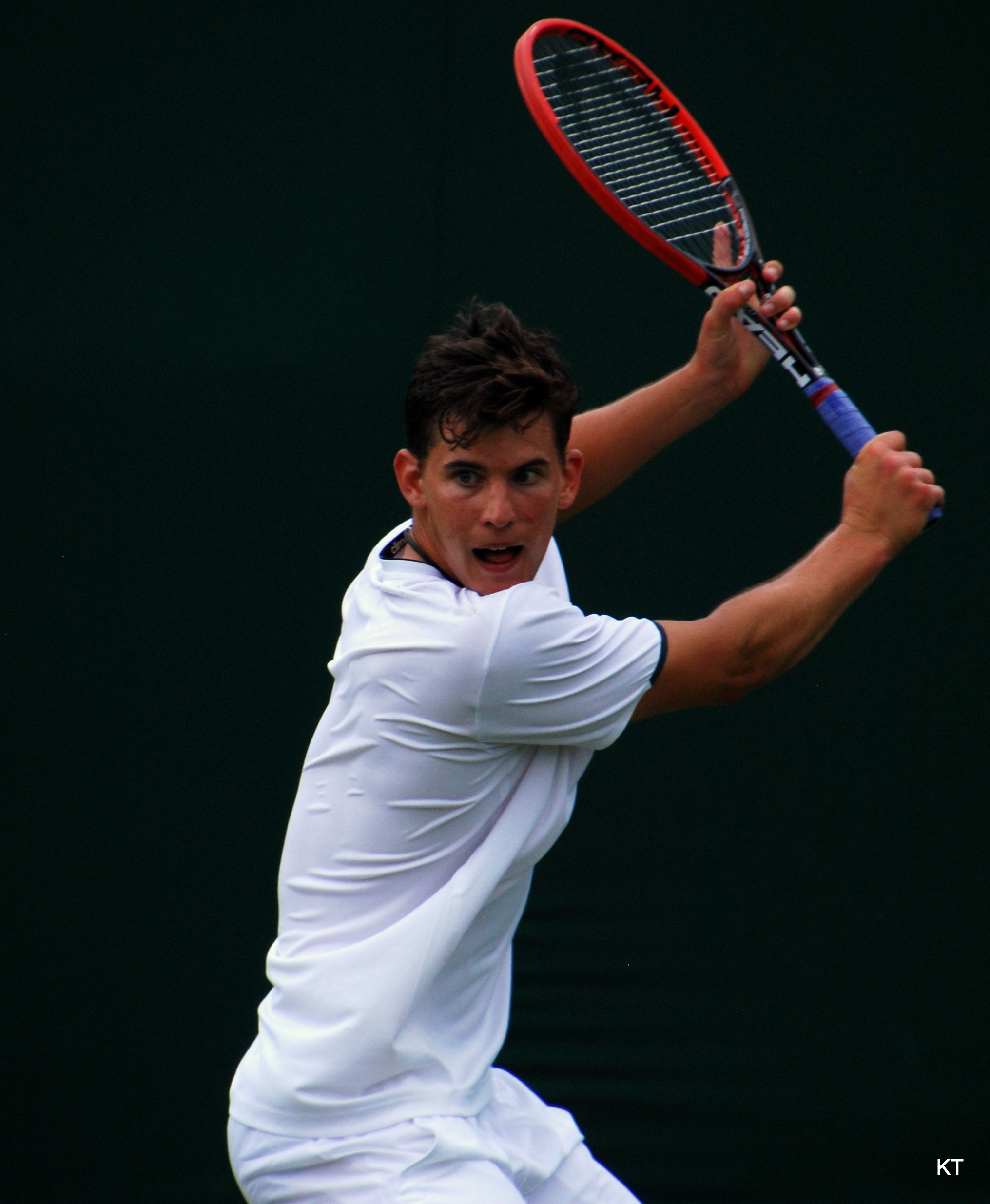
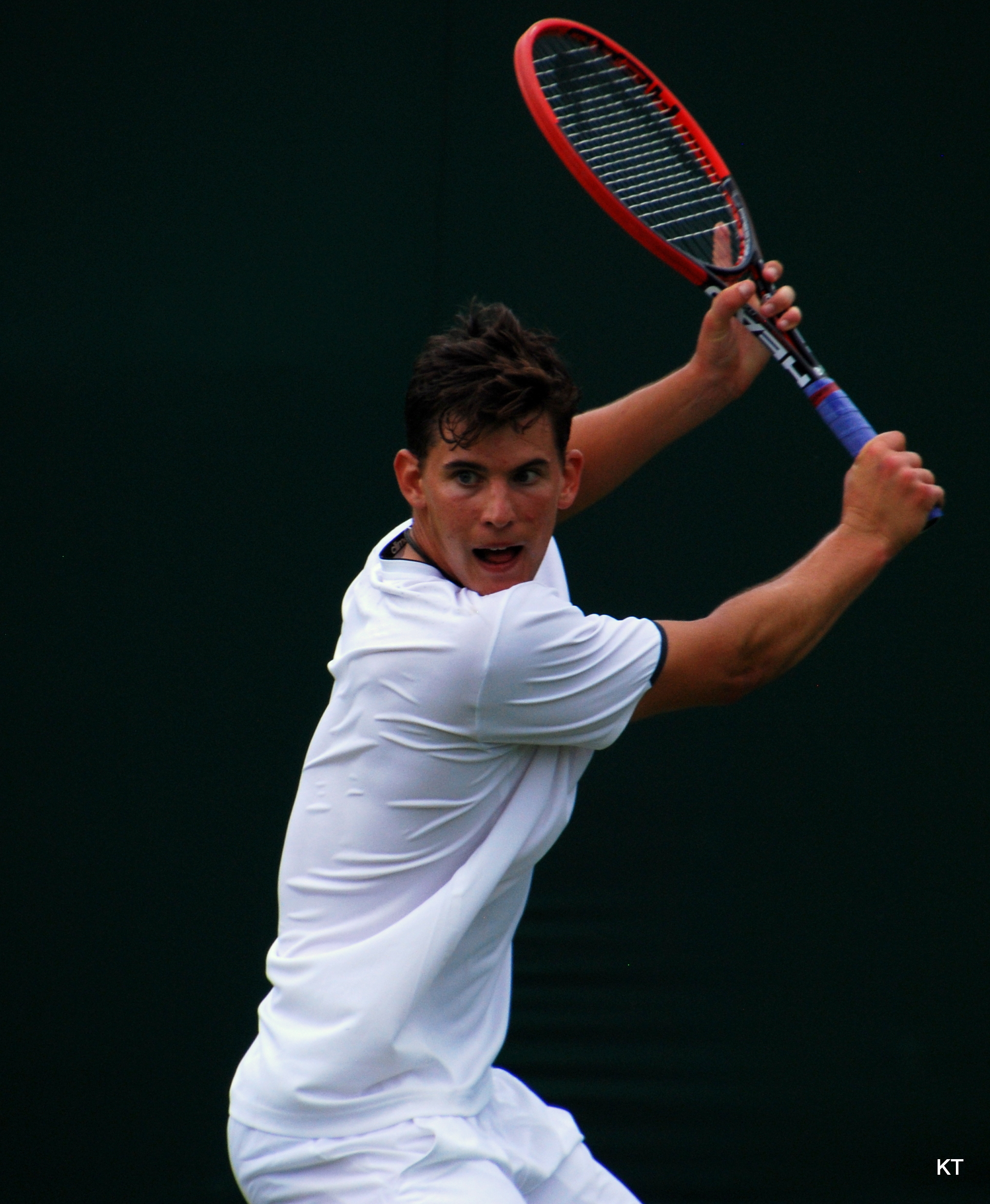
    https://upload.wikimedia.org/wikipedia/commons/7/71/Dominic_Thiem_%2814523555506%29.jpg

    Introduction

    It wasn’t so long ago that the up-and-coming “Young Guns” on the ATP tour were players like Grigor Dimitrov and Bernard Tomic, born in 1991 and 1992, respectively; now, after half a decade of anemic results and no elite prospects, there have been some promising young players showing up on tour over the last year or two. I discussed this new generation back in April in a two-part series, Looking for the Next Great Player, but with seven months of tennis and the year ending, I thought it was time to take stock and see how the “Younger Guns” did in 2016.

    Consider that the youngest players to win Grand Slam titles were born in 1988: Juan Martin del Potro and Marin Cilic. We are amidst the worst dry spell in tennis history, with no Slam title-holders that are age 27 or younger. Kei Nishikori and Milos Raonic have birthdays in December, turning 27 and 26, respectively; no-longer-a-baby Dimitrov is 25, and Tomic is 24. These are no longer young players, but all in the peak range of tennis players. Historically speaking, these are the players that should be dominating now; in fact, Nishikori is the same age that Roger Federer was in late 2008, when he was starting to show signs of slippage. Perhaps even worse than the lack of a Slam title, is the lack of even a Masters title: Marin Cilic, at age 28, remains the youngest Masters titleist and Slam winner.

    The point being, barring an unprecedented development, it is now absolutely clear that we won’t be seeing any elite players from this group. At best we might see a stray Slam or two won when no one else is looking, and at the very least it is hard to imagine that one of Raonic or Nishikori won’t win at least a Masters. Or we can look to Stanislas Wawrinka, the only multi-Slam winner in Open Era history who won his first Slam at the geriatric age of 28. There is always hope, and certainly it isn’t too late for a Raonic or Nishikori to win a Slam or two, but the chances of any become an actual great are virtually none.

    Regardless of whether or not any of this group wins a Slam or not, or even “does a Stanimal,” we have to chalk the players born from 1989 into the early 90s as a lost generation and our hope for the future lies in the next group, those born in the mid to late 90s. In what follows, I’m going to look at players born in each year from 1993 to 2000, both reviewing their year in 2016 but also looking at 2017 with an eye for what to expect (or hope for).

    For each year, or “class,” I will include the top five ranked players, using the year-end 2016 rankings. The rankings are as of November 28, which include all ATP Tour and Challenger tournaments of 2016, but don’t include Futures tournaments to be played in December, so there may be some very minor adjustments for players ranked outside of the top 150-200, but the general rankings should remain similar. These top five aren’t necessarily the best five players of their class, but they give us a starting point.

    CLASS OF ’93
    8. Dominic Thiem
    55. Jiri Vesely
    114. Bjorn Fratangelo
    127. Taro Daniel
    145. Roberto Carballes Baena

    In my generation series, 1993 is grouped with the very weak 1989-93 “Lost Generation,” yet I am including it in this discussion because of the emergence of one player: Dominic Thiem. The second best player of this class, Jiri Vesely, is quite a bit behind Thiem, with a career high ranking of #35—and that back in 2015; Vesely’s claim to fame this year was upsetting #1 Novak Djokovic in the second round of the Monte Carlo Masters.

    But back to Thiem, he went from #139 in 2013 to #39 in 2014, then to #20 in 2015. His steady rise continued in 2016, as he finished the year #8 in the world after making his first World Tour Finals as an alternate for Rafael Nadal; Thiem repaid Rafa by winning a Round Robin match to sneak ahead of him in the year-end rankings. He was strongest earlier in the season, as he showed himself to be a real threat on the clay courts, including a Semifinal appearance at Roland Garros – his only second week Slam result thus far.  He also won his first ATP 500 at Acapulco in February and three ATP 250s. But he fizzled out after mid-year. After winning his fourth title in Stuttgart, he held an 42-11 record for the year, or 79%. From that point on he went 16-13, or 55%. To put that another way, for two-thirds of the year he played like a top five player, then after Stuttgart he looked more like a #20-40 player.

    2017 Outlook: After strong gains the last few years, from #139 in 2013 to #8 in 2016, the question is how much higher Thiem can go. He seemed to hit a ceiling this year, his results cooling off in the second half, although whether this was due to exhaustion and a heavy first half schedule, or perhaps his strength on clay vs. the other courts, or maybe he simply reached his ceiling. Thiem just turned 23, which is an age when players should be in their prime, so on one hand we shouldn’t expect much more from him. On the other hand, players may be developing at a slower pace these days, so Thiem could develop a bit further. At this point I think we should enjoy him for what he revealed in 2016: a solid second tier player who is very dangerous on clay. Look to Thiem to stabilize his current level in the lower half of the top 10, and maybe compete for a Master’s title (likely clay) as well as continue to win several low level titles. He’s exactly the type of player who could win a Slam if the context is right, but is unlikely to get past a true elite player like Novak Djokovic or Andy Murray in their primes. In other words, if there’s a Slam title in his future, it probably isn’t in 2017.

    As for the others, Vesely could still have a mini-breakthrough and stabilize in the 20-40 range; he may even dive into the top 20 at some point, but I wouldn’t expect much more. It seems that Fratangelo and Daniel have been hovering around #100 for ages, so I wouldn’t expect much.

    CLASS OF ’94
    15. Lucas Pouille
    75. Adam Pavlasek
    79. Jordan Thompson
    82. Thiago Monteiro
    179. Kimmer Coppejans

    As you can see, this is another weak class, with only one player in the top 50: Lucas Pouille, whose 2016 echoed Thiem’s 2015. Thiago Monteiro may deserve watching, however. The Brazillian showed some early promise in 2011-12 as a 17-18 year old, winning a couple Futures, and then a strong showing on the Challenger circuit in 2013. But then he struggled with injury for a couple years. In 2016 he began the year ranked #463 and moved all the way into the top 100, including his first Challenger title against veteran Carlos Berlocq. He also gained some attention after beating #9 Jo-Wilfried Tsonga in the first round of Rio, before losing to eventual champion Pablo Cuevas in the 2R.

    Pouille is the obvious standout, with a consistent trajectory over the last few years: finishing #204 in 2013, #133 in 2014, #78 in 2015, and #15 in 2016. Some have claimed that he is a limited player and won’t get any better, yet his results speak otherwise: a quick rise in the rankings and two Slam QF appearances, including a five-set upset of Rafael Nadal in the fourth round of the US Open.

    https://www.youtube.com/watch?v=HQHgRFqI-aQ

    Pavlasek and Thompson both made strong gains, rising from #160 and #154, respectively. Coppejans seems to be stagnating.

    2017 Outlook: Look for Pouille to stabilize in the top 20 and creep up to the cusp of the top 10, maybe even sneaking in. He needs to start winning tournaments; his ranking is largely based upon those two QF results and modest consistency in Masters tournaments, and a lone ATP 250 title. He’s a good candidate to win an ATP 500 and/or several ATP 250s, although would be a surprise to win a Masters or Slam, at least in 2017. But he looks to join Thiem as another second tier player of the next era, and should be near or even in the top 10 for years to come.

    Pavlasek and Thompson could breach the top 50, but I wouldn’t expect much more than that. They are likely going to be future top 20-50 players. Monteiro bears watching, but we should also be moderate in our expectations.

    CLASS OF ’95
    13. Nick Kyrgios
    45. Kyle Edmund
    100. Yoshihito Nishioka
    172. Stefano Napolitano
    177. Maximillian Marterer

    Another weak class overall, but we shouldn’t underrate Kyrgios. It seems many are writing him off as a bust already, even though he is still only 21. Consider also that he went from #30 to #13 in 2016, also winning his first three titles (two ATP 250s and one ATP 500) and 72% of his matches, versus 56% the year before. Yet despite clear and significant forward progress, there’s a veneer of disappointment around Kyrgios. I think it is for two reasons: One, after reaching quarterfinals in both the 2014 Wimbledon and 2015 Australian Open, Kyrgios has not made it past the 4R in the last seven Slams. Two, he is clearly a player of prodigious talent, yet he is also a head-case. Yet we must remember that Kyrgios is still quite young—he doesn’t turn 22 until next April—and he is a very dangerous player. He’s probably the most talented player born in the “lost years” between 1989 and 1996 and the only thing keeping him from being an elite player is himself.

    Edmund has given Great Britain a second player to root for, at least in the top 50. He’s young enough to be somewhat excited about, but probably not good enough to be anything more than a top 20 player. Still, he went from #102 at the end of 2015 to #45 now, so should continue to rise.

    2017 Outlook: If there is a player who has never ranked in the top 10 that I think has a chance to be a new Slam or Masters titleist in 2017, it is Kyrgios. Now it is hard to imagine him winning a Slam…yet. But I could definitely see him winning a Masters, and perhaps as soon as this coming year. Look for him to break into the top 10 and be a spoiler that no one wants to face. He has the game to challenge for a ranking in the top 5, but it remains to be seen whether he can harness it enough to get there. His upside remains that of a multi-Slam winner, although probably more in the 2-4 range than 5+, and only if all goes right. But what is exciting about Kyrgios is it is so unclear how he’ll turn out. Ten years from now he could be looking back at a Slamless career of continual frustration but occasional moments of brilliance, or we could be looking at a handful of Slam titles and even a #1 ranking. Regardless, he looks to be the next top player that people will love to hate.

    On the other hand, as Jeff Sackmann of the Heavy Topspin blog points out, very few players with sub-par return of serve’s like Kyrgios end up winning multiple Slams. He compares him to Mark Philippoussis, who was another relatively one-dimensional but dangerous player who came up empty in Slam titles.

    Edmund also bears watching. The optimistic view is that he’ll “do a Pouille” (just as Pouille “did a Thiem”) and vault into the top 20. That said, my sense is that his upside is a bit lower than Thiem and Pouille and I could also see him stagnating in the #20-40 range ala someone like Borna Coric, Bernard Tomic, or Jack Sock. He seems a similar caliber player, but given his relatively youth, still deserves the benefit of the doubt. He almost certainly won’t be an elite, but he could be a second tier type if all goes well, or perhaps more likely in the third tier Nicolas Almagro/Gilles Simon range.

    CLASS OF ’96
    48. Borna Coric
    53. Karen Khachanov
    99. Daniil Medvedev
    104. Hyeon Chung
    105. Jared Donaldson

    Yet one more relatively weak year, which makes eight in a row (starting with 1989) that are historically weak. It goes beyond the bounds of this study, but begs the question: What happened? One thought that comes to mind is that these years—born 1989-96—are players who started playing tennis in the early 00s, when Pete Sampras was fading and retired, and Agassi not far behind. American tennis fell flat, and we can see few Americans in these group. In fact, if you look at the best Americans born from 1989 to 1996, you find a lackluster list that includes Donald Young, Ryan Harrison, Jack Sock, Denis Kudla, and Jared Donaldson.

    Anyhow, Coric has been around for so long—breaking into the top 100 two years ago—that it is easy to forget that he just turned 20. Yet he completely stagnated this year, even dropping a few rankings. Chung has fallen far—and the third in the group that finished last year in the top 100, Thanasi Kokkinakis—has completely vanished (he’s been injured all year, playing only one professional match). Donaldson—after a brief moment where it seemed he might be progressing—has also stagnated (a word which seems quite descriptive of this group, for the most part).

    That said, there is some good news: Karen Khachanov has emerged, rising quickly up the rankings, and Daniil Medvedev has made solid progress. Right now Khachanov seems like the best of the bunch.

    2017 Outlook: Expect continued progress from Khachanov. He doesn’t look like a future star, but he could be a legit top 20 player, maybe even top 10; he could be on the Thiem-Pouille track. I’m not sure what to expect from Coric at this point, whose 2016 was quite disappointing. After 2015 it became clear that he was unlikely to be a star, but at least he looked like a top 20 player. Now he may not even be that, but it still seems likely that he has another surge in him…he is just 20 years old, after all. But he reminds me of a similarly weaponless player, Bernard Tomic.

    I don’t expect much from Donaldson and Chung, who could be lower-half top 100 players. Medvedev bears watching, but it is too soon to tell. I would also keep an eye out for Kokkinakis. Not a top tier talent, but he should be back in the top 100 if healthy.

    Summary
    As you can see, the prospects are pretty grim among the players born from 1993 to 1996, a continuation of the “lost generation” of 1989 to 1992. There are a bunch of players who look like perennial second tier players and darkhorse Slam candidates, but none that look like sure-fire elites: Dominic Thiem, Lucas Pouille, Kyle Edmund, Nick Kyrgios, and possibly Karen Khachanov, Borna Coric, and one or two others.

    In Part Two we will look at the players born from 1997 to 2000.

    Cover Photo by Carine06 from Wikimedia Commons, Courtesy of Creative Commons License