Tag: Milos Raonic

  • Why We’ll See A New Slam Winner in 2017

    Why We’ll See A New Slam Winner in 2017

    miloswimbledon2016

    Fact: In the history of Open Era tennis, going back to 1968 through 2016—a span of 49 years and 195 Grand Slam tournaments—there has never been more than two years in a row without a new Slam winner. Of those 49 years, only 15 have been years in which at least one of the Slams wasn’t won by a new winner. To put that another way, in about 70% of the Open Era years, at least one Slam was won by a new Slam champion. The years without a new winner are: 1969, 1973, 1978, 1986, 1993-94, 1999, 2006-07, 2010-11, 2013, and 2015-16.

    You’ll notice that a high percentage of those years are recent; six out of the fourteen are all within the last eleven years. You’ll also note that three out of the four two-year gaps are also within the last eleven years. Clearly this points to the homogeneity of Slam winners in recent years. We can also look at the fact that starting with Rafael Nadal’s first Slam, the 2005 French Open, just seven players have won 47 Slams: Nadal (14), Roger Federer (13 of his 17), Novak Djokovic (12), Juan Martin del Potro (1), Andy Murray (3), Stan Wawrinka (3), and Marin Cilic (1).

    Which brings me to the topic: Going purely on this pattern, there will be a new Slam winner in 2017. Who will it be? Who knows? But if I were to make wagers, here are the players who are most likely, in rough order:

    1. Milos Raonic: The blazing server is coming off his best year in which he finished #3—only the second player after David Ferrer in 2013 to finish in the top three in the last ten years, other than the Big Four. He also reached his first Slam final, losing to Andy Murray at Wimbledon. Raonic doesn’t have the well-balanced game to dominate for an extended period of time, but he does have enough weapons to challenge for a Slam title, being particularly dangerous at Wimbledon.

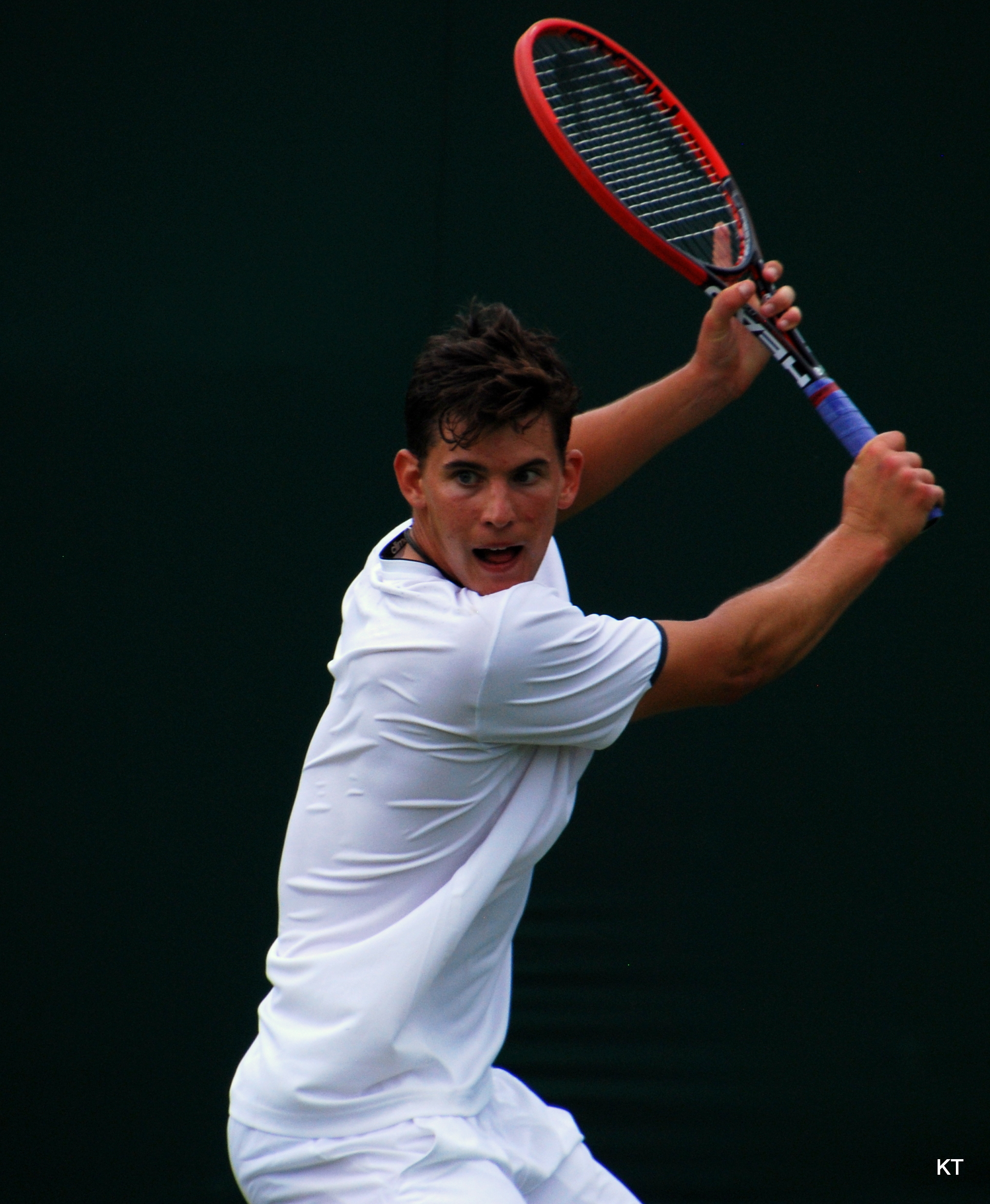
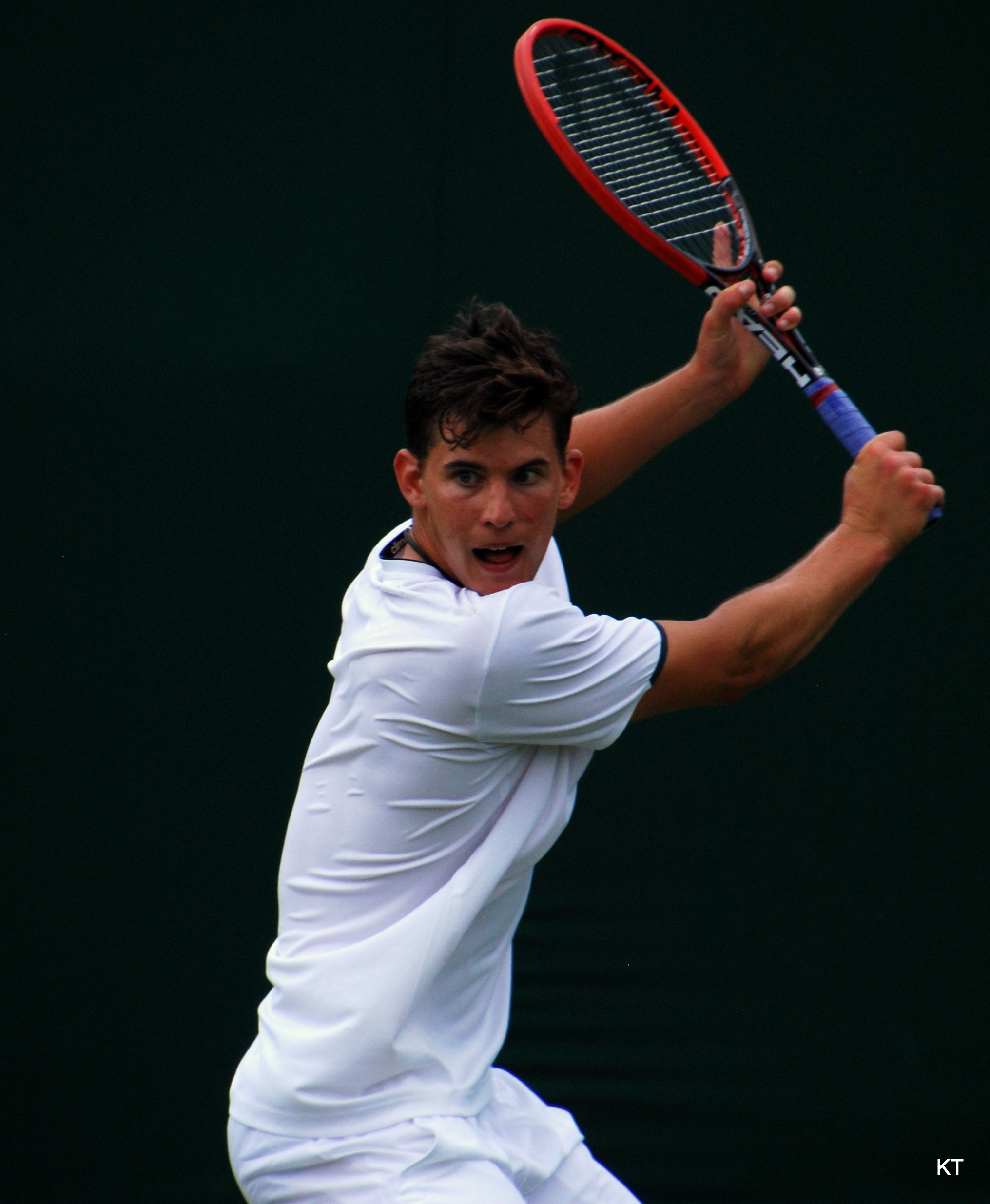
    2. Dominic Thiem: With Rafa questionable and Novak shaky, Andy having not yet truly dominated clay and Stan Wawrinka always erratic, Roland Garros is up for grabs this year. Now it probably won’t be Thiem, but it is his best surface and if anyone other than the usual suspects wins the French Open, it will probably be Thiem, who has a good chance of being the best clay court player over the next half decade or so.

    3. Nick Kyrgios: If the temperamental Australian starts showing an ounce of composure and maturity, the rest of the tour needs to look out: he can be a very dangerous player, capable of beating anyone on the right day. But he may be two or three years from that level of maturity, if he ever finds it, but with another year of steady rising—and his first three titles—Kyrgios is a player to watch (and watch out for, if you’re a player) in 2017.

    4. Kei Nishikori: I haven’t done the research, but I suspect that Kei may be the best player in Open Era history never to win at least a Master tournament. With just a cursory search, other candidates include Raonic, Richard Gasquet, Fernando Gonzalez, Mikhail Youzhny, Todd Martin, Marc Rosset, Aaron Krickstein, Brad Gilbert, Gene Mayer, Eddie Dibbs, and Alex Metreveli. He’s won 11 tournaments so far, including 6 ATP 500s; he’s reached a Slam final and three Masters finals. It seems inevitable that he’ll win a Masters, although a Slam seems less likely as he hasn’t shown the fortitude that it takes to win seven best-of-five matches in a row. Still, he came very close in 2014 and could conceivably threaten again. If Kei were to reach a final against an exhausted Nadal or Federer, he could pull it off.

    5. Alexander Zverev: It isn’t a matter of if, but when. If there is one player on tour that we can be most certain will eventually win at least one Slam, it is Zverev. But 2017 is probably unlikely; he turns 20 years old in April and has yet to even make it to the fourth round of a Slam. If I were to guess, his first Slam will be in 2018 or 2019. Still, he is talented enough that he should be factored into consideration, especially for later in the year.

    Less Likely Candidates: I’d love to see Jo-Wilfried Tsonga or Tomas Berdych finally win one, but these guys turn 32 in 2017 and both look to be showing signs of decline. I’d give Tsonga a slightly better chance. I almost can’t bear to type his name, but Gael Monfils is exactly the type of brilliant player who could be a one-Slam wonder. Yeah, right. Monfils might be a more likely candidate if it weren’t for his abyssmal record in ATP title finals: 6-19! Another of his ilk is Grigor Dimitrov, who has the talent but not the mentality; still, you just never know.  Lucas Pouille is an unlikely candidate, but at 22 years old and ranked #15 in the world, with two QF Slam appearances in 2016, he’s on the map. I’d like to say that David Goffin has a chance, but he just doesn’t have the upside. Similarly with Jack Sock, who seems to be a similar low-ceiling player as Goffin. One final mention: Karen Khachanov. At 20 years old to start the year and #53 in the world, he’s unlikely in 2017, but he made a big jump up the rankings and is exactly the type of “out-of-nowhere” player that could surprise. But along with every other 21-and-under player not named Zverev and Kyrgios, we have to wait and see before considering him a legit Slam threat.

    So there you have it. Statistically speaking, there should be a new Slam winner in 2017. Now this is far from a certainty, and given the composition of the tour in 2016, it is quite conceivable that we will see our first three-year gap of no new Slam winners. But I think those five are the top candidates, with a few others being distantly possible.

    If it isn’t 2017, it certainly will be 2018. But I’m guessing we’ll see a new champ in 2017. I certainly hope so!

    Addendum: New Slam Winners of the Open Era
    I thought some might like to see the whole list, so here goes:

    2016:
    2015:
    2014: Stan Wawrinka, Marin Cilic
    2013:
    2012: Andy Murray
    2011:
    2010:
    2009: Juan Martin del Potro
    2008: Novak Djokovic
    2007:
    2006:
    2005: Rafael Nadal
    2004: Gaston Gaudio
    2003: Juan Carlos Ferrero, Andy Roddick, Roger Federer
    2002: Thomas Johansson, Albert Costa
    2001: Goran Ivanisevic, Lleyton Hewitt
    2000: Marat Safin
    1999:
    1998: Petr Korda, Carlos Moya
    1997: Gustavo Kuerten, Patrick Rafter
    1996: Yevgeny Kafelnikov, Richard Krajicek
    1995: Thomas Muster
    1994:
    1993:
    1992: Andre Agassi
    1991: Jim Courier, Michael Stich
    1990: Andres Gomez, Pete Sampras
    1989: Michael Chang
    1988:
    1987: Pat Cash
    1986:
    1985: Stefan Edberg, Boris Becker
    1984: Ivan Lendl
    1983: Yannick Noah
    1982: Mats Wilander
    1981: Johan Kriek
    1980: Brian Teacher
    1979: John McEnroe
    1978:
    1977: Roscoe Tanner, Vitas Gerulaitis
    1976: Mark Edmondson, Adriano Panatta
    1975: Manuel Orantes
    1974: Jimmy Connors, Bjorn Borg
    1973:
    1972: Andres Gimeno, Ilie Nastase
    1971: Stan Smith
    1970: Jan Kodes
    1969:
    1968: Arthur Ashe

    Cover image by DanielJCooper from Wikimedia Commons, courtesy of Creative Commons License


  • NextGen 2016 In Review and 2017 Outlook — Part One: The Weak Classes of 1993 to 1996

    NextGen 2016 In Review and 2017 Outlook — Part One: The Weak Classes of 1993 to 1996

    https://upload.wikimedia.org/wikipedia/commons/7/71/Dominic_Thiem_%2814523555506%29.jpg

    Introduction

    It wasn’t so long ago that the up-and-coming “Young Guns” on the ATP tour were players like Grigor Dimitrov and Bernard Tomic, born in 1991 and 1992, respectively; now, after half a decade of anemic results and no elite prospects, there have been some promising young players showing up on tour over the last year or two. I discussed this new generation back in April in a two-part series, Looking for the Next Great Player, but with seven months of tennis and the year ending, I thought it was time to take stock and see how the “Younger Guns” did in 2016.

    Consider that the youngest players to win Grand Slam titles were born in 1988: Juan Martin del Potro and Marin Cilic. We are amidst the worst dry spell in tennis history, with no Slam title-holders that are age 27 or younger. Kei Nishikori and Milos Raonic have birthdays in December, turning 27 and 26, respectively; no-longer-a-baby Dimitrov is 25, and Tomic is 24. These are no longer young players, but all in the peak range of tennis players. Historically speaking, these are the players that should be dominating now; in fact, Nishikori is the same age that Roger Federer was in late 2008, when he was starting to show signs of slippage. Perhaps even worse than the lack of a Slam title, is the lack of even a Masters title: Marin Cilic, at age 28, remains the youngest Masters titleist and Slam winner.

    The point being, barring an unprecedented development, it is now absolutely clear that we won’t be seeing any elite players from this group. At best we might see a stray Slam or two won when no one else is looking, and at the very least it is hard to imagine that one of Raonic or Nishikori won’t win at least a Masters. Or we can look to Stanislas Wawrinka, the only multi-Slam winner in Open Era history who won his first Slam at the geriatric age of 28. There is always hope, and certainly it isn’t too late for a Raonic or Nishikori to win a Slam or two, but the chances of any become an actual great are virtually none.

    Regardless of whether or not any of this group wins a Slam or not, or even “does a Stanimal,” we have to chalk the players born from 1989 into the early 90s as a lost generation and our hope for the future lies in the next group, those born in the mid to late 90s. In what follows, I’m going to look at players born in each year from 1993 to 2000, both reviewing their year in 2016 but also looking at 2017 with an eye for what to expect (or hope for).

    For each year, or “class,” I will include the top five ranked players, using the year-end 2016 rankings. The rankings are as of November 28, which include all ATP Tour and Challenger tournaments of 2016, but don’t include Futures tournaments to be played in December, so there may be some very minor adjustments for players ranked outside of the top 150-200, but the general rankings should remain similar. These top five aren’t necessarily the best five players of their class, but they give us a starting point.

    CLASS OF ’93
    8. Dominic Thiem
    55. Jiri Vesely
    114. Bjorn Fratangelo
    127. Taro Daniel
    145. Roberto Carballes Baena

    In my generation series, 1993 is grouped with the very weak 1989-93 “Lost Generation,” yet I am including it in this discussion because of the emergence of one player: Dominic Thiem. The second best player of this class, Jiri Vesely, is quite a bit behind Thiem, with a career high ranking of #35—and that back in 2015; Vesely’s claim to fame this year was upsetting #1 Novak Djokovic in the second round of the Monte Carlo Masters.

    But back to Thiem, he went from #139 in 2013 to #39 in 2014, then to #20 in 2015. His steady rise continued in 2016, as he finished the year #8 in the world after making his first World Tour Finals as an alternate for Rafael Nadal; Thiem repaid Rafa by winning a Round Robin match to sneak ahead of him in the year-end rankings. He was strongest earlier in the season, as he showed himself to be a real threat on the clay courts, including a Semifinal appearance at Roland Garros – his only second week Slam result thus far.  He also won his first ATP 500 at Acapulco in February and three ATP 250s. But he fizzled out after mid-year. After winning his fourth title in Stuttgart, he held an 42-11 record for the year, or 79%. From that point on he went 16-13, or 55%. To put that another way, for two-thirds of the year he played like a top five player, then after Stuttgart he looked more like a #20-40 player.

    2017 Outlook: After strong gains the last few years, from #139 in 2013 to #8 in 2016, the question is how much higher Thiem can go. He seemed to hit a ceiling this year, his results cooling off in the second half, although whether this was due to exhaustion and a heavy first half schedule, or perhaps his strength on clay vs. the other courts, or maybe he simply reached his ceiling. Thiem just turned 23, which is an age when players should be in their prime, so on one hand we shouldn’t expect much more from him. On the other hand, players may be developing at a slower pace these days, so Thiem could develop a bit further. At this point I think we should enjoy him for what he revealed in 2016: a solid second tier player who is very dangerous on clay. Look to Thiem to stabilize his current level in the lower half of the top 10, and maybe compete for a Master’s title (likely clay) as well as continue to win several low level titles. He’s exactly the type of player who could win a Slam if the context is right, but is unlikely to get past a true elite player like Novak Djokovic or Andy Murray in their primes. In other words, if there’s a Slam title in his future, it probably isn’t in 2017.

    As for the others, Vesely could still have a mini-breakthrough and stabilize in the 20-40 range; he may even dive into the top 20 at some point, but I wouldn’t expect much more. It seems that Fratangelo and Daniel have been hovering around #100 for ages, so I wouldn’t expect much.

    CLASS OF ’94
    15. Lucas Pouille
    75. Adam Pavlasek
    79. Jordan Thompson
    82. Thiago Monteiro
    179. Kimmer Coppejans

    As you can see, this is another weak class, with only one player in the top 50: Lucas Pouille, whose 2016 echoed Thiem’s 2015. Thiago Monteiro may deserve watching, however. The Brazillian showed some early promise in 2011-12 as a 17-18 year old, winning a couple Futures, and then a strong showing on the Challenger circuit in 2013. But then he struggled with injury for a couple years. In 2016 he began the year ranked #463 and moved all the way into the top 100, including his first Challenger title against veteran Carlos Berlocq. He also gained some attention after beating #9 Jo-Wilfried Tsonga in the first round of Rio, before losing to eventual champion Pablo Cuevas in the 2R.

    Pouille is the obvious standout, with a consistent trajectory over the last few years: finishing #204 in 2013, #133 in 2014, #78 in 2015, and #15 in 2016. Some have claimed that he is a limited player and won’t get any better, yet his results speak otherwise: a quick rise in the rankings and two Slam QF appearances, including a five-set upset of Rafael Nadal in the fourth round of the US Open.

    No Title

    No Description

    Pavlasek and Thompson both made strong gains, rising from #160 and #154, respectively. Coppejans seems to be stagnating.

    2017 Outlook: Look for Pouille to stabilize in the top 20 and creep up to the cusp of the top 10, maybe even sneaking in. He needs to start winning tournaments; his ranking is largely based upon those two QF results and modest consistency in Masters tournaments, and a lone ATP 250 title. He’s a good candidate to win an ATP 500 and/or several ATP 250s, although would be a surprise to win a Masters or Slam, at least in 2017. But he looks to join Thiem as another second tier player of the next era, and should be near or even in the top 10 for years to come.

    Pavlasek and Thompson could breach the top 50, but I wouldn’t expect much more than that. They are likely going to be future top 20-50 players. Monteiro bears watching, but we should also be moderate in our expectations.

    CLASS OF ’95
    13. Nick Kyrgios
    45. Kyle Edmund
    100. Yoshihito Nishioka
    172. Stefano Napolitano
    177. Maximillian Marterer

    Another weak class overall, but we shouldn’t underrate Kyrgios. It seems many are writing him off as a bust already, even though he is still only 21. Consider also that he went from #30 to #13 in 2016, also winning his first three titles (two ATP 250s and one ATP 500) and 72% of his matches, versus 56% the year before. Yet despite clear and significant forward progress, there’s a veneer of disappointment around Kyrgios. I think it is for two reasons: One, after reaching quarterfinals in both the 2014 Wimbledon and 2015 Australian Open, Kyrgios has not made it past the 4R in the last seven Slams. Two, he is clearly a player of prodigious talent, yet he is also a head-case. Yet we must remember that Kyrgios is still quite young—he doesn’t turn 22 until next April—and he is a very dangerous player. He’s probably the most talented player born in the “lost years” between 1989 and 1996 and the only thing keeping him from being an elite player is himself.

    Edmund has given Great Britain a second player to root for, at least in the top 50. He’s young enough to be somewhat excited about, but probably not good enough to be anything more than a top 20 player. Still, he went from #102 at the end of 2015 to #45 now, so should continue to rise.

    2017 Outlook: If there is a player who has never ranked in the top 10 that I think has a chance to be a new Slam or Masters titleist in 2017, it is Kyrgios. Now it is hard to imagine him winning a Slam…yet. But I could definitely see him winning a Masters, and perhaps as soon as this coming year. Look for him to break into the top 10 and be a spoiler that no one wants to face. He has the game to challenge for a ranking in the top 5, but it remains to be seen whether he can harness it enough to get there. His upside remains that of a multi-Slam winner, although probably more in the 2-4 range than 5+, and only if all goes right. But what is exciting about Kyrgios is it is so unclear how he’ll turn out. Ten years from now he could be looking back at a Slamless career of continual frustration but occasional moments of brilliance, or we could be looking at a handful of Slam titles and even a #1 ranking. Regardless, he looks to be the next top player that people will love to hate.

    On the other hand, as Jeff Sackmann of the Heavy Topspin blog points out, very few players with sub-par return of serve’s like Kyrgios end up winning multiple Slams. He compares him to Mark Philippoussis, who was another relatively one-dimensional but dangerous player who came up empty in Slam titles.

    Edmund also bears watching. The optimistic view is that he’ll “do a Pouille” (just as Pouille “did a Thiem”) and vault into the top 20. That said, my sense is that his upside is a bit lower than Thiem and Pouille and I could also see him stagnating in the #20-40 range ala someone like Borna Coric, Bernard Tomic, or Jack Sock. He seems a similar caliber player, but given his relatively youth, still deserves the benefit of the doubt. He almost certainly won’t be an elite, but he could be a second tier type if all goes well, or perhaps more likely in the third tier Nicolas Almagro/Gilles Simon range.

    CLASS OF ’96
    48. Borna Coric
    53. Karen Khachanov
    99. Daniil Medvedev
    104. Hyeon Chung
    105. Jared Donaldson

    Yet one more relatively weak year, which makes eight in a row (starting with 1989) that are historically weak. It goes beyond the bounds of this study, but begs the question: What happened? One thought that comes to mind is that these years—born 1989-96—are players who started playing tennis in the early 00s, when Pete Sampras was fading and retired, and Agassi not far behind. American tennis fell flat, and we can see few Americans in these group. In fact, if you look at the best Americans born from 1989 to 1996, you find a lackluster list that includes Donald Young, Ryan Harrison, Jack Sock, Denis Kudla, and Jared Donaldson.

    Anyhow, Coric has been around for so long—breaking into the top 100 two years ago—that it is easy to forget that he just turned 20. Yet he completely stagnated this year, even dropping a few rankings. Chung has fallen far—and the third in the group that finished last year in the top 100, Thanasi Kokkinakis—has completely vanished (he’s been injured all year, playing only one professional match). Donaldson—after a brief moment where it seemed he might be progressing—has also stagnated (a word which seems quite descriptive of this group, for the most part).

    That said, there is some good news: Karen Khachanov has emerged, rising quickly up the rankings, and Daniil Medvedev has made solid progress. Right now Khachanov seems like the best of the bunch.

    2017 Outlook: Expect continued progress from Khachanov. He doesn’t look like a future star, but he could be a legit top 20 player, maybe even top 10; he could be on the Thiem-Pouille track. I’m not sure what to expect from Coric at this point, whose 2016 was quite disappointing. After 2015 it became clear that he was unlikely to be a star, but at least he looked like a top 20 player. Now he may not even be that, but it still seems likely that he has another surge in him…he is just 20 years old, after all. But he reminds me of a similarly weaponless player, Bernard Tomic.

    I don’t expect much from Donaldson and Chung, who could be lower-half top 100 players. Medvedev bears watching, but it is too soon to tell. I would also keep an eye out for Kokkinakis. Not a top tier talent, but he should be back in the top 100 if healthy.

    Summary
    As you can see, the prospects are pretty grim among the players born from 1993 to 1996, a continuation of the “lost generation” of 1989 to 1992. There are a bunch of players who look like perennial second tier players and darkhorse Slam candidates, but none that look like sure-fire elites: Dominic Thiem, Lucas Pouille, Kyle Edmund, Nick Kyrgios, and possibly Karen Khachanov, Borna Coric, and one or two others.

    In Part Two we will look at the players born from 1997 to 2000.

    Cover Photo by Carine06 from Wikimedia Commons, Courtesy of Creative Commons License


  • Preview: Indian Wells Men’s Final

    Preview: Indian Wells Men’s Final

    Milos Raonic Novak Djokovic

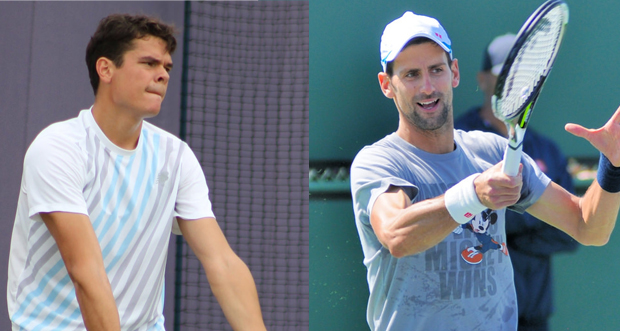
    There can be little doubt that Novak Djokovic goes into today’s title match against Milos Raonic as the clear favourite.

    The World Number One is a two time defending champion at the event, and remains unbeaten on slow, grittier hard court surfaces the event takes place on of late. Raonic is a great hard court player, the booming server enjoying a title run in slow conditions in Brisbane this year, before stretching Andy Murray to five sets in the Australian semifinals a few weeks later. Both men enjoy their best results on hard courts, but their head-to-head stats make for grim reading for Milos.

    The Canadian has gone down in all his five meetings against Novak, taking just one of the fourteen sets they’ve contested. More crucial still, his last two losses, late 2014 in the Paris Masters, and last year in the Australian Open quarters, Raonic was beaten in straight sets on hard courts of comparable speed to those in Indian Wells.

    It is a bad matchup for the Canadian. Although he has improved other facets of his game in recent years, his entire game is predicated on his gargantuan serve. When this has been on song, Raonic has been able to dictate and attack against Federer, Nadal, and Murray, enjoying wins against each of these hall of famers. Djokovic, though, widely regarded as the best returner in the game, is able to nullify this shot, and thus dictate the rallies himself. This is the worst possible thing that can happen to Raonic. Although fitter, and possessing a better ground game than when he relied purely on his serve, at six foot five inches he is not going to be able to chase down shot after shot against Novak. The Serb is inevitably going to try to put his man on the defensive wherever possible.

    All is not lost for Milos. He is arguably playing the tennis of his life, backing up his big serve with choice attacks at the net, and ripping the backhand where once this was a passive rallying shot. He is a markedly improved player in the year and two months since their last meeting. Furthermore, his opponent has not looked entirely convincing this week, losing a set in a sluggish opening match, before almost losing a set to Nadal in yesterday’s semifinal.

    I back Djokovic to win today. He is good at bringing his best to bear in finals, even after less than convincing results en route to them. The slower variant of hard courts is where he is at his best, and his style is the closest thing to a roadblock the Canadian will face on the tour. I do not write Raonic off, though. He has looked mostly sharp this week, is in a rich vein of form of late, and if he serves and attacks well, stretching the Serb to tiebreaks, it is anyone’s match.

    Djokovic to win in three sets.

    [divider]

    Cover Photo (Creative Commons License): sirobi / Christian Mesiano

  • Open Era Generations, Part Fourteen: Gen 12 (1989-93) – The Lost Generation, aka the Donald Young Guns

    Open Era Generations, Part Fourteen: Gen 12 (1989-93) – The Lost Generation, aka the Donald Young Guns

    Donald Young Kei Nishikori Grigor Dimitrov

    Why the Name?
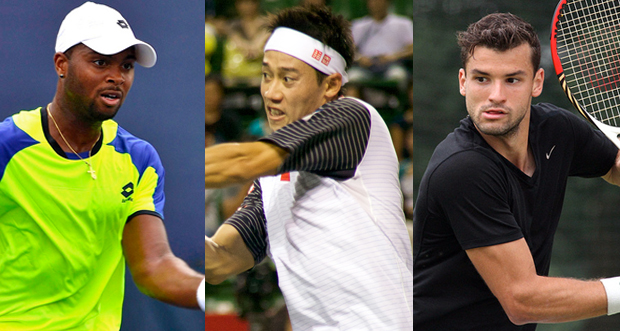
    Donald Young is not among the best players of this generation, but to me he exemplifies it, one of the very first of what is looking to be the weakest generation that the Open Era has seen thus far.

    Aside from the clever-ish title, why Donald Young? Well, his trajectory displays the disappointment and weakness of this generation. A two-time Junior Grand Slam winner, Young finished 2007 ranked No. 100 at the age of 18, looking poised to eventually inherit the mantle of the premier American player from Andy Roddick. But he floated for several years, not reaching the Top 100 again until 2011 when he was 22 years old, no longer a tennis prodigy. And even that wasn’t the first year of a breakout; he dropped again in the rankings, failing to even qualify for the 2013 Australian Open and Wimbledon. He’s played a bit better of late, finishing 2015 at No. 57, largely due to a fourth round appearance in the US Open – his best result since 2011. But Young, no longer young at 26, is a far cry from what he was expected to be some eight years ago and is a cautionary tale of how not all highly-regarded prospects turn out. He isn’t alone among his generation, as we shall see.

    I also call this the “Lost Generation” because it has a chance of being the only five-year generation—in the year spans that I’m using—that will not win a Grand Slam, in all of tennis history. Even if a player of this generation does eventually win one, it will almost certainly be a lower amount than any of the Open Era, with Ashe’s generation being the current lowest total at five.

    Best Players by Birth Year
    1989: Kei Nishikori (JPN), Benoit Paire (FRA), Martin Klizan (SLO), Joao Sousa (POR), Donald Young (USA), Steve Johnson (USA), Aljaz Bedene (UK)
    1990: Milos Raonic (CAN), David Goffin (GER), Vasek Pospisil (CAN), Jerzy Janowicz (POL), Guido Pella (ARG), Andrey Kuznetsov (RUS), Dusan Lajovic (SERB), Evgeny Donskoy (RUS)
    1991: Grigor Dimitrov (BUL), Denis Kudla (USA), Pablo Carreno Busta (ESP)
    1992: Bernard Tomic (AUS), Jack Sock (USA), Diego Schwartzman (ARG), Ryan Harrison (USA), Damir Dzumhur (SERB)
    1993: Dominic Thiem (AUT), Jiri Vesely (CZE)

    Note that my bar for this generation is a lot lower in the list above, both because it is a weaker generation but also because it is contemporary right now, so it’s difficult to say who will end up being the best players by year.

    Consider that we have still not yet seen either a Slam or a Masters title from this generation, and only a handful of ATP 500’s: six from Nishikori, and one each from Klizan, Raonic, Dimitrov, and Thiem.

    Given that this group of players turned 22-26 last year, this is the generation that should be peaking right now. Consider the years that great players turned 22: 2003 for Roger Federer, 2008 for Rafael Nadal, 1993 for Pete Sampras, etc. There really has been no great player in the Open Era who was not an elite by the year they turned 22, and even lesser greats are usually pretty good by this age.

    Here’s a telling statistic: if we go back every five years (2010, 2005, etc), the generation with the No. 1 player was the same age as this one, age 22-26…until 2015, when the No. 1 player was 28-years old and only one player from the 89-93 generation finished in the Top 10, a downturn from 2014 when three players finished No. 11 or better. As great as Novak is, his reign should be challenged by the younger generation and there’s simply no player that is good enough to do so. And even if Novak weren’t around, there are still plenty of players who are.

    Also, consider that 2015 is equivalent age-wise to the previous generation in 2010, or 2005 for Federer’s generation. Compare the number of players in the Top 20 in 2015, compared to the previous two generations in the equivalent year:

    1989-93 Gen in 2015: Nishikori No. 7, No. 14, No. 16, No. 18-20
    1984-88 Gen in 2010: Nadal No. 1, No. 3-6, No. 12-15, No. 18-20
    1979-83 Gen in 2005: Federer No. 1, No. 3-6, No. 8-9, No. 11, No. 13, No. 15-16, No. 18, No. 20

    Part of the problem is that this generation has followed after two strong ones which include three players amassing 42 Slams and counting. This is not unlike the situation that Arthur Ashe’s generation faced after following the great 1934-38 generation that included Rod Laver, Ken Rosewall, Roy Emerson, and Lew Hoad, not to mention four-Slam winners like Ashley Cooper and Manuel Santana. This is further compounded by the fact that Novak Djokovic is maintaining a peak level into his late 20s, Roger Federer is still formidable in his mid-30s, and Andy Murray still remains better than any player younger than him (except for Novak, of course).

    Yet we’re approaching a point where this generation may have a window of opportunity. While Djokovic and Murray remain strong, it is inevitable that both start to slip a bit at some point in the next couple years. Roger isn’t getting any younger, and even if Rafa bounces back during the upcoming clay season, it is unlikely we’ll see another 2013. The next generation, players born 1994-98, looks much stronger, but they are probably still at least a year or two away from entering their peak years, and several years from dominance.

    So consider this possibility: 2016 could be the last year in which Djokovic’s generation completely dominates. In 2017, Novak and Andy will turn 30, Rafa 31, and Roger 36, not to mention players like Stan Wawrinka, Tomas Berdych, and Jo-Wilfried Tsonga turning 32. Gen 12 will be turning 24-28, still prime years, while Gen 13 will be turning 19-23 – starting to come into their own, but probably not quite peak level. For a couple years, say 2017-18, all titles might be up for grabs and we could see a similar environment as we saw in the late 90s and early 00s. I would guess that we see at least one or two Slams and Masters fall to players like Nishikori, Raonic, Dimitrov, and Thiem, or even a Goffin, Sock, Tomic, Klizan, Paire, or Vesely, if the stars align correctly.

    There are also glimmerings of hope. Consider that so far this year we’ve completed four ATP 500s and thirteen ATP 250s. Here is how those tournaments breakdown by generation in 2016, through the end of February:

    79-83 Gen: 1 ATP 250
    84-88 Gen: 2 ATP 500s, 8 ATP 250s
    89-93 Gen: 2 ATP 500s, 4 ATP 250s
    94-98 Gen: 1 ATP 250

    Not even counting the Australian Open, the 84-88 still holds the crown, but so far this year the 89-93 generation is second, with the other generations quite a bit behind. Compare to last year at this point, when the 89-93 generation had not yet won an ATP 500 and had only won a couple ATP 250s.

    It is also worth noting that the “elder statesmen” 79-83 generation has started much slower, although this is partially due to Federer’s injury and a slower start by Ferrer; that generation is pretty much dependent upon those two (although Estrella Burgos has the only title this year from that generation, repeating his Quito title). But given that generation’s age, turning 33-37 this year, it is only a matter of time before they dwindle away completely. The previous generation, born 1974-78 (e.g. Gustavo Kuerten, Yevgeny Kafelnikov, etc) was at the same point age-wise in 2011 as Federer’s is in 2016, and won only four more titles from 2011 on: an ATP 500 (Radek Stepanek at Washington in 2011) and three ATP 250s (all by Tommy Haas, in 2012 and 2013). Even the great 1969-73 generation which included Pete Sampras and Andre Agassi and was at the equivalent point in 2006, only won two more ATP 250s, both by Fabrice Santoro (Newport 2007 and 2008).

    The point being, the 1979-83—which won 16 titles last year, including a Masters and six ATP 500s—is phasing out and, if nothing else, the 89-93 generation should be able to pick up some of the slack. It is probably already happening.

    Underachievers and Forgotten Players
    Well, all of them, which is why I still have not discussed particular players in any depth – I was saving them all for this section. OK, that’s a bit harsh, but not entirely untrue.

    The player that stands out the most to me is Grigor Dimitrov, because he was the player of this generation with probably the highest upside and most expectations. He’s still only 24, so has half a decade of potentially peak years left, but his chances of being a great player have declined to the point of being nonexistent. Consider, for instance, that his 2015 is the equivalent age-wise with Federer’s 2005 or Djokovic’s 2011. I recently made the observation that “Baby Federer” looks a bit like Roger Federer on the practice court: he is smooth and elegant, but lacks the “teeth” needed to compete on the big stage.

    Grigor is also in danger of being surpassed by younger, hungrier players like Dominic Thiem, Nick Kyrgios, Borna Coric, Alexander Zverev, and Taylor Fritz. He’s got time, but the field isn’t going to get less crowded. While the chances that Dimitrov will become a great player are slim at best, I still hold out hope that we’ll see a Masters title or two, maybe even a Slam. He’s got a complete game and is a good candidate to win some bigger titles once the current elites slip if he develops the necessary mindset.

    Kei Nishikori also seems like an underachiever in that he is capable of truly brilliant tennis but doesn’t seem to have the fortitude to take home a big title. Still, with six ATP 500 titles – by far the most among active players without a Masters – he is the most accomplished player of this generation (so far), and it seems only a matter of time before he wins a Masters.

    Among forgotten players, there are two that come to mind: Ryan Harrison and Cedrik-Marcel Stebe. A few years ago Harrison was one of two players of this generation in the Top 100, along with Bernard Tomic. But he never rose higher than No. 43 and that was almost four years ago. Stebe won several Challengers and Futures in 2009-11 and finished 2011 No. 81 at the age of 21, but then his career was derailed by injury. One more to mention is Ricardas Berankis, who won the 2007 Junior US Open and was the highest ranked player under 21 in 2010, at No. 87. Berankis pretty much stalled out at that level, his ranking never going higher than No. 67. He’s a good reminder that a Top 100 ranking at a relatively young age isn’t an automatic ticket to the Top 20.

    Did You Know?
    Despite the unprecedented weakness of this generation, there is one strange anomaly by which it outperformed the previous, far greater generation. The first title won by a player of this generation was in 2008 by an 18-year old Kei Nishikori, at Delray Beach. The equivalent year for the previous generation was 2003; it wasn’t until 2004 that the 84-88 generation won titles, when Rafael Nadal, Robin Soderling, and Tomas Berdych all won ATP 250s. But the title did prove to be a bit of an anomaly, as no player of this generation would win another until 2011, when Milos Raonic won San Jose.

    Ten Highest Ranked Players (as of week of 2/29)
    6. Kei Nishikori
    13. Dominic Thiem
    14. Milos Raonic
    17. David Goffin
    20. Bernard Tomic
    22. Benoit Paire
    23. Jack Sock
    26. Grigor Dimitrov
    28. Martin Klizan
    35. Steven Johnson

    The good news is that almost one-third of the Top 30 are players of this generation. The bad news is that they’re mainly clustered in the lower half. Expect this to change over the next year or two; right now, only six 89-93 players are in the Top 20—my prediction is that, by year’s end, 8-10 will be in the Top 20, and 2-3 will be in the Top 10.

    Top Ten Players of the Generation (So far)
    1. Kei Nishikori
    2. Milos Raonic
    3. Grigor Dimitrov
    4. Dominic Thiem
    5. Martin Klizan
    6. Bernard Tomic
    7. David Goffin
    8. Jack Sock
    9. Jiri Vesely
    10. Benoit Paire

    Honorable Mentions: Federico Delbonis, Vasek Pospisil, Pablo Carreno Busta, Jerzy Janowicz.

    This list is mainly based upon accomplishment so far and is always changing, but right now Nishikori has the best career by a good margin. No player has won even a Masters tournament, but Nishikori has made it to a Slam final, has won 11 tournaments in all, including six ATP 500s. No other player has won more than a single ATP 500.

    Milos Raonic remains a dark horse at any fast court, although the limitations of his game makes it seem unlikely that he has what it takes to get past the elites at a big tournament. But if he sticks around his time may come. At least he’ll probably have a career somewhere between Tomas Berdych and John Isner.

    A few years from now this list could look quite different. When I wrote down notes for every generation of this series last fall, I used the word “dark horse” for Dominic Thiem. Now it seems inappropriate as his star is rising fast, with two titles under his belt so far this year. He is on the verge of surpassing Dimitrov, and only needs better success at Slams to be considered the more accomplished player. In fact, Thiem could be first or second on this list by year’s end.

    The rest on the list could be interchangeable. Vesely and Sock are still rising, although the best case scenario looks more like Top 10 players than Top 5, and maybe more likely Top 20 types – as with Goffin and Tomic.

    Grigor Dimitrov remains the dark horse of the generation. He could go the way of an Ernests Gulbis, or he could be a late-bloomer and win a Slam or three in his late 20s. While I have given up my earlier hope that he would be a great, I still find him a fascinating player to watch and think he has the talent to bring home a big trophy someday.

    There is some talent in this generation, but it really is similar to the 1939-43 and 1974-78 generations, both in terms of the reduced talent from prior generations, but also the fact that it is coming at the back-end of a golden age of tennis greats. It is a hard context to play in.

    [divider]

    Cover Photo (Creative Commons License): stevenpisano / angelicalbite / Marianne Bevis
  • Murray Vs. Raonic: Australian Open Semifinal Preview

    Murray Vs. Raonic: Australian Open Semifinal Preview

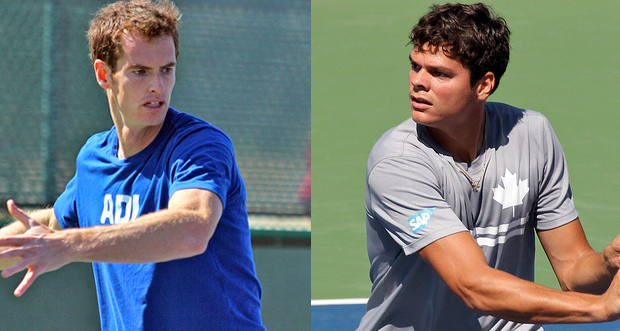
    Andy Murray Milos Raonic

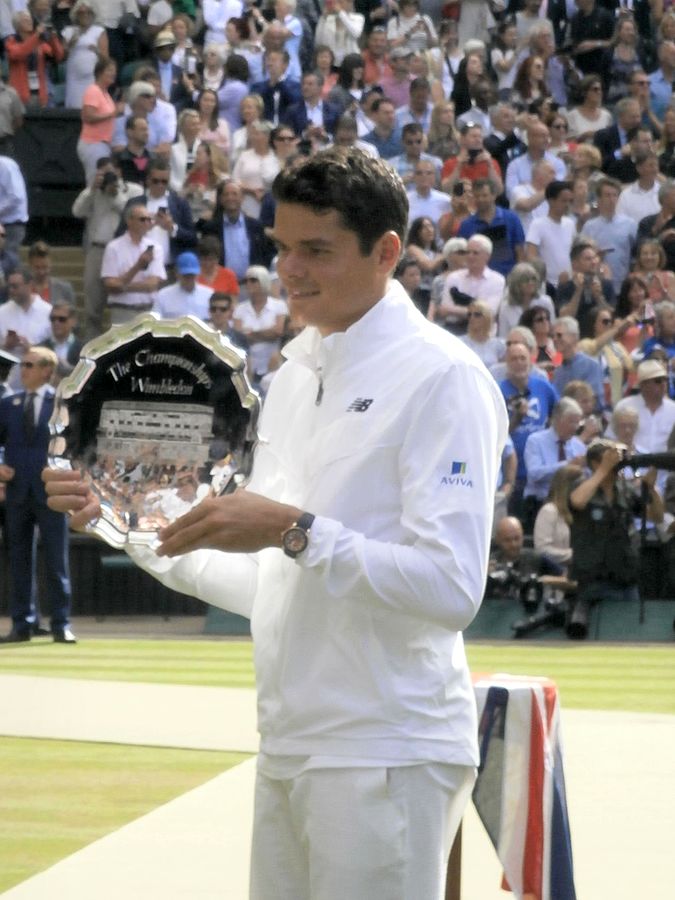
    Raonic vs. Murray has the potential to be a very interesting match. It’ll certainly provide a nice contrast of styles.

    Murray is the game’s consummate defensive counterpuncher — his speed, efficient groundstrokes, and low error rate all combine to make him a shoe-in for the latter rounds of this Major, played on a medium-to-slow variant of his favourite hard surface.

    [divider]

    Click here to discuss the Murray/Raonic semifinal in the Discussion Forum.

    [divider]

    Raonic’s eight titles to date have also been on his favoured surface of hard courts. Although his height and relative lack of mobility aren’t helpful on a slower surface, as in Australia, his serve — up there in the top four in the world, arguably — combined with a renewed commitment to dictate offensively with his forehand, as well as attacking the net, do much to nullify the surface’s pitfalls. He is enjoying quite a streak in Australia, winning in Brisbane this month and progressing through five rounds in Melbourne to contest his second Major semifinal.

    Both players are tied at three wins apiece in their head-to-head series, although Murray has won their sole meeting at Slam level. The Scot certainly starts off as clear favourite in this match, a two-time Major Champion, four times a finalist in Melbourne, and owning four times as many trophies in his cabinet than his Canadian opponent. He will be the last person, though, to underestimate Raonic Mark III that we have been seeing of late.

    Although Murray stands to benefit if this becomes a baseline war of attrition, where he can move his man about and outfox him as he has done so many times before to taller, slower opponents, it would be folly to revert to his passive comfort zone. Raonic is likely to be able to hold the majority of his service games, even against Murray, a player with returning prowess second only to Djokovic. Also, if Raonic sees a lot of Murray’s weak second serves to swat away at leisure, as well as the Scot’s weaker forehands landing in the middle of the court as they often are liable to do, he will be able potentially to dictate the rallies and put Murray on the defensive.

    I like what I have been seeing from Raonic of late, and I hope he continues this rich vein of form into the rest of the season. Such is the calibre and experience of Murray, though, I believe that this will alas be a bridge too far for the amiable Canadian.

    Murray to win in four sets.

    [divider]

    Cover Photo (Creative Commons License): Marianne Bevis

  • 15 Up-and-Coming Players to Watch in 2015 / Jonathan Northrop

    15 Up-and-Coming Players to Watch in 2015 / Jonathan Northrop

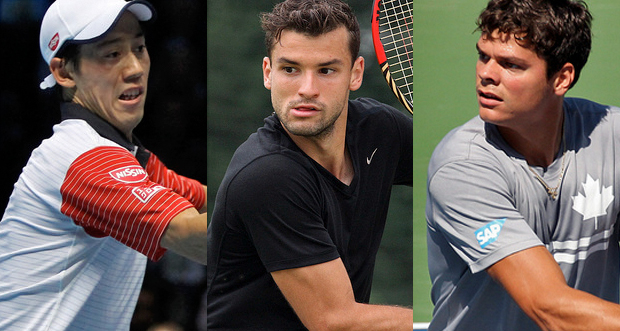
    Kei Nishikori Grigor Dimitrov Milos Raonic

    As the first tournaments of 2015 wrap up, it is almost shocking to think that the Australian Open is just around the corner on January 19. As always, we’ll all be watching the top players with the usual questions: How healthy will Rafael Nadal be and will it be enough to supplant Novak Djokovic at the top of the rankings? Can Novak maintain his focus? Will Father Time catch up with Roger Federer, who turns 34 later this year? Can Andy Murray find his 2012-13 form again? Will Juan Martin del Potro be healthy enough to rise again? And so on.

    But what about the rest of the pack? We focus so much on the “Big Four” and a few dark-horse candidates, while there are a lot of interesting stories and players beyond the big name elite. Let’s take a look at these other players, in particular those who bear watching in 2015 for whatever reason – but mainly as players poised to rise in the rankings. Some may be knocking at the door of the elite, while others may simply be establishing themselves as players to know, while others yet might be potential future stars.

    There are, of course, many other players worth watching – but I wanted to highlight these fifteen as particularly interesting, for a variety of reasons. Let’s take a look.

    [divider]

    Click here to discuss “15 Up-and-Coming Players to Watch in 2015” in the discussion forum.

    [divider]

    THE ALMOST BIG THREE
    Grigor Dimitrov

    Let’s start with Grigor Dimitrov, who may have been so overrated in the past in terms of expectations that he’s now being underrated (although his recent Brisbane demolishing at the hands of Federer is not exactly encouraging). Let us not forget that Grigor has improved in each year he’s been on tour; consider his year-end rankings since 2008: 493, 288, 106, 76, 48, 23, 11. Notice the trend? If Grigor keeps it up in 2015 he will possibly make it as high as the edge of the Top 5. But of course at some point he’s going to even out, and it is hard to imagine him supplanting Novak, Rafa, or even Roger. But it seems that he can beat anyone else, or at least remain competitive among the rest of the near-elites of the game. The problem with Grigor seems to be that, while he’s very good at almost every facet of the game, he doesn’t have any truly killer weapons – and seemingly lacks a killer instinct altogether.

    Prediction: The book is still open for Grigor. He needs something else — a killer shot and perhaps more of a killer instinct — to fully actualize his potential, otherwise he’ll remain more of a pretty player to watch, but not a true elite. In 2015 I think we’ll see continued incremental gains as Grigor creeps into the Top 10. He’ll continue to go deeper in Slams, being relevant at Masters tournaments, with a chance of winning one late in the year (Paris?), eventually earning his way to the World Tour Finals next November.

    Kei Nishikori
    On one hand, we may have seen the best of Kei in 2014. On the other, he seems to keep getting better and better, and of the rest of the field seems like he has what it takes to upset one of the Big Three. Kei is now a legit candidate to win a Masters and a dark horse at the Slams. Whether he has the stamina to make it through remains to be seen; despite his strong year, it should be remembered that he still only made it to the second week once.

    Prediction: Kei settles in within the second half of the Top 10. For some reason Nikolay Davydenko comes to mind – a player that never really challenged at Slams, but won a couple Masters and was always around. Perhaps Kei will have a similar peak.

    Milos Raonic
    At first I excluded Mighty Milos from this list but then I decided that it would be unfair. The big Yugo-Canadian is, quite frankly, a bit underrated at this point. Like Dimitrov it is hard to imagine him beating any of the Top 3 when it really counts, but he did just that versus Roger Federer at the Paris Masters. Milos continues to make small gains, as evidenced by his year-end rankings: 373, 156, 31, 13, 11, 8. If the pattern holds he’ll finish 2015 in the No. 5-6 range. At the least, though, I think Milos is a fixture to hand out in the latter half of the Top 10 for years to come, playing a similar role in the next half decade as Tsonga and Berdych have for the last half decade.

    Prediction: Something good for Milos in 2015. Will it be a Masters? A Slam even? Hard to imagine, but he’s knocking at the door. I think he wins several titles in 2015, maybe even a Masters. He feels close.

    DON’T FORGET ABOUT THE OTHER TWO
    Jiri Vesely & Dominic Thiem

    For some reason I pair these two players. Well, the reasons are pretty clear: they’re of a similar age, on the younger side of “Generation Raoshitrov”; Vesely’s advancement was steady but perhaps a bit disappointing, going from No. 85 to No. 66, while Thiem jumped 100 ranks from No. 139 to No. 39.

    Prediction: I expect continued steady progress from both. Both, I think, will fully establish themselves in the Top 40, and Thiem might even challenge for the Top 20. I think we’re still a couple years away from their peaks, but both should eventually be fixtures in the Top 20 and may even challenge for the Top 10 as players like Ferrer, Berdych, Wawrinka, and Tsonga age themselves out of it. But that’s probably a couple years away.

    THE BOYS ARE GROWING UP
    Nick Kyrgios

    The first of two up-and-comers to beat Rafael Nadal in 2014. Nick Kyrgios is a big kid (6’4”) with a big game and a big serve (14.8 ace %, good for No. 6 among the Top 50); I can’t help but think of Juan Martin del Potro when I see him out there. Ironically enough, the last time a teenager upset the world No. 1 at a Grand Slam was Rafa over Roger Federer at the 2005 French Open. Anyhow, great things are ahead for the Australian – he finished the year at No. 52 up from No. 182 in 2013, so he made quite a jump. He turns 20 years old in April, so still has some room to grow.

    Prediction: Nick makes steady progress but doesn’t quite jump into the elite. That said, he fights for, and at least comes close to, a year-end Top 20 ranking. While he may play the spoiler in 2015 again, he probably won’t be in the mix for big titles until 2016.

    Borna Coric
    No young player has me quite as excited as Borna Coric. I just see him having the highest upside of any player currently on the radar (that is, in the Top 300 or so). We all know him for taking out Rafael Nadal at Basel, but let’s not forget that he also beat Ernests Gulbis in that tournament and lost to red-hot David Goffin in three sets. Coric is for real and his advancement should be steady from here on, although at this point we should remain patient – he did just turn 18 a couple months ago, after all.

    That said, it is important to note that most truly elite players were ranked somewhere in the second half of the Top 100 or so at Coric’s age, and most jumped into the Top 20 the year after. Compare the year-end rankings for recent all-time greats at age 18 and 19:

    Djokovic: 78, 16
    Nadal: 51, 2
    Federer: 64, 29
    Sampras: 81, 5
    Agassi: 3, 7

    (Prior greats – starting with Agassi, but including Becker, Edberg, Wilander, etc., tended to have their break-out a year earlier, with age 17 being the first in the Top 100 and age 18 the big jump; one could speculate that perhaps we’re going ahead another year, with Nick Kyrgios’ trajectory being closer to the norm for elite players – first year in the Top 100 at age 19, big jump at age 20).

    Now compare the next tier down:
    Del Potro: 92, 44
    Murray: 65, 17
    Roddick: 156, 14
    Hewitt: 25, 7
    Kuerten: NA, 188
    Kafelnikov: 275, 102
    Courier: 43, 24

    As you can see, the next tier tends to rise a bit later, or at least more slowly.

    The point here is that if Coric is going to be great—as in an all-time great—then he needs to rise fast. Given the fact that players seem to be taking longer to develop these days with later peaks, I think we can go a bit easier on him and not expect a Rafa-like or Pete-like rise, but for me the benchmark would be a Top 40 or 50 ranking by year’s end. If he makes it into the upper half of the Top 100, then I think it is a sign that he has a chance to be special, even a truly great player. If he sticks around No. 100 or slips out of the Top 100, then we might need to temper our expectations a bit.

    Prediction: Borna will continue to rise, with some bumps in the road, but his overall trajectory will be clear. He finishes somewhere in the No. 40-50 range, although I would be surprised if he wins anything more than maybe an ATP 250.

    Alexander Zverev
    The second youngest player on this list, 17-year-old Zverev finished the year ranked No. 136. That might not sound all that impressive, but consider that of the active players who have ranked in the Top 10, only Tomas Berdych (No. 103), Lleyton Hewitt (No. 100), and Rafael Nadal (No. 49) ranked higher at the end of the year they turned 17. Novak was No. 186, Roger No. 301, and many players weren’t even on tour yet. While we should be moderate in our expectations at this point, it is hard not to get excited about this kid. If Nick Kyrgios and Borna Coric are the top two candidates to be the next elite players, then Zverev is No. 3 and not far behind.

    Prediction: Baby steps. Zverev doesn’t turn 18 until April, so has a lot of room to grow – both as a human body and as a player. I think he has a good shot at the Top 100 this year, but I wouldn’t expect much more than a year-end No. 80-100 ranking.

    OTHERS TO KEEP AN EYE ON
    Ernests Gulbis:
    Long viewed as an underachiever, Ernests (named after Hemingway) had his best year, challenging at one point for the Top 10. But questions remain: After an erratic career, can he maintain his current level? Can he take it a step higher? Or is he in the vein of up-and-down perennial underachievers like Alexandr Dolgopolov and Richard Gasquet? Who knows with Ernests. I suspect he’ll have more upsets like the fourth round French Open victory over Roger Federer, but not be consistent enough to break into the elite. That said, I think he’ll flirt with the Top 10 and maybe dip into it briefly, but then fall back and finish somewhere in the latter half of the Top 20. I’d prefer not to be so specific in my predictions, but for some reason No. 15-18 sounds about right.

    Jack Sock: While it is hard to become too excited about a 22-year old ranked No. 42 and with no titles to his name, consider that Sock is now the fourth highest ranked American and only one of five in the Top 100. Not only that, he’s the youngest American ranked in the Top 200, just a month younger than No. 121 Denis Kudla, and a few months younger than No. 190 Ryan Harrison. But here is where there is some hope: Sock’s rise has been strong and steady – consider his year-end rankings from 2010 to the present: 878, 381, 150, 102, 42. We probably can’t expect Sock to be the next Andy Roddick, but he could be the next John Isner or Mardy Fish.

    Stefan Kozlov: Stefan who? Well, a year or two from now he could be front and center in our minds. Who is Stefan Kozlov, you ask? He’s the youngest player to finish in the Top 500 this year at No. 468. No. 468?! Who cares? Well, I care – because Stefan Kozlov was born in 1998. Yes, 1998. Kozlov is 16-years old, turns 17 in February. He hasn’t done much yet, but he did play in the qualification rounds of the US Open, defeating his first round opponent, Mitchell Frank, before losing in three sets to “old man” Borna Coric. Kozlov is a long way away, but I wanted to introduce him as he’s a player worth keeping an eye on. Oh yeah, and best of all, while he’s Macedonia-born, he’s technically American (I know, it feels like cheating – but tell that to the Canadians re: Milos).

    Yoshihito Nishioka: In the shadow of similarly named (at least to a Westerner) top-ranked and fellow Japanese player, Kei Nishikori, Nishioka is 19 years old and ranked No. 156, and could be a real sleeper to break into the Top 100 next year and a player to watch.

    Thanasi Kokkinakis: Another member of the “Class of ’96,” which is turning out to have some talent. Kokkinakis is the third highest ranking teenager at No. 150, behind only Coric and Zverev. Another Australian to watch.

    Jared Donaldson: Ranked all the way down at No. 261, 18-year-old Jared Donaldson is worth mentioning not as much because he’s the sixth highest ranking teenager, but mainly because he’s the highest ranking American teenager; actually, he’s the highest ranking American age 21 or younger, which makes him arguably America’s Great Hope to return to relevance. But let’s check in next year to see where he is.

    Hyeon Chung: Korean-born, the fourth member of the Class of ’96 on this list (along with Coric, Kokkinakis, and Donaldson). I don’t know what his upside is but at No. 173 he’s the highest ranked Korean by a good margin, and well-situated on the career trajectory towards a strong career.

    ADDENDUM: Another 15 to the Mix
    I’d like to add a few more names to keep an eye on. Again, remember that the above list is not meant to be comprehensive, but a the same time I’d be remiss not to give at least an honorable mention to a few others.

    Roberto Bautista Agut: A surprising rise from No. 58 to No. 15 in 2014, can he maintain a top 20 ranking for a few years?
    David Goffin: After a disappointing 2013, Goffin had a tremendous rise in 2014, going from No. 110 to No. 22.
    Jerzy Janowicz: Let’s not forget about Jerzy, but’s he fast becoming a cautionary tale, a least for those of us that got excited a year or two ago. He’s still young enough to turn it around.
    Pablo Carreno Busta: It seemed that he was a cult favorite to be excited about a year ago, but after only a moderate rise in 2014–to a solid No. 49–I think expectations have cooled. Still, he’s a name to get used to as he could be a regular in the top 40 for years to come.
    Dusan Lajovic: Best known for making it the 4R at Roland Garros where he lost to Rafa, but not before beating Delbonis and Sock to get there. I think he’s a sleeper to be a solid player.
    Bernard Tomic: Oh Bernie, it is hard to root for you. You’re like a playboy superstar that isn’t a star. Time to grow up if you want a decent career.
    Victor Estrella Burgos: In contrast to Tomic, how can we not cheer for this guy? Starting on the ATP tour at age 33-34, and he made it as high as No. 65! Who knows what’s ahead but I’m cheering him on.
    Lucas Pouille: Another sleeper – seems talented.
    Luke Saville: Ditto. These guys aren’t future elites, but they are probably future top 50 players.
    Diego Schwartzman: At 5’7″ you’ve got our attention. Seems like another sleeper.
    Elias Ymer, Christian Garin, Roman Safiullin, Andrey Rublev, Gianluigi Quinzi: More young ‘uns to keep an eye on, all born in 1996-97.

    OK, that’s it. The problem with trying to be semi-comprehensive with this second list is that there is no way to draw the line. No Vasek Pospisil? Federico Delbonis? Well, I had to draw the line somewhere and it is “15 + another 15.”

  • Age-Related Discussion

    Age-Related Discussion

    Feliciano Lopez
    One of my favorite topics is the relationship of age and career performance, questions such as: What are the different phases of a career? When is the most common peak range? Are players peaking later now? Etc.

    For the sake of context and perhaps a taxonomy that would be useful for discussion, as I’ve written quite a few times before, I’ve posited that the historical norm has four general phases:

    Developmental Phase: Age 17-21. Player rises towards peak level.
    Peak Phase: Age 22-26. Player maintains highest level of career.
    Plateau Phase: Age 27-31. Player remains at a very high level, but slightly below peak, with gradual decline.
    Decline Phase: Age 32+. Player declines rapidly and/or retires.

    Again, these are the norms, or the averages if you will. Every player is different – but historically, those are the general ranges that most players fall into, or near to.

    Now what is interesting in recently years is that quite a few players seem to be peaking later, more in what would normally be their plateau phase. David Ferrer is an example, with his best years being 2012-13 when he turned 30 and 31. Despite beating Andy Murray today, Ferrer has showed signs of slowing this year, so he may be entering his decline phase – or he could simply be dropping to a plateau.

    And then we have the inspiration for this thread, Feliciano Lopez, who is 33 years old and possibly having the best year of his life. While his highest ranking was achieved a couple years ago in 2012 (No. 15), he’s at No. 14 in the live rankings now and has a good chance of having his best year-end ranking (which is currently No. 20 in 2011).

    And then of course there is Stan Wawrinka, who won his first Grand Slam at age 28 and is amidst his best year at age 28-29, and will probably finish the year ranked No. 4, better than last year’s career best of No. 8.

    Marin Cilic is still in what is normally the Peak Phase, but he won his first Slam just before turning age 26 – on the older side.

    And then we have young players like Milos Raonic and Grigor Dimitrov. Grigor is 23 years old, having his best year, but there’s also the sense from many that he’s another year or so away from his peak. Milos is also 23, turning 24 in December, and may or may not be at his peak.

    One thing that strikes me is that these outliers from the career norms are all non-elite players. Roger Federer’s career follows the averages quite closely, as does Nadal’s, Djokovic’s, and Murray’s – although it is still too soon to tell if and when they’ve entered their Plateau. Certainly it seems that Rafa and Andy have; Novak had his best year in 2011 at age 23-24, but I’d have a hard time saying that he’s not still in his Peak phase (that is, best year shouldn’t be equated with Peak phase; the best year usually comes within the peak).

    Those are just some examples. A few questions to consider/discuss:

    • Are players really peaking later?
    • If so, why?
    • Is there a historical precedent for players having their best years in their 30s (e.g. Ferrer and Lopez)?
    • Is it only “second tier” talents that are peaking later? (As it certainly seems like we’ve seen the best of Nadal, Djokovic and Murray)

    And so forth. Any thoughts?

    [divider]

    [divider]

    Cover Photo: Kiu Kaffi, Tennis Frontier Correspondent

  • Nishikori Denies Raonic in Tokyo

    Nishikori Denies Raonic in Tokyo

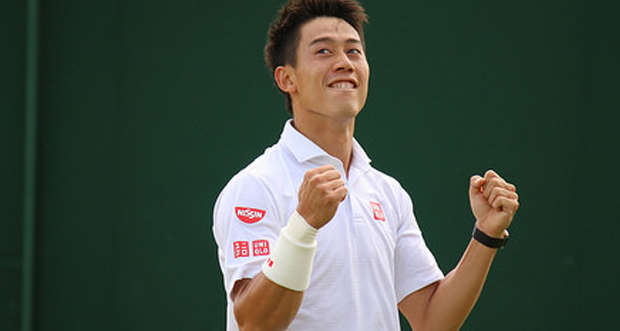
    Kei Nishikori

    Tokyo brought defeat for the top two seeds in the first round, which was all the opening the third seed, Kei Nishikori of Japan, and the fourth seed, Milos Raonic of Canada, needed to march into the final.

    In a tight three sets, Nishikori beat Milos Raonic 7-6(5), 4-6, 6-4, in a match which lasted 2 hours and 13 minutes.

    Tokyo has been good to Japan’s top player — this was Kei’s second title there.  He now has four titles in 2014, along with a Grand Slam final appearance at the US Open.  It’s safe to say these are Kei’s best career achievements.

    But there is more to be achieved.  Both Nishikori and Raonic are still fighting for the last five spots that are yet to be filled in the race to the year end championship in London.

    [divider]

    Click here to discuss the Tokyo tournament in our Discussion Forum.

    [divider]

    Cover Photo (Creative Commons License): Sum_of_Marc

  • Raonic Overcomes Compatriot in All-Canadian Final at Citi Open

    Raonic Overcomes Compatriot in All-Canadian Final at Citi Open

    Milos Raonic

    The Canadian Milos Raonic moved a step higher in his bid to become a significant Top 10 player by winning his first ATP 500 title at the Citi Open in Washington, DC. He bested his compatriot, Vasek Pospisil, in the first-ever all-Canadian ATP final. Pospisil, who was forced to play his quarterfinal and semifinal matches yesterday, due to weather, seemed very much gassed in the first set. He rallied in the second to make a match of it, but Raonic, the more seasoned player, prevailed to win it 6-1, 6-4.

    It was Pospisil’s first ATP final. Raonic now has six titles to his credit.

    [divider]

    Photo credit:  Kiu  (© Tennis Frontier)

  • Wimbledon Day 11: Men’s Semifinals – Order of Play & Scores

    Wimbledon Day 11: Men’s Semifinals – Order of Play & Scores

    Day 11 of Wimbledon features the Men’s Semifinals on Centre Court. Action begins with 2011 champion and the No. 1 seed Novak Djokovic (SRB) taking on the Bulgarian Grigor Dimitrov, the No. 11 seed. The second semifinal pits seven-time champion and No. 4 seed Roger Federer against the Canadian Milos Raonic (8).

    The full schedule for Day 11 is listed below (results to follow). All times are local.

    [divider]

    Centre Court – 1:00 P.M.

    Gentlemen’s Singles – Semi-finals
    Novak Djokovic (SRB) (1) d Grigor Dimitrov (BUL) (11) — 6-4, 3-6, 7-6(2), 7-6(7)

    Gentlemen’s Singles – Semi-finals
    Roger Federer (SUI) (4) d Milos Raonic (CAN) (8) — 6-4, 6-4, 6-4

    [divider]

    No. 1 Court – 1:00 P.M.    

    Gentlemen’s Doubles – Semi-finals
    Bob Bryan (USA) (1) / Mike Bryan (USA) (1) d Michael Llodra (FRA) (12) / Nicolas Mahut (FRA) (12) — 7-6(4), 6-3, 6-2

    Mixed Doubles – Quarter-finals
    Aisam Qureshi (PAK) (16) / Vera Dushevina (RUS) (16) d Neal Skupski (GBR) / Naomi Broady (GBR) — 6-4, 6-3

    [divider]

    No. 3 Court – 11:30 A.M.    

    Gentlemen’s Invitation Doubles
    Jacco Eltingh (NED) / Paul Haarhuis (NED) d Greg Rusedski (GBR) / Fabrice Santoro (FRA) — 6-3, 6-4

    Gentlemen’s Doubles – Semi-finals
    Vasek Pospisil (CAN) / Jack Sock (USA) d Leander Paes (IND) (5) / Radek Stepanek (CZE) (5) — 7-6(5), 6-3, 6-4

    [divider]

    Court 12 – 11:30 A.M.

    Ladies’ Doubles – Semi-finals
    Sara Errani (ITA) (2) / Roberta Vinci (ITA) (2) d Andrea Hlavackova (CZE) (9) / Jie Zheng (CHN) (9) — 6-3, 6-2

    Ladies’ Doubles – Semi-finals
    Timea Babos (HUN) (14) / Kristina Mladenovic (FRA) (14) d Andrea Petkovic (GER) / Magdalena Rybarikova (SVK) — 6-1, 6-3

    Mixed Doubles – Quarter-finals
    Max Mirnyi (BLR) (14) / Hao-Ching Chan (TPE) (14) d Jamie Murray (GBR) (10) / Casey Dellacqua (AUS) (10) — 6-2, 3-6, 6-3