Tag: Mikhail Youzhny

  • Curious About Pleasure

    Curious About Pleasure

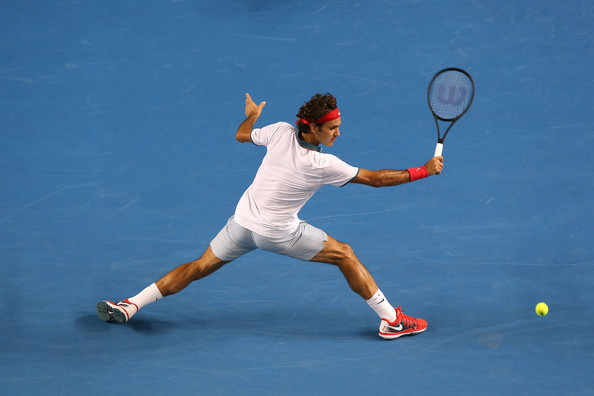
    Roger+Federer+2014+Australian+Open+Day+4+5TYQ1KH1Qakl

    Australian Open 2014, Second Round, Days 3 and 4

    Florian Mayer def. [14] Mikhail Youzhny 6-4, 3-6, 6-3, 3-6, 6-3

    Sam Querrey def. Ernests Gulbis 6-2, 6-3, 6-4

    [3] Maria Sharapova def. Karin Knapp 6-4, 3-6, 10-8

    [6] Roger Federer def. Blaz Kavcic 6-2, 6-1, 7-6

    Back when I was gearing up for my visit to Melbourne, when I bought my copy of Australia: The Continent so Hot it Melts Concrete, I also purchased a pretentious hardcover book about coffee: The Blue Bottle Craft of Coffee, by James Freeman. Because reading about the comparative merits of pour-over versus siphon extraction is perfect preparation for international travel. (The flight attendants on New Zealand Air were thrilled when I demanded to know whether their on-board brew was made with wet- or dry-process beans.) Also, it was an impulse buy. The photo of the cup of coffee on the book cover happened to look exactly like the cup of coffee I wanted to be drinking at the time. Amazon knows these things about us.

    Anyway, the book turned out to be absorbing. Its subject-matter—growing, roasting, and drinking a caffeinated beverage—is held in highest regard, and discussed with utmost gravity. Freeman describes the lonesome, creative suffering of a career as a coffee roaster with the same level of seriousness usually reserved for heart surgery or saving babies. Or sports-writing. But, if you like excellent coffee, or hoity-toity cafes, or luxury gadgetry, it’s a goldmine of fascinating details. And it reminded me of tennis.

    Freeman, who is the founder of Blue Bottle, one of Northern California’s most respected—borderline fetishized— coffee-roasting companies, might inflate the importance of coffee in the grand scheme of life, but he isn’t wrong about the strange satisfaction to be found in the repetitive loneliness of trying to do something unnecessary, unnecessarily well. Roasting the perfect blend of coffee beans is not unlike the Sisyphean suffering involved in playing tennis devotedly, and even in watching tennis devotedly—or, at any rate, in wilting in the concrete-busting afternoon heat while one of your favorite players loses a fifth set of tennis.

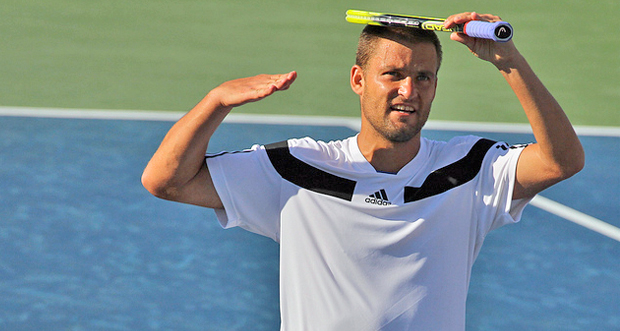
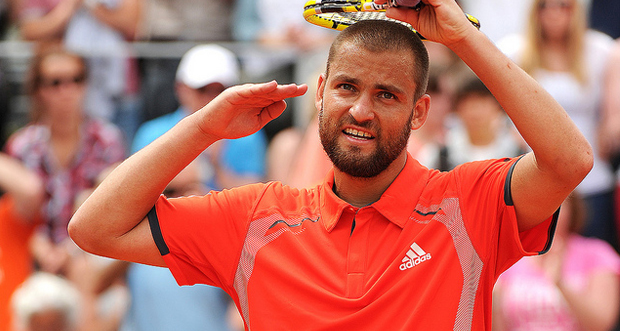
    On my first day at Melbourne Park, I watched Mikhail Youzhny and Florian Mayer play a midday five-set match on Court 8. The match eventually went the way of the German, who was stepping gingerly on his tender, booted ankle, and sculling away at his double-handed backhand slice, but who also played mostly well and almost always aggressively. Youzhny, by contrast, played well occasionally, mostly when his back was against the wall in the fourth set, or down break points in the fifth. Otherwise, the Russian spent the hottest part of a searingly hot afternoon slapping an endless series of groundstrokes and serves into the tape, excoriating himself emphatically in his mother tongue, and clenching his square jaw in rage until his tanned complexion turned the color of cooked lobster. At no point during the match did Mikhail Youzhny look like he found the competitive process fun.

    Later, in Margaret Court Arena, Ernests Gulbis quickly got down to the business of making tennis look like a truly wretched way to spend time. The Latvian lost in straight sets to American Sam Querrey, who executed his special brand of morose excellence with a level-headedness that neatly juxtaposed his opponent’s decompensating ego. The crowd looked for any and every excuse to get behind Gulbis, cheering enthusiastically for each wing-flapping forehand winner, and cooing sympathetically after every drop shot that dropped, mortally wounded, onto the wrong side of the net. But the most exciting moment of the match turned out to be when Gulbis launched his racquet vaguely in the direction of a ball-child and exactly toward the ground. The racquet head snapped in half on court, where Gulbis left it for dead. After shucking his sweaty wristband into the stands, Gulbis slowly unwrapped a new racquet, gestured imperiously for a child to fetch his designer vibration dampener off his broken stick, and sauntered back to the baseline to continue spraying forehand errors.

    My first day at the Happy Slam seemed intent on reminding me that playing tennis for a living is less about playing than it is about hard, virtually liquefying, work. Even Alexandr Dolgopolov, usually content to at least grin in the face of defeat, looked thoroughly miserable to be losing to a determined Jeremy Chardy in the humid early evening breeze. (I’ll spare Matt Ebden the ignominy of describing the purgatory that was his loss to an injured Vasek Pospisil during the night session on Rod Laver Arena.) And on Day 4, the tennis suffering seemed to be, if anything, worse. The heat—extreme western heat, if you will— continued on being relentlessly hot, but there was less cloud cover than on the day before, and sunlight poured over the blue courts like so much molten gold. 

    Despite her stylish changeover ice-vest, Maria Sharapova looked heat-stricken and muddle-headed on Rod Laver Arena as she dragged herself—and her straining vocal cords—to a victory over Karin Knapp, 10-8 in the third. Carla Suarez Navarro also needed three sets and over three hours under the cruel sun to defeat her opponent, Galina Voskoboeva. And then the tournament itself was forced to deploy the “extreme heat rule,” which decrees that all coffee served on the grounds must be thoroughly iced—and also that people stop playing tennis outdoors. 

    Speaking of coffee, I thought about Freeman’s book on crafting the perfect cup on Wednesday, as I watched Youzhny try to coax forth something like his best tennis on a seriously off day while I, my spectating self, struggled to avoid slipping into a full-on heat-stupor.* In The Craft of Coffee Freeman described, at length, the necessity of vigilant attention to detail, not to mention the overall tedium involved in learning to make coffee-making look effortless. But he also wrote lovingly of the finished product, saying, among other things, that coffee makes us curious about pleasure. This was a declaration that stuck with me, and I think it applies to almost anything in life—person, place, or thing—into which we project our emotional experience of potential. If it doesn’t make us curious about the good things in life, it should. 

    It was this curiosity that came to mind as I realized Youzhny was not going to bounce back against Mayer in the fifth set as he had bounced back in the fourth. The match was not a pleasure for me to watch, and I imagine it was not a pleasure for the Russian to play – or for the German either, for that matter. But although watching all those sets of tennis, only to see my guy lose in the end was dreary, and cost me most of the salt reserves in my body, it wasn’t a disappointing disappointment. (If that makes sense.) Instead, it felt a part of the larger experience—a low note to emphasize the high ones to come, to use Freeman’s language. It was still tennis, and it made me curious about pleasure.

    As fortune would have it, a high note wasn’t far away. Within 24 hours of Youzhny’s loss I found myself with an excellent seat on Hisense, underneath a closed roof in an air-conditioned stadium, cradling a dish of affogato, and watching Roger Federer unfurl two sets of sleek tennis on his way to a 6-2, 6-1, 7-6(4) victory over a game, clean-hitting, and occasionally bold Blaz Kavcic. It was all very posh—like a siphon-brewed cup of Ethiopia Yirgacheffe on a leisurely (and temperate) Sunday morning. That is, if a leisurely Sunday morning included the cracking sound of swiftly struck forehand winners and the cheers of a few thousand sports fans.

    Roger Federer, the sixth seed, was having a pretty good night. He displayed an unerring attraction to the open court, as well as an affinity for break point conversions and the happy ability to please a crowd that loved nothing more than to Ooh and Ah at his shot-making prowess. People tend to say that Federer makes it—tennis, perfection— look easy. I’m not so sure about that. A better way to put it might be that Federer, when he’s playing well, makes it look unattainable. There was a fantastic, and fantastically long point on Federer’s serve at 3-0 in the second set wherein the Swiss managed to get to several balls he had no business arriving at, and then doing things with those shots that he had no business doing. He eventually won the point, while Kavcic was left shaking his head in disbelief. Only Federer.

    But as many times as Kavcic was left with nothing but a wry grin of frustration, he didn’t give up. Just after that long, magic point from Federer, the Slovenian broke the Swiss for 1-3. Federer responded by hitting four winners and breaking right back. For two solid sets of tennis, it was that kind of night for the Rolex Brand Ambassador. Still, it wasn’t a perfect performance. In the third set Kavcic lifted his game, primarily via gutsy serving, and Federer’s level dropped to somewhere between fair-to-middling and just-plain-passive. There were several interesting shanks. But the Swiss regained some rhythm as the third set aged, earning match point in the tiebreaker, which he won after forcing Kavcic to dive for not one, but two, volleys in a row. Carlos Bernardes called “game, set, match” while the Slovenian was still coming out of his second roll on the concrete. It was an absolute pleasure. And it made me very curious about how Rafa was doing over on Laver. 


    *At some point during the fourth set I worried I might be succumbing to heat-induced auditory hallucinations because I imagined I heard live accordion music. Further investigation—in the form of directing my gaze to the stands of Court 13—proved that it was only Damir Dzumhur’s loyal fans, who’d come thoroughly equipped to help the Bosnian defeat Ivan Dodig. Besides a few dozen Bosnian flags and a catalog of traditional Bosnian tennis folk-chants, they’d also brought a piano-accordion to play during changeovers.
  • Nature’s Eternal Wonder

    Nature’s Eternal Wonder

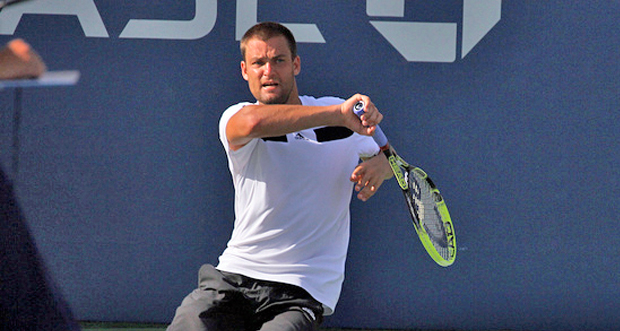
    Valencia Youzhny

    Basel, Final

    (1) Del Potro d. (3) Federer, 7-6(3), 2-6, 6-4

    Roger Federer this afternoon enjoyed the unusual sensation of entering Basel’s St. Jakobshalle as the underdog, although perhaps “enjoyed” isn’t the word. In truth he probably enjoyed it about as much as the Swiss crowd, which for the better part of a decade had been sustained on easy brilliance, but must now seek additional nourishment in hope, a notoriously fickle dietary supplement. It has been that kind of season, and in Juan Martin del Potro he was facing a fine player who has transformed himself into a fearsome contender on every surface, roofed or not.

    Last year in Basel Federer performed about as patchily as he has this year, and eventually fell to del Potro in a reasonable three-set final. At that time he was the world No. 1, and all the commentary centred on his doomed bid to retain his ranking until the end of the year. His return to No. 1 had been masterful, and apparently entailed visiting an unusual number of dispiriting losses on del Potro, indeed rather more than seemed necessary. As a consequence, Federer was still the strong favourite for last year’s final. This year he certainly wasn’t. Before the final, he hadn’t defeated another member of the Top 10 since the quarterfinal of the Australian Open, and was now ranked lower than del Potro. After the final, both those facts are still true. The interest this year lies in wondering whether he will qualify for the World Tour Finals, an event he has won six times. Sky Sports’ resident math-whiz Barry Cowan has run the sums, and reassured us that Federer will be there. Even so, it has, to put it mildly, been a horrible season.

    Even that is misleading, though, since the concept of a single season in professional tennis is mostly meaningless. The suggestion that Federer is having a bad season glosses over the reality that he has been playing quite poorly for much longer than that. In fact, though I might be courting a measure of disapproval by saying so, I don’t think he has looked truly impressive since last year’s Olympics. This may seem a contentious point, given that soon after the Games he claimed the Cincinnati Masters without dropping serve, bagelling Novak Djokovic in the final. To the already potent mixture of injury and slumping form, one cannot help but add the question of desire. Overall, his hunger no doubt remains as undiminished as he insists when asked, but at those crucial moments in important matches when every choice must be razor sharp and execution flawless, his instinct lately seems blunted, the old audacity dulled. Perhaps it is merely an issue of confidence, the least tangible casualty of injury and prolonged poor form, and always the last to recover.

    Still, Federer looked amply committed today, and wasn’t all that far from winning, and far from sanguine when he didn’t. It was a decent final, and tangentially diverting for how the shape of the whole match was thoughtfully captured in the first set, the way a tree’s form is reprised in each leaf, or the entire idiocy of pop culture is present in a single Kardashian. Nature’s wonder truly is eternal. Anyway, both players looked good early, before del Potro broke and moved ahead, but was broken back to love as he served for the first set. They reached a tiebreak, and Federer’s level plummeted while the Argentine’s didn’t. Federer stormed back in the second, as del Potro conducted an ill-conceived experiment to ascertain how well he’d do without a first serve. Not very well, it turned out.

    Having satisfied himself of this, he set about proving the corollary in the third set, winning sixteen of the seventeen first serves he put into play. On the slick Basel court, this rendered him all but unbreakable. If only Federer had been. Alas, the key moment came early in the set, as Federer forwent several chances of maintaining his second set momentum, and was laboriously broken. His only opportunity to break back came immediately, but del Potro held steady when it counted. The rest of the match turned out to be a long coda. Del Potro, afterwards, was ecstatic. Look for him in Paris, and London. Look for Federer, too.

    [divider]

    Valencia, Final

    Youzhny d. (1) Ferrer, 6-3, 7-5

    Mikhail Youzhny won’t feature in London, although by claiming the title in Valencia a short while later he has reinserted himself back into the Top 20, displacing a few others, and settling at No. 15. Ferrer, meanwhile, will be in London, since despite losing today he remains comfortable at world No. 3. I cannot help but think this lofty position does not reflect his current form.

    Unlike Federer, the last twelve months have been the finest of Ferrer’s career, including a maiden Masters title, a Roland Garros final, and a career-high ranking. Again I’ll court perversity, this time by arguing that Ferrer has achieved these results in spite of his form and not because of it. If anything this renders his achievement greater still, although I also suspect he has enjoyed a healthy slice of luck, which at the right dosage is hard to gainsay. Consider this: he won the Bercy title last year without playing a match in which he was not the clear favourite, which is a pretty unlikely scenario when you think about it. He reached the Australian Open semifinal only by the grace of Nicolas Almagro’s brain, while the Jo-Wilfried Tsonga whom Ferrer encountered in the Roland Garros semifinal was a mere shade of the majestic Frenchman who’d trounced Federer the round before. A similar case can be made for Ferrer’s run to the Miami final. I’m not one of those who take pleasure in deriding Ferrer. He’s likeable, is rightly commended for the extent to which he maximises his gifts, and all any player can do is take advantage of situations that fall his way. But I do think he was a much better player last year.

    That being said, I also thought he would beat Youzhny in the Valencia final. For all that victories over Almagro shouldn’t be considered a form guide for anything – even allowing for the degree to which match-ups between compatriots can go haywire – it seemed that Ferrer’s inherent advantages over Youzhny would only be rendered overwhelming by the environment. People euphemistically call Basel Federer’s court, but Valencia really is Ferrer’s court. He co-owns the event, which is staged in the Agora, an attractively stylised bone-cathedral that helps it feel like a novelty level from Topspin 4. One presumes Ferrer’s interests are at least partly responsible for the chemical miracle of Valencia’s surface, so far the world’s most successful attempt at rendering molasses into so striking a shade of cobalt. Unlike Stockholm where the court rewards excellent value for shots, a fact Grigor Dimitrov eventually exploited by hitting a few of his in, the Valencia surface is notoriously difficult to penetrate. Like Ferrer, this court is built for retrieval. For an aggressive yet self-destructive player like Youzhny, whose passage through the draw had mostly entailed outlasting even flakier men than himself, it was a tough proposition.

    However, while I maintain that there’s more that can go wrong with an attacking game than a defensive one, Ferrer this year is living proof that inherently defensive tennis still requires more than a pair of legs. He remains as quick as ever, but his retrieving lately has been nowhere near as accomplished as one might expect. Youzhny was superb, bold from the very beginning, from all parts of the court, varied in his approach, and fearless when pressed. Once he finds his groove there are few players more attractive, although his recurrent issue is that he can be de-grooved so readily by a really tenacious opponent. Often the one extra shot is one too many, but today Ferrer only sporadically forced the Russian to come up with it.

    There was a brief period in the second set when it felt like Ferrer would tear the match away. Youzhny could barely win a point, the local crowd found its voice as their man pulled ahead. But Ferrer’s momentum mysteriously flagged, and a poor service game saw him repeatedly out-rallied and broken back. Soon he was broken again, and Youzhny stepped up to serve for the title, after spending a precious minute pre-visualising it under his towel at the changeover. I cannot say whether it went as he’d planned, but it went as well as he could have hoped. His backhand up the line is unorthodox and beautiful, and today it was instrumental. The last point was thus an appropriate summary: Youzhny launched an attack, Ferrer scrambled desperately, and finally managed to get the ball safely up high to the Russian’s single-hander. The Russian, despite many excellent reasons to grow timid, launched a fearless backhand up the line. Ferrer could reach it, but not control it, and that was the match. Youzhny’s smile afterwards as he saluted the Valencia crowd – far more civilised than Madrid’s – was immense, but exceeded easily by that of his coach. Boris Sobkin doesn’t smile often, but it’s always worth the wait.

    Cover Photo (Creative Commons License): Marianne Bevis

  • Youzhny Reigns in Spain, Wins Valencia Open 500

    Youzhny Reigns in Spain, Wins Valencia Open 500

    Mikhail Youzhny

    In a battle of the 31-year-olds, Russian Mikhail Youzhny, ranked No. 15 in the world, overcame local boy David Ferrer, world No. 3, to snag a surprising, and surprisingly dominant win over the three-time previous winner by a score of 6-3, 7-5.  The win gave Youzhny his tenth career title, and only his second at the ATP 500 level, and his second of the season, having also won in Gstaad.  2013 has been something of a renaissance for the Russian, who was ranked as high as No. 8 in 2010, but has slumped around the 20-30s for the past couple of years.

    Ferrer had been having a very fine week, and was doing away handily with most of all comers.  However, he encountered a very motivated Youzhny today and failed to find the answers.

    “It was a great week for me and a great tournament,” Youzhny said. “It was a great atmosphere. I felt nobody was against me, of course they were for David, but when I played well they applauded me.”

    [divider]

    Photo credit:  Marianne Bevis  (Creative Commons License)

  • Federer, Del Potro, Ferrer and Youzhny Advance to Finals in Basel and Valencia

    Federer, Del Potro, Ferrer and Youzhny Advance to Finals in Basel and Valencia

    Men's final Fed DP Youzhny Ferrer

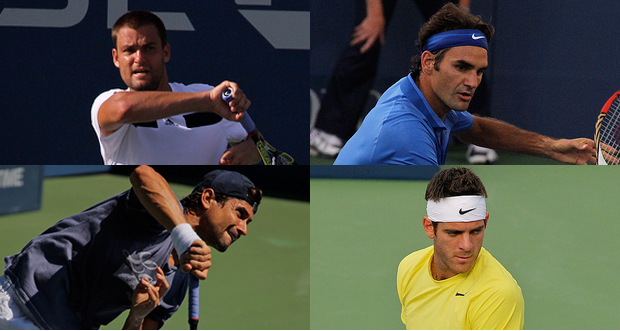
    Roger Federer, Juan Martin Del Potro, David Ferrer, and Mikhail Youzhny have advanced to the finals of Basel and Valencia.

    In Basel, the Argentine Del Potro beat the Frenchman Edouard Roger-Vasselin in three sets, 6-4, 4-6, 6-2. In the next semifinal, the Swiss Roger Federer won a hard-fought contest against the young Canadian Vasek Pospisil, finally winning in three sets, 6-3, 6-7(3), 7-5.

    In Valencia, the first semifinal was an all-Russian affair, with Mikhail Youzhny knocking out Dmitry Tursunov, 6-2, 6-4. Up next, No. 1 seed David Ferrer, of Spain, beat countryman Nicolas Almagro, 6-2, 6-3, to advance to the final.

    On Sunday, the Basel final will take place not before 14:30 P.M. (local time); the Valencia final is scheduled for not before 16:00 (local time).

  • All Manner of Absurdity

    All Manner of Absurdity

    US Open, Quarterfinals Recap

    The US Open, an entity which I contend boasts not only impish sentience but an eye for proportion, thoughtfully balanced a pair of men’s quarterfinals that more or less lived down to expectations with two others that could have hardly conformed less. Two predictable blowouts and two extravagant upsets: what could be more formally elegant? There was a brief period in the last of these encounters, as Mikhail Youzhny stole a set from a momentarily unfocussed Novak Djokovic, when I feared this graceful symmetry might be fractured, or, more worryingly, that I might have to rewrite this opening paragraph. Fortunately the world number one steadied magnificently, and I was able to salvage my broader point, such as it is. For all that I would have enjoyed an audacious comeback from Youzhny almost as much as the tennis-starved punters in Arthur Ashe Stadium, I’d prefer it didn’t cost me whole minutes of work.

    [divider]

    Click here to discuss “All Manner of Absurdity” and more in our discussion forum.

    [divider]

    It’s a nice question whether Richard Gasquet defeating David Ferrer in five sets constitutes a more surprising upset than Stanislas Wawrinka beating Andy Murray in straights, leaving to one side the question of which was the more upsetting surprise. If one were writing a screenplay, which result would cause viewers suddenly to rediscover their disbelief, and simply walk out? Cinema audiences will put up with all manner of absurdity – midi-chlorians, Nicholas Cage – but there are limits. This is the US Open, not Wimbledon. It would probably be more convincing had the scores been swapped: Wawrinka might have prevailed in a tough grind, while an incandescent Gasquet might conceivably have swept the formless Ferrer aside quickly.

    (2) Nadal d. (19) Robredo, 6-0, 6-2, 6-2

    It was always likely that Rafael Nadal would make short work of his quarterfinal, given his exalted hardcourt form and Roger Federer’s exit in the fourth round. But the fact that he was facing a veteran who’d never progressed beyond this stage of a Major in several dozen attempts put it almost beyond doubt. Realisation that this veteran was a compatriot of Nadal’s removed even that modicum of uncertainty. Add in a single-handed backhand and it was hard to see how the encounter would stretch far beyond eighty-minutes. The opponent was Tommy Robredo, who’d done such a sterling job two days earlier in providing a sturdy platform for Federer to ritually disembowel himself on. Robredo brought a similar commitment into his match with Nadal – standing way back, looping groundstrokes, and retrieving like a terrier – with the result that he won five whole points in the opening set. These points sadly weren’t clumped such that they equated to a whole game. Forget eighty minutes — maybe it wouldn’t last the hour.

    The next two sets were marginally more competitive, but such terms are relative, and it was never a contest. Before the match Nadal had somehow maintained a straight face while declaring that in order to have any chance at beating Robredo he’d have to play his best. As it happened Nadal did play somewhere near his best, with the result that Robredo had no chance whatsoever. Nadal has moved through to the semifinals, an outcome he subsequently described as “unbelievable”, which I think translates as “very believable”, considering he has made it at least that far in New York every year since 2007, apart from last year when he didn’t reach the first round.

    For a refreshing contrast he will next face a tour veteran to whom he has never lost, who employs a single-handed backhand, and prefers to operate ten feet behind the baseline. This player is Richard Gasquet, and to say that Nadal has never lost to the Frenchman is slightly misleading. Gasquet actually beat Nadal fourteen years ago, in juniors. This result has no material bearing on their upcoming US Open semifinal except that Gasquet brought it up in his press conference, thereby proving that it’s no longer possible for a professional sportsperson to make a joking aside without having it over-analysed to death. Nadal was naturally quizzed about this during his post-match interview, and astonished everyone by recounting the match in granular detail. Even Brad Gilbert was left momentarily speechless. Jason Goodall reliably wasn’t, joking, “I suppose he’s out for revenge in the semifinal, then.”

    (8) Gasquet d. (4) Ferrer, 6-3, 6-1, 4-6, 2-6, 6-3

    It is hard to imagine he won’t get it, but then it’s pretty hard to believe that Gasquet is there at all. Even to reach the quarterfinals he required five sets, and had to overcome one of the worst fourth round Major records in history (0-11 since Wimbledon 2007). Admittedly that was only against Milos Raonic, who himself had never progressed beyond the round of sixteen. In the quarterfinal Gasquet faced the fourth seeded David Ferrer, thus pitting a man who rarely beats those ranked above him against a guy who seldom loses to those ranked lower, a guy whose constant presence in Major semifinals has ceased to elicit surprise even if it is destined never to gain acceptance. Ferrer will presumably drop out of the top four long before everyone stops wrongly assuming that his quarter of the draw is the one fated to collapse. It was once again to everyone’s chagrin that the only quarterfinal match-up that panned out according to seedings was Ferrer’s, although I do maintain that it was only by the grace of Dmitry Tursunov’s delicate thighs that this was possible.

    Gasquet took the first two sets in fairly convincing fashion, and it seemed likely that a perfunctory upset was underway. This would have been surprising in a sense, though hardly in the league of Federer’s loss to Robredo. Ferrer has been horribly short on form, and sometimes Gasquet is simply unplayable. It happens. But then Ferrer fought back, and levelled the match at two sets each. Gasquet was no longer anything like unplayable, and Ferrer wasn’t playing that badly. The scene – an idyllic French farm setting circa 1917 – was precisely the kind of one into which the Frenchman will typically plummet in a tangle of flaming wreckage. But somehow he remained aloft, mostly due to his serve. Despite his appalling record in fourth rounds, Gasquet has also never lost in the quarterfinals. But nor has he won a semifinal.

    (9) Wawrinka d. (3) Murray, 6-4, 6-3, 6-2

    Murray’s seppuku was only marginally less extravagant than Federer’s, though it was characteristically louder, and given he was facing a superior opponent on a bigger stage, it all worked out looking about the same. By losing to Wawrinka, Murray has failed to reach the final at a Major for the first time since Roland Garros last year (he didn’t play Paris this year). Indeed, aside from last year’s French Open he had reached at least the semifinals at the last nine Majors he had entered, going back to the 2010 US Open, where he lost in the third round to, as fortune would have it, Wawrinka. A mere coincidence, of course, though Murray’s many fans are no doubt right to be dismayed by the connection, since their man is supposed to have moved on from flaccid efforts like this.

    Perhaps they can find some comfort in the suggestion that this new Wawrinka is a categorically superior version to the old one. The addition of Magnus Norman to his team appears to have worked a similar trick for the Swiss that it did for Robin Soderling a few years ago, although it’s worth bearing in mind that Wawrinka was still coach-less when he almost beat Djokovic in Melbourne, so far the season’s finest match. Any changes that Norman has wrought in Wawrinka’s game – the focus appears heavily to be on buttressing his sense of self-belief more than anything technical – are a refinement to the course he’d already set. Wawrinka’s faith in his own capacity to match top ten players was amply displayed against Tomas Berdych in the last round, and reprised today.

    History, in the guise of countless mid-match collapses against Federer, had previously taught all discerning fans that it is rarely a question of whether Wawrinka will collapse in a high-stakes tennis match. It is merely a question of when, which in turn propels one onward to the gasping query of why (for the love of god). So it was today, when Eurosport’s English commentators tirelessly awaited a reversal that never came, even to the end. Wawrinka opened his final service game with a double-fault, then watched unperturbed as Murray smacked a return winner past him. From there it was all Wawrinka, all aggression – including a tremendous bounce-smash winner from the baseline – all the way to the end.

    The defending champion is out.

  • Djokovic Into Semifinals

    Djokovic Into Semifinals

    World #1 Novak Djokovic booked his place in his 18th consecutive Major semifinal by beating Mikhail Youzhny under the lights in New York tonight, 6-3, 6-2, 3-6, 6-0.

    The Russian Youzhny, who was coming off a long and valiant 5-set win over Lleyton Hewitt, came up with break points in the first game of the match, but failed to capitalize.  Djokovic then broke immediately on Youzhny’s first service game.  The Russian tried to hang close, but looked under-inspired, and never found a way into the Djokovic serve, either in the first, or the second sets.

    [divider]

    Click here to discuss the Djokovic/Youzhny quarterfinal in our discussion forum.

    [divider]

    In the fourth game of the third set, however, after a fantastic get on a drop volley at 1-2 on Djokovic’s serve, Youzhny energized both himself and the crowd.  He finally converted his 8th break point chance for a 3-1 lead.  The fans in the stadium, clearly wanting to see a real match, got behind the Russian, which seemed to rattle the Serbian favorite, who began to spray errors.  Djokovic broke back from 0-40 down, for 3-4 in the 7th game, but then double-faulted away his hold game for 3-5.  It was a surprisingly passive and  poor game from Djokovic that gave Youzhny the third set on his serve.

    In the fourth, however, all the accumulated effort seemed to have left the Russian with nothing, and Djokovic appeared to have righted the ship.  Youzhny failed to win a single game.

    Djokovic will play Stan Wawrinka in the semifinals, who upset the defending champion Andy Murray earlier today.

  • US Open Men’s Quarterfinals Schedule of Play: Thursday, Sept. 5

    US Open Men’s Quarterfinals Schedule of Play: Thursday, Sept. 5

    [Scores added as known.]

    Arthur Ashe Stadium – 12:00 P.M.

    Men’s Doubles – Semifinals
    Leander Paes (IND) (4) / Radek Stepanek (CZE) (4) d. Bob Bryan (USA) (1) / Mike Bryan (USA) (1) — 3-6, 6-3, 6-4

    Not Before: 1:30 P.M.

    Men’s Singles – Quarterfinals
    Stanislas Wawrinka (SUI) (9) d. Andy Murray (GBR) (3) — 6-4, 6-3, 6-2

    Not Before: 8:00 P.M.

    Men’s Singles – Quarterfinals
    Novak Djokovic (SRB) (1) d. Mikhail Youzhny (RUS) (21) — 6-3, 6-2, 3-6, 6-0

    [divider]

    Click here to discuss the Murray/Wawrinka quarterfinal in our discussion forum.

    Click here to discuss the Djokovic/Youzhny quarterfinal in our discussion forum.

    [divider]

    Louis Armstrong Stadium — Not Before: 12:30 P.M.

    Women’s Doubles – Quarterfinals
    Serena Williams (USA) / Venus Williams (USA) d. Sara Errani (ITA) (1) / Roberta Vinci (ITA) (1) — 6-3, 6-1

    Men’s Doubles – Semifinals
    Alexander Peya (AUT) (2) / Bruno Soares (BRA) (2) d. Ivan Dodig (CRO) (10) / Marcelo Melo (BRA) (10) — 7-5, 6-4

    Women’s Doubles – Semifinals
    Ashleigh Barty (AUS) (8) / Casey Dellacqua (AUS) (8) d. Sania Mirza (IND) (10) / Jie Zheng (CHN) (10) — 6-2, 6-2

  • Those Lethal Cocktails

    Those Lethal Cocktails

    US Open, Fourth Round Recap

    A brief survey of the men’s quarterfinalists for this year’s US Open is revealing. For starters all eight men are Europeans, of whom three, naturally, are Spanish. Unsurprisingly, one of them is Swiss. Three of these men are over thirty, while the youngest is twenty-six. Unbelievably, none of these elderly Continental gents is Roger Federer.

    [divider]

    Discuss this article and more in the Tennis Frontier Forum

    [divider]

    (21) Youzhny d. Hewitt, 6-3, 3-6, 6-7(3), 6-4, 7-5

    The match of the day, and probably of the round, was the terrific dust-up between Lleyton Hewitt and Mikhail Youzhny, which stretched to five sinuous sets, the last of which was eventually won by the Russian. Hewitt led by two sets to one, and by 4-1 in the fourth. Hewitt’s mental fortitude was duly praised, or, as it happened, overpraised. Contrary to popular opinion, he was never an accomplished frontrunner, and even during his eighty weeks atop the rankings would often permit leads disastrously to slip. There have been a few players more habituated to producing monuments, but Hewitt is nearly unmatched in his capacity to make routines matches unnecessarily monumental.

    From that perilous position, Youzhny clawed back, and won the next six games, in the process taking the fourth set and moving ahead by a break early in the fifth. From there it was Hewitt’s turn, winning five of the next six, moving to 5-2. Winning a sixth game would have snared him the match, but it wasn’t to be. Youzhny surged again, broke, held, broke, and served out the match, which is an exceedingly rapid way of describing a process that was fraught, frequently brilliant, and occasionally approached genius. A quarterfinal would have been a fitting result for Hewitt, who’d performed so mightily to defeat Juan Martin del Potro a few rounds ago. Alas.

    It is equally as fitting a result for Youzhny, if not to say a surprising one. I confess, watching on as he struggled to overcome Matthew Ebden in five sets in Melbourne in January, I’d believed that Youzhny’s best days were fast receding behind him. Ebden was actually pushing him around. One should have more faith, though that’s an easy thing to misplace when an aggressive player loses confidence. Tentative where once he’d been reckless, he now appeared indecisive and error-prone, and it was easy to assume, too, he’d never regain his speed and certainty. I am pleased to be wrong, but surely not as pleased as he was today, saluting the crowd. It would’ve been nice to hear what he had to say, but instead Eurosport cut away to Barbara Schett, who was bringing her weaponised vivacity to bear on Victoria Azarenka. “You haven’t just been busy on the court, but off the court as well! I hear you’ve been involved in a photo-shoot for a campaign to help ex-smokers! Can you tell us a little bit about that?!” “Well, I’ve never smoked myself so I can’t really relate. But I do find them very inspirational.”

    (1) Djokovic d. Granollers, 6-3, 6-0, 6-0

    Sadly this lethal cocktail of bonhomie couldn’t go on indefinitely. There was live tennis to be had, though live is perhaps a misleading term, if not an ironic one, in the case of the sadly lifeless Marcel Granollers. One presumes he hadn’t held out much hope against Novak Djokovic, though he probably hoped for more than he got, or at any rate hoped that his inevitable beating might be less savage. He won only three games, all of which came in the first set, although this should not lead one to believe he was any closer to winning that set than the others. He failed to win a single point on Djokovic’s first six service games. Then he failed to win a game on his own serve for the rest of the match. Chris Bowers on Eurosport suggested that had it been a boxing match the referee would have stopped the bout. But it was a tennis match, and so Djokovic was permitted to continue pummelling Granollers for our entertainment, until the Spaniard lay unmoving on the side of the court and even his groans had ceased.

    Afterwards, Djokovic granted Brad Gilbert the brief contractually-obligated interview, thus augmenting his total time on court by about a third. The world No. 1 was typically classy, smoothly stepping around his opponent’s body, though if asked he’d no doubt subscribe to Andre Agassi’s view that one should not deny any opponent so rich a learning-experience. When quizzed about his magisterial serving stats, Djokovic took due care to praise John Isner, to scattered applause from the sparse American crowd. Realistically the assembled onlookers might have filled a less extravagant facility, but even sizeable crowds can be lost within Arthur Ashe Stadium. Presumably many of those absent had stepped out to relieve themselves or seek sustenance after the previous match, and couldn’t make it back in time. Tournament officials had by now scraped Granollers’s remains off the court, and Djokovic respectfully followed the procession up the tunnel. “He’s good, isn’t he?” asked one Eurosport commentator. “Djokovic or Brad Gilbert? Djokovic, yes,” responded the other.

    We were returned to Schett. “He was just better in every compartment!” she declared breathlessly. Apparently denied a studio of their own, she and Wilander were once more anchoring the Eurosport coverage from the grounds. Djokovic soon joined them, looking as relaxed as a man who’d just won a tennis match as easily as he had should. He summoned a sensible response when queried about Federer’s loss, and the persistent demands for the great man to retire, although he might have pointed out that the persistent demands largely consist of the media asking questions like that. He didn’t think Federer should retire. He did point out that time catches up to us all, and that younger players are always appearing, making the tour, stronger, and faster than ever. Presumably by younger players he was speaking of his own “generation”, and not the next one.

    (19) Robredo d. (7) Federer, 7-6(3), 6-3, 6-4

    He was mostly right, although it should equally be pointed out that Federer did not lose to a younger player yesterday, but to Tommy Robredo, a veteran to whom he’d never lost. In some ways this was the most telling aspect of yesterday’s upset, not least because it continues a trend that has underscored Federer’s long decline. Defining when such things begin is mostly idle folly, and would serve no special purpose even if consensus were possible. But one cannot help but think back to late 2009, when there was still a large pool of very good players who had either never beaten Federer, or at any rate hadn’t beaten him for a very long time. Prominent among this group were Nikolay Davydenko, Robin Soderling, Andy Roddick, Lleyton Hewitt, Mikhail Youzhny, David Ferrer, and Robredo. Ferrer and Youzhny are still winless, but the rest of them have since defeated Federer at least once, in every case inspiring onlookers to recycle Vitas Gerulaitis‘s venerable quip about no one beating him seventeen times in a row. The significance is that these players are all around Federer’s age. Failure to sustain his domination of them cannot be ascribed to advanced years, to being overrun by the race.

    On the other hand, Federer going undefeated against these guys for so long is probably more amazing than any eventual loss proved to be, a fact we tend to overlook. Winning streaks work the strange trick of making it seem as though constant victory is the natural way of things, or normalising what is in fact exceptional. It is a paradox of sport that although the longest streaks are the most difficult to compile, they work to make any eventual loss seem aberrant. Even sprinting along a tightrope can look easy after a while, such that one forgets it is only growing harder. Sooner or later there will be a misstep.

    These are broadly satisfactory musings, perhaps, but they don’t tell us much about any specific encounter. They don’t quite explain how Federer actually managed to lose to Robredo yesterday. The answer, I suspect, is that everyone has bad days, and sometimes they occur on a big stadium against a guy you’ve never lost to. Federer had a very bad day, bad in almost every direction at once. His movement was sluggish, his decisions were poor, his returning patchy, his serve lacked bite, and his outfit didn’t match. It was altogether a worse performance than the one that saw him lose to an inspired Sergiy Stakhovsky in Wimbledon. He was unfortunate that he had this bad day against a player as solid as Robredo, though the truth is that because the bad days are now coming more often, they’re more likely to come when it matters. Part of it is age, but I maintain that he’s mostly just short on form.

    Robredo was admittedly outstanding, but Federer was still correct in declaring that he had largely beaten himself. Robredo pulled off any number of improbable passing shots, but they wouldn’t have been possible at all if Federer hadn’t so consistently failed to put balls away into the open court, or essay approaches with greater venom. Time and again Robredo simply stood his ground. By the third set even he stopped looking surprised when Federer hit the ball straight back to him. Often these came on crucial points, such as the many break points on Robredo’s serve. Federer grabbed at handfuls of these after the first set, but could hang on to none of them, and that’s really the whole deal with break points. Similarly Robredo was dictating most of the rallies. It tells you everything about Federer’s lethargy that the Spaniard was permitted to maintain pressure from ten feet behind the baseline while maintaining high clearance over the net and rarely going for the lines. On a reasonably quick hardcourt – Federer afterward said Armstrong if anything plays faster than Ashe – this should never happen.

    But it did happen, and it does seem to be happening with gathering regularity. As with Youzhny earlier in the year, Federer looked like a temperamentally aggressive player very low on confidence, plagued with uncertainty. Even comparing them feels odd. I hold Youzhny in the highest esteem, but Federer’s career has instilled in us a belief that even when his form was off, he remained in a separate class. His bad patches were not like others, and even when he played badly he still won. Now when he plays badly, he looks like anyone else playing badly, which is to say he looks lost.

  • Youzhny triumphs in Gstaad

    Youzhny triumphs in Gstaad

    Mikhail Youzhny triumphed 6-3 6-4 over dutchman Robin Haase to claim the Swiss Open title in front of a packed house.

    Youhzny took the match with a brace of service breaks, one in each set to clinch the title in just over an hour.

    After the match, Youzhny said “Every one of my matches was a tough one. It was a hard week but it ended very well.”

    It was the Russian veteran’s ninth ATP title and he extended his perfect Head to Head with Haase to 5-0.

    [divider]

    Click here to dicuss the match with fellow tennis fans in our discussion forum

  • Roger Federer Wins the Gerry Weber Open, Halle

    Roger Federer Wins the Gerry Weber Open, Halle

    Roger Federer picked up his 78th career title winning the Gerry Weber Open at Halle for the sixth time.

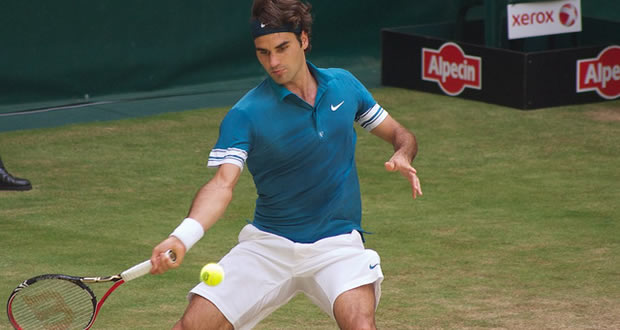
    The 31-year-old Swiss defeated Russia’s Mikhail Youzhny in a tight three-set encounter, 6-7, 6-3, 6-4.  Youzhny had not beaten Federer in 14 previous attempts, but started brightly by winning the first set tiebreak.

    Federer responded by taking the second and third sets to seal his first title of the year.

    Click here to discuss the Halle Tournament and Federer’s title with fellow tennis fans.