A few years ago I wrote a couple blog articles on the sad state of American tennis, one a bit more straightforward—Houston, We Have a Problem—and one a bit more mythological: American Men’s Tennis and the Cycle of Ages. At the time of those writings, August of 2013, there wasn’t a lot to be excited about. Andy Roddick had retired and the last truly great American men’s player, Andre Agassi, had retired in 2006. The top American players at the time of the former article were (with their ages at the time in parentheses):
14. John Isner (28)
29. Sam Querrey (25)
87. Jack Sock (20)
92. Michael Russell (35)
97. Ryan Harrison (21)
100. James Blake (33)
Sock and Harrison looked vaguely promising, but Harrison (now 24) continued to stagnate and is ranked #90, and Sock (now 23) slowed his development and seems to have peaked as a top 20-30 type.
Here’s an update, the 2016 year-end top 100 Americans:
19. John Isner (31)
23. Jack Sock (24)
31. Sam Querrey (29)
33. Steve Johnson (26)
76. Taylor Fritz (19)
88. Donald Young (27)
90. Ryan Harrison (24)
As you can see, it doesn’t look much better than three years ago. Isner remains the top American and he’s just barely hanging on to a top 20 ranking. There’s a bit more meet in the middle, with four Americans in or close to the top 30, where three years ago there were only two. And there’s Fritz, who is the brightest young American player in years. On the surface it looks like Sock was only a year older but ranked similarly to Fritz, but in actuality he was almost two years older, so Fritz’s ranking is far more impressive.
But the top 100 only tells part of the story. Let’s compare the top ranked Americans age 21 and under in 2016 with those in the year-end in 2013:
2013
100. Ryan Harrison (21)
102. Jack Sock (21)
114. Denis Kudla (21)
306. Bjorn Fratangelo (20)
437. Christian Harrison (19)
476. Mitchell Krueger (19)
573. Marcus Giron (20)
594. Evan King (20)
2016
76. Taylor Fritz (19)
105. Jared Donaldson (20)
108. Frances Tiafoe (18)
116. Stefan Kozlov (18)
141. Ernesto Escebedo (20)
198. Michael Mmoh (18)
200. Noah Rubin (20)
204. Reilly Opelka (19)
I picked eight players for each to give a sense of the depth of 2016’s field. As you can see, there is much more to be excited about now than there was three years ago. Looking solely on my “Pace of Greatness” theory, Fritz and Tiafoe have already accomplished the first benchmark: ranking in the top 100 as 18-year olds. Kozlov is very close, and Mmoh has an outside chance. But the main point is that even if none of these eight players become true greats, there is a lot more talent there than in 2013.
https://www.youtube.com/watch?v=iciaF8VryAU
Let’s go back a bit further. Starting in the late 90s and into the early 00s, there was a talented group of young Americans: James Blake, Andy Roddick, Taylor Dent, Mardy Fish, and Robby Ginepri. Ginepri and Dent had decent but unspectacular careers: Ginepri won an ATP 500 and reached the 2005 US Open semifinal, ranking as high as #15, and Dent won four titles and ranked as high as #21. Fish was better, finishing 2011 #8 in the world and reaching several Slam quarterfinals and Masters finals, but never winning more than an ATP 250 level tournament (he won six); his career was marred and shortened by a heart condition. Roddick was a Slam winner and #1, and perhaps the player who suffered most from Roger Federer’s dominance. James Blake had some good years, peaking in his late 20s, and was probably slightly better than Fish, and thus the distance second behind Roddick among this group.
After the group who came of age in the early 2000s, you get to players like John Isner, Sam Querrey, Brian Baker, and Donald Young. Isner is the best of the bunch, a third tier player who has spent many years in the top 20 but only just barely sniffed the top 10. Querrey is something of a disappointment, looking promising in his early 20s but stagnating; Baker never amounted to much, and the fact that I used Young as the emblematic player of the generation of players born from 1989-93 should speak volumes. I think we can safely say that the current crop of young Americans is the best such group that we’ve seen in at least fifteen years.
Going back before Roddick’s era, the mid-to-late 90s also didn’t see much in the way of American talent, with players like Vince Spadea, Jan-Michael Gambill and Justin Gimelstob being the top ranked young Americans. Gambill and Spadea were solid players who spent some time in the top 20, but never in the top 10 or with major titles.
We have to go all the way back to the early 90s to find a generation of truly great young Americans. Check out the American men age 21 and under in the top 100 in 1990:
1990
4. Andre Agassi (20)
5. Pete Sampras (19)
15. Michael Chang (18)
25. Jim Courier (20)
27. David Wheaton (21)
93. MaliVai Washington (21)
Sampras and Agassi are, along with Jimmy Connors and John McEnroe, two of four truly great American men’s players of the Open Era. Jim Courier won four Slams and remains the youngest player (at age 22 years and 11 months) to have appeared in the finals of all four Slams, and was #1 for 58 weeks; Michael Chang was also a Slam winner and perennial top 10 player, with 34 titles and 7 Masters to his name. Even David Wheaton won the prestigious Grand Slam Cup title and ranked as high as #12, and Washington is known for his run at the 1996 Wimbledon (he lost to Richard Krajicek in the final). Overall we probably haven’t seen a crop of this kind of talent coming up at the same time from any country.
In Conclusion
Let me be clear: I am not predicting that the current crop of young Americans is on par with that group from 1990, but what I am saying is that we have to go back to 1990 to find a more promising group of Americans in terms of youth and rankings. If you go back to that 2016 21-and-under rankings list, there probably isn’t an Andre Agassi or Pete Sampras in that group, but there could be an Andy Roddick, a Michael Chang, even a Jim Courier, or at least several players akin to Todd Martin or Mardy Fish. In other words, American men’s tennis is on the rise and looks more promising now than it has in at least 15 years, and possibly more like 25 years.
There is hope!
Cover photo from Wikimedia Commons courtesy of the Creative Commons License.
Revisiting the Benchmarks: the Pace of Greatness
To recap the last installment, we have clear benchmarks that all true greats (6+ Slam winners) hold in common:
Before their 19th birthday: Ranked in the top 100
Before their 20th birthday: Ranked in the top 50
Before their 21st birthday: Ranked in the top 10; won a title; made it to a Slam QF
Before their 22nd birthday: Ranked in the top 5
Before their 25th birthday: Ranked number 1, won a Slam
We also found that there are about 70 players in the ATP ranking era (1973-present) who met that first benchmark—a top 100 ranking at age 18. Of those 70, 17 are active today, a list we’ll get to in a moment.
“Failed Greats”
Now just because a player meets all of those criteria does not mean they will become a great player. There are players who met all of those criteria and only won a Slam or two. There are also players who met all of the criteria except for one or both of the “fruition” benchmarks met by age 25, the Slam and number one ranking. These two groups combined are players that we could call “failed greats”–they passed all, or almost all, of the benchmarks, but failed to become true greats.
Here are two lists of players, the first being those who accomplished all benchmarks, the second all but the age 25 criteria, the Slam and number one ranking:
All benchmarks: Jim Courier, Michael Chang, Marat Safin, Lleyton Hewitt, Andy Roddick
All except age 25: Goran Ivanisevic, Andrei Medvedev, Juan Martin del Potro
So these are eight players in the Open Era who were on the “pace of greatness,” including five who actually met all of the benchmarks, but eventually fell short of true greatness. It is a surprisingly small number, and tells us that most players who reach the various benchmarks along the way will become great players. If we go back to those players for whom we have all the data, from Borg to Djokovic, we have 11 all-time greats (6+ Slam winners). That means that 11 of 16 players (69%) who met all of the benchmarks became greats, and 11 of 19 (58%) who met all except the age 25 benchmarks.
The main thing these eight players have in common with the true greats is that they all developed very quickly. Consider the fact that one of the criteria is to reach the top 5 before turning 22 years old. That in itself is a difficult benchmark that erases many other players from contention.
Let’s take a look at each of these players, to get a sense of what “went wrong” in their careers. First we have four players born in the first half of the 1970s:
Jim Courier (b. 1970) was one of the top players on tour for a few years, the first of his generation to become #1, four months before Agassi and more than a year before Sampras. But Courier declined quickly, dropping from a top 3 player in 1993 to #13 in ’94, #8 in 95, and out of the top 20 for the remainder of his career. His mid-20s decline is similar to later number one players like Juan Carlos Ferrero and Lleyton Hewitt. There was always the sense with Courier that he was playing over his head and ability, and was less talented than his peers Sampras and Agassi. Courier’s decline coincided with Sampras’s rise to dominance; un-surprisingly, Courier won only 4 of his 20 matches with Sampras. Still, Courier ended his career with 4 Slams, 23 titles overall, a year-end #1 ranking in 1992 and, along with Guillermo Vilas, is one of the two players who I consider the “Gatekeepers” of true greatness.
Goran Ivanisevic (b. 1971) was one of the better players of the 90s who was unable to get past the dominance of Sampras and Agassi, losing two Wimbledon finals to Sampras and one to Agassi. Yet despite fading in the latter part of the decade, he entered the 2001 Wimbledon ranked #125 and miraculously won it, which was the inspiration behind the film Wimbledon. Known for his tremendous serve, Ivanisevic wasn’t very multi-dimensional, although not nearly as one-dimensional as, say, Ivo Karlovic, and was probably a bit better than Milos Raonic is now.
Michael Chang (b. 1972) was the youngest player of the Open Era to win a Grand Slam: the 1989 French Open at the age of 17 years and 4 months, one of only three players—along with Mats Wilander and Boris Becker—to win a Slam before his 18th birthday (Martina Hingis is the youngest woman, winning her first at 16 and 4 months). Yet Chang had a lower ceiling than other early bloomers. While he had a long and prolific career, including 34 titles and 7 Masters, he never ranked higher than #2 or won another Slam. In a way he was the David Ferrer of his generation (although more successful in big tournaments): never in contention for the best on tour, but always right there behind the top players.
Andrei Medvedev (b. 1974) was an early bloomer who looked destined for greatness after ranking #6 in 1993 at the age of 19, and then winning two Masters the following year. Yet Medvedev floundered and was never able to take that next step up. His best years were 1993-95 when he was 19-21 years old.
And then we come to the trio of Marat Safin, Lleyton Hewitt, and Andy Roddick—the best peers of Roger Federer.
Marat Safin (b. 1980) won his first Slam in 2000 at the age of 20 but only won one other and goes down as one of the biggest underachievers in tennis history. He was a very talented player who was capable of an extremely high level and very well could have formed a duo of greats with Federer, but he didn’t have the requisite focus and had the well-earned reputation of being something of a playboy.
Lleyton Hewitt (b. 1981) was the youngest player in the ATP era to reach the number one ranking, which he did in 2001 at the age of 20 years old and 9 months. Hewitt was a very strong player for the first half of the 00s, and was the year-end #1 player in 2001 and 2002, but was more the first among near-equals than truly dominant over the field, and was eclipsed first by Roddick and then Federer in 2003 and never could climb back to the top. He fell out of the top 10 in 2006 and was never to return, playing a long second-half of his career as a non-elite player.
Andy Roddick (b. 1982) is perhaps the player whose career was most damaged by Roger Federer’s greatness. Roddick won the US Open and the year-end #1 ranking in 2003 at 21 years old, and seemed destined for greatness. But Federer became simply better at almost every facet of the game, and Roddick’s relatively one-dimensional game became exploited by others. He was an excellent player and remained a consistent top 10 player throughout the 00s, but never won another Slam, going 1-4 in Slam finals.
Finally we come to Juan Martin del Potro (b. 1988), who through 2009 had met all of the benchmarks of greatness: he was 21, had won a Slam, and was ranked in the top 5. And then injury struck and he hasn’t been the same since. While still a dangerous player when healthy, we’ll never know what a fully healthy del Potro would have looked like. My guess is that he would have vied with Andy Murray for the title of third greatest player of his generation, perhaps even surpassed him. But “Delpo” turns 28 later this year and is unlikely to ever reach his full potential.
In all eight of these we see players who developed early and to a high level, but for various reasons were unable to take that next step, whether due to talent, mentality, or injury. Again, we can return to our “characteristics of greatness,” which all greats have had, and the failed greats have lacked one or more of.
It is also interesting to note that these are all players born 1970 or later; 18 years old in 1973 is the starting point of these criteria because that is the beginning of the computerized rankings. This means that, for whatever reason, for the first 15 years there were no failed greats. Every player that met all of the criteria up to age 25 became greats, including Bjorn Borg, John McEnroe, Ivan Lendl, Mats Wilander, Stefan Edberg, and Boris Becker—a 100% “conversion rate.” Since 1970 we’ve had the eight failed greats along with Agassi, Sampras, Federer, Nadal, and Djokovic—so 5 of 13, or a 38% rate. Why exactly this is, I don’t know, although it could simply be that, as we saw in Part One, there were many more 18-year olds in the top 100 in the late 80s and early 90s than any other period of the Open Era.
I would also add one more possibility. Note that the first four players—Courier, Ivanisevic, Chang, and Medvedev—were all peers of Sampras, while the next three—Safin, Hewitt, and Roddick—were peers of Federer. It could be that part of the reason these players “failed” in becoming true greats was because they were eclipsed by an even greater player in Sampras and and Federer (del Potro was close to Nadal and Djokovic, although his failure to achieve greatness has been blocked by injuries. We simply cannot know what a healthy del Potro would have looked like).
Current Players: Off the Pace of Greatness
So of active players, who was initially on the pace but has since fallen off? We’ll start with the oldest and work our way forward.
Mikhail Youzhny (b. 1982) met the first criteria, and also won his first title at age 20, but slowed in his development. He has had a solid career, been a top 10 player and won 10 titles, but is far from great; I ranked him as the tenth greatest player of his generation (b. 1979-83), behind Tommy Robredo and ahead of Fernando Gonzalez and Guillermo Coria, although the latter two were better players and possibly deserved to rank higher than Youzhny, although Mikhail’s longevity was better.
Tomas Berdych (b. 1985) met the first several benchmarks, ranking in the top 100 at age 18, the top 50 at age 19, winning his first title at 19 and even reaching the top 20 as a 20-year old. But he didn’t reach the top 10 or a Slam QF until a year later, at 21, and only made the top 5 at age 27. Berdych won the Paris Masters in 2005 at 20 years old, but has not won a Masters since. He is what could be called an “aborted great:” he had the early signs, but never blossomed beyond the level of a very good player, which he remains today.
Richard Gasquet (b. 1986) reached the top 100 at 17 years old, the top 50 and his first title at 18, and the top 20 as a 19 year old. But like Berdych, he didn’t reach a Slam QF or the top 10 until he was 21 and approaching 30-years old in June has never ranked in the top 5 or even won a title above an ATP 250. He is often cited as one of the more disappointing players of his generation, although I think in hind-sight it now looks like he simply had a lower ceiling of talent than his teenager career promised.
Gael Monfils (b. 1986) showed immense promise at a young age, winning three Junior Slams in 2004. Monfils ranked in the top 50 at age 18 but took another four years to reach the top 10. He remains an enigmatic player on tour, extremely talented but the classic “head-case.”
Andy Murray (b. 1987) was on the pace until his 21st birthday. He met all of the ranking benchmarks, won his first title, but failed to win a Slam QF until just after his 21st birthday. He also didn’t win his first Slam until 25 and has yet to rank number one. As we all know, Andy is known for his temper and penchant for falling apart in tight matches, as illustrated in his 2-7 record in Slam finals. While he could still win another Slam or two, especially as Federer and Nadal fade away, he turns 29 in a couple months and seems on the wrong side of his peak.
Juan Martin del Potro (b. 1988) is in the “failed great” category and accomplished all of the benchmarks except the number one ranking, so he was even closer than Murray. He is 27, so it hard to imagine him winning 5+ more Slams to become a true great.
Ernests Gulbis (b. 1988) is another of the same type as Gasquet and Monfils: very talented, but considered an underachiever. Gulbis reached the first two ranking benchmarks and also won his first title at age 19, but stalled out in his early 20s, not reaching the top 10 until 25, and then only briefly.
Donald Young (b. 1989), as I have said elsewhere, represents both the failure of his generation and American men’s tennis. He made the top 100 at 18 but has floundered since, still as yet not winning a title, reaching a Slam QF, or ranking higher than #38. According to my research, he has the dubious honor of being one of the half a dozen or so worst players in the ATP era to reach the top 100 as an 18-year old.
Kei Nishikori (b. 1989) won his first title at age 18, but slowed until his early 20s. He has met all of the criteria of 2-4 Slam winners, although at age 26 has yet to win a Slam. Kei has 11 titles so far, including 6 ATP 500s, and is the only player on tour with more than two ATP 500 titles and no Masters or Slams. While he’s a good candidate to eventually win a Masters, if he fails to do so he could end up being one of the greatest players ever not to win a Masters tournament or higher.
Bernard Tomic (b. 1992) reached the top 50 and a Slam QF at age 18, and won his first title at age 20, but then floundered around #50 for a couple years and is now well off the pace of greatness. He is still just 23-years old, although looks more like a top 20 type than a future Slam winner.
Nick Kyrgios (b. 1995) technically already missed one of the benchmarks, as he did not reaching the top 100 until he was 19 years and three months. But I do not think that three months should disqualify him. He did reach the top 50 before turning 20, win his first title and reach his first QF before 21, and he has a shot at reaching the top 20 by age 21, but probably not the top 10 (he turns 21 on April 27). So it could be that Kyrgios turns 21 with three of the first five benchmarks (not including a Slam title), which is pretty good. We’ll need to see a quick rise over 2016 and into the top 10 and, to get back on the pace, he would need to rank in the top 5 by his birthday in 2017. A tall order, but we’ve seen some positive signs of late, a high level of play that, if he can access on a regular basis, could make him a truly great player.
Active Players: On the Pace (So Far)
There are currently only four players who have both reached the first benchmark, the top 100 at age 18, and not yet failed one: Hyeon Chung, Borna Coric, Alexander Zverev, and Taylor Harry Fritz.
Hyeon Chung (b. 5/19/1996) reached the top 100 at 18 but has not yet broken into the 50, which is the benchmark that he must meet before his 20th birthday, on May 19 of this year. That said, he did reach as high as #51, so maybe we can give him some slack. He’s currently ranked #71 so has been stagnating for awhile now; hopefully we see a step forward this year.
Borna Coric (b. 11/14/1996) is 19 years old, turning 20 in November. He is the only player who has reached two benchmarks and is still on the pace: he was in the top 100 at age 18 and top 50 at age 19. Actually, Coric has accomplished one remarkable feat: he has out-paced Novak Djokovic in rankings on their17-19th birthdays; compare:
Djokovic: 515, 128, 63
Coric: 396, 89, 45
Just looking at those numbers point to potential great things for Coric. But beyond that, there are worrying signs. First of all, at 19 years and 4 months, Coric has yet to win a title; at the same age, Djokovic was about to win his second (both ATP 250s) and was about half a year away from his first Masters title and a little over a year from his first Slam.
Where Djokovic went from #63 on his 19th birthday to #6 on his 20th birthday, Coric has been stagnating for about a year now. That said, he doesn’t need to keep pace with Djokovic to be a future great. In order to remain on the pace, he needs to reach the top 10, win a title, and reach a Slam QF all before November of 2017. So he’s got plenty of time to develop his game further. That said, it seems more likely that he becomes closer to Richard Gasquet than Djokovic.
Alexander Zverev (b. 4/20/1997) turns 19 on April 20, and has already reached his first benchmark. In fact, he will turn 19 ranked #50, which is the next benchmark that he needs to reach—but not until April of 2017, so he’s a year ahead of schedule. After that, Zverev would need to reach the next round of benchmarks—top 10, a title, and Slam QF—all before April of 2018, which is two years away. He seems to have a good chance of all of that. So it is quite early for Zverev, which is a good sign. His recent three-set loss to Rafael Nadal at Indian Wells shows us both his potential and that he still needs a lot of work. But signs are encouraging.
Taylor Fritz (b. 10/28/97) is in a similar situation as Zverev. He’ll be 19 later this year, about a year younger than Coric. Fritz is in the top 100 and doesn’t need to reach his next benchmark, the top 50, for a year and a half; he’s currently ranked #68, so is close already. His game is still raw, but he shows a lot of promise and the fact that he’s risen so quickly is a very good sign.
Active Players: On the Cusp
Those are only players who have reached at least one or more benchmark, but there are several others that are “due” for that first benchmark and look to have a solid chance to reach it.
Andrey Rublev (b. 10/20/97) is about a week older than Fritz and currently ranked #154. He needs to squeeze into the top 100 by his birthday to be on pace, which seems very possible. He seems like a player that is ripe to start a quickened pace of development, so bears watching this year.
Frances Tiafoe (b. 1/20/98) just turned 18 a few months ago, so has a lot of time to reach the top 100. He shows a lot of promise, including a three-set loss to David Goffin that showed some of his potential. He is currently the youngest player ranked in the top 200, at #182.
Tommy Paul (5/17/97) and Omar Jasika (5/18/97) turn 19 in May, and are distant possibilities, but need to move very quickly, ranked #192 and #313 respectively.
Duckhee Lee (5/29/98) is quite young and looks to have a good shot. At #206, he is the highest ranked 17-year old on tour, and the only one to be ranked in the top 400.
Stefan Kozlov (2/1/98), ranked #224, and Michael Mmoh (1/10/98) ranked #322, are two young foreign-born Americans that bear watching. Kovlov made a big jump recently, losing in a Challenger final. He is a good candidate to at least come close to the top 100 by year’s end.
Beyond them you have 17-year olds Stefanos Tsitsipas (8/12/98) and Mikael Ymer (9/9/98) and even younger players for him it is just too soon to tell—like Denis Shapovolov (4/15/99) Felix Auger Aliassime (8/8/2000) and Rayane Roumane (9/11/2000), the only ranked players that were born in 2000. Again, it is way too soon for these kids, but theirs are names to remember.
Missing the Cut
There are also quite a few young players who show promise, but did not make that first benchmark. I will mention their names, though, given the possibility that this newer generation simply might be peaking later. Still, I think all of them are far less worthy candidates for the next great player, but could be names we see in the top 50 within the next new several years.
Jared Donaldson, Elias Ymer, Karen Khachanov, Yoshihito Nishioka, Kyle Edmund, Quentin Halys, Thanasi Kokkinakis, Noah Rubin.
Kokkinakis met the first benchmark and ranked as high as #69 last June, but has struggled since and is ranked #143 just after turning 20.
“Stanislas Potential”
There is one final player that I’d like to mention, who is far off the pace of greatness but has drawn attention of late: Dominic Thiem (b. 9/3/93). While I think it very unlikely that he becomes a 6+ Slam winner as he is so far off the pace, Thiem—at 22—has reached the various benchmarks of the near-greats, the 2-4 Slam winners. He reached the top 100 and then top 50 as a 20-year old, then won his first title and the top 20 as a 21-year old, and is currently on the verge of the top 10 and has a good chance to reach it, and play in his first Slam QF, before his 23rd birthday in September.
And then there’s our old friend, Grigor Dimitrov (b. 5/14/91), who at almost 25 is no longer a prospect. We might have to accept Grigor for who he is and will never be. That said, while Grigor did not fulfill any of the criteria for greatness, he has fulfilled almost all of the criteria for near-greatness: reaching the top 100 at 19, the top 50 at 21, the top 20 at 22, and the top 10 at 23. He also made his first Slam QF at 22, although did not win his first title until 22: all multi-Slam winners won their first title at age 21 or younger. So while Grigor will not be a 6+ Slam winner, he is a darkhorse candidate, albeit a fading one, to expand the horizons of near-greats.
Ranking the Candidates
So when all is said and done, where does that leave us? As of right now, I would categorize the candidates the following groups:
Best Candidates for Greatness: Alexander Zverev, Taylor Fritz
Borderline/Outside Chance: Nick Kyrgios, Borna Coric, Hyeon Chung
The Stanislas Darkhorse: Dominic Thiem
Too Soon to Tell, but Promising: Andrey Rublev, Francis Tiafoe, Stefan Kozlov
On the Edge of the Radar: Duckhee Lee, Mikael Ymer, etc
Very Unlikely: Everyone else
Finally, there are the kids—players of the next generation, 1999-2003, for whom it is just far too soon, but we are at least starting to see some names pop up in Futures tournaments.
Which of these players will become true greats? Your guess is as good as mine, but chances are at least one of them will. If in 5 or 10 years we look back and the next 6+ Slam winner wasn’t mentioned in this article, I’ll have to eat my words, but I think there’s a very good chance that won’t be the case.
Cover photo from Wikimedia Commons, By Tomas-ko0 – Own work, CC BY-SA 4.0, https://commons.wikimedia.org/w/index.php?curid=45898208
Last of the Great Americans
The United States has always been central to men’s tennis, from early greats like Richard Sears, William Larned, and Bill Tilden to the “golden age” of the 30s to 50s, with stars like Ellsworth Vines, Don Budge, Bobby Riggs, Jack Kramer, and the great Pancho Gonzales. American men’s tennis dipped in the 60s and then resurged with Stan Smith and Arthur Ashe being the harbingers of the first Open Era superstar, Jimmy Connors. Jimmy passed the baton to John McEnroe, who in turn passed it to Andre Agassi and Pete Sampras, the twin stars of Gen 8.
This was the last great—and probably greatest—generation of American men’s tennis. This generation included two (Sampras and Agassi) of the four greatest Open Era Americans (along with Connors and McEnroe), as well as a strong supporting duo in Jim Courier and Michael Chang.
Players by Birth Year 1969: Cedric Pioline (FRA), MaliVai Washington (USA), Alberto Mancini (ARG), David Wheaton (USA) 1970: Andre Agassi (USA, 8), Jim Courier (USA, 4), Todd Martin (USA), Marc Rosset (SWI), Magnus Larsson (SWE) 1971: Pete Sampras (USA, 14), Goran Ivanisevic (CRO, 1), Sergi Bruguera (ESP, 2), Richard Krajicek (NED, 1), Wayne Ferreira (SAF) 1972: Michael Chang (USA, 1), Patrick Rafter (AUS, 2), Jonas Bjorkman (SWE) 1973: Greg Rusedski (CAN/UK), Alberto Berasategui (ESP), Albert Portas (ESP)
Discussion
This was a very talented generation, with 33 Slams distributed among eight players, including two who could be considered all-time greats and three other multi-Slam winners.
It is easy to forget how good Courier was for a few years, as he was historically well overshadowed by Sampras and Agassi. He was a player who wasn’t as naturally gifted as his contemporaries, but played his heart out to the tune of four Slam titles, all within 1991-93. He finished 1992 as the year-end No. 1, then 1993 as year-end No. 3, and then finished in the Top 10 only once more, in 1995, despite playing through the decade.
Pete Sampras was to the 90s what Roger Federer was to the 00s: the premier player by a good margin. He was never able to win the French Open — not even coming close, really — but he dominated Wimbledon with seven titles and the US Open with five. While some might look at his Slam performance record and think that it doesn’t compare to those of the recent three greats because of Sampras never winning more than two Slams in a year, and with plenty of first week losses even in his prime, it must be understood that the tennis of the 90s was a more diverse game in terms of the courts, before the surface homogenization that has taken place over the last decade or so.
Sampras was also considered by many to be the best player of the Open Era until Federer, Nadal, and Djokovic came along. He was such a dangerous player; one of his most notable skills was his incredible second serve, known to deliver many an ace. The lone match between Sampras and Federer is must-watch tennis:
Andre Agassi was no less memorable than Sampras, although more for his storied career than his play – although he was a great player, just not on the level of Sampras. Andre essentially had two careers: the first being a fiery and troubled youth who finished in the Top 100 at age 16 in 1986, although did not win his first Slam until six years later in 1992. Andre’s career unraveled in 1997 when he played only 13 tournaments and dropped to No. 110. He came back slowly at first in 1998, but then had his best year in 1999, winning two Slams and earning the year-end No. 1 ranking. He was the elder statesman of the game in the early 00s, for a few years after Sampras had retired, becoming the oldest player to be ranked No. 1 in 2003 at the geriatric age of 33, remaining in the Top 10 past the page of 35.
Underachievers and Forgotten Players
There is no clear player in this generation that I’d call an underachiever, although many players who have glimmerings of it. Agassi was an underachiever in his youth, but made up for it later on. I cannot remember the source, but I believe it was an interview on NPR in which Andre stated that he hated tennis and resented his family for pushing him into it – at least early on. Michael Chang could also be considered an underachiever in that he won his only Slam at the tender age of 17, but his overall skill set was more comparable to the better Slam-less players and overall he had an excellent career.
Jim Courier is an interesting case in that he could be considered both an under- and overachiever. He is an underachiever if you look at his career through 1993 when he turned 23, which included four Slams and a year-end No. 1 in ’92, and compare it to 1994 onward – when he never won a Slam or even made it to another final. But he could be considered an overachiever in that for those few years in 1991-93 he maximized his modest talent and was one of the best players in the game.
Two other players that come to mind, who probably fit the term better: Goran Ivanisevic, who had the skill-set to be a dominant grass and fast-court player but only won a single Wimbledon; and Richard Krajicek, an almost great but flawed player who was the only peer of Sampras to have a winning record against the generation’s greatest player, but only a single Slam winner.
Did You Know?
One of my favorite stories from this generation is the tale of Goran Ivanisevic – one of the greatest servers in the history of the game, and one of the ten or so best players of the 90s. Imagine Ivanisevic in 2000: he ended the year 29 years old, had seen his ranking fall each year from No. 4 in 1996 to No. 129 in 2000. The big Croat had lost the three Slam finals he had played in, all at Wimbledon – one to Agassi, two to Sampras. 2001 looked to be no different. He went out in the first round of qualifications at the Australian Open, didn’t play in the French Open, and entered Wimbledon ranked No. 125. He then proceeded to plow his way through the rounds, defeating everyone from Carlos Moya to an 18-year old Andy Roddick, Greg Rusedski, Marat Safin, Tim Henman, and then finally facing–and defeating–third seed Patrick Rafter in the final in five sets, becoming the first wildcard ever to win Wimbledon. I guess it is never too late; Ivanisevic should remain an inspirational story for Slam-less players in the twilights of their careers.
Top Ten Players of the Generation
Pete Sampras
Andre Agassi
Jim Courier
Michael Chang
Patrick Rafter
Goran Ivanisevic
Sergi Bruguera
Richard Krajicek
Todd Martin
Wayne Ferreira
Honorable Mentions: Cedric Pioline, Greg Rusedski, Jonas Bjorkman.
The top three are very easy to rank. After that you could make an argument for different orders of numbers 4-7, although I like Chang’s longevity better than the other three. Chang was, in a way, the 90s version of David Ferrer, but if Ferrer had managed to sneak a Slam in. Rafter won two Slams, but had a relatively short career. Sergi Bruguera was the definition of a clay-court specialist. He won two French Opens, made the final of another and the semifinal of a fourth, yet never made it past the 4th round at any other Slam.
Richard Krajicek is an interesting player in that he is one of the few to own a winning record against Pete Sampras, including beating him in the quarterfinal of the 1996 Wimbledon en route to his lone Slam title. It was Sampras’ only loss at Wimbledon between 1993 and 2000. After Krajicek, I ranked Martin and Ferreira in the top 10, but the honorable mentions are all close.
[divider]
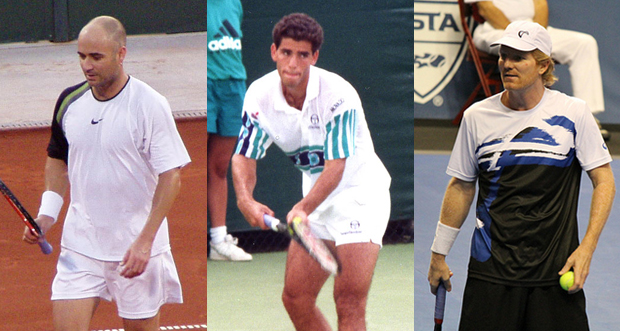
Cover Photo (Creative Commons License): Chris Josefy / James Marvin Phelps / shinyasuzuki
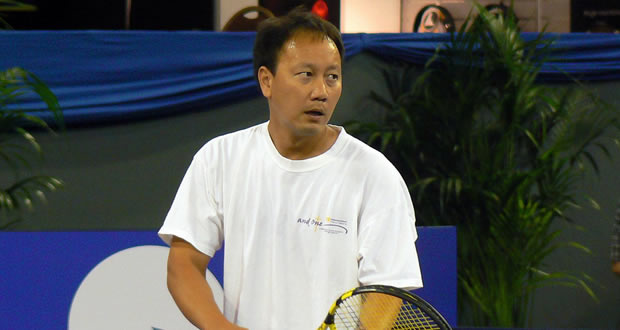
We’re joined on our latest installment of “Down The T” by Michael Chang, the 1989 French Open champion, and winner of multiple singles titles on the men’s tour. A big thank you to Rebecca Brown of the Chang Family Foundation for helping to facilitate the interview.
[divider]
Owen (Tennis Frontier): Michael, Thank you for agreeing to be interviewed by the Tennis Frontier. We really appreciate you taking the time out. I took the opportunity to ask members of our online tennis community if they would like to contribute some questions and we had a big response. I narrowed it down to ten, as I know your time is valuable!
[divider]
Q1. You rose through the ranks alongside a particularly strong peer group of American tennis players including Pete Sampras, Andre Agassi, and Jim Courier.
In his autobiography, Sampras identified you as his personal measuring stick for his progress and level of play. How did you look upon the other members of your peer group and who (if anyone) did you compare your progress with when coming through the junior ranks and moving into the pros? (A Question from Britbox)
I think the reason Pete said that was because I had a very good record against him in our latter junior years, as well as the first couple of years playing him as pros. My results were pretty high up there during that time and we obviously competed against each other a lot.
As far as my peers, I can’t say I really compared myself to anybody just because everyone was in the same boat and no one player really accomplished any real breakthroughs until Andre’s year in 1988 and my French Open win in 1989.
[divider]
Q2. You were the “youngest-ever” to do a lot of things in your career, most notably, win a Major. What do you think the unique pressures are to winning things at such a young age?(A Question from Moxie629)
I actually don’t think there are too many pressures at that young of an age if they are playing professional. No one expects anything and the only pressures might be coming from sponsors or media hype.
For me, I really didn’t feel pressure until after winning the French Open because who would really expect a 17 year old to win on the ATP Tour, much less a Grand Slam?!
[divider]
Q3. Why do you think the transition from juniors to pros is taking much longer in the current era, and do you think we’ll see teenage Major winners again? (A Combined Question from Didi, Moxie629)
I think the transition is much more difficult today because tennis is a lot more physical. Guys are hitting harder and playing more physically demanding tennis. On top of that, the technology of the current rackets and strings allow players to generate so much more spin and power.
It’s tough for a teenager to compete with that now from a strength perspective. Obviously, it can still be done but it’s certainly much more difficult.
[divider]
Q4. Winning the French Open Final against Stefan Edberg was a stunning breakthrough. Tell us a little bit more about the day – your ritual before and after the match, and how you felt as the match unfolded. (A Question from britbox)
I didn’t change anything before the final at Roland Garros. The only thing I made sure of was to hydrate a bit more because I had serious cramping issues in two prior matches. It was a warm day on that final so hydration was important, especially as it ended up being another five-setter.
[divider]
Q5. The match with Lendl at Roland Garros earlier in the tournament has been described as one of the most memorable in tennis history. The underarm serve, moving up to the service box to receive, and the various strategies to unsettle Ivan, while at the same time dealing with cramps. Did you decide on the tactics beforehand or during the match, and have you ever discussed the match with Lendl since? (A Combined Question from 1972Murat, Jesse Pentecost, JLLB)
I have never discussed the match with Ivan although I have talked to him about many other things since. I don’t plan on bringing it up with him either!
The underhand serve was never planned (not sure how you could plan that actually) and in fact, the thought to do it only occurred moments prior to me hitting it.
[divider]
Q6. You were on the tour at the same time as some great players – Sampras, Courier, Agassi, Edberg, Becker, Lendl, just to name a few.. Who did you enjoy playing the most and which players were you “friendliest” on a social level with during your career?(A Question from Denisovich)
I enjoyed playing against all those players through the years. I have beaten them all but I have lost to every one, too!
To know that I played against so many tennis great through my career was pretty exciting though. It didn’t make it easier to win titles but it was fun and exciting!
If you think about it, how many players get to compete against so many Hall of Famers in one span of a career. And that is still not including McEnroe, Connors, and Federer.
[divider]
Q7. One of our contributing writers, Scoop Malinowski, is currently penning a book on Lleyton Hewitt. How did you find playing Lleyton? And what was your most memorable match or anecdote?(A Question from Scoop)
I only played Lleyton twice in my career and unfortunately, it was toward the end of my career.
He is a great champion and certainly one of the toughest competitors out there. He has a great game but we all know he’s won even more matches because of his tenacity.
[divider]
Q8. Do you think the physicality of the modern game poses a disadvantage to smaller players such as Kei Nishikori? This question is really twofold: How do you think you’d have adapted your game in the current era, and what kind of advice would you give Kei? (A Combined Question from Broken Shoelace, Masterclass)
I would never say a smaller player has a disadvantage in tennis.
They may not be able to hit as hard or serve as big but tennis is not all about that. Being one of the smaller players on tour, there are always ways to beat the bigger players and being smaller and quicker has its advantages. I do think a smaller player does need to be able to play different styles, though, because it keeps bigger players off balance and guessing.
I do believe I could have adapted to this current era as well just because the same questions were asked of me when I first played on tour. I would get plenty of comments like, he’s too small, his serve isn’t big enough, he doesn’t have enough weapons, etc.
You believe what you want to believe but for me, I know where my strength is, and I would never listen to what other people think I can or can not do. If I did that, I never would have even turned pro.
[divider]
Q9. There has been plenty of discussion about the homogenization of surfaces, strings, racquet technology in the current era. What do you like and dislike about today’s game? What kind of changes would you make, if any?(A Combined Question from Arienna Lee, Front242, Riotbeard, Denisovich, Moxie629)
Homogenization will never truly happen.
The simple reason is because there are way too many differing factors in different places where pros play around the world. They tried to do that with something as simple as balls being played each week and it couldn’t be done.
Weather conditions, altitude, humidity already make each city different in playing conditions. I think it’s exciting and fun that players play with different equipment, and surfaces are changing during the seasons. Everyone is unique and special and that should be celebrated!
[divider]
Q10. Of the players in the current era, who do you particularly like watching and why? (A Question from Denisovich)
It’s fun watching the top players like Rafa and Novak go at it but also, it’s great watching the players in general, playing at their best.
I would hope a few more Asian players would succeed and do well, though, especially on the men’s side. I think that would be great for tennis and for the growth of tennis in Asia.
[divider]
Finally, please tell us about your Foundation work in recent years, integrating tennis, family, and faith, and the meaning this has brought to your own life. (A Question from Masterclass)
The Chang Family Foundation has been a wonderful way to not only give back to the community but also to share the Gospel message through sports like tennis, basketball, and volleyball.
It has been very rewarding and we have the opportunity to touch many lives along the way! When you think about sports, its real purpose is to bring people together, and through various events and leagues, we can use those opportunities to encourage others in life while sharing the love of Christ. To do both of those things through sports, particularly tennis, is satisfying knowing that you’re touching hearts and making a difference. That’s what our Foundation is all about.
Find out more about the Chang Family Foundation at mchang.com