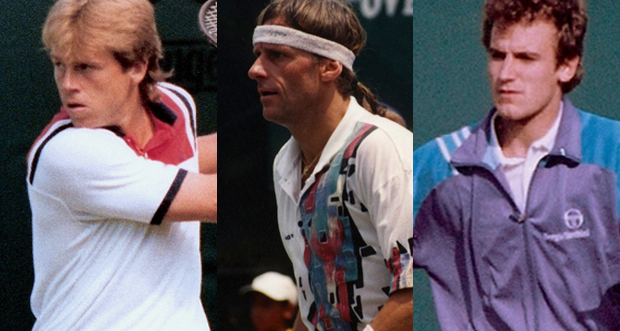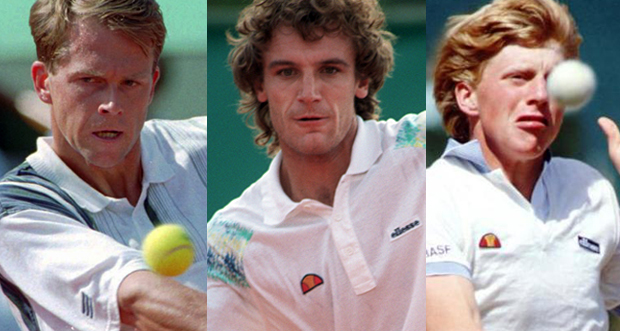

Where the last generation had two all-time greats, this generation had three: Mats Wilander, Stefan Edberg, and Boris Becker, each with very different careers – as we will discuss in a moment. This is the generation that rose in the early 80s and peaked from the mid-80s through the early 90s, although there was only a short gap of years between the reigns of McEnroe/Lendl and Sampras in which they were the dominant generation in the sport.
[divider]
[divider]
Best Players by Birth Year
1964: Mats Wilander (SWE, 7), Jimmy Arias (USA), Miroslav Mecir (CZE/SLO), Henrik Sundstrom (SWE), Jakob Hlasek (SUI)
1965: Pat Cash (AUS, 1), Guy Forget (FRA), Karel Novacek (CZE), Emilio Sanchez (ESP)
1966: Stefan Edberg (SWE, 6), Jay Berger (USA), Andrei Chesnokov (USSR/RUS)
1967: Boris Becker (GER, 6), Thomas Muster (GER, 1), Aaron Krickstein (USA)
1968: Michael Stich (GER, 1), Petr Korda (CZE, 1), Kent Carlsson (SWE)
As you can see, seven different players won 23 Slams in all – the most in both categories since the 1934-38 generation.
Mats Wilander followed in Bjorn Borg’s footsteps, with Sweden winning at least one Slam in every year from 1974 to 1985, and all but two years until 1992 – the end of the Swedish reign and co-dominance with the United States. Wilander was a tender 17-years old at the 1982 French Open and clearly benefited from the absence of Borg. His early rise was quick and fierce; while he only finished No. 1 once, his three-Slam 1988, he was ranked No. 7 or higher from 1982-88, and No. 4 or higher in all but 1982. Wilander’s 1988 was a swan song after which he declined quickly, never even making another Slam final or ranking in the Top 10 until he retired after 1996 – one of the worst declines of any great tennis player.
Edberg and Becker will likely be forever linked. They are players of very similar career accomplishments, as we will discuss more in a moment when we look at the best players of the era.
Underachievers and Forgotten Players
Miroslav Mecir is probably one of the most talented players in Open Era history never to win a Slam. His career was short and bright; if it had been longer, he really could have added a Slam trophy. He played only eight years on tour, from 1983-90, made it to two Slam finals–losing to Ivan Lendl in both–won three Grand Prix (Masters) tournaments and the 1988 Olympics. Perhaps the highlight of his career was winning the WCT Finals in 1987 against John McEnroe.
Aaron Krickstein was a promising young player who never fulfilled his early success. In 1984 he finished No. 12 at the age of 17. But his career stalled out for several years, until he reached his highest ranking of No. 6 in February of 1990. Krickstein would go on to win six titles but never better than a semifinal result at a Slam. If we look at all players in the Open Era, Krickstein’s career could be the most disappointing relative to his ranking as a 16-17 year old, as we will see in a moment…
Did You Know?
Aaron Krickstein was the youngest player to win an ATP title at the age of 16 years and 2 months when he won Tel Aviv in 1983, a record that remains to this day. He is also one of only three players in the ATP Era (1973-present) to finish in the top 100 as 16-year olds, along with Andre Agassi and Michael Chang, and one of only four to finish in the Top 20 as 17-year olds along with Agassi, Chang, and Borg.
Top Ten Players of the Generation
- Boris Becker
- Stefan Edberg
- Mats Wilander
- Thomas Muster
- Michael Stich
- Petr Korda
- Pat Cash
- Miroslav Mecir
- Guy Forget
- Aaron Krickstein
Honorable Mentions: Emilio Sanchez, Andrei Chesnokov, Karol Novacek, Jakob Hlasek, Jimmy Arias
Ranking the top three is difficult, with valid arguments for any of them to be at the top. Wilander had the best year in 1988, and won one more Slam than the other two, but declined very young. Becker had the longest range of Slam titles but was less consistent year in and year out than Edberg, and never finished the year as the No. 1 player. Their match-up is “Fedalian” in terms of how lopsided it was (Becker led it 25-10), but Edberg held the edge in Slams (3-1) and ATP finals (1-0) and of course had two year-end No. 1 rankings.
Really it is 1a, 1b, and 1c, or perhaps 1a, 1b and 3, with Wilander a step behind the others. These three players peaked during one of the most competitive eras in men’s tennis, when Connors, McEnroe, and Lendl were still elite players, and Sampras, Agassi, and Courier were rising to the top. When I started writing this series I gave Edberg the edge, but have since given it to Becker because, if you look below the surface, Becker has the edge in a number of ways. While both won six Slams, Boris had two more years in the Top 10 than Stefan, and also won two more ATP finals and five more Grand Prix/Super 9 (Masters equivalent) tournaments, with a superior overall record in title finals: 49-28 compared to Edberg’s 42-38. Becker was also a much better player against Top 10 opponents, with a career 65.1% vs. Edberg’s 45.7%.
To put the comparison of the three graphically, I used one of my various statistic systems called “Title Shares,” which imagines that the big tournaments–all four Slams, the tour finals, and the Masters–equal 100 total shares for a given year, or 14 for each Slam, 8 for the ATP year-end championships, and 4 for each Masters. This system then adds 1 point per other title (ATP 250 and 500), and in the case of the WCT year-end championships, 5 extra points; consider these all to be “extra credit.” Now this system makes more sense in recent years, as the ATP structure has been more consistent, but it gives you an idea of the different trajectories of the three players and their relative dominance:

As you can see, Wilander was more dominant overall through 1988, which turned out to be a final supernova after which his career sputtered and faded. Edberg was a force from 1985 on, with his best phase in the early 90s. Becker was also relatively strong from 1985 on, but where Edberg faded in 1993, Boris had a resurgence from 1994-96 that strengthened his overall legacy.
After the Big Three, there’s a steep drop-off to Thomas Muster, but he’s a solid No. 4. Muster is best known for being both a great clay-court player but also an incredible competitor in finals. He has an overall 44-10 record in ATP finals, or 81.5% – far ahead of anyone else. Nikolay Davydenko is number two with a 21-7 (75%) record in ATP finals; Borg has the best among all-time greats, with a 64-24 (72.7%) record.
Michael Stich was a very good player for, unfortunately, a rather short length of time. He is best known for upsetting Boris Becker in the 1991 Wimbledon final. A comparable recent player would be Juan Martin del Potro. Pat Cash is solidly No. 6, and then Korda and Mecir are harder to rank. Korda has the one Slam but Mecir was probably a better player. He was, in some ways, the Robin Soderling of his generation – very good for a too-short period of time, his career ended prematurely by injury. The last two spots go to Forget and Krickstein, with Emilio Sanchez and Andrei Chesnokov just missing the cut.