
Test your knowledge of the US Open! See if you can name every Open Era champion — in order!
[divider]
Cover Photo (Creative Commons License): Kiu Kaffi / mirsasha
Test your knowledge of the US Open! See if you can name every Open Era champion — in order!
[divider]
Cover Photo (Creative Commons License): Kiu Kaffi / mirsasha

After surveying Open Era tennis through the five nations with the highest Slam totals, we’re left with a few questions and unexplored areas which I’ll try to tackle in this concluding segment.
[divider]
Click here to discuss National Tennis Careers – Part Six: Summing Up in the discussion forum.
[divider]
Who’s left?
The “big five” tennis nations include many, even most, of the all-time greats of the Open Era. Let’s take a look at the other nations and their players by Slam count:
Czechoslovakia/Czech Republic (12): Ivan Lendl (8), Jan Kodes (3), Petr Korda (1).
Serbia (9): Novak Djokovic (9)
Germany/West Germany (7): Boris Becker (6), Michael Stich (1)
Argentina (6): Guillermo Vilas (4), Gaston Gaudio (1), Juan Martin del Potro (1)
Russia (4): Yevgeny Kafelnikov (2), Marat Safin (2)
Brazil (3): Gustavo Kuerten (3)
Croatia (2): Goran Ivanisevic (1), Marin Cilic (1)
Romania (2): Ilie Nastase (2)
South Africa (2): Johan Kriek (2)
United Kingdom (2): Andy Murray (2)
Austria (1): Thomas Muster (1)
Ecuador (1): Andres Gomez (1)
France (1): Yannick Noah (1)
Italy (1): Adriano Panatta (1)
Netherlands (1): Richard Krajicek (1)
Before Djokovic is through, Serbia’s Slam count should surpass that of the Czechs as a whole.
Slavic Surge?
I almost titled this last part “Slavic Surge!” because it would seem that the tennis from Slavic countries has been on the rise. But it wasn’t quite as extreme as I thought. There are some strong Slavic players currently in their peaks, namely Djokovic, Berdych, Cilic, and Karlovic. There are some younger players with some upside, including Damir Dzumhur (23, No. 100), Grigor Dimitrov (24, No. 16), and Jiri Vesely (22, No. 45). But there is only one player that looks like a potential future star, and that is the 18-year-old Croatian Borna Coric, who is currently ranked No. 37. So while Slavic tennis is strong, it is hardly dominant (Novak aside).
Possible Future Slam Winning Countries
So who might the next Slam winners be? Specifically, which countries have the most possible future Slam winners? Well, that is for a future study that I’m working on. But I will say that as we’ve seen in the previous segments, there isn’t much on the horizon for Spain or Switzerland, and only really the Ymer brothers in Sweden; in the US there are a few prospects, and Australia at least has “K&K”: Kyrgios and Kokkinakis.
All in all there doesn’t seem to be a central location for tennis right now or the foreseeable future. We can sum up the Open Era by looking at early dominance by Australians, namely Ken Rosewall, Rod Laver, and John Newcombe, then the rise of Americans in Jimmy Connors and John McEnroe, and Sweden in Bjorn Borg, Mats Wilander, and Stefan Edberg. Along with German Boris Becker and Czech Ivan Lendl, Americans and Swedes dominated tennis from the mid-70s into the early 90s, with Sweden dropping off as Edberg retired, but the United States remained dominant into the 21st century, led by Pete Sampras and Andre Agassi. But then the US dropped off precipitously, and Switzerland and Spain took up the rulership of men’s tennis, with Serbia playing its part.
What the future will bring, well, it is a truly global world out there. There’s no sign of any of the five great tennis nations regaining their dominance. There are some glimmerings of improvement in Australia, and a bit in the US, but nothing substantial or worthy of the term “future dominance.” We’re going to see a shared effort, it would seem.
[divider]
Cover Photo (Creative Commons License): kulitat / mirsasha / Kiu Kaffi
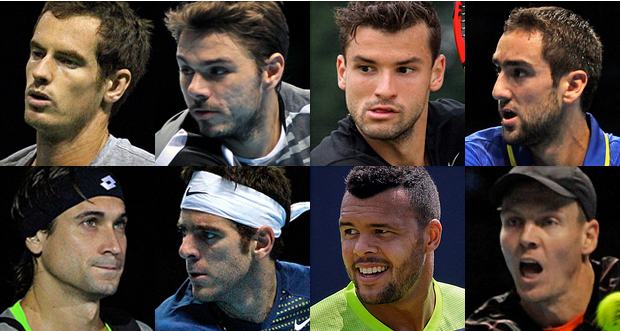

Most tennis fans, whether casual or serious, tend to follow the elites – the best players in the game who are perennial contenders for Grand Slams, ranked in the Top 5, and assemble resumes for the history books. Think Roger Federer, Rafael Nadal, Novak Djokovic, and, at times, Andy Murray. Serious fans of the game might extend their radar to the Top 100 and even a bit beyond, especially for long-time veterans and up-and-coming players. Your average serious fan – which I’d define as someone who follows the tour on at least a weekly basis and generally knows what tournaments are occurring, at least the bigger ones – probably could scan the Top 100 and recognize the names of most of them (perhaps another criteria for “serious fan”).
Federer, Nadal, and Djokovic are household names – they have all been to the top of their sport and are all-time greats. Andy Murray is borderline, but after that it gets dicey. A casual fan of tennis knows the names Juan Martin Del Potro, David Ferrer, Tomas Berdych, Jo-Wilfried Tsonga, and, after 2014, Stan Wawrinka and Marin Cilic, and depending upon where one lies on the casual-to-serious scale, it starts tapering off after the Top 10. But those names – bonafide Top 10 players, but generally not Slam winners – aren’t all that well known among the general public.
The purpose of this thread is to look at those “second tier” players – players who are not all-time greats, not multi-Slam winners, not No. 1’s, but still very good players. In fact, let’s define a few criteria for what I’m calling a “second tier” player:
What differentiates a second tier player versus a “third tier” and the rest of the pack? Some general guidelines might be:
Who fits the bill among active players? Let’s take a look at the players, with a brief overview of their careers.
[divider]
Click here to discuss “Second Tier Players” in the discussion forum.
[divider]
David Ferrer is an interesting case, because on one hand he’s a bit of a tragic figure – he’s made it to the final of nine big tournaments (one Slam, one WTF, and seven Masters) and won only a single one, perhaps the weakest of the lot—the Paris Masters in 2012, and only then arguably because he didn’t have to face any of the erstwhile Big Four (his opponent in the final was Jerzy Janowicz).
On the other hand, he’s a testament to hard work and thus is perhaps the definition of over-achiever. In other words, Ferrer has made the most of what he has and has come away with an impressive resume. He’s won 21 titles and finished in the Top 10 eight years in a row, the Top 20 ten years in a row, ranking as high as No. 3. He’s had his best two years in 2012-13, at the age of 30-31. In a way he’s as good as you can be without being great. There’s no shame in that.
[divider]
Of all the players on this list, del Potro might be the biggest “could have been.” A promising young player he finished 2008, the year he turned 20, at No. 9. Then, in 2009—at a time when the tour was dominated by two players, Federer and Nadal, with everyone else lining up to try to get a piece of the pie—he took the tennis world by storm by defeating Federer in the US Open final. He was not yet 21, and it looked like tennis had a new superstar, or at least someone to complete with Djokovic and Murray for “best of the rest.” After finishing the year No. 5 at the tender age of 21, the sky seemed the limit.
Then, in an exhibition match in January of 2010, disaster struck: del Potro’s wrist began to hurt, and it kept on hurting. He entered the Australian Open with an ailing wrist, eventually losing in the fourth round to Marin Cilic. He then proceeded to miss nine months and only came back for a couple small tournaments late in the year, his ranking dropping to No. 258. He seemed healthy (or healthy-ish) in 2011, but wasn’t the same player. He did win a couple ATP 250 tournaments but could not make it into the second week at any Slam, although still finished the year No. 11. 2012 and 2013 saw further improvement, years in which he finished No. 7 and No. 5, respectively, but he could not quite match his 2009 glory. In early 2014 disaster struck again, and del Potro was out for most of the year, finishing at No. 138. We can only hope that “Delpo” will come back strong in 2015; he is only 26 years old and still in his prime, but he is clearly a brittle player.
[divider]
Berdych is another player with elements of disappointment to his career (see a pattern here?). The Czech rose quickly in 2005, winning his first, and so far only, big tournament – the revolving door that is the Paris Masters. Not to take that away from him, but it is worth noting that neither of the top two players in the game – Roger Federer and Rafael Nadal – played in the 2005 Paris Masters. Anyhow, Berdych finished that year at No. 24 and seemed poised to challenge for a place among the elite. Yet he stagnated, finishing the next four years in the No. 13-20 range, making the quarterfinal of only one Slam.
Yet something seemed to click for Tomas in 2010 and, since then, he’s been one of the more consistent players on tour – finishing either No. 6 or No. 7 in each of the past five years, a span of time in which he’s made it to the second week (quarterfinal or later) in half of all Slams, once making the final – losing to Rafael Nadal in the 2010 Wimbledon, although not before defeating Roger Federer and Novak Djokovic.
Berdych remains an excellent player and a fixture, for the time being, in the Top 10. But he does turn 30 years old in 2015, so the window is closing for him.
[divider]
It is easy to pair Berdych and Tsonga, for not only were they born in the same year (1985), but they’ve haunted similar territory in the lower half of the Top 10 for the last half decade or so, and their career accomplishments are quite similar, although with Tsonga’s win at the Canada Masters this year he’s pulled ahead a bit.
Tsonga was a successful junior player, winning the 2003 Junior US Open over Marcos Baghdatis. He suffered through a series of injuries before rising quickly on the tour in 2007 and 2008, finishing that year at No. 6. For the last seven years he’s finished No. 13 or higher, five of those years in the Top 10. Tsonga has been deemed an underachiever; he’s got a big game, but doesn’t seem to have the big match mentality. Like Berdych he turns 30 next year, so the hourglass is about to turn.
[divider]
The “Stanimal” was born the same year as Berdych and Tsonga and, if you look at his career through 2012, could be viewed as an underachiever and disappointment – yet as of this writing, he’s the only one of the Class of ’85 who has come away with a big prize. He rose to No. 54 in 2005, No. 30 in 2006, and then crept up to No. 13 in 2008, but floundered for a few years – looking more like a third tier and perennial Top 20 player, but only just grazing the Top 10 for a few months in 2008. But something seemed to click in 2013 – his results were more consistent as he regularly went deeper into tournaments, including his first Slam semifinal at the US Open and making it to the final of four tournaments, although winning only one, an ATP 250 (the Portugal Open). Stan finished the year at No. 8 after a not-embarrassing performance at the ATP World Tour Finals where he defeated David Ferrer and Tomas Berdych to make it to the semifinals where he lost to eventual champion Novak Djokovic.
At the beginning of 2014 it seemed that Wawrinka was coming off a career year. He began the year well by winning the Aircel Chennai Open. But it was the Australian Open that proved the shocker: After defeating Novak Djokovic in the quarterfinals, and Tomas Berdych in the semifinals, Stan faced off against No. 1 Rafael Nadal. No one really gave him a chance, but he ended up defeating Rafa in four sets (it is easy to call this a cheap win for Wawrinka as Rafa was injured in the second set, but let us not forget that Stan won the first set and Rafa was well enough to win the third; certainly Rafa’s injury was a major factor, but the focus should be on Stan’s accomplishment). It was easy to consider that a fluke win, but Stan ended up also winning his first Masters, defeating Roger Federer in the Monte Carlo final and improving upon his 2013, finishing No. 4.
What’s next for Stan? It is hard to imagine a quick drop-off, but it is also hard to imagine him repeating his 2013 performance – especially his Slam. But he’s likely going to remain a Top 10 player for at lest another year or two.
[divider]
Talk about a surprising player. After a surge into the Top 10 in early 2010, after making it to the semifinals of the Australian Open at the age of 21, Cilic was erratic for the last few years, settling in as a third tier player. Then he was suspended for nine months (which was reduced), which seemed to serve as a wake-up call, or perhaps merely inspiration, as he rose quickly through the rankings in 2014, winning three minor tournaments before his surprising win at the US Open.
Cilic is not the worst player ever to win a Slam, but there are better players in terms of overall career level, and thus is a good example of both how a single Slam does not equate with greatness, but also how tenacity can pay off. But he is a Slam winner and finished his second year in the Top 10, so is now a bonafide second tier player. It will be interesting to see whether he can maintain it.
[divider]
You might quibble with my choices, but in my mind none of them are true second tier players. Some have vied for a spot in the second tier; for instance, Tommy Robredo finished 2006-07 in the Top 10, but for most of his career he’s been more of a third tier No. 20-30-type player. The same could be said for the others. Gasquet is an interesting one because in some sense he’s been the “gatekeeper” between the second and third tier for the last few years, or at least for 2012-13 when he finished No. 10 and No. 9. Gasquet would consistently beat everyone below him and lose to everyone above; previously other players like Janko Tipsarevic, perhaps Almagro, and before both, Fernando Verdasco, filled this role.
Among this group, or at least those mentioned, the one who stands out as the “could have been more” (and perhaps still can be) is Gael Monfils. He is a player whose reputation and ability far exceeds his usual ranking, mainly due to seemingly being injury prone and perhaps a non-championship mentality. Monfils is a second tier talent with a third tier career–in a sense, the inverse of David Ferrer—and thus is the type of player who could surprise us and win a big tournament. The 2015 Paris Masters?
[divider]
Kei in particular might deserve to be a second tier player by virtue of his No. 5 finish this year. He’s won six titles but consider that he has not yet won a big tournament (he made the final of both a Slam and Masters this year), nor has he finished in the Top 10 more than once. But if he finished in the Top 10 a second year in a row and/or wins a big tournament, he’s in.
Similarly with Raonic and Dimitrov. It only seems a matter of time. With Dimitrov there may even be a chance that he becomes a lesser first tier player along the likes of Andy Murray, but the clock is ticking.
[divider]
It is hard to feel bad for someone with two Grand Slam trophies, 31 titles overall, not to mention an impending marriage to the beautiful Kim Sears. Andy will forever be beloved in the United Kingdom for being the first British player to win a Grand Slam title in the Open Era, and the first since Fred Perry in 1936 to take Wimbledon. But Andy comes off, at least in the press, as disgruntled, surly, and forever unhappy with his standing. Just as Novak Djokovic was the third wheel on the Fedal bicycle for four years in a row, Andy has been the “best of the rest/worst of the best” for just about his entire career. Unlike Novak, Andy didn’t break through the players ahead of him and rise to No. 1. He did win two Grand Slams within one calendar year, being a true member of the Big Four for at least that year, but he couldn’t maintain it.
That said, Andy Murray is no second tier player. He is a truly great player, the third greatest of a generation that has produced what should turn out, when all is said and done, two of the ten or so greatest players of all time in Nadal and Djokovic. If Andy were born ten years earlier and peaked in the weak era of the late 90s to early 00s, he would undoubtedly have many more Slams than two. But every player has a “what if” story, and in the end, Andy’s career is what it is – and not only is it not over yet, it has been a stellar one so far. My opinion is that Andy is the greatest player of the Open Era with less than four Slams – greater than Kuerten, Hewitt, Safin, even Ashe. (What I mean by “greatness,” in this context, is a combination of peak level and career accomplishment).
In some ways Andy is the Guillermo Vilas of the current era. Vilas was born in the same year as Jimmy Connors and peaked alongside Connors, Bjorn Borg, John McEnroe, and, to a lesser degree, Ivan Lendl. That’s what I’d call a “raw deal.” Yet Vilas still managed to win four Slams and 62 titles and was ranked in the Top 6 for nine years in a row, but—like Andy so far—he never did rank higher than No. 2, despite arguably being the best player in 1977.
Career-wise, despite currently stalling out in his Slam count, Andy is closing in on four-Slam winners Vilas and Jim Courier, who are the gatekeepers to the true elites of the Open Era. I’d say he probably needs at least one more Slam to join them, but still has the possibility of surpassing him. Wouldn’t it be appropriate if Andy finished his career with four or five Slams, and became the historical “best of the rest, worst of the best?”
[Note: At some point I’d like to write a “Part Two – Second Tier Players of the Past,” but there are a few articles on the burner, so stay tuned.]
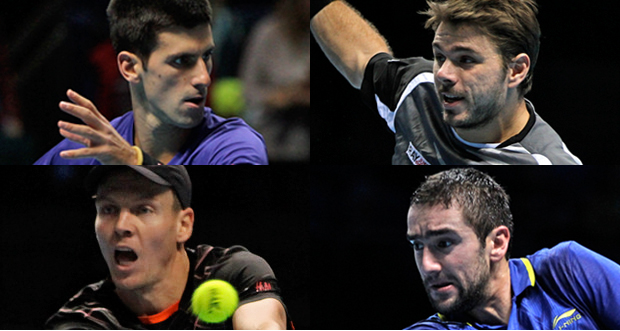

Round robin play at the Barclays ATP World Tour Finals concludes on Friday, November 14. The afternoon session features World No. 1 and the defending champion Novak Djokovic, facing off against the Czech Tomas Berdych. The evening session will conclude with Australian Open champion Stan Wawrinka playing the US Open champion Marin Cilic.
[Scores added as known. All times are local.]
[divider]
Afternoon Session:
Doubles — 12:00 P.M.
Kubot/Lindstedt d Rojer/Tecau — 6-5, 7-6(4)
Singles — 2:00 P.M.
Djokovic d Berdych — 6-2, 6-2
[divider]
Evening Session:
Doubles — 5:45 P.M.
Bryan/Bryan d Peya/Soares — 7-6(3), 7-6(2)
Singles — 8:00 P.M.
Wawrinka d Cilic — 6-3, 4-6, 6-3
[divider]
Click here to discuss the Day 6 matches in the discussion forum.
[divider]
Cover Photo (Creative Commons License): Marianne Bevis

One of my favorite topics is the relationship of age and career performance, questions such as: What are the different phases of a career? When is the most common peak range? Are players peaking later now? Etc.
For the sake of context and perhaps a taxonomy that would be useful for discussion, as I’ve written quite a few times before, I’ve posited that the historical norm has four general phases:
Developmental Phase: Age 17-21. Player rises towards peak level.
Peak Phase: Age 22-26. Player maintains highest level of career.
Plateau Phase: Age 27-31. Player remains at a very high level, but slightly below peak, with gradual decline.
Decline Phase: Age 32+. Player declines rapidly and/or retires.
Again, these are the norms, or the averages if you will. Every player is different – but historically, those are the general ranges that most players fall into, or near to.
Now what is interesting in recently years is that quite a few players seem to be peaking later, more in what would normally be their plateau phase. David Ferrer is an example, with his best years being 2012-13 when he turned 30 and 31. Despite beating Andy Murray today, Ferrer has showed signs of slowing this year, so he may be entering his decline phase – or he could simply be dropping to a plateau.
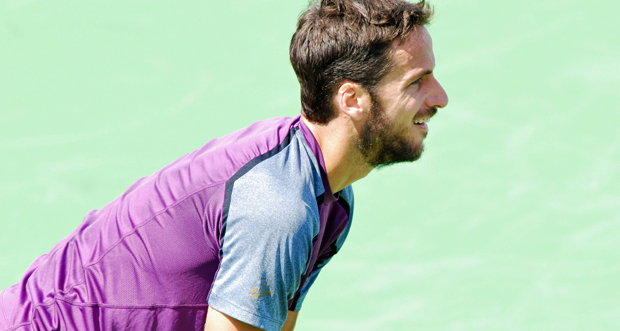
And then we have the inspiration for this thread, Feliciano Lopez, who is 33 years old and possibly having the best year of his life. While his highest ranking was achieved a couple years ago in 2012 (No. 15), he’s at No. 14 in the live rankings now and has a good chance of having his best year-end ranking (which is currently No. 20 in 2011).
And then of course there is Stan Wawrinka, who won his first Grand Slam at age 28 and is amidst his best year at age 28-29, and will probably finish the year ranked No. 4, better than last year’s career best of No. 8.
Marin Cilic is still in what is normally the Peak Phase, but he won his first Slam just before turning age 26 – on the older side.
And then we have young players like Milos Raonic and Grigor Dimitrov. Grigor is 23 years old, having his best year, but there’s also the sense from many that he’s another year or so away from his peak. Milos is also 23, turning 24 in December, and may or may not be at his peak.
One thing that strikes me is that these outliers from the career norms are all non-elite players. Roger Federer’s career follows the averages quite closely, as does Nadal’s, Djokovic’s, and Murray’s – although it is still too soon to tell if and when they’ve entered their Plateau. Certainly it seems that Rafa and Andy have; Novak had his best year in 2011 at age 23-24, but I’d have a hard time saying that he’s not still in his Peak phase (that is, best year shouldn’t be equated with Peak phase; the best year usually comes within the peak).
Those are just some examples. A few questions to consider/discuss:
And so forth. Any thoughts?
[divider]
[divider]
Cover Photo: Kiu Kaffi, Tennis Frontier Correspondent
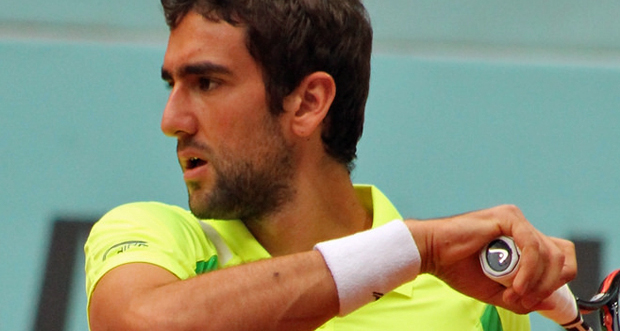
The 14th seeded Marin Cilic of Croatia became the lowest ranked player to win the men’s title at the US Open since Pete Sampras in 2002. He shut down 11-seed Kei Nishikori in straight sets, 6-3, 6-3, 6-3. The final line-up was a surprise, when each man beat the #2 and #1 seeds, respectively, Roger Federer and Novak Djokovic, in a semi-finals day of upsets on Saturday. This was the first final since the Australian Open 2005 to feature none of the so-called “Big Four,” (Federer, Nadal, Djokovic, Murray,) and only the third of the last 39 men’s finals not to be won by one of them.
The loss is a disappointment for Japanese fans, who were rallied behind Nishikori as the first Asian man to come so far in a Major tournament, including semis. Nishikori, who had debated even playing here, after a recent surgery on his toe, had a tough road to the final, having to defeat three top-5 players in the last 3 rounds, two of which went to five sets, and one, against Wawrinka (3) that finished at 2:26am, tying the latest matches ever at the Open. Cilic, for his part, beat two top-6 seeds.
While the match started nervously from both, they held serve until the 6th game in the first set, when Cilic got the break. Cilic he also broke in the 4th game of the second set, and the fifth game of the third. Once he had the breaks, he only needed to hold serve and did. Cilic’s percentage of first serve points won, 80% versus 55% for Nishikori was one of the telling stats of the match. Additionally, Nishikori’s winners-to-unforced errors count was 19-30, whereas Cilic put up 38-27. The 5’10” Nishikori had trouble finding open space in the court against the 6’6″ wingspan of the Croat. But, in the end, Cilic was the one with purpose and focus, and didn’t let the Japanese man into the match. Nishikori, for his part, wasn’t allowed to play his tricky, agile game, being shut down but Cilic’s big serve and powerful hitting.
2014 has seen four different winners of the men’s Slams, as it did 2012. But in 2012, the wins were divided evenly between the “Big Four.” This year has let two new winners in: Stan Wawrinka at the Australian Open, and Marin Cilic in this US Open. The tennis world will be watching to see if this trend continues into 2015.
[divider]
Cover Photo (Creative Commons License): si.robi

[divider]
Arthur Ashe Stadium — 5:00 P.M.
Men’s Singles – Final
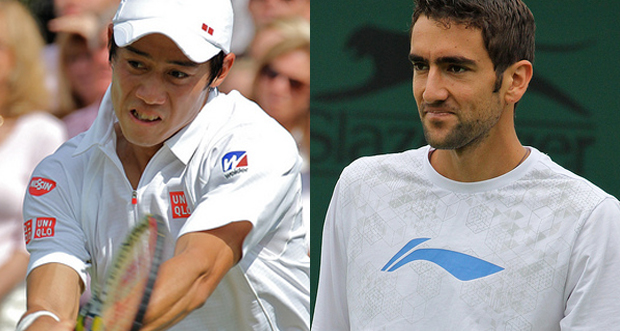
Marin Cilic (CRO) (14) d. Kei Nishikori (JPN) (10) — 6-3, 6-3, 6-3
[divider]
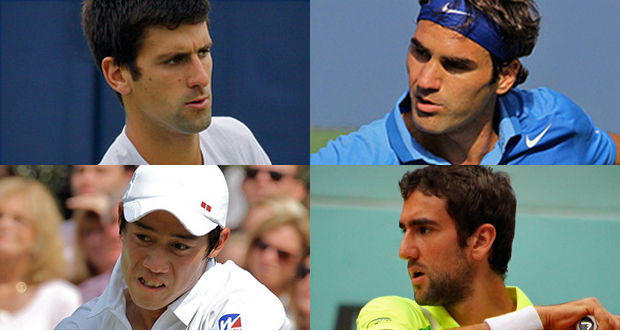

Novak Djokovic and Roger Federer, the #1 and #2 seeds, respectively, will be hoping to set up the anticipated re-match of the Wimbledon final. Kei Nishikori and Marin Cilic will be hoping to spoil the party.
The full schedule for Day 13 is listed below (Results to follow). All times are local.
[divider]
Arthur Ashe Stadium — 12:00 P.M.
Men’s Singles – Semifinals
Kei Nishikori (JPN) (10) d. Novak Djokovic (SRB) (1) — 6-4, 1-6, 7-6(4), 6-3
Not Before: 1:30 P.M.
Men’s Singles – Semifinals
Marin Cilic (CRO) (14) d. Roger Federer (SUI) (2) — 6-3, 6-4, 6-4
Not Before: 3:00 P.M.
Women’s Doubles – Final
Ekaterina Makarova (RUS) (4) / Elena Vesnina (RUS) (4) d. Martina Hingis (SUI) / Flavia Pennetta (ITA) — 2-6, 6-3, 6-2
[divider]
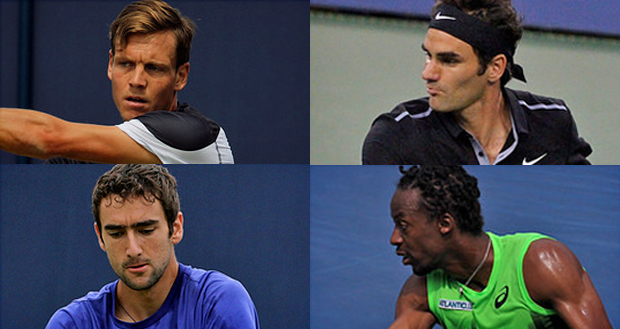

Day 11 features the Men’s Quarterfinals for the bottom half of the draw – Berdych v. Cilic, and Federer v. Monfils, to set the men’s semis. Also in play are the Women’s and Men’s Doubles Semi-finals. Women’s singles semi-finals are Day 12.
The full schedule for Day 11 is listed below (Results to follow). All times are local.
[divider]
Arthur Ashe Stadium — 12:00 P.M.
Men’s Doubles – Semifinals
Bob Bryan (USA) (1) / Mike Bryan (USA) (1) d. Scott Lipsky (USA) / Rajeev Ram (USA) — 6-4, 4-6, 6-3
Not Before: 1:30 P.M.
Men’s Singles – Quarterfinals
Marin Cilic (CRO) (14) d. Tomas Berdych (CZE) (6) — 6-2, 6-4, 7-6(4)
Not Before: 8:00 P.M.
Men’s Singles – Quarterfinals
Roger Federer (SUI) (2) d. Gael Monfils (FRA) (20) — 4-6, 3-6, 6-4, 7-5, 6-2
[divider]
Louis Armstrong Stadium — 11:00 A.M.
Women’s Doubles – Semifinals
Ekaterina Makarova (RUS) (4) / Elena Vesnina (RUS) (4) d. Kimiko Date-Krumm (JPN) / Barbora Zahlavova Strycova (CZE) — 7-5, 6-3
Not Before: 12:30 P.M.
Men’s Doubles – Semifinals
Marcel Granollers (ESP) (11) / Marc Lopez (ESP) (11) d. Ivan Dodig (CRO) (4) / Marcelo Melo (BRA) (4) — 6-4, 6-4
Not Before: 2:00 P.M.
Women’s Doubles – Semifinals
Martina Hingis (SUI) / Flavia Pennetta (ITA) d. Cara Black (ZIM) (3) / Sania Mirza (IND) (3) — 6-2, 6-4
[divider]
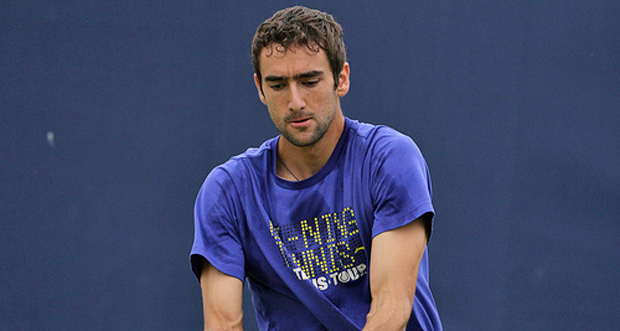

In a battle of the big men, Marin Cilic of Croatia won the Del Ray Open in Florida, 7-6(6), 6-7(7), 6-4. Cilic was serving for the match in the second, but the South African found a way to break, and then won the tiebreak, forcing the third set. It was a tight match, but Anderson was always playing catch-up.
Cilic has recently taken on Goran Ivanisevic as his coach, which seems to be producing the results that have long been awaiting him. One amongst a string of 1990’s celebrity players to start coaching current stars, this seems to have some legs and make some sense. Cilic is surely on a roll.
[divider]
Cover Photo (Creative Commons License): Marianne Bevis