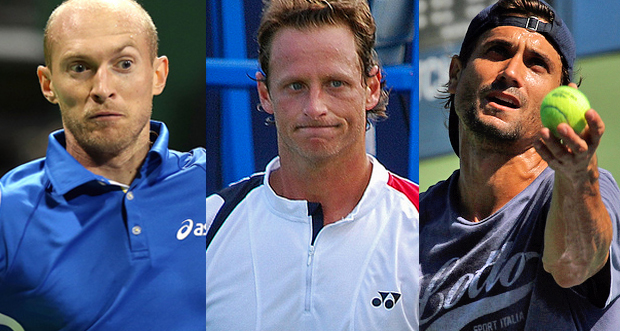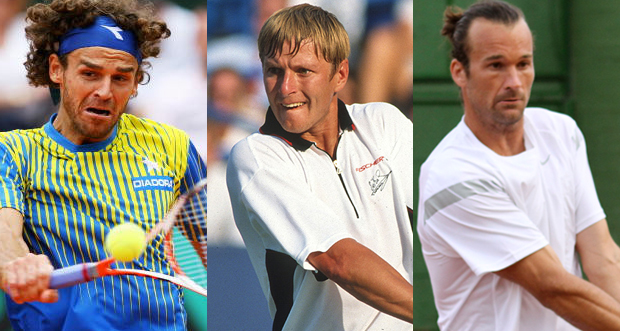

While one of the weakest generations of the Open Era — by my account, third after Gen 2 (1939-43) and Gen 12 (1989-93) — I personally find this one of the most interesting. I’m not exactly sure why, but I think it has to do with the fact that it is hard to define, with no clear stars. It is the generation that was at its peak in the late 90s and early 00s, between the dominance of Sampras-Agassi and Federer. The generation has an interesting balance of players – no real standouts or all-time greats, but several excellent players.
Best Players by Birth Year
1974: Yevgeny Kafelnikov (RUS, 2), Alex Corretja (ESP), Thomas Enqvist (SWE), Andrei Medvedev (UKR), Tim Henman (UK)
1975: Marcelo Rios (CHIL), Thomas Johansson (SWE, 1), Jiri Novak (CZE), Albert Costa (ESP, 1)
1976: Gustavo Kuerten (BRA, 3), Carlos Moya (ESP, 1), Mark Philippoussis (AUS), Rainer Schüttler (GER), Magnus Norman (SWE)
1977: Nicolas Kiefer (GER), Guillermo Canas (ARG)
1978: Gaston Gaudio (ARG, 1), Tommy Haas (GER), Radek Stepanek (CZE), Sébastien Grosjean (FRA), Michael Russell (USA)
[divider]
[divider]
This generation is responsible for only 9 Slams, the lowest since the 1939-43 generation (4). There are no all-time greats, merely a couple almost-greats, and a handful of very good players.
The two best players of the generation were Gustavo Kuerten and Yevgeny Kafelnikov, who accounted for five of the nine Slams. Kuerten was a clay-court specialist who won the French Open three times, as well as four clay Masters. But he also won the 2000 Tennis Masters Cup, defeating Pete Sampras and Andre Agassi – the only player to defeat both in the same tournament – and the hard-court Cincinnati Masters, so could play well off clay. “Guga” was only a Top 5 player for three years (1999-2001), and only finished in the Top 40 for eight years (1997-2004); his “near-greatness” was largely due to his lack of longevity, which was largely because of injuries starting in 2002. The second half of his career is one of the great What-If stories of the last couple decades.
Kafelnikov was less brilliant at his best, but had a longer peak than Guga, ranking No. 11 or better from 1994 to 2001. The third most accomplished player of the generation, Carlos Moya, ranked No. 61 or higher for fourteen straight years, from 1995 to 2008, including thirteen years No. 43 or better, and five years No. 7 or better – a consistently very good player.
Single-Slam winners Thomas Johansson, Albert Costa, and Gaston Gaudio are the definition of one-Slam wonders. Johansson had a long career, including eleven years in the Top 100, but he never finished a year in the Top 10; imagine if someone like Nicolas Almagro won a Slam and you get a sense of Johansson’s feat. Costa was a clay-court specialist, probably similar in talent to someone like Feliciano Lopez, but happened to play between the reins of Kuerten and Rafael Nadal, and thus able to win a French Open (in 2002). Gaudio could be the worst player in the Open Era ever to win a Slam, the 2004 French Open against Guillermo Canas. He finished No. 10 in 2004 and 2005, but never finished another year in the Top 20.
This is the oldest generation to still have players on tour, but it won’t be much longer. After a resurgence in 2012-13, 37-year-old Tommy Haas has slipped the last couple years and seems like he’s winding down. Haas started on the ATP tour in 1996, losing his first Slam match to Sergi Bruguera at the US Open in the first round. 2015 makes it 20 years on tour. Haas has been around so long that his first year was the last year Boris Becker won a Slam (although he never played Becker).
Radek Stepanek is also ranked around No. 200, which would be the first year on tour that he hasn’t finished No. 68 or higher – going back to 2002. Michael Russell, also from that 1978 birth year, just retired.
Underachievers and Forgotten Players
There’s a reason I didn’t mention Marcelo Rios above, as I was saving him for this category. In 1998 he looked like the heir apparent to Pete Sampras as the premier player in the game, taking the No. 1 ranking in late March and winning three Masters that year, as well as the Grand Slam Cup. Yet Rios’s relatively mediocre second half of the year led to a loss of the No. 1 ranking to Sampras, and while he remained a Top 10 player in 1999, he slipped and stumbled in 2000 and never regained his elite status, largely due to injuries.
Another player who had a disappointing career is Andrei Medvedev, who was the first of the generation to rank in the year-end Top 10, finishing 1993 ranked No. 6 at age 19. While he would go on to win four Masters, he would never rank in the Top 10 again and made a Slam final only once.
There are several other players who fit the category of “close, but no cigar” as far as Slams go – Alex Corretja was 0-2 at French Open Slam finals, Thomas Enqvist was meant to revive Swedish tennis but–along with Johansson–instead ended up being a kind of dead-cat bounce after the great 1970s-80s era, and Tim Henman goes down as one of the greatest grass court players never to win Wimbledon. And boy did he try – eight out of nine years from 1996-2004 making the quarterfinals or later, including four semifinals but never a final. Mark Philippoussis also comes to mind in this category.
Did You Know?
I first came across Roberto Carretero’s name when looking at Masters winners of the 90s. Carretero has quite a story: he won the Hamburg Masters in 1996 as a virtual unknown, ranked No. 143 and defeating Yevgeny Kafelnikov en route to a final win against rising young Spanish star, Alex Corretja. He never ranked higher than No. 58 and never made it past the second round in a Slam, retiring in 2001. But he does have that Hamburg Masters title.
Top Ten Players of the Generation
- Gustavo Kuerten
- Yevgeny Kafelnikov
- Carlos Moya
- Marcelo Rios
- Alex Corretja
- Tim Henman
- Tommy Haas
- Albert Costa
- Thomas Enqvist
- Andrei Medvedev
Honorable Mentions: Mark Philippoussis, Thomas Johansson, Sebastian Grosjean, Magnus Norman, Gaston Gaudio, Radek Stepanek.
This is actually a hard generation to rank. I feel confident about the top four, although think Moya and Rios could be swapped, and I went back and forth on Kuerten and Kafelnikov, but in the end prefer Kuerten’s higher peak to Kafelnikov’s greater longevity. After the “biggish four,” Corretja is probably the best of the rest, with Henman, Haas, Costa, and Enqvist not far behind, but that tenth spot could go to any of Medvedev, Philippoussis, Johansson, or Grosjean.