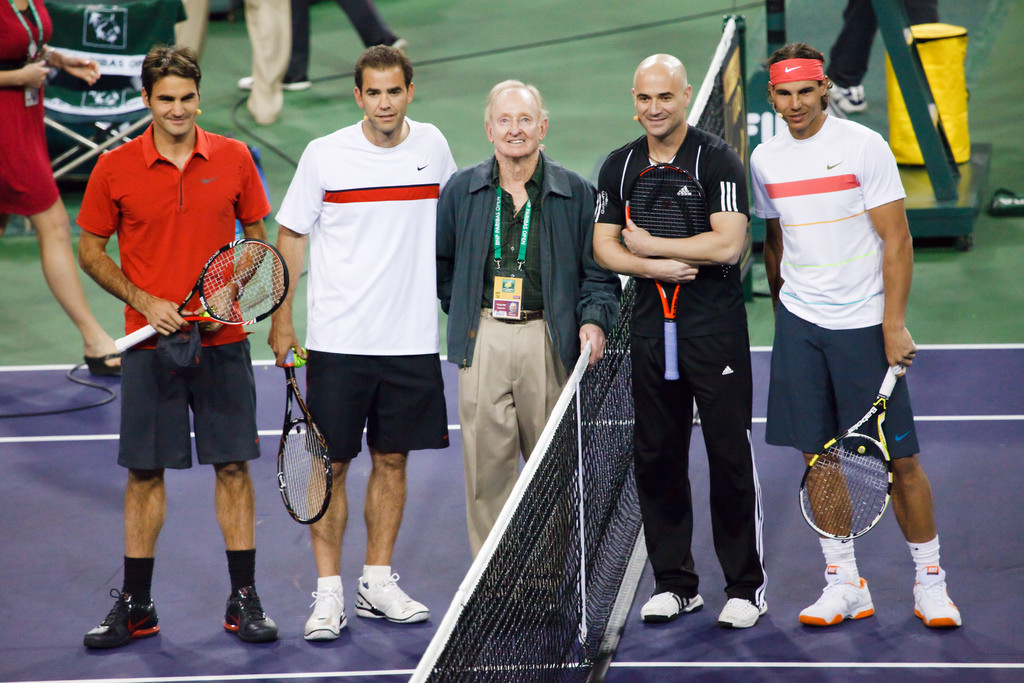
Tag: ken rosewall

  • The Open Era Top Twenty at the End of 2016

    The Open Era Top Twenty at the End of 2016

    4446582661_b188f82f3c_b

    By Jonathan Northrop

    With another year in the books, and encouraged by an email from a reader of Tennis Frontier, I thought I’d offer a highly subjective but statistically informed list of the greatest players of the Open Era. Another factor in deciding to do this is, of course, Andy Murray’s epic and—for most—unexpected rise to #1. I was curious where he might rank, or if he would make it into the top twenty at all.

    A few preliminary thoughts and clarifications. First of all, the Open Era spans from the 1968 French Open to the present. Some of the players on this list—most notably Rod Laver and Ken Rosewall, but also John Newcombe and Arthur Ashe—had careers spanning that turning point of modern tennis, even winning Slams before and after. Actually, Laver and Rosewall are the only two players to win Professional, Amateur, and Open Era Slams. In compiling such a list I am left with a judgement call: Do I include these players and, if so, do I include only their Open Era record or their entire career? I have chosen the latter; to include them, but to use their entire career. I feel that we cannot penalize Laver and Rosewall for playing the bulk of their careers—and their best years, for the most part—before the Open Era. Both were great enough in the Open Era that they should be included simply by virtue of their Open Era accomplishments, but I just can’t stomach the idea of ranking them lower on this list, as would be required if we only considered their Open Era careers. I have excluded such greats as Roy Emerson and Pancho Gonzales, both of whom played during the Open Era but whose best years were before.

    The other thing I want to talk about is methodology. I rank players by a statistical formula which accumulates points for every Slam result, every title, and year-end rankings. But I don’t stop there; if I did, I’d have Jimmy Connors and Ivan Lendl ranked ahead of Pete Sampras, and that just doesn’t feel right. I also look at a variant that more strongly weighs certain factors (e.g. giving far more weight to Slams and #1 rankings, for example). And then I make a subjective adjustment based upon what I know about the context in which that player played. Any serious historian of tennis knows that the two Grand Slams won by Johan Kriek are far less impressive than any of those won by Novak Djokovic, or that Jan Kodes three Slams are less impressive than Stan Wawrinka’s. But it is difficult (even impossible) to objectively account for that, so I’ve just used my best judgement.

    A major aspect of methodology is how to weigh peak vs. longevity. Most analysts tend to emphasize the former, which I generally agree with, but it isn’t an either/or matter. The key is finding the right balance, which unfortunately only really can be done subjectively. For example, I’ve created several variations of my formula and they all rank Connors and Lendl ahead of Borg, which I find problematic.  Even TennisBase.com, which uses a far more sophisticated formula than I do, ranks those two ahead of not only Borg, but Sampras as well. While I don’t want to overly focus on Slam titles, I cannot so easily ignore the +6 lead Sampras has over those two. Tennis Base also ranks Andy Murray ahead of Mats Wilander and John Newcombe, because they emphasize depth of records and longevity. Again, I don’t think we can rank Andy ahead of those two seven-Slam winners, at least not yet. But given the rest of their careers, it is reasonable to think that if Andy can win even just a couple more Slams, his overall record would push him ahead of those two. But we’ll cross that bridge when we come to it.

    Finally, I’m ranking them in clusters or tiers, because there are gaps in terms of which players are closer in their overall greatness. This will be discussed below.

    All that said, the curtain is pulled back and here is the list…

    1. Rod Laver
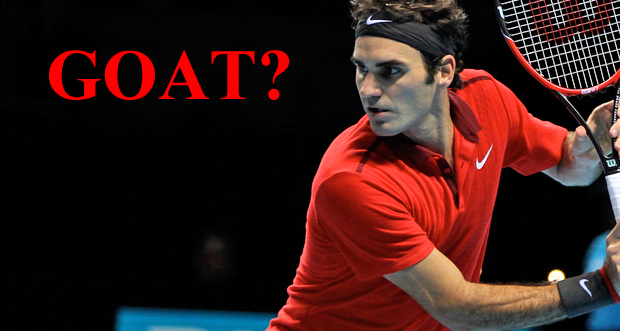
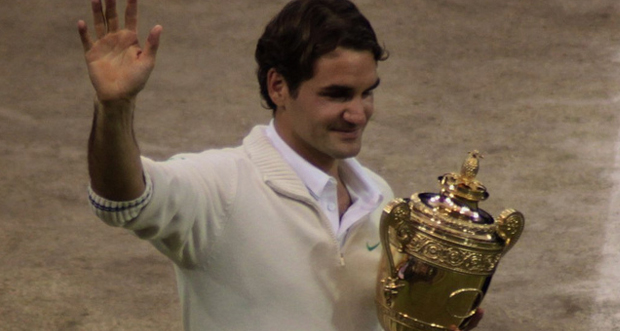
    2. Roger Federer
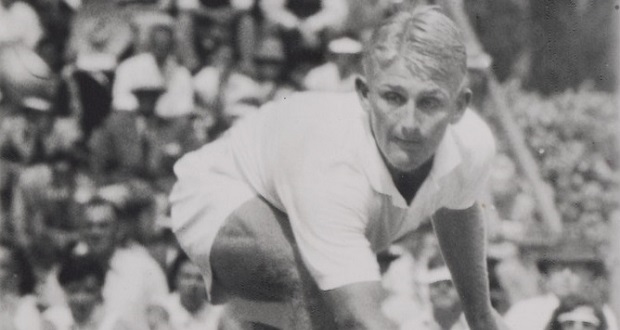
    3. Ken Rosewall

    These are the big three. For awhile it looked like Rafa was going to be joining them, but it seems that ship has sailed unless, of course, he (re)discovers the Fountain of Youth in 2017. For Rafa to get in, he probably needs at least a couple more Slams. Novak is also a contender for this tier, but the jury is still out. But as of this writing, these three stand above the rest of the pack by a solid margin. If we were doing an all-time list I’d probably put Bill Tilden as the fourth, with Pancho Gonzales also a candidate, but possibly in the next group down.

    Why Laver first? No player has had as dominant a decade as Laver, from 1960-1969. During those ten years he was about as dominant as Federer was for his best four, 2004-07. Add to that not one but two calendar year Grand Slams and 200 titles! That’s almost 70 more than the next guy down, Rosewall, and more than double Federer. If we want to find one chink in Laver’s armor, it is that he stopped winning Slams in 1969. But this is largely due to his scheduling and some of the politics of the early 70s; he only played in eight Slams from 1070-77, although remained a top 10 player through 1975.

    It is tempting to put Rosewall above Roger due to the massive accumulation of statistics. In fact, if we look at longevity, no one comes even close to what Rosewall accomplished. Rosewall was a freak, winning Slams across over 22 years—double the range of Laver—winning his first Slam in 1951 at age 18 and his last in 1972 at age 37. That would be like Rafael Nadal winning his first Slam in 2005 at age 19 (which he did), but winning his last in 2024 at age 38! Rosewall was the Jimmy Connors of his era; he was very, very good for a very long time, but there was (almost) always someone better than him. First it was Pancho Gonzales, then Lew Hoad, then Laver, then Connors. Still, no one has the breadth of his career, except for perhaps Martina Navratilova and Serena Williams, and no one has the Slam count: 23 including Pro, Amateur, and Open (Laver’s total is 19).

    4. Novak Djokovic
    5. Pete Sampras
    6. Rafael Nadal

    Perhaps the most controversial thing here is that I rank Novak higher than both Pete and Rafa, but understand that it is very, very close, and I think there are arguments to be made for any arrangement of the three. Pete still has a slight edge with his 14 Slams to Novak’s 12 and 6 year-end #1s to Novak’s four, but Novak is building a stronger overall resume, with more titles, almost triple the Masters, and better overall Slam results. Part of this is due to the era; Pete played during a time in which courts were more diverse, and had serious trouble on clay. That said, we cannot penalize Novak for playing in the time he has; one of the core qualities of greatness is adapting to the context you play in, and Novak has done that in an almost unparalleled fashion. I think it is also worth mentioning that Novak–unlike Rafa, Pete, and even moreso, Roger–doesn’t have many “gimme” Slam titles. In fact, he only has one: Jo-Wilfried Tsonga. Sampras had quite a few, Rafa several, and Roger even more.

    Of course the book isn’t closed on Novak or Rafa. Perhaps Rafa has one more surge in him, another Slam (or even two), and several more Masters. I think just one more Slam that would put him ahead of Sampras, who gets the edge over Rafa because of his greater consistency and year-end #1s; but right now, I give the edge to Pete. If Novak wins just two more Slams, I think my ranking will be more fully justified. If he wins 3+ more and maybe another year-end #1, he enters the top echelon of greats.

    7. Bjorn Borg
    8. Ivan Lendl
    9. John McEnroe
    10. Jimmy Connors
    11. Andre Agassi

    Here also you can play with the rankings a bit, although I’d always leave Agassi last among these five. He just didn’t have as strong a peak as any of them. Borg is one of the great “What if” stories: what if he hadn’t retired at age 25? How many Slams would he have finished with? It is easy to imagine several more and him being in the first tier; on the other hand, he retired when it was clear he was no longer the best player in the sport. I do think he would have won two or three more, but not four or more. But we’ll never know.

    Still, I have to rank Borg ahead of the rest. Some also might take issue with my ranking Lendl ahead of McEnroe, but despite the latter having greater virtuoso brilliance and a higher level of dominance, I must respect the workman-like consistency of Lendl, which saw him playing in 19 Slam finals during one of the most competitive eras in tennis history. In fact, Lendl is the only player to have played against three groups of greats playing at or near their peaks; Connors, Borg and McEnroe in the late 70s to early 80s; Wilander, Edberg, and Becker in the 80s; and Sampras and Agassi in the early 90s. That’s a tough context to play in.

    12. Boris Becker
    13. Stefan Edberg
    14. John Newcombe
    15. Mats Wilander

    This is another group that could be ranked differently, but I do think Becker and Edberg are closely paired, with Newcombe and Wilander a bit behind. I give a slight edge to Boris, but have gone back and forth. Edberg has the edge in the rankings, with two year-end #1s and 72 weeks at #1 to Boris’ mere 12 weeks, but Boris’ non-Slam title count is significantly better, and of course he had a huge edge in the head-to-head.

    Newcombe is hard to rank because he played within a very different context and won several of his seven Slams in the weak era of the Australian Open when mainly only Australians played, but he also is one of the few players to win all four Slams and was a consistent great for a decade; he is perhaps the most understated, least known great player of the Open Era, at least today. Plus, there’s the handle-bar mustache.

    john_newcombe_c1974Photo by Unknown, from Wikimedia Commons courtesy of Creative Commons License.

    As for Wilander, he had that terrific 1988, in which he was the only player between Jimmy Connors in 1974 and Roger Federer in 2004 to win three Slams in a year, and was really good for the half decade before that, but he just collapsed at the age of 24 and his overall record is weakened for it.

    16. Andy Murray
    17. Guillermo Vilas
    18. Arthur Ashe
    19. Ilie Nastase
    20. Jim Courier

    This ordering might generate controversy, but I now think that Andy Murray is the “best of the near-greats.” I also rank Nastase ahead of Courier, despite the 2-to-4 Slam deficit. But Nastase is another player—like Newcombe—that is too easily forgotten. He only won two Slams, but he won 58 ATP events and several more in the early Open Era during a time when Slams weren’t quite as prestigious as they are today. Ashe is also difficult to rank, because he only has those three Slams across a long career. But he won a ton of titles before the ATP era, and of course also had a harder context to play in than any player on this list, due to the color of his skin.

    Back to Andy for a moment. As of this writing he really has an unusual record. His stats, if you count everything and look at Slam finals rather than wins, is very much closer to that of the next tier up. He played in one more Slam final (11) than Becker and Newcombe (10 each), and as many Slam finals as Stefan Edberg, Mats Wilander and John McEnroe, but has gone 3-8 instead of 6-5, 7-4 and 7-4, respectively. The reason? Well, consider who Andy lost eight times to: three times to Roger Federer and five times to Novak Djokovic. He beat Novak twice and beat Milos Raonic at Wimbledon this year. In other words, of his 11 chances only once did he not face one of the five or so best players of the Open Era. Consider that 10 of Roger’s 17 Slam titles were played against players that are not on this list; he beat Agassi in one Slam final, Rafa in two, Novak in one and Andy in three, and the rest were against lesser players. This isn’t to downplay Roger’s greatness, as his match-ups were more consistent with historical norms, but to point out just how hard Andy’s lot has been.

    Rafa and Novak have also had some tough Slam finals, but even Rafa had more (relatively) easy match-ups: Mariano Puerta, Robin Soderling, Tomas Berdych, and David Ferrer. Novak’s only had Tsonga, which accounts for his lower win percentage in Slam finals: 12-9 (57%) vs Rafa’s 14-6 (70%) and Roger’s 17-10 (63%).

    My point is not that Andy is as good as the other members of the Big Four—he isn’t—but that he is better than his three Slams account for, even much better, and that if he can win another Slam or two, he’ll move up to the next group and possibly even surpass them.

    Honorable Mentions: Stan Smith, Thomas Muster, Michael Chang, Gustavo Kuerten, Yevgeny Kafelnikov, Lleyton Hewitt, Andy Roddick, Stan Wawrinka.

    There’s a significant (and convenient) gap between the top twenty and this next group, who would be the next tier down. None of these players really even come close to the top 20. That said, if Stan Wawrinka wins another Slam it will be hard not to seriously consider him. He has such an anomalous record, similar to Jan Kodes in that aside from the three Slam titles there isn’t a huge amount of career accomplishments; Stan’s record aside from those three Slams is more like Tomas Berdych’s than Andy Murray’s and unlike Kodes, all three of his titles are against great opponents (twice Novak, once Rafa); Kodes beat Nastase in one, but Zeljko Franulovic and Alex Metreveli in the other two, players comparable to contemporaries like Nicolas Almagro or Gilles Simon.

    Final Word
    I’ll take another look at this list a year from now as a few things could alter the rankings. If Stan wins another Slam, he could put pressure on Courier and Nastase. If Andy wins another Slam or two, he could be passing Wilander and Newcombe and be looking at surpassing Becker and Edberg before he’s through (although probably not Agassi). If Rafa wins another Slam, he passes Pete; if Novak wins another Slam or two, his ranking is stabilized and he could be looking at making the Open Era Big Three a Big Four. Finally, if Roger wins another Slam…well, I’m not sure I’m quite ready to rank him above Laver, but it would be tempting. If he is able to win #18 (possible, if unlikely), and re-take #1 if only for a week (very unlikely) and reach 100+ titles, then I think I’d have to slide him past Laver. But that’s a lot to ask for a 35 year old.

    Over Photo by mirsasha, courtesy of Creative Commons License.
  • Historical Smash Shots 1: Generational Diversity in the 1974-75 Rankings

    Historical Smash Shots 1: Generational Diversity in the 1974-75 Rankings

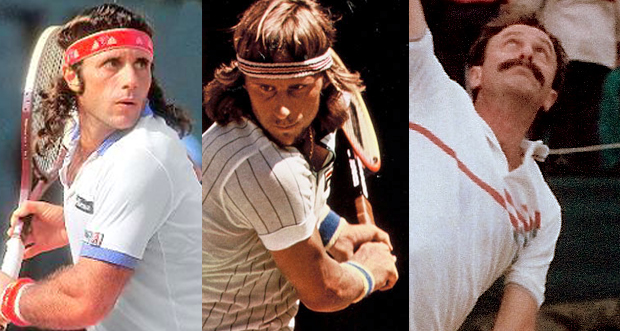
    Guillermo Vilas, Bjorn Borg, John Newcombe

    While researching Part Five in my Open Era Generations series (coming later this week), I ran across an interesting little tidbit that I wanted to share (and in so doing decided to start a new segment for this blog, with random statistical bits or “smash shots” that provide angles on tennis today and in the past). Using my Generation Theory, in most years anywhere from two to four generations inhabit the Top 10, with three being the most common; but in 1974 and 1975 fully five different generations were represented in the Top 10 – the only time this has happened in the Open Era.

    Take a look at the 1974 year-end Top 10 with their birth years:

    1. Jimmy Connors (1952)
    2. John Newcombe (1944)
    3. Bjorn Borg (1956)
    4. Rod Laver (1938)
    5. Guillermo Vilas (1952)
    6. Tom Okker (1944)
    7. Arthur Ashe (1943)
    8. Ken Rosewall (1934)
    9. Stan Smith (1946)
    10. Ilie Nastase (1946)

    What are we looking at here? On first glance it looks like a bunch of all-time greats. But notice a couple things. First, as an aside to the point of this article, notice the sheer talent. If we include Pro, Amateur, and Open Era Slams, the above Top 10 includes a whopping 79 major titles. OK, that amazing fact aside, the main point is to look at the wide range of players – the youngest being Bjorn Borg, the oldest Ken Rosewall. The difference? 22 years.

    [divider]

    Click here to discuss “Historical Smash Shots 1: Generational Diversity in the 1974-75 Rankings” in the Discussion Forum.

    [divider]

    Now here’s the fun part. Let’s translate that to today. Let’s place players of a similar age differential in the above list into a hypothetical Top 10 for 2015. Jimmy Connors was 22 in 1974, so we need someone born in 1993 for the number one spot. Swapping age-appropriate players, we get something like this:

    Jiri Vesely, Dominic Thiem, Alexander Zverev

    “Fantasy 2015”

    1. Dominic Thiem (1993)
    2. Stan Wawrinka (1985)
    3. Alexander Zverev (1997)
    4. James Blake (1979)
    5. Jiri Vesely (1993)
    6. Jo-Wilfried Tsonga (1985)
    7. Robin Soderling (1984)
    8. Marcelo Rios (1975)
    9. Novak Djokovic (1987)
    10. Andy Murray (1987)

    Look at that range – A 40-year old Marcelo Rios still in the Top 10, with 18-year old Alexander Zverev No. 3 in the world — two players 22 years apart!

    We really haven’t seen anything like this in some time. The closest thing in recent years, and the last time there were four generations in a year-end Top 10, was 2005 – when Federer’s generation (b. 1979-83) ruled the rankings, with a young teenage upstart named Rafael Nadal (b. 1986) finishing No. 2, and 35-year-old Andre Agassi (b. 1970) making his last appearance in the Top 10. Before that you have to go all the way back to the 80s when it was relatively common for four generations to be represented, although this was mainly due to the anomaly that was Jimmy Connors.

    It would require a longer study to look further into historical trends, and when we get to more recent generations in the Open Era Generations Theory we will look at how things look now compared to in the past. But for now I think it is clear that there is much greater “generational homogeneity” at the top of the men’s game, with seven of the Top 10 being in the generation born 1984-88, with only Roger Federer and David Ferrer from the older generation (b. 1979-83), and only Kei Nishikori from the younger generation (b. 1989-93). As I will discuss later, this is likely to change relatively soon.

    [divider]

    Cover Photo (Creative Commons License): cwkarl / patrickpeccatte / 43555660@N00

    (Photo (Creative Commons License): mirsasha / mirsasha / stevenpisano)

  • Open Era Generations, Part Three: Gen 1 (1934-38) – Dominance from Down Under

    Open Era Generations, Part Three: Gen 1 (1934-38) – Dominance from Down Under

    11861575603_154b1987a0_o

    The Great Australians

    The generation of players born between 1934 and 1938 was, in a way, more accurately the last generation before the Open Era as it peaked in the 1960s. Yet it was also the generation that was “in power” when the Open Era began, so I am considering it the first of the Open Era.

    When the Open Era began in 1968, the youngest players of this generation were turning 30 years old. The generation still dominated for the first few years, winning six of the first seven Slams (two to Rosewall, four to Laver) through 1969, but then the decline really started with the new decade in 1970. While Laver remained a strong player for several more years (top 10 through 1975),  he never won another Slam. Rosewall won three more, one in each year during 1970-72, and was in or near the top 10 through 1977, which he finished at #12 at the ripe age of 43, but clearly the baton had been passed in the 70s.

    This first generation was dominated by the Australians, with 66 of the 76 Slams won by the men from Down Under. In tennis history the late 50s and 60s is possibly the greatest period of dominance by a country, perhaps only revivaled by the last and greatest period of American dominance in the 1990s.

    Best Players by Birth Year (with Slam total):
    1934: Ken Rosewall 23 (AUS), Lew Hoad 5 (AUS)
    1935: Mal Anderson 2 (AUS)
    1936: Roy Emerson 12 (AUS), Ashley Cooper 4 (AUS), Alex Olmedo 3 (USA)
    1937: Andres Gimeno 1 (ESP)
    1938: Rod Laver 19 (AUS), Manuel Santana 4 (ESP), Fred Stolle 2 (AUS), Rafael Osuna 1 (MEX)

    Total Slams: 76 (best of the 13 Gens and all-time), including 50 Grand Slams and 26 Pro Slams.

    File:Hoad Rosewall Wimbledon.jpg

    Lew Hoad and Ken Rosewall playing doubles at the Wimbledon Championships in 1954 or 1955. (courtesy Wikimedia Commons: State Library of Victoria).

    Discussion
    It would be hard to argue that this is not the “GGOAT” – greatest generation of all time, in 139 years of tennis history from 1877 to 2015. Rosewall and Laver alone would make it a contender with any generation, but adding in Hoad, Emerson, not to mention Santana, Cooper, Stolle and Olmedo, and it is head and shoulders above every other generation in terms of Slam count. Of course part of this is due to the “doubling up” of Amateur and Pro Slams during the 50s and 60s, but regardless, 76 majors is a lot –  more than double that of any generation of the Open Era.

    Rosewall and Laver are on the very short list of greatest players. Laver had a higher peak, being the dominant player of the 1960s, bookended by Calendar Slams in 1962 (as an Amateur) and 1969 (the first full year of the Open Era), but Rosewall had greater longevity, with an incredible span of 20 years between his first Slam title in 1953 and his last in 1972 – four years longer than the second longest record of Bill Tilden’s sixteen years (1920-35), twice that of contemporary Rod Laver’s ten years (1960-69) and far more than the longest of the Open Era, Pete Sampras’ thirteen years (1990-2002). To put it another way, Rosewall’s first Slam title came seven years before Laver’s first, and his last came three years after Laver’s last. During those 20 years he won 23 majors in all, eclipsing Laver’s 19. Yet at their best, Laver was more dominant, not only over Rosewall but the rest of the sport. Laver won a record 200 titles, well surpassing Rosewall’s 133.

    Roy Emerson is both over and under-rated, depending upon who you ask. All 12 of his Slam titles came before the Open Era, and most when the best players in the sport—including his contemporaries Rosewall and Laver—were on the pro tour. Yet Emerson held his own against the young Laver, and still dominated the amateur tour for a few years. Yet in terms of career greatness he is perhaps more comparable to players with half his Slam count.

    Underachievers and Forgotten Players
    Many who saw Lew Hoad play, or played against him, claim that he is the most talented player in tennis history. For instance, Pancho Gonzales claimed that Hoad’s “game was the best game ever. Better than mine. He was capable of making more shots than anybody. His two volleys were great. His overhead was enormous. He had the most natural tennis mind with the most natural tennis physique.” Gonzales also said that Hoad “was the only guy who, if I was playing my best tennis, could still beat me.”[1]

    Hoad was plagued by injury and, according to Jack Kramer, laziness and lack of interest [1]. Kramer also claimed that despite the mystique around Hoad, saying “when you sum Hoad up, you have to say that he was overrated. He might have been the best, but day-to-day, week-to-week, he was the most inconsistent of all the top players” [1]. In other words, if we read between the lines a bit, it would seem that while Hoad was one of the most talented players of his generation, with his best level being as good or better than anyone, he did not have the consistency and focus to make him a truly great player, which is why he is less remembered than players with higher Slam counts.

    While a career that included five Slams can hardly be considered disappointing, we can easily see a player in Hoad that was as talented as his more successful contemporaries in Gonzales, Rosewall and Laver, yet without the career achievements.

    Did You Know?:  Rod Laver and Ken Rosewall played each other 144 times in all, including 46 times in 1963. Laver won the head-to-head 80-64. Rosewall led 34-12 their first year of playing each other in 1963, with Laver dominating most years after. However, Rosewall won their last two matches in 1976. For some of the only available footage of this great rivalry, check out this video here.

    File:Rod Laver 1976.jpg

    Rod Laver at the 1976 ABN World Tennis Tournament in Rotterdam (courtesy Wikimedia Commons: Rob Bogaerts, Nationaal Archief Fotocollectie Anefo)

    Top Ten Players of Generation One

    1. Rod Laver (AUS)
    2. Ken Rosewall (AUS)
    3. Lew Hoad (AUS)
    4. Roy Emerson (AUS)
    5. Manuel Santana (ESP)
    6. Ashley Cooper (AUS)
    7. Alex Olmedo (USA)
    8. Fred Stolle (AUS)
    9. Mal Anderson (AUS)
    10. Andres Gimeno (MEX)

    Honorable Mention: Rafael Osuna (Mex).

    Due to limited records it is difficult to give accurate rankings before the Open Era. But it is relatively easy to see the above players in groups. The first group is comprised of Laver and Rosewall; the two are very close, with Rosewall having superior longevity but Laver having a higher peak. Actually, Rosewall—along with Pancho Gonzales–is perhaps the least mentioned inner circle great, but by any reasonable way of accounting he is certainingly one of the five or so greatest players of all time – this despite the Tennis Channel’s egregious ranking of him as only the 13th greatest male tennis player of all time in their “100 Greatest of All Time” in 2012, behind the likes of Roy Emerson and Andre Agassi, among others [2].

    The next group is another pair, Hoad and Emerson. Many would rank Emerson over Hoad, but Hoad was a much better player. Then we have another pair, “Manolo” Santana and Ashley Cooper, both with four amateur Slams, both very strong players but not the very best of the generation, the Andy Murrays and Guillermo Vilases of their time.

    The final group includes Olmedo, Stolle, Anderson and Gimeno. Olmedo has the edge in Slam totals with three, Stolle and Anderson with two each, and Gimeno with only one – that one being the 1972 French Open which he won at 34 years of age. Actually, Gimeno is the only player other than Rosewall who who won a Slam after the age of 32 during the Open Era. Anderson had a long and storied career. He won only two Slams – the 1957 US Open and the 1959 Wembley Pro, but made a Slam final as late as 1972 at age 36, losing to the 37-year old Ken Rosewall in the Australian Open.

    Regardless of the exact ranking, it is a very strong group – dominating tennis from the late 50s into the 70s, perhaps partially due to the weakness of the following generation, which we will look at in the next installment.

    Works Cited:
    [1] Quote from https://en.wikipedia.org/wiki/Lew_Hoad
    [2] http://admin.tennischannel.com/goat/71.aspx

    [divider]

    Cover Photo (Creative Commons License): State Library Victoria Collections

    Hoad/Rosewall and Rod Laver photos: Wikimedia Commons

  • National Tennis Careers – Part Four: Australia

    National Tennis Careers – Part Four: Australia

    Rod Laver Patrick Rafter John Newcombe Lleyton Hewitt

    A Long Time Ago, Down Under…

    Of the five nations discussed, Australia peaked the earliest. Truly, Australia dominated men’s tennis in the late 1950s to the early 1970s led by two of the very greatest players of all time: Rod Laver and Ken Rosewall. Australia remained strong at the beginning of the Open Era, with Laver’s Calendar Slam in 1969, and the baton partially passed to John Newcombe, who was one of the few amateur stars that was able to maintain a similar level during the Open Era.

    Other top Australians before the Open Era include Frank Sedgman, Lew Hoad, Fred Stolle, Ashley Cooper, and Roy Emerson. Emerson held the Grand Slam record of 12 until Pete Sampras broke it, although it’s often considered overrated due to the fact that he dominated the Amateur Slams when the best players were playing pro – namely his countrymen Laver and Rosewall. Hoad is another “what if” story; Jack Kramer compared him to Ellsworth Vines as players with immense talent but lacking drive. Pancho Gonzales claimed that Hoad was the only player who could beat Gonzales when he was playing his best; others, including Ken Rosewall, voiced similar sentiment. Regardless, Hoad’s career was plagued by injury and even if he was arguably the most talented player of all time, his record places him as a lesser great: with five total majors to his name.

    [divider]

    Click here to discuss “National Tennis Careers – Part Four: Australia” in the discussion forum.

    [divider]

    Let’s take a look at the Open Era record:

    Australia Career

    As you can see, Australia dominated for the first few years of the Open Era then gradually petered out in the mid to late 70s and never recovered. There were a few bright spots – Pat Cash in the mid-80s with Australia’s lone Slam between 1976 and 1997, and then a short era of strength during the late 90s and early 2000s, when number ones Patrick Rafter and Lleyton Hewitt won two Slams each. Yet after Hewitt’s early peak and quick decline, Australian men’s tennis has been at a low during the last half decade or so. But there may be hope, but more on that in a moment…

    Ten Greatest Australian Players of the Open Era
    1. Rod Laver
    2. Ken Rosewall
    3. John Newcombe
    4. Lleyton Hewitt
    5. Patrick Rafter
    6. Tony Roche
    7. Pat Cash
    8. Mark Philippoussis
    9. Mark Edmondson
    10. John Alexander

    Honorable Mentions: Malcolm Anderson, Dick Crealy, Phil Dent, Kim Warwick, Mark Woodforde, John Marks, Roy Emerson.

    It is a bit tricky ranking the Australians of the Open Era as the top three all saw large portions of their careers before the Open Era, with Laver and Rosewall both seeing the bulk of their accomplishments happening before. But even if we rank them only by what they accomplished after the Open Era began, the top three remain the same.

    A brief word on Rosewall and Laver. The two are forever linked, not unlike Borg and McEnroe or Sampras and Agassi or Federer and Nadal. If we look at all-time greatness as merely a combination of longevity and accumulated career statistics, then Ken Rosewall would probably be considered the greatest player of all time due to his all-time best 23 Slam titles, including 8 Grand Slams and 15 Pro Slams. Perhaps even more remarkable is the fact that in all major tournaments, Rosewall played in 55 semifinals; consider that Bill Tilden (37), Roger Federer (36), Pancho Gonzales (34), Rod Laver (32), and Jimmy Connors (31) all made it to 31-37 Slam semifinals — all more than four year’s worth less than Rosewall.  Certainly, many of those were Pro Slams, which were shorter than today’s Grand Slams, but the fact that he is so far above everyone else is remarkable. But Laver had the greater peak – the two Grand Slams and the overall dominance during the 1960s and over Rosewall. Also, Laver’s 200 titles is by far the most in tennis history. Regardless, both men are on the very short list of GOAT candidates.

    John Newcombe is a bit underappreciated historically. I think this is partially because he played alongside the greater Laver and Rosewall, although was quite a bit younger than both, but also that he was surpassed later in his career by Connors and Borg. But Newcombe was, along with Arthur Ashe, the “bridge player” of the Amateur and Open Eras and was a top player for almost twenty years, including a shared No. 1 ranking in both 1970 and ’71. His overall record is comparable to players like Boris Becker and Stefan Edberg.

    There’s a big drop-off from Newcombe to the rest, with Lleyton Hewitt and Pat Rafter easy No. 4 and No. 5 picks. In a way the two have opposite careers: Rafter’s much shorter, only about a decade, and with a later peak, his last five years being his best; Hewitt’s has been quite long, with his best years early on. Having witnessed the diminished version of Hewitt over the last eight or nine years it is easy to forget that for a short period of time he was a truly great player. He is known for being the youngest world No. 1, at 20 years old, and if you looked at his career through 2002 when he was finishing his second year-end No. 1 ranking, at just 21 years of age, with two Slams and two World Tour Finals under his belt, you’d think he would be one of the all-time greats. But he never won another Slam and was eclipsed not only by Roger Federer, but Andy Roddick and a number of other players. Where Rafter retired as the No. 7 ranked player in the world, it has been a decade now since Hewitt has finished in the Top 20.

    Tony Roche’s peak was before the Open Era started, although he remained a good player deep into the 70s. Some might argue with the ranking of Philippoussis over Edmondson given that the latter won a Slam while the former did not, but Philippoussis was a superior player with an overall better career, and could be considered an underachiever. The last spot goes to John Alexander just edging out Phil Dent.

    The Future
    Let’s take a look at the Australian men in the Top 100, through Wimbledon:

    25. Bernard Tomic (22)
    41. Nick Kyrgios (20)
    68. Sam Groth (27)
    69. Thanasi Kokkinakis (19)
    84. James Duckworth (23)
    97. John Millman (26)

    Kyrgios dropped 12 spots when he couldn’t repeat last year’s quarterfinal appearance, although he still made it to the fourth round this year and has shown improvement overall this year, with a good chance of approaching the Top 20 by year’s end. Kokkinakis also shows some promise, being one of four teenagers currently in the Top 100. Bernard Tomic is also having his best year yet, although he has less upside. He is best known for reaching the Wimbledon quarterfinal in 2011, losing to Novak Djokovic. Tomic has still not reached the second week of a Slam since then, and is known to be somewhat of a playboy, but now ranked No. 25 he seems at least primed to be a Top 20 player. Groth is already 27 but looks to be a late-bloomer; his powerful serve might see him around for awhile. Duckworth is another interesting name, someone who was more highly regarded a few years ago but has progressed slowly. The top ranked 18-year old is Omar Jasika, ranked around No. 300, who won the Junior US Open and has won two ITF tournaments this year so far, so he bears keeping an eye on.

    There is hope for Australian men’s tennis, with Kyrgios and Kokkinakis possibly the best young prospects since Lleyton Hewitt came up 15 years ago, and Tomic, Groth, and Duckworth a solid supporting cast. Some have criticized Kyrgios for his diva antics, but as Jan Kodes just reminded us, Kyrgios is only just 20 years old, and many greats were also temperamental at that age. Kodes believes that Kyrgios has what it takes to win a Slam and is about “three years away.” We shall see.

    [divider]

    Cover Photo (Creative Commons License): Duncan

  • Top 20 Greatest Players of All Time (Yet Another Take)

    Top 20 Greatest Players of All Time (Yet Another Take)

    Roger Federer

    Here’s another take on the Top 20 of all time – they’re always fun to talk about and never fail to get someone’s panties in a wad. The caveat is just that: it is a take and is not meant to be taken as fact or even how I see things. I was just looking at pre-ATP rankings for players and was surprised to see that players like Jack Kramer had finished (alone or tied) No. 1 six times. I decided to create a quick ranking system based upon two things and two things only, to determine true greatness:

    * Year-end No. 1 rankings: three points for solo; two points for shared
    * Majors won: two points for pre-Open Era Grand or Pro Slams; three points for Open Era Slams

    Now obviously, and again, this is a huge over-simplification. It doesn’t take into account a whole host of important data: Non-win results, other titles, non-No. 1 rankings, etc, not to mention it doesn’t differentiate Slams enough (e.g. the Australian Open in the 1970s was less competitive than other Slams). But it is a quick and dirty system and, I think, worked out pretty well.

    So here we go, the Top 20 players of all time according to one system. I’ve also included the points so you can see how close or far players were from each other.

    1. Roger Federer 66
    2. Rod Laver 62
    3. Ken Rosewall 61
    4. Pete Sampras 60
    5. Pancho Gonzales 56
    6. Rafael Nadal 51
    7. Bill Tilden 48
    8. Bjorn Borg 42
    9. Jimmy Connors 39
    10. Ivan Lendl 36
    11t. Don Budge 34
    11t. William Renshaw 34
    13. John McEnroe 33
    14. Fred Perry 31
    15t. Jack Kramer 30
    15t. Novak Djokovic 30
    17. Andre Agassi 27
    18t. Ellsworth Vines 25
    18t. Henri Cochet 25
    18t. John Newcombe 25

    Some interesting things to note.

    1) Whatever you think of the exact order, I think it has the Top 10 players rightly in the Top 10. Novak has a chance of sneaking in there and edging Lendl out in another year or two, but right now it works.

    2) To be honest, the accuracy of the next ten gets decreasingly reliable as I didn’t research absolutely everyone. But I think the next ten is mainly right, although maybe one or two players weren’t accounted for. It is really hard to research 19th century players. Also right off the edge of the list would be players like Stefan Edberg, Mats Wilander, Bobby Riggs, Roy Emerson, etc.

    3) While many (myself included) think Nadal has surpassed Sampras, this system likes Pete quite a bit more because of those year-end number ones. I think it makes a valid point.

    4) This system rightly honors perhaps the most underrated historical great player, Pancho Gonzales, who is underrated because his peak was in the Pro Slam era and he only won two Grand Slams, while winning 15 Pro Slams. Pancho was the best player of the 50s and finished No. 1 a record eight times.

    5) Yes, Roger Federer is No. 1. Sorry Roger Haters, just about any system is going to place him as the greatest of all time, or at least the greatest of the Open Era. Rafa may pass him, although according to this system Roger would have to remain stagnant (a distinct possibility) and Rafa would have to have five more Slam wins and/or year-end No. 1’s to tie him – a tall order, but possible. But for now I think Roger deserves his place.

    [divider]

    Click here to discuss “Top 20 Greatest Players of All Time” in the discussion forum.

    [divider]

    Cover Photo (Creative Commons License): Marianne Bevis

  • Roger Federer’s Yesterdays and Tomorrows – A Champion’s Fate

    Roger Federer’s Yesterdays and Tomorrows – A Champion’s Fate

    Roger Federer has achieved so much in his career it boggles the mind. He holds or shares hundreds of records, achievements, and awards in tennis. Led by his record 17 Major titles in the Grand Slam arena, and over 300 weeks ranked the No. 1 player in the world, one wonders what is left for him to do in the future? What is his motivation to continue? He has said he loves the sport, so one might think he will play as long as he is physically able to play, within the limits of his family priorities, and as long as he is happy playing.

    [divider]

    Discuss this article with fellow tennis fans in the tennis forums

    [divider]

    I would not be surprised to see Roger play more doubles as he ages.  I think it benefits and compliments his particular game. There is much more precision required in doubles, including serving and returns.  If played correctly, it obviously helps one’s net play and confidence at the net. Quick thinking tactics and execution are extremely important to set up a winner. Quick footwork and agility are more at a premium in doubles than pure side-to-side movement.

    Overall, I think some more doubles play would help him accentuate his strengths and improve some of his weaknesses.

    Doubles obviously doesn’t require nor would it help much with fitness or endurance, but Federer’s game was never really based on that, and at this stage in his career, I don’t see that changing.  He doesn’t have to change his game to a grinding style and constantly rally for 15+ shots as that isn’t his strength. My guess is that he will work on as many of his strengths as his health allows. These strengths are what set him apart and made him the competitor he is.

    First, he can work on his serve. According to the ATP’s Match Facts statistics, as recently as 2012, he won 91% of his service games, third highest on the tour, while playing 80 matches. (Raonic was first with 93%, and Isner second with 92% but playing fewer matches — 62 and 60, respectively.)  Federer’s 91% last year was higher than his career average of 88%, and the second highest in his career (92% in 2004).  This year, Federer has won 88% of his service games. Yes, it is his career average, but I think it needs to be higher to have an edge these days.  And if one looks inside the numbers, the biggest difference is his second serve winning percentage. Last year, he topped all players on tour with an excellent 60% of second serves won.  (Nadal was second with 57%.)  So far this year, Federer has dropped to 56% (his career avg.-2nd), while Nadal is second with 57% (his career avg.- 1st) and Djokovic leads with 59% (career avg. 55%-6th).  Interestingly, Murray and Berdych are 26th and 27th with only 52% (also their career avg.).  These percentage differences may look small, but the differences are small among the top players and any edge is vital.  Finally, serving well gives Federer confidence in the rest of his game. Confidence is obviously important.

    Second, Federer undoubtedly realizes that he needs to focus on the key points more. His break points converted (39%) and break points saved (65%) this year have both dipped. Last year, they were 42% and 69%. Career wise, he has averaged 41% and 67%.

    Curiously, his return statistics this year are about the same as last year and for his career, maybe even very slightly better.

    Federer does have to have enough fortitude to have the patience when required to set up a point and then go for the clean winner when there is an opening.  But even then, his tactics and execution have to improve from some of the play he has recently exhibited.  He can’t set up the point perfectly, and then hit right back to the opponent instead of the open court.  The “hit behind the player” tactic should be used more sparingly to surprise a player. He also can’t bungle shots when he has the opponent at his mercy.  He did this kind of thing against Robredo, and it cost him the match as he admittedly self-destructed.

    Despite that result, I don’t think he is far off the mark; just more inconsistent and a bit below normal. Perhaps that can partially be explained by his not playing as much this year.  His back appears to have bothered him more during the year.  He also announced that this would be a transition year (whatever that means), so perhaps some of this is self-imposed.

    Will Roger Federer turn it around in 2014?  Only time will tell.  One day, no one can say for sure when, he won’t be able to play at a high enough level to win big tournaments or remain near the top.  Some believe it has already happened this year, and perhaps it has, but only history will tell us for sure.  I, for one, believe it’s pretty unreasonable to say that “he is finished” less than a year after he was No. 1 in the world. After all, people have been predicting his imminent demise since 2008 when he “only” won one Major and again in 2011, when he hadn’t won a Major since the 2010 Australian Open, and look what happened in 2012.  Though he could win anywhere with some fortune, one would think that the Wimbledon lawn is his best chance to win another Major. The competitive ability on it is more sparse, the surface suits his game, especially if it is not too sun-baked and high bouncing, and he is co-record holder along with Pete Sampras with seven winner’s trophies.

    Still, he is 32 years old and has some high mileage, fifth (only 21 matches short of Agassi) in the Open Era in matches played, and what is certain is that nobody plays men’s singles on this tour forever.

    But even when Roger Federer can no longer reach the highest levels consistently, what is wrong with Roger playing on for the love of the game?  Unfortunately, I believe that there are too many these days that cannot accept or appreciate performances that don’t continuously match or exceed a player’s best.  Media, fans, and even the tour promoters alike seem only too eager to look at the most recent results – in a “what have you done lately” syndrome – and bury champions that still have exciting moments to give to the sport. In this writer’s eyes that is just plain wrong.

    One mustn’t forget that some of the great players in the game have risen to the heights on occasion, even in the dimming twilight of their careers.

    In my fading memories, I still recall a nervous almost 42-year-old Richard “Pancho” Gonzalez beating 1969 Grand Slam Champion Laver in a winner-take-all best-of-five set match in 1970 at Madison Square Garden.  Gonzalez said that night he was always frightened of playing there, because it was frightening to think he might play a bad match at MSG.

    Gonzalez taping his fingers before Laver MSG match

    I recall 36-year-old Ken Rosewall winning the 1971 Australian Open against a strong field (he would win again at 37, but against a very depleted field), beating Emerson in the quarterfinals, Okker in the semifinals, and Ashe in straight sets in the final.  At 41 and 42, in 1976 and 1977, Rosewall would make it to the semifinals in Australia.

    1971 Australian Open Final – Rosewall beats Arthur Ashe

    And who can forget 39-year-old Jimmy Connors’s run in the 1991 US Open coming from two sets to one down to beat Aaron Krickstein in the deciding set tiebreaker in the fourth round, then playing Paul Haarhuis at night in the quarterfinals, and whipping the crowd into a frenzy behind some incredible defending to break Haarhuis serving for a 2-0 lead, to tie the set, and eventually win the match in four sets. He finally succumbed to Jim Courier in the semifinal, but it was a most memorable run.

    1991 US Open – Amazing point where Connors breaks Haarhuis in the second set to begin comeback

    Enjoy them all while you still can. Like our children, they learn, they play, they struggle, they succeed to our delight much more than they fail to our sorrow, and finally they get older and leave our admiring gaze.  ‘Tis ever a champion’s fate.

    Credits: Cover Photo: anonlinegreenworld (Creative Commons License)