
[divider]
Arthur Ashe Stadium — 5:00 P.M.
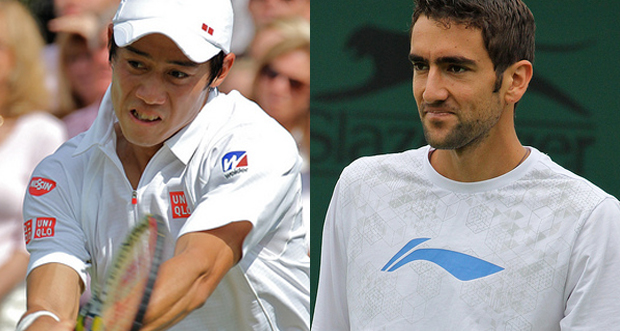
Men’s Singles – Final
Marin Cilic (CRO) (14) d. Kei Nishikori (JPN) (10) — 6-3, 6-3, 6-3
[divider]
[divider]
Arthur Ashe Stadium — 5:00 P.M.
Men’s Singles – Final
Marin Cilic (CRO) (14) d. Kei Nishikori (JPN) (10) — 6-3, 6-3, 6-3
[divider]
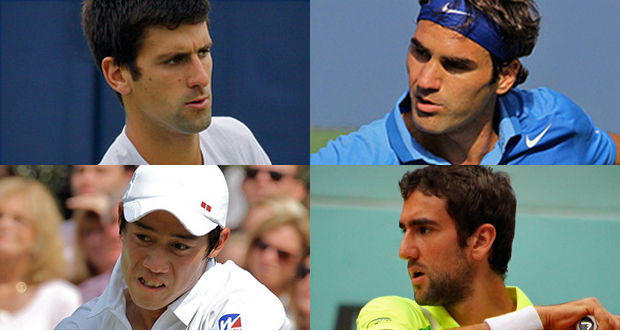

Novak Djokovic and Roger Federer, the #1 and #2 seeds, respectively, will be hoping to set up the anticipated re-match of the Wimbledon final. Kei Nishikori and Marin Cilic will be hoping to spoil the party.
The full schedule for Day 13 is listed below (Results to follow). All times are local.
[divider]
Arthur Ashe Stadium — 12:00 P.M.
Men’s Singles – Semifinals
Kei Nishikori (JPN) (10) d. Novak Djokovic (SRB) (1) — 6-4, 1-6, 7-6(4), 6-3
Not Before: 1:30 P.M.
Men’s Singles – Semifinals
Marin Cilic (CRO) (14) d. Roger Federer (SUI) (2) — 6-3, 6-4, 6-4
Not Before: 3:00 P.M.
Women’s Doubles – Final
Ekaterina Makarova (RUS) (4) / Elena Vesnina (RUS) (4) d. Martina Hingis (SUI) / Flavia Pennetta (ITA) — 2-6, 6-3, 6-2
[divider]
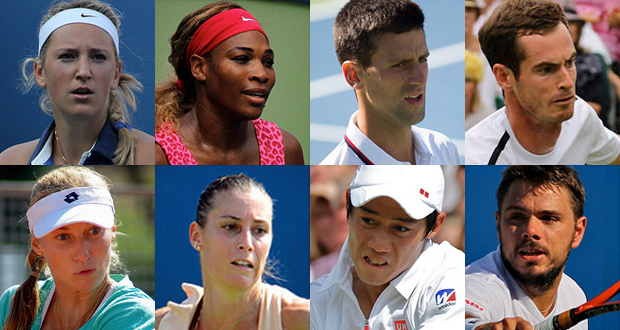

Day 10 brings the quarterfinal clashes in the top halves of both the women’s and men’s draws, with three former US Open champions in action. Defending champion and overall 5 times winner here, Serena Williams, will face Flavia Pennetta, while Victoria Azarenka, last year’s finalist, will play Ekaterina Makarova. On the men’s side, one of the matches features two former champs. Novak Djokovic, 2011 winner and last year’s runner-up will play Andy Murray, the 2012 winner. And this year’s Australian Open winner, Stan Wawrinka will battle Kei Nishikori for a slot in the semi-finals.
The full schedule for Day 10 is listed below (Results to follow). All times are local.
[divider]
Arthur Ashe Stadium — 11:00 A.M.
Mixed Doubles – Semifinals
Abigail Spears (USA) (10) / Santiago Gonzalez (MEX) (10) d. Taylor Townsend (USA) / Donald Young (USA) — 6-3, 6-4
Not Before: 12:30 P.M.
Women’s Singles – Quarterfinals
Ekaterina Makarova (RUS) (17) d. Victoria Azarenka (BLR) (16) — 6-4, 6-2
Not Before: 3:00 P.M.
Men’s Singles – Quarterfinals
Kei Nishikori (JPN) (10) d. Stan Wawrinka (SUI) (3) — 3-6, 7-5, 7-6(7), 6-7(5), 6-4
Not Before: 7:00 P.M.
Women’s Singles – Quarterfinals
Serena Williams (USA) (1) d. Flavia Pennetta (ITA) (11) — 6-3, 6-2
Men’s Singles – Quarterfinals
Novak Djokovic (SRB) (1) d. Andy Murray (GBR) (8) — 7-6(1), 6-7(1), 6-2, 6-4
[divider]
Louis Armstrong Stadium — 11:00 A.M.
Men’s Doubles – Quarterfinals
Marcel Granollers (ESP) (11) / Marc Lopez (ESP) (11) d. Alexander Peya (AUT) (2) / Bruno Soares (BRA) (2) — 7-6(3), 6-4
Women’s Doubles – Quarterfinals
Kimiko Date-Krumm (JPN) / Barbora Zahlavova Strycova (CZE) d. Andrea Hlavackova (CZE) (8) / Jie Zheng (CHN) (8) — 6-3, 4-6, 6-3
Men’s Doubles – Quarterfinals
Ivan Dodig (CRO) (4) / Marcelo Melo (BRA) (4) d. Carlos Berlocq (ARG) / Leonardo Mayer (ARG) — 3-6, 6-4, 6-2
Mixed Doubles – Semifinals
Sania Mirza (IND) (1) / Bruno Soares (BRA) (1) d. Yung-Jan Chan (TPE) / Ross Hutchins (GBR) — 7-5, 4-6, 10-7
[divider]
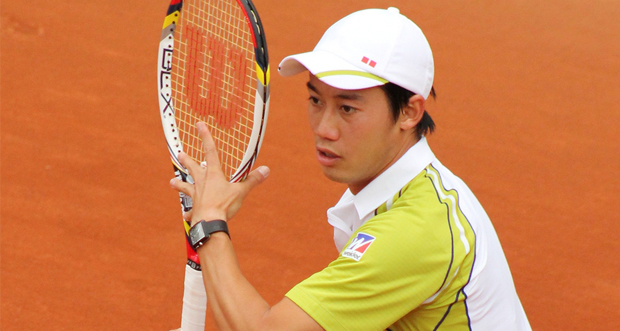

Madrid Open, Men’s Final
[1] Rafael Nadal def. [10] Kei Nishikori 2-6, 6-4, 3-0
There are many reasons I enjoy watching tennis, not least among them is that tennis is a form of theater. The drama is frequently compelling, the staging appealingly straightforward, and tennis has, of course, its varied cast of players. As such, yesterday’s production of the Men’s Madrid Final had the makings of a thoroughly engaging show: It was performed on traditional red clay, featured one of the world’s most renowned clay-courters, co-starred one of the sport’s rising stars, had a supporting cast of beautiful, belted extras (all with the word “Pull” emblazoned over the right breast and “Bear” over the left as if declaring some bold, yet alluringly vague, nymphet creed), and it took place inside a box-shaped theater of Magic.
And it did turn out to be an interesting production, but not an altogether satisfying one. Both players experimented—with more and less success—by moving outside their typical range. Kei Nishikori executed the Djokovic Method with tremendous flair, going hard and fast at Nadal’s forehand and taking his own backhand audaciously early, changing the direction of the ball with seeming ease. Rafael Nadal, on the other hand—who was recently dubbed “Sir Rafa, Bloodless Warrior Prince” by the friendly-faced Queen of Spain—forwent dictating with his forehand out of his backhand corner in favor of scrambling, committing errors (some tentative and forced, others entirely out of his control), and reciting brief, but intensely self-critical soliloquies between points. (In my opinion, for such a fine performer, the groundstroke errors were a mistake—many mistakes, actually—but the monologues were excellent. Nadal projected his troubled emotional state exceptionally well. I didn’t even need to understand the words to comprehend the force of his meaning: the warrior prince was distinctly displeased.)
ESPN coverage of the final ended traditionally enough, with Rafa chomping yet another trophy. This Madrid victory is Nadal’s 27th Masters Title, one for every year he’s been alive, and five more than anyone else has got. The trophy itself looks like it might have once done a stint as Iago’s favorite cudgel. [I can’t help but think that the runner-up plate should actually be a set of brass knuckles adorned with diamond-studded tennis balls.] Nonetheless, seeing the sadistic-looking scepter held aloft in the bandaged hands of the defending champion, reigning World No. 1, knighted bloodless warrior, and anointed King of Clay made everything feel back to normal, if not quite all right.
One obvious source of emotional dissonance was the fact that the curtain dropped on this particular Madrid production midway through the third act. This left me with a feeling of –surprise, surprise—incompleteness. The other wrong note sounded from the fact that I wasn’t really surprised by the way things played out, or failed to play out, as the case might be. I expected Nadal to win, I expected him not to be at his best, and I expected Nishikori to be somehow injured. What I had not expected was Nishikori to play so incredibly well before succumbing so suddenly to injury. It was disappointing to watch, and it must have been nightmarish to experience firsthand.
Kei Nishikori has a very entertaining game, solid all-around, and starring a forehand that’s big and flashy without being the least reckless. The Japanese No. 1—today the first Japanese man ever to enter the Top 10—also has a nuanced grasp of strategy that seems only to be improving. For instance, yes, Nishikori required ten match points to see off David Ferrer in the semifinals (the match of the tournament), but it’s worth noting that Ferrer outplayed Nishikori for most of the first and a good portion of the second set. Ferrer returned exceptionally well in Madrid, most notably while launching himself into the air after John Isner’s exploding kick-serves (the tall American only won 30 out of 50 points behind his massive first serve in his third round loss to the Spaniard). But Nishikori found his way around Ferrer’s uncanny return, choosing his spots carefully and hitting them well (especially his serve down the T on the ad side, which broke away from a lunging Ferrer over and over again).
It wasn’t his strategy but his courage that wavered at the close, as Nishikori started to miss his first serves and send smothered forehands into the net cord (that, and Ferrer played his guts out). But, although Nishikori’s heart missed a few beats, it didn’t fail him. After three sets, ten match points—the first coming nearly an hour before the next nine—and almost three hours of tennis, Nishikori had earned his first role as a Masters-level finalist. This new battle-hardened Nishikori pleased me (he won the Barcelona title in April, his first on clay), as I assume he pleased many other tennis fans wondering who besides Wawrinka might come into his own on the ATP tour this year. Kei Nishikori is 24-years-old, his tennis is textured and exciting, and he seems like a nice fellow. We could do much worse.
The question is whether Nishikori can stay healthy. Unfortunately, he has a pattern following up a big win or a promising run with an injury retreat (hence my expectation that he’d pull up lame in yesterday’s final). There might be nothing at all that can be done for what ails Nishikori’s body. The repetitive nature of tennis doesn’t allow much space for the healing of certain wounds, and carrying an injury makes a player more susceptible to injury. Still, there was something about the storyline of yesterday’s match, in the way the balance of power shifted from Nishikori to Nadal that felt, for lack of a better word, familiar. And where there is familiarity, it’s a good bet there’s also psychology.
Nishikori won the first set in stunningly dominant fashion, making the Warrior Price look unsettlingly ordinary. Then, to the dismay of the Spanish crowd, Nishikori kept it up in the second set, breaking immediately for 1-0. That’s when the structure began to crumble for Nishikori, at the very moment he found himself up a set and a break on the greatest clay-courter of our time. Was it simply his injury beginning to bother him? Or was this the moment when he started to think about the possibility of actually winning? Did he somehow prompt the other shoe to drop? And did that shoe, perhaps, land directly on his wounded back? Did Nishikori start to worry his body wouldn’t hold out for long enough to secure the win? Or did he worry that he’d backed one of the game’s most deadly competitors into a corner and that this competitor was now going to box him about the ears with his forehand cudgel?
Or maybe—most likely—it was a mix of all of the above and more. Because Nishikori immediately went down 0-40 on his serve, and although he managed to fend off the break, he didn’t look even close to as settled as he had in the first nine games. Then, while still leading 3-1 in the second set, Nishikori asked the umpire to quiet the partisan crowd, thereby insuring stoney silence in La Caja Mágica whenever he won a point, and, more crucially, letting Nadal know he was a bundle of anxiety underneath all that tremendous ball-striking.
At the 4-3 changeover Nishikori received a massage from the trainer. Another note of encouragement to his opponent, who is—we all know—not the type of player to shy away from attacking an injured foe. Sure enough, Rafa broke the very next game, looking, for the first time in the match, like the bloodless Warrior Prince version of his self. The word “roar” is overused as it applies to Rafael Nadal, but it’s the still the best one to describe his reaction when Nishikori’s let-cord sailed long, leveling the set at 4-4. Rafa roared. The commentators took the opportunity to observe that not only is Nadal “a mental fortress,” he was also aiming to get in Nishikori’s grill and “rattle his cage.” Nishikori, for his part, took the opportunity to call for the trainer. His grill was rattled.
Nadal has been without his full-on game for months now. The walls of his mental fortress are in need of a good spackling. But he is still Rafael Nadal, and therefore nobody knows just when and where he’ll get his game back. He waits only for the tournament, or the match, or even the lone point, on which to turn his fate, and rekindle his desire to devour every available tennis trophy. This potential energy, ever on the verge of becoming searingly kinetic, frightens people standing opposite him. Indeed, it was Nadal’s big cudgel forehand that earned him the crucial break point in the second set, but it was also the point that seemed to break Nishikori’s body and spirit—he turned an ankle trying to cope with Nadal’s attack, and nothing turned out well for him after that.
By the time the first game of the third set had elapsed, it was obvious Nadal would win the match. Nishikori’s capitulation was complete, which meant, interestingly, that Nadal’s victory was not, or at least not quite yet. As faithful as both players were to their assigned roles—the underdog put up a good fight, but went out meekly in the end, and the leading man got the trophy (and all the girls)—the script failed to convince. Both Nishikori and Nadal have more to offer, and—one hopes— more to prove. Fortunately, in the tennis version of theater, the script is rewritten each week anew, and the play has already begun at the Foro Italico. In Rome, as a famous playwright once noted, ambition should be made of sterner stuff.
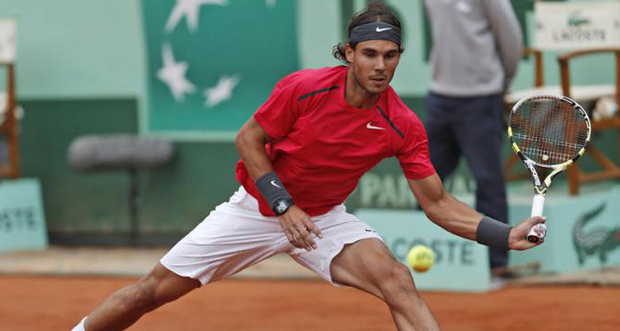

In a stunning turn of events at the Mutua Madrid Open, Kei Nishikori went from dominating the defending champion Rafael Nadal, to struggling to serve or even walk, and finally throwing in the towel in the third set. Nadal was rather gifted over the title, 2-6, 6-4, 3-0 Ret.
Nishikori, who will become the first Japanese man ever in the men’s Top 10 when the rankings come out tomorrow, had a game plan against the world No. 1, and he was executing it for a full set and a half. Nadal, for his part, was helping his opponent’s cause with a rash of uncharacteristic errors. After having won the first set, and up a break in the second, before serving at 4-2 up, Nishikori called for the trainer. He’d been seen by the trainer for his back in the long semifinal yesterday against Ferrer. After that, he clearly struggled on serve and was broken by Nadal to even the set at 4-4. Nadal won the second, but Nishikori was clearly not the player he had been, and in the third set, he could hardly move, and had to concede the match. The win is Nadal’s fourth in Madrid, and third since it has been contested on clay.
[divider]
Cover Photo (Creative Commons License): Marianne Bevis
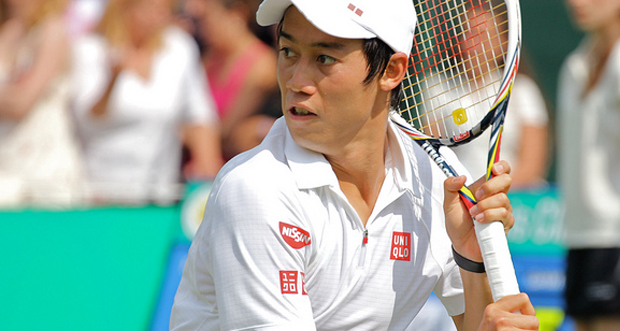

Kei Nishikori of Japan has beaten Santiago Giraldo of Colombia to become the first non-Spaniard to win in Barcelona since Gaston Gaudio of Argentina won it in 2002. This was the first final at the Conde de Godó to have no Spaniard in the final since 1996.
After dropping his first service game of the match Nishikori dominated Giraldo, thereafter, winning 6-2, 6-2, to take his fifth career title, and first ever on clay for the 24-year-old Japanese superstar. Giraldo, 26, was in his second ATP final, though he has yet to take a trophy.
[divider]
Cover Photo (Creative Commons License): Marianne Bevis
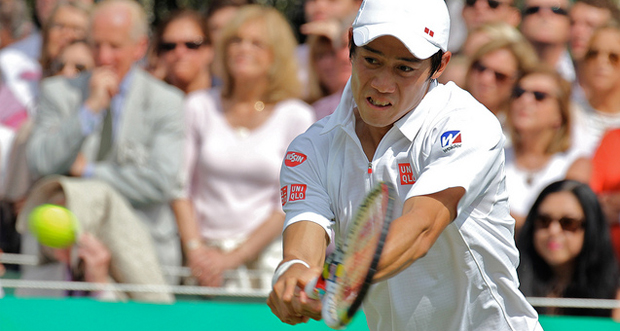

Japan’s Kei Nishikori defeated the big-serving Croat Ivo Karlovic, 6-4, 7-6(0) today in Memphis to successfully defend his U.S. National Indoor Tennis Championships.
“It’s amazing to defend a title for the first time, especially here,” Nishikori said. “I had a great memory from last year and I’m playing great.”
The win gave Nishikori his fourth ATP World Tour title. He has taken Michael Chang as his new coach and improves to 11-2 this season.
Nishikori secured an early break in the third game of the match and despite 20 aces from Karlovic, he took the second-set tiebreak at love, and the final in 90 minutes.
“He’s really fast,” Karlovic said. “He hits winners from any position on the court. That’s his game. He returned really well.”
[divider]
Cover Photo (Creative Commons License): Marianne Bevis
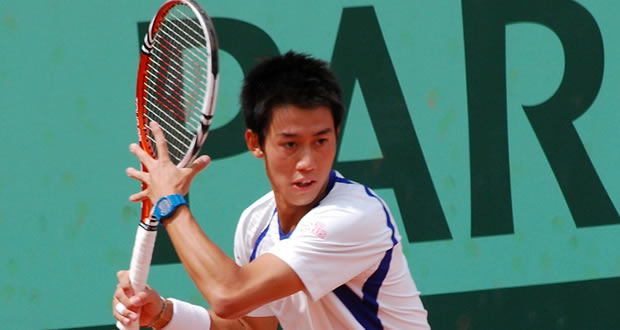
Roger Federer crashed out of the Mutua Madrid Open with a surprise defeat to 23-year-old Kei Nishikori in the third round.
Nishikori, the 14th seed, defeated the defending champion 6-4, 1-6, 6-2 in one hour, 35 minutes. Federer is the second high-profile casualty of the tournament following Novak Djokovic’s shock exit by way of Grigor Dimitrov two days earlier.
Federer was playing his first tournament in eight weeks, and his first of the year on clay, after taking an extended break due to niggling back problems. He was broken in the fifth game of the opening set, and his Japanese opponent served it out to take the lead.
The 17-time major winner fought back strongly in the second set, taking it 6-1, and looked to have the momentum as they moved into the deciding set.
However, Nishikori took control again, reasserting his ground game and broke Federer for an initial 3-1 advantage and held on for victory.
“Overall, I’m pretty disappointed with my play,” Federer stated in the post-match press conference. “I’m not sure how well Kei thought he played. I didn’t think he had to play his very best, either, which is even more disappointing. It doesn’t change my mindset going forward. I’m going to go back to the practice court, train hard, and make sure I don’t have these kind of days anymore.”
Nishikori, who will now meet Spanish wildcard Pablo Andujar in the quarterfinals, said, “I wasn’t really expecting this — 6-2 in the third, that’s not easy against him. I played well. I was a little bit tight, of course, but he didn’t make many first serves in the third set, and I was able to attack his second. I was even more aggressive in the third set. I’m pretty happy the way I played.”
Click here to discuss this and more with fellow tennis fans on our discussion board.
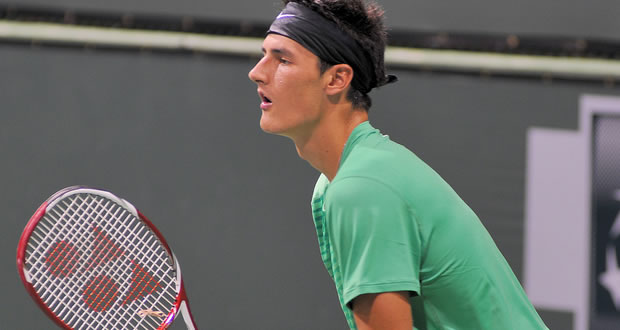
Below are ten players age 24 or younger that could be risers in the rankings and bear watching. They are ordered by current official ATP ranking (as of March 4th), and thus before Indian Wells. I’m also including their birth month and year in parentheses.
#16 – Kei Nishikori (12/89) – Kei made a big leap in 2011, going from #98 to #25, but his rise was slower in 2012, finishing the year just six ranks higher at #19. But remember that he missed the French Open, as well as Madrid and Rome, so any points in those three tournaments should help his ranking. Like Milos Raonic, Kei is a good candidate to challenge Janko Tipsarevic and Richard Gasquet for a spot in the top 10 this year and should at least become a player regularly ranking the #10-15 range.
#17 – Milos Raonic (12/90) – Milos cruised up the rankings last year, from #31 to #13. He’s been holding steady in the mid-teens so far this season and hasn’t quite had that breakthrough performance, making it the 4R at the last two Slams and never going past the QF at an ATP 1000. Milos has played seven finals, winning all four ATP 250s and losing all three ATP 500s. Raonic is as good a candidate as any to play spoiler at a Slam or even contend for an ATP 1000, but he doesn’t seem to be able to get over the hump…yet. When he does he could be a similar player to Juan Martin Del Potro at his best.
#22 – Alexandr Dolgopolov (11/88) – Talk about an enigma. Alexandr looked like he was going to rise quickly when he made it to the QF of the 2011 Australian Open, but has been erratic since. Sometimes he looks like a top 10 player, sometimes he goes out in the first round of a tournament. He finished 2011 at #15 and 2012 at #18; he’s now #22, so the trajectory is not a good one. He needs to straighten things out – he’s going to turn 25 at the end of the year, so he should be playing at his best by now. That said, I see him more in the Gasquet/Cilic mold – very talented, but probably not a regular in the top 10.
#24 – Jerzy Janowicz (11/90) – Jerzy bust on the scene last year by making it to the final of the Paris Masters, plowing through Andy Murray and a few other top 20 players before David Ferrer taught the youngster a lesson. He followed up with a solid Australian Open, losing in the 3R to Nicolas Almagro. Jerzy is somewhat similar to Milos Raonic: A big man with a big serve, although his serve isn’t as good as Milos’s. That said, his overall game might be as good or better. Like Raonic, he could be a spoiler this year. I think he’ll have his ups and down but will finish the year in the top 20, maybe higher, and have a chance for big things in 2014.
#29 – Martin Klizan (7/89) – Martin Klizan, you ask? Well, he had a strong performance at the US Open last year – making it to the 4R – and then following it up with an ATP 250 win in St Petersburg, defeating Fabio Fognini. Klizan won’t be an elite player but he could be a perennial top 20 player.
#31 – Grigor Dimitrov (5/91) – Ah, Grigor, what a tease. He still hasn’t gone past the 2R at a Slam, but has risen about 30 spots in each of the last two years, finishing 106, 76, and 48 in 2010-12, and already has risen half that in this early season. Baby Fed is talented, although probably not talented enough to live up to his nickname. But I can’t help but like him – he DOES have some of Roger’s smoothness, and he’ll occasionally offer a backhand and/or dropshot reminiscent of the Great One. But let’s look at Dimitrov for what he is: A rising talent, but probably not an all-time great. At almost 22, it may be a bit too late for that. But I do have high hopes for Grigor. I think he could be one of a few players–along with Raonic, Janowicz, and Tomic, maybe one or two others–that will start taking tournaments from the Big Four in the next two or three years as they begin to age. In other words, a 21-year old Dimitrov might not be a challenge for a 25-year old Djokovic, but a 24-year old Dimitrov might challenge a 28-year old Djokovic.
Expect Grigor to firmly place himself in the top 20 by the end of this year, and perhaps vie for the top 10 next year. He may not be a future #1, but in another two or three years he could be one of the 5-10 best players in the game.
#40 – Benoit Paire (5/89) – For some reason I pair Paire (pun intended) with Klizan. Both will turn 24 in a few months, both seem to have similar upside – top 15-20 at best. Paire hasn’t won a tournament yet, although has made it to two ATP 250 finals, most recently losing to Richard Gasquet in Montpellier. Paire has yet to make it past the 3R at a Grand Slam and most recently went out in the 1R in Australia, so he needs to up his game a bit at the Slams.
#45 – Bernard Tomic (10/92) – The second great tease of this list. Bernard is one of the few players on this list that actually took a slight step back in the rankings, finishing 2011 at #42 and 2012 at #52. But that’s largely due to the fact that he made it to the QF of 2011 Wimbledon, although had an overall slightly better year in 2012 – and certainly played a fuller schedule. i think Tomic is ready to rise up the rankings and, like Dimitrov, could end the year in the top 20. He could suprise, though, and make it to another Slam QF this year.
#54 – David Goffin (12/90) – I can’t help but like David Goffin. He started on the tour late, but made his mark last year by making it to the 4R at the French Open and the 3R at Wimbledon. But he only played in three ATP 1000 tournaments, and only made it past the qualifications once, so this year could see a lot of points added. I don’t see an elite player but, like Klizan and Paire, he could find himself a regular place in the top 20.
#83 – Evgeny Donskoy (5/90) – He’ll be 23 soon, but he bears watching. Why? Well, in his first Slam that he made it past the Qualifications, he made it to the 3R, defeating Adrian Ungur and then Mikhail Youzhny before losing to Kei Nishikori. Yesterday he defeated Tatsumo Ito and will face Andy Murray in the 2R at Indian Wells, so his journey likely ends there. But again, he bears watching. He could rise quickly and enter the top 40-50 in short time.
Bonus player…
#330 – Nick Kyrgios (4/95) – Nick Kyrgios? Well, he’s 17 years old and is the highest ranked teenager in the ATP Race Ranking right now, which isn’t saying much but says something. He won the boys event at the AO and is now on the men’s tour. I know nothing about his skills but it is hard not to take notice of a 17-year old on the tour…let’s hope he does well!
Honorable Mentions – Ryan Harrison, Jack Sock, Rhyne Williams, Matthew Barton.
