Tag: juan martin del potro

  • Djokovic Wins Marathon; Murray Keeps British Hopes Alive

    Djokovic Wins Marathon; Murray Keeps British Hopes Alive

    [divider]

    Click here to discuss the Del Potro/Djokovic semifinal with fellow tennis fans.

    Click here to discuss the Murray/Janowicz semifinal with fellow tennis fans.

    [divider]

    In the last shock of a tournament that has left many fans feeling as if they’d be tasered more than a few times, the men’s Number 1 and 2 seeds actually got through to the final. However, the outcome of today’s matches was about the only thing that went as expected.

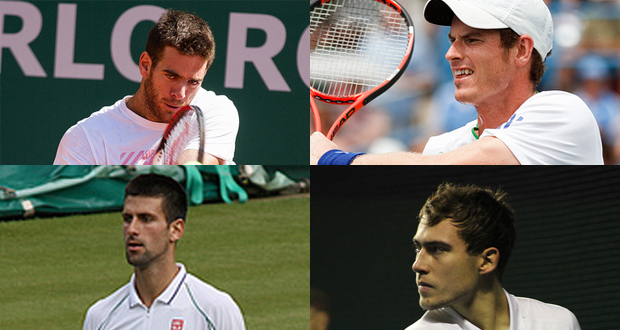
    That Juan Martin Del Potro would even play today against Novak Djokovic was in question, as late as this morning, due to a knee injured and re-injured in two previous rounds. If he did play, the conventional wisdom had it, he’d better serve big and get off the court in a hurry. Instead, they played the longest match ever in a Wimbledon semifinal, with Nole prevailing after 4 hours, 43 minutes: 7-5, 4-6, 7-6(2), 6-7(6), 6-3. Surely, it was the best match of the tournament. In all of that time, there were only 5 breaks of serve.  The ace count was 22-4, but the surprise was that it was the Serbian ace who hit 22 winners, while the Tower of Tandil came up with only 4. Perhaps even more unexpected was that, of rallies that went 9+ shots, it was the 6’9″ Del Potro — he of the gimpy knee — who won more of them, over the fast and flexible Serb.  Glancing at today’s match stats, you’d have been forgiven for reversing the names.

    In the “marquee” match of the day, when it finally started, many expected that the young Polish hopeful, Jerzy Janowicz, would be intimidated by the moment, in his maiden semifinal of a Major. But his display of nerves lasted about 3 or 4 points into Murray’s first service game. Then he settled in, taking on the Great Scot and the heavily partisan crowd with big serves, shot variety, and a more than a little aplomb. He got the first set to a tiebreaker and dominated it, surprising nearly everyone, it seemed, but himself, and putting all of Britain on its last nerve, after the nail-biter they’d endured against Verdasco on Wednesday.

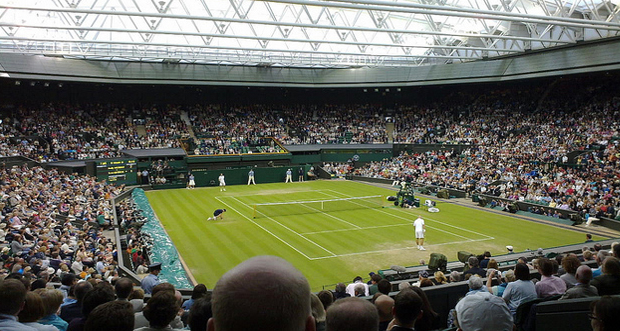
    The next three sets went Andy Murray’s way, but not without a fight. Or controversy. With Murray finding his A-game, and riding a huge wave of momentum to win the third set, the chair umpire decided to close the roof as a preventive measure against impending darkness, which was some 45-60 minutes away. (The only previous set that lasted longer than 43 minutes was the first, at 50.) While it only takes 10 minutes to close the roof, it takes another 10-15 to acclimatize the arena, and then the players have to warm up again — essentially all the time it might have taken to play a fourth set. Additionally, Janowicz had been seeming to campaign for closing the roof since around lunchtime. And no wonder…he had previously beaten Murray in Bercy last autumn, an indoor event. The sometimes curmudgeonly #2 complained, but there’s no getting an umpire to back down.

    After carrying on, (and on…) Andy managed to keep calm, and came back to break early in the 4th and close it out: 6-7 (2), 6-4, 6-4, 6-3.

    In all, there was much good news for men’s tennis today: Juan Martin Del Potro is still very much a danger; young Janowicz may be the brightest of the up-and-comers, fully willing to stick his chin out; and for the moment, at least, a little order is restored.

    Here’s hoping that the final can live up to the semifinals that proceed it, and appropriately cap off a rather astonishing Wimbledon.

  • Wimbledon Day 11: Friday, July 5 – Order of Play & Scores

    Wimbledon Day 11: Friday, July 5 – Order of Play & Scores

    [divider]

    Click here to discuss the Del Potro/Djokovic semifinal with fellow tennis fans.

    Click here to discuss the Murray/Janowicz semifinal with fellow tennis fans.

    [divider]

    [Scores will be added as known.]

    [divider]

    Centre Court – 1:00 PM

    GENTLEMEN’S SINGLES – SEMI-FINALS
    Novak Djokovic (SRB) (1) d Juan Martin Del Potro (ARG) (8) — 7-5, 4-6, 7-6(2), 6-7(6), 6-3

    GENTLEMEN’S SINGLES – SEMI-FINALS
    Andy Murray (GBR) (2) d Jerzy Janowicz (POL) (24) — 6-7(2), 6-4, 6-4, 6-3

    [divider]

    No. 1 Court – 1:00 PM

    LADIES’ DOUBLES – SEMI-FINALS
    Ashleigh Barty (AUS) (12) / Casey Dellacqua (AUS) (12) d Anna-Lena Groenefeld (GER) (7) / Kveta Peschke (CZE) (7) — 7-6(6), 6-2

    LADIES’ DOUBLES – SEMI-FINALS
    Su-Wei Hsieh (TPE) (8) / Shuai Peng (CHN) (8) d Shuko Aoyama (JPN) / Chanelle Scheepers (RSA) — 6-4, 6-3

    MIXED DOUBLES – SEMI-FINALS
    Bruno Soares (BRA) (1) / Lisa Raymond (USA) (1) d Jean-Julien Rojer (NED) / Vera Dushevina (RUS) — 6-4, 6-4

    [divider]

    No. 3 Court

    MIXED DOUBLES – SEMI-FINALS
    Daniel Nestor (CAN) (8) / Kristina Mladenovic (FRA) (8) d Nenad Zimonjic (SRB) (3) / Katarina Srebotnik (SLO) (3) — 6-2, 6-7(4), 11-9

  • Murray Wins 5-set Thriller to Keep British Hopes Alive at Wimbledon

    Murray Wins 5-set Thriller to Keep British Hopes Alive at Wimbledon

    [divider]

    Click here to discuss the Ferrer/Del Potro match with fellow tennis fans.

    Click here to discuss the Verdasco/Murray match with fellow tennis fans.

    Click here to discuss the Djokovic/Berdych match with fellow tennis fans.

    Click here to discuss the Kubot/Janowicz match with fellow tennis fans.

    [divider]

    Andy Murray ran into an inspired Fernando Verdasco today at the Wimbledon, and had to overcome a 2-set deficit to avoid elimination in this upset-ridden tournament.  He eventually overcame the Spaniard in 3 hours, 27 minutes in the  (surprisingly) most hotly-contested match of the gentlemen’s quarterfinals.

    Verdasco has been ranked as high as No. 7 in the world and has struggled the last couple of years, but he’s regained his form recently, and was having a very fine tournament.  He served superbly throughout the match, hit powerfully, and took his chances in a display of nerve and calm that isn’t often associated with him.  However, with the crowd in the stadium and on Henman Hill urging him on, Murray found his own nerve and eventually prevailed, 4-6, 3-6, 6-1, 6-4, 7-5.

    Juan Martin Del Potro had to overcome a tumble in the first game of his match against David Ferrer, hyper-extending his knee and nearly ending a match that had barely begun.  Hard to know if the scare focussed his efforts to get through quickly, but the Argentine served very well, and mostly kept the scrappy world No. 3 out of rhythm.  Ferrer battled hard to take the match to 4 sets, but lost in the 3rd-set tiebreak.  Del Potro won 6-2, 6-4, 7-6(5), and earned the right to play the world No. 1, Novak Djokovic.

    In a first-ever all-Polish quarterfinal, Jerzy Janowicz defeated countryman Lukasz Kubot, 7-5, 6-4, 6-4, to become the first Polish man to reach the semifinals of any Slam event.  (Another Pole is still in the tournament:  Agnieszka Radwanska will play in the women’s semifinals tomorrow against Sabine Lisicki, the German who ended Serena’s run yesterday.)   Janowicz is 22 years old, and one of the young players being scrutinized for bigger things.  He will face Andy Murray in the semis.

    Djokovic got past the powerful Czech, Tomas Berdych in straight sets, though the scoreline is somewhat deceptive, as it could easily have gone longer.  After a razor-thin first set, Novak was down two breaks in the second, but fought back to take the set and the match:  7-6(5), 6-4, 6-3.  When he faces Del Potro on Friday, it will be knowing that neither of them has dropped a set in the tournament.  However, all attention will be on the tall Argentine’s knee.


  • Wimbledon Day 9: Wednesday, July 3 – Order of Play & Scores

    Wimbledon Day 9: Wednesday, July 3 – Order of Play & Scores

    [divider]

    Click here to discuss the Ferrer/Del Potro match with fellow tennis fans.

    Click here to discuss the Verdasco/Murray match with fellow tennis fans.

    Click here to discuss the Djokovic/Berdych match with fellow tennis fans.

    Click here to discuss the Kubot/Janowicz match with fellow tennis fans.

    [divider]

    [Scores will be added as known.]

    [divider]

    Centre Court – 1:00 PM

    GENTLEMEN’S SINGLES – QUARTER-FINALS
    Juan Martin Del Potro (ARG) (8) d David Ferrer (ESP) (4) — 6-2, 6-4, 7-6(5)

    GENTLEMEN’S SINGLES – QUARTER-FINALS
    Andy Murray (GBR) (2) d Fernando Verdasco (ESP) — 4-6, 3-6, 6-1, 6-4, 7-5

    [divider]

    No. 1 Court – 1:00 PM

    GENTLEMEN’S SINGLES – QUARTER-FINALS
    Novak Djokovic (SRB) (1) d Tomas Berdych (CZE) (7) — 7-6(5), 6-4, 6-3

    GENTLEMEN’S SINGLES – QUARTER-FINALS
    Jerzy Janowicz (POL) (24) d Lukasz Kubot (POL) — 7-5, 6-4, 6-4

    [divider]

    No. 2 Court – 11:30 AM

    LADIES’ DOUBLES – QUARTER-FINALS
    Su-Wei Hsieh (TPE) (8) / Shuai Peng (CHN) (8) d Jelena Jankovic (SRB) / Mirjana Lucic-Baroni (CRO) — 6-4, 7-5

    LADIES’ DOUBLES – QUARTER-FINALS
    Ashleigh Barty (AUS) (12) / Casey Dellacqua (AUS) (12) d Andrea Hlavackova (CZE) (2) / Lucie Hradecka (CZE) (2) — 2-6, 6-2, 6-4

    MIXED DOUBLES – THIRD ROUND
    Bruno Soares (BRA) (1) / Lisa Raymond (USA) (1) d Frederik Nielsen (DEN) / Sofia Arvidsson (SWE) — 6-3, 6-4

    MIXED DOUBLES – THIRD ROUND
    Nenad Zimonjic (SRB) (3) / Katarina Srebotnik (SLO) (3) d Scott Lipsky (USA) (13) / Casey Dellacqua (AUS) (13) — 6-2, 6-7(3), 6-2

    [divider]

    No. 3 Court – 11:30 AM

    GENTLEMEN’S DOUBLES – QUARTER-FINALS
    Ivan Dodig (CRO) (12) / Marcelo Melo (BRA) (12) d James Blake (USA) / Jurgen Melzer (AUT) — 7-5, 6-0, 6-7(0), 6-4

    MIXED DOUBLES – THIRD ROUND
    Marcin Matkowski (POL) (11) / Kveta Peschke (CZE) (11) d Alexander Peya (AUT) (5) / Anna-Lena Groenefeld (GER) (5) — 6-7(3), 6-4, 6-2

    MIXED DOUBLES – THIRD ROUND
    John Peers (AUS) / Ashleigh Barty (AUS) d Marcelo Melo (BRA) (6) / Liezel Huber (USA) (6) — 6-4, 1-6, 6-2

    [divider]

    Court 12 – 11:30 AM

    MIXED DOUBLES – THIRD ROUND
    Rohan Bopanna (IND) (7) / Jie Zheng (CHN) (7) d Johan Brunstrom (SWE) / Katalin Marosi (HUN) — 7-6(4), 3-6, 6-1

    MIXED DOUBLES – THIRD ROUND
    Horia Tecau (ROU) (2) / Sania Mirza (IND) (2) d Eric Butorac (USA) / Alize Cornet (FRA) — 6-1, 7-5

    LADIES’ DOUBLES – QUARTER-FINALS
    Shuko Aoyama (JPN) / Chanelle Scheepers (RSA) d Julia Goerges (GER) (16) / Barbora Zahlavova Strycova (CZE) (16) — 7-6(6), 5-7, 6-4

    MIXED DOUBLES – THIRD ROUND
    Jean-Julien Rojer (NED) / Vera Dushevina (RUS) d David Marrero (ESP) (14) / Kimiko Date-Krumm (JPN) (14) — 6-7(4), 7-6(3), 7-5

    [divider]

    Court 18 – 11:30 AM

    LADIES’ DOUBLES – QUARTER-FINALS
    Anna-Lena Groenefeld (GER) (7) / Kveta Peschke (CZE) (7) d Nadia Petrova (RUS) (3) / Katarina Srebotnik (SLO) (3) — 7-6(2), 6-3

    MIXED DOUBLES – THIRD ROUND
    Daniel Nestor (CAN) (8) / Kristina Mladenovic (FRA) (8) d Aisam Qureshi (PAK) (10) / Cara Black (ZIM) (10) — 3-6, 6-3, 6-2

  • “Physical Impediments A Nightmare For Juan Martin del Potro” (From: Canchallena)

    “Physical Impediments A Nightmare For Juan Martin del Potro” (From: Canchallena)

    [divider]

    Translated from: “Los obstáculos físicos, una gran pesadilla para Juan Martín Del Potro” (Canchallena.lanacion.com.ar, May 23, 2013)

    Click here to discuss this and more with fellow tennis fans in our community forums.

    [divider]

    In keeping with a year that has had more heartache than happiness, the world #7 won’t be playing at the French Open this year; due to a viral infection, physical problems are still complicating his career.

    Del Potro keeps running into problems, one after the other — inopportune, harmful.  Every week since the beginning of the year, the current top Argentine player has been losing ground from where he was projected to be, which was #5 in the world, after a recharged 2012 that included an Olympic Bronze Medal.  The injuries and health issues have squelched  the path of JMDP in the last months of ATP action.  And now, the biggest blow of the season:  he won’t play at Roland Garros.

    The physical issues aren’t new:  they’ve plagued him since he turned pro, and when he had a real chance to realize his dream, to be #1 [after the USO in 2009,] injuries got in the way.  At this point, the decision of whether or not to skip the second Grand Slam of the year, where he is defending 360 QF points, came down to him, his team, and sports cardiologist, Roberto Piedró.

    In the start-up to the European clay court season, he contracted an upper-respiritory infection, and a lower digestive tract virus, which required him to stop training.  A recurrence of the bronchial spasms caused the withdrawal from Oeiras (formerly Estoril, where he had won in 2011-12,) and also from Madrid, a MS1000.

    It was in Rome, also a MS1000, where, lacking rhythm, he lost, not unexpectedly, and returned to [Argentina] to recover.  He regained his general strength, but he wasn’t in top competitive shape, and, since he wouldn’t be going into RG at his maximum level, he and his team decided that the best course was to keep up with the rehab, and to begin looking forward to the  grass swing, which, depending on how it goes, will include Queen’s (10 June), an exhibition at Boodle’s (18 June), and Wimbledon (starting 24 June).

    Unlike last year, in the current calendar year del Potro has lost several matches – at least 4 – to lesser rivals, and certainly he wasn’t willing to expose himself to another fall in Paris.  Up to this point in the year, the Argentine has accumulated only 1605 ranking points, whereas, up to this point last year, through RG, he had gained 2475.

    “I’m sad not to participate at RG, and to have been able to play [the European clay court swing] the way I would have liked to.  RG is one of the most important tournaments of the year, and I don’t like having to miss it.  I’m not in the best physical shape to fight for a tournament of this level.  I’m going to keep working as hard as possible, because I want, more than anyone, to come back at my best,” del Potro declared, on his Facebook page.  At the same time, interviewed for The Nation, Piedró explained, “Juan Martin is better than he was a while back, but still is not 100% to compete in a tournament of best of 5 sets.  He wanted to play, that was his intention, but we analyzed it all together, and the important thing was not to have a set-back.”

    Piedró … was not surprised about the virus that took down del Potro.  “This is the season when we see a lot of these cases, especially in the beginning of the Spring.  The recovery time depends on each person, but, with Juan Martin,  this one hit him particularly hard, and it created respiratory problems.  I’m actually surprised by how quickly he’s gone back to training.  He has to train physically and aerobically, and get back to full capacity,” says del Potro’s personal physician.

    After an interesting 2012, [del Potro] looked forward to this year with dreams of success, and solid strides in the big tournaments.  But, once again, as has happened so many times in his career, injuries or health issues have stalled him.


  • Inside Out: The Era of Forehand and Movement

    Inside Out: The Era of Forehand and Movement

    As Rafael Nadal and Roger Federer prepared for their thirtieth meeting, a familiar sense of nostalgia grew inside tennis fans. Still very much among the top three best players in the game – rankings notwithstanding – Federer and Nadal were once the undisputed rulers of the tennis world. They’ve given us classics, drama, and dominance, and their rivalry transcended the sport. Despite the lack of animosity, it has been so universally appealing in large part due to the contrast in styles. Beyond how they look, dress, and act, it was the way they play that was so different, and therefore, so captivating.

    And yet, despite the multiple nuances in their games, the different attributes, and the very few weaknesses, both Federer and Nadal made a living off one particular weapon – the forehand. Their games couldn’t be more different: Federer was always more complete, more aggressive-minded, had a better serve, took more offensive court positioning, and attacked the net; Nadal was a one-of-a-kind physical specimen, a defensive wall, stood farther behind the baseline, and took control of points through engaging in longer rallies where he would gradually wear out his opponent. None of that changes the fact that, regardless of the adjustments they’ve made throughout the years – Nadal has become more aggressive and well-rounded; Federer had to readjust some aspects of his game to better operate with age – when push came to shove, they cemented their spots in tennis history due to their respective forehands.

    Like the rest of their games, their forehands bore very few similarities: Different grips, different spins, and a different follow-through. And yet, whether Federer was running around his backhand to hit an inside out winner, or Nadal was pummeling his opponent’s weaker wing relentlessly, the result was often the same. In what will inevitably go down as the “Fedal era,” one of the most memorable phases in tennis history will be defined by one shot.

    Increased racquet technology, homogenization of the surfaces, and the rise of a new breed of phenomenal athletes have altered the game considerably, with serve and volley taking a backseat to a noticeable shift towards baseline tennis. The change has been characterized by a strong emphasis on the forehand. In fact, it is hardly a coincidence that the last couple of world number one’s before the Federer era were Juan Carlos Ferrero and Andy Roddick, two men who, in their heyday, possessed two of the most lethal forehands on tour. And yet, fearsome as those shots were, they paled by comparison to the brilliance that the Swiss Maestro’s racquet would later produce.

    Simply put, Roger Federer’s forehand revolutionized the sport. Widely tipped to be the greatest ground stroke in tennis history, Federer re-set the standards of what constitutes a world-class forehand. It wasn’t merely his ability to fire winners off that side that set him apart – after all, James Blake, Fernando Gonzalez, and Andy Roddick hardly struggled to rip out inside-out bullets – but rather, Federer’s combination of power, spin, versatility, taking the ball early, and the ability to hit it on the run that made him a nightmare to deal with.

    None of this would be possible had it not been for Federer’s most characteristic trait: his otherworldly movement. Federer’s ability to glide effortlessly on a tennis court was poetry in motion. He always put himself in perfect position to take the ball precisely when he meant to, and the results were devastating. The mixture of movement, precision, and taking the ball on the rise rendered his forehand near unplayable. Lleyton Hewitt had laid the foundations a couple of years earlier by running circles around his opponents, but he lacked the necessary weapons and offensive tools. Federer, on the other hand, didn’t.

    In fairness, cat-like quickness wasn’t exclusive to Federer, as the man who previously dominated the world of tennis, Pete Sampras, remains one of the best athletes the sport has ever seen. Meanwhile, the likes of Davydenko, Blake, the above mentioned Hewitt, and others were all great movers in their own right. However, Federer’s footwork was so utterly unique in its fluidity, quickness, smoothness, and efficiency.

    Then came Rafael Nadal, arguably the greatest pure athlete in tennis history. He redefined the word “speed,” covered every inch of the court like nobody before him, displayed unprecedented levels of explosiveness, and showed a level of physicality that no one else could match. When he first burst onto the scene, Nadal’s game was, to put it bluntly, fairly limited. His serve was harmless, his backhand was solid but, ultimately, did little offensive damage — beyond the trademark open-stance passing shots — and his return of serve was meant to neutralize points above anything else (which applies even today).

    If there is a prime example of how great movement and an elite forehand dominate today’s men’s game, it’s Nadal. Better than anyone in history, he was able to mask his weaknesses with a dominant forehand and unparalleled movement. Even more so than Federer, Nadal based much of his game around running around his backhand wing. However, the Spaniard lacked his rival’s serve and variety, making his forehand an even more integral part of his game.

    His entire early success is attributed almost entirely to his forehand and movement. Even as his game developed into something far more polished, Nadal’s bread-and-butter remained intact. Unlike anyone else, Federer included, Nadal is able to find his forehand wing time and time again. The amount of effort required to run around his backhand at every possible opportunity meant the Mallorcan had to work particularly hard in each rally, but Nadal was all too willing to make the effort. Like Federer, his forehand is actually deadlier from his backhand wing, where he can put it pretty much anywhere on the court. Once Nadal is able to find a forehand early in the rally, unless your name was Novak Djokovic, Nikolay Davydenko, and a select others, you weren’t wrestling the point away from him.

    No Title

    No Description

    The man who ultimately broke the Fedal monopoly was, unsurprisingly, Novak Djokovic. Long tipped to be the future of tennis, the Serb may have differed from his great rivals in that he possessed one of the best backhands the games has ever seen — a shot many deem to be his strongest. However, it wasn’t until Djokovic recaptured the magic on his forehand side that he became the world’s finest player. Following a very strong 2008, Djokovic’s results became increasingly inconsistent. The reasons were numerous, from struggles with fitness, focus, and serve, but above all else, it was his forehand that grew more erratic, and the results underwhelmed accordingly.

    Djokovic moves as well as anyone on a tennis court, but the quality of his backhand provides him with far more options, therefore, he doesn’t need to run around that shot as frequently as Federer and Nadal. And yet, you often see him doing just that these days, to great effect. Good as his backhand is, the basic mechanics of the forehand mean he has more options off that wing. Additionally, Djokovic’s backhand being his better shot often clouds the fact that his forehand is easily one of the best on tour, and when playing well, it is the side that does the bigger damage. Yes, it remains the shot that is more likely to break down and fail him when things go south, as opposed to his always rock solid backhand, but offensively, it is slowly becoming his most potent shot.

    A quick look at today’s top 10 players shows just how essential it is to possess a great forehand. Beyond the aforementioned players, almost all of the world’s elite players share a world-class forehand: Ferrer, Berdych, Tsonga, Del Potro, etc. Naturally, there are exceptions, but even those, quite ironically, reinforce the rule. Richard Gasquet, for instance, was initially thought to be destined for greatness, only to fail to live up to the hype, in large part due to his unreliable forehand. Even previous one-of-a-kind shot-makers like Nalbandian and Davydenko occasionally suffered due to an inconsistent forehand.

    The most notable aberration, of course, is current world number 2, Andy Murray. Far from being a bad shot, Murray’s forehand remains nevertheless below the level of Federer, Nadal, or Djokovic. However, the Brit is able to make amends through fantastic movement, tennis IQ, tactical awareness, counter-punching, and a backhand that is easily among the very best in the men’s game. Nevertheless, it is hard not to attribute some of his shortcomings to his main rivals’ ability to expose his forehand. Djokovic has repeatedly dominated Murray in forehand-to-forehand cross-court exchanges and drew short replies, Nadal’s flattened-out cross-court backhands and inside out forehand have historically troubled Murray on faster surfaces — surprisingly enough — while Federer’s offensive onslaught has robbed Murray of three additional grand slam titles to his resume.

    A quick glance at the current crop of up-and-coming players shows no real candidate that fits the description of a modern day champion — a great mover with a world-class forehand. For now, at least, the status quo at the top of the men’s game seems safe.

    Click here to discuss this and more with fellow tennis fans on our discussion boards.
  • Murray, Del Potro And Others Pull Out Of Roland Garros

    Murray, Del Potro And Others Pull Out Of Roland Garros

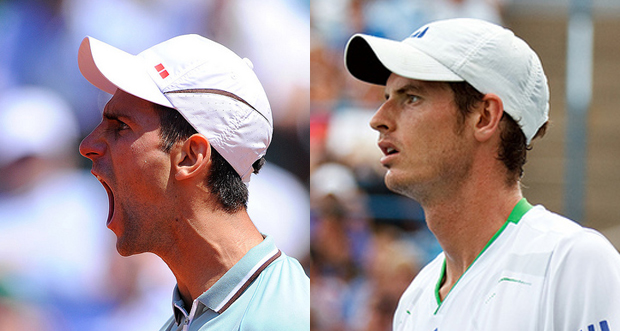
    Andy Murray has pulled out of Roland Garros. He said in a statement: “It’s a really tough decision and I love playing in Paris, but after seeking medical advice I am not fit to compete,” adding “now my complete focus is on getting back on the court as soon as possible.”

    World #2 Murray has been troubled with a lower-back injury that caused him to retire from his second-round match in Rome. He has also stated that Wimbledon is his main priority.

    Juan Martin Del Potro has also pulled out. The World #6 and a former French Open semi-finalist has been suffering with a bronchial infection since appearing at the Monte Carlo Open. He was forced to sit out scheduled events at the Portuguese Open and Madrid Masters. He returned for the Italian Open in Rome but was below his best in a poor outing against the Frenchman Benoit Paire. Following the Paire loss, Del Potro returned to Argentina.

    Other Roland Garros casualties also include the Americans Mardy Fish and Brian Baker. They will be replaced in Friday’s draw by Joao Sousa of Portugal, and Guido Pella of Argentina.

    Additionally, John Millan, an Australian wild card, has withdrawn due to shoulder injury, and will be replaced by Nick Kyrgios of Australia.

    Click here to discuss this story on our discussion board with fellow tennis fans.