Tag: juan carlos ferrero

  • National Tennis Careers – Part Three: Spain

    National Tennis Careers – Part Three: Spain

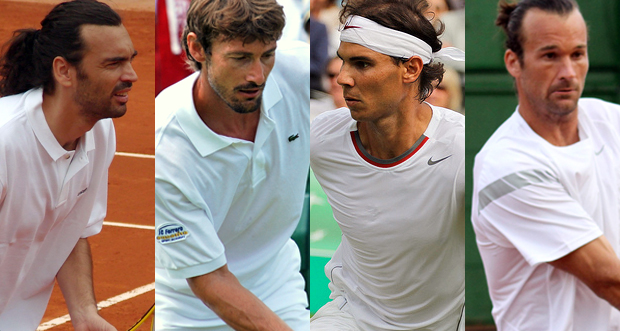
    Sergi Bruguera Juan Carlos Ferrero Rafael Nadal Carlos Moya

    Rafa & The Conquistadores

    Among the five greatest tennis nations in this series, Spain and Switzerland share something in common: they are completely dominated by a single player, one who is head and shoulders above the rest of the field. These two players will be forever linked, not only as two of the greatest ever to play the game, but because of their evocative (albeit lopsided) rivalry.

    [divider]

    Click here to discuss “National Tennis Careers – Part Three: Spain” in the discussion forum.

    [divider]

    Before getting to Rafa, let’s look at Spanish tennis before the King of Clay. Before the Open Era, only three Spanish players appeared in Slam finals, Pro or Amateur: Manuel Santana, Andres Gimeno, and Juan Gisbert Sr. The first two are well known as top players of the 1960s, but Gisbert Sr is not so well known – he lost to William Bowrey in the 1968 Australian Open final, the last Slam before the Open Era began. Santana won four Amateur Slams in the 1960s and was ranked No. 1 among Amateurs in 1966 when he won Wimbledon, but never entered the professional circuit, so didn’t play the top players in the game.

    Andres Gimeno was one of the best players from the 60s that wasn’t Australian. He had a long career, beginning as an amateur in 1956, turning pro in 1961, and playing until 1973. While he never won a Pro Slam, he played in four finals – losing to Rod Laver three times, Ken Rosewall once. He is perhaps best known for winning the 1972 French Open at the ripe age of 34.

    Spanish tennis became stronger during the Open Era, but didn’t see its first truly great player until Rafael Nadal emerged from the clay of Manacor, fully formed like some Mediterranean deity. Let’s take a look at the Open Era Slam record:

    Spain Career

    As you can see, before Nadal seven Slams were won by Spanish players: one each by Gimeno, Manuel Orantes, Albert Costa, Carlos Moya, and Juan Carlos Ferrero, and two by Sergi Bruguera. The weakest era for Spain was the 1980s, after Manuel Orantes retired, but then picked up in the 90s with Bruguera, then later Moya and Ferrero, among others. It is also worth noting that of the seven Spanish Slam winners of the Open Era, only Orantes and Nadal won Slams on a surface other than clay.

    Ten Greatest Spanish Players of the Open Era
    1. Rafael Nadal
    2. Manuel Orantes
    3. Juan Carlos Ferrero
    4. Carlos Moya
    5. Sergi Bruguera
    6. David Ferrer
    7. Andres Gimeno
    8. Alex Corretja
    9. Albert Costa
    10. Tommy Robredo

    Honorable Mentions: Jose Higueras, Emilio Sanchez, Felix Mantilla, Carlos Costa, Albert Berasategui, Francisco Clavet, Feliciano Lopez, Fernando Verdasco, Nicolas Almagro, Albert Portas, Juan Aguilera.

    Number one is easy, but after that it gets really dicey. Orantes, Ferrero, Ferrer, Moya, Bruguera, and Gimeno could be ranked in any number of ways. Gimeno would probably be second if we counted his whole career, but his Open Era career wasn’t as impressive as the others. Albert Costa is, along with Thomas Johansson and Gaston Gaudio, a one-Slam wonder who benefited from playing in the weak early years of the 21st century. Alex Corretja is among the better players never to win a Slam – along with later countryman David Ferrer.

    Spanish tennis has been strong over the last ten years, although with one player dominating. But David Ferrer, Feliciano Lopez, Tommy Robredo, Fernando Verdasco, and Nicolas Almagro have all had very good careers.

    A bit on Rafael Nadal. There is little doubt that he is the most dominant clay court player in the history of the game, and there has been no harder task than beating Rafa at Roland Garros where he holds a 70-2 record. Rafa was the clear World No. 2 for 2005-07 but then stole not only Wimbledon but the No. 1 ranking from Roger Federer in 2008. He has struggled with injury through much of his career, so there’s an element of “what if” to Rafa’s career. Some say that if he had been healthy he’d have surpassed Federer’s Slam count by now, while others say that we cannot separate Rafa’s penchant for injury from his greatness due to his style of play. Either way, his record is what it is: Regardless of what his future accomplishments might be, right now he is one of the greatest players in tennis history.

    The Future
    Troubled times may be ahead for Spain. Consider the Spanish players current (as of July 6) in the Top 100 with their ages:

    7. David Ferrer (33)
    10. Rafael Nadal (29)
    16. Feliciano Lopez (33)
    19. Tommy Robredo (33)
    22. Roberto Bautista Agut (27)
    32. Guillermo Garcia-Lopez (32)
    37. Pablo Andujar (29)
    43. Fernando Verdasco (31)
    63. Daniel Gimeno-Traver (29)
    65. Albert Ramos (27)
    67. Pablo Carreno Busta (23)
    72. Marcel Granollers (29)

    Notice something? Nine of the twelve players are 29 or older. We could chalk this up to the way of things these days, but there’s a disturbing lack of young players on that list. In other words, of those twelve players only Carreno Busta and possibly Bautista Agut and Ramos have room to improve, however none of them are likely to be future elite players.

    There is also the question of Rafa’s decline. Clearly he is not the player he was in 2008-13, his peak range. Rafa has a tendency to play well, get injured, then surge back to the top again – a cycle that has repeated itself a few times. But this latest round hasn’t seen a surge (yet), and we’re now almost eight months from his appendicitis surgery. Does Rafa have another surge him? Who knows? Many, including myself, have long speculated that when the end comes for Rafa it will come quickly. But I, for one, am not ready to relegate him to the history books. Not yet. I doubt we’ll see another 2013, but we could see a lesser version.

    But other than the players listed above, is there a future for Spanish men’s tennis? Let’s take a look at the youth.

    Highest Ranked Player By Age
    23: Pablo Carreno Busta (No. 67)
    22: Roberto Carballes Baena (No. 169)
    21: David Perez Sanz (No. 305)
    20: Albert Alcaraz Ivorra (No. 481)
    18/19: Jaume Munar (No. 690)
    17: Carlos Taberner (No. 970)

    So consider that – the highest ranked Spanish teenager is No. 481 in the world. Even the United States has three teenagers ranked higher. History has shown us that great players are usually pretty good while still in their teens – meaning in or near the Top 100 – and there’s no player even close to that. Even if we say that players are starting their peaks more in the 23-25 range rather than 20-22, as in the past, there’s no young Spanish player who looks to be on the trajectory for greatness. Surprise weather patterns happen, but the forecast as of right now is not positive for Spanish men’s tennis – at least not over the next few years. What we are likely going to see is a gradual and then quick diminishing of Spanish tennis as Nadal, Ferrer, Lopez, Verdasco, Robredo, and Almagro all fade away and then retire, with perhaps only Bautista Agut and Carreno Busta carrying the torch as Spanish players in the Top 20-30 range in a few years time. Whether they can carry that torch long enough to pass to the next great Spaniard remains to be seen.

    [divider]

    Cover Photo (Creative Commons License): bourgol / Carine06 / Marianne Bevis / conson
  • Inside Out: The Era of Forehand and Movement

    Inside Out: The Era of Forehand and Movement

    As Rafael Nadal and Roger Federer prepared for their thirtieth meeting, a familiar sense of nostalgia grew inside tennis fans. Still very much among the top three best players in the game – rankings notwithstanding – Federer and Nadal were once the undisputed rulers of the tennis world. They’ve given us classics, drama, and dominance, and their rivalry transcended the sport. Despite the lack of animosity, it has been so universally appealing in large part due to the contrast in styles. Beyond how they look, dress, and act, it was the way they play that was so different, and therefore, so captivating.

    And yet, despite the multiple nuances in their games, the different attributes, and the very few weaknesses, both Federer and Nadal made a living off one particular weapon – the forehand. Their games couldn’t be more different: Federer was always more complete, more aggressive-minded, had a better serve, took more offensive court positioning, and attacked the net; Nadal was a one-of-a-kind physical specimen, a defensive wall, stood farther behind the baseline, and took control of points through engaging in longer rallies where he would gradually wear out his opponent. None of that changes the fact that, regardless of the adjustments they’ve made throughout the years – Nadal has become more aggressive and well-rounded; Federer had to readjust some aspects of his game to better operate with age – when push came to shove, they cemented their spots in tennis history due to their respective forehands.

    Like the rest of their games, their forehands bore very few similarities: Different grips, different spins, and a different follow-through. And yet, whether Federer was running around his backhand to hit an inside out winner, or Nadal was pummeling his opponent’s weaker wing relentlessly, the result was often the same. In what will inevitably go down as the “Fedal era,” one of the most memorable phases in tennis history will be defined by one shot.

    Increased racquet technology, homogenization of the surfaces, and the rise of a new breed of phenomenal athletes have altered the game considerably, with serve and volley taking a backseat to a noticeable shift towards baseline tennis. The change has been characterized by a strong emphasis on the forehand. In fact, it is hardly a coincidence that the last couple of world number one’s before the Federer era were Juan Carlos Ferrero and Andy Roddick, two men who, in their heyday, possessed two of the most lethal forehands on tour. And yet, fearsome as those shots were, they paled by comparison to the brilliance that the Swiss Maestro’s racquet would later produce.

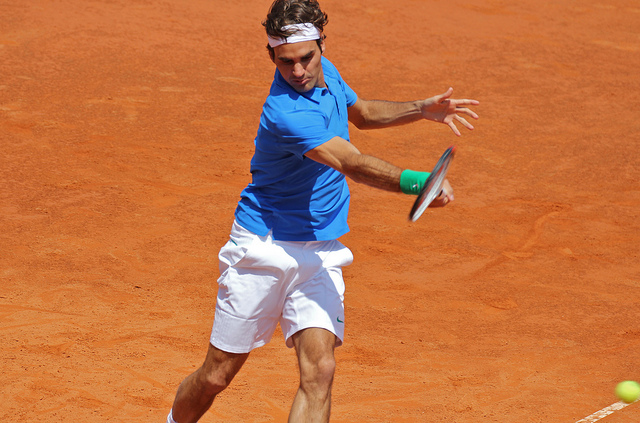
    Simply put, Roger Federer’s forehand revolutionized the sport. Widely tipped to be the greatest ground stroke in tennis history, Federer re-set the standards of what constitutes a world-class forehand. It wasn’t merely his ability to fire winners off that side that set him apart – after all, James Blake, Fernando Gonzalez, and Andy Roddick hardly struggled to rip out inside-out bullets – but rather, Federer’s combination of power, spin, versatility, taking the ball early, and the ability to hit it on the run that made him a nightmare to deal with.

    None of this would be possible had it not been for Federer’s most characteristic trait: his otherworldly movement. Federer’s ability to glide effortlessly on a tennis court was poetry in motion. He always put himself in perfect position to take the ball precisely when he meant to, and the results were devastating. The mixture of movement, precision, and taking the ball on the rise rendered his forehand near unplayable. Lleyton Hewitt had laid the foundations a couple of years earlier by running circles around his opponents, but he lacked the necessary weapons and offensive tools. Federer, on the other hand, didn’t.

    In fairness, cat-like quickness wasn’t exclusive to Federer, as the man who previously dominated the world of tennis, Pete Sampras, remains one of the best athletes the sport has ever seen. Meanwhile, the likes of Davydenko, Blake, the above mentioned Hewitt, and others were all great movers in their own right. However, Federer’s footwork was so utterly unique in its fluidity, quickness, smoothness, and efficiency.

    Then came Rafael Nadal, arguably the greatest pure athlete in tennis history. He redefined the word “speed,” covered every inch of the court like nobody before him, displayed unprecedented levels of explosiveness, and showed a level of physicality that no one else could match. When he first burst onto the scene, Nadal’s game was, to put it bluntly, fairly limited. His serve was harmless, his backhand was solid but, ultimately, did little offensive damage — beyond the trademark open-stance passing shots — and his return of serve was meant to neutralize points above anything else (which applies even today).

    If there is a prime example of how great movement and an elite forehand dominate today’s men’s game, it’s Nadal. Better than anyone in history, he was able to mask his weaknesses with a dominant forehand and unparalleled movement. Even more so than Federer, Nadal based much of his game around running around his backhand wing. However, the Spaniard lacked his rival’s serve and variety, making his forehand an even more integral part of his game.

    His entire early success is attributed almost entirely to his forehand and movement. Even as his game developed into something far more polished, Nadal’s bread-and-butter remained intact. Unlike anyone else, Federer included, Nadal is able to find his forehand wing time and time again. The amount of effort required to run around his backhand at every possible opportunity meant the Mallorcan had to work particularly hard in each rally, but Nadal was all too willing to make the effort. Like Federer, his forehand is actually deadlier from his backhand wing, where he can put it pretty much anywhere on the court. Once Nadal is able to find a forehand early in the rally, unless your name was Novak Djokovic, Nikolay Davydenko, and a select others, you weren’t wrestling the point away from him.

    No Title

    No Description

    The man who ultimately broke the Fedal monopoly was, unsurprisingly, Novak Djokovic. Long tipped to be the future of tennis, the Serb may have differed from his great rivals in that he possessed one of the best backhands the games has ever seen — a shot many deem to be his strongest. However, it wasn’t until Djokovic recaptured the magic on his forehand side that he became the world’s finest player. Following a very strong 2008, Djokovic’s results became increasingly inconsistent. The reasons were numerous, from struggles with fitness, focus, and serve, but above all else, it was his forehand that grew more erratic, and the results underwhelmed accordingly.

    Djokovic moves as well as anyone on a tennis court, but the quality of his backhand provides him with far more options, therefore, he doesn’t need to run around that shot as frequently as Federer and Nadal. And yet, you often see him doing just that these days, to great effect. Good as his backhand is, the basic mechanics of the forehand mean he has more options off that wing. Additionally, Djokovic’s backhand being his better shot often clouds the fact that his forehand is easily one of the best on tour, and when playing well, it is the side that does the bigger damage. Yes, it remains the shot that is more likely to break down and fail him when things go south, as opposed to his always rock solid backhand, but offensively, it is slowly becoming his most potent shot.

    A quick look at today’s top 10 players shows just how essential it is to possess a great forehand. Beyond the aforementioned players, almost all of the world’s elite players share a world-class forehand: Ferrer, Berdych, Tsonga, Del Potro, etc. Naturally, there are exceptions, but even those, quite ironically, reinforce the rule. Richard Gasquet, for instance, was initially thought to be destined for greatness, only to fail to live up to the hype, in large part due to his unreliable forehand. Even previous one-of-a-kind shot-makers like Nalbandian and Davydenko occasionally suffered due to an inconsistent forehand.

    The most notable aberration, of course, is current world number 2, Andy Murray. Far from being a bad shot, Murray’s forehand remains nevertheless below the level of Federer, Nadal, or Djokovic. However, the Brit is able to make amends through fantastic movement, tennis IQ, tactical awareness, counter-punching, and a backhand that is easily among the very best in the men’s game. Nevertheless, it is hard not to attribute some of his shortcomings to his main rivals’ ability to expose his forehand. Djokovic has repeatedly dominated Murray in forehand-to-forehand cross-court exchanges and drew short replies, Nadal’s flattened-out cross-court backhands and inside out forehand have historically troubled Murray on faster surfaces — surprisingly enough — while Federer’s offensive onslaught has robbed Murray of three additional grand slam titles to his resume.

    A quick glance at the current crop of up-and-coming players shows no real candidate that fits the description of a modern day champion — a great mover with a world-class forehand. For now, at least, the status quo at the top of the men’s game seems safe.

    Click here to discuss this and more with fellow tennis fans on our discussion boards.

  • “Tribute To Juan Carlos Ferrero” (From: Marca)

    “Tribute To Juan Carlos Ferrero” (From: Marca)

    [divider]

    Translated from: “El Godó homenajea a Ferrero” (Marca, April 25, 2013)

    [divider]

    It was just before the second game of Rafa Nadal’s match against  Benoit Paire at the Barcelona Open, tournament organizers paid tribute to the great clay courter Juan Carlos Ferrero, who shone in the early part of the century and lost in 2001 to Carlos Moya in one of the best French Open finals in recent times.

    Ferrero, who retired from official competition last October after his final tournament in Valencia, of which is now director, was presented with a crystal trophy by Albert Agustí, president of the Catalan club and Albert Costa, tournament director.

    ‘Juanqui’, retired with 16 titles under his belt, including the 2003 French Open.