Tag: John newcombe

  • Open Era Generations, Part Five: Gen 3 (1944-48) – Newcombe and the Class of ’46

    Open Era Generations, Part Five: Gen 3 (1944-48) – Newcombe and the Class of ’46

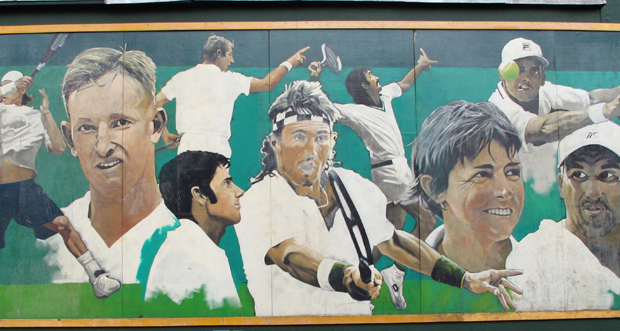
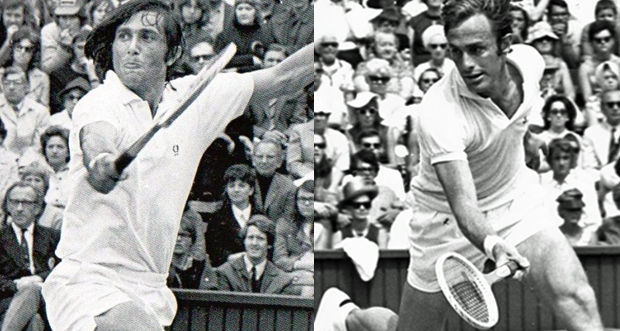
    Ilie Nastase John Newcombe

    A Transitional Generation
    The generation born between 1944 and 1948 began establishing itself in the mid-60s but was in peak form during the early years of the Open Era. This was the last generation that saw some players with a significant portion of their careers before the Open Era began, although it is also the first generation that saw the majority of its players peak in the Open Era.

    Best Players by Birth Year
    1944: John Newcombe (AUS, 7), Tom Okker (NED), Alex Metreveli (USSR)
    1945: Tony Roche (AUS, 1)
    1946: Jan Kodes (CZE, 3), Ilie Nastase (ROM, 2), Stan Smith (USA, 2), Cliff Richey (USA)
    1947: Bob Lutz (USA), Zeljko Franulovic (CRO), Gerald Battrick (UK)
    1948: Brian Fairlie (NZ), John Bartlett (AUS), Vladimir Korotkov (USSR)

    Discussion
    There are several players in this generation that have a lasting heritage. John Newcombe, as will be discussed, is a bit of an underrated great, standing in the shadow of his greater predecessors, Ken Rosewall and Rod Laver. But he was the best player of this generation, and tied with Jimmy Connors for second most Slam titles in the 1970s (5) after Bjorn Borg (8).

    After Newcombe, the class of 1946 presents a strong year of tennis births, with multi-Slam winners Nastase, Kodes, and Smith, who split seven Slams among them.

    Nastase is a player whose Slam count doesn’t adequately reflect how good he was. He is perhaps best known for being the first ATP ranked year-end No. 1 player in 1973. He was a Top 10 player for most of the 70s and won a huge total of 58 titles overall, or by some accounts as many as 87—one less than Roger Federer—due to the fact that records were not fully accurate before the ATP in 1973.

    Underachievers and Forgotten Players
    The first player I’d like to mention is this generation’s greatest player, John Newcombe. While Newcombe, with seven Slams, cannot be considered an underachiever, he is a bit forgotten, for a couple reasons. One, he wasn’t as great as his Australian predecessors in Rosewall and Laver. Secondly, he didn’t quite have the cachet and sex appeal of later tennis superstars Jimmy Connors, Bjorn Borg, and John McEnroe. Yet Newcombe was a great player; while he won three Australian Opens during an era when the field was still weaker than the other Grand Slams, he also won Wimbledon and the US Open twice each, defeating champions as diverse in range as Ken Rosewall (b. 1938) in the 1970 Wimbledon, to Jimmy Connors (b. 1952) in the 1975 Australian Open. Furthermore, Newcombe was one of the few top players of the amateur era whose success translated to the Open Era. With apologies to Patrick Rafter and Lleyton Hewitt, Newcombe is the last truly great Australian male tennis player.

    I wouldn’t call Tom Okker an underachiever as much as a nearly-great player that never won a Slam. In a way he was his generation’s version of David Ferrer – a player always in the mix, with great results and many titles, but no majors. In fact, as discussed in one Tennis Frontier discussion thread, Okker is a good candidate for the best Slam-less player of the Open Era.

    Finally, we have Stan Smith, who is probably the best suited to the title of underachiever, or at least a peak that didn’t match his total career. First of all he was a relatively late bloomer, although less so by his era’s standards. He didn’t reach his first Slam QF until 1970 when he was 23 years old, and won his first of two Slams a year later at 24. For a few years—the first half of the 70s—he was a Top 10 player, and for a couple years—1971-72—he was either No. 1 or co-No. 1. But after 1974 his performance dropped substantially. Throughout the late 70s and into the 80s he was a borderline Top 20 player, but no longer a star. Smith was one of the greatest Davis Cup players, being part of seven US titles. In my National Tennis Careers blog series, I ranked him as the 8th greatest American male tennis player of the Open Era right between No. 7, Andy Roddick, and No. 9, Michael Chang.

    Did You Know?
    1946 saw three multi-Slam winners born. While many years since then have had two multi-Slam winners born, or multiple Slam winners born, you have to go all the way back to 1921 to find another year that had three multi-Slam winners: Jack Kramer (5, 3 Grand, and 2 Pro), Pancho Segura (4 Pro Slams), and Jaroslav Drobny (3 Grand Slams).

    Top Ten Players of the Generation

    1. John Newcombe
    2. Ilie Nastase
    3. Stan Smith
    4. Jan Kodes
    5. Tony Roche
    6. Tom Okker
    7. Cliff Richey
    8. Alex Metreveli
    9. Zeljko Franulovic
    10. Onny Parun

    Honorable Mentions: Bob Lutz, Brian Fairlie, Vladimir Korotkov, John Bartlett, Gerald Battrick.

    The first two spots are easy. Newcombe has a record head and shoulders above the rest, his seven Slams — as much as Kodes, Nastase, and Smith combined. Nastase is a clear No. 2. He had one less Slam than Kodes, but his career was much better. Not only was he the first year-end No. 1 of the ATP era but he won an impressive 58 titles (or 87 by some accounts). Smith also was a stronger peak player than Kodes, although had a weak second half of his career, as mentioned. I was tempted to put Roche above Kodes as he probably had a better overall career, with 26 titles versus Kodes’ 11; but it is hard to argue with Kodes’ three Slams to Roche’s one, even if one of Kodes’ was the 1973 Wimbledon which the majority of top players boycotted due to the banning of Nikola Pilic. But Roche’s lone Slam was during the pre-Open Era in a relatively weak field, defeating Alexander Metreveli, Francois Jauffret, and Istvan Gulyas in the last three matches on the way to the title (who? That’s the point!). Roche also had a Murray-esque 1-5 record in Slam finals.

    After the top five, Tom Okker is an easy pick; I was even tempted to edge him over Roche but controlled myself. Cliff Richey is also a relatively easy next pick, but after that the rankings and talent gets murky. But the gap between the top five and Okker is far slimmer than Okker and the rest of the generation, which is pretty weak from that point on and difficult to rank.
  • Historical Smash Shots 1: Generational Diversity in the 1974-75 Rankings

    Historical Smash Shots 1: Generational Diversity in the 1974-75 Rankings

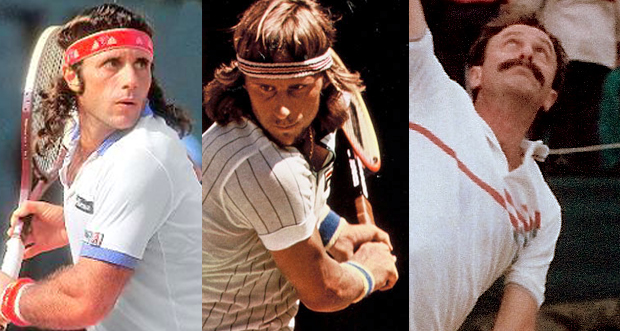
    Guillermo Vilas, Bjorn Borg, John Newcombe

    While researching Part Five in my Open Era Generations series (coming later this week), I ran across an interesting little tidbit that I wanted to share (and in so doing decided to start a new segment for this blog, with random statistical bits or “smash shots” that provide angles on tennis today and in the past). Using my Generation Theory, in most years anywhere from two to four generations inhabit the Top 10, with three being the most common; but in 1974 and 1975 fully five different generations were represented in the Top 10 – the only time this has happened in the Open Era.

    Take a look at the 1974 year-end Top 10 with their birth years:

    1. Jimmy Connors (1952)
    2. John Newcombe (1944)
    3. Bjorn Borg (1956)
    4. Rod Laver (1938)
    5. Guillermo Vilas (1952)
    6. Tom Okker (1944)
    7. Arthur Ashe (1943)
    8. Ken Rosewall (1934)
    9. Stan Smith (1946)
    10. Ilie Nastase (1946)

    What are we looking at here? On first glance it looks like a bunch of all-time greats. But notice a couple things. First, as an aside to the point of this article, notice the sheer talent. If we include Pro, Amateur, and Open Era Slams, the above Top 10 includes a whopping 79 major titles. OK, that amazing fact aside, the main point is to look at the wide range of players – the youngest being Bjorn Borg, the oldest Ken Rosewall. The difference? 22 years.

    [divider]

    Click here to discuss “Historical Smash Shots 1: Generational Diversity in the 1974-75 Rankings” in the Discussion Forum.

    [divider]

    Now here’s the fun part. Let’s translate that to today. Let’s place players of a similar age differential in the above list into a hypothetical Top 10 for 2015. Jimmy Connors was 22 in 1974, so we need someone born in 1993 for the number one spot. Swapping age-appropriate players, we get something like this:

    Jiri Vesely, Dominic Thiem, Alexander Zverev

    “Fantasy 2015”

    1. Dominic Thiem (1993)
    2. Stan Wawrinka (1985)
    3. Alexander Zverev (1997)
    4. James Blake (1979)
    5. Jiri Vesely (1993)
    6. Jo-Wilfried Tsonga (1985)
    7. Robin Soderling (1984)
    8. Marcelo Rios (1975)
    9. Novak Djokovic (1987)
    10. Andy Murray (1987)

    Look at that range – A 40-year old Marcelo Rios still in the Top 10, with 18-year old Alexander Zverev No. 3 in the world — two players 22 years apart!

    We really haven’t seen anything like this in some time. The closest thing in recent years, and the last time there were four generations in a year-end Top 10, was 2005 – when Federer’s generation (b. 1979-83) ruled the rankings, with a young teenage upstart named Rafael Nadal (b. 1986) finishing No. 2, and 35-year-old Andre Agassi (b. 1970) making his last appearance in the Top 10. Before that you have to go all the way back to the 80s when it was relatively common for four generations to be represented, although this was mainly due to the anomaly that was Jimmy Connors.

    It would require a longer study to look further into historical trends, and when we get to more recent generations in the Open Era Generations Theory we will look at how things look now compared to in the past. But for now I think it is clear that there is much greater “generational homogeneity” at the top of the men’s game, with seven of the Top 10 being in the generation born 1984-88, with only Roger Federer and David Ferrer from the older generation (b. 1979-83), and only Kei Nishikori from the younger generation (b. 1989-93). As I will discuss later, this is likely to change relatively soon.

    [divider]

    Cover Photo (Creative Commons License): cwkarl / patrickpeccatte / 43555660@N00

    (Photo (Creative Commons License): mirsasha / mirsasha / stevenpisano)

  • National Tennis Careers – Part Four: Australia

    National Tennis Careers – Part Four: Australia

    Rod Laver Patrick Rafter John Newcombe Lleyton Hewitt

    A Long Time Ago, Down Under…

    Of the five nations discussed, Australia peaked the earliest. Truly, Australia dominated men’s tennis in the late 1950s to the early 1970s led by two of the very greatest players of all time: Rod Laver and Ken Rosewall. Australia remained strong at the beginning of the Open Era, with Laver’s Calendar Slam in 1969, and the baton partially passed to John Newcombe, who was one of the few amateur stars that was able to maintain a similar level during the Open Era.

    Other top Australians before the Open Era include Frank Sedgman, Lew Hoad, Fred Stolle, Ashley Cooper, and Roy Emerson. Emerson held the Grand Slam record of 12 until Pete Sampras broke it, although it’s often considered overrated due to the fact that he dominated the Amateur Slams when the best players were playing pro – namely his countrymen Laver and Rosewall. Hoad is another “what if” story; Jack Kramer compared him to Ellsworth Vines as players with immense talent but lacking drive. Pancho Gonzales claimed that Hoad was the only player who could beat Gonzales when he was playing his best; others, including Ken Rosewall, voiced similar sentiment. Regardless, Hoad’s career was plagued by injury and even if he was arguably the most talented player of all time, his record places him as a lesser great: with five total majors to his name.

    [divider]

    Click here to discuss “National Tennis Careers – Part Four: Australia” in the discussion forum.

    [divider]

    Let’s take a look at the Open Era record:

    Australia Career

    As you can see, Australia dominated for the first few years of the Open Era then gradually petered out in the mid to late 70s and never recovered. There were a few bright spots – Pat Cash in the mid-80s with Australia’s lone Slam between 1976 and 1997, and then a short era of strength during the late 90s and early 2000s, when number ones Patrick Rafter and Lleyton Hewitt won two Slams each. Yet after Hewitt’s early peak and quick decline, Australian men’s tennis has been at a low during the last half decade or so. But there may be hope, but more on that in a moment…

    Ten Greatest Australian Players of the Open Era
    1. Rod Laver
    2. Ken Rosewall
    3. John Newcombe
    4. Lleyton Hewitt
    5. Patrick Rafter
    6. Tony Roche
    7. Pat Cash
    8. Mark Philippoussis
    9. Mark Edmondson
    10. John Alexander

    Honorable Mentions: Malcolm Anderson, Dick Crealy, Phil Dent, Kim Warwick, Mark Woodforde, John Marks, Roy Emerson.

    It is a bit tricky ranking the Australians of the Open Era as the top three all saw large portions of their careers before the Open Era, with Laver and Rosewall both seeing the bulk of their accomplishments happening before. But even if we rank them only by what they accomplished after the Open Era began, the top three remain the same.

    A brief word on Rosewall and Laver. The two are forever linked, not unlike Borg and McEnroe or Sampras and Agassi or Federer and Nadal. If we look at all-time greatness as merely a combination of longevity and accumulated career statistics, then Ken Rosewall would probably be considered the greatest player of all time due to his all-time best 23 Slam titles, including 8 Grand Slams and 15 Pro Slams. Perhaps even more remarkable is the fact that in all major tournaments, Rosewall played in 55 semifinals; consider that Bill Tilden (37), Roger Federer (36), Pancho Gonzales (34), Rod Laver (32), and Jimmy Connors (31) all made it to 31-37 Slam semifinals — all more than four year’s worth less than Rosewall.  Certainly, many of those were Pro Slams, which were shorter than today’s Grand Slams, but the fact that he is so far above everyone else is remarkable. But Laver had the greater peak – the two Grand Slams and the overall dominance during the 1960s and over Rosewall. Also, Laver’s 200 titles is by far the most in tennis history. Regardless, both men are on the very short list of GOAT candidates.

    John Newcombe is a bit underappreciated historically. I think this is partially because he played alongside the greater Laver and Rosewall, although was quite a bit younger than both, but also that he was surpassed later in his career by Connors and Borg. But Newcombe was, along with Arthur Ashe, the “bridge player” of the Amateur and Open Eras and was a top player for almost twenty years, including a shared No. 1 ranking in both 1970 and ’71. His overall record is comparable to players like Boris Becker and Stefan Edberg.

    There’s a big drop-off from Newcombe to the rest, with Lleyton Hewitt and Pat Rafter easy No. 4 and No. 5 picks. In a way the two have opposite careers: Rafter’s much shorter, only about a decade, and with a later peak, his last five years being his best; Hewitt’s has been quite long, with his best years early on. Having witnessed the diminished version of Hewitt over the last eight or nine years it is easy to forget that for a short period of time he was a truly great player. He is known for being the youngest world No. 1, at 20 years old, and if you looked at his career through 2002 when he was finishing his second year-end No. 1 ranking, at just 21 years of age, with two Slams and two World Tour Finals under his belt, you’d think he would be one of the all-time greats. But he never won another Slam and was eclipsed not only by Roger Federer, but Andy Roddick and a number of other players. Where Rafter retired as the No. 7 ranked player in the world, it has been a decade now since Hewitt has finished in the Top 20.

    Tony Roche’s peak was before the Open Era started, although he remained a good player deep into the 70s. Some might argue with the ranking of Philippoussis over Edmondson given that the latter won a Slam while the former did not, but Philippoussis was a superior player with an overall better career, and could be considered an underachiever. The last spot goes to John Alexander just edging out Phil Dent.

    The Future
    Let’s take a look at the Australian men in the Top 100, through Wimbledon:

    25. Bernard Tomic (22)
    41. Nick Kyrgios (20)
    68. Sam Groth (27)
    69. Thanasi Kokkinakis (19)
    84. James Duckworth (23)
    97. John Millman (26)

    Kyrgios dropped 12 spots when he couldn’t repeat last year’s quarterfinal appearance, although he still made it to the fourth round this year and has shown improvement overall this year, with a good chance of approaching the Top 20 by year’s end. Kokkinakis also shows some promise, being one of four teenagers currently in the Top 100. Bernard Tomic is also having his best year yet, although he has less upside. He is best known for reaching the Wimbledon quarterfinal in 2011, losing to Novak Djokovic. Tomic has still not reached the second week of a Slam since then, and is known to be somewhat of a playboy, but now ranked No. 25 he seems at least primed to be a Top 20 player. Groth is already 27 but looks to be a late-bloomer; his powerful serve might see him around for awhile. Duckworth is another interesting name, someone who was more highly regarded a few years ago but has progressed slowly. The top ranked 18-year old is Omar Jasika, ranked around No. 300, who won the Junior US Open and has won two ITF tournaments this year so far, so he bears keeping an eye on.

    There is hope for Australian men’s tennis, with Kyrgios and Kokkinakis possibly the best young prospects since Lleyton Hewitt came up 15 years ago, and Tomic, Groth, and Duckworth a solid supporting cast. Some have criticized Kyrgios for his diva antics, but as Jan Kodes just reminded us, Kyrgios is only just 20 years old, and many greats were also temperamental at that age. Kodes believes that Kyrgios has what it takes to win a Slam and is about “three years away.” We shall see.

    [divider]

    Cover Photo (Creative Commons License): Duncan